Our readers keep the lights on and my smoothie glass nicely filled. As an Amazon Associate, I earn from qualifying purchases.
Finding a condenser microphone that delivers professional-grade vocal clarity without forcing you to drain your savings is the central challenge for any new podcaster, streamer, or home-studio vocalist. The market is flooded with USB-based entry-level mics that promise “studio quality” but deliver thin, brittle sound that requires heavy post-processing to salvage. The real test is separating the mics that provide a genuinely warm, detailed, and usable signal from those that merely have an attractive price tag and a shiny box.
I’m Mohammad Maruf — the founder and writer behind WellFizz. I’ve spent years analyzing audio hardware specifications, dissecting customer feedback across hundreds of studio microphones, and cross-referencing noise floors, frequency response curves, and build tolerances to determine which models actually deliver on their sonic promises for the budget-conscious creator.
After extensive research through verified user experiences and technical datasheets, I’ve curated this roundup to help you navigate the noise and find your ideal best affordable condenser microphone.
How To Choose The Best Affordable Condenser Microphone
Choosing the right entry-level condenser microphone comes down to understanding a few non-negotiable specifications. A cheap mic with a high noise floor or a poorly suited polar pattern will never produce professional results, regardless of how good your recording environment is. Focus on these three pillars to ensure your purchase is a long-term asset, not a disposable gadget.
Decide Between USB and XLR Connectivity
This is the first and most critical fork in the road. USB microphones, like the HyperX SoloCast 2, offer true plug-and-play simplicity — just connect to your computer and start recording. They are ideal for streamers and podcasters who want minimal setup and no external gear. XLR microphones, such as the Mackie EM-91C, require an audio interface or mixer to supply phantom power, but they provide a clearer upgrade path, lower inherent noise floors, and the ability to integrate into full studio chains later. Your choice should hinge on whether you value immediate convenience or future flexibility.
Understand Polar Patterns and Your Room
Most affordable condenser microphones feature a cardioid polar pattern, which primarily captures sound from the front while rejecting noise from the sides and rear. This is the standard choice for spoken word and vocal recording because it minimizes room echo and background hum. Some models, like the Behringer Bigfoot, offer multi-pattern options including omnidirectional and bidirectional modes. Unless you have a fully treated recording space, stick with cardioid-only designs to simplify your workflow and achieve cleaner takes with less post-production noise reduction.
Check the Noise Floor and Frequency Response
The noise floor, measured in decibels (dBA), tells you how much self-noise the microphone electronics generate. A lower number — 20 dBA or less on a premium model like the LEWITT LCT 240 Pro — means a cleaner signal, which is especially important if you plan to record quiet vocals or apply heavy compression. The frequency response range (e.g., 20 Hz to 20 kHz) should ideally cover the full spectrum of human hearing, but more important is how smooth the response is. Look for models that don’t have a harsh spike in the upper mids, as that can make vocals sound fatiguing.
Quick Comparison
On smaller screens, swipe sideways to see the full table.
| Model | Category | Best For | Key Spec | Amazon |
|---|---|---|---|---|
| LEWITT LCT 240 Pro | XLR | Home Studio Vocals | 20 dBA Noise Floor | Amazon |
| Blue Blackout Spark SL | XLR | Broadcast Vocals | 16.4 dBA Noise Floor | Amazon |
| SENNHEISER Profile | USB | Streaming & Podcasting | 60 dBA Audible Noise | Amazon |
| Blue Ember | XLR | Vocal Clarity | 78 dBA Audible Noise | Amazon |
| Behringer Bigfoot | USB | Multi-Pattern Versatility | 75 dBA Audible Noise | Amazon |
| Mackie EM-91C | XLR | Sibilant Voice Control | 78 dBA Audible Noise | Amazon |
| HyperX SoloCast 2 | USB | Gaming & Comms | 79 dBA Audible Noise | Amazon |
In‑Depth Reviews
1. LEWITT LCT 240 Pro

The LEWITT LCT 240 Pro earns its reputation as a low-cost entry into professional recording by delivering a remarkably low noise floor that you would expect from a microphone costing several times more. At 20 dBA, the self-noise is virtually inaudible during normal recording, which gives you a pristine canvas for vocal processing. The large-diaphragm cardioid capsule is tuned to capture modern, detailed vocal performances with a slight airy boost in the high frequencies, making it an excellent choice for voiceover work and home music production where clarity is paramount.
Build quality is robust with a stainless-steel enclosure that feels substantial without being overly heavy, and the reduced proximity effect helps maintain consistent bass response even when you move slightly off-axis. Users consistently praise its ability to reject ambient room noise, which is a huge advantage for those recording in untreated spaces. The XLR connectivity does require an audio interface, but it opens the door to future upgrades like outboard preamps and compressors.
A slight harshness around the 2 kHz region has been noted by some users, particularly when compared to dynamic microphones like the RE320, but this can be easily tamed with a narrow EQ cut during mixing. If you are building a home studio and want a microphone that will still be relevant after you upgrade your other gear, the LCT 240 Pro is the smartest long-term investment at this price point.
Why it’s great
- Extremely low self-noise floor for clean recordings.
- Solid stainless-steel build with a modern, detailed sound signature.
- Excellent off-axis rejection suitable for untreated rooms.
Good to know
- Requires an audio interface with 48V phantom power.
- Minor harshness around 2 kHz may need EQ tailoring.
2. SENNHEISER Profile

When Sennheiser enters the USB microphone arena, expectations are high, and the Profile delivers a warm, natural sound that accentuates the body and presence of the human voice without the brittle top-end that plagues many budget USB mics. The plug-and-play simplicity is flawless — no drivers, no software, just a USB-C connection and immediate zero-latency headphone monitoring via the built-in jack. This is the microphone for streamers and podcasters who want professional results without tinkering with audio interfaces or drivers.
The metal housing and German-engineered cardioid capsule provide a build quality that inspires confidence, and the physical controls for gain, mix, and volume are thoughtfully placed on the front of the unit for easy access during a live stream. The low noise floor is competitive with many XLR microphones in its class, and the internal pop filter effectively reduces plosives during close-up speaking. It works natively on Windows, macOS, and Linux, making it one of the most versatile friction-free options available.
One minor limitation is the included table stand, which is somewhat short and can pick up desk vibrations. A boom arm is recommended for optimal placement and to minimize handling noise. While it lacks an XLR output for recording, the convenience and sound quality make it the premier entry-level USB option for creators who prioritize ease of use and consistent vocal tone.
Why it’s great
- True plug-and-play with no software dependency.
- Warm, natural vocal reproduction with zero-latency monitoring.
- Sturdy all-metal construction from a trusted audio brand.
Good to know
- Short stand may require a boom arm to avoid desk noise.
- USB-only connectivity limits future chain upgrades.
3. Blue Ember

The Blue Ember is a surprisingly capable XLR condenser microphone that punches well above its price point, delivering the kind of open and accurate sound that makes vocals feel present and commanding without being harsh. Using a custom Blue condenser capsule, the Ember captures stunning depth and clarity, and its cardioid pattern is exceptionally precise at rejecting room reflections. It is a fantastic upgrade for anyone moving from a USB microphone to a dedicated audio interface setup for the first time.
The build is all-metal and feels remarkably solid for its weight, though the slim cylindrical shape means it is very light and may require a counterweight on a standard boom arm to stay in place. Users consistently report that the sound profile is “darker” than cheap condenser mics but extremely clear and detailed, making it excellent for voiceovers, streaming, and even vocal recording that needs a smooth, non-fatiguing high end. No external shock mount or pop filter is strictly necessary, though both are recommended for best results.
One trade-off is that the Ember requires more gain than some competitors, so a preamp with sufficient clean gain is essential. Users with quieter interfaces may notice a slight noise floor rise when cranking the gain. At this price, however, the Ember offers a level of vocal clarity and build integrity that typically costs double, making it a top-tier value for budget-conscious XLR adopters.
Why it’s great
- Very detailed and clear vocal reproduction with a smooth top end.
- All-metal build with excellent cardioid rejection.
- Great price-to-performance ratio for XLR starters.
Good to know
- Requires a preamp with ample clean gain.
- Lightweight body may need counterweighting on boom arms.
4. Behringer Bigfoot

The Behringer Bigfoot is a chameleon in the USB microphone space, offering four selectable polar patterns — cardioid, omnidirectional, bidirectional, and stereo — that allow you to adapt your recording technique to almost any scenario. Whether you are interviewing a guest, recording a single vocalist, or capturing the ambience of a room, this mic can do it all without requiring any additional hardware. The metal build is surprisingly heavy and robust for the price, feeling much more premium than its budget positioning suggests.
Sound quality is clean and detailed for the category, with a low noise floor that benefits from the solid construction. The cardioid mode excels at rejecting off-axis sound in untreated rooms, making it a practical choice for beginner streamers and podcasters. It also includes a built-in headphone jack with direct monitoring, which is a welcome feature for real-time performance checks. The microphone is compatible with standard universal mounting screws and even fits Blue Yeti mic covers, adding to its value.
Some users have noted that the omnidirectional mode is not as effective as the others, and the microphone requires an ASIO driver (such as ASIO4ALL) for use with digital audio workstations, which can be a minor inconvenience for absolute beginners. However, for a microphone under that offers multi-pattern flexibility, a metal chassis, and solid sound, the Bigfoot is an outstanding entry-level Swiss Army knife.
Why it’s great
- Four polar patterns offer unmatched versatility for the price.
- Heavy, sturdy metal construction with a premium feel.
- Excellent cardioid rejection for untreated rooms.
Good to know
- Requires ASIO driver for DAW use.
- Omnidirectional mode performance is weaker than other patterns.
5. Blue Blackout Spark SL

The Blue Blackout Spark SL is a studio-grade XLR condenser microphone that delivers a warm, radio-announcer vocal signature prized by podcasters and streamers who want a broadcast-ready sound with minimal post-processing. Its standout feature is the incredibly low noise floor of 16.4 dBA, making it one of the quietest microphones available in the affordable tier. The included custom shock mount and wooden storage box add a premium unboxing experience that is rare at this price.
The sound profile is focused and narrow, with a natural roll-off in the highs that results in a smooth, non-fatiguing tone. The built-in 100 Hz high-pass filter is exceptionally useful for cutting low-end rumble from HVAC systems or desk vibrations, and the -20 dB pad allows you to record louder sound sources without distortion. The cardioid pattern is precise, and users consistently find that background noise from keyboards or fans is effectively rejected during streaming sessions.
One important consideration is that the Spark SL thrives with a higher-end preamp; users with budget interfaces have noted the need for significant gain, which can add noise. The small footprint is great for tight desk spaces, but the lightweight construction means it may need a heavy stand or counterweight. If you prioritize a warm, effortless vocal sound and are willing to pair it with a decent interface, this mic delivers immense value.
Why it’s great
- Incredibly low self-noise for ultra-clean recordings.
- Warm, broadcast-ready sound with useful high-pass filter.
- Premium accessories including shock mount and hard case.
Good to know
- Best performance requires a quality preamp with clean gain.
- Lightweight body may not stay put on a standard boom arm.
6. Mackie EM-91C

The Mackie EM-91C is a no-frills large-diaphragm XLR condenser microphone designed for a very specific purpose: taming sibilant voices during long-form spoken word recording. Its frequency response is deliberately rolled off in the high frequencies, which means it naturally reduces harsh S and T sounds without requiring a de-esser in your DAW. For voice actors, audiobook narrators, and podcasters with bright voices, this is a quick and elegant solution to a common recording problem.
The package includes a shock mount and an XLR cable, which is a welcome value-add for first-time buyers stepping into the XLR world. The build is rugged and reliable, with a stainless-steel enclosure that can withstand regular use in a home studio. The cardioid pattern is effective, and the low cut around 100 Hz is easily applied via EQ to remove muddiness from the vocal track. Users have compared it favorably to a cheaper version of the Audio-Technica AT2020 for spoken word applications.
The limitation is that this microphone is not ideal for singing or instrument recording due to its subdued high end; users looking for a brighter, more detailed sound will find the EM-91C lacking. Additionally, it requires an audio interface with phantom power. If your primary goal is clean, smooth spoken word without sibilance issues, the EM-91C is an unbeatable value in the budget XLR category.
Why it’s great
- Naturally reduces sibilance for comfortable long-form recording.
- Includes shock mount and XLR cable, reducing initial costs.
- Rugged stainless-steel build suitable for daily use.
Good to know
- Not suited for bright vocal or instrument recording.
- XLR-only connectivity requires an audio interface and phantom power.
7. HyperX SoloCast 2
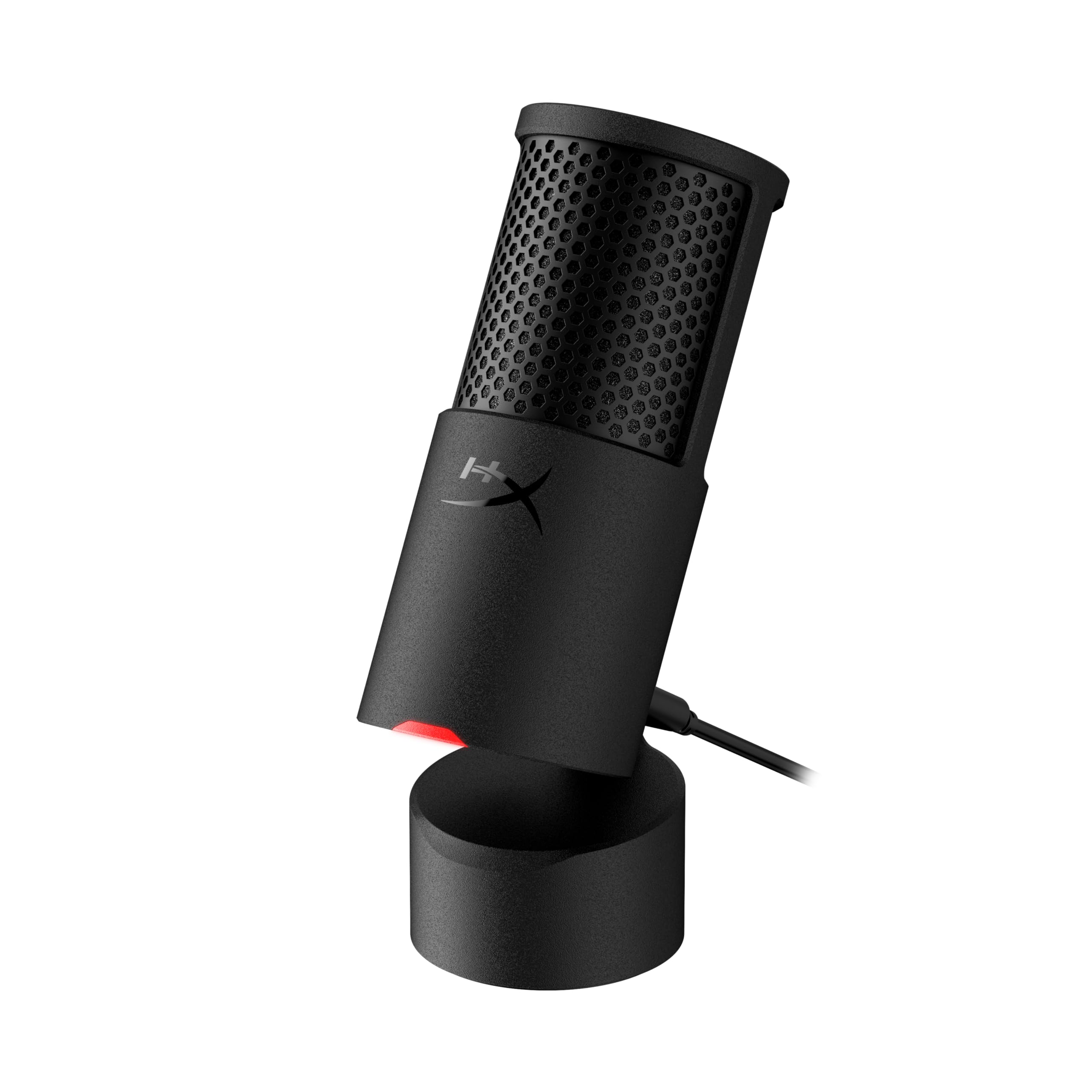
The HyperX SoloCast 2 is a thoughtfully designed USB condenser microphone that prioritizes ease of use and noise reduction in a compact form factor. Its key innovation is the built-in internal suspension system that delivers shock-absorbing benefits traditionally reserved for external shock mounts, effectively isolating the capsule from desk vibrations and accidental bumps. This makes it an excellent choice for gamers and remote workers who need reliable, clean communication without complex setup.
The microphone offers 24-bit/96 kHz high-resolution audio capture, and the built-in foam pop filter helps reduce plosives effectively during close speaking. The tap-to-mute function with a red LED indicator is responsive and intuitive, while the adjustable tilt stand with a weighted base provides stability on any desk. Customizable audio filters — including high-pass, low-pass, and voice enhancement — are accessible via the HyperX NGENUITY software, and settings can be saved directly to the microphone for consistent performance across different systems.
One of the main downsides is that the stock stand is relatively low, which can lead to picking up keyboard or mouse clicks from the desk. A boom arm is strongly recommended for optimal positioning. The microphone is also quite sensitive to background noise, so a quiet recording environment is necessary. For its price, the SoloCast 2 delivers impressive audio quality, but it needs the right setup to shine.
Why it’s great
- Built-in internal shock mount reduces vibration noise.
- High-resolution audio with customizable software filters.
- Intuitive tap-to-mute and stable weighted base.
Good to know
- Low stand height necessitates a boom arm for best results.
- High sensitivity to ambient background noise.
FAQ
Can I use an XLR condenser microphone without an audio interface?
Why does my condenser microphone pick up so much background noise?
What is the difference between a USB and an XLR condenser microphone?
Do I need a pop filter for a condenser microphone?
Final Thoughts: The Verdict
For most users, the best affordable condenser microphone winner is the LEWITT LCT 240 Pro because its exceptionally low noise floor and detailed, modern sound signature provide a professional foundation that will serve you well even as you upgrade your studio over time. If you want uncompromising plug-and-play convenience with a warm vocal sound, grab the SENNHEISER Profile. And for the tightest budget where value is the priority, the Behringer Bigfoot offers multi-pattern versatility and a robust build that is hard to beat.

Mo Maruf
I created WellFizz to bridge the gap between vague wellness advice and actionable solutions. My mission is simple: to decode the research and give you practical tools you can actually use.
Beyond the data, I am a passionate traveler. I believe that stepping away from the screen to explore new environments is essential for mental clarity and physical vitality.