Our readers keep the lights on and my smoothie glass nicely filled. As an Amazon Associate, I earn from qualifying purchases.
Finding a camera that delivers the dynamic range, log profiles, and frame rates needed for serious filmmaking without draining your production budget is the central challenge for independent creators. The gap between professional cinema rigs and consumer camcorders is wide, but a new generation of mirrorless and dedicated cinema cameras has bridged it, offering 4K 10-bit internal recording and advanced stabilization at prices that won’t sink an entire project.
I’m Mohammad Maruf — the founder and writer behind WellFizz. I’ve spent years analyzing sensor technology, codec implementation, and lens ecosystems to identify which affordable cameras punch far above their weight class for narrative, documentary, and commercial work.
Whether you’re a one-person crew or building a B-cam kit, this guide breaks down the top contenders to help you find the absolute best affordable cameras for filmmaking that match your workflow and creative vision.
How To Choose The Best Affordable Cameras For Filmmaking
Selecting a camera for filmmaking on a tighter budget means prioritizing the features that directly impact your final edit: color depth, dynamic range, and recording options. You don’t need the highest megapixel count, but you absolutely need the right codec and a lens mount that supports your creative vision.
Prioritize Internal Recording and Color Depth
An 8-bit 4:2:0 internal recording will limit your ability to push colors in post-production without introducing banding. For filmmaking, a camera that offers 10-bit 4:2:2 internal recording—or at least a clean 10-bit output via HDMI—is a significant advantage. This is non-negotiable for serious grading work, especially when shooting in log profiles.
The Lens Mount Determines Your Future
A camera body is only as good as the glass in front of it. Micro Four Thirds (MFT) offers a massive selection of affordable vintage and cine lenses; Sony E-mount has a rich ecosystem of third-party autofocus lenses; RF and Z mounts are newer but growing. An EF adapter can bridge many systems, but native mount compatibility for speed boosters or focal reducers is a key consideration for budget builds.
Look for Log Profiles and LUT Support
Flat picture profiles like V-Log L, S-Log, C-Log, or Blackmagic RAW give you maximum dynamic range to work with in post. Cameras that allow you to view user LUTs on the LCD or embed them in the metadata (like Cine EI on Sony) vastly speed up on-set monitoring and color matching, saving time in the grade.
Quick Comparison
On smaller screens, swipe sideways to see the full table.
| Model | Category | Best For | Key Spec | Amazon |
|---|---|---|---|---|
| Sony FX30 | Cinema Line | Professional Entry-Level Cinema | 6K Oversampled 4K / Dual Base ISO | Amazon |
| Blackmagic Pocket 4K | Dedicated Cinema | Narrative & Commercial Production | 13 Stops DR / BRAW Recording | Amazon |
| Sony A7 III | Full-Frame Hybrid | Run & Gun + Photo | 24.2MP BSI Sensor / 693 AF Points | Amazon |
| Canon EOS RP | Full-Frame Mirrorless | Travel Vlogging & Portraits | RF 24-105mm f/4-7.1 IS STM Kit | Amazon |
| Nikon D7500 | DSLR | Sports & Wildlife Hybrid | 51-Point AF / 8 fps Burst | Amazon |
| DJI Osmo Pocket 3 | Gimbal Camera | Ultra-Portable Vlogging | 1” CMOS / 3-Axis Stabilization | Amazon |
| Nikon Z 30 | Mirrorless Vlogger | YouTube & Livestreaming | 4K 30p / Flip-Out Touchscreen | Amazon |
| Canon T7 Bundle | Entry-Level DSLR | Learning Photography + Video | 24.1MP APS-C / 1080p Video | Amazon |
| Panasonic G85 | Mirrorless Hybrid | Stabilized 4K Handheld | Dual I.S. 2 / 4K 30p | Amazon |
| Panasonic G100 | Compact Mirrorless | Social Media Content | Built-in 360° Mic / 4K 24p | Amazon |
| OM System OM-1 Mark II | Flagship MFT | Rugged Outdoor Filmmaking | IP53 Sealing / 50fps Burst | Amazon |
In‑Depth Reviews
1. SONY FX30 Cinema Line Super 35 Camera

The Sony FX30 brings professional-grade cinema tools to an accessible price point, making it a strong contender for indie filmmakers and commercial creators. Its Super 35 (APS-C) sensor captures a 6K oversampled 4K image with S-Cinetone color science, delivering filmic skin tones straight out of camera without heavy grading.
The dual base ISO (800 and 2500) and 14+ stops of dynamic range give you exceptional latitude in controlled lighting, while Cine EI Quick and S-Log3 modes allow advanced color timing workflows. The active cooling system prevents overheating during long takes or livestreams, a critical reliability feature for production environments.
With 495 phase-detection AF points and 4K 120p recording, the FX30 handles fast-moving subjects and slow-motion capture with ease. The full-size HDMI port and dual card slots (CFexpress Type A / SD) make it a practical B-cam for an FX3 or a standalone workhorse for serious projects.
Why it’s great
- 6K oversampled 4K with S-Cinetone delivers rich color straight out of camera
- Dual base ISO and 14+ stops DR provide excellent low-light latitude for narrative work
- Active cooling system allows unlimited recording in 4K without thermal shutdown
Good to know
- Battery life hovers around 1-2 hours of continuous recording; external power recommended
- Native E-mount lenses can be expensive, though third-party options are plentiful
2. Blackmagic Design Pocket Cinema Camera 4K

The Blackmagic Pocket Cinema Camera 4K is a dedicated cinema camera that prioritizes image fidelity above all else. Its Four Thirds sensor records 12-bit Blackmagic RAW internally with 13 stops of dynamic range, giving colorists the same latitude as far more expensive setups. The included DaVinci Resolve Studio license means you can edit, grade, and finish in one seamless workflow.
The 5-inch LCD touchscreen is large and bright enough to pull focus on set without an external monitor, and the dual recording media (CFast 2.0 and SD/UHS-II) plus USB-C direct-to-SSD recording offer flexibility for any budget. The mini XLR input with phantom power lets you capture professional audio directly into the camera, reducing post-sync complexity.
This camera is built for narrative, documentary, and interview productions where manual operation is standard. It lacks continuous autofocus and in-body stabilization, meaning you’ll need a gimbal or tripod for most shots. The battery life is short (roughly 30 minutes), so external power rigs are almost mandatory for all-day shoots.
Why it’s great
- 12-bit Blackmagic RAW internal recording with 13 stops of dynamic range for serious grading
- Large 5-inch touchscreen eliminates the need for an external monitor in many setups
- Mini XLR input with phantom power for professional on-camera audio capture
Good to know
- No in-body stabilization; requires tripod, gimbal, or support rig for stable footage
- NP-F570 battery lasts roughly 30 minutes; external V-mount battery is recommended
3. Sony a7 III Full-Frame Mirrorless with 28-70mm Lens

The Sony a7 III remains a benchmark entry into full-frame mirrorless filmmaking, offering a 24.2MP back-illuminated sensor with 15 stops of dynamic range. It shoots 4K 30p (from a 6K oversample) in S-Log2 and S-Log3, and its 693-point phase-detection AF system is fast and reliable for run-and-gun production where you can’t pull focus manually.
The kit 28-70mm lens is functional but not optically brilliant—many filmmakers swap it for a fast prime or a constant-aperture zoom like the Tamron 28-75mm f/2.8. The camera also features 5-axis in-body stabilization, which smooths out handheld shots significantly when pairing with unstabilized lenses.
Battery life is industry-leading (about 710 shots or 2+ hours of video), and the dual SD slots support UHS-II for reliable backup recording. The a7 III’s menu system is dense, but the core video tools—including zebra, peaking, and S-Log—are readily accessible for a hybrid workflow that includes both stills and cinema work.
Why it’s great
- Full-frame 24.2MP BSI sensor with 15 stops DR and excellent low-light performance
- 693-point AF system with reliable eye-tracking for automated focus pulls
- Class-leading battery life supports long production days without swapping packs
Good to know
- 4K 30p has a slight crop in Super 35 mode; no 4K 60p on this generation
- Kit lens is functional but upgrading to constant-aperture glass unlocks this sensor’s potential
4. Canon EOS RP Full-Frame Mirrorless with RF 24-105mm F4-7.1 IS STM Lens

The Canon EOS RP is a lightweight full-frame mirrorless that offers an affordable entry to the RF ecosystem, making it a great choice for filmmakers who prioritize portability and color science. Its 26.2MP sensor delivers pleasing skin tones and excellent dynamic range for the price, and the RF 24-105mm f/4-7.1 IS STM lens gives you a versatile zoom range for doc-style shooting.
Video recording peaks at 4K 24p, but with a significant crop factor and a 30-minute record limit that feels restrictive for longer shoots. The Dual Pixel CMOS AF is fast and smooth, and the body remains one of the smallest full-frame options available, making it easy to rig for gimbal work or pack in a small bag for travel.
For filmmakers coming from a Canon DSLR background, the RP is a natural upgrade that retains familiar menu logic. The lack of 4K 60p and the cropped 4K mode are drawbacks, but the 1080p 60p footage is clean and sharp enough for broadcast-style projects where 4K isn’t mandatory.
Why it’s great
- Lightweight full-frame body that rigs easily for gimbal and travel productions
- Dual Pixel CMOS AF with smooth, reliable tracking for video subjects
- RF 24-105mm kit lens offers image stabilization and a useful focal range for doc work
Good to know
- 4K recording has a significant crop factor and a 30-minute record limit
- No 4K 60p; electronic viewfinder can dim during long shoots in bright sunlight
5. Nikon D7500 DSLR with AF-S DX NIKKOR 18-140mm VR Lens

The Nikon D7500 is a rugged DSLR that brings D500-level metering and image processing to a more accessible body. Its 20.9MP APS-C sensor records 4K UHD at 30fps with stereo sound and power aperture control, making it a solid option for filmmaking projects that need long battery life and durable weather sealing for outdoor shoots.
The 51-point AF system with 15 cross-type sensors, combined with up to 8 fps continuous shooting, handles fast-moving subjects well. The 18-140mm VR kit lens covers a wide to telephoto range, and the optical viewfinder offers zero-lag composition that mirrorless shooters sometimes miss in bright sunlight.
For filmmakers, the D7500 offers good 4K quality straight out of camera, but it lacks advanced log profiles and 10-bit output. The tilting touchscreen LCD makes low-angle shots easier, and the stereo microphone jack supports external audio. This camera excels in hybrid photo-video projects where stills are the priority but 4K is needed for social media clips.
Why it’s great
- D500-derived 51-point AF system with fast 8 fps burst for action sequences
- Excellent battery life and weather sealing for all-day field production
- 18-140mm VR kit lens provides a versatile range for doc and travel filming
Good to know
- No log profile or 10-bit output; color grading options are limited compared to mirrorless rivals
- DSLR form factor is larger and heavier than modern mirrorless alternatives
6. DJI Osmo Pocket 3 Creator Combo

The DJI Osmo Pocket 3 redefines pocket-sized filmmaking with a 1-inch CMOS sensor that records 4K at 120fps with genuine 3-axis mechanical stabilization. It’s a dedicated vlogging and gimbal camera that, when paired with the Creator Combo’s DJI Mic 2 transmitter, delivers gimbal-smooth footage and high-quality audio in a form factor that fits in a jacket pocket.
The 2-inch rotatable touchscreen automatically switches between horizontal and vertical orientation, making it ideal for multi-platform content creation. ActiveTrack 6.0 locks onto subjects and keeps them center-frame even during panning or movement, and D-Log M with 10-bit color depth allows for basic color grading that improves on typical phone-log footage significantly.
For solo creators and run-and-gun storytelling, the Pocket 3 eliminates the need for a separate gimbal rig. The battery handle extends recording time, and the wide-angle lens adapter expands the field of view for immersive interviews. It’s not a cinema camera, but for narrative vlogging and B-roll acquisition, it’s an incredibly efficient tool.
Why it’s great
- 1-inch sensor with true 3-axis mechanical stabilization for gimbal-smooth handheld footage
- 4K 120fps slow-motion and 10-bit D-Log M color space for post-production grading
- Creator Combo includes DJI Mic 2, battery handle, and wide-angle lens for a complete kit
Good to know
- Fixed lens means no versatility; wide-angle adapter is needed for immersive shots
- Gimbal mechanism is delicate and requires careful handling; not as rugged as a full camera body
7. Nikon Z 30 Mirrorless 4K with 16-50mm Zoom Lens

The Nikon Z 30 is Nikon’s most compact mirrorless camera purpose-built for creators who prioritize video over stills. Its 20.9MP APS-C sensor records 4K 30p with oversampled sharpness, and the flip-out selfie touchscreen makes solo recording or framing interviews straightforward. The 16-50mm retractable kit lens keeps the total package incredibly pocketable.
For filmmakers, the Z 30 offers reliable autofocus with eye detection for people and pets, a built-in stereo microphone with adjustable sensitivity, and a bright red REC light that clearly indicates recording status. USB-C connectivity supports plug-and-play webcam operation in Full HD 60p, plus constant power delivery for long streaming sessions or interviews.
The absence of an electronic viewfinder is noticeable for traditional photographers but not a hindrance for video-first workflows. The camera supports unlimited video recording time in 4K, and the clean HDMI output allows connection to external recorders for higher-quality capture if needed. For social media filmmakers, the Z 30 is a nimble, affordable entry point into the Nikon Z ecosystem.
Why it’s great
- Compact body with flip-out selfie screen and red REC light for confident solo recording
- USB-C connectivity supports plug-and-play 4K streaming and continuous power delivery
- No 4K recording time limits; ideal for long-form interviews and livestreams
Good to know
- No electronic viewfinder; framing relies entirely on the rear LCD screen
- Some streaming setups require a specific USB-C PD cable not included in the box
8. Canon EOS Rebel T7 DSLR with 18-55mm + 75-300mm Lens Bundle
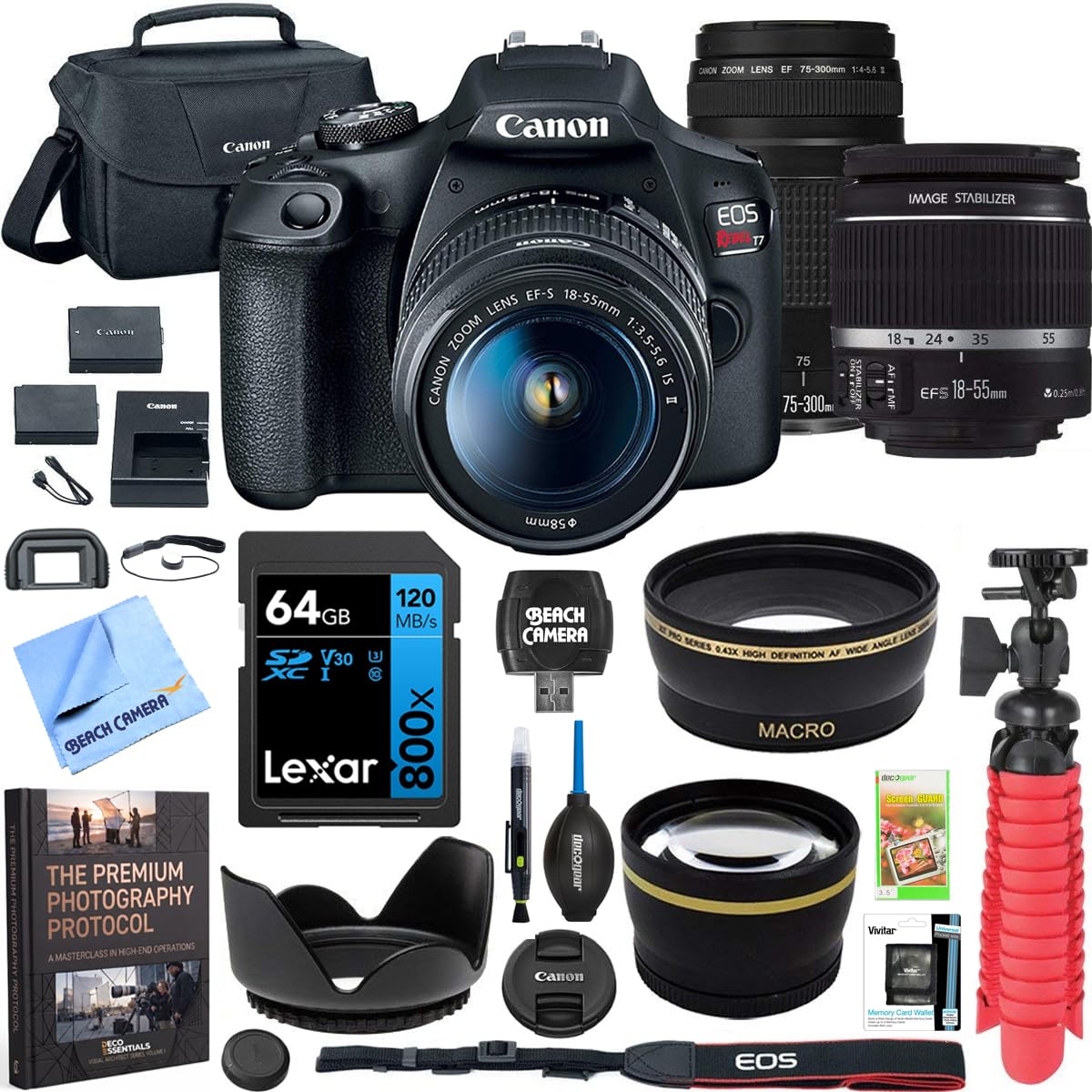
The Canon EOS Rebel T7 is a classic entry-level DSLR that provides a complete photo/video learning platform at an accessible entry point. Its 24.1MP APS-C sensor and DIGIC 4+ processor deliver Full HD 1080p video at 30fps, making it suitable for early filmmaking experiments and educational content where 4K is not a requirement.
This bundle includes both the EF-S 18-55mm f/3.5-5.6 IS II kit lens and a telephoto 75-300mm f/4-5.6 III lens, covering wide to super-telephoto ranges for varied projects. The 9-point AF system with AI Servo tracking is basic but functional for slow to moderate action, and the optical viewfinder offers a real-time, lag-free shooting experience. Built-in Wi-Fi and NFC allow easy sharing to a smartphone for quick social media uploads.
For filmmaking specifically, the T7 lacks 4K, log profiles, and advanced codecs, which means your grading options are limited. However, the large accessory bundle—including extra battery, memory card, tripod, and cleaning kit—gives a complete starter kit for someone learning to frame shots and edit footage without a steep initial investment.
Why it’s great
- Complete bundle with dual lenses, tripod, extra battery, and memory card
- Optical viewfinder and 9-point AF system offer a traditional DSLR learning experience
- Built-in Wi-Fi for quick transfer and remote control via smartphone
Good to know
- 1080p only; no 4K video recording capability for modern filmmaking projects
- 7-point AF system is limited for video use; slow continuous shooting at 3 fps
9. Panasonic LUMIX G85 4K with 12-60mm Power O.I.S. Lens

The Panasonic LUMIX G85 is a mirrorless hybrid that punches above its class with class-leading in-body dual image stabilization. The 16MP Micro Four Thirds sensor, which lacks a low-pass filter, resolves exceptional fine detail, and when paired with the 12-60mm Power O.I.S. lens, the Dual I.S. 2 system compensates for camera shake during handheld 4K video recording.
The weather-sealed magnesium alloy body provides durability for location shoots, and the 3-inch tilt-and-touch LCD offers flexible framing for low and high angles. The electronic viewfinder (2360K dots) is bright and responsive, while the 4K Photo and Post-Focus modes allow you to extract 8MP stills from video with selectable focus points after capture. The 49-point contrast-detect AF system is reliable in most conditions, though it can struggle in very low-light scenarios while recording video.
For filmmaking, the G85 records 4K QFHD (3840 x 2160) at 30p with 4:2:0 8-bit internally. It lacks a headphone jack for real-time audio monitoring, which is a notable omission for serious audio post-production. Nevertheless, the stabilization alone makes it a fantastic entry-level camera for handheld documentary work without rigging a gimbal, and the Micro Four Thirds lens ecosystem provides affordable primes and cinema lenses for expansion.
Why it’s great
- Dual I.S. 2 offers exceptional in-body and lens stabilization for handheld 4K video
- Weather-sealed magnesium alloy body is durable for outdoor location shoots
- Extensive MFT lens ecosystem with affordable primes and cine lenses
Good to know
- No headphone jack for real-time audio monitoring during recording
- Contrast-detect AF can be slow in low-light conditions for video autofocus
10. Panasonic LUMIX G100 4K with 12-32mm Lens

The Panasonic LUMIX G100 is a compact mirrorless camera designed specifically for content creators who need a small footprint without sacrificing image quality. Its 20.3MP Micro Four Thirds sensor records 4K 24p and 30p video with excellent color rendering, and the built-in audio microphone with subject tracking captures directional sound that adjusts automatically—perfect for solo vloggers and interview-style recordings.
The 12-32mm retractable kit lens keeps the body extremely pocketable when closed, and the iA (Intelligent Auto) mode provides reliable point-and-shoot performance for users transitioning from smartphones. The camera also functions as a plug-and-play webcam for livestreaming, and the built-in Wi-Fi allows for quick frame marker overlays for social media aspect ratios during shooting.
For filmmaking, the G100 records 4K video at 24p with 4:2:0 8-bit color, and offers V-Log L recording for flat footage. The main limitation is a very short 4K recording time (the camera stops recording after a few minutes), which makes it unsuitable for long interviews or event coverage. It’s best deployed as a travel B-cam or a dedicated social media content tool where shot duration is short.
Why it’s great
- Compact body with retractable kit lens fits easily in a jacket pocket
- Built-in microphone with subject tracking for clear audio in vlogs and interviews
- V-Log L profile available for flat footage with room for color grading
Good to know
- 4K recording time is severely limited, stopping after a couple of minutes
- Contrast-detect autofocus can hunt in low-light conditions during video
11. OM SYSTEM OM-1 Mark II with M.Zuiko Digital ED 12-40mm F2.8 PRO II Lens

The OM SYSTEM OM-1 Mark II is a flagship Micro Four Thirds camera built for extreme environments and computational imaging. Its 20MP Stacked BSI Live MOS sensor, paired with the TruePic X engine, delivers blazing-fast readout speeds and advanced features like Handheld High-Res Shot (up to 50MP) and Live ND, which apply computational corrections directly in-camera that previously required post-production work.
The Cross Quad Pixel AF system offers 1,053 all cross-type focus points covering 100% of the frame, making it one of the fastest and most accurate autofocus systems for tracking subjects in both photos and video. The M.Zuiko 12-40mm F2.8 PRO II kit lens is a constant-aperture workhorse that matches the body’s IP53 dustproof, splashproof, and freezeproof (-10°C) construction, making this the most weather-resistant kit on this list for outdoor adventure filmmaking.
For filmmaking, the OM-1 Mark II records 4K 30p and 60p with 10-bit 4:2:2 internally, and its in-body image stabilization (IBIS) is class-leading, effectively allowing handheld long exposures that would normally require a tripod. The computational photography suite, including live composite, focus stacking, and HDR, provides filmmakers with tools to capture complex scenes efficiently. The premium price reflects the pro-level build and speed, but the lens and body combination offers exceptional value for documentary and nature filmmakers who work in variable weather conditions.
Why it’s great
- IP53-rated weather sealing for extreme outdoor filming in dust, rain, and freezing temps
- Class-leading IBIS eliminates tripod need for many handheld low-light shots
- Constant f/2.8 PRO II lens provides sharp, fast-aperture coverage throughout the zoom range
Good to know
- Micro Four Thirds sensor is smaller than full-frame; high ISO noise is more apparent
- Premium price point places it in the mid/high range; less accessible for strict budget builds
FAQ
Is 8-bit video enough for professional filmmaking projects?
Do I need a speed booster or adapter for vintage lenses on MFT cameras?
What is the minimum dynamic range I should look for in an affordable filmmaking camera?
Final Thoughts: The Verdict
For most users, the best affordable cameras for filmmaking winner is the Sony FX30 because it combines professional cinema features—6K oversampled 4K, S-Cinetone, and active cooling—in a compact body that integrates seamlessly into a serious production workflow. If you want raw internal recording and the widest dynamic range for color grading, grab the Blackmagic Pocket Cinema Camera 4K. And for a rugged, stabilizer-free outdoor filmmaking rig that can weather any storm, nothing beats the OM SYSTEM OM-1 Mark II with its IP53 sealing and constant f/2.8 lens.

Mo Maruf
I created WellFizz to bridge the gap between vague wellness advice and actionable solutions. My mission is simple: to decode the research and give you practical tools you can actually use.
Beyond the data, I am a passionate traveler. I believe that stepping away from the screen to explore new environments is essential for mental clarity and physical vitality.