Our readers keep the lights on and my smoothie glass nicely filled. As an Amazon Associate, I earn from qualifying purchases.
Stepping up from a smartphone to a dedicated camera means facing a wall of sensor sizes, mount types, and conflicting advice about what actually matters for image quality. The wrong choice traps you in a system that limits your growth or delivers images no better than your phone. This guide cuts through the noise to find the body and lens combos that genuinely improve your photography without demanding a second mortgage.
I’m Mohammad Maruf — the founder and writer behind WellFizz. I’ve spent years analyzing sensor technology, lens ecosystems, and autofocus systems to identify which cameras deliver the sharpest return on investment for aspiring photographers.
After evaluating hundreds of hours of real-world test results and user experiences with the Sony a7 III, Fujifilm X-T30 II, and Canon EOS R100, I’ve built a definitive list of the best affordable camera for photography that balances sensor performance, lens availability, and long-term value.
How To Choose The Best Affordable Camera For Photography
The sheer number of options in the sub- space can paralyze a new buyer. The key is to ignore marketing fluff about megapixel arms races and focus on three pillars: sensor size, lens ecosystem, and the autofocus system that matches your typical subject.
Sensor Size: The Real Image Quality Driver
An APS-C sensor (found in the Nikon Z50 II, Canon EOS R100, Sony ZV-E10) offers roughly 2.5 times the surface area of a Micro Four Thirds sensor like the one in the Panasonic G85 or OM System E-M10 Mark IV. Larger sensors capture more light at every ISO setting, producing cleaner shadows and smoother color gradations. Full-frame sensors (Sony a7 III) double that area again but at a higher entry price. For affordable photography, APS-C represents the sweet spot — excellent low-light performance without the cost penalty of full-frame glass.
Lens Ecosystem: Your Five-Year Investment
The camera body you buy today will be outdated long before your lenses. An affordable camera is only as good as the glass it accepts. Canon’s RF mount (EOS R100) has growing third-party support. Sony’s E-mount (ZV-E10, a7 III) offers the deepest selection of affordable primes and zooms. Micro Four Thirds lenses are typically smaller and cheaper than APS-C equivalents, but the selection of native wide-aperture primes is mature. Nikon’s Z-mount (Z50 II) is newer but already has excellent kit lenses. Choose a mount that gives you upgrade paths, not a dead end.
Autofocus Performance for Your Subject
If you shoot portraits and still life, any modern AF system with face/eye detection will suffice. For kids, pets, and wildlife, the number of autofocus points and subject-tracking capabilities matter. The Sony a7 III’s 693 phase-detection points and the Fujifilm X-T30 II’s AI-powered subject detection handle moving subjects with ease. Conversely, the 9 AF points on the Canon T7 feel dated for action. Always prioritize AF point coverage and tracking consistency over burst rate specs.
Quick Comparison
On smaller screens, swipe sideways to see the full table.
| Model | Category | Best For | Key Spec | Amazon |
|---|---|---|---|---|
| Sony a7 III | Full-Frame Mirrorless | Pro-level image quality on a budget | 24.2MP Full-Frame, 693 AF points | Amazon |
| Fujifilm X-T30 III | APS-C Mirrorless | Film simulations and color science | 26.1MP X-Trans, 425 AF points | Amazon |
| Nikon Z50 II | APS-C Mirrorless | Two-lens travel kit | 20.9MP DX, 231 AF points | Amazon |
| Sony ZV-E10 | APS-C Mirrorless | Vloggers who also shoot stills | 24.2MP APS-C, 425 AF points | Amazon |
| OM System E-M10 IV | MFT Mirrorless | Compact travel and selfies | 20MP MFT, 5-axis IBIS | Amazon |
| Panasonic G85 | MFT Mirrorless | Video with in-body stabilization | 16MP MFT, 5-axis IBIS + OIS | Amazon |
| Panasonic G100 | MFT Mirrorless | Lightweight hybrid with advanced audio | 20.3MP MFT, 49 AF points | Amazon |
| Canon EOS R100 | APS-C Mirrorless | Entry-level RF mount start | 24.1MP APS-C, 143 AF points | Amazon |
| Canon T7 Bundle | APS-C DSLR | Budget double-zoom kit | 24.1MP APS-C, 9 AF points | Amazon |
| Canon EOS 4000D | APS-C DSLR | Absolute beginner bundle | 18MP APS-C, 19 AF points | Amazon |
| Nikon D3400 Renewed | APS-C DSLR | Built-in guide mode for learners | 24.2MP APS-C, 11 AF points | Amazon |
In‑Depth Reviews
1. Sony a7 III

The Sony a7 III redefined the full-frame entry point. Its 24.2MP back-illuminated Exmor R sensor delivers 15 stops of dynamic range and clean shadows up to ISO 12800, which is transformative for indoor event photography or low-light landscapes that cheaper cameras would render noisy. The 693 phase-detection AF points covering 93% of the frame lock onto eyes without hunting, and the 10 fps mechanical shutter captures action without blackout.
Battery life is best-in-class at approximately 710 shots per charge, a practical benefit for all-day shooting where smaller mirrorless bodies would leave you swapping packs. The 28-70mm kit lens in the box is decent for standard focal lengths, but the real value of the a7 III is the gateway it provides to Sony’s vast E-mount lens library — including Sigma’s affordable 24-70mm f/2.8 and Tamron’s zooms.
Keep in mind the menu system is dense and the 4K video requires a UHS-II card for consistent recording. The kit lens, while reliable, lacks the wide aperture needed for heavy subject separation. Factor in a prime lens like the 50mm f/1.8 to unlock the sensor’s true potential for portrait work.
Why it’s great
- Exceptional 15-stop dynamic range cleans up shadow detail
- 693-point phase-detection AF with reliable eye-tracking
- Outstanding battery endurance for a mirrorless camera
- Full-frame sensor captures significantly more light than APS-C
Good to know
- Kit lens is serviceable but not optically elite
- Menu layout is deep and requires learning time
- No built-in flash requires hotshoe accessory for fill light
- 4K video needs fast UHS-II memory cards
2. Fujifilm X-T30 III
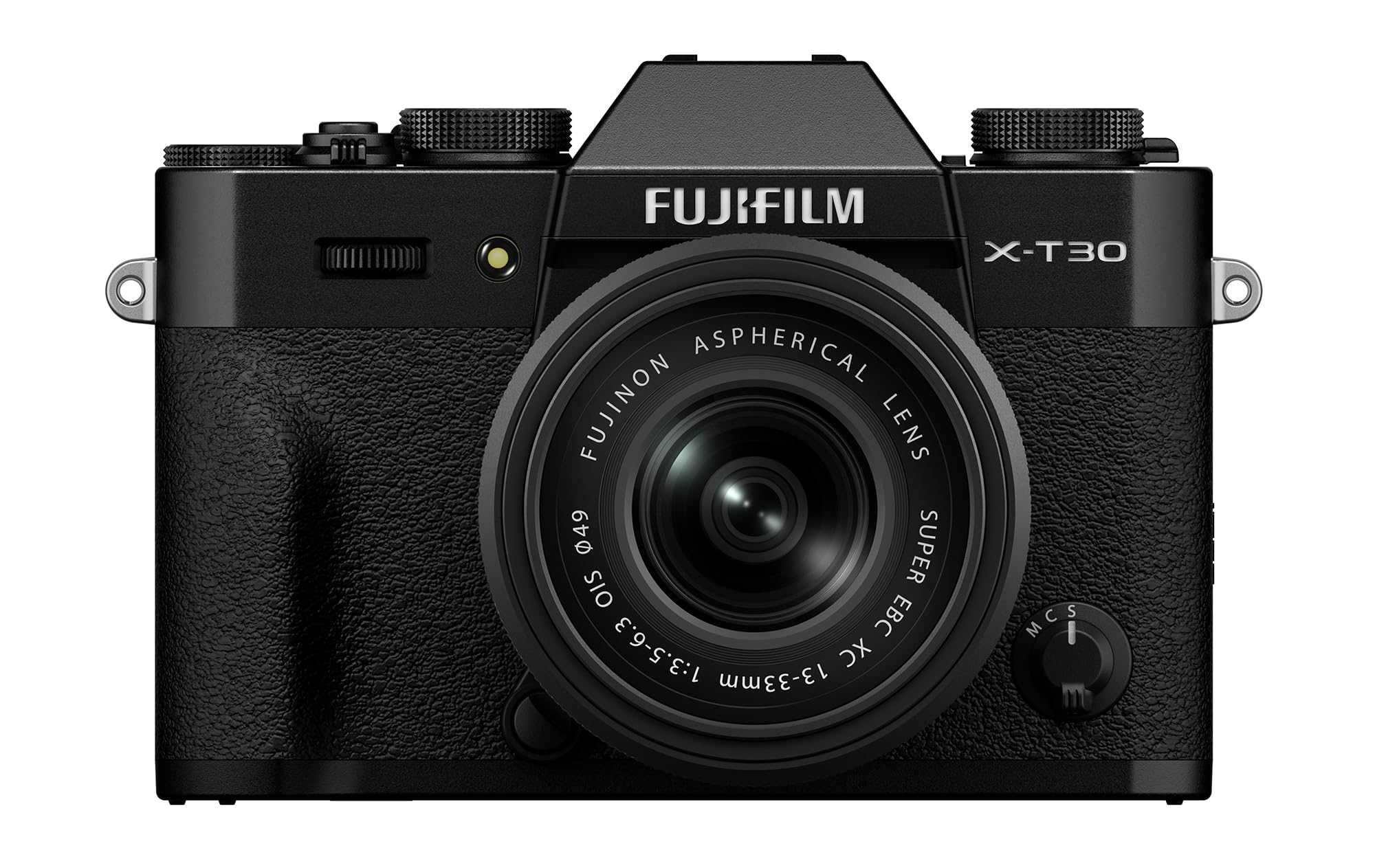
Fujifilm’s X-Trans sensor architecture and 20 built-in Film Simulations make the X-T30 III the only camera on this list that can produce straight-out-of-camera JPEGs mimicking Kodachrome, Provia, and Astia with startling accuracy. Hobbyists who dislike post-processing will find the color science alone worth the investment. The 26.1MP APS-C sensor resolves detail well beyond the 24MP standard, and the X-Processor 5 engine powers AI-driven subject detection autofocus that tracks animals and vehicles with confidence.
The body is remarkably compact, making it a genuine daily carry option. The included XC13-33mm f/3.5-6.3 OIS kit lens provides optical stabilization and a versatile zoom range, though its variable aperture struggles in twilight. Analog dials for ISO, shutter speed, and exposure compensation give tactile control that DSLR users will appreciate.
Two important shortcomings: the X-T30 III lacks in-body image stabilization, meaning you must rely on lens OIS or a tripod for sharp handheld shots at slow shutter speeds. Battery life is moderate, and the camera ships without a dedicated charger — plan for USB charging and spare batteries if you shoot for extended periods.
Why it’s great
- Outstanding film simulations eliminate heavy editing
- AI-powered AF detects animals, birds, and vehicles
- Compact analog body fits in small bags easily
- X-Trans sensor produces sharp, artifact-free images
Good to know
- No in-body image stabilization for handheld video
- No charger included — uses USB-C only
- Battery drains faster than larger Sony/Nikon bodies
- Kit lens aperture slows significantly at telephoto end
3. Nikon Z50 II

The Z50 II arrives with two stabilized lenses — a 16-50mm f/3.5-6.3 VR and a 50-250mm f/4.5-6.3 VR — covering wide-angle to telephoto without an immediate second purchase. The 20.9MP DX-format sensor produces lifelike colors with excellent dynamic range, and Nikon’s 31 built-in Picture Control presets let you dial in looks ranging from rich landscape contrast to soft portrait tones without touching RAW files.
Subject detection autofocus tracks nine distinct categories including dogs, cats, birds, and airplanes, which makes it unusually capable for wildlife on a budget. The 4K UHD/60p video output includes built-in electronic VR and a product review mode, making the Z50 II a strong hybrid performer for family content creators. The SnapBridge app transfers images to your phone in seconds over Bluetooth.
At this tier, the Z50 II’s key limitation is battery life when using the flip-out LED screen for video — carry a backup battery for extended shoots. The kit lenses, while optically good, have variable apertures that require higher ISO in dim settings compared to a constant f/2.8 zoom. The Z-mount lens library is still maturing relative to Sony’s E-mount.
Why it’s great
- Two-lens kit covers 16-250mm right out of the box
- Excellent subject detection for animals and vehicles
- 31 Picture Control presets for instant looks
- Compact and lightweight for a dual-lens travel rig
Good to know
- Battery life shorter with flip-out screen active
- Kit lenses have variable aperture, not constant f/2.8
- Native Z-mount lens selection is smaller than Sony E
- No in-body stabilization built into the camera body
4. Sony ZV-E10
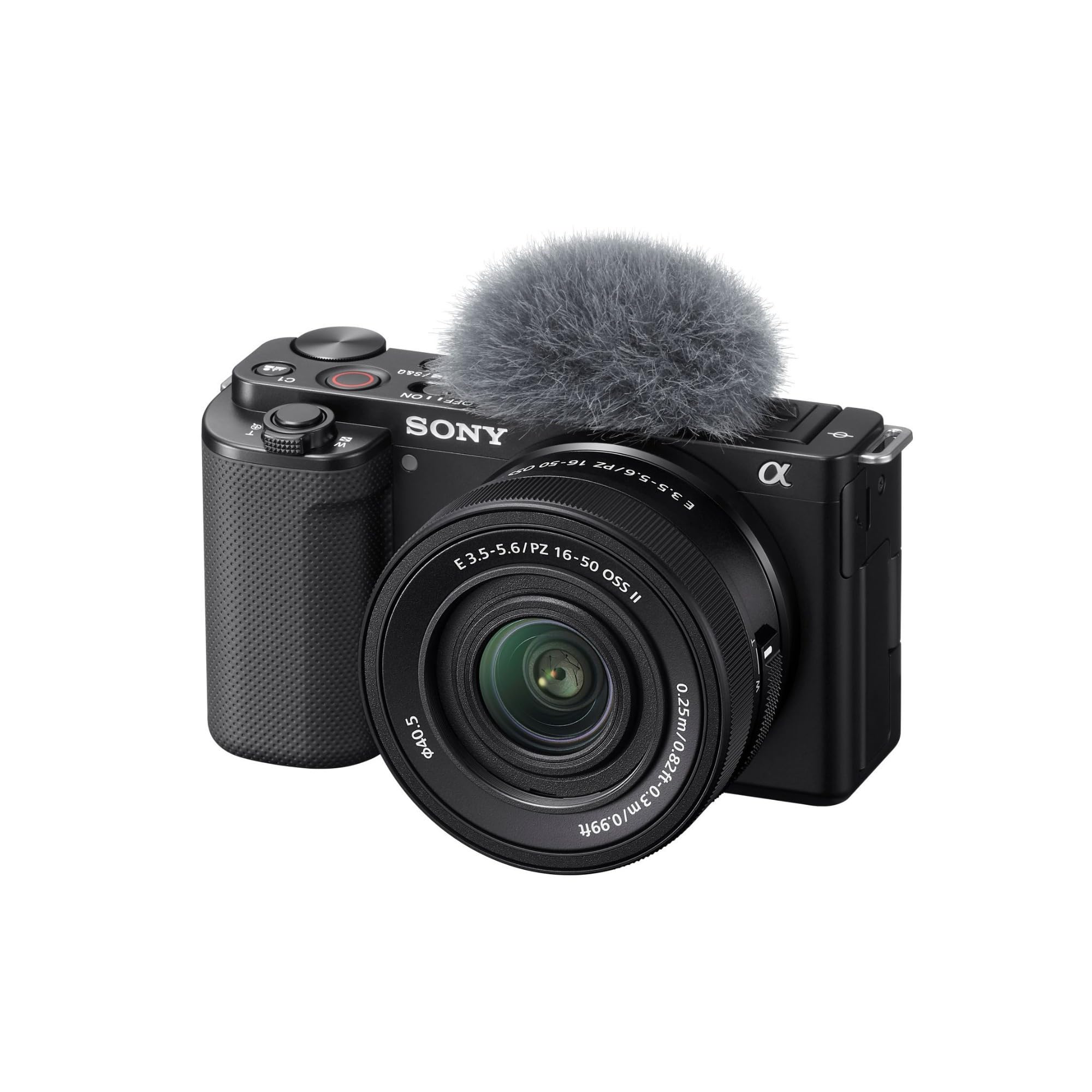
The ZV-E10 packs the same 24.2MP APS-C Exmor sensor found in Sony’s higher-end a6000 series into a body designed specifically for content creators who shoot both stills and video. The oversampled 4K from a 6K readout delivers remarkable sharpness without aliasing, and the Product Showcase Setting instantly pulls focus from your face to an object you hold up — an indispensable feature for product reviews and tutorials.
The Background Defocus button toggles between a blurred and sharp background with one tap, effectively simulating a wide-aperture lens effect even with the kit zoom. The 425 hybrid autofocus points combined with real-time eye tracking for humans and animals keep moving subjects crisp without manual intervention. The 16-50mm power zoom lens retracts for a compact profile when off.
The trade-off is ergonomics: the ZV-E10 lacks a built-in viewfinder, requiring reliance on the rear LCD for framing — a struggle in direct sunlight. The single SD card slot and microSD support are functional but not redundant for professional backup. Battery life is adequate but not class-leading, and the kit lens aperture is slow at f/3.5-5.6.
Why it’s great
- 4K video oversampled from 6K readout for maximum detail
- Product Showcase Setting switches focus seamlessly
- Background Defocus button for instant bokeh effect
- Excellent 425-point hybrid AF with eye-tracking
Good to know
- No built-in viewfinder for sunny day shooting
- Single SD card slot with no backup
- Kit lens is slow (f/3.5-5.6) for low light
- Battery life only moderate for video sessions
5. OM System E-M10 Mark IV

The E-M10 Mark IV is the lightest interchangeable lens camera on this list without sacrificing image quality. Its 20MP Micro Four Thirds sensor pairs with a 5-axis in-body image stabilization system rated for 4.5 stops of compensation, meaning you can shoot handheld at 1/4 second shutter speeds and still produce sharp frames — ideal for evening strolls or museum interiors where tripods are banned.
The flip-down screen activates a dedicated selfie mode with touch shutter, making it the most natural option on the list for self-portraits and travel photographers who shoot from low angles. The 14-42mm EZ pancake kit lens compresses to roughly 25mm when powered off, fitting into a jacket pocket — something no APS-C or full-frame kit lens can match. The 121 contrast-detect AF points are snappy in good light and the 4K video output is stabilizing enough for walking clips.
The MFT sensor’s smaller surface area shows in low light: ISO 3200 images have more noise than APS-C competitors at the same sensitivity, and the 4:3 aspect ratio crops differently than the standard 3:2. The included battery charger is not USB-C, and the OI Share app can be slow for image transfers over WiFi.
Why it’s great
- Class-leading 5-axis IBIS with 4.5 stops of correction
- Compact pancake kit lens shrinks for pocket storage
- Flip-down selfie screen with dedicated mode
- Lightest interchangeable lens camera in this group
Good to know
- Smaller MFT sensor shows more noise above ISO 3200
- Charging is not USB-C; uses proprietary connector
- WiFi image transfer is slower than expected
- Dial layout takes time to memorize for manual shooters
6. Panasonic G85

The G85 combines a 16MP Micro Four Thirds sensor with class-leading Dual Image Stabilization 2, which coordinates the in-body 5-axis IBIS with the lens-based OIS in the included 12-60mm Power O.I.S. lens. The result is footage that looks gimbal-stabilized even when walking, making this the best video-oriented body in the mid-range if your priority is clean handheld clips.
The magnesium alloy front plate and weather sealing give it a build toughness rare at this price point. The 4K Photo mode captures 30 fps bursts and lets you select the exact frame after the fact, and Post Focus lets you shift the focal point in a still image after capture — both genuinely useful features for macro and product work. The 49 contrast-detect AF points work reliably for stills in good light, though they hunt more in dim environments compared to phase-detection systems.
The 16MP sensor is the lowest resolution on this list, and some shooters notice the reduced cropping headroom compared to 24MP APS-C alternatives. The camera lacks a headphone jack for video monitoring, and its weight (approximately 505g with battery and card) approaches DSLR territory despite the smaller sensor. Kit lens copies can have asymmetrical sharpness — inspect early.
Why it’s great
- Dual I.S. 2 enables near-gimbal handheld video
- Weather-sealed magnesium alloy construction
- 4K Photo burst mode with Post Focus capability
- Excellent ergonomics with deep grip
Good to know
- 16MP sensor limits cropping and large prints
- Contrast-detect AF hunts in low-light scenarios
- No headphone jack for audio monitoring
- Heavier than expected for an MFT body
7. Panasonic G100

The G100 carves a unique niche as a hybrid camera built for creators who prioritize audio quality out of the box. Its built-in microphone with OZO Audio tracking automatically adjusts directionality based on where the subject is in the frame — when you record a vlog, it captures from the front; when you pan to a person off-screen, it switches to a stereo pattern. This eliminates the immediate need for an external shotgun mic in many scenarios.
The 20.3MP Micro Four Thirds sensor delivers excellent color tones and the 12-32mm retractable lens keeps the body pocketable when powered off. The camera features a built-in frame marker for social media aspect ratios (square, vertical, 16:9) which helps creators compose specifically for Instagram or TikTok without guessing crops. The intelligent Auto mode is genuinely reliable for beginners, while manual controls are available as skills develop.
The G100 has a significant limitation for video shooters: 4K recording stops after approximately 10 minutes due to heat management, making it unsuitable for long takes or event coverage. The contrast-detect autofocus is slower than phase-detect equivalents, and the lack of headphone jack prevents audio monitoring during recording. The kit lens’s f/3.5-22 variable aperture requires good lighting for clean shots.
Why it’s great
- OZO Audio tracking adjusts mic direction automatically
- Compact retractable kit lens for easy carry
- Social media frame markers for perfect composition
- Intelligent Auto mode works for total beginners
Good to know
- 4K video limited to ~10 minutes recording time
- Contrast-detect AF slower than phase-detect systems
- No headphone jack for audio monitoring
- Variable aperture kit lens struggles in low light
8. Canon EOS R100
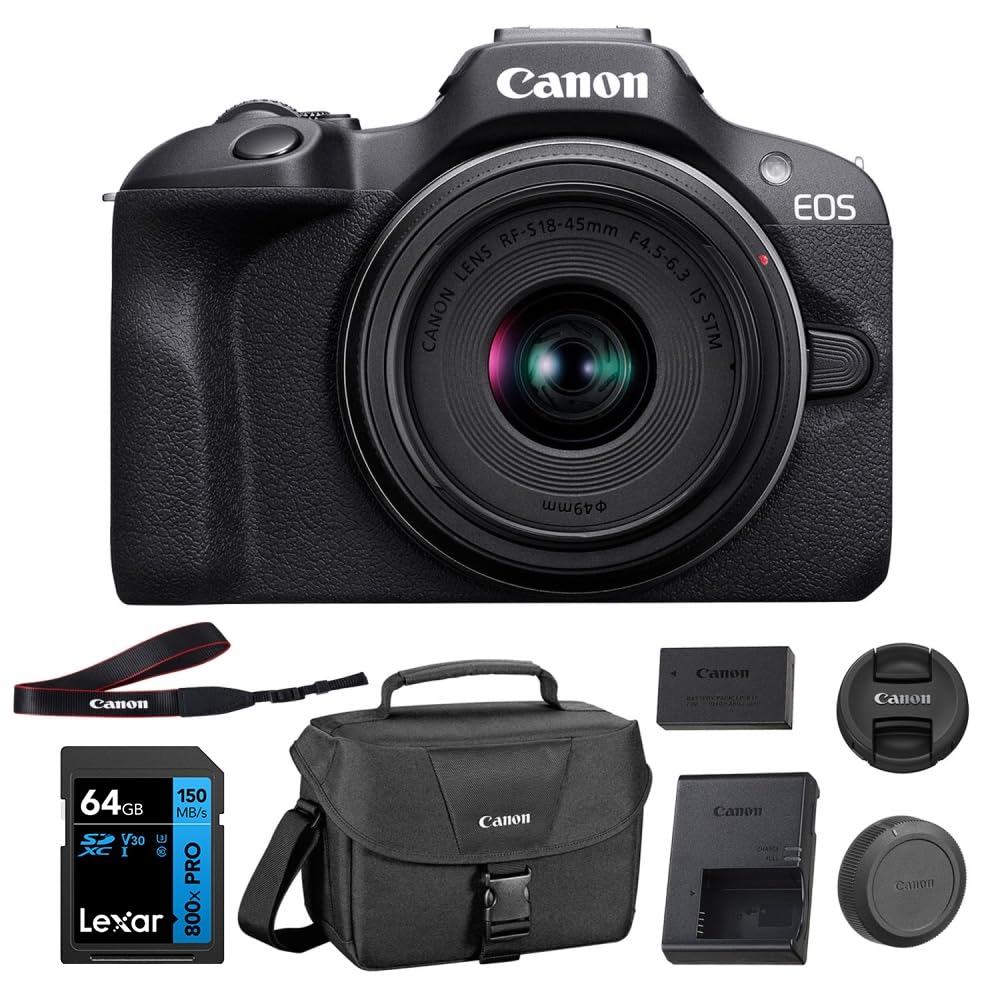
The EOS R100 is the most affordable entry point into Canon’s RF mirrorless system, which promises a future upgrade path to bodies like the R8 or R6 II without changing lenses. The 24.1MP APS-C sensor paired with the DIGIC 8 processor delivers clean images up to ISO 6400, and Dual Pixel CMOS AF covers 143 zones with human face and eye detection — reliable autofocus performance that outpaces any smartphone.
The compact body is the smallest and lightest in the EOS R series, making it a strong candidate for new photographers who want a camera they’ll actually carry daily. The RF-S 18-45mm kit lens is retractable and lightweight, and the bundled shoulder bag and 64GB memory card in the kit provide everything you need to start shooting immediately. The 6.5 fps burst rate is adequate for casual action.
The R100 uses the same DIGIC 8 processor found in older DSLRs, limiting it to 4K at 24 fps with some crop factor, and you won’t get the advanced AI autofocus features of the newer DIGIC X processors. The 3-inch LCD has modest 1040K dot resolution and is fixed, not articulating, which limits angle flexibility. The RF-S lens selection is still small; you’ll eventually want to budget for third-party RF glass.
Why it’s great
- Entry-level gateway to Canon’s RF mirrorless ecosystem
- Dual Pixel CMOS AF with 143 zone coverage
- Compact and lightweight for daily carry
- Included bag and memory card in starter kit
Good to know
- 4K video is limited to 24 fps with crop factor
- Fixed LCD screen limits creative shooting angles
- DIGIC 8 processor lacks newer AI features
- Native RF-S lens selection is still growing
9. Canon T7 Bundle
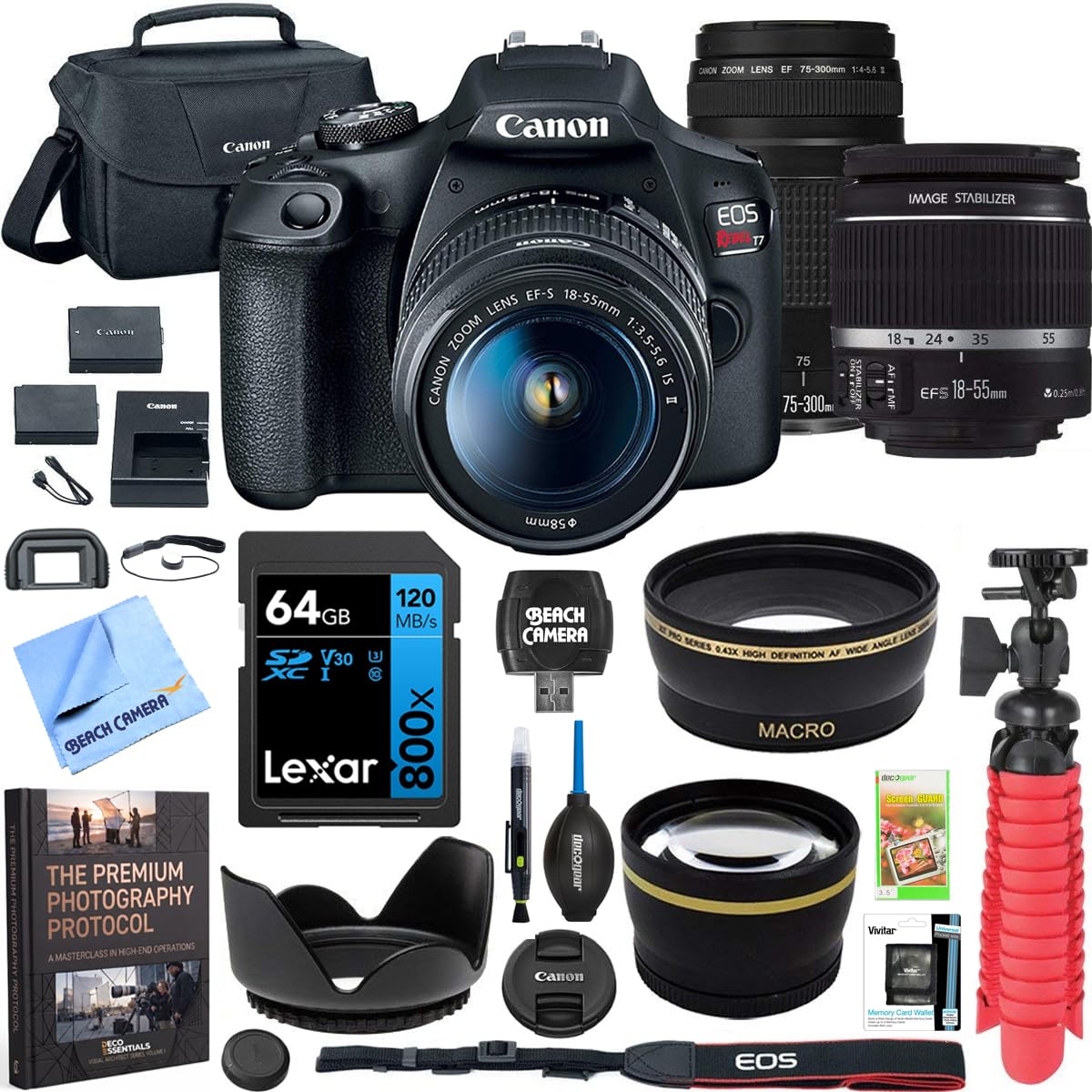
The Canon T7 bundle provides the most comprehensive accessory package in this guide: two lenses (18-55mm IS II and 75-300mm III), a tripod, extra battery, cleaning kit, SD card, and case. For absolute beginners who do not own any camera accessories, this kit removes the friction of buying multiple pieces separately. The 24.1MP APS-C sensor captures the same resolution as the R100, and DIGIC 4+ processing handles everyday stills competently.
The 75-300mm telephoto lens extends your reach for wildlife and sports without requiring a separate purchase. Built-in WiFi and NFC enable wireless image transfer to your phone for quick social sharing. The optical viewfinder shows the scene without lag, and the 3 fps burst rate is sufficient for stationary subjects and slow-moving family scenes.
The autofocus system is the weakest link here — only 9 AF points in a cluster near the center, which forces composition compromises for off-center subjects. The DIGIC 4+ processor is five generations behind current models, producing noticeable noise above ISO 1600 and limiting the camera to 1080p video. The included tripod and bag are basic quality, and the LP-E10 battery has known durability issues with some units failing quickly.
Why it’s great
- Complete kit with two lenses, tripod, and extras
- 240mm effective reach with 75-300mm telephoto lens
- WiFi and NFC for wireless image transfer
- 24.1MP resolution for detailed large prints
Good to know
- 9-point AF system is severely limited for action
- DIGIC 4+ processor shows noise above ISO 1600
- No 4K video recording capability
- Included accessories are basic in build quality
10. Canon EOS 4000D

The EOS 4000D is the analytical baseline against which all other affordable cameras measure. Its 18MP APS-C sensor offers up to 19 times the surface area of a typical smartphone sensor, which alone justifies the upgrade for anyone frustrated by their phone’s night mode. The included 18-55mm f/3.5-5.6 III kit lens is the standard starter glass found in Canon’s budget DSLRs. The Pixi Advanced Bundle adds a wide-angle lens attachment, a zoom attachment, a microfiber cloth, and a tripod setup.
The 19-point autofocus system is more flexible than the T7’s 9-point array, and the contrast-detection AF works admirably for stationary portraits and still life. New photographers consistently report that the camera’s learning curve is gentle, with menus that feel familiar to anyone who has used a Canon power-shot in the past. Bundle extras like the UV filter protector and lens hood help protect the front element from scratches.
The 18MP sensor crops more aggressively than the 24MP options — recovering a tight composition will reveal grain sooner at higher ISOs. The camera is fully polycarbonate with no weather sealing, and the viewfinder covers only roughly 95% of the frame, meaning you will reframe slightly in post. The included case in the bundle is noted by multiple users as small and flimsy, likely requiring replacement for regular transport.
Why it’s great
- 19-point AF system for improved composition flexibility
- Large sensor offers real upgrade over smartphone cameras
- Bundle includes lens attachments, tripod, and case
- Very gentle learning curve for absolute beginners
Good to know
- 18MP sensor limits cropping headroom
- No weather sealing; fully polycarbonate body
- Viewfinder shows only about 95% of capture area
- Included camera bag is too small and flimsy
11. Nikon D3400 Renewed

The D3400 is a renewed classic whose primary competitive advantage is Nikon’s Guide Mode — an interactive on-screen tutorial that walks new users through aperture priority, shutter priority, and manual settings with plain-language explanations instead of jargon. This makes it the single best option for someone who has never used a camera with a mode dial. The 24.2MP DX-format sensor still produces excellent images today, with the EXPEED 4 processor delivering clean files up to ISO 3200.
The AF-P DX NIKKOR 18-55mm VR lens provides a smooth, quiet stepping motor for autofocus and vibration reduction that compensates for hand shake at wide angles. SnapBridge Bluetooth connectivity transfers images to a phone automatically in the background — a convenience feature missing from many budget DSLRs. The no-optical-low-pass-filter design boosts sharpness in fine patterns, producing more detail than the T7 or 4000D in the same price bracket.
The D3400 lacks a microphone input, making it unsuitable for video-focused users. Renewed units may arrive with third-party batteries that have questionable longevity, and the lack of a 4K video output limits its future versatility. The 11-point AF system is clustered centrally, similar to the T7’s constraints, requiring focus-and-recompose for off-center subjects. Charger quality varies with renewed condition.
Why it’s great
- Guide Mode teaches photography fundamentals interactively
- 24.2MP sensor with no low-pass filter for sharper detail
- AF-P lens has fast, quiet autofocus motor
- SnapBridge Bluetooth for automatic image transfer
Good to know
- No microphone input for video recording
- 11-point AF system is center-clustered
- No 4K video capture capability
- Renewed units may include subpar third-party batteries
FAQ
Is 24 megapixels enough for professional photography today?
Should a beginner buy a DSLR or a mirrorless camera in 2026?
What is the difference between a kit lens and a prime lens for budget photography?
Does in-body image stabilization matter for photography or just video?
Final Thoughts: The Verdict
For most users, the best affordable camera for photography winner is the Sony a7 III because it delivers full-frame dynamic range, professional autofocus, and industry-leading battery life at a price that rivals many APS-C kits. If you want film simulations straight out of camera and a compact analog experience, grab the Fujifilm X-T30 III. And for the ultimate travel-ready bundle that covers every focal length from wide to telephoto without buying extra glass, nothing beats the Nikon Z50 II.

Mo Maruf
I created WellFizz to bridge the gap between vague wellness advice and actionable solutions. My mission is simple: to decode the research and give you practical tools you can actually use.
Beyond the data, I am a passionate traveler. I believe that stepping away from the screen to explore new environments is essential for mental clarity and physical vitality.