Our readers keep the lights on and my smoothie glass nicely filled. As an Amazon Associate, I earn from qualifying purchases.
Landscape photography demands a camera that can resolve fine foliage detail across a wide dynamic range, handle low-contrast light at golden hour, and survive dusty trails without weighing you down. Finding that balance between sensor performance and cost is the real challenge.
I’m Mohammad Maruf — the founder and writer behind WellFizz. For this guide I’ve combed through sensor specs, lens ecosystem costs, real-world dynamic range tests, and hundreds of user reports to separate the cameras that truly deliver for landscape work from those that just look good on paper.
Whether you are chasing sweeping vistas or intimate forest textures, the right body and lens combination makes all the difference. This guide to the affordable camera for landscape photography focuses on models that produce printable files with wide tonal latitude and reliable build quality for outdoor use.
How To Choose The Best Affordable Camera For Landscape Photography
Landscape shooting is uniquely demanding: you need high dynamic range to hold detail in bright skies and dark shadows, a sensor with good noise control at base ISO, and a body that can handle a tripod-and-hike workflow. The wrong pick means blown-out highlights or muddy shadows that no amount of post-processing can fix.
Sensor Size and Dynamic Range
Full-frame sensors (like the one in the Canon EOS RP) offer roughly two stops more dynamic range than smaller sensors at base ISO, which directly translates to recoverable shadow detail. APS-C models like the Nikon D5600 or Canon R100 still deliver excellent results when paired with a fast lens, but you lose some latitude when pulling up underexposed foregrounds.
Lens Ecosystem for Wide-Angle Glass
A landscape camera is only as good as its wide-angle lens. Cameras using the Canon RF, Nikon F, or Micro Four Thirds mounts give you access to affordable third-party options. The Panasonic G85, for example, benefits from the deep MFT lens library where 7-14mm and 9-18mm zooms exist at multiple price points. Factor in the cost of a dedicated wide zoom before committing to a mount system.
Weather Sealing and Build Quality
You will shoot in dew, light drizzle, and dusty conditions. The Panasonic G85 and Nikon D7500 feature weather-sealed bodies that protect against moisture and dust ingress. Entry-level models like the Canon R100 lack full sealing, so you need to be more careful in adverse weather or budget for a rain cover.
In-Body Stabilization
IBIS allows you to shoot handheld at shutter speeds two to four stops slower than normal — useful for capturing flowing water or twilight scenes without a tripod. The G85 and D7500 have excellent stabilization systems. DSLRs like the Canon Rebel T7 lack IBIS entirely, meaning every long exposure requires a tripod.
Quick Comparison
On smaller screens, swipe sideways to see the full table.
| Model | Category | Best For | Key Spec | Amazon |
|---|---|---|---|---|
| Canon EOS RP + RF 24-105mm | Mirrorless | Entry-level full-frame landscapes | 26.2MP Full-Frame Sensor | Amazon |
| Nikon D7500 + 18-140mm | DSLR | Rugged field use with long battery life | 20.9MP APS-C, 51 AF points | Amazon |
| Panasonic LUMIX G85 + 12-60mm | Mirrorless | Compact system with IBIS and weather sealing | 16MP MFT, 5-Axis IBIS | Amazon |
| Nikon D5600 + 18-55mm & 70-300mm | DSLR | Budget-friendly dual-lens kit for variety | 24.2MP APS-C, SnapBridge | Amazon |
| Canon EOS R50 V + 14-30mm | Mirrorless | Ultra-wide shooting in a compact body | 24.2MP APS-C, Dual Pixel AF | Amazon |
| Canon PowerShot V1 | Compact | Pocketable walk-around landscape snapshots | 22.3MP 1.4-Type Sensor | Amazon |
| Panasonic LUMIX G100 + 12-32mm | Mirrorless | Ultra-light hikes and quick sharing | 20MP MFT, 5-Axis Hybrid IS | Amazon |
| Canon EOS R100 + 18-45mm | Mirrorless | Smallest RF-mount body for travel | 24.1MP APS-C, DIGIC 8 | Amazon |
| Canon EOS Rebel T7 + 18-55mm | DSLR | Simple, low-cost entry into DSLR photography | 24.1MP APS-C, 9 AF points | Amazon |
| Panasonic LUMIX FZ80D | Bridge | Extreme zoom for distant landscape details | 18.1MP, 60x Optical Zoom | Amazon |
| Canon EOS 5D Mark IV + 24-105mm f/4L | DSLR | Professional-grade full-frame for serious work | 30.4MP Full-Frame, 61 AF points | Amazon |
In‑Depth Reviews
1. Canon EOS RP Full-Frame Mirrorless + RF24-105mm Lens Kit

The Canon EOS RP is the most affordable full-frame mirrorless body on the market, and for landscape work that sensor size is a genuine advantage. You get roughly two stops more dynamic range at base ISO compared to APS-C rivals, meaning you can pull deep shadow detail from a single exposure without introducing noise. The RF 24-105mm f/4-7.1 kit lens is a useful starting zoom, though you will eventually want a dedicated wide-angle like the RF 16mm f/2.8 or RF 14-35mm f/4 for serious landscape compositions.
At just 485 grams body-only, the RP is lighter than many APS-C DSLRs and fits easily into a hiking pack. The 2.36-million-dot OLED viewfinder is bright for composing in direct sunlight, and the fully articulating touchscreen helps with low-angle ground-level shots. The 4K video mode has a 1.7x crop and a 30-minute recording limit, but for stills photography neither limitation matters. What matters is that 14-bit RAW files that handle exposure recovery beautifully.
Battery life is modest at around 250 shots per charge, so carry at least one spare for a full day out. The body lacks in-body stabilization, relying entirely on lens-based IS — this is fine for bright landscape work but limits handheld twilight shooting. Overall, the RP delivers full-frame tonal range and detail at a price where most competitors only offer APS-C, making it the clear choice for landscape shooters who want the widest dynamic range possible without jumping to a five-figure system.
Why it’s great
- Full-frame sensor with excellent dynamic range for high-contrast landscape scenes
- Very lightweight body makes it easy to carry on long hikes
- RF mount gives access to both native glass and affordable adapted EF lenses
Good to know
- 4K video has a heavy crop and recording limit
- Battery life is below average for mirrorless shooters
- No in-body stabilization
2. Nikon D7500 + AF-S DX 18-140mm VR

The Nikon D7500 is a mid-range DSLR that borrows its sensor and metering system from the pro-level D500. The 20.9MP APS-C sensor delivers excellent colour depth and a wide dynamic range that holds detail in bright skies and dark foregrounds. The 51-point autofocus system with 15 cross-type sensors locks onto distant subjects quickly, though for static landscapes any modern AF system will do — the real strength here is the image processing and the 14-bit RAW files that handle heavy edits without falling apart.
Build quality is where the D7500 separates itself from entry-level options. The body is weather-sealed against dust and moisture, and the magnesium-alloy chassis feels reassuringly solid in hand. The 18-140mm f/3.5-5.6 VR lens is a versatile all-in-one that covers wide-angle to medium telephoto, giving you a 27-210mm equivalent range. That single-lens setup means you can cover everything from a sweeping valley to a distant peak without swapping glass in the field.
The optical viewfinder is large and bright, and the tilting touchscreen LCD allows live-view composition at awkward angles. Battery life is outstanding at over 900 shots per charge — enough for multiple days of shooting. The D7500 also shoots 4K video without a crop, though the continuous recording limit is 30 minutes. The trade-off for this toughness is size: at 720g body-only, it is heavier than mirrorless alternatives, but the battery endurance and ruggedness make it ideal for multi-day treks.
Why it’s great
- Weather-sealed body built for adverse outdoor conditions
- Excellent dynamic range from the D500-derived sensor
- Best-in-class battery life for all-day field work
Good to know
- Heavier than equivalent mirrorless cameras
- Single SD card slot
- 4K recording limited to 30 minutes
3. Panasonic LUMIX G85 + 12-60mm Power O.I.S.

The Panasonic G85 is a weather-sealed Micro Four Thirds camera that packs an extraordinary amount of value into a compact body. The 16MP sensor has no low-pass filter, which sharpens fine detail like grass textures and rock patterns directly out of camera. The 12-60mm f/3.5-5.6 kit lens (24-120mm equivalent) provides a useful wide-to-short-telephoto range that covers most landscape compositions, and the lens benefits from optical stabilization that works together with the in-body five-axis IBIS for very steady handheld shooting.
The weather-sealing on the G85 is legit — it uses a magnesium-alloy front frame and sealed joints that handle light rain and spray without issue. For landscape photographers who shoot near waterfalls, coastlines, or during misty mornings, this protection is a meaningful advantage over non-sealed cameras. The 2.36-million-dot OLED electronic viewfinder is clear and responsive, and the fully articulating touchscreen folds out for waist-level or overhead shots.
One of the G85’s strongest arguments is the Micro Four Thirds lens library. You can pick up an affordable Laowa 7.5mm f/2 or Olympus 9-18mm for serious ultrawide coverage, and the lenses are smaller and lighter than equivalent APS-C glass. The autofocus can hunt a little in very low contrast scenes, but for static landscapes you will be using manual focus anyway. Overall the G85 offers the best ratio of image quality, build, and lens affordability in this guide.
Why it’s great
- Weather-sealed body and lens for reliable outdoor use
- Excellent 5-axis IBIS eliminates the need for a tripod in many scenarios
- Micro Four Thirds lens mount offers very affordable ultrawide options
Good to know
- AF can struggle in low-contrast scenes
- 16MP is lower resolution than most APS-C alternatives
- Battery life is average at about 330 shots
4. Nikon D5600 + 18-55mm VR & 70-300mm (Renewed)

The Nikon D5600 provides a recipe that has proven itself for years: a 24.2MP APS-C sensor with solid dynamic range, paired with a vari-angle touchscreen and excellent SnapBridge wireless connectivity. This particular kit bundles the standard 18-55mm VR zoom with a 70-300mm telephoto lens, giving you a total focal range equivalent to 27-450mm. That telephoto reach is surprisingly useful for landscape detail shots — compressing distant layers of ridges or isolating a lone tree against a valley.
The 39-point autofocus system is reliable and the 14-bit RAW files provide enough latitude to recover shadows and dial back highlights during post-processing. The vari-angle touchscreen is useful for live-view shooting from ground level, and SnapBridge transfers images to your phone automatically for quick sharing. At 465g body-only it is lightweight enough for day hikes without becoming a burden.
This is a renewed unit, meaning it comes with a limited 90-day warranty from Nikon rather than a full new-camera warranty. The D5600 lacks 4K video (maxing out at 1080p 60fps), and the plastic body construction does not include weather sealing. For strictly landscape photography where you are not exposing the camera to rain, this is a very capable budget system that leaves room in the budget for a dedicated wide-angle prime or an ultrawide zoom.
Why it’s great
- Dual-lens kit covers wide-angle to telephoto landscape shots
- Great image quality from the 24.2MP sensor with good dynamic range
- Lightweight body with easy wireless transfer to your phone
Good to know
- Renewed unit with a shorter 90-day warranty
- No 4K video recording
- Plastic build lacks weather sealing for wet conditions
5. Canon EOS R50 V + RF-S 14-30mm IS STM PZ
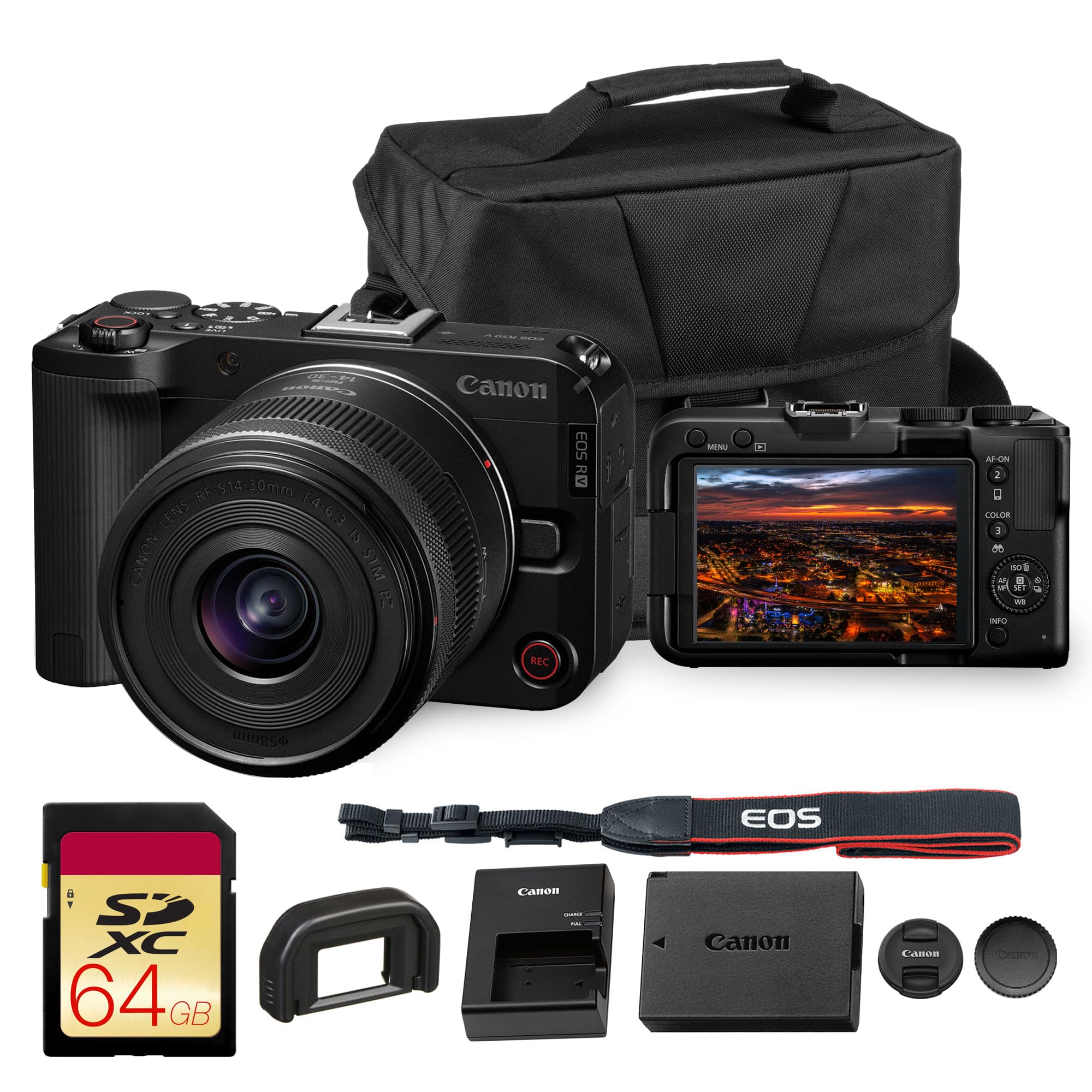
The Canon EOS R50 V is a content-focused body that happens to be an excellent compact landscape camera when paired with the RF-S 14-30mm kit lens. The 14mm wide end (22.4mm full-frame equivalent) gives you a spacious field of view that captures dramatic foreground-to-background compositions without needing to stitch panoramas. The 24.2MP APS-C sensor and DIGIC X processor produce detailed 14-bit RAW files that handle exposure recovery well for this price bracket.
The camera is extremely light at 376g body-only, making it one of the most packable options for hikers who prioritize weight savings. The fully articulating screen flips out for composition at awkward angles, and the Dual Pixel CMOS AF with eye tracking ensures sharp focus when including people in your landscape shots. The 14-30mm lens has built-in image stabilization and silent STM autofocus, though the slow f/4-6.3 aperture means you will need a tripod for golden-hour work.
There is no built-in flash or viewfinder, so you rely entirely on the rear LCD for composition. Battery life is around 310 shots, which is typical for compact mirrorless bodies. The lack of weather sealing means you need to be careful around spray or drizzle. Despite these compromises, the R50 V delivers very sharp wide-angle images in a package that disappears into a small bag, and the 4K 30p video with vertical support makes it a dual-purpose tool for video and stills.
Why it’s great
- Ultra-wide RF-S 14-30mm lens included for dramatic landscape perspective
- Very lightweight body ideal for long hikes
- Excellent Dual Pixel AF and DIGIC X processing
Good to know
- No electronic viewfinder
- No weather sealing
- Slow kit lens aperture requires tripod for twilight work
6. Canon PowerShot V1 Hybrid Compact

The Canon PowerShot V1 breaks the point-and-shoot mold with a 1.4-type sensor (larger than typical 1-inch sensors) and a built-in 16-50mm f/2.8-4.5 wide-angle zoom lens (equivalent to roughly 18-55mm). The fast f/2.8 wide end allows better handheld low-light landscape shooting than typical compact cameras, and the larger sensor produces files with more tonal depth than smartphone cameras. The hybrid AF system with 100 autofocus points locks focus quickly even in moderate light.
The built-in cooling fan allows extended 4K video recording without overheating, which is useful if you capture B-roll alongside your stills. The 10-bit Canon Log 3 recording provides a wide dynamic range for video colour grading. For stills, the 22.3MP resolution is sufficient for large prints, and the lens delivers sharp results across the frame when stopped down to f/5.6-f/8, which is typical for landscape work.
The V1 lacks optical image stabilization in the lens, relying on electronic stabilization that works adequately for stills but introduces crop judder in video. There is no built-in flash and no viewfinder — you compose on the rear screen. Battery life is inconsistent depending on whether you use the cooling fan, and the SD card slot sits under the battery door which is inconvenient on a tripod. Still, for a camera that slips into a jacket pocket and captures real RAW files with a proper wide-angle lens, the V1 is a unique urban and travel landscape tool.
Why it’s great
- Large 1.4-type sensor for a compact camera gives better dynamic range
- Fast f/2.8 wide-aperture lens for low-light handheld work
- Built-in cooling fan for long 4K recording sessions
Good to know
- No optical image stabilization in the lens
- No viewfinder or built-in flash
- Battery life can be short with fan engaged
7. Panasonic LUMIX G100 + 12-32mm Lens

The Panasonic G100 is one of the lightest interchangeable-lens cameras you can buy at just 352g including the 12-32mm kit lens. That retractable pancake zoom covers a 24-64mm equivalent range, which is wide enough for most landscape situations and collapses down for effortless packing. The 20MP Micro Four Thirds sensor with no low-pass filter captures fine detail with pleasing colour rendition, and the 5-axis Hybrid IS provides steady framing for handheld compositions.
The built-in microphone with tracking audio is a vlogging feature, but the electronic viewfinder is genuinely useful for landscape composition in bright light. The 49-point contrast-detect autofocus is reliable for static subjects, though it hunts slightly in low contrast scenes. The iA (intelligent auto) mode is accurate enough as a starting point, but full manual control is available as your skills grow. The G100 also supports V-Log L recording, which gives video editors flexibility in colour grading.
The main limitation for landscape work is the 12-32mm lens — it is very compact and optically decent, but it lacks image stabilization. You rely entirely on the body for stabilization. The 4K video recording has a hard time limit that stops after several minutes, which can be frustrating for long timelapses. Battery life is average at around 250 shots. The G100 is best appreciated by hikers who want the absolute minimum weight without sacrificing interchangeable-lens flexibility, and who are willing to invest in a separate ultrawide lens later.
Why it’s great
- Extremely light and compact for effortless hiking carry
- 20MP sensor with good colour reproduction and fine detail
- V-Log L recording for flexible video grading
Good to know
- Kit lens lacks image stabilization
- 4K video recording is time-limited
- Contrast-detect AF can struggle in very low light
8. Canon EOS R100 + RF-S 18-45mm F4.5-6.3 IS STM

The Canon EOS R100 is the smallest and lightest RF-mount camera body available, making it an easy choice for travelers who want APS-C image quality in a truly compact form. The 24.1MP sensor paired with the DIGIC 8 processor delivers sharp 14-bit RAW files that hold reasonable dynamic range for the entry-level price. The RF-S 18-45mm f/4.5-6.3 kit lens gives a 29-72mm equivalent range — wide enough for general landscapes though you lose the ultrawide perspective.
The Dual Pixel CMOS AF with 143 zones and human/animal/vehicle detection locks focus quickly for static scenes, though continuous tracking is limited to 6.5 fps in One-Shot mode which is adequate for moving subjects like flowing water. The 2.36-million-dot electronic viewfinder is surprisingly good for this price level, making composition in bright sunlight straightforward. The compact body also makes it easy to carry a secondary lens like the RF 16mm f/2.8 for wider landscapes without filling your bag.
The R100 lacks a fully articulating screen (it uses a fixed rear display) which makes low-angle compositions more difficult. The 4K video records at up to 24fps with a crop, and the body has no weather sealing. The battery life is rated at about 250 shots. For the price, the R100 is a capable, no-fuss entry into the Canon RF system that delivers clean landscape images as long as you keep expectations realistic about low-light performance and wide-angle coverage.
Why it’s great
- Smallest and lightest RF-mount body for maximum portability
- Very affordable entry into the Canon RF lens system
- Good image quality with capable Dual Pixel AF
Good to know
- Fixed LCD screen limits creative composition angles
- No weather sealing for wet outdoor use
- 4K video is cropped and limited to 24fps
9. Canon EOS Rebel T7 + 18-55mm Kit
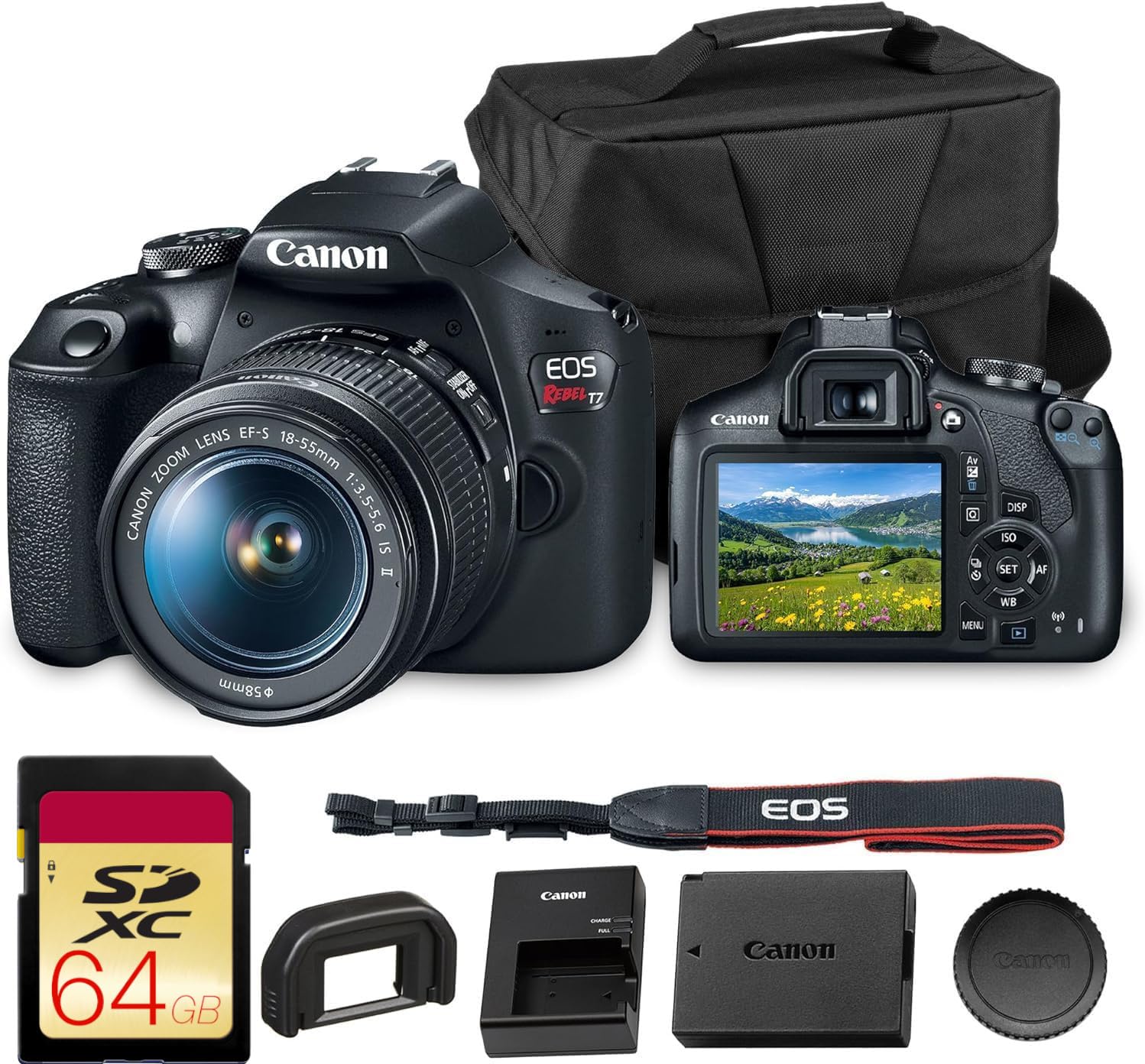
The Canon Rebel T7 is the most affordable DSLR in this lineup and serves as a reliable entry point for learning landscape photography fundamentals. The 24.1MP APS-C sensor produces images with the same resolution as much more expensive cameras, and the 14-bit RAW files provide decent shadow recovery latitude when you properly expose toward the right. The 18-55mm f/3.5-5.6 kit lens covers basic wide-angle to portrait range, and you can expand with very affordable used EF-S glass like the 10-18mm f/4.5-5.6 IS STM.
The 9-point autofocus system is basic by modern standards but perfectly functional for stationary landscape subjects. The optical viewfinder gives a direct, lag-free view that many photographers prefer over electronic finders for framing. Built-in Wi-Fi and NFC transmit images to your phone for sharing, though the Canon Camera Connect app interface is slower than modern mirrorless solutions. The battery life is excellent at over 500 shots — enough for a full day in the field without swapping.
The Rebel T7 has no weather sealing, no articulating screen, no 4K video, and no in-body stabilization. The DIGIC 4+ processor is dated and the burst rate is a slow 3 fps. For pure landscape photography where you are setting up on a tripod and composing carefully, none of those missing features ruin the experience. The T7 is best suited for a strict budget where the priority is getting into the Canon EF/EF-S lens ecosystem with the lowest possible initial cost.
Why it’s great
- Very low entry price with access to Canon’s huge EF lens library
- Solid 24.1MP image quality for the price
- Optical viewfinder for direct, real-time composition
Good to know
- No 4K video and slow burst rate
- Fixed screen and no weather sealing
- DIGIC 4+ processor is several generations old
10. Panasonic LUMIX FZ80D Point and Shoot

The Panasonic FZ80D is a bridge camera with a fixed 60x optical zoom lens covering a 20-1200mm equivalent range. That telephoto reach is unique among cameras at this price — you can pick out distant mountain peaks, compress layers of ridges, or photograph wildlife within a landscape scene without carrying multiple lenses. The 18.1MP sensor is small (1/2.3-inch) and does not approach the dynamic range or low-light performance of larger-sensor cameras, but in good light the images are clean enough for social media and small prints.
The POWER O.I.S. stabilization is effective at the telephoto end, keeping handheld shots steady at full 1200mm zoom. The Post Focus feature lets you adjust the focus point after capturing, which is handy for landscape detail shots where you want maximum sharpness on a specific foreground element. The 2.36-million-dot OLED live viewfinder provides a clear view even in bright sun.
The image quality degrades noticeably in low light — the small sensor produces visible noise even at ISO 800, and the lens softens at the long end of the zoom. The camera also lacks Wi-Fi, making image transfer more cumbersome. Battery life is average at about 330 shots, and the zoom motor drains it faster. The FZ80D works well for hikers who need extreme telephoto reach in a single lightweight package and who shoot primarily during daylight hours.
Why it’s great
- 60x optical zoom (20-1200mm) covers ultra-wide to super-telephoto
- Effective stabilization keeps long telephoto shots steady
- Single-lens design eliminates lens-swapping in the field
Good to know
- Small sensor produces visible noise in low light
- No Wi-Fi for easy image sharing
- Battery drains quickly when using the zoom motor
11. Canon EOS 5D Mark IV + EF 24-105mm f/4L II USM

The Canon 5D Mark IV remains a benchmark for landscape photography even years after its release. The 30.4MP full-frame sensor delivers approximately 12 stops of dynamic range at base ISO, which means you can expose for the sky and pull detail out of deep shadows in post-production without noticeable noise. The 61-point AF system with 41 cross-type sensors covers the frame widely, giving you precise focus point placement across the composition. Paired with the EF 24-105mm f/4L IS II USM lens, you have a tough, weather-sealed system that handles all-day outdoor shooting in variable conditions.
The build quality is professional-grade: a magnesium-alloy body with extensive weather sealing, a shutter rated for 150,000 cycles, and dual card slots (CF and SD) for backup storage. The 3.2-inch touchscreen LCD allows quick menu navigation and focus point selection, though it does not articulate for awkward angles. The optical viewfinder provides a bright, uncompromised view of the scene. The built-in GPS geotags every image automatically — a feature landscape photographers appreciate for organizing location-based portfolios.
At 890g body-only, the 5D Mark IV is the heaviest camera in this guide, and the 24-105mm f/4L lens brings the total kit weight to over 1.3kg. The 4K video mode has a 1.7x crop and the files are large (30MB per RAW), requiring fast CF cards. For pure landscape photography, the resolution, dynamic range, and lens ecosystem of the 5D Mark IV are still outstanding, making it the choice for photographers who plan to print large and need maximum flexibility in the edit.
Why it’s great
- Excellent 30.4MP full-frame sensor with wide dynamic range
- Tough, weather-sealed body built for demanding outdoor work
- Massive Canon EF lens library with many affordable landscape primes
Good to know
- Heavy body adds up during long hikes
- 4K video has a significant crop factor
- Relatively low resolution EVF compared to newer mirrorless options
FAQ
How many megapixels do I need for landscape prints?
Is full-frame worth the extra cost for landscape photography?
Can I use vintage lenses on modern mirrorless cameras for landscapes?
What is the best all-in-one zoom lens for landscape hiking?
Should I get a tripod or a camera with IBIS?
Final Thoughts: The Verdict
For most users, the affordable camera for landscape photography winner is the Canon EOS RP because it delivers full-frame dynamic range and resolution at a significantly lower investment than any other full-frame system. The light weight makes it practical for hiking, and the RF mount provides a clear upgrade path to better wide-angle glass. If you need weather sealing and longer battery life for multi-day backcountry trips, the Nikon D7500 is the smarter choice with its rugged build and excellent 18-140mm kit lens. And for the hiker who values the smallest possible system, the Panasonic G85 gives you IBIS, sealing, and an affordable lens ecosystem in a truly compact body.

Mo Maruf
I created WellFizz to bridge the gap between vague wellness advice and actionable solutions. My mission is simple: to decode the research and give you practical tools you can actually use.
Beyond the data, I am a passionate traveler. I believe that stepping away from the screen to explore new environments is essential for mental clarity and physical vitality.