Our readers keep the lights on and my smoothie glass nicely filled. As an Amazon Associate, I earn from qualifying purchases.
The promise of a warm, fresh-baked loaf on command is one of the few kitchen conveniences that consistently delivers exactly what it advertises. But the path to that golden-crusted loaf often gets derailed by a machine that overheats, fails to rise, or simply produces bread that tastes more like the appliance than the ingredients. The real frustration is that most affordable bread machines on the market under-deliver on the very features that make bread-making a joy rather than a chore—namely, consistent temperature control and a non-stick pan that actually lasts.
I’m Mohammad Maruf — the founder and writer behind WellFizz. I’ve spent years analyzing home appliance specs, paying close attention to wattage, pan materials, programmable versatility, and real-world baking results across dozens of bread machine models.
After combing through over 50,000 customer reviews and technical specifications, the field of contenders for the title of best affordable bread machine narrows down to a handful of models that balance feature density with genuine baking reliability.
How To Choose The Best Affordable Bread Machine
A budget-friendly bread machine does not mean you have to settle for mediocre loaves. The key is knowing which components are non-negotiable for consistent baking results, and which features are simply marketing fluff that drives up the price tag without improving outcome.
Pan Material: The Single Most Important Component
The bread pan is the engine of the entire machine. Standard non-stick pans with a PTFE coating lose their release properties after a few months of regular use, leading to loaves that stick and a paddle that becomes impossible to remove. A ceramic non-stick pan—like the ones found in mid-range and premium models—resists scratching better, offers superior heat conductivity, and lasts significantly longer without degrading. If you plan on baking more than once a week, the ceramic pan is worth the premium.
Motor Wattage and Mixing Power
A bread machine with a 550W to 650W motor can handle denser doughs like whole wheat, rye, and gluten-free blends without straining. Lower wattage machines (around 450W) often overheat or require multiple kneading cycles to properly develop gluten, resulting in a denser loaf. The 650W motors are the sweet spot for this category—they deliver enough torque to knead thoroughly without excessive noise or vibration.
Programmable Cycles vs. Preset Quantity
Many manufacturers boast 19 or 29 presets, but in practice most users cycle through the same 4 or 5 settings: basic white, whole wheat, gluten-free, dough, and jam. The real value comes from having a customizable “homemade” cycle where you can adjust knead time, rise duration, and bake temperature. This feature alone turns an entry-level machine into a versatile tool that can accommodate non-standard flours and personal recipe experiments.
Delay Timer and Keep-Warm Function
A 13- to 15-hour delay timer is standard across most affordable machines, but the keep-warm function duration varies. A 60-minute keep-warm feature ensures your bread stays at the optimal serving temperature without drying out, which is particularly useful for those who set the timer overnight. A longer keep-warm window gives you more flexibility without the bread sitting in a cooling chamber for hours.
Physical Stability and Noise Level
Affordable bread machines tend to be lighter, and a lightweight machine can “walk” across the counter during the kneading cycle, especially with a thick dough. Look for models that weigh at least 9 pounds—the added heft keeps the machine planted. Noise level is another subtle differentiator; a machine with a brushless motor will run noticeably quieter than one with a standard brushed motor, which is important if you plan on using the delay timer while sleeping.
Quick Comparison
On smaller screens, swipe sideways to see the full table.
| Model | Category | Best For | Key Spec | Amazon |
|---|---|---|---|---|
| KBS 19-in-1 | Mid-Range | Precision & Custom Baking | 650W, Ceramic Non-Stick Pan | Amazon |
| KITCHENARM 29-in-1 | Mid-Range | Most Programs & Recipes | 29 Menus, 2-Year Warranty | Amazon |
| Briskind BM8206 | Mid-Range | Quiet Operation & Glass Panel | 600W, Ceramic Pan, Glass Touch | Amazon |
| KOVIET 25-in-1 | Mid-Range | Dual Dispensers & Convection | 650W, Dual Dispenser, Convection | Amazon |
| Starfrit 024707 | Mid-Range | Nut Dispenser & Simple Controls | 550W, Automatic Nut Dispenser | Amazon |
| Hamilton Beach 29987 | Budget | Compact Kitchens & Express Loaves | 2 lbs Capacity, 14 Settings | Amazon |
| Elite Gourmet EBM8103B | Budget | Best Entry-Level Value | 19 Presets, Dishwasher Safe Pan | Amazon |
In‑Depth Reviews
1. KBS 19-in-1 Programmable Bread Maker

The KBS 19-in-1 is the closest you can get to premium build quality without leaving the mid-range price bracket. Its 650W motor, combined with a 360° planetary mixing paddle and a 316 stainless steel body, provides the kind of torque and stability usually reserved for machines costing twice as much. The ceramic non-stick pan, treated at 3,000°F, conducts heat evenly and resists the scratching that plagues standard non-stick pans after repeated use.
Baking performance is its strongest argument. The 4-season constant temperature system ensures the interior stays at 100°F during fermentation, regardless of your kitchen’s ambient temperature—this alone reduces the failure rate of sourdough and whole wheat recipes dramatically. The 15-minute power interruption recovery is another practical touch; a brief power flicker won’t ruin a 3-hour cycle.
On the downside, the housing is relatively thin, and the machine can shift slightly during kneading unless placed on a non-slip mat. The touch buttons, while responsive, lack tactile feedback, and the included recipe book could be more detailed for advanced bakers. But for anyone who wants consistent results across gluten-free, sourdough, and artisan loaves, this machine sets a new standard in its tier.
Why it’s great
- 650W motor handles dense doughs without strain
- Ceramic non-stick pan is durable and releases loaves cleanly
- Customizable fully programmable mode for every baking stage
- Power backup resumes cycle after short interruptions
Good to know
- Thin housing may allow machine to move during kneading
- Recipe book lacks depth for experienced bakers
- Nut dispenser can be noisy when engaging
2. KITCHENARM 29-in-1 SMART Bread Machine

KITCHENARM goes beyond the numbers game by making its 29 programs genuinely useful. Beyond the usual gluten-free, sourdough, and whole wheat settings, it includes dedicated Salt Free and Sugar Free cycles that modify the rise and bake times to compensate for the missing structural ingredients. The machine also supports all-purpose flour in its recipes, not just high-gluten bread flour—a rare admission that most home bakers use what they have in the pantry.
The headline feature is the ability to save up to four fully customized “HOME MADE” menus, each with its own knead, rest, rise, and bake timings. This level of granularity is something I usually see only in commercial or prosumer models. The 2.5-inch LCD display is large and legible, and the ETL certification with a 3-prong grounding plug provides genuine electrical safety.
Where it loses ground to the KBS is in pan material—the KITCHENARM uses a food-grade Teflon-coated pan rather than ceramic. While it works well initially, the coating is more prone to wear over time, especially if you use metal utensils. The pan is also narrower and taller, making loaf removal slightly awkward when hot. Still, for the sheer breadth of settings and a recipe book with 77 tested recipes, this machine is a fantastic choice for adventurous home bakers.
Why it’s great
- 29 programs including salt-free, sugar-free, and keto cycles
- Four fully customizable HOME MADE menus
- 2-year warranty with lifetime customer support
- Works with all-purpose flour, not just bread flour
Good to know
- Teflon-coated pan may wear faster than ceramic
- Taller, narrower basket can make removal tricky
- Cleaning the tight corners around the pan requires care
3. Briskind Bread Maker Machine BM8206

The Briskind BM8206 differentiates itself through a design philosophy that prioritizes user experience over raw feature count. Its slightly angled glass touch panel with white backlit LCD is genuinely easier to read and interact with than the vertical or flat panels found on most competitors. The machine is also notably heavier and more stable than its price point suggests—at roughly 11 pounds, it stays planted during kneading even with thick whole wheat doughs.
The ceramic non-stick pan is the star here. It is a horizontal pan, which produces a traditionally shaped loaf rather than a vertical tower, and the ceramic coating is PTFE, PFOA, and PFAS-free. The paddle is easy to attach and remove, and the built-in smart sensor for internal temperature during fermentation makes seasonal baking far more predictable. The 15-minute power failure backup and mute alert beeps are thoughtful additions that many mid-range machines neglect.
The trade-off is that the Briskind lacks an automatic nut and fruit dispenser—it uses an audible chime to remind you to add ingredients manually. The chime itself is on the quiet side, which may be missed in a noisy kitchen. Additionally, the ceramic pan, while excellent, requires hand washing to preserve its coating. For bakers who value a quiet, stable machine with a premium feel and consistent results, the BM8206 is a top contender.
Why it’s great
- Heavy stainless steel body stays stable during kneading
- Ceramic non-stick pan releases loaves easily
- Angled glass touch panel is intuitive and easy to read
- Smart temperature sensor improves fermentation consistency
Good to know
- No automatic nut/fruit dispenser
- Add-reminder chime is quiet
- Ceramic pan requires hand washing for longevity
4. KOVIET 25-in-1 Bread Maker Machine

The KOVIET 25-in-1 stands out for its dual automatic ingredient dispensers—a feature typically found on machines that cost significantly more. Two separate compartments release ingredients at the optimal moment based on the adaptive temperature control, which means you can load in seeds, nuts, dried fruit, and even chocolate chips at the start without worrying about them being crushed or over-mixed. This alone makes it the most convenient option for bakers who regularly add mix-ins.
The 650W brushless motor is noticeably quieter than the brushed alternatives, and the claimed convection airflow system (which circulates heated air around the baking chamber) promotes more even browning. The 13-hour delay timer and 1-hour keep-warm function are standard, but the 10-minute power-off recovery adds an extra layer of reliability. The machine also handles gluten-free and whole wheat recipes well, thanks to the higher torque motor.
However, the KOVIET has some usability quirks. The control panel lacks a backlight, making it difficult to read in low light, and the nut/fruit dispenser lids do not auto-close, so you have to remember to shut them manually. There is also no interior light to check on the bread’s progress. For the price, these omissions are minor, but they prevent the machine from being a perfect all-rounder. If dual dispensers and a quiet motor are your priorities, this is a strong contender.
Why it’s great
- Dual automatic dispensers for nuts, seeds, and fruit
- 650W brushless motor runs quietly and efficiently
- Convection airflow for even browning
- Power-off recovery resumes cycle after short outages
Good to know
- Control panel has no backlight
- Dispenser lids do not auto-close
- No interior light to view baking progress
5. Starfrit Electric Bread Maker 024707
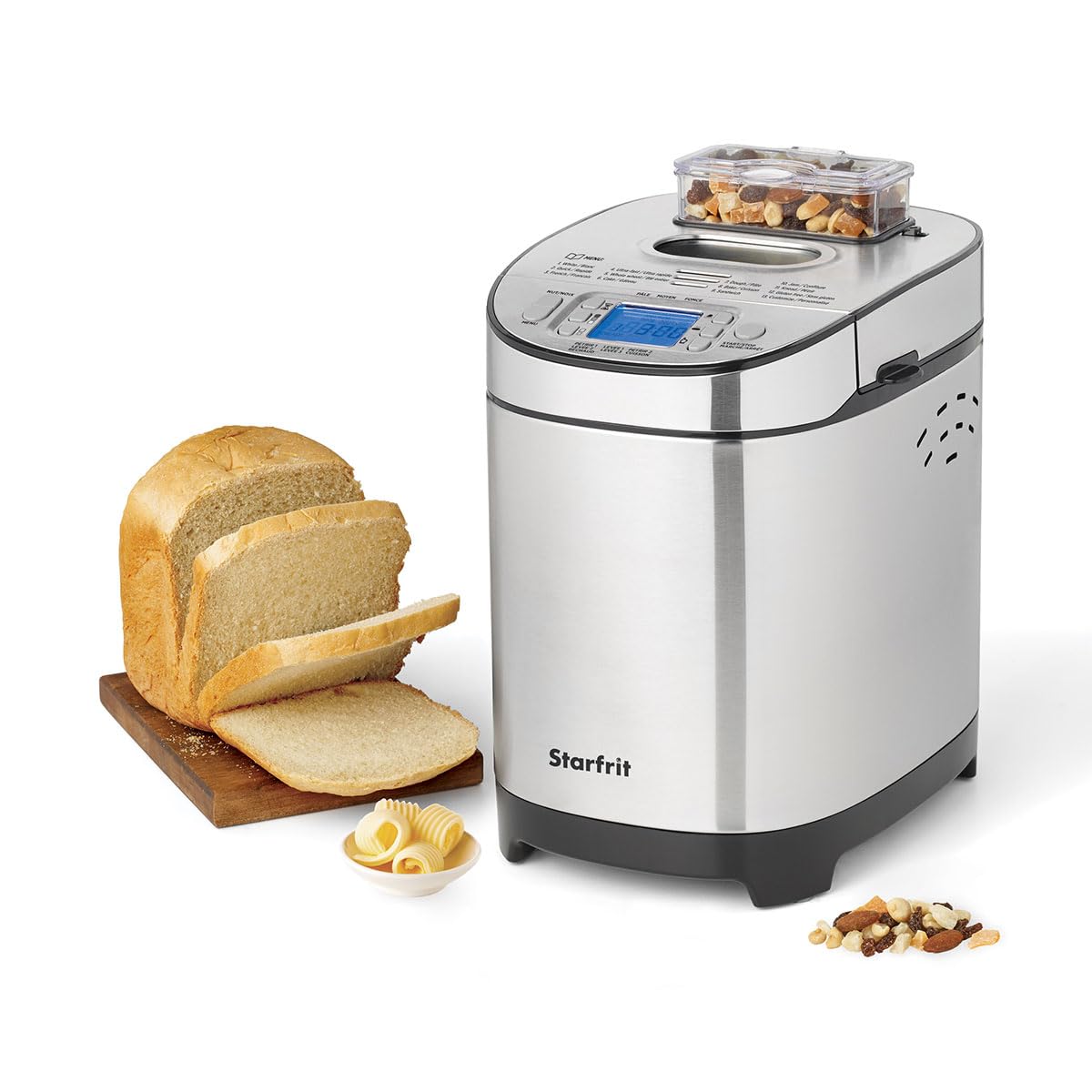
Starfrit’s 024707 is a straightforward machine that focuses on doing the essentials well: consistent baking, easy cleanup, and reliable mix-ins. The 550W motor is adequate for standard white and whole wheat loaves, though it can struggle slightly with very dense gluten-free doughs compared to the 650W alternatives. The removable non-stick baking pan and single kneading blade make cleanup fast, and the automatic nut dispenser is a genuine time-saver for those who add seeds or dried fruit to every loaf.
The 13 preset programs cover the most common needs—white, quick, French, gluten-free, and dough—and the 13-hour delay timer offers enough flexibility for overnight bakes. The large viewing window gives a good visual on the baking progress, and the three crust color options let you dial in your preference. Users report that the machine produces consistently good results with a simple, repeatable process.
The main criticism from long-term owners is that the machine is relatively light (8.68 pounds) and can walk during the kneading cycle if not placed on a grippy surface. The 550W motor also means the express loaf cycles can produce a denser crumb than you’d get with a higher-wattage machine. But for someone who wants a reliable workhorse for everyday white and wheat bread without fussing over customization, the Starfrit delivers dependable value.
Why it’s great
- Automatic nut dispenser for hands-off mix-ins
- Removable non-stick pan and single paddle simplify cleanup
- Large viewing window to monitor baking progress
- Simple controls are easy to master quickly
Good to know
- Lightweight build may shift during kneading
- 550W motor is less effective with dense doughs
- Vertical loaf shape may not suit all preferences
6. Hamilton Beach Digital Electric Bread Maker 29987

The Hamilton Beach 29987 is the most compact machine on this list, making it ideal for kitchens with limited counter space. At just over 9 pounds and with a smaller footprint than most, it still manages to produce loaves up to 2 pounds. The 14 settings include dedicated cycles for artisan dough, gluten-free, and even a jam program, which adds surprising versatility for such a compact unit.
One of its best features is the Express cycles for 1 lb, 1.5 lb, and 2 lb loaves, which can produce a finished loaf in under two hours. These shorter cycles sacrifice some crust development and crumb structure, but for a quick weekday sandwich loaf, they are perfectly adequate. The removable non-stick pan and paddle are dishwasher safe, which is a welcome convenience after a messy bake session.
The biggest drawbacks are noise and stability. The machine is prone to walking during the kneading cycle due to its light weight, and the motor is notably loud compared to the KBS and Briskind models. Some users also reported an initial chemical smell that dissipates after an empty pre-bake cycle. The lid is also somewhat short—taller 2 lb loaves can touch the top during the final rise. For the price, however, these are manageable trade-offs for a compact and competent machine.
Why it’s great
- Compact footprint fits small kitchens
- Express cycles produce bread in under 2 hours
- Dishwasher-safe pan and paddle for easy cleanup
- Versatile settings including jam and artisan dough
Good to know
- Lightweight and can vibrate across the counter
- Loud motor during kneading cycles
- Initial chemical smell requires a pre-bake
7. Elite Gourmet Programmable Bread Maker EBM8103B

The Elite Gourmet EBM8103B is the true budget champion of this lineup, offering 19 presets at an entry-level price that is hard to beat. The aluminum pan with non-stick coating is dishwasher safe, which is a rarity at this price point and a significant convenience for daily bakers. The 15-hour delay timer and 60-minute keep-warm function match the specs of machines costing nearly double, making it a remarkably feature-dense package for the money.
Baking results are solid for standard white, wheat, and even gluten-free loaves. The 2 lb capacity gives you flexibility across three loaf sizes, and the 19 prests include dedicated cycles for gluten-free, dough, and jam. The included recipe book is beginner-friendly, and the machine’s compact dimensions (9.45 x 11.89 x 13.98 inches) mean it won’t dominate your countertop. The ceramic pan paddle is easy to remove, and the interior is simple to wipe down.
The trade-offs are primarily in build quality. The aluminum pan, while functional, does not conduct heat as evenly as a ceramic pan, which can lead to slightly uneven browning on the sides versus the top. The motor is also not as robust as the 650W models—it handles standard doughs well but can struggle with thick buckwheat or heavy rye blends. For a first-time bread maker owner or someone who bakes once or twice a week, the Elite Gourmet delivers exceptional value without frustrating the user.
Why it’s great
- 19 presets at an entry-level price
- Dishwasher-safe aluminum pan and paddle for easy cleaning
- Compact footprint fits small counters
- 15-hour delay timer and 60-minute keep-warm
Good to know
- Aluminum pan heats less evenly than ceramic
- Motor has limited power for very dense doughs
- Some users report small loaf volume for 2 lb setting
FAQ
Do I need a bread machine with a ceramic non-stick pan?
Why does my bread machine produce a short dense loaf?
How much power does a bread machine use per loaf?
What is the difference between a 1 lb, 1.5 lb, and 2 lb loaf setting?
Final Thoughts: The Verdict
For most users, the best affordable bread machine winner is the KBS 19-in-1 Programmable Bread Maker because it combines a 650W motor, ceramic non-stick pan, and fully customizable cycles at a price that undercuts the premium competition. If you want the most program variety and a 77-recipe book to explore, grab the KITCHENARM 29-in-1 SMART Bread Machine. And for quiet operation with a premium glass touch panel, nothing beats the Briskind BM8206.

Mo Maruf
I created WellFizz to bridge the gap between vague wellness advice and actionable solutions. My mission is simple: to decode the research and give you practical tools you can actually use.
Beyond the data, I am a passionate traveler. I believe that stepping away from the screen to explore new environments is essential for mental clarity and physical vitality.