Our readers keep the lights on and my smoothie glass nicely filled. As an Amazon Associate, I earn from qualifying purchases.
Dialogue that gets buried, explosions that lack punch, and a soundstage that feels flat—these are the pains of relying on TV speakers or a cheap soundbar for your home theater. Building a true 5.1 surround sound system without draining your savings requires separating the kits that deliver genuine immersion from those that just add boxes to your room.
I’m Mohammad Maruf — the founder and writer behind WellFizz. I’ve spent years analyzing the performance metrics, amplifier specs, and real-world trade-offs of thousands of audio products to help you find the exact system that makes movies, music, and games feel alive.
Whether you value dialogue clarity for late-night viewing or want thunderous bass for action films, this guide breaks down the best components and all-in-one solutions for the best affordable 5.1 surround sound system.
How To Choose The Best Affordable 5.1 Surround Sound System
Picking the right system starts with understanding the three main routes: buying individual passive speakers plus a receiver, grabbing an all-in-one powered kit with a built-in amp, or choosing a soundbar with dedicated rear speakers and subwoofer. Each path has different implications for sound quality, expandability, and ease of setup.
Passive Components vs. All-in-One Kits
Passive speakers (like the Polk Signature Elite series) require a separate AV receiver to power them. This route offers the best sound quality, upgradeability, and resale value, but it demands more planning, wiring, and budget allocation for the receiver. All-in-one kits (like the Bobtot systems) include the receiver inside the subwoofer and come with everything needed out of the box. They are simpler and cheaper but limit your ability to swap out individual speakers down the road. Soundbar-based systems (like the Hisense or Samsung) compromise on sound separation compared to true discrete speakers but offer the cleanest installation with the least visible wiring.
Dolby Atmos and Height Channels
A 5.1 system by default handles five satellite channels plus a subwoofer. True Dolby Atmos requires additional height channels—represented in models as 5.1.2 or 5.1.4. The systems in this guide use either up-firing drivers in the soundbar or dedicated rear speakers with upward-angled tweeters to bounce sound off the ceiling. Systems without these drivers can still decode Atmos signals and apply virtual processing, but the overhead effect will be less convincing. If ceiling height or material is non-standard, consider a system with physically angled rear speakers instead of relying on reflected audio.
Power Ratings and Amplifier Quality
Peak power ratings (like 1200W or 760W) are marketing numbers that measure instantaneous bursts. Continuous power (RMS) is the metric that indicates how loud a system can play without distortion. System sensitivity, measured in dB, tells you how efficiently speakers convert power into volume. Higher sensitivity (87dB and above) helps budget receivers drive the system to reference levels. For the most accurate comparison, look for systems that list RMS wattage for each channel or the total RMS output.
Wired vs. Wireless Rear Speakers
Wireless rear speakers connect to the subwoofer or main soundbar via radio frequency rather than long speaker wires. True wireless rear speakers still need a power cord to each speaker, so they are not completely cordless—they just eliminate the unsightly channel cable running across your room. Systems with wired rears offer more robust audio quality because no wireless compression is involved and they can be placed further from the subwoofer without signal drop. Ensure wireless rear systems use 5GHz transmission for stability, especially in homes with congested 2.4GHz networks.
Quick Comparison
On smaller screens, swipe sideways to see the full table.
| Model | Category | Best For | Key Spec | Amazon |
|---|---|---|---|---|
| ULTIMEA Skywave X50 | Soundbar System | Cinematic immersion | 5.1.4ch, 8″ sub, 28Hz bass | Amazon |
| ULTIMEA Skywave X40 | Soundbar System | True Atmos on budget | 5.1.2ch, 530W peak, GaN amp | Amazon |
| Amazon Fire TV Soundbar Plus | Soundbar System | Fire TV integration | 5.1ch, wireless rears | Amazon |
| Samsung Q-Series HW-Q600F | Soundbar System | Q-Symphony TV sync | 3.1.2ch, AI sound optimization | Amazon |
| Hisense AX5140Q | Soundbar System | Versatile EQ presets | 5.1.4ch, 6.5″ wireless sub | Amazon |
| Polk Signature Elite ES35 | Center Speaker | Dialogue clarity upgrade | Slim design, six 3″ woofers | Amazon |
| Polk Signature Elite ES10 | Surround Pair | Timbre-matched surround | 4″ woofer, Power Port tech | Amazon |
| Logitech Z906 | PC System | Desktop gaming | THX, 500W continuous | Amazon |
| Bobtot Home Theater System | All-in-One Kit | Budget entry-level | 10″ sub, LED lights, karaoke | Amazon |
In‑Depth Reviews
1. ULTIMEA Skywave X50 5.1.4ch Soundbar System
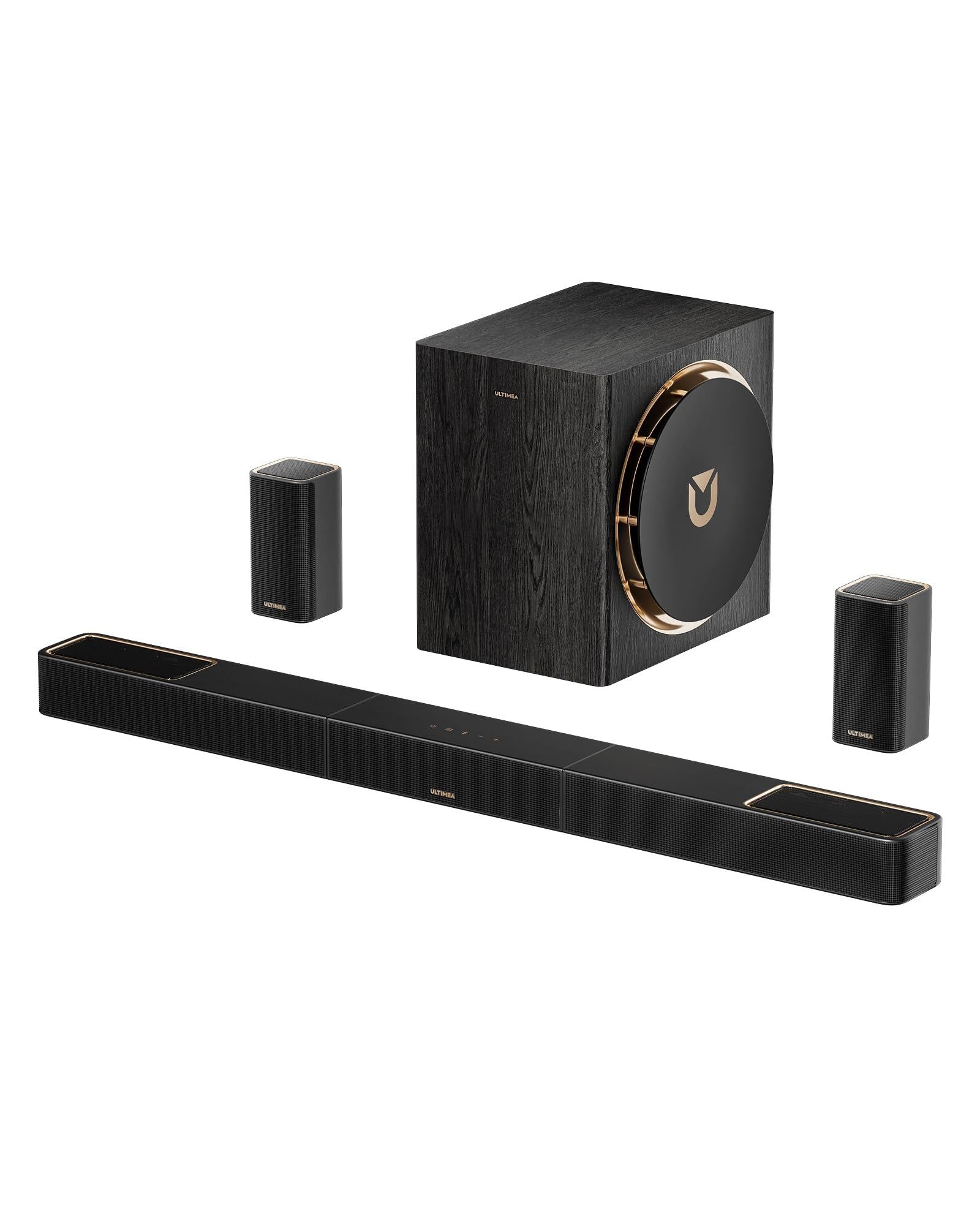
The Skywave X50 is the most complete system in this roundup, delivering true 5.1.4 channel immersion with two wireless surround speakers that include up-firing drivers for overhead effects. The 8-inch subwoofer with Gravus Ultra-Linear Bass Technology hits frequencies down to 28Hz, making floor-shaking explosions a reality without muddying the midrange. Its GaN amplifier pushes 760W peak with over 98% efficiency, meaning the system stays cool even during extended viewing sessions.
Setup is genuinely plug-and-play thanks to dual 5GHz wireless transmission that pairs the surrounds and subwoofer automatically. The NEURACORE multi-channel audio engine processes 24-bit/192kHz signals with less than 0.5% THD, providing clean spatial fidelity that outperforms many soundbars costing twice as much. The wood-crafted subwoofer cabinet and metal grille add a premium aesthetic that blends with modern furniture.
Reviewers consistently praise the deep, clean bass and the effectiveness of the height channels, with several noting it surpasses their previous Samsung flagships. The app provides granular control over EQ presets and individual channel levels, though some users find the hidden display hard to read during setup. For anyone seeking a complete wireless system that delivers true Atmos without a receiver, this is the benchmark.
Why it’s great
- True 5.1.4 height channels with up-firing rear drivers
- 28Hz bass extension from 8-inch subwoofer
- GaN amplifier provides clean power with minimal heat
- Wireless surround speakers eliminate visible channel cables
Good to know
- Power cords still required for each surround speaker
- Display on soundbar is hidden and hard to read
- Optimal height effect requires flat, standard ceiling
2. ULTIMEA Skywave X40 5.1.2ch Soundbar System
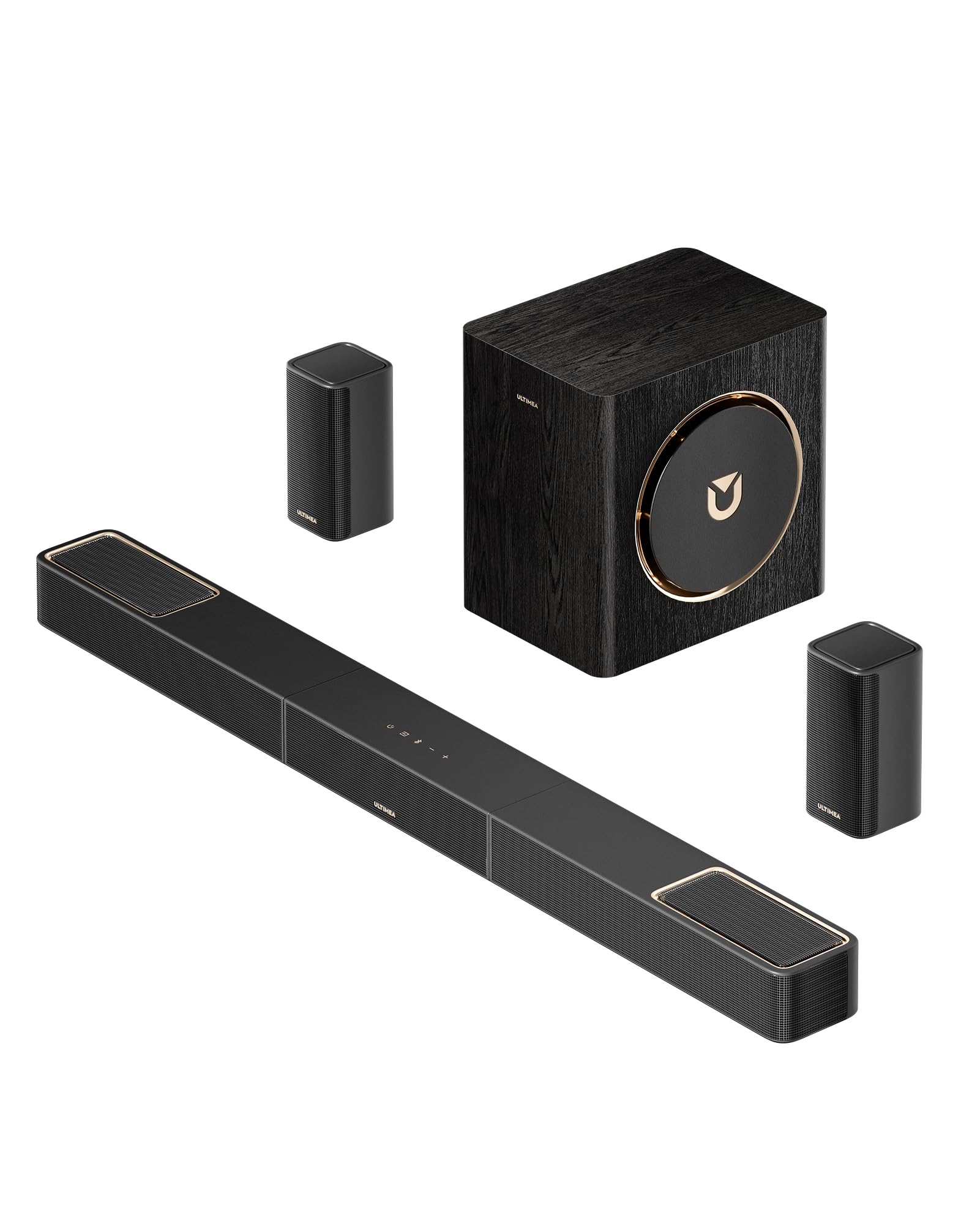
The Skywave X40 is a slightly trimmed-down sibling that keeps the core innovations—GaN amplifier, Gravus bass technology, and wireless 5GHz connectivity—while dropping to a 5.1.2 channel layout with a 6.5-inch subwoofer. The 530W peak power still fills most living rooms effortlessly, and the GaN amp’s 8x faster response time compared to silicon ensures transients like gunshots and door slams have sharp attack without distortion.
This system is ideal for buyers who want genuine Dolby Atmos height effects but don’t need the additional two rear up-firing channels of the X50. The two surround speakers are truly wireless and pair instantly with the soundbar, and the app offers intuitive control over bass, treble, and surround levels. Setup takes under five minutes out of the box, with HDMI eARC handling all TV communication through a single cable.
Customer feedback highlights the clear dialogue, deep bass extension down to 35Hz, and the seamless integration with universal remotes via eARC. The rose gold accents and wood-crafted subwoofer give it a refined look that punches above its price tier. The surround speakers, while effective for ambient effects, lack low-frequency headroom compared to wired alternatives. This is the sweet spot for buyers prioritizing value per channel.
Why it’s great
- GaN amplifier provides distortion-free audio at high volumes
- Wireless surround speakers with 5GHz stable transmission
- 35Hz bass extension from compact subwoofer
- App-based control with multiple EQ presets
Good to know
- Surround speakers lack low-frequency headroom
- App can occasionally lose Bluetooth connection
- No up-firing drivers in rear surrounds
3. Amazon Fire TV Soundbar Plus 5.1 System

Amazon’s own 5.1 channel system integrates seamlessly with Fire TV devices, allowing you to adjust sound modes directly from the Fire TV interface. The dedicated center channel driver provides a five-level dialogue boost that makes voices cutting through even dense action scenes, a critical feature for households where subtitle dependency is a pain point. The wireless subwoofer and rear speakers pair automatically with the soundbar upon powering up.
The system supports Dolby Atmos and DTS:X decoding, though it relies on virtual processing since there are no physical up-firing drivers. This means the overhead effect is subtle but the surround imaging from the discrete rear speakers creates a convincing wraparound bubble. The included HDMI cable handles eARC audio return and 4K HDR passthrough, keeping your setup clean. Movie, Music, Sports, and Night modes tailor the sound profile to your content.
Users report dramatic improvements in dialogue clarity compared to previous soundbars, and the system draws minimal power, making it viable for RVs and off-grid setups. The subwoofer requires 12 inches of clearance from walls for optimal bass response. At full retail price, the feature set feels sparse compared to competitors with height channels, but on discount, it is a compelling option for Fire TV loyalists.
Why it’s great
- Five-level dialogue boost with dedicated center channel
- Seamless Fire TV remote integration
- Low power draw suitable for RVs and tiny homes
- Pre-paired wireless surround speakers
Good to know
- No up-firing drivers for physical Atmos height effects
- Subwoofer needs 12-inch clearance for best bass
- Full price lacks features compared to competition
4. Samsung Q-Series HW-Q600F 3.1.2ch Soundbar
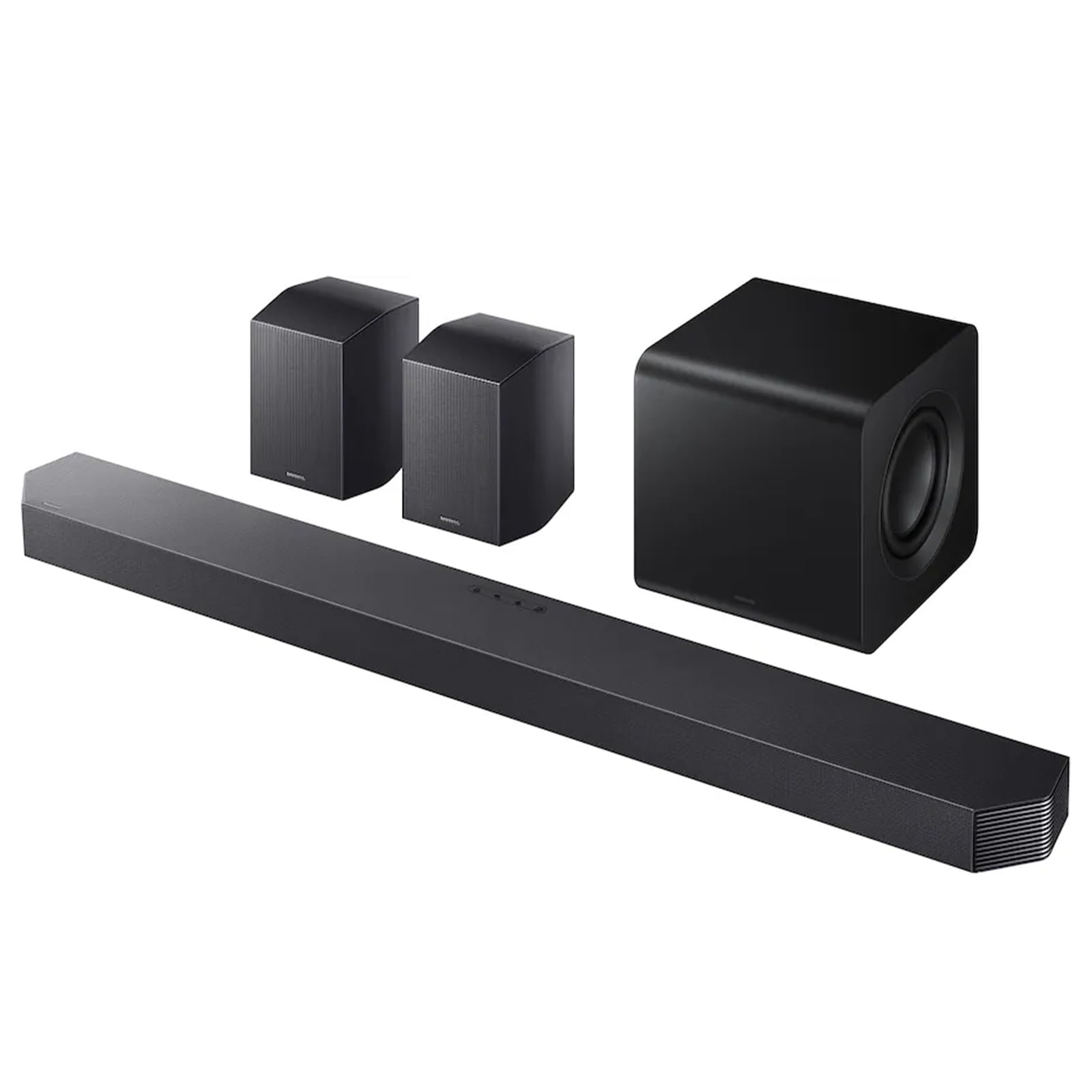
While technically a 3.1.2 channel configuration, the HW-Q600F earns its place among 5.1 systems by supporting wireless rear speaker expansion (sold separately) and using Samsung’s Q-Symphony technology to synchronize with compatible Samsung TV speakers for a wider soundstage. The two up-firing channels deliver genuine Dolby Atmos height effects, and the AI-powered Adaptive Sound optimizes EQ in real-time based on the content being played.
Game Pro Mode is a standout feature for console gamers—when the soundbar detects a game console, it automatically switches to a mode that emphasizes directional audio cues, making footsteps and environmental sounds more distinct. The SpaceFit Sound calibration analyzes room acoustics and adjusts bass response and channel timing for a optimized listening position. The wireless subwoofer is engineered by Harman Kardon and produces tight, musical bass that integrates well with the soundbar’s drivers.
Customers note that the system gets incredibly loud—volume level 7 on the soundbar equals what they previously used at 50-60 on their TV speakers. Setup requires some patience, but once configured, the single-remote control via Samsung TV remote simplifies daily use. The Q-Symphony effect is genuinely useful for filling larger rooms, but the system reaches its full potential only when paired with a Samsung TV and optional rear speakers.
Why it’s great
- Q-Symphony uses TV speakers for wider soundstage
- Game Pro Mode enhances directional audio for gaming
- SpaceFit Sound calibrates EQ to room acoustics
- Harman Kardon subwoofer provides musical bass
Good to know
- Rear speakers sold separately for true 5.1
- Best features require Samsung TV compatibility
- Setup requires more initial configuration than rivals
5. Hisense AX5140Q 5.1.4ch Soundbar
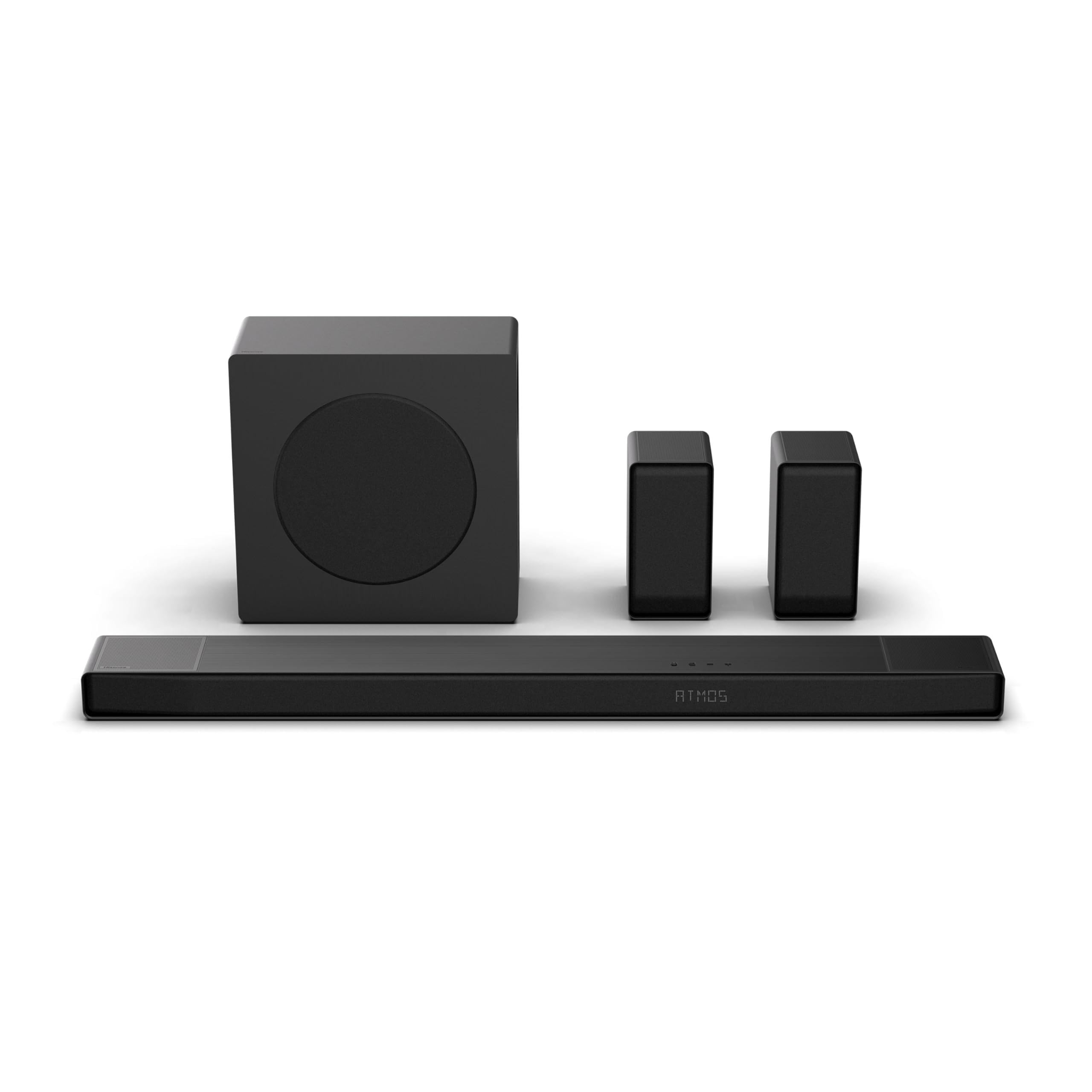
The Hisense AX5140Q delivers a rare 5.1.4 channel count at mid-range pricing, with six front-firing drivers, two up-firing drivers for height channels, and four surround speakers. The wireless 6.5-inch subwoofer digs down to 40Hz, providing solid low-end extension for action movies without dominating the room. The seven Quick Touch EQ modes let you instantly switch between Music, Movie, News, and other presets from the remote.
One of the most useful features is the built-in Room Calibration, which analyzes your seating position and adjusts the timing and level of each channel to compensate for room irregularities. HDMI eARC simplifies connectivity with a single cable that carries uncompressed Dolby Atmos and DTS:X audio while also handling 4K HDR passthrough. Bluetooth 5.3 ensures stable wireless streaming from your phone or tablet with minimal latency.
Reviewers consistently note the excellent dialogue clarity and the immersive effect of the height channels, though the rear speakers are less powerful than the main bar and may feel underpowered in large rooms. The subwoofer’s wireless connection is rock solid, and the system pairs seamlessly with Hisense TVs. The minimalist design with rounded corners and black matte finish fits well under most wall-mounted TVs.
Why it’s great
- 5.1.4 channel layout with dedicated up-firing drivers
- Room Calibration optimizes sound for your seating position
- Seven EQ presets for instant tuning
- Wireless subwoofer with 40Hz bass extension
Good to know
- Rear speakers may be underpowered in large rooms
- Surround effect less compelling than wired alternatives
- Bluetooth audio can occasionally glitch with iPhones
6. Polk Signature Elite ES35 Slim Center Channel Speaker

If you are building a component-based system and dialogue clarity is your priority, the Polk ES35 is the center channel to anchor your setup. Its slim profile—about 4.5 inches tall—fits under most TVs without blocking the IR sensor, yet it houses six 3-inch woofers alongside a 1-inch Terylene tweeter in a Dynamically Balanced Array. Polk’s patented Power Port technology extends low-frequency response and reduces port noise, ensuring voices stay natural even at higher volumes.
The ES35 is timbre-matched to the entire Signature Elite series, meaning it blends seamlessly with the ES10 surrounds and ES60 tower speakers for a cohesive front soundstage. Its high sensitivity and 4- and 8-ohm compatibility make it easy to drive with budget-friendly AV receivers. The rear port design allows flush wall placement, and the magnetic grille attaches cleanly for a polished look.
Buyers consistently praise the ES35’s ability to render British drama dialogue without subtitles—a real-world test of center channel performance. The six-driver array provides exceptional headroom for center channel information, which carries about 75 percent of a movie’s audio. Some users note that the plastic enclosure feels less premium than Polk’s older models, but the acoustic performance more than compensates. This is the single best upgrade for anyone struggling with dialogue intelligibility.
Why it’s great
- Six 3-inch woofers provide outstanding vocal clarity
- Slim design fits under most TVs without blocking sensors
- Power Port delivers clean, extended low-end
- Timbre-matched to Polk Signature Elite series
Good to know
- Plastic cabinet may feel less premium than alternatives
- Requires an AV receiver for power (not self-powered)
- Needs 20-30 hours of break-in for optimal performance
7. Polk Signature Elite ES10 Surround Speaker Pair

The ES10 bookshelf speakers serve as the ideal side or rear surrounds in a Polk Signature Elite setup. Each speaker pairs a 1-inch Terylene tweeter with a 4-inch woofer in a ported cabinet that uses Polk’s Power Port technology to deliver 3dB louder bass than conventional ported speakers of the same size. This means you get fuller sound from smaller cabinets, which is critical for surround channels that often lack low-end weight.
With a sensitivity that works well with both 4- and 8-ohm amplifiers, these speakers integrate easily with a wide range of AV receivers. The keyhole slots and screw inserts provide flexible wall-mounting options, allowing you to fire the speakers toward the listening position with precision. When combined with the ES35 center and ES60 towers, the entire system is timbre-matched for seamless panning effects across the soundstage.
User feedback highlights the clean, neutral sound signature that works well for both movies and music. The Power Port does produce noticeably fuller bass than competitors in the same size class, though these speakers still roll off below 80Hz and rely on a subwoofer for true low-end impact. The vinyl wood-grain finish is the only aesthetic compromise—the acoustic performance is genuinely impressive at this tier.
Why it’s great
- Power Port delivers 3dB louder bass than conventional designs
- Timbre-matched to Polk Elite series for seamless blending
- Keyhole slots and screw inserts for flexible wall mounting
- Neutral, clean sound works for movies and music
Good to know
- Bass rolls off below 80Hz—subwoofer required
- Vinyl wood-grain finish feels budget-level
- No mounting brackets included in the box
8. Logitech Z906 5.1 Surround Sound Speaker System

The Logitech Z906 is a long-established benchmark for PC-based 5.1 audio, with THX certification that guarantees a minimum level of fidelity and 500 watts of continuous power (1000W peak) across five satellites and a down-firing subwoofer. The system connects up to six devices via digital optical, coaxial, RCA, and three 3.5mm inputs, making it incredibly versatile for gamers who want simultaneous connection to their PC, console, and TV.
The control console and infrared remote provide independent volume control for each satellite and the subwoofer, along with input selection and effects modes like 3D Stereo and 4.1. The subwoofer is massive and heavy, producing room-shaking bass that can fill a small living room or large office. The satellites are wall-mountable and include metal grilles for protection against accidental damage.
The included speaker wires are thin and short, and many users upgrade them for better performance in larger rooms. The amplifier module runs hot even at idle, as there is no external heatsink. This is a proven workhorse for desktop setups, not a living room home theater component system.
Why it’s great
- THX certification guarantees cinema-quality sound
- 500W continuous power handles dynamic peaks easily
- Six device inputs accommodate multi-source setups
- Independent channel-level adjustment from the remote
Good to know
- Amplifier runs hot even at idle—ventilation required
- Included speaker wire is thin and short for larger rooms
- No mounting brackets or stands included
- Limited low-end below 15kHz for treble detail
9. Bobtot 5.1 Channel Surround Sound System
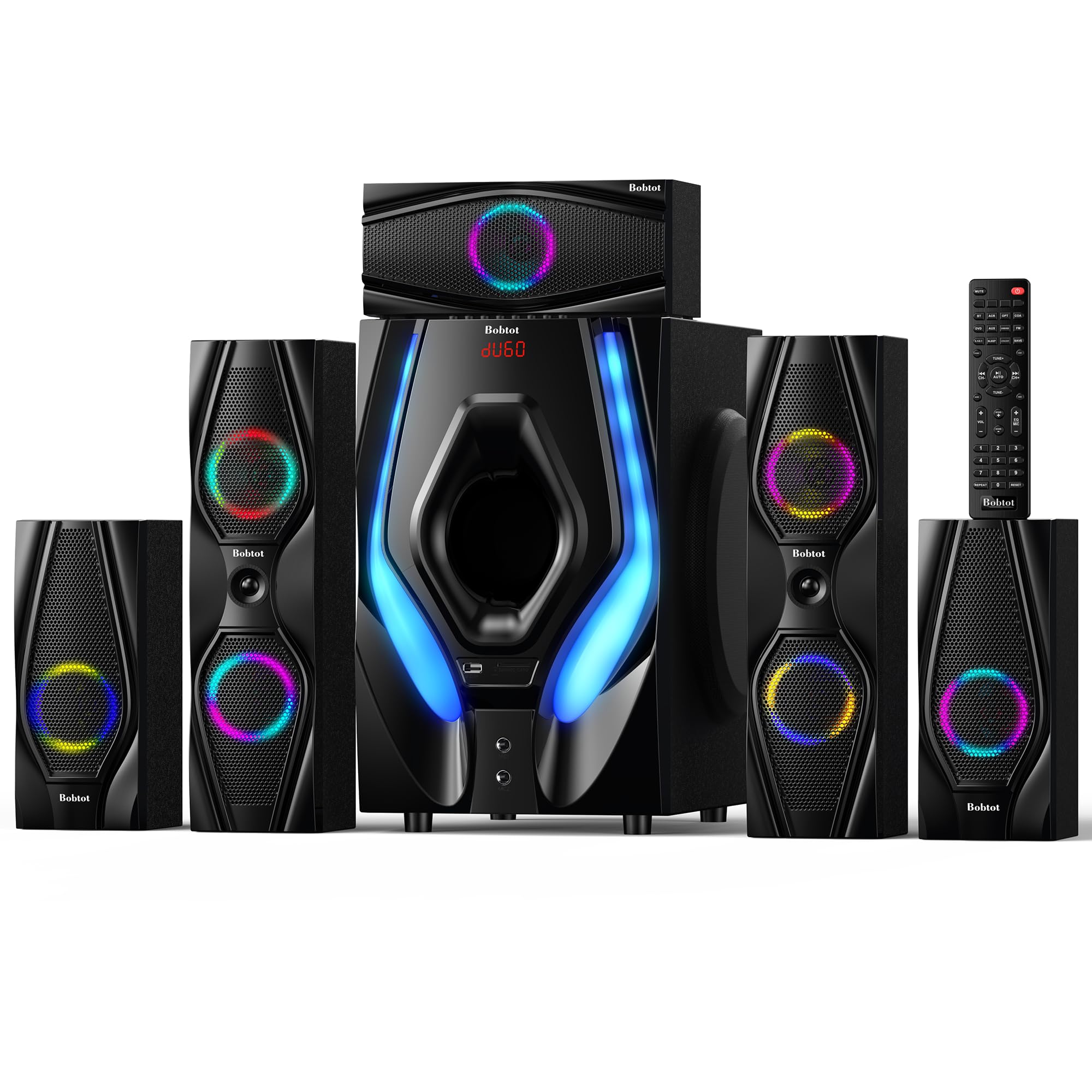
The Bobtot system is an all-in-one kit that packs a 10-inch subwoofer with a built-in receiver, five satellite speakers, and a center channel into a single purchase. The 1200W peak power rating drives the system to high volumes suitable for parties, and the LED ambient light effects on the subwoofer add a visual element that syncs with the beat. The two 1/4-inch microphone inputs with echo control turn the system into a karaoke machine for family gatherings.
Connectivity is comprehensive for the price: Bluetooth 5.3, ARC, optical, coaxial, AUX, USB, and SD card playback are all available. The remote allows independent control of each speaker’s volume, and the system switches between 5.1 and 2.1 channel modes via a button on the subwoofer or remote. The built-in FM radio and digital display add functionality that competing systems simply skip.
Customer feedback reveals a split experience. Many users praise the thunderous bass and the value proposition for under . However, a significant number report reliability issues, including subwoofer failures and wireless connectivity problems that require warranty replacements. Support is handled via email with a two-week turnaround. This system is best viewed as an entry-level party solution where absolute audio fidelity is less critical than sheer loudness and visual flair.
Why it’s great
- 10-inch subwoofer produces powerful, room-shaking bass
- Karaoke capability with dual microphone inputs and echo
- LED light effects with multiple modes sync to music
- Extensive input options including ARC and Bluetooth 5.3
Good to know
- Reliability concerns include subwoofer failures
- Customer support is limited to email with slow response
- Distortion becomes noticeable at very high volumes
- Center channel position can block TV IR sensor
FAQ
Can I add rear speakers to a soundbar system later without replacing anything?
Is a 5.1.4 system worth the extra cost over a standard 5.1 soundbar?
What size subwoofer works best for a 5.1 system in a 300-square-foot room?
Why does my 5.1 system sound hollow or echoey after setup?
What is the most overlooked feature when buying an affordable 5.1 system?
Final Thoughts: The Verdict
For most users, the best affordable 5.1 surround sound system winner is the ULTIMEA Skywave X50 because it delivers true 5.1.4 channel immersion with wireless convenience and an 8-inch subwoofer that hits 28Hz without requiring a separate receiver. If you want the cleanest integration with a Samsung TV and plan to add rear speakers later, grab the Samsung HW-Q600F. And for a purely wired, upgrade-friendly component system where dialogue clarity is non-negotiable, nothing beats the Polk ES35 center channel paired with the ES10 surround pair.

Mo Maruf
I created WellFizz to bridge the gap between vague wellness advice and actionable solutions. My mission is simple: to decode the research and give you practical tools you can actually use.
Beyond the data, I am a passionate traveler. I believe that stepping away from the screen to explore new environments is essential for mental clarity and physical vitality.