Our readers keep the lights on and my smoothie glass nicely filled. As an Amazon Associate, I earn from qualifying purchases.
Choosing the wrong squat rack can turn your home gym into a hazard zone, where every lift feels precarious and your confidence crumbles with the weight. It’s not just about holding a bar; it’s about creating an unshakeable foundation for your strength journey.
I’m Mohammad Maruf — the founder and writer behind WellFizz. For years, I’ve dissected market trends and analyzed thousands of data points on home gym equipment, focusing on the engineering and specifications that truly dictate safety and performance.
This guide cuts through the noise by comparing critical build quality, stability tests, and real-user feedback to pinpoint the racks that deliver. Through rigorous analysis of specifications and consumer data, we’ve identified the critical factors that separate reliable racks from risky ones in the search for the best adjustable squat rack.
How To Choose The Best Adjustable Squat Rack
Selecting a rack isn’t about finding the cheapest option; it’s about matching engineering to your lifting habits. Overlooking key specs can lead to instability, unsafe fails, and a rack that collects dust. Let’s break down what actually matters.
Primary Stability: The Foundation of Safety
The base design is paramount. Look for H-shaped or wide rectangular footprints that resist tipping. Thin, lightweight stands may wobble dangerously when re-racking heavy weights. The best racks use thicker steel tubing (like 2×2 inch) and have a low center of gravity.
Adjustability & Safety Systems
True adjustability means multiple, secure height positions for both the bar hooks and safety spotters. Pin-and-pipe systems are common, but check that the pins are long enough to engage fully. Safety arms should be long enough to actually catch a failed lift, not just symbolic.
Weight Capacity vs. Real-World Load
Manufacturer claims can be optimistic. Consider your current max and future goals, then choose a rack rated for at least 100-150 pounds more. Dynamic loads—like dropping or slamming weights—stress the rack far more than static weight, so a higher claimed capacity provides a necessary buffer.
Space & Portability Needs
If you’re tight on space, separate squat stands offer flexibility but may sacrifice some stability. Integrated racks with a connected base are more solid but less mobile. Measure your area and consider if you’ll need to move or store the rack frequently.
Quick Comparison
On smaller screens, swipe sideways to see the full table.
| Model | Type | Best For | Key Feature | Amazon |
|---|---|---|---|---|
| CANPA Adjustable Rack | Power Rack | Overall Safety & Capacity | 600 lbs capacity, integrated storage | Amazon |
| Lmdex Adjustable Rack | Power Cage | Versatile Training | 21 adjustment positions, pull-up bar | Amazon |
| JupiterForce Rack Stands | Squat Stands | Balanced Value | 14-position safety spotters, H-base | Amazon |
| Yaheetech Pair Adjustable | Squat Stands | Compact Spaces | 44-70″ height range, anti-skid feet | Amazon |
| ZENY Adjustable Rack | Squat Stand | Sturdy Triangle Base | 550 lbs capacity, non-slip feet | Amazon |
| FONBEAR Adjustable Rack | Multi-Function Rack | Beginner Multi-gym | 3-in-1 design, foldable | Amazon |
| Yaheetech 45-71 Inch Rack | Squat Stands | User-Friendly Setup | Includes tools, wide height range | Amazon |
| BangTong&Li Rack | Compact Rack | Integrated Storage | H-shaped base, barbell storage | Amazon |
| F2C Max Load 550Lbs | Squat Stands | Entry-Level Training | 13 adjustable safety positions | Amazon |
| F2C Adjustable Pair | Squat Stands | Portable Use | Lightweight, 41-66″ adjustment | Amazon |
| Generic Adjustable Stand | Squat Stands | Ultra-Budget Option | Multi-functional, portable | Amazon |
In‑Depth Reviews
1. CANPA Adjustable Squat Rack Stand

The CANPA rack stands out as a premium, all-in-one solution for the serious home lifter. Its heavy-duty 2×2 inch steel construction and H-shaped base deliver a level of stability that cheaper stands simply can’t match, effectively minimizing wobble during heavy squats or bench presses.
With a robust 600-pound weight capacity, it accommodates advanced lifters while offering practical features like rear barbell storage racks to keep plates organized. The six-level height and width adjustability provide a customized fit, though note the absence of extended safety arms means you must rely on the built-in spotters and train with control.
Assembly is straightforward with included tools, and the powder-coated finish resists rust. While it commands a higher investment, its balanced combination of capacity, stability, and added functionality makes it the most reliable centerpiece for a dedicated home gym.
Why it’s great
- Exceptional stability from thick steel and a wide H-base.
- High weight capacity suitable for progressive overload.
- Useful integrated plate storage saves floor space.
- Adjustable width accommodates different bars and exercises.
Good to know
- Lacks long safety spotter arms for failed lifts.
- The fixed cross member can limit bench placement for some users.
- Higher price point within the category.
2. Lmdex Adjustable Squat Rack

This power cage-style rack from Lmdex is designed for lifters who want a comprehensive training station. Its standout feature is an impressive 21 positions for height and width adjustment, offering fine-tuned customization for squats, bench presses, and even pull-ups with its included curved bar.
The construction feels substantial, and the safety catches come with protective rubber sleeves. However, the rack’s stability is somewhat dependent on loading weight onto its storage pegs; without added plates, it can exhibit some sway during dynamic movements like kipping pull-ups.
It’s a strong choice for intermediate athletes looking to consolidate multiple functions into one footprint. The assembly is manageable with the provided tools, and the design includes spots for two barbells, making it a hub for a varied strength routine.
Why it’s great
- Extensive adjustability for precise positioning.
- Built-in pull-up bar adds significant exercise variety.
- Rubber-protected safety arms and bar holders.
- Can store multiple barbells conveniently.
Good to know
- Requires weight on the storage pegs for optimal stability.
- Pull-up bar height may be low for users over 5’10”.
- Assembly instructions can be vague in later steps.
3. JupiterForce Adjustable Squat Rack Stands
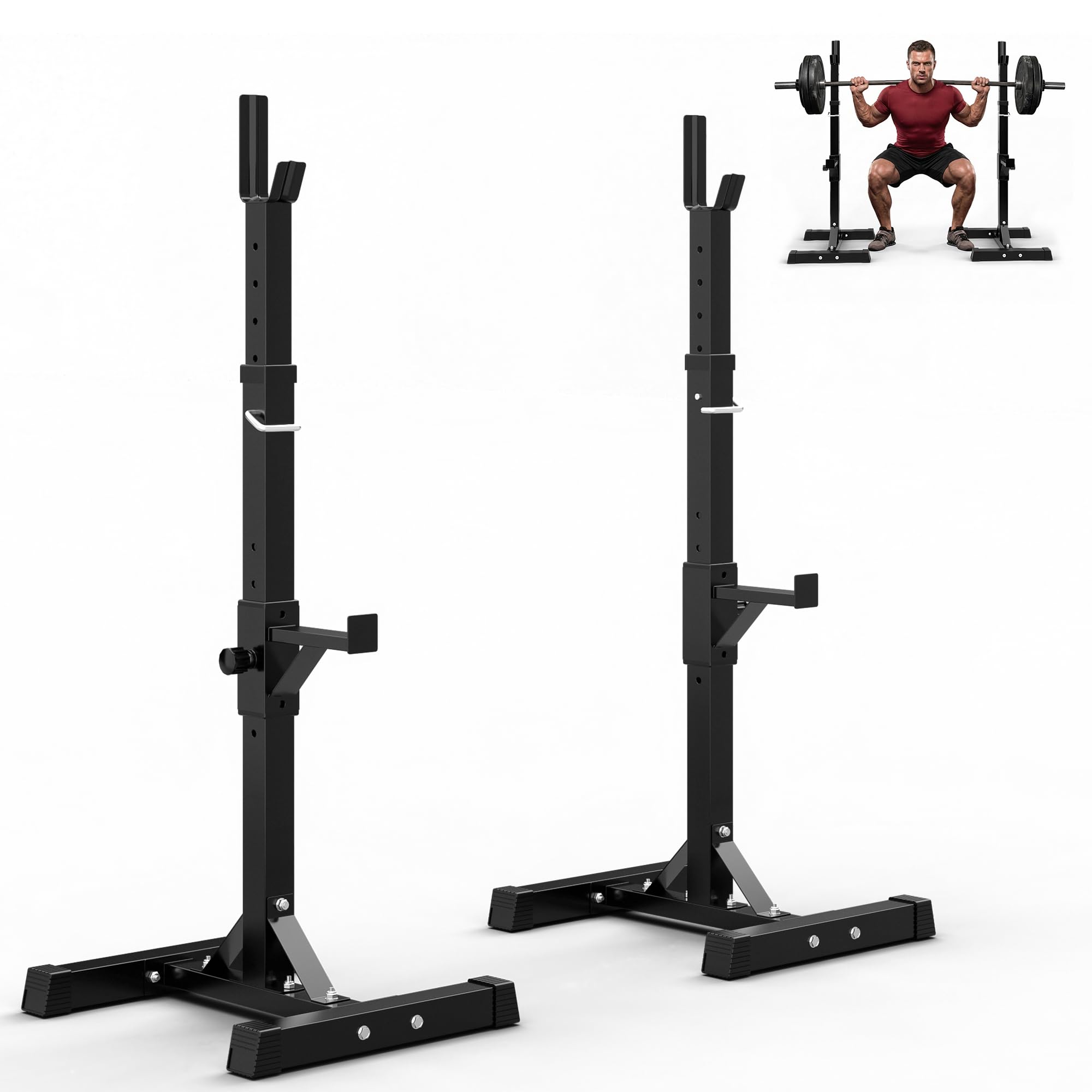
JupiterForce hits a sweet spot in the mid-range category, offering a robust feature set that belies its accessible positioning. The 14-position adjustable safety spotters provide meaningful catch points for fails, and the H-shaped base with lock nuts ensures the stand stays put during intense sets.
Made from 50x50mm steel tubing, it feels solid under load up to its 550-pound rating. The anti-skid rubber pads are effective on various floors. Assembly requires your own 17mm socket wrench, but once tightened, the rack exhibits minimal play, inspiring confidence for solo lifters.
For those seeking reliable performance without venturing into premium territory, this pair of stands delivers exceptional utility. They are portable enough to move yet stable enough for serious training, making them a cornerstone for evolving home gyms.
Why it’s great
- Excellent stability from a well-designed H-base.
- Multiple safety spotter positions enhance solo safety.
- Good weight capacity for most intermediate lifters.
- Rubber feet protect floors and reduce noise.
Good to know
- No tools included, requiring a specific socket size.
- Some users report minor challenges with bolt alignment during assembly.
- The safety arms, while adjustable, are not overly long.
4. Yaheetech Pair of Adjustable Squat Rack

When floor space is at a premium, these Yaheetech stands offer a clever solution. Their separate, upright design allows them to be positioned exactly as needed and then stowed away with ease. The wide 44 to 70-inch height adjustment range accommodates very tall users and various exercises.
The construction uses heavy-duty steel tubing, and the anti-skid feet work well. However, as with most lightweight standalone stands, they can teeter when re-racking weights aggressively. Users recommend placing weight plates on the base or controlling the bar’s return motion carefully.
This is an ideal choice for apartment dwellers or those with multi-purpose rooms who need effective equipment that doesn’t dominate the space. They perform admirably for moderate loads and offer great flexibility.
Why it’s great
- Extremely versatile placement and storage options.
- Broad height range suits a wide variety of users.
- Sturdy feel for a pair of separate stands.
- Simple, tool-required assembly.
Good to know
- Requires careful, controlled re-racking to prevent tipping.
- Safety pins are not spring-loaded, making height changes less fluid.
- Rubber foot caps can loosen with frequent moving.
5. ZENY Adjustable Squat Barbell Rack Stand

The ZENY rack employs a triangle strong design at its base, which theoretically distributes force efficiently for enhanced stability. In practice, this makes it feel planted during exercises like bench press, and the non-slip feet grip the floor securely.
It supports up to 550 pounds and adjusts from 41 to 66 inches. Some users note that the J-hooks can be narrow for Olympic bars and may benefit from added rubber padding to protect the bar’s knurling. The assembly is standard but requires metric wrenches not included in the box.
This stand is a solid, no-frills workhorse for the mid-range buyer. Its design prioritizes a stable footprint, making it a dependable choice for foundational lifts, though the safety catches are somewhat short for comprehensive fail-safety.
Why it’s great
- Very stable triangular base design resists tipping.
- Clean, straightforward aesthetic.
- Adequate weight capacity for most home training.
- Rubber feet protect flooring effectively.
Good to know
- J-hooks may be narrow and could damage bar knurling over time.
- Safety arms are relatively short.
- Instructions are in small print and can be unclear.
6. FONBEAR Adjustable Squat Rack

FONBEAR aims to be a all-in-one station with its claim of integrating a squat rack, pull-up bar, and dip station. This makes it appealing for beginners or those wanting to maximize a single purchase. The frame is adjustable in height and width and can be folded, a rarity in this category.
However, this versatility comes with compromises. The stability under heavy load is a common concern, with notable wobble reported when approaching its 550-pound capacity. The pull-up and dip attachments are functional but may feel less robust than dedicated stations.
It’s a compelling entry-level package for light to moderate training where space and budget are tight. The included three-year warranty adds peace of mind, but serious lifters will likely find its performance limiting.
Why it’s great
- Unique foldable design for easy storage.
- Multiple functions in one footprint.
- Includes tools for assembly.
- Backed by a lengthy warranty.
Good to know
- Exhibits wobble and instability with heavier weights.
- Multi-function attachments may feel less durable.
- Adjustment mechanisms can be cumbersome to use.
7. Yaheetech 45-71 Inch Adjustable Rack

This Yaheetech model distinguishes itself by including the necessary assembly tools, a welcome convenience often missing from competitors. Its height adjusts from 45 to 71 inches, making it one of the tallest adjustable stands available, suitable for overhead presses with clearance.
The solid steel tube construction feels durable, and rubber end caps provide floor protection. While stable for its class, it still shares the inherent characteristic of lightweight stands: it requires careful re-racking. Some users reinforce stability by weighing down the base with sandbags.
For the user who wants a complete out-of-the-box experience and needs extra height, this is a strong contender. It simplifies setup and offers great flexibility for a variety of lifts in constrained spaces.
Why it’s great
- Assembly tools are included, easing setup.
- Exceptional height range for tall users or overhead work.
- Sturdy feel and effective rubber feet.
- Compact storage footprint when not in use.
Good to know
- Can wobble if weights are slammed onto it.
- Safety bars are short, offering limited catch area.
- Bolts on the feet can protrude, affecting stability on hard floors.
8. BangTong&Li Squat Rack Stand

The BangTong&Li rack is a compact, integrated unit that cleverly incorporates plate storage into its H-shaped base. This design not only saves floor space but also adds ballast to improve stability when the storage pegs are loaded. The construction uses 2×2 inch square tubing, giving it a solid feel.
Adjustability is focused on the bracket height, ranging from 50 to 57 inches, which may be limiting for very tall users. The fixed cross member at the base adds rigidity but can interfere with bench placement for some; users recommend facing the rack during squats to avoid contact. Assembly is reported to be straightforward with clear instructions.
This rack is best for lifters with moderate space and weight goals who appreciate built-in organization. It’s a thoughtful design for home gyms where equipment needs to serve multiple purposes without sprawling.
Why it’s great
- Integrated plate storage adds stability and organization.
- H-shaped base provides good foundational stability.
- Compact footprint for smaller home gyms.
- Straightforward assembly with clear instructions.
Good to know
- Fixed lower crossbar can limit bench positioning.
- Height adjustment range is narrower than some stands.
- Some users report potential for rust if kept outdoors.
9. F2C Max Load 550Lbs Adjustable Squat Rack

This F2C model is a popular entry point, offering core functionality at an accessible price. The 13-position adjustable safety spotters are a legitimate safety feature for solo training, and the H-base construction provides a stable platform. The anti-skid rubber pads are effective on most surfaces.
As with many budget stands, stability under heavy or dynamic loads is a common note; users recommend controlled re-racking and possibly weighing down the base for heavier lifts. Assembly requires a 17mm socket and wrench, and some patience with bolt alignment is needed.
For beginners or those on a strict budget, this rack delivers the essential ability to squat and bench press safely at home. It’s a practical first step into barbell training, with the understanding that its performance has limits compared to more premium options.
Why it’s great
- Provides multiple safety spotter positions at a budget-friendly point.
- H-base design offers decent stability for the cost.
- Rubber pads protect floors and reduce slip.
- Lightweight and relatively portable.
Good to know
- Can feel wobbly when re-racking heavy weights aggressively.
- Safety arm pins are short and don’t pass fully through the upright.
- Assembly can be challenging without the right tools.
10. F2C Adjustable Squat Rack Pair

Weighing in at a manageable 40 pounds for the pair, these stands are designed for easy portability. They can be moved around a garage or even taken outdoors for a workout. The 13 adjustable safety levels and 41-66 inch height range cover the basic needs for most users.
The trade-off for portability is inherent instability. The lightweight construction and small base mean they are susceptible to tipping if the bar is not centered or is slammed. Many users successfully mitigate this by placing weight plates on the base legs during use.
This is an ideal choice for the lifter who values flexibility and storage above all else, and who is disciplined about controlled lifting. It’s a tool that enables training where space is truly at a premium.
Why it’s great
- Very portable and easy to store away.
- Adequate adjustability for basic lifts.
- Simple, no-frills design gets the job done.
- Good for light to moderate weight training.
Good to know
- Requires added weight on the base for stability with heavier loads.
- Safety arms are very short, offering minimal catch area.
- Some users report issues with bolt threads and knob durability.
11. Generic Adjustable Squat Rack Stand

This generic stand represents the most accessible entry point into barbell training. It’s lightweight, adjustable from 40 to 66 inches, and claims a 550-pound capacity. For very light duty—like supporting a bar for curls, light bench presses, or bodyweight exercises—it performs adequately.
Critical reviews highlight significant variability in quality control, including misaligned holes, incomplete welds, and hardware issues. Stability is a major concern for any substantive weight; it is not designed for heavy squats or aggressive training.
Consider this only if your needs are extremely minimal and your budget is the absolute primary constraint. It’s a stepping stone, but one that requires tempered expectations and extreme caution.
Why it’s great
- Extremely budget-friendly starting point.
- Adjustable height and portable design.
- Serves for very light support and storage.
- Quick to assemble and move.
Good to know
- Poor quality control; risk of receiving defective parts.
- Not stable or safe for heavy lifting or failed reps.
- Hardware and construction are not durable for intense use.
Understanding the Specs
Weight Capacity
This is the maximum static load the manufacturer claims the rack can hold. It’s crucial to differentiate between the capacity of the uprights and the often lower capacity of the safety arms. For safety, choose a rack with a capacity rating at least 25% higher than your maximum planned working weight to account for dynamic forces and future progress.
Adjustability & Hole Spacing
Look for the number of height settings and the spacing between them (e.g., 1-inch or 2-inch increments). Smaller spacing allows for more precise positioning of the bar and safety arms, which is vital for proper biomechanics and safety during bench presses and squats. Also, check if the width is adjustable to accommodate different barbells and user stances.
Base Design & Footprint
The base determines stability. H-shaped and wide rectangular bases resist tipping forward and backward better than simple uprights. A larger footprint generally means more stability but also takes up more floor space. Some racks allow for bolting to a platform for ultimate security, a key feature for heavy lifters.
Safety Spotter Arms
These are non-negotiable for solo training. Evaluate their length, adjustment mechanism, and weight rating. Longer arms provide a larger catch area if you miss the rack. They should use a secure pin system that fully engages the upright. Some budget racks have very short “safety” arms that are functionally inadequate.
FAQ
Can I really use an adjustable squat rack safely without a spotter?
What’s the difference between squat stands and a power rack?
How important is it to bolt down a squat rack?
What tools will I need for assembly?
Final Thoughts: The Verdict
For most people, the best adjustable squat rack winner is the CANPA Adjustable Squat Rack Stand because it masterfully blends superior stability, a high weight capacity, and practical storage into a reliable, mid-range package. If you want maximum exercise versatility with a pull-up bar and fine-tuned adjustments, grab the Lmdex Adjustable Squat Rack. And for those seeking the best balance of cost and competent performance, nothing beats the JupiterForce Adjustable Squat Rack Stands.

Mo Maruf
I created WellFizz to bridge the gap between vague wellness advice and actionable solutions. My mission is simple: to decode the research and give you practical tools you can actually use.
Beyond the data, I am a passionate traveler. I believe that stepping away from the screen to explore new environments is essential for mental clarity and physical vitality.