Our readers keep the lights on and my smoothie glass nicely filled. As an Amazon Associate, I earn from qualifying purchases.
Mounting vinyl flooring to a vertical wall surface demands an adhesive that can fight gravity without damaging the wall board or the plank itself. Standard floor adhesives are formulated for horizontal weight distribution and often lack the grab or vertical shear strength needed to keep luxury vinyl planks (LVP) or peel-and-stick tiles pressed flat against drywall, tile, or painted surfaces.
I’m Mohammad Maruf — the founder and writer behind WellFizz. I analyze construction chemical formulations, cure times, and tensile bond strength data from open market reviews to separate adhesives that truly hold vinyl to walls from those that sag, bubble, or release within weeks.
This guide focuses on adhesives that have proven vertical grab, low-odor application, and compatibility with vinyl floor materials. Whether you are covering an accent wall, a backsplash, or a wainscot section, the right adhesive for vinyl flooring on walls saves you rework and wall repair.
How To Choose The Best Adhesive For Vinyl Flooring On Walls
Using floor-grade vinyl on a vertical surface changes the adhesive requirements entirely. You need a product with high initial tack, resistance to gravity-induced creep, and a chemistry that bonds to both the vinyl backing and the wall material without causing chemical warping.
Vertical Slip Resistance (Initial Tack)
The biggest failure mode for vinyl flooring installed on walls is gravity slip — the plank sliding downward within the first hour of installation. Adhesives with a thixotropic or gel-like consistency resist sagging better than thin, watery formulations. Look for terms like “high-tack,” “nano-gel,” or “pressure-sensitive” in the product description. A setting time under 30 minutes with active hand pressure is ideal for wall work.
Bond Compatibility With Vinyl Backing
Vinyl floor tiles and planks have a closed PVC surface that some adhesives struggle to grip. Solvent-free SBR and acrylic latex adhesives tend to bond well with vinyl without causing plasticizer migration, which can soften the plank or leave oily stains. Do not use mastic designed for ceramic tile — its cementitious nature does not flex with vinyl and can crack over time on a wall.
Indoor Air Quality (VOC Content)
When applying adhesive to a wall inside a living space, the exposed surface area is large, which means outgassing can be more concentrated than a floor installation. Choose water-based, solvent-free adhesives labeled low-VOC or zero-VOC. This limits respiratory irritation during application and shortens the off-gassing period before you can safely occupy the room.
Substrate Preparation
Walls introduce surface variables that floors often do not: paint, wallpaper residue, joint compound, and texture. The adhesive’s manufacturer must list compatibility with your specific wall material. For painted drywall, scuff-sanding and a primer coat improve shear strength significantly. For tile or glossy surfaces, a nano-gel double-sided tape can sometimes bypass the need for a full wet-set adhesive.
Quick Comparison
On smaller screens, swipe sideways to see the full table.
| Model | Category | Best For | Key Spec | Amazon |
|---|---|---|---|---|
| Roberts 3085 Multipurpose Adhesive | Wet-Set | Felt-back sheet vinyl on walls | SBR latex, solvent-free | Amazon |
| ROBERTS Universal Resilient Flooring Adhesive | Pressure-Sensitive | LVP/LVT wall installations | Acrylic latex, Microban | Amazon |
| Duck Max Strength Double-Sided Gel Tape | Nano-Gel Tape | Lightweight vinyl tiles on smooth walls | 0.94 in. x 10 ft, removable | Amazon |
| Art3d Peel and Stick Vinyl Floor Tiles | Pre-Glued Tile | Budget-friendly wall accent panels | 12×12 in., 30 sq. ft. coverage | Amazon |
| Sterling Self Adhesive Vinyl Floor Tiles | Peel & Stick | Entry-level vertical accent projects | 1.2mm thick, 20 sq. ft. cover | Amazon |
In-Depth Reviews
1. Roberts 3085 Multipurpose Adhesive
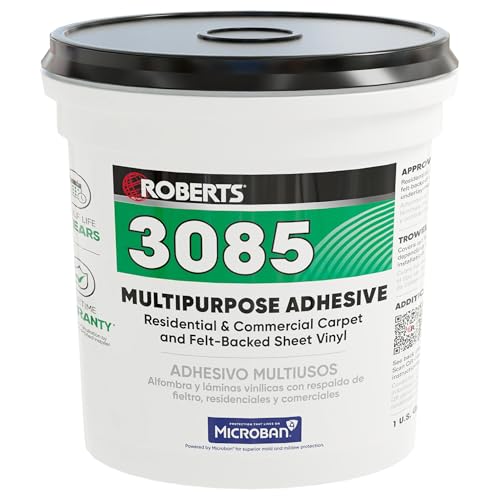
The Roberts 3085 uses an SBR latex, solvent-free formulation that delivers high wet-tack on porous and semi-porous vertical surfaces. Its fast-setting formula allows the vinyl to grab within 30 minutes of thin application, reducing the need for temporary bracing or constant hand pressure.
Customers consistently report strong bonding with felt-back sheet vinyl on drywall and properly primed plywood. The adhesive spreads easily with a trowel, and the gallon covers roughly 92 square feet per can, making it a practical choice for a wall-sized accent panel.
The main limitation is its inconsistency in packaging — some units arrive with broken seals or leaks. Because the formula is solvent-free, cleanup requires immediate attention with warm water before the latex cures permanently.
Why it’s great
- Fast initial grab ideal for vertical vinyl applications
- Solvent-free and low-odor for indoor wall use
Good to know
- Packaging quality inconsistent — some cans arrive leaking
- Requires immediate water cleanup before curing
2. ROBERTS Universal Resilient Flooring & Vinyl-Backed Carpet Tile Adhesive

This Roberts 7350 series adhesive uses an acrylic latex, pressure-sensitive chemistry that dries clear and stays tacky for extended working time — up to six hours in low spots — giving you ample room to adjust vinyl planks or tiles on a wall without rush.
The inclusion of Microban antimicrobial protection is a welcome feature for kitchen and bathroom wall applications where moisture may accumulate behind the vinyl. Users confirm strong hold over six months in demanding environments including RVs exposed to temperature swings.
One downside: the odor is more noticeable than the SBR 3085, and cleanup is difficult once the adhesive begins to skin over. The pail lid seal is also prone to leakage during shipping if not taped down.
Why it’s great
- Extended working time for precise wall positioning
- Microban protection fights stain-causing microbes
Good to know
- Medium odor — ventilate the workspace well
- Pail lids may leak during transit
3. Duck Max Strength Double-Sided Gel Tape with Nano-Grab Technology
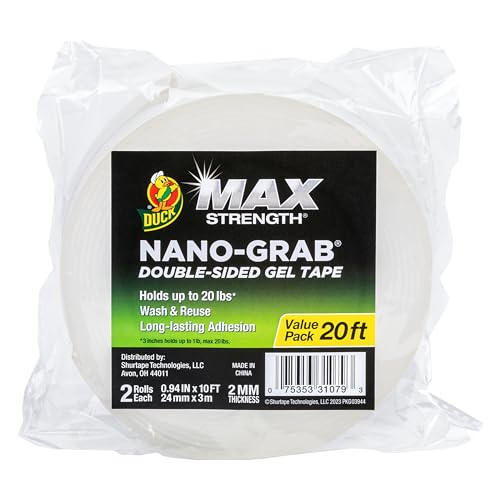
The Duck nano-gel tape takes a completely different approach — no trowel, no open time, no curing. You cut a strip, apply it to the back of the vinyl tile, and press against the wall. The micro-sphere acrylic adhesive particles provide high shear strength while remaining removable without residue.
This tape works best with lightweight vinyl tiles on smooth, painted drywall or tile. Users report holding picture frames and decorations against cat knocks, and the tape survives extreme temperature swings from freezing to over 100°F without losing grip.
The trade-off is that it is not designed for heavy, thick luxury vinyl planks or for covering large continuous surfaces where panel gaps would be visible. Some users also note that the clear finish may not bond as aggressively as Alien Tape equivalents on textured surfaces.
Why it’s great
- Zero mess, no cure time, instant vertical hold
- Removable without damaging painted walls
Good to know
- Not suitable for heavy LVP planks on walls
- Grip on textured surfaces may be inconsistent
4. Art3d Peel and Stick Vinyl Floor Tiles

The Art3d tiles are pre-glued with a pressure-sensitive adhesive backing. For wall use, the adhesion works best on perfectly clean, smooth, and primed surfaces. The 1.2mm thick PVC tile is lightweight enough that gravity sag is minimal when the wall is prepared correctly.
Users appreciate the thick core and waterproof, fireproof properties, which add safety to wall paneling in kitchens. The taupe ash wood-look pattern offers a modern aesthetic without the weight or cost of real wood slats.
The chief complaint across reviews is that the adhesive backing can be difficult to peel, and on some wall substrates like painted particle board, the tiles may lift over time. Supplemental acrylic adhesive is recommended for permanent vertical installations.
Why it’s great
- Pre-glued convenience for quick wall projects
- Thick, rigid tile resists warping on vertical surfaces
Good to know
- Adhesive backing may lift on non-primed walls
- Tiles not pre-sorted — extra time needed for grain matching
5. Sterling Self Adhesive 12-Inch Vinyl Floor Tiles

The Sterling tiles are a classic peel-and-stick solution from Achim Home Decor, providing a simple path to covering a small vertical area without purchasing a separate adhesive. Each box covers 20 square feet with 12-inch square tiles in a semi-gloss white finish.
The primary use case for this product on walls is low-moisture, low-traffic accent areas such as a behind-desk wall panel or a temporary backsplash in a rental unit. The adhesive strength is rated for floor use, and multiple reviews confirm the tiles look great when first applied.
The most common failure for vertical use is that the adhesive does not stick well to painted surfaces, leading to lifting along the top edges. Several reviewers noted that the self-adhesive backing left residue when peeled up, and the tile thickness of 1.2mm makes the surface less forgiving on imperfect wall textures.
Why it’s great
- Very affordable entry point for small wall accents
- No separate adhesive purchase needed
Good to know
- Adhesive may lift from painted drywall without extra glue
- Individual tile quality control varies — some arrive stuck together
FAQ
Can I use regular flooring adhesive to stick vinyl planks to a wall?
Do peel-and-stick vinyl tiles hold well on painted drywall?
What is the best way to prepare a wall before applying vinyl flooring adhesive?
Final Thoughts: The Verdict
For most users, the adhesive for vinyl flooring on walls winner is the Roberts 3085 Multipurpose Adhesive because its solvent-free SBR formula delivers fast vertical grab without strong odor, making it safe for indoor accent walls. If you need extended working time for LVP installation on multiple wall panels, grab the ROBERTS Universal Resilient Flooring Adhesive. And for a lightweight, removable solution on smooth painted walls, nothing beats the mess-free hold of the Duck Max Strength Double-Sided Gel Tape.

Mo Maruf
I created WellFizz to bridge the gap between vague wellness advice and actionable solutions. My mission is simple: to decode the research and give you practical tools you can actually use.
Beyond the data, I am a passionate traveler. I believe that stepping away from the screen to explore new environments is essential for mental clarity and physical vitality.