Our readers keep the lights on and my smoothie glass nicely filled. As an Amazon Associate, I earn from qualifying purchases.
That single loose floor tile that clicks underfoot or the cracked backsplash piece threatening to fall—these small annoyances grow into eyesores fast. A quality adhesive for tile turns a weekend frustration into a permanent fix, whether you are reattaching a ceramic floor tile, patching a porcelain chip, or securing stone on a vertical wall. The right formula bonds to concrete, drywall, and existing tile without cracking under daily foot traffic or moisture.
I’m Mohammad Maruf — the founder and writer behind WellFizz. My research focuses on comparing construction-grade polymer blends, cure times, and application methods to identify which adhesives deliver lasting repairs without requiring professional tools.
After evaluating grab strength, water resistance, and versatility across dozens of formulas, I have broken down every spec to help you find the adhesive for tile that matches your specific project and skill level.
How To Choose The Best Adhesive For Tile
Picking the wrong adhesive leads to tiles sliding off walls, discolored grout lines, or a repair that fails within weeks. Focus on three core factors: the material of your tile and substrate, the adhesive’s physical form and working time, and whether you need a waterproof or gap-filling compound. The right choice depends entirely on whether you are bonding a new tile to a bare wall or patching a chip in an existing floor.
Match the Adhesive to Your Tile and Substrate
Porcelain and dense stone require an adhesive with high initial grab because these materials resist absorbing moisture. Ceramic and acrylic tiles are more forgiving and work well with standard premixed mastics. For concrete substrates, look for a formula labeled for cement bonding—some consumer-grade adhesives peel off concrete within months of foot traffic.
Assess the Working Time and Cure Speed
Premixed mastics like Henry 314 dry quickly, forcing you to set tiles within minutes. Slower-curing acrylic formulas give you repositionability for five to ten minutes, which helps when aligning a pattern. Epoxy putties used for cosmetic repairs harden in under an hour but require thin layers for deep chips to avoid a raised patch.
Consider Water and Heat Exposure
Bathroom and kitchen backsplashes demand a water-resistant bond. Most acrylic-based adhesives handle humidity and occasional splashes, but nothing labeled for “shower surround only” should be submerged. For outdoor fountains or pool surrounds, a fully waterproof hybrid construction adhesive is the safer bet.
Quick Comparison
On smaller screens, swipe sideways to see the full table.
| Model | Category | Best For | Key Spec | Amazon |
|---|---|---|---|---|
| Gorilla Max Strength Construction Adhesive | Hybrid Paste | Heavy-duty gap filling and outdoor repairs | Full cure time: 24 hours | Amazon |
| YKF Heavy Duty Tile Adhesive & Repair Glue | Acrylic Cream | Loose tile repair on floors and walls | Initial grab: 3-5 minutes | Amazon |
| Henry 314 Premixed Mastic Adhesive | Premixed Mastic | Small DIY projects on ceramic tile | Container type: 1-quart pail | Amazon |
| MendMight Tub & Tile Repair Kit | Epoxy Putty | Cosmetic chip and crack repairs | Pigments included: 6 colors | Amazon |
| cocomfix Tile Repair Kit | Epoxy Paste | Color-matched cosmetic tile restoration | Pigments included: 7 colors | Amazon |
In‑Depth Reviews
1. Gorilla Max Strength Construction Adhesive
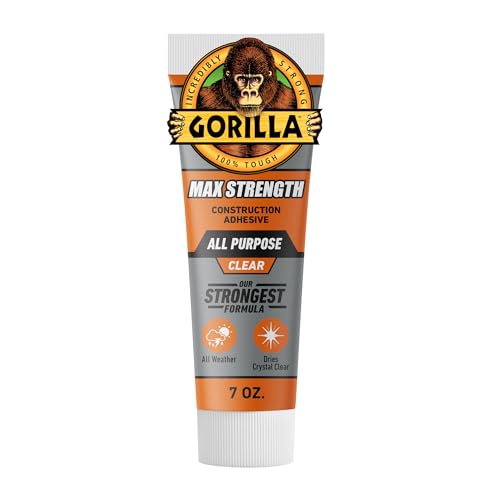
Gorilla’s hybrid formula delivers two times the strength of its own heavy-duty construction adhesive, making this tube the go-to for tiles that need to withstand outdoor weather or high-traffic floors. The paste-like consistency fills gaps up to a quarter-inch, so you can use it on uneven concrete or wall patches without pre-filling. Users report successful bonds on cement, stone, and fiberglass, with the clear finish remaining discreet on visible repairs.
The 7-ounce squeeze tube is straightforward to cut and apply, but the viscosity demands strong hand pressure—a caulking gun adapter would help for larger jobs. The adhesive stays repositionable for about five minutes, then grabs firmly within 30 seconds of contact. Full cure takes the full 24 hours, and the bond hardens to a rubber-like flexibility that absorbs vibration without cracking.
Where this adhesive really shines is in wet environments. Multiple reviews confirm it seals wood and stone underwater and withstands interior car heat without sagging. The main trade-off is cleanup: wet drips wipe away with rubbing alcohol, but dried glue requires scraping.
Why it’s great
- Crystal clear finish leaves no visible residue on light tiles
- Gap-filling formula bridges uneven substrates without pre-patching
- Genuinely waterproof—holds bond even in submerged outdoor installations
Good to know
- Requires full 24-hour clamp time to reach maximum bond strength
- Very sticky—gloves are essential to avoid difficult skin cleanup
- Nozzle hole is wide, making controlled application on small tiles tricky
2. YKF Heavy Duty Tile Adhesive & Repair Glue
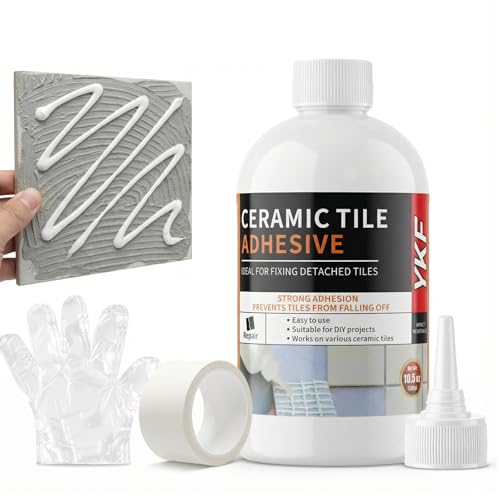
The YKF adhesive is engineered specifically for reattaching loose tiles without loading up a caulking gun. Its cream-like acrylic consistency stays put on vertical surfaces—the non-sag property means you can apply it to a wall tile and let go within three to five minutes without worrying about it sliding. The squeeze bottle with a precision nozzle lets you inject adhesive into hollow spaces behind tiles, which is ideal for fixing that clicking floor tile without removing adjacent pieces.
Customer feedback confirms strong bonds on ceramic, concrete, and marble across indoor applications. The formula dries to a white finish that matches light grout, though reviews warn it can yellow slightly when applied too thick. For best results, use it in temperatures above 41°F to prevent the water-based blend from freezing during shipping. The included gloves and nozzle make this a complete grab-and-go kit for first-time DIY users.
One limitation: this is not designed for submerged use, so skip it for swimming pools or ponds. The 24-hour full cure time is standard, but the initial grab is fast enough that you do not need to hold the tile for long. For the price, this delivers professional-grade performance without needing extra tools.
Why it’s great
- Non-sag formula holds vertically without sliding or dripping
- Mess-free squeeze application with included precision nozzle
- Fast initial grab in 3-5 minutes reduces clamping time
Good to know
- Dries slightly yellow when applied in thick layers
- Water-resistant but not intended for submerged use
- Freezing during shipping can degrade the formula
3. Henry 314 Premixed Mastic Adhesive

Henry 314 is a classic premixed mastic that has been a staple in small-format tiling for years. The beige paste comes ready to use straight from the 1-quart pail—no mixing, no measuring. It works best on ceramic tile bonded to concrete or drywall and is ideal for small backsplash sections or decorative accent pieces. The liquid form spreads easily with a notched trowel, and the mastic grabs within minutes, making it a fast option for weekend projects.
Reviews consistently mention that this mastic dries quickly, so you need to work efficiently. If you hesitate, the exposed glue can crust over and crumble, wasting material. For a small plant stand or an 8-inch by 42-inch area, it is perfect. For larger floors or vertical surfaces, the quick drying time becomes a liability. The packaging is also a weak point—several users report cracked lids that cause the adhesive to dry out before use.
Henry is a trusted brand among tile professionals, but this product is firmly in the consumer-grade category. It is not waterproof and lacks the flexibility of acrylic or hybrid formulas, so skip it for bathrooms or high-moisture areas. For a one-off repair on a dry interior wall, the ease of use and low commitment make it a reasonable choice.
Why it’s great
- Fully premixed with zero prep work required
- Spreads smoothly with a notched trowel for even coverage
- Affordable entry point for small ceramic tile projects
Good to know
- Dries extremely fast—no time for repositioning after application
- Not suitable for wet areas or exterior installations
- Pail lid is prone to cracking during shipping
4. MendMight Tub & Tile Repair Kit
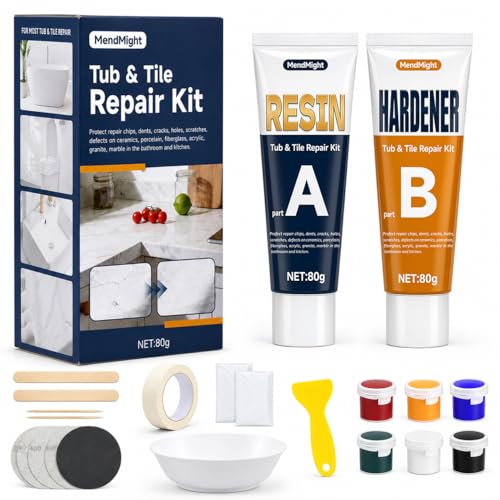
MendMight shifts the focus from bonding to cosmetic restoration. This 5.6-ounce epoxy putty kit is built for fixing chips, hairline cracks, scratches, and small holes on porcelain tubs, ceramic tiles, fiberglass showers, and countertops. The two-part resin hardens to a water-resistant, sandable finish that resists yellowing over time—critical for white bathroom fixtures where discoloration stands out immediately.
The six included pigments (white, red, black, blue, yellow, green) allow you to mix custom shades, but be prepared to experiment. Reviews note that matching beige or stone tones requires careful incremental blending. The kit includes a mixing bowl, scraper, wooden sticks, multi-grit sandpaper, and masking tape, so you do not need to buy extras. For a hairline crack in a white tile, users report an invisible repair that made the damage disappear entirely.
The epoxy applies as a putty that you press into the damaged area, then sand smooth once cured. Deep chips need thin layers to avoid a raised patch. While the color range is sufficient for many whites and grays, users with unique vintage tile shades may struggle to get an exact match. This is a niche tool—excellent for renters avoiding replacement costs, but not a general-purpose bonding adhesive.
Why it’s great
- Complete all-in-one kit with sandpaper, mixing tools, and tape
- Sands to a smooth, glossy finish that blends with surrounding tile
- Water-resistant epoxy resists yellowing after curing
Good to know
- Color matching requires trial and error—not instant match
- Limited to cosmetic repairs; not for bonding loose tiles
- Thick layers may cure with a raised surface needing extra sanding
5. cocomfix Tile Repair Kit
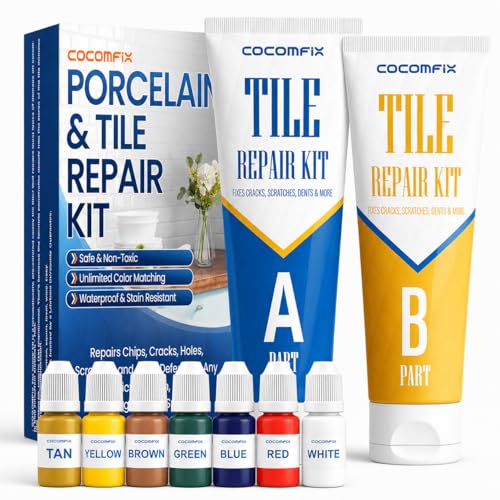
cocomfix expands the color-matching approach with seven primary pigments—adding tan and brown to the standard palette—giving you more latitude to match earthy and neutral tile shades. The two-part epoxy paste cures to a high-gloss finish with strong adhesion on ceramic, porcelain, acrylic, and fiberglass. It is marketed as multi-surface, working on sinks, tubs, and showers alongside floor and wall tiles.
Users who took the time to dial in the color mix report invisible repairs on 1970s bathroom tiles and modern gray floors. The formula is low-odor and non-toxic, which matters for indoor use near children or pets. Once fully cured, the epoxy is waterproof and heat-resistant, making it suitable for kitchen backsplashes that face steam and occasional grease. The included instruction guide offers basic color guidance, but several reviews note the guide is not detailed enough for complex patterns like marble veining.
The biggest frustration reported is the opaque white residue left by the filler if not sanded precisely—one review warns it can strip color from the surrounding tile if you sand too aggressively. The color guide provides only basic ratios, so matching non-standard shades requires patient experimentation. For users willing to invest time in mixing, the results can be seamless.
Why it’s great
- Seven pigments provide the widest color range in this roundup
- High-gloss finish matches glazed tile sheen after curing
- Waterproof and heat-resistant for kitchen and bath use
Good to know
- Color matching requires significant trial and error
- Opaque residue can discolor surrounding tile if sanded poorly
- Color guide is basic—complex shades rely on user intuition
FAQ
Can I use construction adhesive to set a new ceramic floor tile?
How do I remove excess epoxy filler from tile before it cures?
Why does my tile adhesive turn yellow after drying?
Final Thoughts: The Verdict
For most users, the adhesive for tile winner is the Gorilla Max Strength Construction Adhesive because its waterproof, gap-filling hybrid formula handles loose tiles, outdoor repairs, and vertical installations without yellowing. If you need a budget-friendly option for reattaching loose floor or wall tiles, grab the YKF Heavy Duty Tile Adhesive & Repair Glue. And for cosmetic chip and crack repairs on porcelain or ceramic, nothing beats the cocomfix Tile Repair Kit for its seven-pigment color matching system.

Mo Maruf
I created WellFizz to bridge the gap between vague wellness advice and actionable solutions. My mission is simple: to decode the research and give you practical tools you can actually use.
Beyond the data, I am a passionate traveler. I believe that stepping away from the screen to explore new environments is essential for mental clarity and physical vitality.