Our readers keep the lights on and my smoothie glass nicely filled. As an Amazon Associate, I earn from qualifying purchases.
A single missing shingle or a cracked flashing seam can turn a quiet rain into a living room waterfall. The right adhesive bridges that gap, bonding materials back into a weatherproof shield that keeps your home dry. But with dozens of tubes, cans, and formulas on the shelf, picking the right weapon for your specific roof type makes all the difference between a repair that lasts and a leak that returns next season.
I’m Mohammad Maruf — the founder and writer behind WellFizz. I’ve spent dozens of hours combing through chemical data sheets, real-world application reviews, and compatibility charts to build a buyer’s guide that focuses on adhesion strength, material compatibility, and weather resistance for asphalt, metal, and rubber roofing.
Whether you are tackling a missing asphalt shingle or sealing a metal roof seam, the right choice starts with knowing which formula bonds to your substrate. This guide breaks down the best adhesive for shingles by performance tier so you can buy the right tube the first time.
How To Choose The Right Adhesive For Shingles
Selecting the wrong adhesive for a roof repair can lead to cracking, peeling, or simply not bonding at all. You need to match the sealant’s chemistry to your specific roof material and the application environment.
Match the Formula to Your Roof Material
Asphalt shingles respond best to polymer or butyl-based adhesives that stay flexible as the shingle expands and contracts with temperature swings. Metal roofs require a sealant that adheres strongly to Kynar-coated or galvalume surfaces without corroding the metal. Rubber or EPDM roofs need a flexible, rubberized paste that bonds chemically to the membrane without outgassing.
Self-Leveling vs. Non-Leveling
On flat or low-slope roofs, a self-leveling sealant flows into gaps and cracks, creating a smooth, even seal without manual spreading. Steep-slope applications demand a non-leveling or “no-slump” formula that stays exactly where you apply it, even on a vertical surface or an angled shingle edge. Picking the wrong type results in a messy application or a failed seal that lets water through.
Application Temperature and Curing Time
Most roof adhesives require a minimum surface temperature of at least 45°F to bond properly. Applying in colder weather can cause the material to become too thick to spread, while extreme heat can make it runny before it cures. Check the manufacturer’s recommended temperature window and allow the full cure time — usually 24 to 48 hours — before exposing the repair to heavy rain.
Quick Comparison
On smaller screens, swipe sideways to see the full table.
| Model | Category | Best For | Key Spec | Amazon |
|---|---|---|---|---|
| Titebond 62401 | Polymer | Metal Roof Fasteners | 10.1 oz cartridge, UV-resistant | Amazon |
| Dicor 610SASLW-1 | Polyether | RV & Flat Roof Vents | 10.1 oz, self-leveling, non-yellowing | Amazon |
| Henry HE208030 | Asphalt Cement | Flashing & Small Holes | 30 oz can, thick consistency | Amazon |
| Flex Paste Clear | Rubber Paste | Gap Filling & Underwater Repairs | 8.75 oz can, paintable after cure | Amazon |
| Somafix Roof Sealant | Butyl | Asphalt Shingle & Gutters | 10.5 oz cartridge, all-weather | Amazon |
In‑Depth Reviews
1. Titebond 62401 Metal Roof Sealant

The Titebond 62401 uses an advanced polymer formula that bonds aggressively to Kynar-coated metals, aluminum, glass, and wood without needing a separate primer. Its thick liquid consistency flows into cracks around fasteners and ridge caps, then cures to a UV-stable seal that doesn’t turn brittle under direct sun exposure. For metal roof installations where screw heads and flashing joints are the primary failure points, this cartridge delivers coverage for roughly 25 linear feet of 1/4-inch bead.
Customer feedback from large-scale metal roof projects confirms the sealant holds up on hangars and residential homes across 2,000 to 3,600 square feet of roof surface. Users report it stays tacky long enough to tool the bead into place, then dries to a tough, flexible layer that survives heavy seasonal rain. The VOC-compliant formulation also makes it safer to use in confined attic spaces during repair work.
One practical note: the 10.1-ounce tube requires a standard caulking gun for dispensing, and the gray color blends well with galvalume and light-gray metal panels. It is not designed for asphalt shingle adhesion, so stick with polymer sealant for metal and reserve this for steel, aluminum, or coated metal roof repairs where maximum UV protection is a priority.
Why it’s great
- Excellent adhesion to Kynar-coated metals without primer
- Stays flexible after full UV exposure
- Low VOC for safer indoor or attic application
Good to know
- Not designed for asphalt shingles or EPDM rubber
- Requires a caulking gun — no squeeze tube option
2. Dicor 610SASLW-1 Self-Leveling Ultra Sealant

The Dicor 610SASLW-1 is a solvent-free polyether sealant specifically engineered for RV and flat-roof applications where self-leveling is a requirement. Unlike traditional caulk that leaves ridges and high spots, this formula flows into seams and around vent flanges to create a smooth, water-shedding surface without manual tooling. The non-yellowing chemistry keeps repairs looking clean even after prolonged UV exposure, and the material remains flexible enough to absorb vibration from highway travel.
Reviews from van and trailer owners emphasize that one tube covers a standard 14×14 roof vent completely with some leftover for edge sealing. The sealant stays workable for roughly an hour before skinning over, giving you time to position and adjust. After full cure — generally 24 to 48 hours depending on humidity — the bond becomes a hard-yet-flexible layer that resists cracking better than standard silicone or polyurethane alternatives.
Because this is a self-leveling formula, it is not intended for sloped roofs or vertical seams where gravity would cause it to run before curing. Stick to flat or low-pitch surfaces, and make sure the substrate is clean and dry before application. The white color blends well with most RV roof membranes but may stand out against darker shingles or metal panels.
Why it’s great
- Self-leveling action creates a smooth, professional-looking seal
- Non-yellowing formula stays clear after sun exposure
- Solvent-free — safe around sensitive RV materials
Good to know
- Only suitable for flat or low-slope roofs
- White color may not match all roof surfaces
3. Henry HE208030 Roof Cement

Henry is a long-established name in the roofing supply world, and the HE208030 maintains that reputation with a thick, almost paste-like consistency that stays in place on vertical chimney flashing and roof jacks. The 30-ounce can gives you enough material for patching small holes, sealing vent pipe bases, and bonding loose shingle tabs without needing a caulking gun. Its black asphalt color blends naturally with most composite shingle roofs.
Users consistently highlight how well the cement holds its position — no running or sagging even on warm afternoons. One reviewer used it with Henry reinforcing tape to fix a poorly installed vent on a mobile home, reporting the leak stopped immediately and stayed sealed through following storms. Another applied it around a chimney cricket and noted the cement hardened enough to paint over without cracking.
The main trade-off is the package size relative to the price point. The 30-ounce can looks smaller than the product photography suggests, and multiple customers mention it goes quickly on larger jobs. Keep this one reserved for targeted repairs on flashing, vents, and small holes rather than covering entire roof sections. Cold weather slows the curing time significantly, so plan for longer drying periods if applying below 50°F.
Why it’s great
- Thick, no-slump formula stays put on vertical surfaces
- Can be painted over for a finished look
- Works with reinforcing tape for stronger repairs
Good to know
- Can is smaller than expected; limited coverage for large jobs
- Dries slowly in cold weather conditions
4. Flex Paste Clear
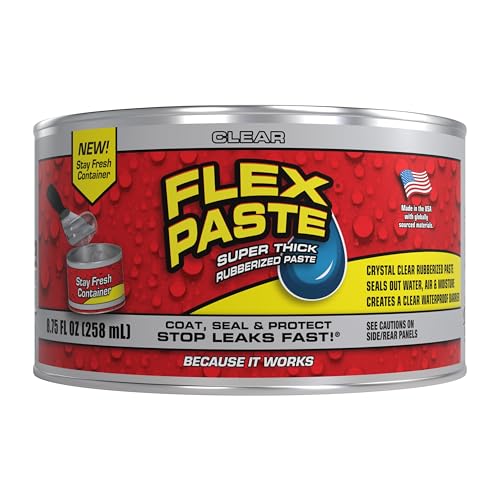
Flex Paste stands apart from traditional roof cements because it is a rubberized paste that can be applied underwater and cures into a fully waterproof, flexible barrier. The clear formulation makes it nearly invisible on most surfaces, which is a major advantage for roof repairs where appearance matters. It fills large gaps and cracks instantly — the super-thick consistency clings to vertical and overhead surfaces without dripping, making it useful for sealing around skylight curbs or damaged flashing.
Customer reports show impressive versatility beyond roofing: one user sealed a crack in a garden hose exposed to continuous water pressure, while another repaired broken ceramic garden pots that had been run over by a van. The rubberized finish retains slight flexibility after curing, so it absorbs thermal expansion and minor structural movement without cracking. The Stay Fresh container also prevents the paste from hardening between uses, which extends the product’s shelf life significantly.
The primary limitation with this product is its performance on curved surfaces — some users note it does not adhere as aggressively on tight radius bends. It also retains a slightly rubbery texture after full cure, which looks different from hard asphalt cement. For homeowners who want a multi-purpose sealant that works on roofs, gutters, and even plumbing repairs, Flex Paste offers a single-tube solution that avoids the need for multiple specialty products.
Why it’s great
- Can be applied and cures underwater for wet repairs
- Clear finish blends with most surfaces after painting
- Works on multiple materials — roof, hose, ceramics, concrete
Good to know
- Adhesion is weaker on tight curved surfaces
- Cures to a rubbery feel, not a hard cement finish
5. Somafix Roof Sealant
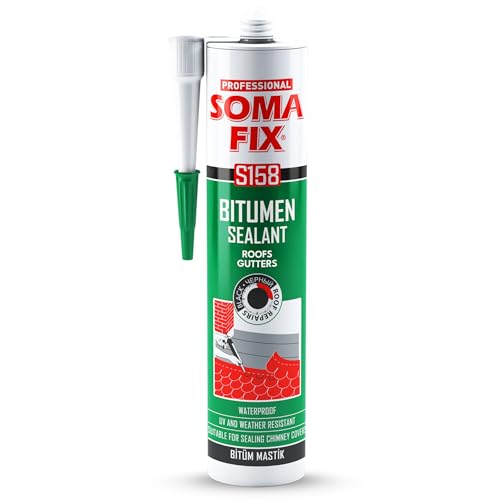
The Somafix Roof Sealant uses a butyl-based formulation that bonds effectively to asphalt shingles, brick, concrete, and metal flashing without requiring a primer. It comes in a standard 10.5-ounce cartridge that fits most caulking guns, and the black color blends well with dark shingles and roof tar. The advertised application window of 46°F to 95°F covers most moderate-weather repair seasons, making it a practical choice for DIY roof maintenance.
User feedback centers on the smooth texture and easy application — the paste spreads evenly and does not slump on sloped surfaces once applied. Reviewers who used it for gutter joint repairs and shingle edge sealing reported that the material dried to a strong waterproof layer within 24 hours. Several commenters appreciated that the sealant remained workable long enough to tool into cracks but cured quickly enough to handle rain within a day.
One area where this product falls short is heavy or structural damage. Multiple reviews point out that while it excels at small leaks and seam sealing, it is not strong enough to bridge large gaps or support loose flashing on its own. Using it for major roof damage will likely result in the sealant failing under load. For homeowners with a few loose shingles or a weepy gutter joint, however, this entry-level butyl sealant gets the job done at a very accessible price point.
Why it’s great
- Smooth, easy-to-apply texture with no slump on slopes
- Dries to a strong waterproof layer within 24 hours
- Works on asphalt, brick, concrete, and metal without primer
Good to know
- Not suitable for large structural gaps or major damage
- Requires a standard caulking gun for clean application
FAQ
Can I apply roof adhesive in cold weather?
How long does roof adhesive take to cure before rain?
Will roof adhesive work on wet surfaces?
Final Thoughts: The Verdict
For most users, the adhesive for shingles winner is the Titebond 62401 because it offers unmatched adhesion to coated metal surfaces with excellent UV stability and low VOC safety. If you need a self-leveling sealant for an RV or flat roof, grab the Dicor 610SASLW-1 for its professional finish and non-yellowing chemistry. And for a versatile, multi-purpose rubber paste that fills large gaps and works underwater, nothing beats the Flex Paste Clear.

Mo Maruf
I created WellFizz to bridge the gap between vague wellness advice and actionable solutions. My mission is simple: to decode the research and give you practical tools you can actually use.
Beyond the data, I am a passionate traveler. I believe that stepping away from the screen to explore new environments is essential for mental clarity and physical vitality.