Our readers keep the lights on and my smoothie glass nicely filled. As an Amazon Associate, I earn from qualifying purchases.
The single biggest mistake in a PVC plumbing project is grabbing the wrong solvent cement and ending up with a joint that weeps under pressure. A cement that works for a sprinkler line may fail dramatically on a schedule 80 pressure pipe, and a fast-set formula can seize before you seat a large-diameter fitting. Choosing the right adhesive means matching the pipe schedule, the ambient temperature, and whether the line will carry pressurized water or simply serve as drain-waste-vent (DWV) conduit.
I’m Mohammad Maruf — the founder and writer behind WellFizz. I’ve spent years analyzing the chemical formulations, cure times, and real-world failure modes of PVC solvent cements to help buyers match the right product to their specific plumbing job.
Whether you are repairing a buried irrigation line, assembling a potable water system, or building a furniture project with rigid PVC, knowing the difference between medium-bodied and heavy-bodied cement — and when to skip the primer — is the key to a permanent, leak-free bond. This guide breaks down the top-rated options to help you pick the best adhesive for pvc pipe for your specific project conditions.
How To Choose The Best Adhesive For PVC Pipe
PVC solvent cement is not a one-size-fits-all product. The chemical formulation, body thickness, and set time are engineered for specific pipe diameters, schedules, and environmental conditions. Choosing wrong can lead to joint leaks, brittle bonds, or cement that hardens before you can assemble the fitting.
Body Type: Medium, Heavy, or Regular
Medium-bodied cement is the most versatile choice for pipes up to 6 inches in diameter on pressure systems and up to 8 inches on non-pressure systems. Heavy-bodied cement is thicker and designed for larger-diameter pipes (schedule 80, over 6 inches) where gap-filling capability is critical. Regular-bodied (thin) cement is generally reserved for smaller diameter pipes under 3 inches.
Set Time: Fast, Medium, or Slow
Fast-set cements (30 seconds to 2 minutes) are ideal for small repairs in cold or wet conditions where you need the joint to hold immediately. Medium-set (2 to 5 minutes) gives you more time to align fittings — critical in warm weather. Slow-set (5 to 15 minutes) is the standard for large-diameter or schedule 80 installations where precise positioning takes longer.
Primer or No Primer
Traditional two-step systems require a purple primer to clean and soften the PVC surface before cement application. One-step self-priming cements combine cleaner and solvent into a single can. While one-step formulas save time and reduce mess, they are generally not approved for pressurized potable water systems by most plumbing codes — always verify local code requirements before skipping the primer.
Quick Comparison
On smaller screens, swipe sideways to see the full table.
| Model | Category | Best For | Key Spec | Amazon |
|---|---|---|---|---|
| Christy’s Wet Or Dry PVC Cement | Wet-Rated | Wet pipes and outdoor repairs | Sets in wet/dry conditions | Amazon |
| Weld-On 711 Gray | Heavy-Duty | Schedule 80 and large diameter | 12-inch pipe capacity | Amazon |
| Oatey Fusion One-Step | Self-Priming | DIY and quick repairs | No primer needed on DWV | Amazon |
| Christy’s Red Hot Blue Glue | Fast Set | High-temp dry conditions | 24-hour full cure | Amazon |
| Oatey Heavy Duty Clear | Large Volume | High-volume professional jobs | 16 oz container capacity | Amazon |
In‑Depth Reviews
1. Christy’s Wet Or Dry Conditions PVC Cement
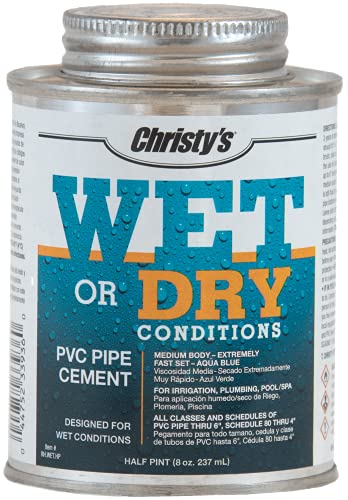
The Christy’s Wet Or Dry cement is uniquely formulated to bond PVC pipe when the surface is actively wet or in high-humidity conditions that compromise standard cements. This medium-bodied aqua blue formula sets extremely fast, ideal for outdoor sprinkler repairs or underground plumbing where you cannot guarantee dry surfaces.
Its low-VOC composition makes it more pleasant for confined crawlspace work, and it carries NSF certification for potable water systems. Users consistently report that it sets immediately and holds reliably even when applied to damp pipes — a rare capability that solves a very specific pain point for well owners and irrigation specialists.
Note that while it works without a primer for non-pressure systems up to 6 inches, pressure systems under 4 inches may also skip primer depending on local code. For beginners, the extremely fast set time means you must seat the fitting in under 60 seconds — there is no time for repositioning.
Why it’s great
- Bonds on wet pipes without strength loss
- Low-VOC formula for indoor use
- NSF certified for potable water
Good to know
- Extremely fast set leaves no adjustment window
- 8 oz size may not cover large-scale projects
2. Weld-On 711 Industrial Grade PVC Heavy-Bodied Cement

The Weld-On 711 is the heavy-bodied workhorse for schedule 80 pressure pipe and large-diameter PVC up to 12 inches. Its gray color matches the pipe resin for a clean professional appearance on exposed plumbing, and the paste-like consistency stays in place on vertical joints without dripping.
Unlike fast-set cements, the 711’s medium-setting time provides a controlled working window — critical for aligning heavy fittings in warm-weather installations. It meets ASTM D2564 and is NSF/ANSI 61 certified for potable water, making it a go-to for commercial plumbers and industrial maintenance crews.
Customers report that the heavy-bodied formula creates a visibly thicker bond line that withstands high pressure and thermal cycling. The only trade-off is that the slower cure requires you to hold the joint steady for a bit longer before it grips, but the resulting weld is the strongest in this lineup.
Why it’s great
- Highest pressure rating of any cement reviewed
- Thick paste fills gaps in loose-fitting joints
- Medium set time allows precise alignment
Good to know
- Gray color may not suit all aesthetic preferences
- Requires more effort to apply than thin formulas
3. Oatey Fusion One-Step Medium-Bodied Cement
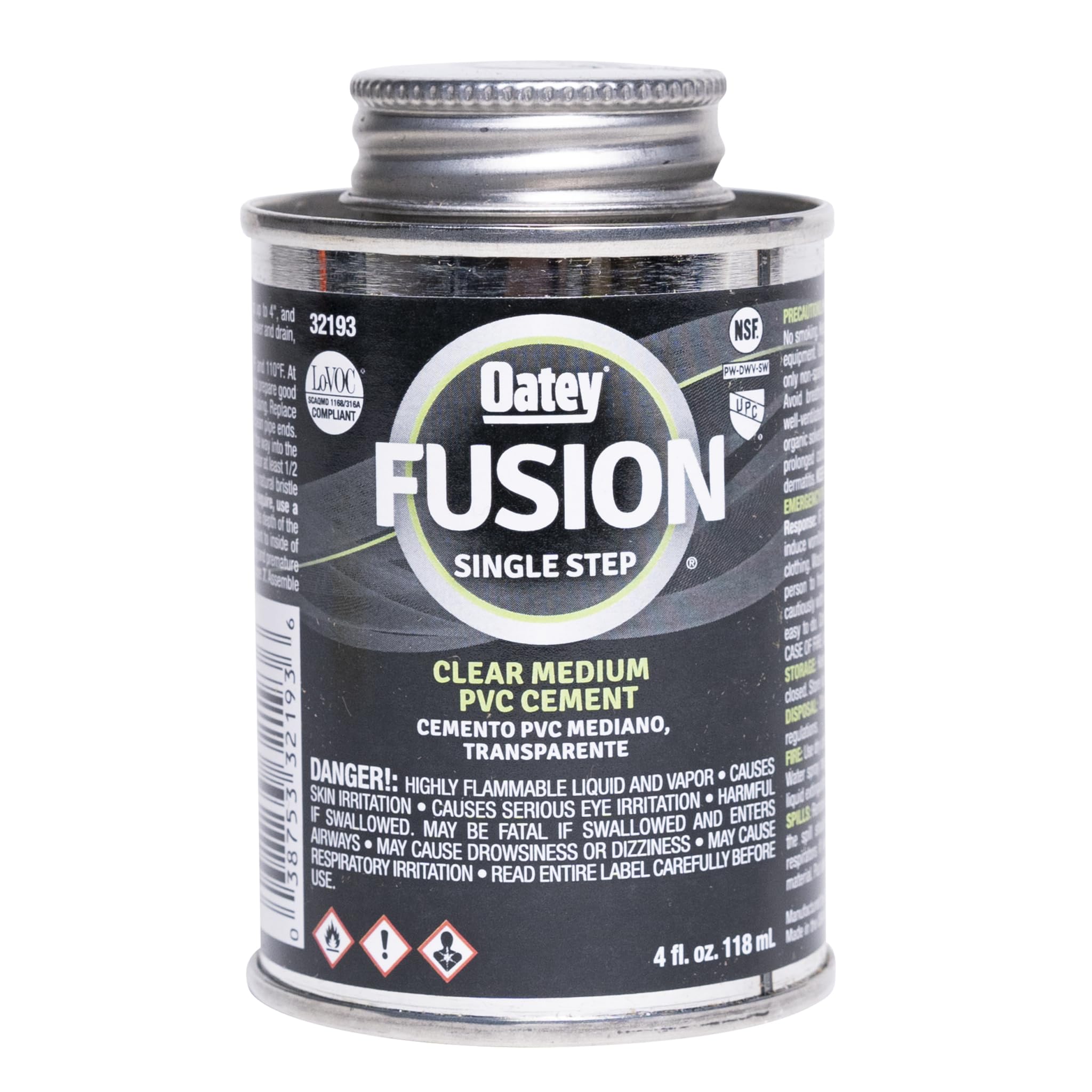
The Oatey Fusion One-Step eliminates the primer step entirely for DWV and conduit applications (where local code permits), saving time and reducing the mess of purple stains on fittings. Its clear formula dries to a nearly invisible bond line, which is appreciated in visible furniture or above-ground conduit projects.
Recommended for residential DIY plumbing up to 4 inches on pressure systems and 6 inches on non-pressure, this medium-bodied cement has a slightly slower set than Christy’s Wet Or Dry, giving beginners a more generous window to seat fittings. Users report it works well on new pipe but caution that old, oxidized PVC still benefits from traditional primer.
The low-odor formulation is a genuine advantage for indoor repairs — you can work in a basement without being overwhelmed by solvent fumes. However, for buried potable water lines, many codes still mandate a two-step primer-plus-cement approach, so check regulations before using this as your sole adhesive.
Why it’s great
- Self-priming saves time and reduces mess
- Low-odor formula for indoor comfort
- Clear finish for invisible repairs
Good to know
- Primer still recommended for old or weathered pipe
- Not universally code-approved for pressurized potable water
4. Christy’s Red Hot Blue Glue PVC Cement

Christy’s Red Hot Blue Glue sets up extremely fast and is designed for environments where you need the joint to grab immediately — underwater sprinkler repairs, outdoor irrigation, or any vertical pipe where holding the fitting in place is awkward. The vivid blue color makes it easy to see coverage and identify missed spots.
This 4 oz bottle is compact and uses a metal can with a dauber applicator that penetrates tight spaces. Users find that the very fast set time is both its greatest strength and its trickiest trait — you must seat the pipe in under a minute or risk the cement gelling before the joint is fully assembled. The blue color also shows up on white PVC, which can be visually distracting on visible work.
Several users noted that the metal lid can be difficult to reseal, and the cement thickens after a couple of uses once air gets in. For occasional repairs, this is a minor annoyance; for daily professional use, you may prefer a larger can with a more reliable seal.
Why it’s great
- Extremely fast set for immediate holding power
- Blue color shows coverage clearly
- Works underwater for irrigation repairs
Good to know
- No adjustment time — seat fitting immediately
- Lid seal degrades, causing cement to thicken
5. Oatey Heavy Duty Clear PVC Cement (16 oz)

The Oatey Heavy Duty Clear in the 16 oz can is the volume leader for jobs that require multiple joints — building a PVC greenhouse frame, running a long DWV line, or plumbing a new bathroom. The heavy-bodied formula fills gaps in large-diameter pipe and loose fitting joints while remaining clear for a clean finish.
Rated for all schedules and classes of PVC up to 12 inches with interference fit (and 18 inches for non-pressure), this cement handles everything from 1-inch sprinkler lines to 6-inch main drains. The low-VOC formulation meets California SCAQMD requirements, so it can be used on commercial projects with strict air quality compliance.
Users note that the heavy-duty consistency is messier than medium-bodied alternatives, especially if you are inexperienced with the applicator dauber. The slower cure time is actually an advantage here — you can adjust multiple fittings in a trunk line before the cement sets. For high-volume professional jobs, this is the most economical choice per joint.
Why it’s great
- Large 16 oz volume for many joints
- Fills gaps in oversized or loose fittings
- Clear finish for visible plumbing
Good to know
- Heavy body can be messy for beginners
- Applicator dauber on large can harder to control
FAQ
Can I use standard PVC cement on schedule 80 pipe?
Does one-step self-priming cement work as well as primer plus cement?
Why does my PVC glue dry jelly-like in the can after a few uses?
Final Thoughts: The Verdict
For most users, the adhesive for pvc pipe winner is the Christy’s Wet Or Dry PVC Cement because it handles the two most unpredictable variables — wet pipes and cold weather — while still being low-VOC and NSF certified for potable water. If you are working on schedule 80 pressure pipe or large-diameter industrial plumbing, grab the Weld-On 711 Gray for its gap-filling heavy body and maximum bond strength. And for DIY homeowners who want to skip the primer mess on DWV repairs, nothing beats the convenience of the Oatey Fusion One-Step.

Mo Maruf
I created WellFizz to bridge the gap between vague wellness advice and actionable solutions. My mission is simple: to decode the research and give you practical tools you can actually use.
Beyond the data, I am a passionate traveler. I believe that stepping away from the screen to explore new environments is essential for mental clarity and physical vitality.