Our readers keep the lights on and my smoothie glass nicely filled. As an Amazon Associate, I earn from qualifying purchases.
Polycarbonate is notoriously difficult to bond. Its chemical resistance, low surface energy, and tendency to craze under stress from harsh solvents mean that most general-purpose glues fail immediately — either the joint pops apart, or the solvent attacks the plastic, leaving a cloudy, weakened mess. A successful bond requires an adhesive that chemically fuses the polymer chains without causing environmental stress cracking, and that delivers a clear, impact-resistant seam that can handle the same loads as the base material.
I’m Mohammad Maruf — the founder and writer behind WellFizz. This guide is built on hundreds of hours of cross-referencing chemical compatibility charts, peel-strength data, and real-world user feedback from fabrication shops, aquarium builders, and automotive restorers who rely on polycarbonate daily.
After sorting through the options, the best adhesive for polycarbonate comes down to whether you need a fast-setting solvent cement, a flexible gap-filling epoxy, or a light-activated instant bond.
How To Choose The Best Adhesive For Polycarbonate
Choosing the wrong glue for polycarbonate can ruin a project. The plastic is vulnerable to chemical attack from solvents found in many common adhesives, which cause microscopic cracks called crazing. The correct adhesive must either be a compatible solvent cement that melts the plastic to create a fusion bond, or a specially formulated epoxy or cyanoacrylate that avoids aggressive solvents and maintains flexibility to match polycarbonate’s impact resistance.
Solvent Cement vs. Epoxy vs. Cyanoacrylate
Solvent cements like Weld-On 16 chemically fuse polycarbonate by dissolving the surface layers, creating a bond as strong as the parent material. These are ideal for structural seams but require precision and ventilation. Two-part epoxies, such as Bob Smith Industries Mid-Cure, offer gap-filling properties and work on dissimilar materials, but you need one without solvents that attack polycarbonate. Cyanoacrylates (super glues) set fast and work best for small repairs, but standard formulas can be brittle; look for specialized formulations like J-B Weld SuperWeld that list polycarbonate compatibility.
Working Time and Cure Speed
Fast-setting options (30 seconds to 2 minutes) are great for quick repairs where you can clamp parts immediately. Slower options (15-minute working time) allow you to position and reposition components precisely, which is critical for complex fabrications or large surface area bonds. Light-activated glues offer the best of both — you can take your time positioning, then cure instantly with a UV light.
Clarity and Aesthetic Finish
Polycarbonate is valued for its optical clarity. Many adhesives dry yellow or leave a visible glue line. For transparent projects like display cases or greenhouse panels, you need an adhesive that dries crystal clear and does not fog the surrounding plastic. Solvent cements typically provide the clearest, most invisible joint because they create a homogenous bond.
Quick Comparison
On smaller screens, swipe sideways to see the full table.
| Model | Category | Best For | Key Spec | Amazon |
|---|---|---|---|---|
| Weld-On 16 | Solvent Cement | Structural fusion bonds | 5-6 min working time | Amazon |
| Bob Smith Mid-Cure Epoxy | Epoxy | Gap-filling repairs | 15 min working time | Amazon |
| J-B Weld SuperWeld 2-Pack | Cyanoacrylate | Quick high-strength bonds | 3500 PSI tensile | Amazon |
| J-B Weld Light Activated | UV Cure | Precision instant repairs | 10 sec UV cure | Amazon |
| Loctite Vinyl & Fabric | Contact Cement | Flexible fabric-to-plastic | 24 hr full cure | Amazon |
In‑Depth Reviews
1. Weld-On 16 Acrylic Plastic Cement

The Weld-On 16 is the gold standard for joining polycarbonate to itself or to other plastics like acrylic and ABS. As a solvent cement, it works by chemically melting the surface of the plastic, fusing the two pieces into a single monolithic part when the solvent evaporates. The result is a joint that is as strong as the surrounding material, with near-invisible clarity — no glue line, no yellowing.
With a working time of 5 to 6 minutes and a medium-body consistency, this cement flows easily into tight seams without running everywhere, but it is thick enough to stay put on vertical surfaces. It bonds not only polycarbonate but also rigid PVC, styrene, and butyrate, making it a versatile shop staple. The low-VOC formulation is a welcome improvement over older solvent cements, though you still need good ventilation.
Users consistently praise its fast grab and permanent hold on 3D-printed PLA and polycarbonate parts, though the tube design can be messy — the thin liquid pours out if you squeeze too hard. Practice on scrap pieces first to get a feel for the flow. For any project where optical clarity and structural integrity matter most, this is the adhesive to reach for.
Why it’s great
- Chemically fuses polycarbonate for invisible, parent-material-strong seams
- Medium viscosity stays on vertical surfaces without dripping
- Works on polycarbonate, acrylic, ABS, PVC, and styrene
Good to know
- Tube packaging can leak if not stored horizontally
- Strong fumes require proper ventilation during use
- Not suitable for bonding polycarbonate to metal or wood
2. Bob Smith Industries Mid-Cure Epoxy
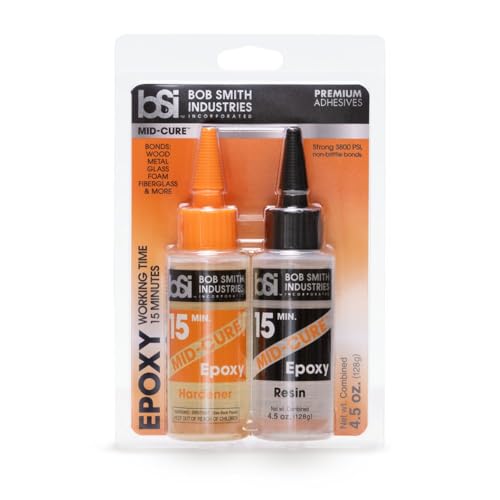
When you need to bond polycarbonate to wood, metal, or fiberglass, or when you are filling a gap left by imperfectly fitted parts, a two-part epoxy like Bob Smith Industries Mid-Cure is your best tool. Unlike solvent cements that only work on plastics, this epoxy grips a wide range of materials and creates a tough, impact-resistant bond that stands up to stress and environmental wear.
The 15-minute working time is generous — you can mix a batch, apply it, and carefully position parts without rushing. The medium-thick consistency fills small gaps and bridges uneven surfaces where thin cyanoacrylates would just wick away and fail. After curing for 30 to 45 minutes, the bond is rigid and durable, and the full cure at 2 hours delivers maximum strength.
Model builders and DIY enthusiasts love this epoxy for its reliability and long shelf life — the separate bottles never harden in storage like syringe dispensers do. The one downside is that it dries to a light amber color rather than completely clear, which may be noticeable on transparent polycarbonate assemblies. For structural repairs where appearance matters less than raw holding power, this epoxy is a solid choice.
Why it’s great
- Unlimited open time lets you reposition parts without hurry
- Gap-filling formula bridges uneven seams
- Adheres polycarbonate to wood, metal, fiberglass, and ceramics
Good to know
- Dries to a light amber color, not fully clear
- Requires mixing resin and hardener before each use
- Not a solvent weld — bond strength is lower than fusion
3. J-B Weld SuperWeld 2-Pack

The J-B Weld SuperWeld is a professional-grade cyanoacrylate that delivers a 3500 PSI tensile strength bond in just 30 seconds. It is one of the few super glues explicitly formulated to work on rigid plastics like polycarbonate without causing crazing, thanks to its controlled chemistry. The precision tip applicator lets you place tiny drops exactly where needed, which is critical for small repairs and intricate assemblies.
This glue bonds more than just plastic — it grips metal, stone, concrete, fiberglass, glass, and wood, making it a versatile addition to any toolbox. The gel formulation is a standout feature; it does not run or drip, so it stays on vertical surfaces and in gaps without making a mess. Users report that it holds tight on automotive parts, household repairs, and 3D-printed components alike.
Be prepared for instant bonding. Once the two surfaces touch, you have virtually no time to reposition, so dry-fit everything first. The 30-second set time is genuinely fast, and the full 24-hour cure yields a bond that feels as solid as a mechanical joint. For a grab-and-go adhesive that works on polycarbonate and a host of other materials, this two-pack delivers outstanding value.
Why it’s great
- Sets in 30 seconds with a 3500 PSI tensile strength
- Gel consistency prevents drips on vertical surfaces
- Works on polycarbonate, metal, wood, glass, and fiberglass
Good to know
- No repositioning possible after contact
- Bonds skin instantly — handle with care
- Tube size is small for larger surface area projects
4. J-B Weld Light Activated Superglue

The J-B Weld Light Activated Superglue solves the biggest frustration of instant adhesives: premature setting. You apply the glue, position your polycarbonate parts exactly where you want them, and only when you shine the included UV light does the bond cure — in just 10 seconds. This gives you unlimited working time for complex alignments where every millimeter matters.
The cured glue is exceptionally hard and crystal clear, matching the optical transparency of polycarbonate itself. With a tensile strength of 2800 PSI, the bond is strong enough for structural repairs on 3D prints, jewelry, automotive trim, and delicate model work. It also cures without the light — it will set in 1 minute and reach full strength in 24 hours — but the UV feature is where the magic happens for precision jobs.
Users consistently warn about two quirks. First, the UV light can burn skin in seconds, so keep it away from your fingers. Second, the cap tends to fuse to the tube if you do not clean the threads thoroughly after each use. Despite these minor frustrations, the ability to cure on command makes this adhesive indispensable for anyone doing detailed polycarbonate repairs or assembly.
Why it’s great
- Unlimited working time — cures only when you apply UV light
- Dries crystal clear and hard as glass
- UV light is included in the cap for portability
Good to know
- UV light can cause skin burns if not handled carefully
- Tube cap fuses shut if threads are not cleaned
- Premium price for the convenience of light activation
5. Loctite Vinyl, Plastic & Fabric Adhesive

The Loctite Vinyl, Plastic, and Fabric Adhesive takes a different approach to bonding polycarbonate. Rather than creating a rigid weld or a hard epoxy joint, this adhesive forms a flexible, rubbery bond that moves with the material. This makes it ideal for applications where the polycarbonate will flex or vibrate, such as attaching fabric or vinyl trim to polycarbonate panels in boat seats or lawn mower cushions.
The paste-like consistency stays where you put it and does not run, making it easy to apply to vertical surfaces. It dries clear and remains flexible enough to handle thermal expansion and impact without cracking. Users report excellent results on vinyl bar stools and padded seats, with bonds lasting through an entire season of outdoor use. The 24-hour full cure time requires patience, but the result is a durable, peel-resistant seam.
Be careful during application — the adhesive tends to form “strings” when you pull the applicator away, which can create a mess if you are not deliberate with your technique. Also, while it works well on polycarbonate for flexible, fabric-to-plastic bonds, it is not the right choice for rigid structural joins. For those specific use cases, this budget-friendly tube performs exactly as advertised.
Why it’s great
- Flexible bond handles vibration and thermal expansion
- Clear finish dries invisible on most surfaces
- Great for attaching fabric, vinyl, or foam to polycarbonate
Good to know
- Creates stringy residue if not applied cleanly
- 24-hour full cure requires overnight clamping
- Not designed for rigid structural polycarbonate joints
FAQ
Will standard super glue work on polycarbonate?
Can I use Weld-On 16 on colored polycarbonate?
How do I prevent the glue from drying in the tube?
Final Thoughts: The Verdict
For most users, the adhesive for polycarbonate winner is the Weld-On 16 because it creates a true chemical fusion that is as strong as the plastic itself and leaves an invisible joint. If you need a gap-filling epoxy that bonds polycarbonate to wood or metal with generous working time, grab the Bob Smith Mid-Cure Epoxy. And for precision repairs where you want unlimited positioning time and instant UV-cured strength, nothing beats the J-B Weld Light Activated Superglue.

Mo Maruf
I created WellFizz to bridge the gap between vague wellness advice and actionable solutions. My mission is simple: to decode the research and give you practical tools you can actually use.
Beyond the data, I am a passionate traveler. I believe that stepping away from the screen to explore new environments is essential for mental clarity and physical vitality.