Our readers keep the lights on and my smoothie glass nicely filled. As an Amazon Associate, I earn from qualifying purchases.
Plastic repairs fail when the adhesive can’t flex with the substrate or doesn’t chemically key to the polymer surface. The result is a brittle joint that pops apart under the slightest stress, leaving you back at square one with a broken part and a wasted tube of glue. Choosing the right chemistry for your specific plastic type determines whether the bond outlasts the item or fails within days.
I’m Mohammad Maruf — the founder and writer behind WellFizz. I’ve spent years analyzing adhesive formulations, tensile strengths, and cure mechanisms to match the right bonding system to the right plastic substrate.
After evaluating cure speed, gap-filling ability, and bond flexibility across five leading contenders, I’ve identified the best adhesive for plastic repairs that delivers professional-grade results without requiring a workshop full of equipment.
How To Choose The Best Adhesive For Plastic
Not all adhesives bond to all plastics. Polypropylene (PP) and polyethylene (PE) have low surface energy and resist most glues without a specialized primer, while ABS, PVC, and polycarbonate accept a wider range of chemistries. Matching the adhesive to both the plastic type and the mechanical load on the joint is the single most important decision you’ll make.
Chemistry Type: Urethane vs Epoxy vs Cyanoacrylate
Urethane adhesives like J-B Weld Plastic Bonder flex with the substrate and fill gaps, making them ideal for automotive bumpers and outdoor gear that experience vibration and temperature swings. Epoxies provide high compressive strength and are excellent for filling cracks and rebuilding missing sections. Cyanoacrylates (super glues) cure fastest but remain brittle; they work best on tight-fitting, non-stressed joints where speed matters more than impact resistance.
Gap-Filling Ability and Viscosity
Thin, runny adhesives wick into hairline cracks and capillary gaps but leave voids in uneven repairs. Thick pastes and putties bridge gaps up to several millimeters and allow you to sculpt the repair. For cracked housings or broken mounting tabs, a medium-to-thick formula prevents the glue from draining away before it cures.
Cure Time and Work Time
Some repairs need instant grab — reattaching a bracket that must hold position immediately. Others benefit from a longer work window to align parts precisely. Fast-curing cyanoacrylates set in seconds, while two-part epoxies and urethanes offer 5 to 30 minutes of adjustment time before the chemical reaction locks everything in place.
Quick Comparison
On smaller screens, swipe sideways to see the full table.
| Model | Category | Best For | Key Spec | Amazon |
|---|---|---|---|---|
| J-B Weld Plastic Bonder Black | Urethane | High-impact structural repairs | 3770 PSI tensile strength | Amazon |
| 3M Scotch-Weld PR100 | Cyanoacrylate | Fast repairs on rubber and silicone | Handling time <20 seconds | Amazon |
| J-B Weld Light-Activated Superglue | UV Cyanoacrylate | Precision clear repairs on glass-like surfaces | 2800 PSI, UV-cured in 10 sec | Amazon |
| Loctite Vinyl, Plastic, and Fabric Adhesive | Contact Cement | Flexible bonds on vinyl and fabric-backed plastic | 24-hour full cure | Amazon |
| Endhokn Epoxy Putty | Epoxy Putty | Filling cracks and underwater repairs | 300g capacity, cures in 24 hrs | Amazon |
In‑Depth Reviews
1. J-B Weld Plastic Bonder Black 25ml Syringe – 2 Pack
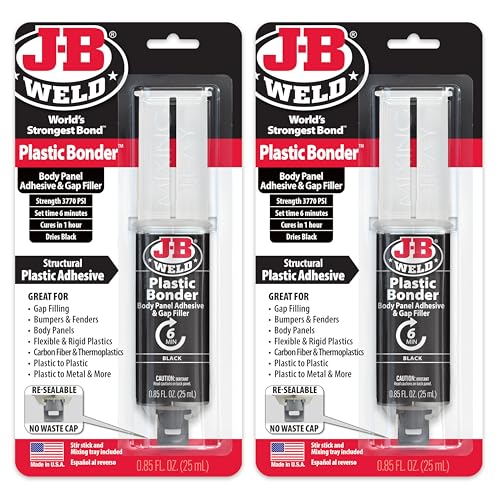
This two-part urethane system delivers a 3770 PSI tensile strength that rivals the structural integrity of the original plastic part. The 1:1 syringe dispenses equal parts automatically, eliminating guesswork and ensuring the correct chemical ratio every time. The black color blends seamlessly into automotive trim, bumpers, and dark plastic housings.
With a 15-minute set time and 30-hour full cure, you have enough working time to clamp complicated assemblies. Users report repairing cracked bumper brackets, scooter steering components, and even windshield wiper covers — the cured material sands and drills like hard plastic. The resealable cap preserves unused adhesive for multiple sessions.
The urethane chemistry provides flexibility that epoxy lacks, making it suitable for parts that experience vibration or thermal expansion. Apply it to thermoplastics, thermoset composites, fiberglass, and coated metals. For any structural plastic repair that must hold under load, this is the reference standard.
Why it’s great
- 3770 PSI tensile strength bonds rigid plastic parts permanently
- Dual-syringe design ensures perfect 1:1 ratio every time
- Sands, drills, and paints like original plastic after curing
Good to know
- Not compatible with polypropylene or polyethylene without a primer
- Chemical smell requires good ventilation during application
2. 3M Scotch-Weld Plastic & Rubber Instant Adhesive PR100

This clear, low-viscosity cyanoacrylate is formulated specifically for difficult substrates like silicone rubber, EPDM, heavily plasticized PVC, and Santoprene. The handling time under 20 seconds means parts lock together almost instantly, making it ideal for production-line assembly or quick field repairs where downtime is expensive.
The flexible container allows precise drop-by-drop application or a steady bead for longer joints. Despite the small 20-gram bottle, a single drop goes a long way. Users have repaired radiator leaks, dishwasher-safe blender pitchers, and eyeglass frames — applications where standard super glues fail. The bond remains strong even on oily or slightly contaminated surfaces.
Be aware that this product is labeled for industrial/occupational use. The fast cure leaves no time for repositioning, so dry-fit your parts beforehand. Store the bottle in the refrigerator to extend shelf life, and always wear gloves — the adhesive bonds skin in seconds.
Why it’s great
- Bonds silicone rubber and EPDM where standard CA glues fail
- Handling strength achieved in under 20 seconds
- Low viscosity wicks into tight capillary gaps
Good to know
- Premium price per ounce compared to consumer super glues
- No working time for repositioning; alignment must be perfect immediately
3. J-B Weld Light-Activated Superglue, Clear, 5g, 2-Pack

This light-activated cyanoacrylate cures in 10 seconds when exposed to the included UV light, giving you control over when the bond sets — an advantage over traditional instant adhesives that harden the moment surfaces touch. The formula remains liquid indefinitely until UV radiation triggers the cure, allowing unlimited repositioning time.
Once cured, the bond is as clear and hard as glass, making it ideal for transparent repairs on eyeglasses, display cases, and clear plastic housings. The 2800 PSI tensile strength rivals structural epoxies while maintaining a nearly invisible finish. It also cures without the UV light — set in 1 minute and full cure in 24 hours — offering flexibility if the light is misplaced.
The precision tip applicator prevents mess on small parts, but the cap tends to adhere to the tube if residue isn’t cleaned after each use. The UV light itself can cause skin burns if held in place too long, so work quickly and keep the beam moving.
Why it’s great
- UV control allows unlimited repositioning before curing
- Cures crystal clear, hard as glass — invisible on transparent plastics
- 2800 PSI strength in a precision applicator format
Good to know
- UV light can burn skin if held stationary
- Cap frequently bonds to tube if threads aren’t cleaned after each use
4. Loctite Vinyl, Plastic, and Fabric Adhesive, Pack of 2 Clear

This contact cement-style adhesive is tailor-made for bonding fabric to vinyl, vinyl to plastic, and other flexible combinations where a rigid epoxy would crack. The paste consistency stays where you apply it without running, and the clear finish disappears into seams and edges. The two-pack gives you a backup tube for larger projects.
Proper surface preparation is essential — users who sanded and cleaned the substrate reported bonds that lasted an entire mowing season on lawn mower seat padding. The adhesive works on vinyl blinds, fabric trim, and custom action figure masks where flexibility matters more than raw tensile strength. Full cure takes 24 hours, so clamp or tape the joint overnight.
The main drawback is stringing during application — the adhesive pulls long threads if you lift the applicator too quickly. Work in short, deliberate strokes and keep a damp rag nearby to wipe excess. For non-structural repairs on flexible plastic assemblies, this is the most budget-friendly option.
Why it’s great
- Flexible bond ideal for vinyl, fabric, and soft plastic combinations
- Clear finish disappears on most surfaces
- Two tubes included for extended use
Good to know
- Tends to string during application if lifted too quickly
- 24-hour full cure requires patience and clamping
5. Endhokn Epoxy Putty, 10.5oz White Putty Stick

This two-part epoxy putty comes in a 300-gram stick that you hand-knead until uniform, then press into cracks, holes, or gaps. The 30-minute work window is generous enough for sculpting complex repairs — rebuilding chipped ceramic legs, sealing 2-inch AC pipe penetrations, or filling gaps in plastic plumbing fixtures.
Once cured in 24 hours, the putty can be drilled, sanded, and painted. It withstands temperatures from -50°C to 130°C and works underwater, making it suitable for swimming pool repairs, leaking pipes, and outdoor equipment. The kit includes gloves and a scraper, so you don’t need extra tools to get started.
The putty has a greasy feel during kneading — a dab of petroleum jelly on your fingers helps smooth the surface. It cures to a matte white finish that accepts paint well. For repairing large missing sections or filling deep voids in plastic and ceramic, this putty delivers exceptional volume at a budget-friendly price.
Why it’s great
- Large 300g capacity for filling substantial gaps and cracks
- Cures underwater and withstands high temperature extremes
- Can be drilled, sanded, and painted after full cure
Good to know
- Greasy feel during kneading; use petroleum jelly for smoother handling
- 30-minute work time is shorter than some competitive epoxy putties
FAQ
Can I use the same adhesive on polypropylene and ABS plastic?
How do I prepare a plastic surface for the strongest bond?
Why does my super glue turn white around the repair area?
What adhesive should I use for outdoor plastic repairs exposed to rain and UV?
Final Thoughts: The Verdict
For most users, the best adhesive for plastic winner is the J-B Weld Plastic Bonder Black because its urethane chemistry delivers the best balance of flexibility, tensile strength, and ease of use for structural repairs. If you need instant bonding on difficult rubbers and silicones, grab the 3M Scotch-Weld PR100. And for filling large gaps or rebuilding missing plastic sections, nothing beats the volume and versatility of the Endhokn Epoxy Putty.

Mo Maruf
I created WellFizz to bridge the gap between vague wellness advice and actionable solutions. My mission is simple: to decode the research and give you practical tools you can actually use.
Beyond the data, I am a passionate traveler. I believe that stepping away from the screen to explore new environments is essential for mental clarity and physical vitality.