Our readers keep the lights on and my smoothie glass nicely filled. As an Amazon Associate, I earn from qualifying purchases.
Marble is a porous, brittle natural stone that demands a specialized bonding approach. Standard epoxies or construction glues often fail because they cannot handle the material’s thermal expansion rate or its moisture sensitivity, leading to yellowed seams or weak repairs that pop loose under light stress. The specific chemistry of an adhesive for marble must be low-viscosity enough to penetrate micro-cracks yet rigid enough after curing to match the stone’s hardness — a balance that commodity glues simply do not deliver.
I’m Mohammad Maruf — the founder and writer behind WellFizz. I’ve spent the last several years building deep market intelligence around specialty stone repair formulations, analyzing resin chemistries, cure times, and tensile bond strengths to separate legitimate repair kits from poorly compounded imitations that stain or fail to grip porous surfaces.
Choosing the right adhesive for marble means evaluating the repair type — chip filling versus reattachment versus crack injection — and matching the product’s viscosity, working time, and color-matching system to your specific stone finish. A clear cyanoacrylate formula that cures in seconds works well for re-bonding broken edges, while a two-part pigmented paste is better suited for filling a chipped corner on a high-traffic countertop.
How To Choose The Best Adhesive For Marble
Selecting the correct formula depends on the damage type, the stone’s porosity, and the finish you need to match. Three variables separate a lasting repair from one that debonds or discolors.
Repair Type: Reattachment vs. Filling
A broken edge that needs rejoining requires a fast-setting adhesive with high tensile strength — cyanoacrylate (super-glue-style) formulas work best because they bond in seconds and cure rock-hard. For surface chips, holes, or scratches, a two-part epoxy paste with color-matching pigments gives you time to shape the fill and sand it flush with the surrounding stone. Mixing up the two approaches is the most common DIY mistake in this category.
Viscosity and Capillary Action
Thin, watery adhesives wick into hairline cracks and porous stone surfaces, creating a deep mechanical bond. Thicker pastes stay on the surface and are better suited for filling voids. If your marble has a visible crack, a low-viscosity formula plus an accelerator spray ensures the glue penetrates before curing. For a chipped edge, a medium-viscosity paste stays put without dripping down the slab face.
Color Matching and Finish
White marble with gray veining cannot be hidden with a clear or white-only paste. Kits that include pigment pastes — black, brown, ochre, beige — allow you to blend a custom shade that mimics the stone’s natural variation. After curing, the repair must be sandable and polishable to match the original gloss level. A repair that fails on color contrast will be more noticeable than the original damage.
Quick Comparison
On smaller screens, swipe sideways to see the full table.
| Model | Category | Best For | Key Spec | Amazon |
|---|---|---|---|---|
| Akfix 710 Stone and Marble Fast Adhesive | Cyanoacrylate + Spray | Rapid reattachment of broken edges | Cure in under 10 seconds | Amazon |
| HIMG Glue Adhesive for Granite, Marble, Stone | Acrylic Syringe | Thin-bond-line reattachment | Cure Hard in 5 Minutes | Amazon |
| Marble and Granite Repair Kit (Color Match) by XUDOAI | Resin Paste Kit | Large-area chip filling with color blending | 24-hour full cure, 160g capacity | Amazon |
| LANBOKIT Tile, Granite and Marble Repair Kit | Pigmented Paste Kit | Budget-friendly color-matched chip repair | 50g + 50g two-part paste | Amazon |
| NNRepair Marble Countertop Repair Kit (Clear) | Clear UV-Cure | Invisible repairs on polished stone | UV-cure in 3 minutes | Amazon |
In‑Depth Reviews
1. Akfix 710 Stone and Marble Fast Adhesive (1.76 oz.) with Activator
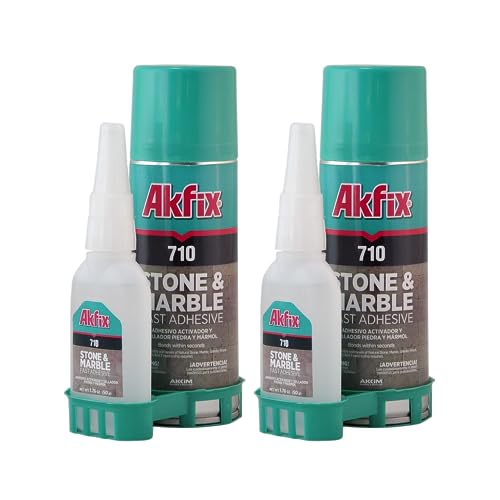
The Akfix 710 system uses a high-viscosity cyanoacrylate gel paired with an aerosol activator spray, which together can bond porous natural stone surfaces in less than ten seconds. This speed makes it the best option for reattaching a broken marble slab edge or repairing a cracked countertop where clamping is impractical — the activator instantly cures the adhesive on contact, so you can release pressure almost immediately. Users have successfully repaired marble trays broken into five pieces and granite slabs over an inch thick, with the bond holding under transport and handling.
Because the formula is cyanoacrylate-based, it delivers exceptional tensile strength and a thin bond line, which is critical for seamless reattachment on polished marble faces. The activator spray also allows the glue to set on surfaces that would normally resist cyanoacrylate due to their porosity — a common failure point with standard super glues. The included aerosol can provides multiple applications, and the gel consistency prevents dripping or running on vertical surfaces like backsplashes or monument faces.
The main trade-off is staining risk on lighter stones, particularly white marble, where the adhesive can leave a visible mark if not applied with extreme precision. Some users find the printed instructions too small to read and recommend watching a short video tutorial before starting. Proper ventilation and eye protection are also important, as the activator spray is potent. For non-porous or very tight hairline cracks, a lower-viscosity epoxy may be a better choice than this fast-curing gel.
Why it’s great
- Full cure in under ten seconds — no clamping required for small pieces.
- High viscosity formula stays on vertical surfaces without running.
- Activator enables bonding on porous marble and granite that reject standard super glue.
Good to know
- Can stain white or light-colored marble if the adhesive spreads beyond the joint.
- Activator aerosol requires good ventilation and eye protection.
- Not designed for filling surface chips or holes — use a pigmented paste instead.
2. HIMG Glue Adhesive for Granite, Marble, Stone, Corian, Quartz

HIMG is a two-part acrylic adhesive designed specifically as an alternative to epoxy for stone bonding. It cures hard in roughly five minutes, giving you just enough working time to position the pieces before the bond locks. The syringe format dispenses a precise strip of both components simultaneously, which is ideal for thin-bond-line applications on cracks, seams, or reattaching a small marble corner. Users report that it does not yellow over time — a key advantage over standard epoxy on white or light stone.
The non-toxic, odorless formulation makes it a more comfortable choice for indoor repairs compared to solvent-based adhesives or strong cyanoacrylates. It bonds well to granite, cultured marble, quartz, and porcelain, and the acrylic chemistry offers a bit more flexibility than brittle cyanoacrylate, which can be beneficial on stone that experiences minor thermal movement. Multiple customer reviews confirm success fixing cracks in kitchen marble countertops where the joint remained stable under regular use.
Some users have reported bonding failures on certain granite surfaces, particularly when the stone was very dense or had a polished finish that the acrylic could not grip effectively. The kit ships with only two mixing nozzles, and because the nozzle cures into the syringe, each clogged nozzle effectively ends that tube’s service life. The 30-gram tube is also small — sufficient for a single repair, but not enough for multiple large jobs or deep crack filling. For edge reattachment on polished granite, a cyanoacrylate system with an activator may provide a more reliable bond.
Why it’s great
- Acrylic formula resists yellowing better than epoxy on light stone.
- Precise syringe applicator allows clean, controlled bead placement.
- Non-toxic and odorless — suitable for indoor kitchen repairs.
Good to know
- Small tube size limits use to a single repair job.
- Mixing nozzle clogs easily and is not replaceable.
- Inconsistent adhesion on some polished granite surfaces.
3. Marble and Granite Repair Kit (Color Match) by XUDOAI

This XUDOAI kit packs 160 grams of two-part resin paste — more than three times the volume of most syringe-based adhesives — and includes five color gels for custom blending. The generous quantity makes it a strong choice for multiple repairs across countertops, floors, and tiles, or for filling deep chips that require several layers. After mixing part A and part B in a 1:1 ratio, the paste cures fully in 24 hours, at which point it becomes waterproof and can be sanded and polished to a smooth finish.
The color-matching system is genuinely useful on granite and darker marble, where blending black, brown, and beige pastes can replicate the stone’s natural variation. Users have successfully hidden chips on black granite countertops, white floor tiles, and marble bathroom ledges. The kit includes all necessary tools — mixing spatulas, sandpaper, and a detailed guide — so a beginner can work through the repair without buying extra equipment. The cured resin is exceptionally strong, holding up to daily cleaning and countertop weight without cracking.
The kit’s main limitation is its opacity: the base paste is solid white, which lacks the translucency that real marble has. On veined or lightly colored marble, the repair area can look like gray putty rather than natural stone. The paste also remains runny until it begins to set, so filling an edge chip often requires taping a mold to contain the material. For marble with pronounced crystalline translucency, a clear epoxy or UV-cure resin will deliver a more invisible result than this pigmented paste.
Why it’s great
- Large 160g volume covers multiple repairs or deep fill jobs.
- Five color gels enable custom shading for granite and dark marble.
- Fully waterproof and sandable after 24-hour cure.
Good to know
- Opaque white base paste lacks translucency for lighter marble.
- Runny consistency requires taping molds for edge repairs.
- Poor match for thin veining or crystalline stone patterns.
4. LANBOKIT Tile, Granite and Marble Repair Kit (Color Match)

LANBOKIT offers a two-part paste system (50g A + 50g B) with four color paste packets that cover white, beige, gray, black, brown, and several other common stone tones. The kit is designed for first-time DIY users who need clear instructions and all tools included — the package comes with a spatula, mixing board, sanding tool, and step-by-step manual. After curing, the repair becomes waterproof and durable enough for countertops, shower surrounds, and floor tiles, according to multiple customer reports.
The color-matching approach relies on mixing small dots of pigment into the base paste until the shade matches the damaged area. Users who took their time with incremental additions reported nearly invisible repairs on white and light-gray stone. The paste sands easily once cured, and the final finish can be polished to a decent sheen, though it may not reach the exact gloss of high-end polished marble. At this entry-level price point, the kit performs well for filling small chips, scratches, and holes on granite, quartz, and porcelain.
The biggest drawback reported across reviews is the messiness of the packaging — the adhesive can leak during shipping, and the pigment tubes may burst if compressed. Color matching is genuinely difficult for anything beyond basic solid colors; matching a multi-veined marble or a stone with subtle undertones often requires multiple passes and a good eye. Some users found that the cured surface left a dull ring around the repair that required extra sanding and polishing to blend. For professional-level invisibility on high-end marble, a more sophisticated system with a clearer base resin would be a better investment.
Why it’s great
- Low entry price with a complete tool set for first-time users.
- Four pigment colors cover a wide range of common stone shades.
- Cured fill is waterproof and durable for kitchen and bath surfaces.
Good to know
- Packaging prone to leaking during shipping.
- Color matching is frustrating on multi-toned or veined stone.
- May leave a visible dull ring that requires extra polishing.
5. NNRepair Marble Countertop Repair Kit (Clear Color + Polisher)
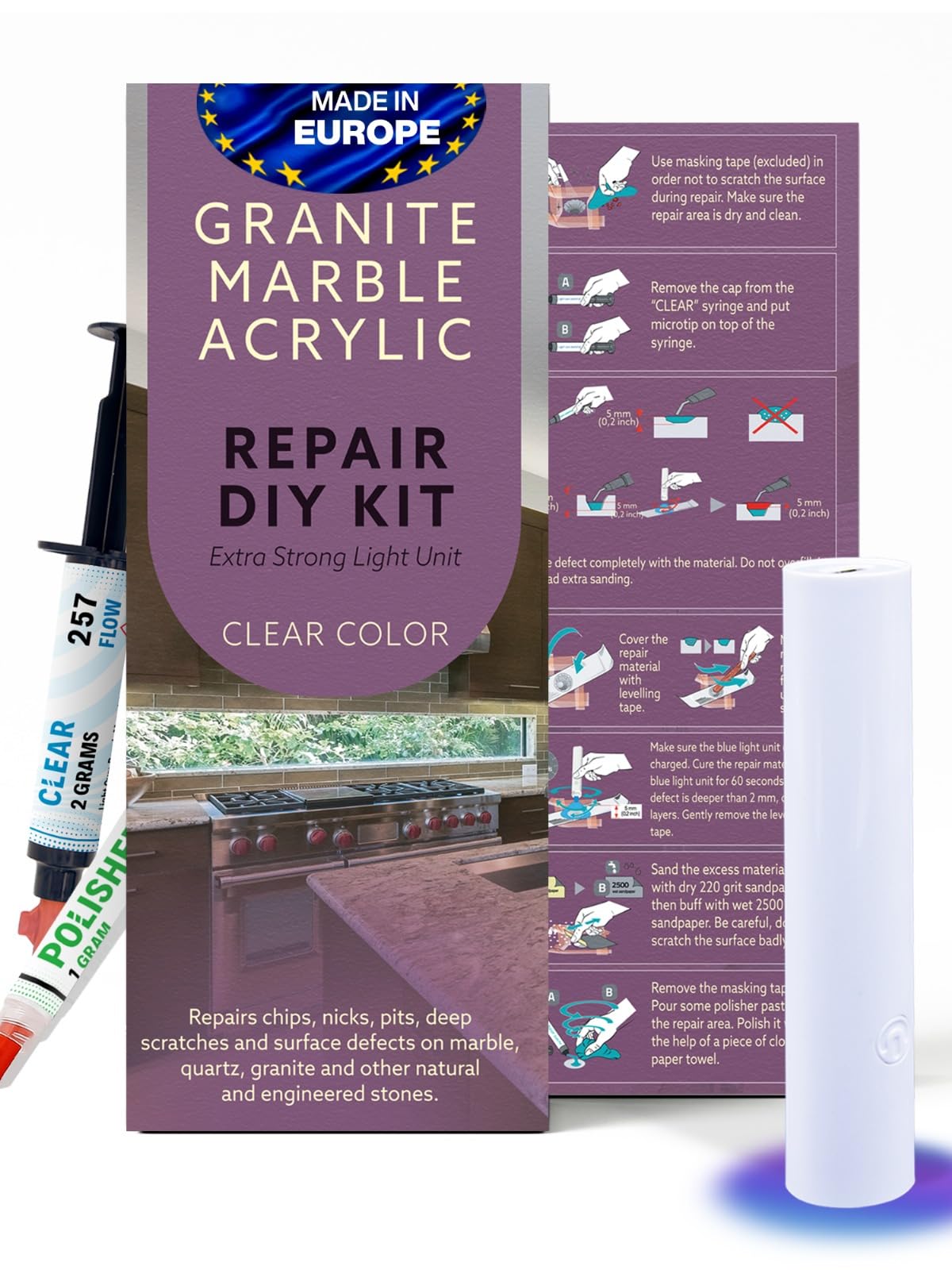
NNRepair’s kit is built around a clear, UV-curing resin that eliminates the color-matching struggle entirely for certain types of damage. The syringe delivers a transparent material that fills a chip or crack and then cures in about three minutes under the included UV light. Because the resin is clear, it works best on polished granite and marble where the repair area is small enough that light refracts through the fill similarly to the surrounding stone. The kit also includes polishing paste and sandpapers so the final surface can be buffed to a high gloss.
This system is particularly good for edge chips on busy-pattern stones like Volga Blue granite, where the natural variation in the stone hides the clear fill. Users have reported that repairs on granite countertops were virtually invisible after sanding and polishing, with the cured resin matching the surrounding gloss level. The kit includes everything needed — mixing stick, microtip applicator, leveling tape, and detailed instructions — so no separate tools are required. It is also effective for repairs on quartz, Corian, and acrylic surfaces.
The clear formula has one major limitation: it does not work well on solid-color marble or stone where the repair area is large enough to be seen as a transparent spot. Some users also reported that the resin failed to cure properly when applied in a wide, thin layer (over a four-inch-wide area), remaining sticky even after extended UV exposure. The manufacturer advises applying in narrow passes, which requires patience and steady hands. For pitted areas or large surface damage, this kit is less suitable than a pigmented paste system.
Why it’s great
- Clear resin requires no color matching on patterned or busy stones.
- Fast three-minute UV cure with included light unit.
- Polishing compound restores high-gloss finish after sanding.
Good to know
- Not suitable for solid-color marble — the clear fill is visible.
- Resin may not cure if applied in a layer wider than two inches.
- Requires steady hands and multiple narrow passes for larger chips.
FAQ
Can I use regular super glue to repair a cracked marble countertop?
How do I match the color of my marble when using a repair kit?
Why did my marble repair adhesive fail to cure properly?
Can a marble adhesive repair be sanded and polished to look like the original surface?
Final Thoughts: The Verdict
For most users, the adhesive for marble winner is the Akfix 710 Stone and Marble Fast Adhesive because its cyanoacrylate gel plus activator spray delivers a rock-hard bond in seconds on porous natural stone, making it the most reliable tool for reattaching broken corners, edges, and slabs. If you need a large-volume color-matched paste for filling chips across multiple surfaces, grab the XUDOAI Marble and Granite Repair Kit. And for an invisible repair on patterned granite or quartz where color matching is impossible, nothing beats the NNRepair Clear UV-Cure Kit.

Mo Maruf
I created WellFizz to bridge the gap between vague wellness advice and actionable solutions. My mission is simple: to decode the research and give you practical tools you can actually use.
Beyond the data, I am a passionate traveler. I believe that stepping away from the screen to explore new environments is essential for mental clarity and physical vitality.