Our readers keep the lights on and my smoothie glass nicely filled. As an Amazon Associate, I earn from qualifying purchases.
The hinge pin on your favorite earring snapped, the stone on your heirloom ring is loose, or you just spent an hour stringing a gemstone bracelet only for a knot to slip. In the world of jewelry making and repair, a single gram of the wrong adhesive turns a delicate project into a brittle mess or a cloudy catastrophe. The difference between a piece that lasts decades and one that fails in a week is measured in the adhesive’s chemistry, cure profile, and gap-filling ability.
I’m Mohammad Maruf — the founder and writer behind WellFizz. My approach to product analysis focuses on dissecting the material science behind each formula, from durometer hardness and viscosity to yellowing resistance and cure time, to find what truly delivers for delicate work.
Whether you’re a professional jeweler setting a stone or a hobbyist sealing a UV resin charm, choosing the right bond makes or breaks your creation. This guide breaks down the top performers, from instant cyanoacrylates to casting epoxies, so you can confidently select the best adhesive for jewelry for your next project.
How To Choose The Best Adhesive For Jewelry
Selecting the right adhesive isn’t about grabbing the strongest glue on the shelf. Jewelry materials—gold, silver, gemstones, glass, ceramic, plastic—each have unique surface energies and thermal expansion rates. An adhesive that bonds a ceramic cabochon perfectly may craze a soft opal or leave a white haze on crystal. Focus on three core factors: material compatibility, cure mechanism, and working time.
Viscosity & Gap Filling
Thin, water-like cyanoacrylates (like the thin variant in a CA glue kit) wick into hairline cracks and porous surfaces for a deep mechanical lock. Thicker formulas—including gel cyanoacrylates and UV resins in the 3000-4000 cps range—bridge gaps, allowing you to position a stone or component before the bond sets. For flush repairs (a gemstone back into a bezel), use thin viscosity. For loose settings with slight play, a medium or thick formula prevents the bond from starving at the joint.
Cure Time & Work Environment
Cyanoacrylates cure via atmospheric moisture, typically setting in under a minute and reaching full strength in 24 hours. An accelerator spray can flash-cure a bond in seconds, ideal for production work. UV resins require a UV lamp (365nm or 405nm) or direct sunlight to initiate polymerization, with a typical cure window of 1-4 minutes. UV resins give you unlimited open time under ambient light, perfect for positioning complex multi-part pieces before curing.
Clarity & Yellowing Resistance
For transparent stones, glass beads, and clear resin charms, yellowing ruin the aesthetic. Standard super glue yellows noticeably within months under UV exposure. Premium UV resins and specialty jewelry cements (like G-S Hypo Cement) are formulated with UV stabilizers to remain water-clear for years. Look for terms like “non-yellowing,” “UV stable,” or “crystal clear” in the product specifications. Hardness also matters—a Shore D hardness of 80-90D indicates a tough, scratch-resistant finish suitable for wearable jewelry.
Quick Comparison
On smaller screens, swipe sideways to see the full table.
| Model | Category | Best For | Key Spec | Amazon |
|---|---|---|---|---|
| Nicpro UV Resin 1000g | UV Resin | Crystal-clear casting & coating | 90D Hardness / 3000-4000cps | Amazon |
| KISREL UV Resin Jewelry Kit | Starter Kit | Beginners & complete projects | 12W UV Lamp included | Amazon |
| KISREL UV Resin 1000g | UV Resin | Bulk casting, cost-effective | 1000g / 36W Lamp cure in 1-3 min | Amazon |
| CA Glue with Activator Kit | Cyanoacrylate | Multi-material instant repair | 16.9 oz Accelerator Spray | Amazon |
| Jewelry Displays & Boxes G-S Hypo Cement (3 Pack) | Jewelry Cement | Precision pearl & bead setting | Dries Clear / Fine Applicator Tip | Amazon |
In‑Depth Reviews
1. Nicpro UV Resin 1000g

Nicpro’s UV resin earns the top spot by balancing professional-grade clarity with user-friendly handling. Formulated to a specific 3000-4000 cps viscosity, it self-levels into smooth, bubble-free layers that cure to a Shore D 90 hardness—hard enough to resist scratching on an everyday wear ring or pendant. The low-odor, non-yellowing formula remains crystal clear even after extended UV exposure, a critical spec for the transparent castings and glass-like coatings jewelry makers demand.
During testing, this resin cures quickly under a standard 36W UV lamp in about 2-4 minutes, with a heat-resistant finish that doesn’t soften in summer temperatures. Users consistently note its resistance to yellowing compared to generic UV epoxies, which often develop a warm tint within months. The self-degassing property reduces bubble formation during pour, and a quick pass with a torch lighter eliminates any remaining micro-bubbles before curing.
The 1000g (35.27 oz) bottle offers exceptional per-gram value for serious hobbyists or production work. The formulation is flexible enough to bond with silicone molds for pendants and keychains while also serving as a durable top coat for wood- or metal-based jewelry components. Just ensure you’re working in thin layers—UV light penetration limits curing depth to roughly 3-5mm per pour.
Why it’s great
- Industry-leading 90D hardness for durable wearables
- Non-yellowing formula stays water-clear long-term
- Low odor makes indoor use comfortable
- Self-leveling and fast bubble release
Good to know
- Requires a separate UV lamp (not included)
- Thicker viscosity may trap bubbles in deep pours
- Bulk 1000g bottle has no beginner accessories
2. KISREL UV Resin Jewelry Making Kit
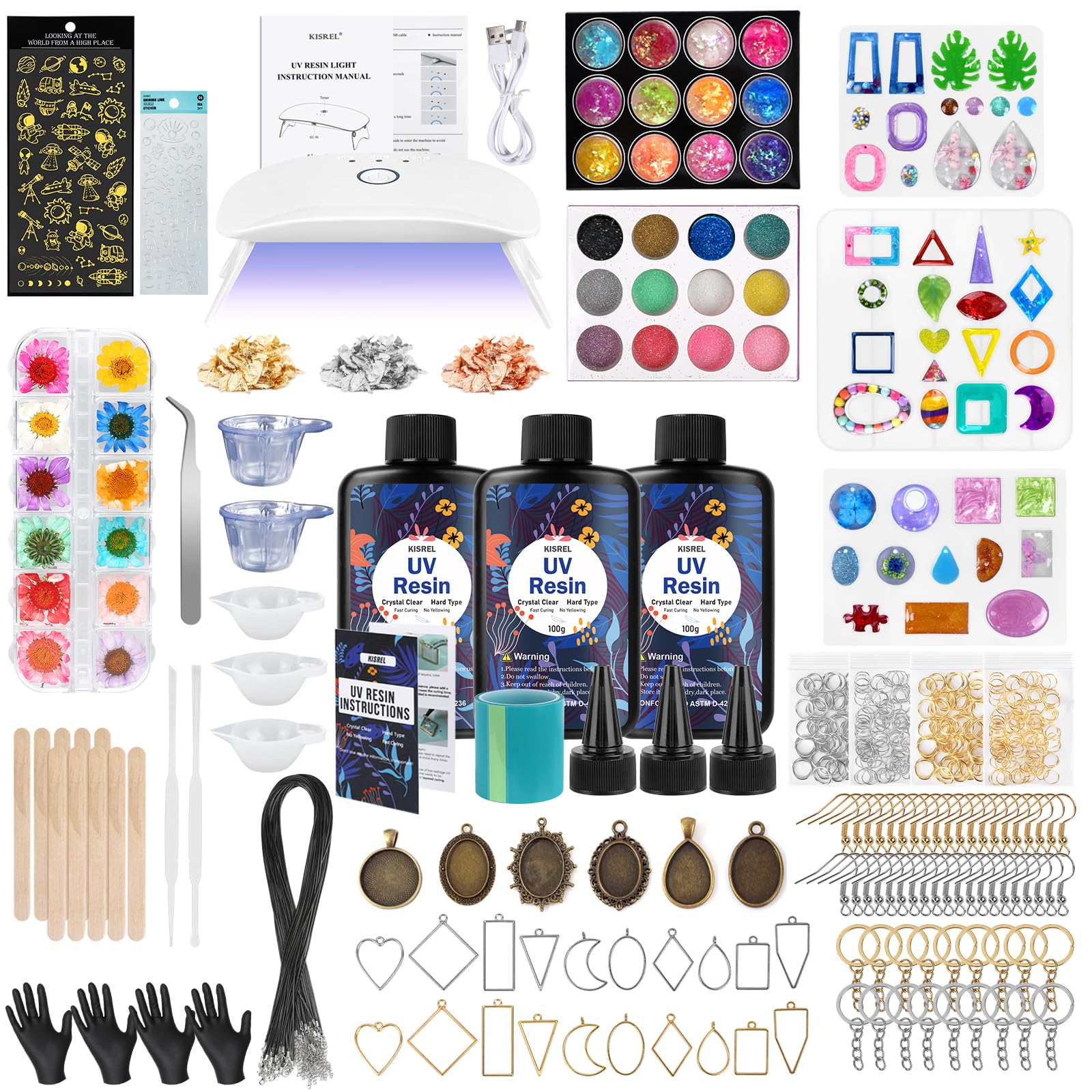
The KISREL UV Resin Jewelry Kit removes guesswork for newcomers by bundling a 12W UV lamp, 300g of crystal-clear resin, silicone molds, and a full set of decorative fillers including dried flowers, glitter, and gold foil. The lamp’s 8 UV beads cure most thin layers within 1-3 minutes, and the included molds are reusable silicone with good tear resistance for repeated demolding.
The resin itself performs well for its tier: it cures hard and non-tacky with minimal yellowing, though the starting kit is best for thin-layer projects like keychains, earrings, and small pendants. Users report that maintaining layer depths under 3mm prevents incomplete curing and sticky residues. The accessory variety—ear hooks, key rings, necklace cords—means you can finish a piece from start to setting in one sitting.
This is a complete creative package, not just glue in a bottle. The included components allow for immediate experimentation with different effects (encapsulating flowers, layering glitter, embedding foil), making it ideal for crafters who want to test the UV resin medium without investing in separate equipment. Just note that heavy mica powder can leave a rough texture if not properly mixed with the liquid resin.
Why it’s great
- Includes everything needed to start (lamp, molds, accessories)
- Resin cures hard and clear with no tackiness
- Low barrier to entry for beginners
Good to know
- Some filler components (glitter, flowers) feel economy-grade
- Lamp is lower power than professional 36W+ units
- Mica powder can cause uneven cure results
3. KISREL UV Resin 1000g

KISREL’s upgraded UV resin offers a polyurethane acrylic formulation that balances cost with performance for heavy-volume users. It cures to a hard, non-stick finish in 1-3 minutes under a 36W UV lamp, and user feedback highlights its low bubble count—a common pain point with cheaper epoxy blends. The resin’s self-leveling property ensures even coatings on rotators and flat castings without streaks.
Multiple reviewers note its suitability for wood coating and jewelry top coats, where the resin’s fast cure prevents dust settling. The low-odor profile is a genuine benefit for indoor workshops without dedicated ventilation, though standard PPE (gloves, mask) remains necessary when handling any uncured epoxy. Some users caution against deep pours (over 5mm) as UV light penetration struggles, leading to uncured pockets in the center of thick castings.
At 1000g, this bottle provides a substantial working volume for batch production—think dozens of pendants, earrings, or charms per bottle. The price-per-gram lands it in an efficient middle ground for makers who have already invested in UV lamps and molds but need a reliable, non-yellowing resin in quantity. Just store it in a cool, dark place to prevent premature thickening.
Why it’s great
- Excellent value for 1000g of UV resin
- Hard, non-stick finish with good clarity
- Low odor reduces workspace irritation
Good to know
- Deep pours may not cure fully without specialized equipment
- No lamp or accessories included
- Thicker formula can trap bubbles if poured too aggressively
4. CA Glue with Activator Kit
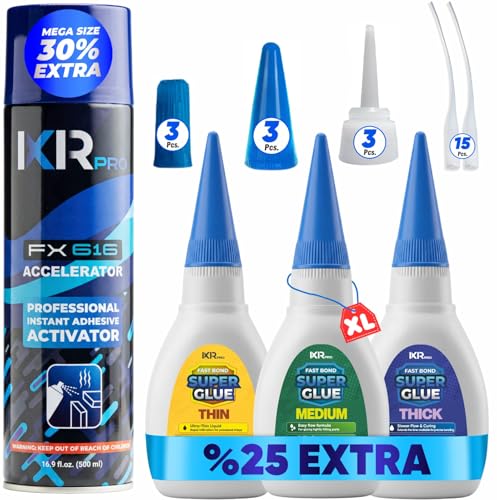
This cyanoacrylate kit from ixirpro is the instant-bond solution for jewelry repairs that can’t wait. It includes three viscosity grades—thin (wicking into cracks), medium (general bonding), and thick (gap filling)—plus a 16.9 oz accelerator spray that flash-cures bonds in seconds. For repairs like reattaching a broken earring post or fixing a loose stone in a prong setting, the thin CA glue penetrates micro-gaps and forms a strong mechanical lock within minutes.
The included 15 precision microtips allow pinpoint application on delicate components without flooding the surrounding area. Users report successful bonds on metal, glass, ceramic, and even plastic findings, with the thick formula providing enough body to hold irregularly-shaped cabochons in place while the bond sets. The accelerator spray is crucial for impatient work—mist it on one surface, apply glue to the other, and press for an instant hold.
One consistent user feedback point is that the bottles can be messy on first opening; twisting the cap slowly and using the included clog-prevention pins helps extend bottle life. This kit is not ideal for transparent castings (CA glue yellows faster than UV resin), but excels in structural repairs where speed and strength outweigh optical clarity. For multi-material bonding on findings, jump rings, and broken frames, this kit provides total control.
Why it’s great
- Three viscosities cover every repair scenario
- 16.9 oz accelerator spray flash-cures bonds instantly
- Good value for a comprehensive CA glue system
Good to know
- Bottle design can lead to messy first pours
- Yellowing occurs faster than UV resin options
- Not suitable for transparent stone or glass bonding
5. Jewelry Displays & Boxes G-S Hypo Cement (3 Pack)
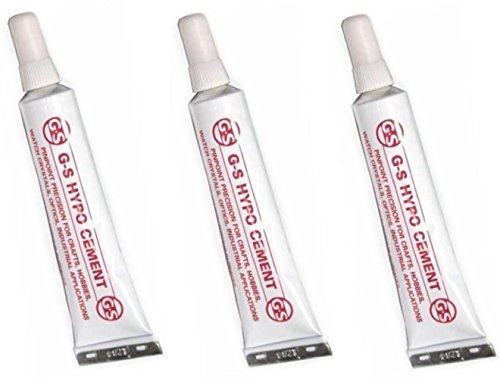
G-S Hypo Cement is a veteran in the jewelry world—a precision cement designed specifically for attaching beads, pearls, and cabochons without the cloudiness or stringing common with general-purpose super glue. This 3-pack delivers three identical tubes of this water-thin, quick-setting formula that dries completely transparent. The needle-like applicator tip allows microscopic placement of glue inside bead holes or behind a flat back stone, preventing messy overflow.
The cement’s consistency is thin enough to wick into tight spaces but sets with enough body to hold pearls in place while the bond cures. Users praise the controlled applicator—the tip stays clear between uses with its included cap, though some note that the tube can leak at the threads if stored horizontally or over-tightened. The 30-gram tubes provide a working volume best suited for small repair batches rather than bulk production.
Where this cement shines is in precision work: gluing a pearl back onto a post, securing a cameo into a bezel, or attaching a rhinestone to a chain. The drying time (around 30-60 seconds to initial set) gives you just enough working time to position the piece, then the bond holds firmly within minutes. For jewelry-specific repair where a clear, non-yellowing, controlled flow is paramount, the G-S Hypo Cement remains a reliable classic.
Why it’s great
- Fine applicator tip for precise, gap-free application
- Dries clear without yellowing on transparent stones
- Quick set with decent working time for positioning
Good to know
- Tube can leak at threads if not stored standing up
- Small 30g tubes are best for occasional repair, not bulk
- Thin formula unsuitable for gap-filling larger gaps
FAQ
Can I use standard super glue for jewelry repair?
What is the difference between UV resin and cyanoacrylate for jewelry?
How do I prevent bubbles in UV resin jewelry?
Which adhesive works best for gluing stones into settings?
How long does UV resin jewelry actually last?
Final Thoughts: The Verdict
For most users, the best adhesive for jewelry winner is the Nicpro UV Resin 1000g because it delivers professional-grade 90D hardness, crystal clarity, and non-yellowing performance for casting and coating alike. If you want a complete starter setup that includes a lamp and molds for immediate creativity, grab the KISREL UV Resin Jewelry Making Kit. And for fast, multi-material repairs where speed matters most, nothing beats the CA Glue with Activator Kit.

Mo Maruf
I created WellFizz to bridge the gap between vague wellness advice and actionable solutions. My mission is simple: to decode the research and give you practical tools you can actually use.
Beyond the data, I am a passionate traveler. I believe that stepping away from the screen to explore new environments is essential for mental clarity and physical vitality.