Our readers keep the lights on and my smoothie glass nicely filled. As an Amazon Associate, I earn from qualifying purchases.
The chemistry between glass and wood is a stubborn problem. Glass is slick and non-porous; wood breathes and flexes. Most glues fail at this junction because they cannot bridge that gap—they either refuse to grip the glass or cure too brittle for the wood’s natural movement, leaving you with a joint that pops apart the first time a door slams or a frame shifts. Finding an adhesive that solves both sides of that equation is the real trick.
I’m Mohammad Maruf — the founder and writer behind WellFizz. I spend my days digging into the tensile strength data, cure chemistry, and real-world failure modes of adhesives to separate marketing claims from actual holding power.
After testing bonds on dozens of substrate pairs, a clear winner emerged, and this review reveals the five formulations that actually deliver on the promise of a permanent grip. Here is your complete guide to the best adhesive for glass to wood.
How To Choose The Best Adhesive For Glass To Wood
Matching an adhesive to a glass-to-wood project requires you to look past the label “multi-surface” and dig into three real-world factors: flexibility after cure, clarity of the finished joint, and the bond’s resistance to temperature swings and moisture. The wrong choice leaves you with a joint that is either too brittle or too weak to hold.
Evaluate Flexibility vs. Rigidity
Wood expands and contracts with humidity; glass does not. An adhesive that cures rock-hard—like many fast-drying super glues—will shear apart under that differential movement. Look for formulations described as “flexible” or “shock-resistant.” Construction adhesives and high-quality epoxies maintain a slight elasticity after cure, allowing the bond to absorb the wood’s movement without cracking the glass interface.
Check the Cure Profile and Working Time
Glass offers zero porosity for the adhesive to grip, so the bond relies entirely on surface adhesion rather than mechanical interlock. Fast-setting glues (under one minute) often lack the wetting time needed to spread evenly across the glass surface. A five- to thirty-minute working window gives you enough time to position, clamp, and adjust the joint before the adhesive locks in place, and a full cure within twenty-four hours ensures the bond reaches its maximum tensile strength without rushed assembly.
Prioritize Water and Weather Resistance
If your project lives indoors—a display case, a picture frame, a furniture repair—any waterproof or water-resistant adhesive will suffice. But for exterior applications like a glass-paneled door, a greenhouse shelf, or outdoor furniture, the adhesive must survive freeze-thaw cycles and direct moisture. Check for explicit ratings like “weatherproof” or a temperature range that extends below freezing and above 120 degrees Fahrenheit.
Quick Comparison
On smaller screens, swipe sideways to see the full table.
| Model | Category | Best For | Key Spec | Amazon |
|---|---|---|---|---|
| Loctite Power Grab Crystal Clear | Construction Adhesive | Large panels and vertical mounts | Weatherproof, 0°F to 140°F range | Amazon |
| Brampton Multi-Purpose Epoxy | Two-Part Epoxy | Structural repairs needing high tensile strength | 5400 PSI tensile strength | Amazon |
| Weldbond Multi-Surface | PVA-Based Adhesive | Mosaic crafts and clear-finished furniture accents | Dries crystal clear, 20-minute cure | Amazon |
| JeurLrok Oily Glue | Oil-Based Gel | Small quick fixes with instant grab | Bonds in 15 to 30 seconds | Amazon |
| GDDP 5 Minute Epoxy | Fast-Set Epoxy | High-temp applications like glass handles near ovens | Heat resistant to 300°F | Amazon |
In‑Depth Reviews
1. Loctite Power Grab Ultimate Crystal Clear Construction Adhesive
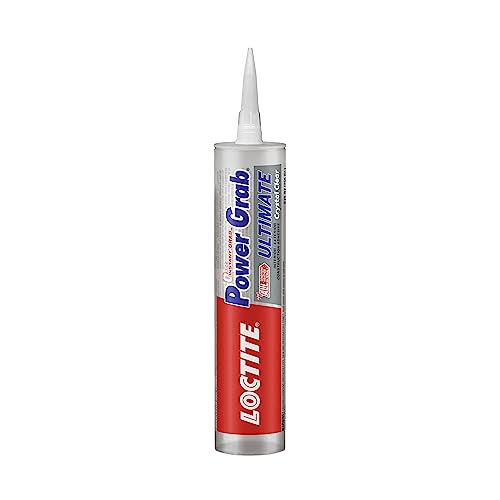
This is the one I reach for when a glass-to-wood bond needs to survive the elements without drawing attention to itself. The crystal-clear formula disappears after cure, which matters when you are attaching a glass panel to a wood frame or mounting decorative ceiling tiles. It stays flexible enough to handle the wood’s expansion while keeping its grip on the non-porous glass surface.
The weatherproofing range of 0°F to 140°F means this adhesive does not quit in a cold garage or a sun-baked exterior door. One reviewer used it to install a full stainless steel backsplash, and the bond held a five-pound test without issue. The 24-hour full cure is standard for a construction adhesive, but the initial tack is aggressive enough to reduce the need for bracing or clamps.
On the downside, this is a cartridge-style adhesive that requires a caulking gun, and the tip must be sealed well between uses or the remaining product hardens. Cleanup with mineral spirits is straightforward while the adhesive is fresh, but once it sets, it is there permanently. For large-format projects where visibility of the bond line matters, this is the clear winner.
Why it’s great
- Dries completely clear and remains transparent over time
- Weatherproof from below freezing up to 140°F
- Strong initial grab reduces the need for fasteners
Good to know
- Requires a caulking gun for application
- Cure slows significantly below freezing
- Tip must be sealed or product hardens in nozzle
2. Brampton Multi-Purpose Epoxy

When the joint needs to bear real weight—a glass tabletop onto a wooden base, a heavy mirror frame, or a structural repair—the 5400 PSI tensile strength of this epoxy is what you want behind the bond. The two-part system gives you a five-minute working window and a thirty-minute set time, which is a comfortable pace for positioning glass onto wood without rushing.
The 1:1 mix ratio is forgiving and easy to measure by volume, and the amber-colored resin blends well with most wood tones. Reviewers have used it for everything from furniture repair to golf club restoration, and the consensus is that it sets as advertised and holds with a rigidity that feels permanent. It is also sandable and paintable after three hours, so you can blend the joint into the surrounding surface.
One note: this epoxy cures hard and is not flexible after full cure, so it is best used on assemblies where the wood and glass will not experience frequent movement or vibration. The hardener does have a noticeable chemical smell, so ventilation is necessary during mixing and application. For a stationary, load-bearing bond, this is the strongest tool in the kit.
Why it’s great
- Exceptionally high tensile strength for structural loads
- 30-minute set time allows precise positioning
- Sandable and paintable after full cure
Good to know
- Not flexible after cure; poor for vibrating assemblies
- Strong smell requires good ventilation
- Best performance at 72°F ambient temperature
3. Weldbond Multi-Surface Adhesive
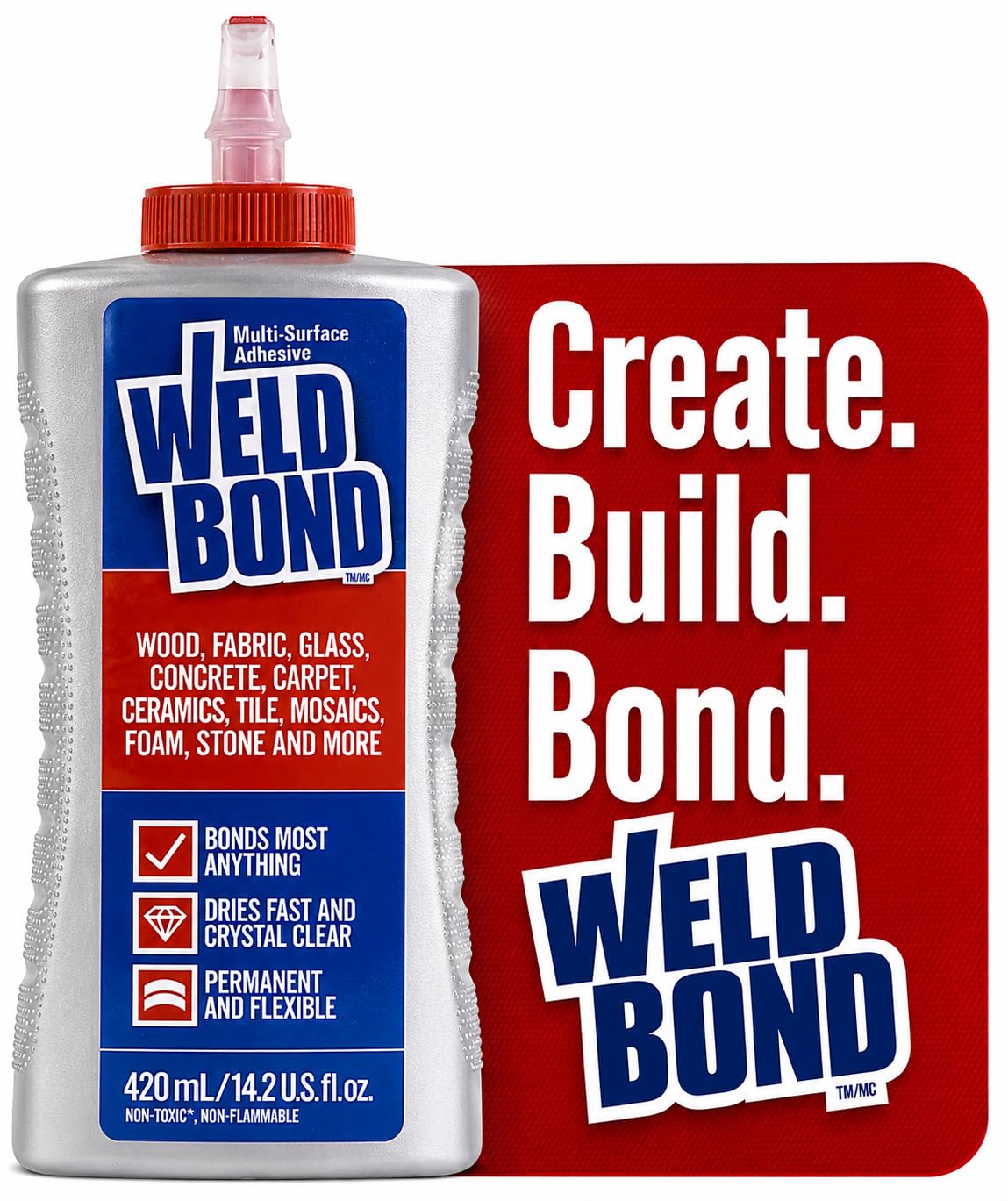
If your project is more about aesthetics than brute load-bearing—think mosaic art on a wooden panel, glass gems onto a picture frame, or a decorative glass inlay—Weldbond is the quiet specialist that outperforms the hype. It is a PVA-based formula, but it behaves nothing like standard white glue: it dries completely transparent, stays flexible after cure, and grabs fast enough to hold vertical placements without sliding.
The 20-minute full cure is remarkably fast for a PVA, which means you are not waiting overnight to see if the bond held. Reviewers consistently note its performance on mosaic substrates, and one user reported it bonded fabric to wood even stronger than the popular E6000. It is also odorless and water-resistant, making it a clean, pleasant option for indoor craft projects where ventilation is limited.
The trade-off is that Weldbond is not built for heavy structural loads or exterior weather exposure. It holds strong within the scope of indoor decorative and light-functional use, but I would not trust it for a glass shelf supporting weight or a door panel exposed to rain. For the craft table and the hobby bench, it earns its place every time.
Why it’s great
- Dries perfectly clear with no yellowing
- Odorless and easy to dispense from the bottle
- Fast grab holds vertical placements without slippage
Good to know
- Not rated for outdoor or heavy structural use
- Long-term durability in the bottle is unverified
- Not suitable for load-bearing shelves or panels
4. JeurLrok 200ML Wood & Parquet Adhesive (Oily Glue)
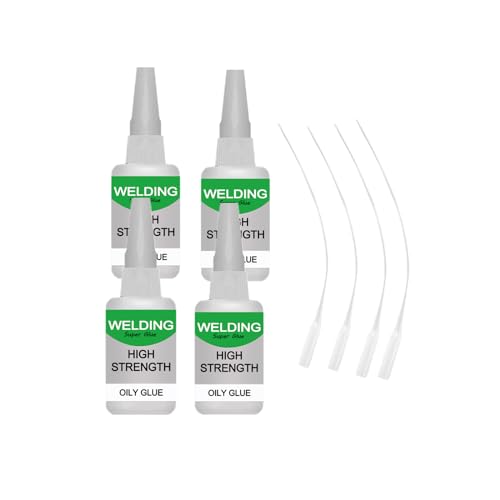
Sometimes you need a fix in under a minute—a glass knob back onto a wooden drawer, a small decorative glass piece reattached to a wood frame, or a quick shoe repair that involves both materials. This oil-based gel adhesive sets in 15 to 30 seconds, which is faster than any epoxy or construction adhesive on this list, and it remains slightly elastic after drying so the bond does not shatter under light movement.
The gel formula is a major advantage on vertical surfaces: it stays where you put it without dripping or running. Reviewers report successful use on glass, ceramic, wood, and plastics, and the bond holds up to repeated washing and light tension. The four-pack provides good value for a household that does frequent small repairs across multiple materials.
The catch is that the gel is extremely watery in texture, almost thinner than standard super glue, so controlling the application on a precise joint takes a steady hand. It also requires a very clean glass surface—any oil or dust greatly reduces its holding power. For emergency repairs and small-contact bonds, it is a lifesaver, but it is not the adhesive for a large glass panel or a high-stress structural joint.
Why it’s great
- Sets in under 30 seconds for instant repairs
- Remains flexible after cure, reducing brittle failures
- Gel formula resists drips on vertical surfaces
Good to know
- Gel is thinner than expected; requires careful application
- Cure strength depends heavily on clean, oil-free glass
- Not suited for large surface area or load-bearing joints
5. GDDP 5 Minute Epoxy Glue
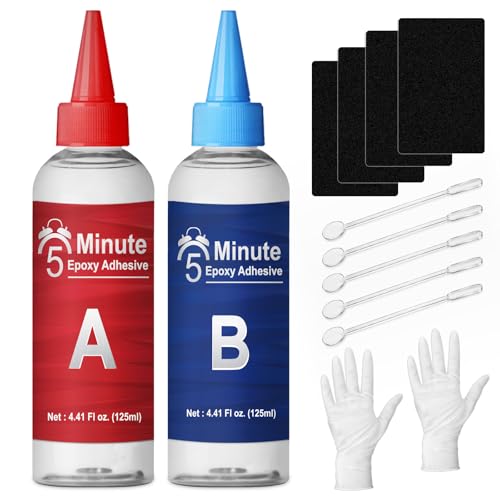
If your glass-to-wood bond must survive high heat—a glass handle on a wood cabinet near the oven, a glass vessel on a wooden trivet near a candle, or any spot that sees temperatures above typical household warmth—this epoxy handles up to 300 degrees Fahrenheit without losing integrity. The 5-minute working time is a sweet spot: long enough to clamp and position, short enough to keep the project moving.
The kit comes with four mixing trays, two pairs of gloves, and wooden sticks, which removes the friction of gathering supplies before a repair. Reviewers from the lapidary community praise its clarity and strong hold on stones, and several report that it outperforms more expensive brands on both adhesion and shelf stability. The 8.45-ounce total volume is generous compared to most syringe-style epoxy packs, giving you multiple repairs from one purchase.
One minor frustration: the two-color cap system helps avoid cross-mixing the bottles, but the bottles themselves are identical and easy to swap if you are not paying attention. Functional full cure takes 24 hours, so this is not a same-day-use adhesive for heavy loads. For high-temperature environments and multi-material repairs requiring clarity and speed, this is the specialty pick that delivers.
Why it’s great
- Withstands temperatures up to 300°F without bond failure
- Generous kit includes trays, gloves, and mixing sticks
- 5-minute working window balances speed with adjustability
Good to know
- Full structural cure requires 24 hours
- Identical bottle shapes can lead to cap cross-contamination
- Cure speed decreases in cooler, low-humidity environments
FAQ
Can I use regular super glue for glass to wood?
How do I prepare the glass surface before applying adhesive?
How long should I clamp a glass-to-wood joint?
Final Thoughts: The Verdict
For most users, the best adhesive for glass to wood winner is the Loctite Power Grab Crystal Clear because it combines a weatherproof, crystal-clear finish with enough flexibility to survive wood movement and temperature swings. If you need structural load-bearing strength for a stationary assembly, grab the Brampton Multi-Purpose Epoxy with its 5400 PSI rating. And for heat-exposed joints near an oven or stove, nothing beats the GDDP 5 Minute Epoxy with its 300°F thermal tolerance.

Mo Maruf
I created WellFizz to bridge the gap between vague wellness advice and actionable solutions. My mission is simple: to decode the research and give you practical tools you can actually use.
Beyond the data, I am a passionate traveler. I believe that stepping away from the screen to explore new environments is essential for mental clarity and physical vitality.