Our readers keep the lights on and my smoothie glass nicely filled. As an Amazon Associate, I earn from qualifying purchases.
Foam on wood is a notoriously difficult material pair — porous wood wicks away moisture, while closed-cell foam resists absorption, leaving most general-purpose adhesives with a bond that fails the first time you flex the joint. Getting a permanent hold means choosing an adhesive formulated to bridge these two surfaces without melting the foam or drying too fast to reposition.
I’m Mohammad Maruf — the founder and writer behind WellFizz. I’ve spent years analyzing adhesive formulations, solvent evaporation rates, and bond-strength metrics across the most demanding DIY and professional categories to find what actually works when wood and foam must become one.
Whether you’re upholstering furniture, building RC aircraft, or crafting a headliner repair, finding the right adhesive for foam to wood is about matching the specific foam type, bond flexibility, and drying speed to your project.
How To Choose The Best Adhesive For Foam To Wood
Selecting an adhesive for foam-to-wood applications requires more than grabbing any spray can off the shelf. The wrong solvent can disintegrate polystyrene foam, while the wrong cure time may leave you clamping for hours. Here are the critical factors to evaluate.
Foam Chemistry Compatibility
Expanded polystyrene (EPS) foam dissolves on contact with many solvent-based adhesives. Look for adhesives labeled “EPS-friendly” or formulated specifically for polyurethane or polyethylene foams. Depron and EPO foams used in RC modeling are more resilient, but always test a small area first before committing to the full surface.
Open Time vs. Instant Tack
Short open time (under 30 seconds) means the bond grabs immediately, reducing the need for clamping but making repositioning impossible. Longer open time, like the 60-minute window of some premium contact cements, allows you to shift the foam into perfect alignment before pressure. For large panels or intricate upholstery, longer open time is a major advantage.
Flexibility and Heat Resistance
Foam expands and contracts with temperature changes, and an adhesive that cures rigid will crack over time. Choose a formula that remains flexible after curing, especially for automotive upholstery or outdoor applications. Check whether the adhesive resists heat up to the maximum temperature your project will face — spray contact cements often list heat resistance up to 200°F or higher.
Quick Comparison
On smaller screens, swipe sideways to see the full table.
| Model | Category | Best For | Key Spec | Amazon |
|---|---|---|---|---|
| Camie Fast TACK 313 | Spray Contact | Upholstery foam-to-wood | Web spray pattern, instant tack | Amazon |
| 3M Hi-Strength 94 ET | Spray Contact | Large surface laminations | 60-minute open time | Amazon |
| Gorilla Ultimate Spray | Spray Contact | Multi-material household projects | Adjustable nozzle, low VOC | Amazon |
| Beacon Foam-Tac | Bottle Applicator | RC model foam & balsa wood | UV blockers, flexible bond | Amazon |
| Titebond Instant Bond Thick | Cyanoacrylate Gel | Small wood parts to foam | 18-second cure, no clamping | Amazon |
In‑Depth Reviews
1. Camie Fast TACK Upholstery Adhesive 313
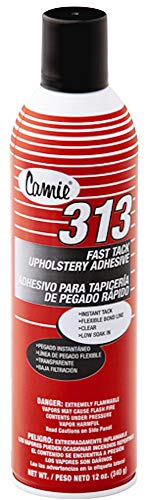
The Camie 313 is purpose-built for upholstery work, and its formula shows a clear understanding of how foam and wood interact. It sprays in a web pattern that lays down an even film without soaking into the foam’s open cells, meaning you get a consistent bond across the entire surface rather than spotty adhesion. The instant tack is a major time-saver — spray both surfaces, wait around 15 seconds, then press together for a permanent hold that resists peeling even when the foam is flexed repeatedly.
Users report strong performance on foam-to-wood applications ranging from seat heater installations to headliner repairs. The flexible bond stays intact under temperature changes inside a vehicle cabin, and the clear, low-soak-in formula means you won’t see staining on lighter fabrics or exposed foam edges. The two-hour full cure time is fast enough for most projects, though full handling strength arrives much sooner.
The spray nozzle can occasionally clog after multiple uses, but a quick soak in xylol resolves the issue. Overspray management is essential — you will want a tarp or drop cloth to protect surrounding surfaces. For anyone whose primary need is upholstery-grade foam-to-wood bonding with reliable instantaneous grip, this is the standout choice.
Why it’s great
- Instant tack that grabs foam to wood in under 30 seconds
- Web spray pattern provides even coverage with minimal soak-in
- Flexible bond withstands vibration and temperature changes
- Dries clear, leaving no visible residue on fabric or foam edges
Good to know
- Spray tip may clog if adhesive is left inside between uses
- Overspray can drift — always protect surrounding surfaces
2. 3M Hi-Strength 94 ET Spray Adhesive
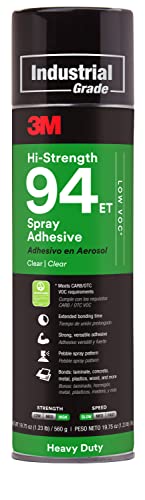
3M’s Hi-Strength 94 ET is a contact adhesive that excels in large-surface laminations where alignment precision matters. The 60-minute open time transforms the workflow — you can spray a full plywood panel and foam sheet, take your time aligning the edges, and then press once the two substrates meet. This is a game-changer for van conversion insulation panels, upholstery over large seat bases, or architectural wall cladding where a missed alignment would waste expensive materials.
The aggressive tack is substantial. Even within the lengthy open window, the bond builds strength fast once you apply pressure, and the final cure holds up under significant shear load. The formula is also Greenguard Certified and low-VOC, making it suitable for interior applications where off-gassing is a concern. Users consistently mention its effectiveness on metal, carpet, and rubber alongside wood and foam, confirming its position as a versatile heavy-duty workhorse.
The chemical odor is strong during application, so ventilation is mandatory. The larger 19.75 oz can offers good value for repeated use, but the spray pattern requires a steady hand to avoid pooling in corners. If your project involves bonding large sheets of foam to wood panels and you need the freedom to reposition, this adhesive is worth the premium.
Why it’s great
- 60-minute open time allows precise repositioning of foam panels
- Low-VOC and Greenguard Certified for interior use
- Aggressive tack holds through high-shear applications
- Large 19.75 oz can covers extensive surface areas
Good to know
- Strong solvent odor requires proper ventilation
- Spray consistency demands careful hand control on smaller pieces
3. Gorilla Ultimate Spray Adhesive
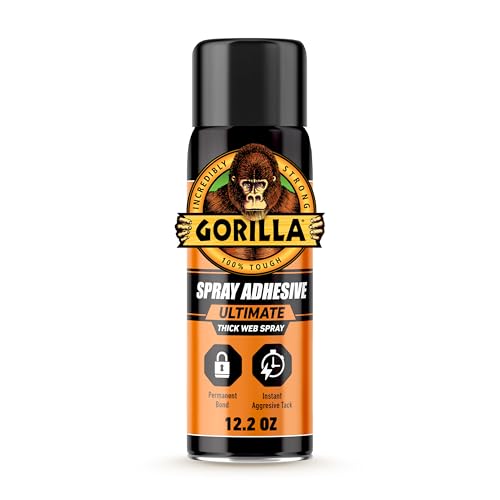
Gorilla’s entry into the spray adhesive market brings the same no-compromise approach the brand is known for. The adjustable nozzle is a standout feature — three settings let you switch between a narrow web for small foam blocks and a wider fan for large upholstery panels, giving you precise control over coverage. The formula offers instant aggressive tack that bonds indoor and outdoor materials, including foam to wood, without the need for extended clamping.
What sets this apart in the mid-range tier is the balance of heat and moisture resistance. Users report successful bonds on car headliners and outdoor cushions where temperature fluctuations would cause weaker adhesives to fail. The low-VOC formula meets CA CARB requirements, so it’s a safer option for enclosed workspaces. The 12.2 oz can size is generous for the price, making it an accessible entry point for DIYers tackling multiple projects.
The web spray pattern can cover more area than intended when using the high setting, so masking adjacent surfaces is advisable. Some users note that the spray is not ideal for ultra-precise application on tiny parts. For general household bonding of foam to wood — such as craft projects, furniture repairs, or rug underlayment — this adhesive delivers reliable performance without breaking the budget.
Why it’s great
- Three-way adjustable nozzle for controlled coverage width
- Resists heat and moisture for indoor/outdoor use
- Low-VOC formula is safer for enclosed project spaces
- Instant aggressive tack eliminates long clamping times
Good to know
- Spray pattern can be too wide for precise small-part bonding
- Bond is permanent once applied — no repositioning possible
4. Beacon Foam-Tac Powerful Glue
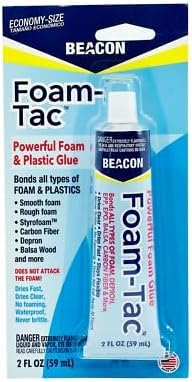
Foam-Tac is the adhesive that RC aircraft builders have relied on for years, and for good reason: it handles the specific demands of EPP, EPO, Depron foam, and balsa wood without melting the substrate. The bottle applicator gives you pinpoint control, which is essential when bonding motor mounts, servos, or control horns into tight spaces. The bond itself remains flexible, absorbing the constant vibration and micro-flexing of a flying model without cracking.
A major upgrade in the current formula is the inclusion of UV blockers, which prevent yellowing and degradation when the adhesive is exposed to sunlight. This makes Foam-Tac a viable option for outdoor projects like foam signage or garden decorations. The adhesion promoter embedded in the formula improves grip on carbon fiber and 3D-printed parts, widening its utility beyond traditional foam-and-wood projects.
The glue is thick — almost snot-like in consistency — which makes application messy without practice. Users recommend using pins or rubber bands to hold parts in place while the 24-hour full cure completes. For precision foam-to-wood bonding where a spray adhesive would over-spray or waste material, Foam-Tac’s bottle format is the superior choice.
Why it’s great
- Safe on EPS, EPO, and Depron foams without melting
- UV blockers prevent yellowing in sunlight exposure
- Flexible bond handles vibration in RC and automotive use
- Bottle applicator enables precise glue placement
Good to know
- Thick consistency can be messy and hard to apply evenly
- Full 24-hour cure time requires clamping for complex assemblies
5. Titebond Instant Bond Wood Adhesive Thick

Titebond’s Instant Bond Thick is a cyanoacrylate gel designed for wood, but its thickness and fast cure make it surprisingly effective for bonding small foam pieces to wooden surfaces. The gel consistency prevents the adhesive from running into unwanted areas, which is critical when you’re gluing foam trim to a wooden picture frame or attaching foam gaskets to plywood panels.
The bond strength is substantial — Titebond claims it bonds stronger than the wood itself, and user reports confirm that a properly cured joint will tear the surrounding material before the adhesive fails. This makes it ideal for repairs where clamping is impractical, such as fixing a broken foam temple on a wooden armchair or securing foam padding inside a toolbox. The thick formula also swells slightly as it dries, filling small gaps between uneven surfaces.
Because it cures so fast, there is zero room for error. Misalignment of even a millimeter is permanent, and the rigid nature of cyanoacrylate means the bond can crack under repeated flexing. This adhesive is best reserved for small, non-structural foam-to-wood bonds where speed is the priority and the joint won’t experience constant movement.
Why it’s great
- 18-second cure eliminates the need for clamping
- Gel consistency stays where placed without dripping
- Fills small gaps with slight swelling during curing
- Extremely high bond strength on wood substrates
Good to know
- Zero repositioning window due to instant curing
- Rigid bond may crack under repeated flexing or vibration
- Not suitable for large surface area bonding jobs
FAQ
Will Gorilla glue work on foam to wood?
What is the strongest adhesive for foam to wood?
Final Thoughts: The Verdict
For most users, the adhesive for foam to wood winner is the Camie Fast TACK 313 because it blends instant tack, a flexible cure, and clear drying into a formula that works equally well for upholstery, crafts, and automotive projects. If you need a 60-minute open time to align large foam panels perfectly, grab the 3M Hi-Strength 94 ET. And for precision bonding of small foam parts to wood where clamping is impossible, nothing beats the Titebond Instant Bond Thick.

Mo Maruf
I created WellFizz to bridge the gap between vague wellness advice and actionable solutions. My mission is simple: to decode the research and give you practical tools you can actually use.
Beyond the data, I am a passionate traveler. I believe that stepping away from the screen to explore new environments is essential for mental clarity and physical vitality.