Our readers keep the lights on and my smoothie glass nicely filled. As an Amazon Associate, I earn from qualifying purchases.
Choosing the right activity tracker for walking isn’t about the flashiest screen or the most notifications—it’s about finding the tool that reliably motivates you and fits seamlessly into your daily stride. The wrong choice can leave you with inaccurate counts, a dead battery, or a device so complicated it ends up in a drawer.
I’m Mohammad Maruf — the founder and writer behind WellFizz. My focus is on deep market research, analyzing thousands of data points and user specifications to cut through marketing claims and identify what truly works for dedicated walkers.
After dissecting specs and poring over real user experiences, I’ve compiled this guide to help you find a tracker that matches your commitment level, whether you’re a casual stroller or a dedicated power-walker. The key is to match your daily habits with a device engineered to support them, not complicate them, which is the core philosophy behind choosing the best activity tracker for walking.
How To Choose The Best Activity Tracker For Walking
The perfect walking tracker is the one you’ll use consistently. This means balancing accuracy, convenience, and personal motivation. Forget about features you’ll never use; focus on the core elements that directly impact your walking routine.
Sensor Technology and Accuracy
For walking, a 3D Tri-Axis accelerometer is the gold standard, especially in clip-on pedometers. It detects motion in multiple planes, providing more accurate step counts whether the device is in your pocket, on your hip, or around your neck. Wrist-based trackers use similar tech but can miscount steps during non-walking arm movements (like washing dishes). If pure step accuracy is your goal, a dedicated 3D pedometer often outperforms a wristband.
Form Factor and Placement
Where you wear your tracker impacts both accuracy and habit formation. Clip-on pedometers excel when attached firmly to a waistband, offering great accuracy and freeing your wrist. Wrist-worn trackers are more convenient for all-day wear and provide heart rate data. Consider your lifestyle: if you frequently push strollers or shopping carts, a wrist tracker may not count those steps, while a clip-on would.
Battery Life and Maintenance
Long battery life removes a major point of friction. Basic pedometers with disposable batteries can last up to a year, making them truly “set and forget.” Smart trackers with rechargeable batteries last days or weeks between charges. Ask yourself how often you’re willing to charge a device. For many walkers, the simplicity of a battery that lasts for months is a significant advantage.
Data and Connectivity Needs
Do you just need to see a daily step total, or do you want detailed trends, heart rate zones, and route maps? Basic trackers show data on the device itself. More advanced models sync via Bluetooth to a smartphone app for in-depth analysis. If you’re motivated by data and long-term trends, a connected tracker is worthwhile. If your goal is simple daily accountability, a non-Bluetooth device is often less frustrating and more private.
Quick Comparison
On smaller screens, swipe sideways to see the full table.
| Model | Type | Best For | Key Feature | Amazon |
|---|---|---|---|---|
| Realalt 3DTriSport | Pedometer | Overall Value & Accuracy | 30-Day Memory, Multi-Metric | Amazon |
| Amazfit Band 7 | Smart Band | Feature-Rich Budget Smart Band | 18-Day Battery, AMOLED Screen | Amazon |
| Garmin vívosmart 5 | Fitness Tracker | Serious Health Metrics | Body Battery, Stress Tracking | Amazon |
| Fitbit Inspire 3 | Fitness Tracker | Ecosystem & Sleep Tracking | Detailed Sleep Score, Premium Trial | Amazon |
| 3DFitBud Simple Step Counter | Pedometer | Pure Simplicity | Large Display, Steps-Only | Amazon |
| Fitpolo Fitness Tracker | Smart Watch | Budget Smartwatch Features | Large Touchscreen, Heart Rate | Amazon |
| FITVII Slim Fitness Tracker | Fitness Tracker | Health Metric Experimentation | Blood Pressure Estimation | Amazon |
| HUAKUA Fitness Tracker | Fitness Watch | Phone-Free Operation | No Bluetooth Needed, Color Screen | Amazon |
| OZO Fitness Clip-on | Pedometer | Seniors & Non-Tech Users | Large Display, Lanyard Included | Amazon |
| Non-Bluetooth Fitness Tracker Watch | Kids Watch | Kids & Teens | Watch Form, No Phone Needed | Amazon |
| Simple Walking Pedometer | Pedometer | Absolute Budget Entry | Carabiner Clip, Basic Counting | Amazon |
In‑Depth Reviews
1. Realalt 3DTriSport 3D Walking Pedometer

The Realalt 3DTriSport strikes an ideal balance between capability, accuracy, and ease of use, making it our top pick for most walkers. It goes beyond simple step counting to track distance, calories, and exercise time while storing a full month of your daily history. This allows you to review your progress over time without needing a smartphone, which is a significant motivational tool.
Its 3D Tri-Axis sensor is consistently praised in user reviews for accuracy, especially when clipped to a waistband. The device includes both a clip and a lanyard, offering flexibility in how you wear it. Setting your stride length is the only required setup, and the large, clear display makes checking your stats at a glance effortless.
Battery life is a strong point, with a standard cell lasting up to a year. This reliability, combined with its mid-range positioning, means you get substantial functionality without the complexity or recurring costs of a smart device. It’s a workhorse that focuses squarely on the metrics walkers care about most.
Why it’s great
- Excellent accuracy with the 3D sensor when worn correctly.
- Tracks steps, distance, calories, and time with 30-day memory.
- Long battery life removes charging hassle.
- Includes both a waist clip and a neck lanyard for versatility.
Good to know
- Requires manual stride length input for distance accuracy.
- The clip can accidentally press buttons if you sit down carelessly.
- No Bluetooth connectivity for automatic data syncing.
2. Amazfit Band 7 Activity Fitness Tracker

For walkers who want smart features without a premium price tag, the Amazfit Band 7 is a standout. Its brilliant 1.47-inch AMOLED display is easy to read in any light, and the battery life is exceptional, lasting up to 18 days on a single charge. This reduces charging frequency dramatically compared to many other smart bands.
It provides comprehensive health monitoring, including 24/7 heart rate, blood oxygen (SpO₂), stress tracking, and detailed sleep analysis. With over 120 sports modes, it’s far more capable than most walkers will need, but the core walking and running tracking is robust. The built-in Alexa support adds voice assistance for quick tasks or information.
The band is 5 ATM water-resistant, meaning it can handle rain and showers without worry. The accompanying Zepp app is well-regarded for presenting health data clearly. This tracker offers a premium smartband experience at a mid-range point, making advanced metrics accessible.
Why it’s great
- Outstanding battery life for a color display smart band.
- Vibrant, always-on AMOLED screen is highly readable.
- Comprehensive health metrics including SpO₂ and stress.
- Strong water resistance for all-weather walking.
Good to know
- GPS requires connection to your smartphone.
- The proprietary band attachment can feel less secure to some.
- The sheer number of features can be overwhelming for simple tracking.
3. Garmin vívosmart 5 Fitness Tracker

The Garmin vívosmart 5 represents the premium end of dedicated fitness trackers, built on Garmin’s reputable ecosystem. Its standout feature is the Body Battery energy monitoring, which combines stress, heart rate variability, sleep, and activity data to estimate your energy reserves throughout the day—a fantastic tool for planning your walking intensity.
It offers advanced health insights like Pulse Ox (blood oxygen) monitoring, respiration tracking, and detailed sleep scoring with advice. For activity, it uses connected GPS from your phone to map walks and runs. The build quality is solid, with a comfortable silicone band and a clear, though monochrome, touchscreen display.
Battery life lasts up to a week, which is standard for this feature set. The Garmin Connect app is arguably the best in the business, offering deep, actionable insights without a subscription paywall. This tracker is for the walker who views their activity as one part of a holistic health picture.
Why it’s great
- Unique Body Battery and stress tracking provide valuable daily insights.
- Accurate heart rate and Pulse Ox monitoring.
- Robust Garmin Connect app with no subscription fees.
- High-quality construction and comfortable fit.
Good to know
- Premium price point.
- Display is monochrome, not color.
- Some users report occasional syncing issues with the app.
4. Fitbit Inspire 3 Health & Fitness Tracker

The Fitbit Inspire 3 is a refinement of a proven formula, offering a sleek, lightweight design and focus on core wellness metrics. Its strongest suit is sleep tracking; it provides a detailed Sleep Score and, for Premium subscribers, a monthly Sleep Profile that analyzes your sleep patterns in depth. For walkers who prioritize recovery, this is a major benefit.
It tracks all-day activity, 24/7 heart rate, Active Zone Minutes, and SpO₂. The battery lasts up to 10 days, and the color touchscreen is bright and responsive. It includes a 6-month trial of Fitbit Premium, which offers more detailed analytics and guided programs—a nice way to explore the ecosystem.
While it sits at a higher price point, the Inspire 3 delivers a polished, user-friendly experience with strong community and app support. It’s an excellent choice for those already invested in or curious about the Fitbit platform, particularly for its sleep and readiness insights.
Why it’s great
- Best-in-class sleep tracking and analysis.
- Slim, comfortable design that’s discreet for 24/7 wear.
- Includes a lengthy trial of Fitbit Premium.
- Reliable step counting and heart rate monitoring.
Good to know
- Many advanced features are locked behind the Premium subscription after the trial.
- Some users desire a larger screen.
- GPS requires a connected phone.
5. 3DFitBud Simple Step Counter Walking 3D Pedometer

The 3DFitBud lives up to its name: it’s a straightforward, reliable step counter without distractions. If your sole mission is to track daily steps accurately and motivate yourself to move more, this device excels. It uses a 3D Tri-Axis sensor for good accuracy in a pocket, on a clip, or on a lanyard.
The display is exceptionally large and clear, making it easy to read for all ages. Setup involves pressing a single button on the back to reset; there’s no programming for stride or weight. It features a helpful “10 Step Error Prevention” feature, which ignores short bursts of movement to prevent false counts but starts logging once you’ve taken 10 continuous steps.
With a battery that lasts up to a year, it’s the definition of low-maintenance. This pedometer is perfect for anyone who has been frustrated by complicated gadgets and just wants an honest, durable tool to count their steps day in and day out.
Why it’s great
- Extremely simple operation with a single-button reset.
- Very large, easy-to-read digital numbers.
- Long battery life with a pre-installed cell.
- Accurate for basic step counting when worn consistently.
Good to know
- Only counts steps—no distance, calories, or time.
- The error prevention feature means it won’t count very short walks under 10 steps.
- Occasional reports of the screen going blank, requiring a reset.
6. Fitpolo Fitness Tracker with Heart Rate Monitor

The Fitpolo tracker packs the look and feel of a much more expensive smartwatch into a budget-friendly package. It features a large 1.8-inch color touchscreen that is responsive and supports customizable watch faces. For walkers who want a wrist-based device that tracks heart rate and sleep without breaking the bank, it’s a compelling option.
It offers 24/7 heart rate monitoring, automatic sleep tracking, and blood oxygen measurements. The device syncs with a smartphone app to provide notifications for calls, texts, and social media. It’s IP68 waterproof, so sweat and rain won’t be an issue, and the battery typically lasts about a week.
While it may not have the long-term reliability or refined software of established brands, it delivers remarkable value for its price point. It’s an ideal “first” smart tracker for someone curious about heart rate zones during walks or wanting basic smart notifications on their wrist.
Why it’s great
- Impressive large color touchscreen for the cost.
- Tracks heart rate, sleep, SpO₂, and multiple exercise modes.
- Receives smartphone notifications.
- IP68 waterproof rating for durability.
Good to know
- Accuracy of health metrics can be inconsistent compared to premium brands.
- The companion app is functional but not as polished.
- Long-term durability can be a concern for some users.
7. FITVII Slim Fitness Tracker with Blood Oxygen, Blood Pressure

The FITVII tracker stands out by including a blood pressure estimation feature, which is rare in this category. It’s important to understand this is for general wellness trending and not for medical diagnosis, but it can be an interesting data point for those monitoring their health. The device itself is quite slim and stylish, with interchangeable bands.
Alongside BP, it tracks heart rate, blood oxygen, sleep, steps, and calories. It offers smart notifications and has a bright color display. The slim profile makes it one of the more comfortable trackers for all-day and all-night wear, which is crucial for consistent sleep and recovery data.
Battery life is good, typically lasting 7-10 days. This tracker is for the walker who is highly data-curious and wants to explore a wider range of biometrics from their wrist without a clinical device. The novelty and breadth of metrics are its main appeal.
Why it’s great
- Includes blood pressure estimation, a uncommon feature.
- Very slim and comfortable design for continuous wear.
- Tracks a comprehensive set of health metrics.
- Bright, clear color display.
Good to know
- Blood pressure readings are estimates and should not be relied upon for medical purposes.
- Some users report the bands can detach easily.
- App and software can feel less refined.
8. HUAKUA Fitness Tracker No Bluetooth No APP Needed

The HUAKUA fills a unique niche: it’s a wristwatch-style fitness tracker that operates completely independently of a smartphone. You set it up directly on the device (entering height, weight, etc.), and it tracks steps, distance, calories, and sleep without ever needing to connect to an app. This is ideal for privacy-conscious users or those who simply don’t want another app on their phone.
It features a full 1.47-inch color touchscreen with multiple watch faces, and it includes practical tools like alarms, a stopwatch, and drink water reminders. It’s IP68 waterproof and the battery lasts about a week. For walkers who want the convenience of a wrist display and basic activity tracking without any digital tether, this is a perfect solution.
The trade-off for independence is a lack of data syncing and historical trend analysis beyond what’s shown on the device itself. It’s a modern take on the classic pedometer watch, updated with a color screen and touch controls.
Why it’s great
- Completely independent operation—no smartphone or app required.
- Full color touchscreen interface.
- IP68 waterproof and decent battery life.
- Great for users wanting to avoid Bluetooth connectivity.
Good to know
- No way to sync or backup your historical data.
- Step and distance accuracy can vary, as with all wrist-based trackers.
- Limited functionality compared to connected smart bands.
9. OZO Fitness Clip-on 3D Pedometer
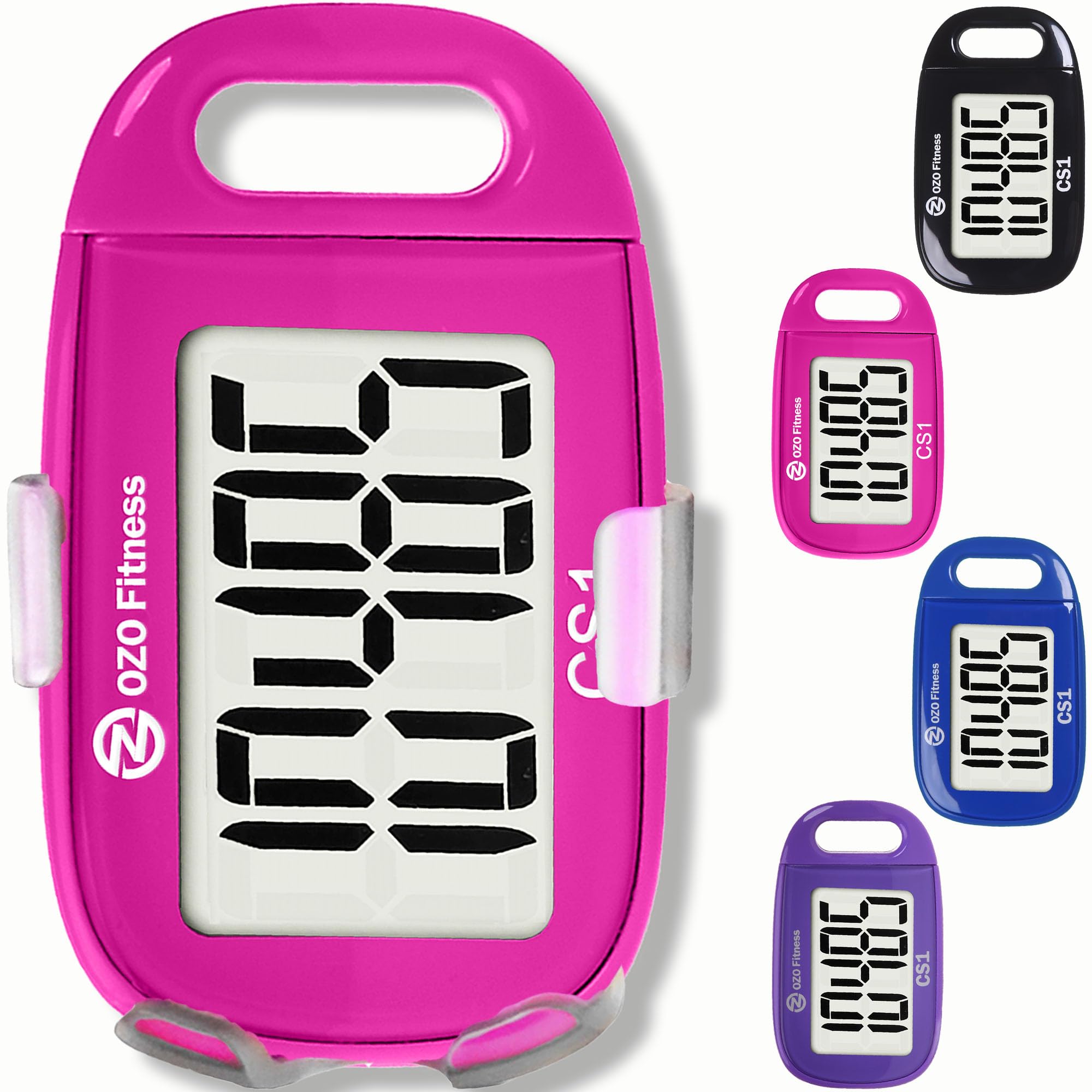
The OZO Fitness pedometer is thoughtfully designed for ease of use, making it an excellent choice for seniors or anyone averse to technology. It boasts a high-contrast digital display with extra-large numbers that are easy to read, even in low light or for those with vision challenges. Setup is genuinely plug-and-play.
It comes with both a sturdy clip and a full lanyard, offering flexible wearing options. The device is splash-resistant and durable, with users reporting it surviving accidental trips through the washing machine. It focuses on doing one thing well: counting steps accurately with a 3D sensor.
Battery life is up to 12 months, and it’s available in multiple colors. This tracker removes all barriers to use—there are no modes to switch, no apps to download, and no buttons to accidentally press (aside from reset). It’s a hassle-free tool for consistent step tracking.
Why it’s great
- Extremely simple, with large, easy-to-read numbers.
- Includes both a clip and a neck lanyard.
- Splash-resistant and durable construction.
- True set-and-forget operation with long battery life.
Good to know
- Only counts steps, no additional metrics.
- Some users note it can overcount if jostled in a pocket.
- Requires manual reset at the end of each day.
10. Non-Bluetooth Led Fitness Tracker Watch

This watch-style tracker is designed for kids and teens, offering a fun, familiar form factor without the need for a smartphone connection. It looks like a smartwatch but operates independently, tracking steps, distance, and calories burned after you input basic profile information directly on the device.
The silicone strap is soft and skin-friendly, and the watch clasp is easy for younger users to manage. It features a bright LED display, an alarm clock, and a stopwatch. Charging is via a micro-USB cable (or USB-C in some versions), and battery life can last up to two weeks, which is convenient for families.
It’s a great tool to encourage activity in children without introducing the distractions of notifications or social media. The lack of Bluetooth means parents don’t have to worry about connectivity or data privacy issues. However, the durability can be hit or miss, and the distance tracking may require calibration for accuracy.
Why it’s great
- Perfect watch form factor for kids and teens who want a “smartwatch” look.
- No Bluetooth or app required, ensuring simplicity and privacy.
- Tracks steps, distance, and calories with a clear display.
- Includes useful features like an alarm and stopwatch.
Good to know
- Build quality and durability can be inconsistent.
- Distance tracking may be inaccurate without proper stride setup.
- Not as feature-rich as connected fitness trackers.
11. Simple Walking Pedometer 3D Step Counter

This is the most basic and entry-level option on the list, a no-frills step counter that does one job. It uses a 3D sensor for reasonable accuracy and features a clever carabiner clip design, allowing you to hook it to a belt loop, bag, or keychain without needing a separate clip or lanyard.
There’s no setup, no Bluetooth, and no extra features—just a step count on the screen. The battery is a standard watch battery that lasts up to a year. It’s incredibly lightweight and small, making it easy to carry without notice. For someone who wants to dip a toe into step tracking with minimal investment and zero complexity, this is the starting point.
Accuracy is acceptable for the price, though it can vary based on placement (a pocket is often better than a loose clip). It’s a tool that proves you don’t need a fancy device to become more aware of your daily movement. The primary goal is to provide a number that motivates you to walk a little more each day.
Why it’s great
- Extremely budget-friendly entry point.
- Simple carabiner clip for easy attachment.
- No setup or settings—just start walking.
- Long battery life with a disposable cell.
Good to know
- Only counts steps, no other data.
- Accuracy can be inconsistent, especially if not worn firmly.
- The reset button can sometimes be pressed accidentally.
Understanding the Specs
3D Tri-Axis Sensor
This is the core technology in most modern pedometers and fitness trackers. Unlike older pendulum-style sensors, a 3D sensor detects motion in three dimensions (up/down, left/right, forward/back). This allows for accurate step counting regardless of how the device is oriented—in a pocket, on a hip, or around your neck. For walking, this sensor type is the most reliable for basic step tracking.
Battery Types & Lifespan
There are two main battery types: disposable (like CR2032) and rechargeable (Li-ion/Polymer). Disposable batteries in simple pedometers can last 6-12 months, offering ultimate convenience. Rechargeable batteries in smart trackers last from 4 to 18 days between charges. Your choice depends on your tolerance for charging; longer intervals mean less chance of forgetting and missing data.
Water Resistance Ratings
Ratings like IP68 or 5 ATM indicate how well a device withstands water. IP68 means it’s dust-tight and can be submerged in water (depth/time varies). 5 ATM means it’s suitable for swimming and showering. For walkers, a water-resistant rating (like IP67) is sufficient for rain and sweat, but if you plan to swim with it, look for 5 ATM or higher.
GPS Connectivity
Built-in GPS precisely maps your route, pace, and distance. Many trackers use “Connected GPS,” which leverages your smartphone’s GPS via Bluetooth. Built-in GPS is more convenient but drains battery faster. For most walkers, connected GPS is perfectly adequate and helps keep the tracker smaller and more affordable.
FAQ
Where is the most accurate place to wear a pedometer?
Do I need a smartphone to use a fitness tracker?
Why does my wrist tracker count steps when I’m not walking?
How often should I reset or sync my tracker?
Final Thoughts: The Verdict
For most people, the best activity tracker for walking winner is the Realalt 3DTriSport because it delivers exceptional accuracy, valuable extra metrics like distance and calories, and a 30-day memory at a mid-range point that feels fair. If you want a full-featured smart band with a gorgeous screen and long battery life, grab the Amazfit Band 7. And for those who value deep health insights and a proven ecosystem above all else, nothing beats the Garmin vívosmart 5.

Mo Maruf
I created WellFizz to bridge the gap between vague wellness advice and actionable solutions. My mission is simple: to decode the research and give you practical tools you can actually use.
Beyond the data, I am a passionate traveler. I believe that stepping away from the screen to explore new environments is essential for mental clarity and physical vitality.