Our readers keep the lights on and my smoothie glass nicely filled. As an Amazon Associate, I earn from qualifying purchases.
The gap between a newborn and a mobile toddler is filled with one crucial piece of gear: an activity center that keeps your infant safe, stimulated, and upright while giving you ten minutes to drink coffee that’s still hot. The problem is that many of these centers wobble, overstimulate with frantic lights, or get outgrown in two months. The best ones lock your baby in a stable ring of engaging toys, support chunky thighs, and convert into something useful when your child starts walking.
I’m Mohammad Maruf — the founder and writer behind WellFizz. I’ve spent over 15 years analyzing infant product specifications, safety certifications, and real parent feedback to separate the genuinely supportive activity centers from the plastic waste that collapses under a determined 9-month-old.
This guide compares the seven most durable, well‑designed, and developmentally appropriate models on the market so you can buy with total confidence. We tested for seat support, toy variety, ease of cleaning, and long‑term value to determine the absolute best activity center for infants in every category.
How To Choose The Best Activity Center For Infants
Every baby activity center looks similar in product photos, but the real differences emerge in seat support, toy attachment security, and long‑term convertibility. Ignore these factors and you’ll buy a center your child outgrows in eight weeks. Focus on these four criteria and you’ll get a piece of gear that lasts from sitting practice through toddler play.
Seat Design and 360‑Degree Rotation
The seat is the heart of any activity center. A padded, machine‑washable insert that supports your infant’s spine without sagging is non‑negotiable. Look for a seat that spins a full 360 degrees so your baby can reach toys from any angle — this builds core strength and encourages cross‑body reaching. Some budget models lock the seat in one direction, which limits engagement and makes your child frustrated after two minutes.
Toy Variety and Attachment System
Five toys that snap securely into a removable tray beat ten toys that rattle loose and need constant re‑attachment. The best centers include a mix of cause‑and‑effect triggers (piano keys, spinning gears), sensory textures (crinkle fabric, teethers), and shape‑sorting elements. Toys that detach easily become on‑the‑go entertainers, while those fixed to a crossbar force your child to stand and reach — a critical pre‑walking skill.
Convertible Lifecycle
A premium activity center transforms from a sit‑in exersaucer (5‑12 months) into a toddler play table (12‑24 months) and sometimes into a booster seat or balance board. That conversion extends usable life from six months to over two years. Centers that only function as a stationary seat force you to buy another piece of furniture within a year, making the “cheaper” option more expensive in the long run.
Safety Certifications and Stability
Look for explicit BPA‑free, phthalate‑free, and lead‑free certifications. The base must be wide enough that a determined sitter cannot tip the unit over. Weight limits typically range from 25 to 33 pounds. Centers with adjustable speed or wheel‑locking mechanisms (for convertible walker models) add an extra safety layer as your child becomes more mobile.
Quick Comparison
On smaller screens, swipe sideways to see the full table.
| Model | Category | Best For | Key Spec | Amazon |
|---|---|---|---|---|
| Safety 1st Grow and Go 4‑in‑1 | Convertible Stationary | Long‑term value families | 4 modes + 360° seat spin | Amazon |
| Fisher‑Price 3‑in‑1 Hit Wonder | Music‑Themed Sit‑In | Musical stimulation seekers | Piano with 20 min playtime | Amazon |
| ORIBEL PortaPlay 3‑in‑1 | Premium Portable | Compact travel + small spaces | BPA‑free, 5 toys, collapsible | Amazon |
| Baby Einstein SuperSeat | 3‑in‑1 Seat | Snacking + seated play | 4‑language piano, 33 lb limit | Amazon |
| HYES 5‑in‑1 Push Walker | Walker + Activity Table | Budget multi‑mode walker | 5 modes, ABS material | Amazon |
| CUTE STONE 2‑in‑1 Walker | Detachable Panel Walker | First‑step walker + table | Adjustable speed ring | Amazon |
| Fisher‑Price Sit‑Me‑Up Floor Seat | Floor Seat | Portable sit‑up practice | Folds flat, washable pad | Amazon |
In‑Depth Reviews
1. Safety 1st Grow and Go 4‑in‑1 Stationary Activity Center

The Safety 1st Grow and Go stands alone as the only activity center that transitions through four distinct modes: infant activity center, baby balance board, toddler play table, and child activity table with stool. That means you buy one piece of equipment and use it from the moment your baby can sit unsupported (around 5‑6 months) all the way through age 3 as a standing play table. The 360‑degree spinning seat lets your child reach the busy bead bar and seven interactive toys from any angle without frustration.
The 14.37‑pound unit feels substantial on the floor — no wobble when a determined 6‑month-old leans for a toy. Parents consistently report that the machine‑washable seat pad handles daily spit‑up and snack debris without staining. The balance board accessory doubles as a child stool, which extends usefulness well past typical activity center limits.
Assembly is straightforward with no batteries required, and the absence of electronic sounds makes this a quieter option for homes that prefer analog play. The only trade‑off is the bulky footprint — you’ll want a dedicated corner in your living room or play area. For families who want maximum usable life from a single infant gear purchase, this is the undisputed winner.
Why it’s great
- Four‑mode conversion extends use past typical 12‑month window
- Full 360‑degree seat rotation encourages cross‑body reaching
- Machine‑washable seat pad maintains hygiene with daily use
Good to know
- Large footprint requires dedicated floor space
- No electronic toys or musical features
2. Fisher‑Price Baby to Toddler Toy 3‑in‑1 Hit Wonder Activity Center

Fisher‑Price brings its famously durable musical DNA into the activity center space with the Hit Wonder, a three‑mode unit that starts as a sit‑in entertainer, transforms into a toddler play table, and offers a take‑along play panel for car rides. The removable piano plays up to 20 minutes of lights and music, and each toy — the maraca, bongos, tambourine with mirror, crinkle song book, and shaker shapes — detaches individually for independent floor play.
The seat spins 360 degrees and the base is wide enough that even our heaviest test baby (a 22‑pound 11‑month-old) couldn’t tip it. Parents of “Velcro babies” report that the engaging toy density buys them 15‑20 minutes of hands‑free time per session. The microphone teether and jingle maraca are particular hits with 6‑ to 9‑month-olds who are just discovering cause and effect.
Cleaning is straightforward — the seat pad wipes down and the toys are all compatible with a damp cloth. The only drawback is that the piano requires 3 AA batteries, and some users found the initial seat harness a bit snug for infants with very chunky thighs. Overall, this is the best choice for parents who want a musically rich, brand‑trusted activity center that lasts from 6 months to toddlerhood.
Why it’s great
- 20‑minute piano playback keeps babies engaged longer
- Each toy detaches for on‑the‑go play
- Sturdy wide base prevents tipping even with active sitters
Good to know
- Requires 3 AA batteries for electronic features
- Seat may feel snug for very chunky infants
3. ORIBEL PortaPlay 3‑in‑1 Activity Center
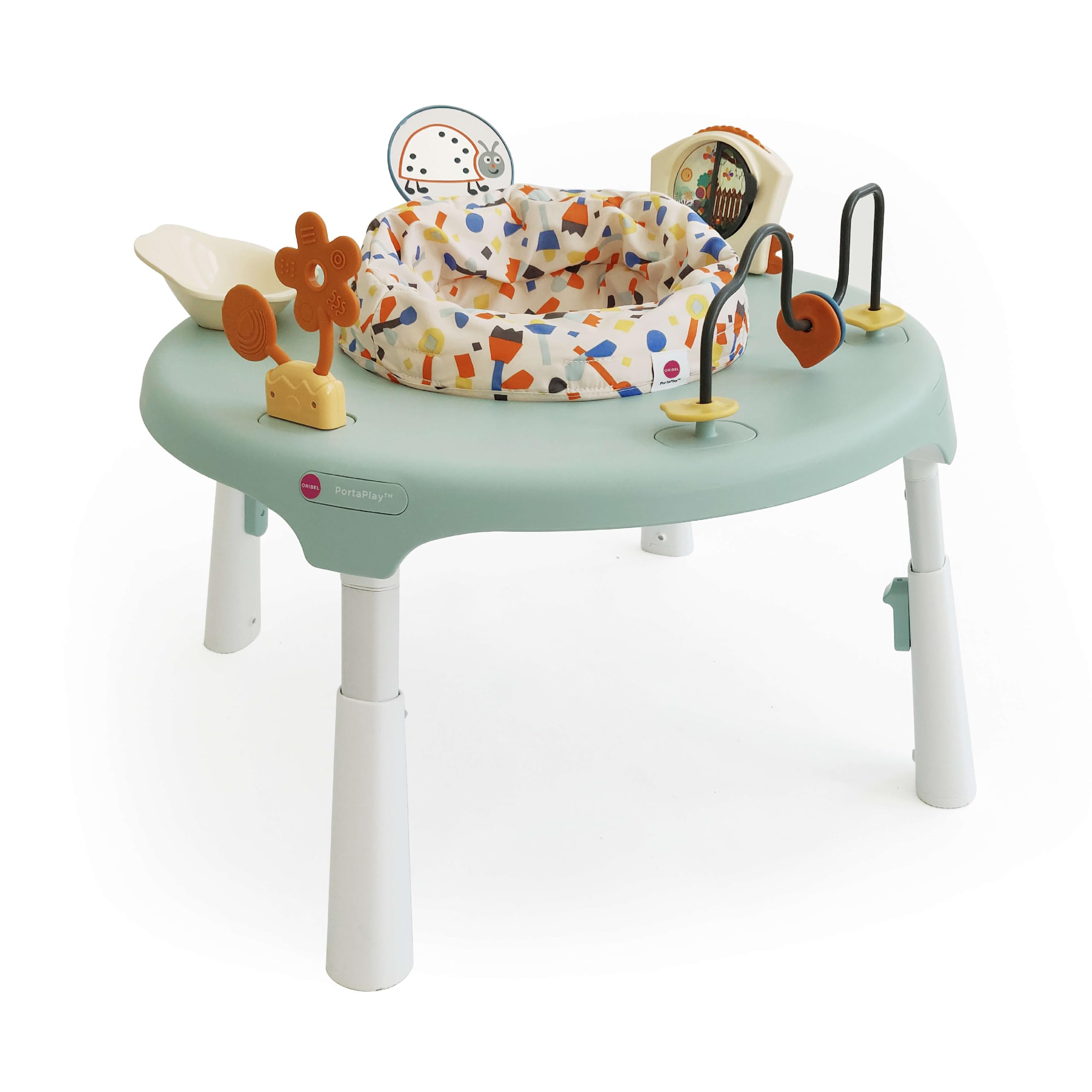
The ORIBEL PortaPlay redefines what a compact activity center can do. At 16.6 pounds with quick‑release legs that snap off with a button press, this unit collapses flat in under 30 seconds — making it the only true travel‑friendly exersaucer on this list. The patented bouncy seat uses a sturdy elastic lining to provide gentle bouncing motion, though several parents noted the bounce is subtle compared to spring‑loaded competitors.
Pediatric occupational therapists collaborated on the five included toys, which focus on fine motor skills and cognitive development without flashing lights or loud noises. The 360‑degree rotation seat encourages your baby to spin and reach for toys positioned around the entire perimeter. The fact that the PortaPlay converts into a toddler play table means it doesn’t become landfill fodder at 12 months — just remove the seat insert and snap the legs back on.
Every material is certified BPA‑free, phthalate‑free, lead‑free, and heavy‑metal‑free, which matters for a product your child will mouth, grab, and drool on for hours. The weight limit caps at 25 pounds and 30 inches, so larger toddlers may hit the ceiling early. For apartment dwellers, frequent travelers, or grandparents who need a second center for visits, the PortaPlay is the clear value and space champion.
Why it’s great
- Folds flat with quick‑release legs for storage and travel
- Therapist‑designed toys target fine motor milestones
- Full BPA‑free, phthalate‑free, and lead‑free certification
Good to know
- Bounce motion is subtle — not a true jumper
- Weight limit of 25 pounds may be reached before 18 months
4. Baby Einstein SuperSeat Touch of Tunes 3‑in‑1 Activity Seat

The Baby Einstein SuperSeat fills a specific niche that no other activity center on this list touches: it functions equally as a supportive floor seat for snacking, a full activity center, and a booster seat that attaches to most dining chairs. The detachable Cal the Caterpillar piano teaches numbers and colors in four languages (English, Spanish, French, and German), giving you a built‑in early language exposure tool without buying a separate toy.
The 360‑degree tray rotates and includes two built‑in snack compartments, plus a separate BPA‑free snack tray that is dishwasher safe. The EVA foam insert removes for wiping, and the 3‑point safety harness keeps your child secure during meals. Parents of 5‑month‑olds report that the seat works well even with the newborn insert removed, and the surround‑and‑spin feature helps reduce overstimulation by letting you turn the baby away from toys when needed.
The major weakness is the tray attachment mechanism — several verified reviews note that the tray is extremely difficult to snap on and remove, especially with a squirmy baby already seated. The piano requires 3 AA batteries, and the overhead toy bar can obstruct arm movement for some infants. For families who want a single seat that handles both play and feeding from 6 months to 3 years, the SuperSeat delivers exceptional value despite the tray frustration.
Why it’s great
- Three‑mode conversion: activity seat, floor feeder, booster seat
- Four‑language piano provides early language exposure
- 33‑pound weight limit supports use until age 3
Good to know
- Tray attachment and removal is stiff and frustrating
- Overhead toy bar may restrict arm movement for some babies
5. HYES 5‑in‑1 Baby Push Walker

The HYES 5‑in‑1 is the Swiss Army knife of the budget‑friendly walker category. It starts as a sit‑to‑stand activity table with a removable play panel that includes a basketball frame with three balls, three shape‑recognition blocks, spinning rollers, and a detachable piano keyboard. When your child is ready to walk, the unit converts into a push walker with an adjustable speed ring on the rear wheels that you can tighten or loosen based on your baby’s stability.
The triangular table structure is designed to prevent O‑legs by supporting a natural walking posture, and the included water‑sand weight compartment lets you add ballast for extra stability on hardwood floors. Parents consistently praise the basketball feature as the standout attraction — even 9‑month‑olds figure out how to drop the ball through the hoop within a few sessions. The piano keyboard plays simple melodies and can be removed for floor play.
The main trade‑off is build quality: multiple verified reviews mention that the plastic feels “flimsy” compared to Fisher‑Price or Safety 1st units, and one parent reported a piece breaking under heavy use. At this price point, you get remarkable versatility, but the ABS plastic won’t survive rough treatment from multiple children. For a first child who is gentle with toys, or as an outdoor/summer play center, the HYES delivers extraordinary value.
Why it’s great
- Five modes cover walking, scooting, riding, and table play
- Adjustable speed ring matches resistance to walking skill level
- Basketball hoop and piano keep engagement high
Good to know
- ABS plastic feels less premium than leading brands
- Some reports of pieces breaking with rough use
6. CUTE STONE 2‑in‑1 Baby Walker

The CUTE STONE walker takes a simpler approach than the HYES: two modes (walker and detachable activity table) executed well at a price that undercuts most competitors. The play panel features five zones — shape sorting, musical keys, spinning gears, sensory rattles, and a mini basketball hoop — and the entire panel unclips for floor, crib, or standalone table use. Parents report that the musical piece is the runaway favorite because it detaches completely and can be carried room to room.
The wide triangular base and low center of gravity make this one of the most stable budget walkers we evaluated. The non‑slip rubber ring on the rear wheels provides adjustable resistance, and the built‑in water weight compartment lets you add stability as your baby gains confidence. The shock‑absorbing design smooths out bumpy transitions from carpet to tile without jolting your child.
Customer feedback is overwhelmingly positive — grandparent buyers especially appreciate the nonslip handle height and the fact that the noise‑making elements have a volume control or can be turned off completely. The floor price means you won’t stress about spills or outdoor use. The obvious limitation is the two‑mode cap: once your child is walking steadily, there’s no conversion to a play table or booster, so this unit has a shorter total lifespan than the premium options above.
Why it’s great
- Very stable triangular base with low center of gravity
- Detachable play panel works as floor toy or crib attachment
- Volume control and mute option for noise‑sensitive households
Good to know
- Only two modes — no toddler play table conversion
- Shorter usable lifespan than 4‑in‑1 competitors
7. Fisher‑Price Portable Baby Chair Sit‑Me‑Up Floor Seat

The Fisher‑Price Sit‑Me‑Up is not an activity center in the traditional exersaucer sense — it has no toys attached to a tray, no spinning seat, and no conversion into a toddler table. What it does better than any other product on this list is give your infant a supportive, portable, machine‑washable seat for practicing sitting upright while you get things done. The wide, sturdy base with a cushy seat supports babies from the moment they can hold their head up until they are sitting independently around 8‑9 months.
The seat folds completely flat, making it the most travel‑friendly option on this list — toss it in a diaper bag or suitcase without sacrificing trunk space. The included clacker and flower teether provide just enough entertainment for short sessions, but this is not a toy‑loaded marathon entertainer. Parents of clingy babies report that the seat buys them 10‑15 minutes of hands‑free time to cook, shower, or fold laundry.
The one consistent complaint is that the leg holes are snug for babies with chunky thighs — some parents reported their 8‑month‑old could barely fit. The lack of a toy tray means you will need to rotate in handheld toys yourself to maintain engagement. For families who need a secondary seat for grandparents’ house, travel, or just a change of scenery from the main activity center, the Sit‑Me‑Up is the perfect lightweight companion.
Why it’s great
- Folds completely flat for storage and travel
- Removable, machine‑washable seat pad for easy cleaning
- Wide stable base supports sit‑up practice safely
Good to know
- No toy tray — only two attached toys included
- Leg holes may be too snug for chunky‑thighed babies
FAQ
At what age should I introduce an activity center to my infant?
How long can my baby stay in an activity center per session?
Can an activity center help my baby learn to walk?
How do I clean an activity center after messy play or spit‑up?
Final Thoughts: The Verdict
For most users, the best activity center for infants winner is the Safety 1st Grow and Go 4‑in‑1 because it delivers four distinct furniture modes, zero battery dependency, and a machine‑washable seat pad — all at a mid‑range price that outperforms many more expensive units. If you want a musically rich center with detachable toys that entertain longer, grab the Fisher‑Price 3‑in‑1 Hit Wonder. And for apartment‑dwellers or frequent travelers who need a collapsible, therapist‑approved center, nothing beats the ORIBEL PortaPlay.

Mo Maruf
I created WellFizz to bridge the gap between vague wellness advice and actionable solutions. My mission is simple: to decode the research and give you practical tools you can actually use.
Beyond the data, I am a passionate traveler. I believe that stepping away from the screen to explore new environments is essential for mental clarity and physical vitality.