Our readers keep the lights on and my smoothie glass nicely filled. As an Amazon Associate, I earn from qualifying purchases.
That hollow slap-back in your recordings, the muddled gaming chat, or the annoying ring in your home office isn’t a bad mic or speaker—it’s your bare walls reflecting sound waves straight back at you. Acoustic foam panels are the go-to fix for taming flutter echo, reverb, and standing waves, turning a live, noisy space into a dry, controlled listening environment. Whether you are laying down tracks in a home studio, hosting Zoom calls, or dialling into a competitive match, the right foam density and thickness make the difference between professional clarity and a hollow mess.
I’m Mohammad Maruf — the founder and writer behind WellFizz. I have spent countless hours analysing polyester densities, NRC ratings, adhesive tenacity, and real-world user feedback across the acoustic treatment market to build a guide that cuts through the hype and gets straight to what actually works.
This guide walks through the critical specs, real-world trade-offs, and top picks to help you find the best acoustic foam panels for your space and budget, without falling for marketing fluff.
How To Choose The Best Acoustic Foam Panels
Acoustic foam panels are not all created equal. Before you buy, focus on four factors that determine whether you’ll get meaningful echo reduction or just a decorative wall covering.
Thickness and Density
Thicker panels absorb lower frequencies better. A 1-inch thick panel is adequate for high-frequency flutter echo (voice sibilance, room ring), but bass frequencies below 200 Hz need at least 2 inches of depth. Denser foam with a higher lbs/ft³ rating absorbs more sound energy across a broader range, making it harder for sound waves to pass through the material.
Adhesive and Installation Reality
Self-adhesive backing is convenient, but the bond strength varies wildly between brands. Some adhesives hold firm on smooth, matte paint for years, while others fail on textured walls or in high humidity. If you rent or want to rearrange, check whether the adhesive leaves residue or peels paint—many users find they need spray mount or double-sided tape for a permanent setup.
NRC Rating vs. Real-World Coverage
The Noise Reduction Coefficient (NRC) is a lab measurement of absorption averaged across frequencies. A panel with an NRC of 0.95 absorbs 95% of the sound that hits it. But coverage matters: placing a single 12×12 panel in the corner of a 10×12 room will do almost nothing. Covering 15–20% of the wall and ceiling area is the typical threshold for a noticeable improvement.
Quick Comparison
On smaller screens, swipe sideways to see the full table.
| Model | Category | Best For | Key Spec | Amazon |
|---|---|---|---|---|
| 2nd Gen Acoustic Panels (Orange & Moon Grey) | Premium | Professional studio clarity & aesthetics | 390 lbs/yd³ ultra-high density | Amazon |
| Ekkogo Acoustic Panels 12-Pack | Premium | High NRC eco-friendly treatment | NRC rating 0.95 | Amazon |
| Amantech Hexagon Panels | Mid-Range | Stylish design & echo reduction | Hexagon 12×10.23×0.4 inch | Amazon |
| BSHEAD 12in Acoustic Panels | Mid-Range | Value-priced dense polyester treatment | 0.47 inch thick, 35% denser | Amazon |
| Sonicism Pyramid Panels | Budget | Entry-level high-frequency noise control | 1 inch thick PU foam | Amazon |
In‑Depth Reviews
1. Self-Adhesive Acoustic Panels [2nd Generation] (Orange & Moon Grey)

These second-generation panels stand out for their exceptional 390 lbs/yd³ density—roughly 30% higher than standard polyester foam. The patented vacuum needle punching technique compresses the 6D polyester fiber into a dense, rigid felt that absorbs sound energy more efficiently across mid and high frequencies. Each large hexagon measures 14 by 12 inches, offering more coverage per panel and a modern, clean look with the Orange and Moon Grey color combination.
The self-adhesive backing passed an 88.2-ounce tensile test, which means it holds securely on smooth, flat surfaces like matte drywall or painted walls. Users report that the adhesive remained strong after a full year of use, even in rooms with gaming consoles and music gear. This panel set is also SGS-certified, confirming no off-gassing, odors, or formaldehyde—making it a safer choice for bedrooms and children’s spaces.
One consistent note from the field is that the adhesive struggles on painted concrete or rough plaster; several users supplemented with strong double-sided tape or construction adhesive for a permanent bond. Once mounted, the panels effectively dampen flutter echo from flutes, clarinets, and vocals, improving articulation and clarity without deadening the room entirely.
Why it’s great
- Industry-leading density for superior absorption.
- SGS-certified, odorless, and formaldehyde-free.
- Stylish hexagon shape with consistent color.
Good to know
- Self-adhesive may fail on textured or painted concrete surfaces.
- Single pack won’t transform a large room; multiple packs needed for full coverage.
2. Ekkogo Acoustic Panels 12-Pack (White Square)

Ekkogo takes a different approach by using high-density, 5.9 oz/ft² poly-fiber panels made from recycled ocean-bound plastic bottles. Each 12×12 inch square has a beveled edge for a clean, tile-like appearance, and the material reaches an NRC of 0.95—meaning it absorbs 95% of incident sound in lab testing. This makes it one of the most absorbent options in this price tier, especially for mid and high frequencies.
What sets these panels apart is their eco-friendly construction: they are odorless, formaldehyde-free, and flame retardant. The white finish blends into light walls easily, and users have repurposed them as pin boards for quilting designs, which speaks to the dense, sturdy felt quality. The lack of included adhesive is a catch—you will need to supply your own spray mount, construction adhesive, or double-sided tape to mount them securely.
Real-world feedback shows they effectively deaden echoes from conversations and reduce the sound of neighbor movements like bed springs or charging devices. However, they are not very thick at 0.4 inches, so they offer minimal absorption of low bass frequencies. A few users felt the difference was subtle with just one pack, reinforcing the rule that adequate coverage across a larger wall area is required for dramatic improvement.
Why it’s great
- Highest NRC of the group at 0.95.
- Made from recycled ocean plastics—environmentally conscious.
- Clean, beveled design suits modern interiors.
Good to know
- No adhesive included—requires separate purchase.
- Thin profile limits low-frequency absorption.
3. Amantech 12 Pack Hexagon Acoustic Panels (Moonlight Grey)
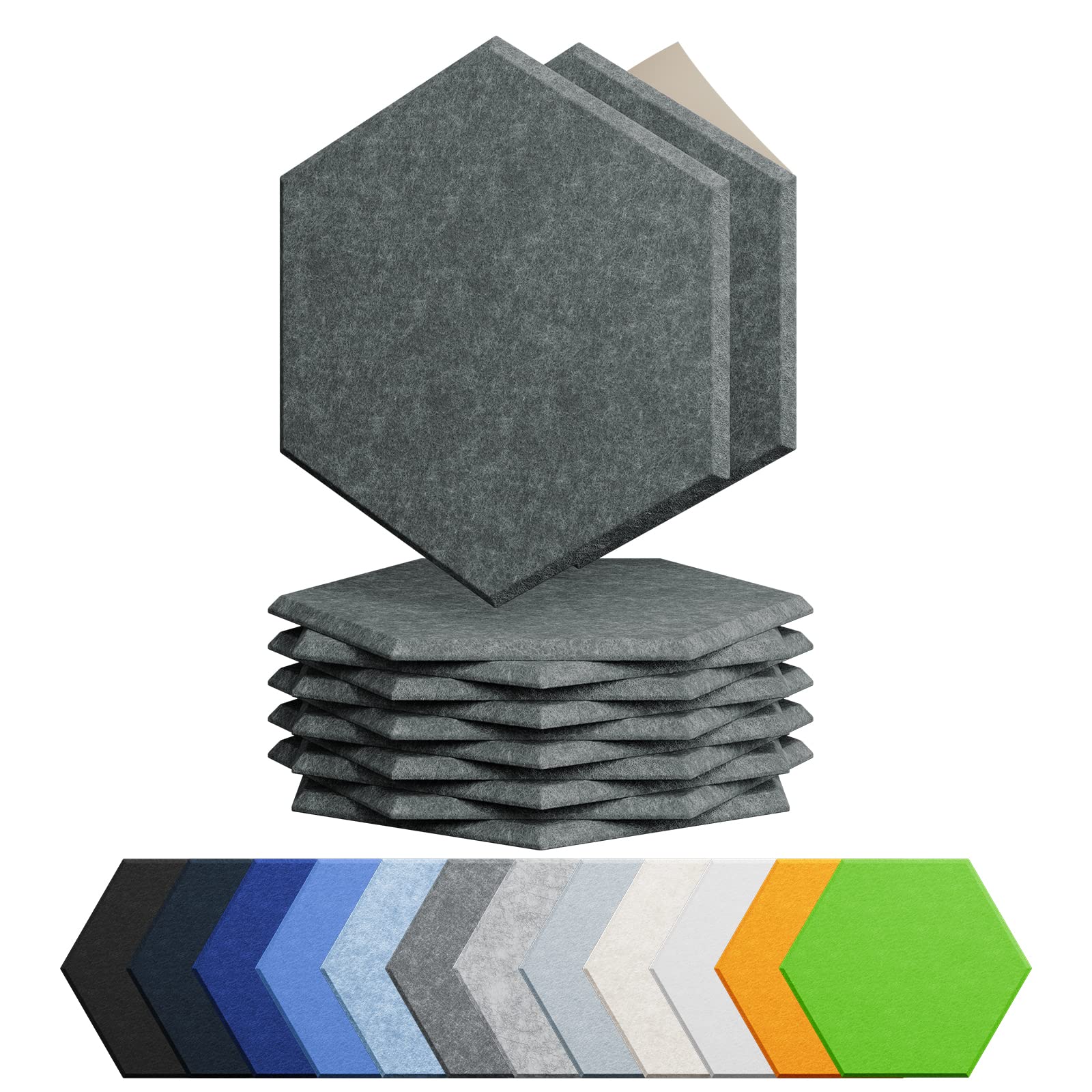
Amantech delivers a honeycomb-inspired hexagon design that prioritizes visual appeal alongside basic echo reduction. Each panel measures 12 by 10.23 inches with a 0.4-inch thickness and is made from 100% polyester fiber that is odorless, non-toxic, and formaldehyde-free. The hexagon shape fits together like a beehive, which not only looks modern but can also create a wider distribution of absorption across the mounting surface due to the angled edges breaking up sound reflections.
The back includes a self-adhesive layer that makes installation quick—peel off the protective film and press onto a clean, flat wall. Users appreciated the no-smell quality and the ease of cutting these panels with a utility knife to fit tight spaces or outlets. The Moonlight Grey color is neutral and complements most decor schemes without dominating the room.
Reviews consistently note that while the panels reduce echo and improve the feel of a live room, they are too thin for serious soundproofing or low-end frequency control. Multiple users recommend buying several packs to cover enough surface area for a meaningful effect. Additionally, removal can leave adhesive residue on walls, so consider mounting them on a board if you are renting.
Why it’s great
- Self-adhesive backing for instant installation.
- Hexagon shape offers flexible, creative layouts.
- Odorless and safe for sensitive environments.
Good to know
- Thin at 0.4 inches—limited low-frequency absorption.
- Adhesive may leave messy residue upon removal.
4. BSHEAD 12in Acoustic Panels High Density (8-Pack)

BSHEAD offers a compelling value proposition with panels that are 25% thicker and 35% denser than typical budget foam tiles. The 0.47-inch thickness sits between standard thin tiles and thicker professional panels, and the 100% polyester construction is flame retardant and completely odorless. These are square 12×12 panels with a 45-degree chamfered edge that gives them a clean, modern profile when arranged in a grid or staggered pattern.
The included self-adhesive backing allows for tool-free installation, and users found the adhesive strength to be reliably strong on smooth surfaces. The panels cut cleanly with a utility knife, making them adaptable for tight spots or DIY shapes. With approximately 7.6 square feet of coverage per 8-pack, these are ideal for covering a small wall section behind a desk or studio desk without stretching your budget.
User feedback highlights dramatic echo reduction in small rooms—specifically, a noticeable drop in ambient noise from a workshop air compressor and cleaner vocal recordings in a home studio. The adhesive can fail on rough or heavily textured walls, so a layer of spray adhesive is recommended for those surfaces. Overall, these are a sensible entry point for anyone wanting a measurable improvement without committing to a premium price.
Why it’s great
- Thicker and denser than typical budget panels.
- Self-adhesive with strong initial bond on smooth surfaces.
- Chamfered edges create a clean wall finish.
Good to know
- Small pack size requires multiple purchases for full room coverage.
- Adhesive may not hold on textured or painted concrete walls.
5. Sonicism 12 Pack Pyramid Sound Proof Foam Panels

Sonicism uses a classic pyramid 3D profile made from high-density PU sponge polymer. At 1 inch thick, these are the thickest panels in this roundup, which gives them an advantage for absorbing slightly lower frequencies than the 0.4-inch tiles. The pyramid surface increases the contact area for sound waves, effectively scattering and trapping high-frequency flutter echo from vocals, keyboards, and ambient room noise.
The panels ship compressed and expand rapidly once removed from packaging—often within seconds. This expand-and-recover feature is convenient, but a small number of units arrived with permanent creases or deformation that did not fully bounce back. The self-adhesive backing is strong, but user reports warn that removal can be extremely difficult, often leaving sticky residue or ripping paint off walls. Several buyers opted to use the included spare adhesive strips or switched to spray adhesive after initial placement.
In a 10×12 room, users found that a full wall of these panels significantly reduced engine noise and made conversation easier. However, the inconsistent packing quality (about a third of one user’s panels arrived deformed) and the aggressive adhesive are the main trade-offs. These are best suited for permanent installations where you do not plan to move or repaint.
Why it’s great
- 1-inch thickness offers better low-mid absorption than thinner tiles.
- Fast-expanding foam restores shape quickly out of box.
- Strong self-adhesive holds well on smooth walls.
Good to know
- Inconsistent packing can leave panels permanently deformed.
- Adhesive is nearly permanent—removal damages paint and leaves residue.
FAQ
What thickness do I need for vocal echo in a home studio?
Can I use acoustic foam panels to block noise from my neighbors?
Final Thoughts: The Verdict
For most users, the best acoustic foam panels winner is the 2nd Generation Self-Adhesive Acoustic Panels because it combines the highest density in the group (390 lbs/yd³) with an attractive hexagon design and strong adhesive that holds up over a long period. If you want an eco-conscious, high-NRC solution that absorbs 95% of sound, grab the Ekkogo Panels. And for a budget-friendly entry into acoustic treatment that offers decent thickness and easy installation, nothing beats the Sonicism Pyramid Panels.

Mo Maruf
I created WellFizz to bridge the gap between vague wellness advice and actionable solutions. My mission is simple: to decode the research and give you practical tools you can actually use.
Beyond the data, I am a passionate traveler. I believe that stepping away from the screen to explore new environments is essential for mental clarity and physical vitality.