Our readers keep the lights on and my smoothie glass nicely filled. As an Amazon Associate, I earn from qualifying purchases.
That thin gap between your baseboard and the floor, the hairline crack around an electrical box, the tiny void where the wall meets the ceiling — these silent pathways carry noise straight into your sanctuary, turning a home theater into a noisy echo chamber and a quiet bedroom into a front-row seat for the neighbor’s conversation. Acoustic caulk is the specialized sealant engineered to close those sound leaks, maintaining the Sound Transmission Class (STC) rating of an assembly where standard paintable caulks or expanding foams would fail under building code scrutiny.
I’m Mohammad Maruf — the founder and writer behind WellFizz. My market research focuses on isolating the measurable acoustic and physical properties that separate a proper acoustic sealant from a general-purpose filler, analyzing independent lab data on STC compliance, flame spread ratings, and cure behavior.
These products range from budget-friendly latex formulations to premium viscoelastic compounds that stay permanently pliable, and this guide breaks down exactly where each type fits a real noise-sealing project. Whatever you choose, the best acoustic caulk will seal those invisible leaks without becoming brittle, cracking, or shrinking after installation.
How To Choose The Best Acoustic Caulk
Standard caulks dry into a rigid, hard mass that acts as a sound bridge, transmitting vibration across the gap. A proper acoustic sealant stays permanently flexible, absorbing vibrational energy rather than passing it through. That fundamental difference is the single most important attribute to verify before buying.
Check for Non-Hardening or Permanently Pliable Formulation
Most building codes (IBC 1207.2) and acoustic standards (ASTM-C919) require a sealant that remains flexible over time to maintain the assembly’s STC rating. If a product label says “non-hardening,” “acoustical sealant,” or “remains pliable,” it is designed for this job. General-purpose acrylic latex or silicone caulk dries to a hard, brittle state that actually undermines soundproofing efforts.
Verify STC Compliance and Flame Spread Rating
Commercial and multi-family projects require a sealant tested to ASTM-E90 for sound transmission and ASTM-E84 for surface burning characteristics. Look for a Class A flame spread rating (0-25) if the sealant passes through a fire-rated assembly. For home studios or single-family rooms, these ratings are less critical, but they remain the benchmark of professional-grade performance.
Match the Viscosity and Application Method
Thicker, paste-like formulations stay put on vertical surfaces and fill larger gaps without sagging or running. Thinner, soupy caulks may be easier to tool but can drip from ceiling joints or fail to maintain a continuous seal in wider cracks. Evaluate the gap size: a 1/8-inch gap around a door frame needs a different viscosity than a 1-inch gap at a floor-wall intersection.
Quick Comparison
On smaller screens, swipe sideways to see the full table.
| Model | Category | Best For | Key Spec | Amazon |
|---|---|---|---|---|
| TMS Acoustical Soundproofing Caulk | Acoustic Sealant | Wall perimeters and outlets | 28 oz tube, Class A (20) flame spread | Amazon |
| Green Glue Noiseproof Compound | Viscoelastic Damping | Between drywall layers | 28 oz cartridge, 90% noise dissipation | Amazon |
| Acoustical Caulk (29 oz) + Wipe | Latex Acoustic Caulk | Doors, windows, and outlets | 29 oz tube, 48-hour full cure | Amazon |
| Sashco Big Stretch Grey Caulk | High-Stretch Acrylic | General gap sealing and painting | 10.5 oz cartridge, 500% stretch | Amazon |
| Stanley Black Expanding Foam | Expanding Polyurethane | Large voids in non-STC assemblies | 12 oz aerosol, fills gaps up to 3 inches | Amazon |
In‑Depth Reviews
1. TMS Acoustical Soundproofing Caulk

Trademark Soundproofing’s TMS Acoustical Caulk is the most balanced package for anyone building a home studio, finishing a basement, or sealing a condo wall assembly. The 28-ounce tube delivers roughly 60 linear feet of coverage, and the synthetic rubber formulation stays permanently pliable rather than hardening into a sound bridge. Users consistently report a noticeable reduction in noise transmission after applying it around wall perimeters, ceiling joints, and electrical boxes.
The material carries a Class A flame spread rating of 20, tested to ASTM-E84, and it complies with IBC 1207.2 and ASTM-C919 — the benchmarks that matter if your project requires code inspection. Adhesion holds firmly on drywall, wood, concrete, and metal studs, which makes it versatile for both new construction and retrofit sealing. A few early batches shipped without nozzles, so check the box on arrival, but the caulk itself performs exactly as specified.
Viscosity is thick enough to stay put on vertical surfaces without sagging, yet it tools cleanly with a wet finger. The 24-hour full cure time is standard for water-based acoustic sealants, and the odor is mild enough that you do not need to vacate the room during application. For a single all-purpose tube that hits every technical box a professional looks for, this is the one.
Why it’s great
- Remains permanently flexible without hardening or cracking
- Class A flame spread rating meets professional and code requirements
- Thick viscosity stays put on vertical and overhead surfaces
Good to know
- Some units have shipped without the application nozzle
- Thin consistency reported by one user for wall assemblies
2. Saint-Gobain Green Glue Noiseproof Compound

Saint-Gobain’s Green Glue is the most scientifically distinct product in this lineup — it is not a traditional gap sealant but a viscoelastic damping compound designed to be sandwiched between two layers of drywall or plywood. Independent lab tests claim up to 90 percent noise dissipation, with peak performance reached 30 days after application. This is the engineered solution for low-frequency noise from subwoofers, home theaters, and mechanical equipment that standard acoustic caulks cannot fully address.
The compound never fully dries into a solid — it remains in a permanently sticky, gel-like state that converts vibrational energy into a negligible amount of heat. That same stickiness makes it messy to work with: drips must be cleaned immediately, and the compound tends to ooze out under pressure if the drywall screws are not perfectly aligned. Users building soundproof booths or recording studios praise its effectiveness, but the 30-day cure requires patience that a quick renovation may not allow.
Coverage is roughly 28 ounces per tube, and one tube covers about 20 square feet when applied between two 4×8 sheets. This is not a product for sealing perimeter gaps — use it only as a constrained-layer dampener between rigid panels. Pair it with a traditional acoustic caulk (like the TMS entry above) to seal the assembly’s edges for a complete system.
Why it’s great
- Viscoelastic damping absorbs low-frequency vibration that standard caulk cannot
- Independent lab testing shows up to 90% noise dissipation in constrained-layer assemblies
- Never hardens, maintaining sound-dampening properties indefinitely
Good to know
- Extremely sticky and messy to apply; drips require immediate cleanup
- 30-day cure time to reach full performance
- Limited to between-panel applications, not for perimeter or gap sealing
3. Acoustical Caulk (29 oz) with Cleanup Wipe
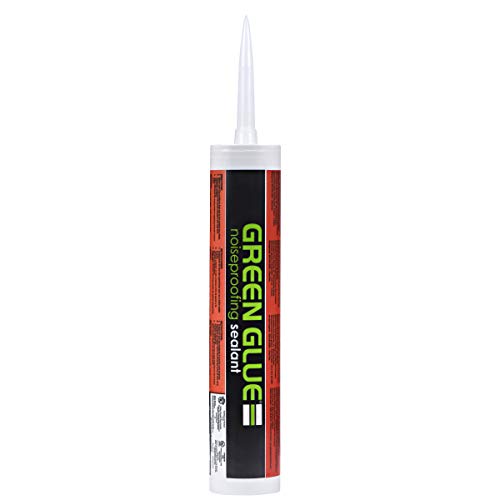
This Green Glue-branded acoustic caulk is a straightforward latex-based sealant formulated for the standard soundproofing tasks: sealing perimeters of walls and ceilings, gaps around electrical outlets, window frames, and door casings. The UL rating and water-based low-odor formula make it suitable for occupied spaces during renovation without requiring a respirator or vacating the room. Coverage is estimated at 40 to 50 linear feet from the 29-ounce tube, and the included Big Wipes cleanup pad is a thoughtful addition that saves a trip to the hardware store.
Multiple users report dramatic noise reduction — one home theater build recorded a 30 dB drop after sealing a door frame. The material remains flexible after full cure (48 hours) and accepts paint or joint compound, which means you can finish the surface seamlessly. A subset of users note that the caulk can run or sag in vertical gaps larger than a standard crack, and the slow drying time requires patience before painting or taping over the seal.
Application requires a 28-ounce caulk gun, which is a larger frame than the standard 10-ounce gun most DIYers own. If you do not already have a full-size gun, factor that into the total cost. The tube is also prone to dripping if not continuously pressurized — keep a rag handy and work in short, controlled beads.
Why it’s great
- Low-odor, water-based formula safe for occupied indoor spaces
- Included cleanup wipe simplifies post-application cleanup
- Dries to a paintable, tape-able finish for seamless integration
Good to know
- Requires a large 28 oz caulk gun, not standard size
- Slow 48-hour cure time before painting or mudding
- Can sag or run on large vertical gaps without support
4. Sashco Big Stretch Acrylic Latex Caulk

Sashco’s Big Stretch is not marketed as an acoustic sealant, but its acrylic latex formulation deserves a place here for one specific reason: extreme elasticity. The material stretches to more than 500 percent of its original size and compresses back without cracking, which makes it the best option for sealing gaps in surfaces that experience natural thermal movement, such as log homes, concrete slabs, or fence boards where sound leaks are secondary to structural movement.
The 10.5-ounce cartridge fits standard caulk guns and dispenses with minimal effort. Paint adheres to it immediately without fish-eyeing or peel-back, and the gray color blends well with most stucco, concrete, and painted surfaces. User reviews overwhelmingly reflect satisfaction with the cartridge design — the tube’s rear plunger pushes nearly every drop out, reducing waste compared to cheaper caulk tubes that leave significant material behind.
Two important caveats for acoustic use: this is not a non-hardening sealant, so it will eventually cure to a firm-but-flexible state rather than remaining permanently tacky. For soundproofing assemblies that require a continuously damped seal (such as STC-rated walls), this is a downgrade from a dedicated acoustic caulk. It also degrades under prolonged UV exposure, so it is best suited for interior or shaded exterior applications.
Why it’s great
- 500% stretch capacity outperforms standard latex caulks for moving joints
- Dispenser design pushes nearly all material out with minimal waste
- Paint-ready in 24 hours with excellent adhesion for finish coats
Good to know
- Cures to a firm flexible state, not permanently pliable like true acoustic sealant
- Not UV stable — do not use in direct sunlight
- Not tested to ASTM-E90 or IBC acoustic standards
5. Stanley Black Expanding Polyurethane Foam
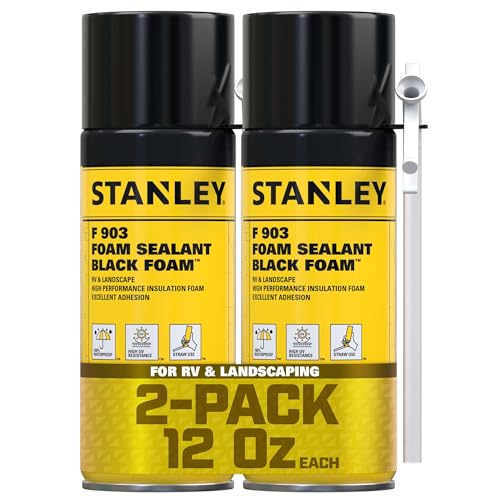
Stanley’s expanding polyurethane foam fills a separate niche from every other product on this page — it is designed to seal large cavities (up to three inches wide) using expanding foam rather than a caulk bead. The black color is formulated to blend with landscaping, RV underbodies, pond rocks, and automotive cavities where visual discretion matters. UV resistance and waterproofing make it suitable for exterior applications where standard acoustic caulk would degrade rapidly.
This product is not an acoustic sealant. It does not meet STC requirements, it does not remain pliable (it cures into a rigid foam), and its cellular structure actually transmits sound more readily than a solid, flexible sealant. However, for filling large gaps such as the cavity behind a recessed light, a plumbing penetration in a crawl space, or a construction void that will later be covered by drywall and sealed at the perimeter with proper acoustic caulk, this foam serves as an effective air-sealing backup layer.
Application requires care: the foam expands significantly, so fill only 30 to 50 percent of the cavity depth. Wear gloves because uncured foam is extremely sticky and difficult to remove from skin. The aerosol can has no stream adjustment — it delivers full blast or nothing, which limits precision. For the specific use case of blocking large irregular cavities before applying a final layer of acoustic caulk to the assembly edges, this is a useful companion product.
Why it’s great
- Expands to fill large, irregular gaps that caulk cannot bridge
- UV resistant and waterproof, suitable for outdoor and marine use
- Non-toxic formula safe for ponds, plants, and wildlife areas
Good to know
- Cures rigid — does not dampen sound and is not a substitute for acoustic caulk
- No nozzle adjustment; delivers full blast only
- Extremely sticky when wet; wear gloves and protect surfaces
FAQ
Can I use standard paintable silicone instead of acoustic caulk?
Does acoustic caulk stop low-frequency noise like bass or subwoofers?
How long does acoustic caulk take to dry before painting?
Can I use expanding foam instead of acoustic caulk for soundproofing?
Final Thoughts: The Verdict
For most users, the best acoustic caulk winner is the TMS Acoustical Soundproofing Caulk because it delivers Class A flame spread, permanent flexibility, and reliable adhesion across all common building surfaces at a price that fits a full room’s worth of tubes. If you want viscoelastic damping for low-frequency noise in a home theater or recording studio, grab the Saint-Gobain Green Glue Noiseproof Compound. And for sealing large, irregular construction voids before the final acoustic sealant layer, nothing beats the Stanley Black Expanding Foam.

Mo Maruf
I created WellFizz to bridge the gap between vague wellness advice and actionable solutions. My mission is simple: to decode the research and give you practical tools you can actually use.
Beyond the data, I am a passionate traveler. I believe that stepping away from the screen to explore new environments is essential for mental clarity and physical vitality.