Our readers keep the lights on and my smoothie glass nicely filled. As an Amazon Associate, I earn from qualifying purchases.
The sharpest knife in your block is a blunt tool without the right surface to meet. That surface—your cutting board—determines how often you sharpen, how much your counters flood with juice, and whether wood splinters end up in tonight’s dinner. Acacia wood brings exceptional density, natural water resistance, and a grain pattern that looks good enough to stay on the counter between meals. Choosing the wrong thickness or grain orientation wastes those advantages.
I’m Mohammad Maruf — the founder and writer behind WellFizz. I’ve spent the better part of a decade cross-referencing wood density data, juice-groove geometry, and edge-grain versus end-grain durability claims to separate cutting boards that last from those that warp before their first oiling.
Whether you are carving a roast, dicing onions for a crowd, or building a charcuterie spread that impresses guests, the construction details determine how well the board performs. I have analyzed seven contenders to help you find the best acacia cutting boards for your kitchen and your routine.
How To Choose The Best Acacia Cutting Boards
Acacia wood is a dense hardwood that naturally resists moisture and bacteria more effectively than bamboo or many domestic hardwoods, but not every acacia board performs the same. Three factors separate a board that feels solid for a decade from one that shows cracks after a few months.
Thickness and Grain Orientation
Thickness is the single best predictor of long-term flatness. A board under 1 inch thick can bow under heavy chopping or when exposed to temperature changes. Boards in the 1.25- to 1.6-inch range stay put and absorb impact without transferring all the force to your knife edge. End-grain construction—where the wood fibers run vertically—lets the board “self-heal” as fibers separate and bounce back, dramatically reducing visible cut marks. Edge-grain boards are more affordable but show wear faster and can dull knives slightly more over time.
Juice Groove Depth and Handle Design
Juice grooves prevent countertop puddles when carving meat or slicing juicy fruit, but shallow grooves fill quickly and overflow. Look for grooves that are at least a quarter-inch deep and run continuously around the perimeter. Handles matter too: recessed side cutouts keep the board stable during use and make lifting easy without grabbing the cutting surface itself. Boards without handles force you to pinch from underneath, which gets messy fast when the surface is wet.
Size and Prep Area
A board that is too small forces you to crowd ingredients, increasing the risk of knife slips. Boards in the 20-by-15-inch range provide comfortable room for a full meal prep session without overwhelming standard counter space. The largest options—24 by 18 inches—can double as a stovetop cover or sink topper, effectively adding work surface in a small kitchen. Choose based on your counter dimensions and typical batch size rather than aiming for the biggest option available.
Quick Comparison
On smaller screens, swipe sideways to see the full table.
| Model | Category | Best For | Key Spec | Amazon |
|---|---|---|---|---|
| Cookaholic Premium | End Grain | Heavy daily prep | 1.5″ thick, 9.1 lbs | Amazon |
| BABILONIA 3-in-1 | Edge Grain | Integrated scoop plate | 1.6″ thick, oil included | Amazon |
| HOMESTEAD XXL | End Grain | Extra-large meal prep | 23x18x1.5 in | Amazon |
| GAOMON XXL | Edge Grain | Oversized surface, multi-use | 24x18x1.1 in | Amazon |
| HOMESTEAD End Grain | End Grain | Butcher-block durability | 20x15x1.25 in | Amazon |
| FANICHI XL | Edge Grain | Dual-sided serving | 20x15x1.5 in | Amazon |
| Misawce 3-Piece Set | Edge Grain | Budget-friendly set | 17x12x1 in each | Amazon |
In‑Depth Reviews
1. Cookaholic Premium End Grain Acacia Cutting Board

The Cookaholic Premium board hits all the right notes for a serious home cook. At 20 by 15 inches with a full 1.5-inch thickness and end-grain construction, the board feels substantial without being absurdly heavy. The vertical wood fiber structure absorbs knife impact rather than deflecting it, which keeps your blade sharper longer and significantly reduces visible cut marks. Users report that after months of daily use, the surface shows minimal scratching compared to edge-grain boards.
The deep juice groove runs continuously around the perimeter and genuinely contains runoff from a large roast or watermelon without overflow. The board is pre-cured with coconut oil, which gives a mild pleasant scent out of the box and means you can start prepping immediately after a quick wash. The built-in side handles are recessed, so the board remains stable during chopping and easy to lift when you want to move it from counter to table.
At 9.1 pounds, this board stays put during vigorous cutting without needing a damp towel underneath. The end-grain pattern—a checkered mosaic of wood blocks—adds visual appeal that makes the board suitable for serving cheese and charcuterie directly. While the weight can make it awkward to carry to the sink for cleaning, the overall build quality justifies the premium positioning.
Why it’s great
- End-grain self-healing fibers hide cut marks
- Pre-cured with coconut oil, ready to use
- Deep juice groove contains heavy runoff
Good to know
- Heavy at 9.1 lbs; not easy to flip mid-use
- Requires periodic oiling to prevent drying
2. BABILONIA 3-in-1 Acacia Cutting Board
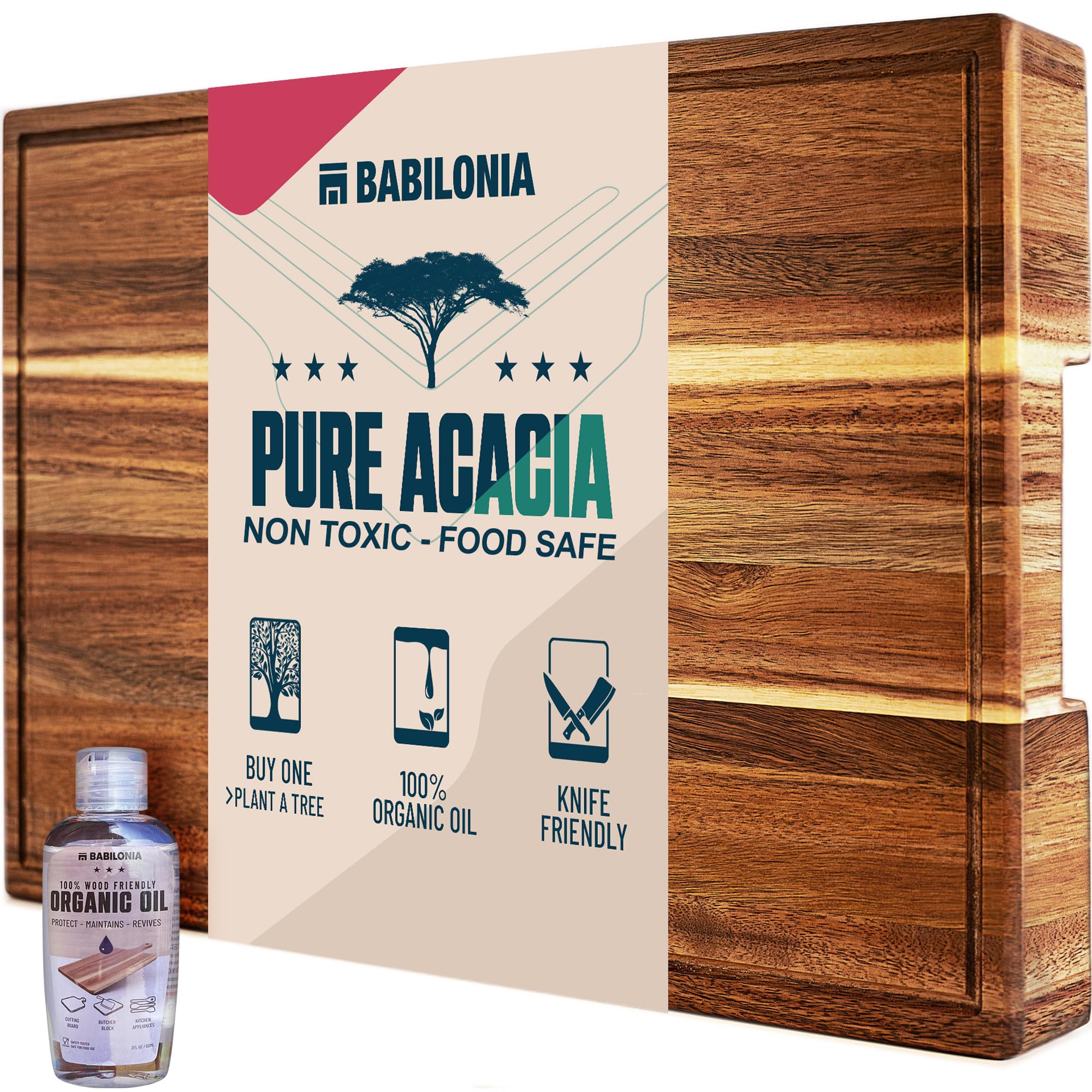
The BABILONIA board introduces a genuinely useful innovation: a built-in notch and a small stainless-steel plate that sits below it. Sweep chopped onions, garlic, or diced vegetables directly into the notch, and they collect on the plate instead of scattering across the counter. This feature alone saves the annoying step of lifting the board to scrape ingredients into a bowl, which is particularly valuable during fast-paced meal prep.
At 19.7 by 12.2 inches with a thickness of 1.6 inches, the board is among the thickest edge-grain options in this lineup. The extra heft provides stability and helps the board resist warping over time. The acacia wood is edge-grain, which is slightly more prone to showing cut marks than end-grain, but regular oiling keeps the surface looking clean. The board ships pre-oiled and includes a bottle of organic oil for maintenance.
One reviewer noted that the board has held up well with use about six times per week over several months, requiring only a single re-oiling. The dark natural grain pattern looks refined enough to double as a serving board for bread, cheese, or antipasti. The reversible design means the smooth flat side works for rolling dough while the grooved side handles carving duty.
Why it’s great
- Integrated notch and plate eliminate ingredient scattering
- 1.6-inch thick edge-grain stays stable
- Includes organic oil for maintenance
Good to know
- Edge-grain shows cut marks faster than end-grain
- Not dishwasher safe like all wood boards
3. HOMESTEAD End Grain Acacia Cutting Board (23×18)
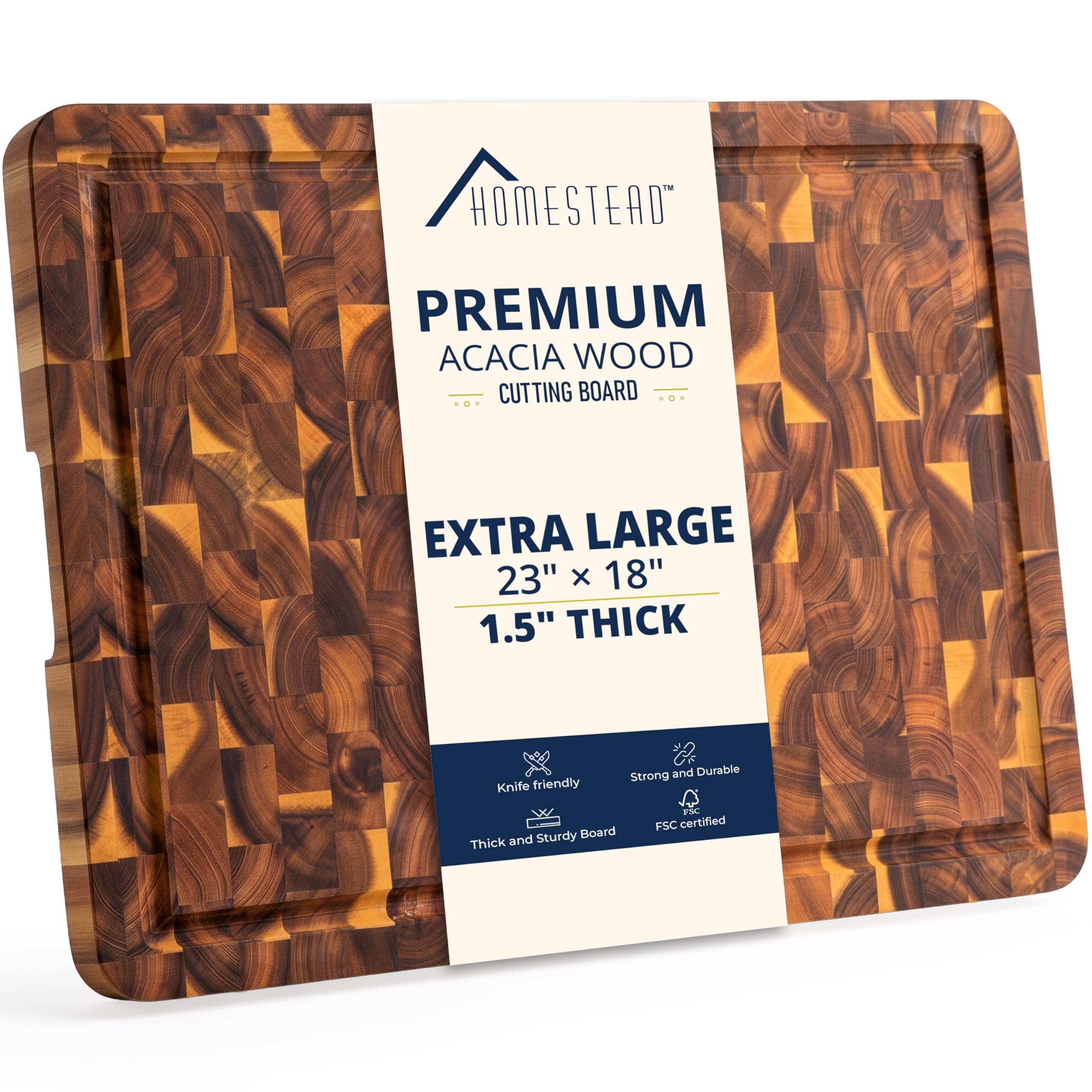
The larger HOMESTEAD variant stretches to 23 by 18 inches with a 1.5-inch thickness, making it one of the biggest end-grain boards you can reasonably fit on a standard kitchen counter. The sheer surface area allows two people to prep simultaneously without crossing knives, and the board can handle a full turkey or a massive batch of vegetables without crowding. The end-grain construction uses interlocking vertical fibers that absorb heavy chopping impact and resist warping even under demanding use.
The juice groove runs around the perimeter and is deep enough to catch drips from large cuts of meat. Recessed side handles make lifting the board manageable despite its size. One customer reported that the board arrived flat out of the box and performed well as a monitor base before being repurposed for food prep, which speaks to the flatness and stability of the build. Another user noted that a board cracked within two days but the vendor replaced it immediately, suggesting that individual units can have variability but the warranty support is responsive.
The board is thirsty out of the box and benefits from an initial soaking with food-grade mineral oil or board butter before first use. Without that conditioning, the wood can dry out and develop surface checks over time. The large format makes it less convenient to wash in a standard sink, but the end-grain surface stays smooth and knife-friendly with proper care.
Why it’s great
- Massive surface for two-person prep
- End-grain absorbs impact, protects knives
- Deep groove contains meat juices
Good to know
- Heavy and may barely fit large sink
- Requires thorough initial oiling
4. GAOMON XXL Acacia Cutting Board (24×18)

The GAOMON XXL stretches to 24 by 18 inches, making it the longest board in this selection. Despite the generous dimensions, the board is relatively lightweight because it is only 1.1 inches thick. That lighter weight makes it easy to move around the kitchen—one reviewer uses it as a stovetop cover to create extra counter space—but the reduced thickness means it may not feel as planted during heavy chopping sessions as thicker boards.
The acacia edge-grain surface is smooth and well-sanded out of the box, with a dark natural color that shows off the wood grain. The juice groove is built into the perimeter and does an adequate job catching runoff, though the shallow depth relative to thicker boards means large volumes of liquid can overflow if you are not careful. Several reviewers noted that the board shows cut marks on the first use, which is typical for edge-grain acacia, but also mentioned that the board reduces knife sharpening frequency.
The recessed handholds on the sides are helpful for lifting this oversized board, but some users reported that the edge cutouts feel slightly rough or unfinished. The board fits comfortably over a standard double sink, allowing it to function as a sink topper for draining and drying tasks. For the price, the GAOMON delivers an impressively large workspace, though the thinner profile means it is better suited for moderate prep rather than heavy butcher-block duty.
Why it’s great
- Extra-large 24×18 inch surface for big jobs
- Lightweight enough to move and store easily
- Fits over sink for extra counter space
Good to know
- 1.1-inch thickness may flex during heavy chopping
- Cut marks appear quickly on edge-grain surface
5. HOMESTEAD End Grain Acacia Cutting Board (20×15)
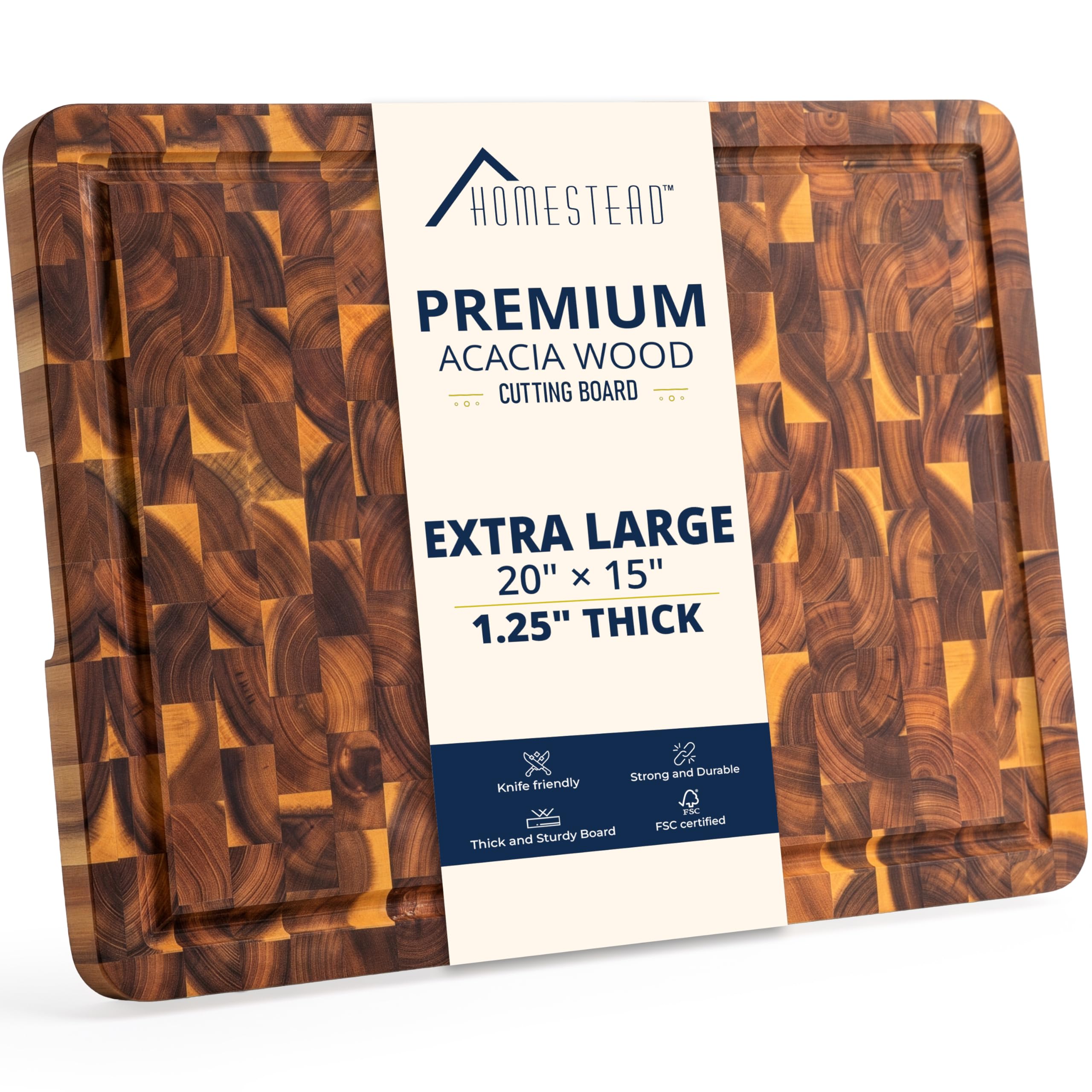
The standard HOMESTEAD end-grain board measures 20 by 15 inches with a 1.25-inch thickness, offering a solid middle ground between the compact budget options and the oversized premium boards. The end-grain construction uses vertical wood fibers that open when cut and close back up, which hides knife marks and protects blade edges over time. The interlocking structure also resists warping better than most edge-grain boards of similar dimensions.
The juice groove is carved deep enough to catch drippings from meat and fruit prep without spilling onto the counter. Integrated side handles make lifting and carrying straightforward. Several reviewers commented on how good the board looks sitting on the counter, and one user treated it with tung oil for use as a monitor stand before repurposing it for food prep, which suggests the wood quality and flatness are well above average. The board weighs 7.21 pounds, giving it enough mass to stay put during vigorous cutting.
A common theme among reviews is that the board arrives quite dry and thirsty. Without proper oiling before first use—and periodic maintenance afterward—the wood can develop small cracks. One customer experienced a crack within two days but received a prompt replacement from the vendor, so the warranty support is reassuring. The board would benefit from being shipped with a small bottle of oil, which is a missed opportunity given the premium positioning.
Why it’s great
- End-grain self-healing minimizes wear
- Deep juice groove captures meat runoff
- Solid 7.2 lbs stays stable during use
Good to know
- Arrives dry; needs immediate oiling
- No maintenance kit included
6. FANICHI XL Acacia Wood Cutting Board (20×15)
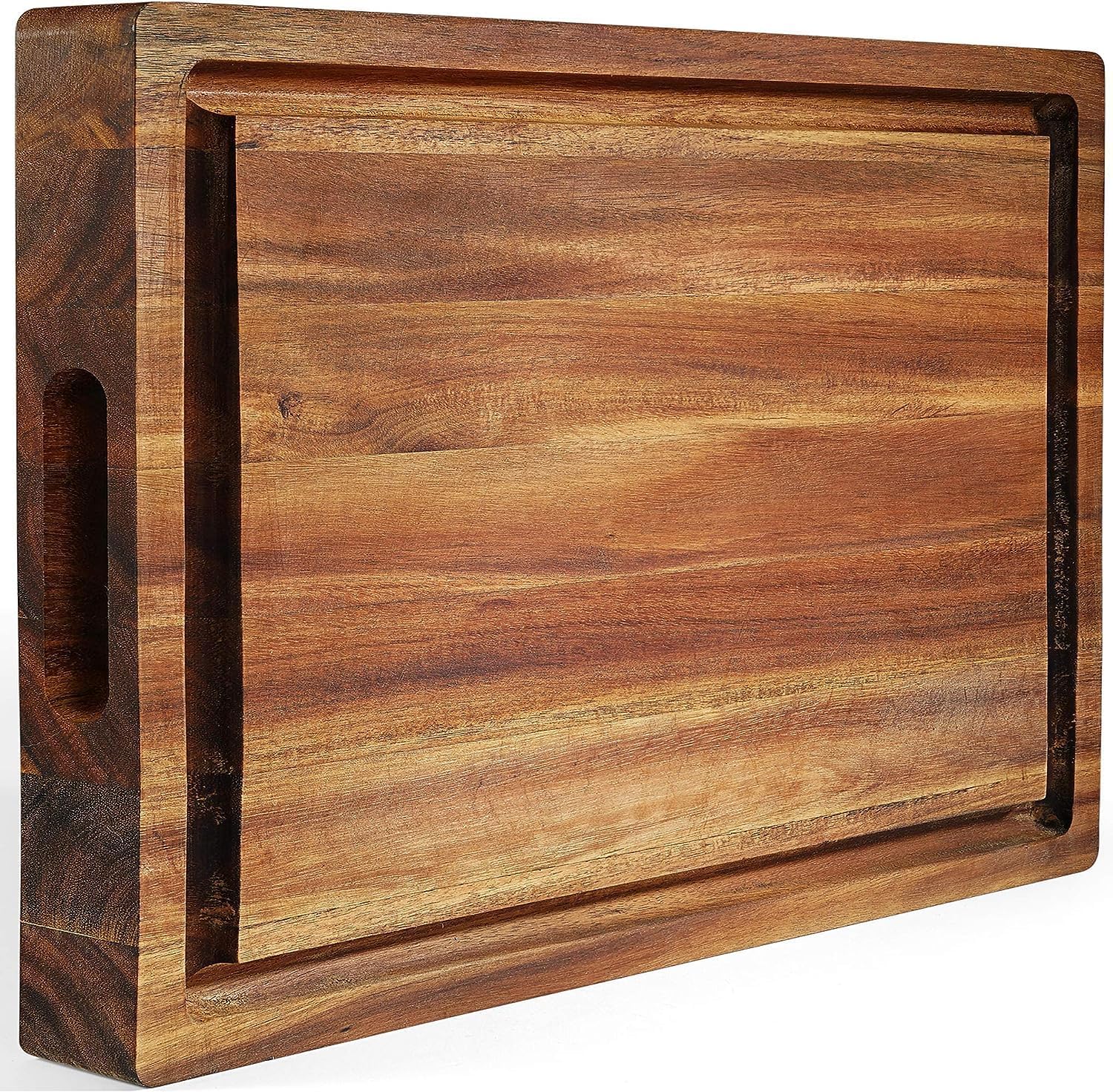
The FANICHI XL board brings a 20-by-15-inch footprint with a full 1.5-inch thickness, giving it the same heft as several premium options at a more accessible price point. The board is edge-grain acacia, which means the surface is smooth and sanded to a silky finish right out of the box. One side features a juice groove for carving meat, while the reverse side has a long cracker holder that doubles as a bread-cutting guide—a thoughtful dual-purpose design that serves both prep and presentation.
The inner side handles are cut into the board rather than protruding, which keeps the profile clean and makes it easy to carry the board from counter to table for serving. Reviewers praised the board for arriving pre-oiled and ready to use, and many noted that a quick re-oiling made the surface water-resistant and simple to wipe clean. The dark acacia grain pattern gives the board a rustic elegance that complements charcuterie spreads and cheese platters.
One limitation is that the board can feel slightly unbalanced during cutting—several users reported needing a damp towel underneath to prevent movement. The edge-grain surface shows cut marks more readily than end-grain alternatives, though regular oiling reduces their visibility. The board is not dishwasher safe, which is standard for acacia wood, and users who ignored that warning learned the hard way. For the size and thickness, the FANICHI offers strong value for cooks who prioritize a large, attractive prep surface.
Why it’s great
- 1.5-inch thick board at a mid-range price
- Reversible with juice groove and cracker holder
- Pre-oiled and smooth out of the box
Good to know
- May slide on smooth counters without a towel
- Edge-grain shows cut marks over time
7. Misawce Large Acacia Wood Cutting Board (17×12)

The Misawce board is a single-piece edge-grain acacia board measuring 17 by 12 inches with a 1-inch thickness. While the dimensions are more modest than the XL options above, the board is well-suited for everyday meal prep for one or two people. The integrated juice groove runs into the handle area, which is a clever approach that prevents juice from pooling near the edge where it might drip onto the counter.
Reviewers consistently describe the board as smooth, sturdy, and well-finished. The acacia wood resists staining and odors better than softer woods like pine or rubberwood, and the reversible surface lets you use one side for meat and the other for vegetables to reduce cross-contamination. The 1-inch thickness keeps the board light enough to lift and wash easily, though it does not offer the same planted feel during heavy chopping as thicker boards.
One user mentioned that the board showed white marks from cutting, which is normal for hardwoods and fades with oiling. Another reviewer trimmed half an inch off each side with a table saw to fit under cabinets, which suggests the board is solid enough to withstand modification. The Misawce board is a practical entry point into acacia cutting boards, offering genuine wood quality and thoughtful design at a budget-friendly price.
Why it’s great
- Smooth surface resists stains and odors
- Reversible for separate meat and veg prep
- Lightweight and easy to handle
Good to know
- 1-inch thickness may warp over time
- Shows cut marks without regular oiling
FAQ
How often should I oil my acacia cutting board?
Can I put my acacia cutting board in the dishwasher?
Why does my new acacia board show cut marks after the first use?
What is the ideal thickness for an acacia cutting board?
Final Thoughts: The Verdict
For most users, the best acacia cutting boards winner is the Cookaholic Premium End Grain because the combination of end-grain construction, 1.5-inch thickness, and deep juice groove provides the best long-term performance for daily heavy prep. If you want the convenience of an integrated scoop plate for faster meal prep, grab the BABILONIA 3-in-1. And for sheer workspace that lets two people cook simultaneously without crowding, nothing beats the HOMESTEAD 23×18 End Grain.

Mo Maruf
I created WellFizz to bridge the gap between vague wellness advice and actionable solutions. My mission is simple: to decode the research and give you practical tools you can actually use.
Beyond the data, I am a passionate traveler. I believe that stepping away from the screen to explore new environments is essential for mental clarity and physical vitality.