Our readers keep the lights on and my smoothie glass nicely filled. As an Amazon Associate, I earn from qualifying purchases.
That musty smell when your AC kicks on isn’t just unpleasant—it signals a biofilm clogging your evaporator coils, choking efficiency and raising your electric bill. The right cleaner dissolves that grime without damaging the delicate aluminum fins or requiring a full system teardown.
I’m Mohammad Maruf — the founder and writer behind WellFizz. I’ve analyzed dozens of HVAC chemical formulations, comparing active ingredients, foam cling rates, and no-rinse efficacy to separate the products that genuinely restore cooling performance from those that just smell good for a day.
After testing foam densities and reviewing real-world results from homeowners and technicians, I’ve narrowed the market to five standout formulas. This guide covers the best ac evaporator coil cleaner options for restoring efficiency, eliminating odors, and protecting your equipment without harsh acid damage.
How To Choose The Best AC Evaporator Coil Cleaner
Evaporator coil cleaners fall into two camps: no-rinse foams that you apply and let drain naturally, and concentrated liquids that require dilution and sometimes a water rinse. Selecting the right one depends on your coil type, access difficulty, and whether you’re battling mold smell or simple dirt buildup.
Foam Cling vs. Liquid Run-Off
Thick foam is critical for vertical evaporator coils in air handlers and mini-splits. A thin liquid runs off before it can dissolve biofilm deep between the fins. Look for formulations that expand on contact and hold their structure for at least ten minutes. The best foams lift dirt upward and outward rather than letting it settle in the drain pan.
Enzyme vs. Alkaline Chemistry
Enzyme-based cleaners target organic odors—the “dirty sock” syndrome—by digesting the bacteria that cause the smell. Alkaline degreasers (pH 9–12) handle grease, cooking residue, and heavy dust cakes. If your unit smells bad, an enzyme formula is your first-line choice. If the coil is visibly crusted with grime, an alkaline foam will restore airflow faster.
Concentrate vs. Ready-to-Use Aerosol
Aerosol foam cans are convenient for quick maintenance and tight spaces where a sprayer won’t fit. Concentrated liquids offer better value per ounce and allow you to dial in the strength for heavily soiled coils—but they require a pump sprayer, gloves, and careful mixing. For most homeowners, a quality ready-to-use foam is the simpler, safer bet.
Quick Comparison
On smaller screens, swipe sideways to see the full table.
| Model | Category | Best For | Key Spec | Amazon |
|---|---|---|---|---|
| Frost King ACF19 | Aerosol Foam | General household maintenance | 19 oz foam, low VOC | Amazon |
| QwikProducts Coil Cleaner | Aerosol Foam | Versatile use on AC & refrigerators | Self-rinsing, lemon scent | Amazon |
| Viper Evap+ Coil Cleaner | Liquid Concentrate | Eliminating “dirty sock” odor | 128 oz, enzyme formula | Amazon |
| Rectorseal Clean-N-Safe | Aerosol Foam | Microchannel and delicate coils | 20 oz, non-acid foam | Amazon |
| Coil King 90-099 | Liquid Concentrate | Heavy-duty condenser coil cleaning | 1 qt, dilutable 3:1 to 10:1 | Amazon |
In‑Depth Reviews
1. Frost King ACF19 Foam Coil Cleaner

The Frost King ACF19 hits the sweet spot of value and performance. Its thick foam clings to vertical evaporator coils for a full ten minutes, dissolving grease, cooking residue, and light biofilm without requiring a rinse. The 19-ounce can covers an entire 3-ton air handler, and the low-VOC formula means you can use it indoors without overwhelming chemical fumes.
Users report dramatic cooling improvements after just one application on window units and central air systems alike. The foam lifts dead bugs and dirt from between fins, and the no-rinse design lets the residue drain naturally into the pan—just flush the drain line afterward to prevent clogs. The lemon deodorizer neutralizes musty smells effectively without leaving an artificial perfume overlay.
For routine biannual maintenance, this is the easiest option to grab. No mixing, no sprayer, no heavy PPE required—just shake, spray, and let gravity do the work. It’s safe on aluminum, copper, and steel, and the low price per can makes it feasible to use on both evaporator and condenser coils.
Why it’s great
- Thick foam clings to vertical coils without runoff
- No-rinse formula saves time and mess
- Low-VOC and safe for indoor use
Good to know
- Single can may be insufficient for heavily soiled 4-ton systems
- Not formulated for persistent bacterial odor (dirty sock syndrome)
2. QwikProducts Foaming Coil Cleaner

QwikProducts positions itself as a heavy-duty industrial cleaner, but its self-rinsing alkaline foam works just as well on residential evaporator coils and refrigerator condensers. The foam expands on contact, penetrating between tightly packed microchannel fins and lifting baked-on grease without scrubbing. The self-rinsing property means water spray isn’t strictly required, though a gentle hose spray helps clear heavy debris.
Users have found it effective on window AC coils, whole-house systems, and even car radiators and CPU heatsinks—testament to its broad compatibility with different metals. The lemon fragrance is mild and doesn’t linger, and the foam holds its structure long enough to work on vertical coils without dripping off immediately. The 19-ounce can treats one outdoor condenser plus a small mini-split.
Where this product excels is its cost-to-coverage ratio for homeowners who want one cleaner for multiple jobs. It’s not the best at digesting biological odor—that’s not its design—but for physical dirt, dust, and light grease, it’s a top performer. Always wear gloves; the alkaline pH can irritate skin with prolonged contact.
Why it’s great
- Self-rinsing foam works on coils, radiators, and fridge condensers
- Made in USA with industrial-grade alkaline formula
- Safe on all common HVAC metals
Good to know
- Not designed for bacterial odor elimination
- Alkaline formula requires gloves and eye protection
3. Refrigeration Technologies Viper Evap+ Coil Cleaner

Viper Evap+ is the benchmark for eliminating “dirty sock syndrome”—that sour, locker-room smell from bacterial growth on evaporator coils. Its enzyme-based formulation digests the organic biofilm responsible for the odor rather than just masking it with fragrance. The one-gallon bottle provides enough concentrate for multiple treatments, making it a smart investment if odor is your primary complaint.
Application requires a garden sprayer, not direct aerosol. Users spray the coil, let the enzyme solution dwell for 24 to 48 hours, and let the condensate carry the residue away. Multiple technicians report that this is the only product that consistently removes DSS on Mitsubishi and Daikin mini-splits when applied correctly. The non-toxic formulation means no harsh fumes and no risk of coil corrosion.
Be aware that this isn’t a degreaser. If your coil is caked with visible dirt and grease, you’ll need a separate alkaline cleaner first, then follow up with Viper Evap+ for the odor. The liquid form also requires more prep and cleanup than an aerosol can. For serious smell remediation, though, nothing else in this list comes close.
Why it’s great
- Enzymes digest biofilm, eliminating root cause of odors
- Non-toxic and safe for indoor air quality
- Large 128-ounce bottle provides excellent value per treatment
Good to know
- Requires 24–48 hour dwell time and a sprayer
- Not effective for heavy physical dirt or grease
4. Rectorseal Clean-N-Safe 83780 Coil Cleaner

Rectorseal Clean-N-Safe is specifically formulated for microchannel condenser coils and evaporators where acid-based cleaners would cause pitting. The non-acid foam is biodegradable and presents almost no hazard to plants, aquatic life, or pets—ideal for outdoor condenser units near landscaping. The 20-ounce aerosol can applies as a foam that clings to vertical fins and breaks down soils without etching.
User feedback highlights its effectiveness on outdoor condensers and window units, particularly where corrosion protection is a concern. The foam rinses off easily with a garden hose, and the unscented formula won’t conflict with sensitive indoor environments. Tradesmen often recommend this for maintenance contracts because it’s safe, fast, and doesn’t require neutralization like acid cleaners.
One limitation: the 20-ounce can may not be enough for a large 4-ton condenser. Budget for two cans if your system is oversized or hasn’t been cleaned in years. It’s also worth noting that this is a general-purpose coil cleaner—it won’t specifically target biological odors the way enzyme cleaners do.
Why it’s great
- Non-acid formula is safe for microchannel and aluminum coils
- Biodegradable and environmentally low-impact
- Corrosion-free, leaves no residue that attracts dirt
Good to know
- One can may be insufficient for large condenser units
- Not formulated for biofilm or odor elimination
5. Coil King 90-099 Heavy Duty Foaming Condenser Coil Cleaner
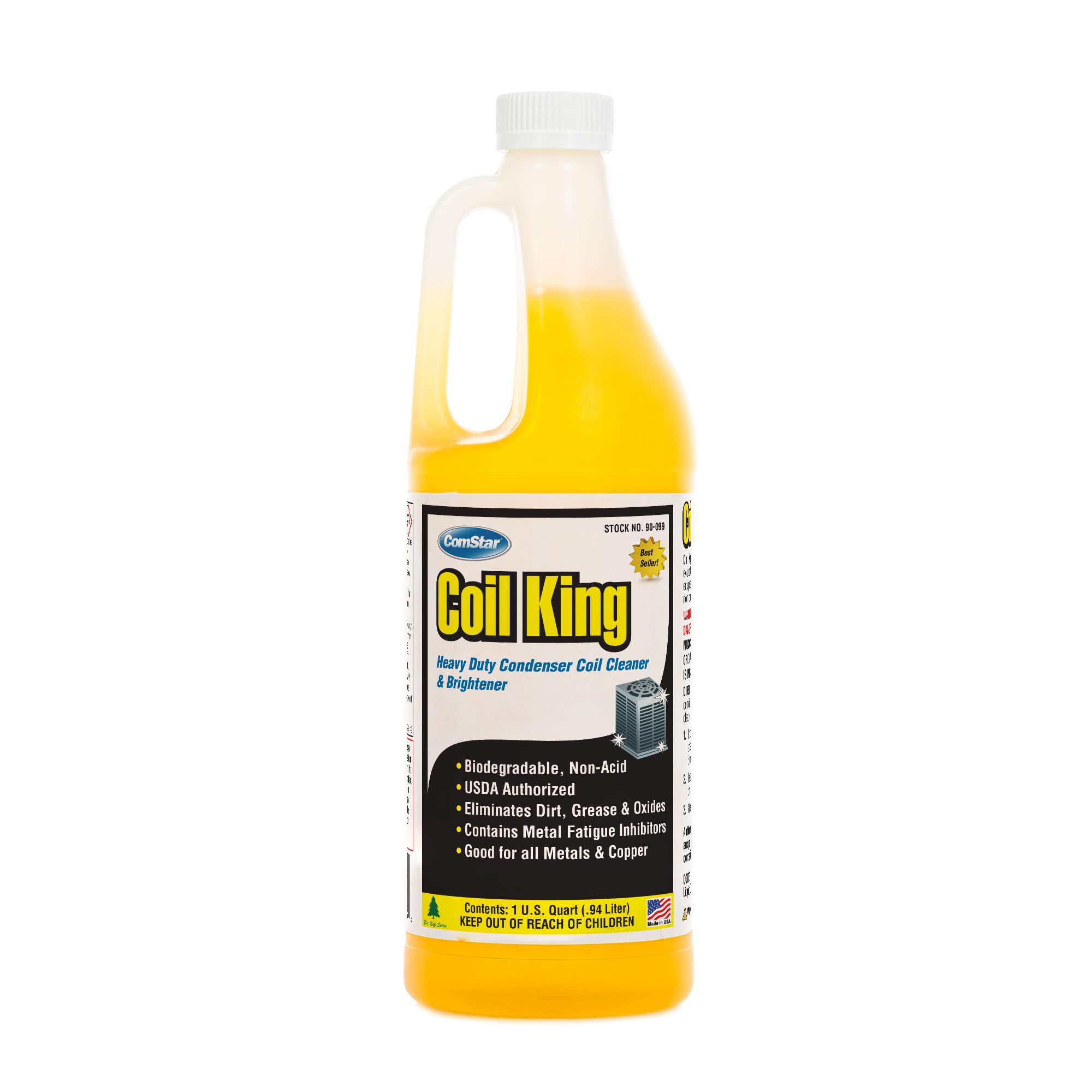
Coil King is a professional-strength alkaline concentrate designed for heavily soiled condenser coils. The quart bottle mixes at ratios from 3:1 to 10:1 with water, giving you control over cleaning intensity. At a 1:1 ratio, it’s aggressive enough to strip baked-on grease and brighten aluminum fins; at 10:1, it’s suitable for light maintenance on evaporator coils. Users report visible restoration of nearly plugged condenser coils after a single 15-minute soak.
This is not a casual product. The alkaline chemistry requires full PPE—gloves, goggles, and a respirator—because the fumes can irritate the lungs and the liquid stings skin. But for dirty outdoor units that haven’t been cleaned in years, nothing in this list matches its raw cleaning power. The concentrate format also means less plastic waste and lower cost per application compared to aerosol cans.
One drawback: it’s not ideal for indoor evaporator coil odor issues. The foaming action is excellent for lifting physical debris, but the alkaline chemistry doesn’t specifically attack the biological film that causes smells. Use this for the condenser coil and pair it with an enzyme cleaner for the evaporator if odor is a concern.
Why it’s great
- Concentrated formula provides huge value per ounce
- Cleans condenser coils to near-new brightness
- Safe on all common HVAC metals when diluted correctly
Good to know
- Requires pump sprayer, mixing, and full PPE
- Not formulated for biological odor elimination
FAQ
Can I use an AC coil cleaner on my mini-split evaporator?
How often should I clean my evaporator coils?
What’s the difference between condenser and evaporator coil cleaner?
Is it safe to use acid-based coil cleaners on my HVAC system?
Final Thoughts: The Verdict
For most users, the best ac evaporator coil cleaner winner is the Frost King ACF19 because it combines thick foam cling, low-VOC safety, and no-rinse convenience at a price that makes biannual maintenance affordable. If you’re fighting dirty sock syndrome, grab the Viper Evap+ for its enzyme-based odor elimination. And for heavy condenser coil restoration, nothing beats the Coil King concentrate.

Mo Maruf
I created WellFizz to bridge the gap between vague wellness advice and actionable solutions. My mission is simple: to decode the research and give you practical tools you can actually use.
Beyond the data, I am a passionate traveler. I believe that stepping away from the screen to explore new environments is essential for mental clarity and physical vitality.