Our readers keep the lights on and my smoothie glass nicely filled. As an Amazon Associate, I earn from qualifying purchases.
Every drawer full of dead alkaline cells is a reminder of the waste and recurring expense that standard batteries create. For high-drain devices like camera flashes and game controllers, or for simple remotes that gobble power silently, the shift to rechargeables is one of the simplest money-saving upgrades you can make. But not all rechargeable AAA cells are created equal — the choice between NiMH and Lithium-Ion chemistry, capacity ratings, and cycle life expectations vary wildly.
I’m Mohammad Maruf — the founder and writer behind WellFizz. I’ve spent years analyzing battery performance data, comparing real-world capacity tests against manufacturer claims, and studying the voltage discharge curves that determine whether a battery keeps your device running or cuts out early.
This guide breaks down the top contenders to help you find the best aaa rechargeable batteries for your specific devices, budget, and tolerance for maintenance.
How To Choose The Best AAA Rechargeable Batteries
Three factors separate a great rechargeable AAA battery from a frustrating one: the chemistry, the self-discharge rate, and the cycle life. Here is what to look for when scanning the shelf.
Chemistry: NiMH vs. Lithium-Ion
Standard NiMH cells output a nominal 1.2V, which works perfectly for most devices designed for alkaline’s 1.5V — but some gadgets (like certain smart locks or older clocks) may show a low-battery warning prematurely. Lithium-Ion AAA cells, like the Paleblue, use a built-in voltage regulator to deliver a constant 1.5V until they suddenly cut off, which means no gradual dimming in a flashlight but also no warning before total failure.
Low Self-Discharge (LSD) Technology
Older NiMH cells drained significantly in storage. Modern LSD variants — including standard Eneloop and Amazon Basics — retain 70–85% of their charge after one to three years on the shelf. This makes them practical for emergency devices like flashlights and remote controls that see sporadic use.
Cycle Life and Capacity
The rated mAh tells you the energy storage, but cycle life tells you how many times you can recharge before capacity degrades noticeably. Eneloop standard cells claim 2100 cycles, while Eneloop Pro and Amazon Basics rate at 500 cycles. High-drain devices benefit from lower internal resistance, which allows the battery to deliver current more efficiently — look for cells with internal resistance under 200 mΩ for best results in camera flashes.
Quick Comparison
On smaller screens, swipe sideways to see the full table.
| Model | Category | Best For | Key Spec | Amazon |
|---|---|---|---|---|
| Eneloop Standard 8-Pack | Mid-Range NiMH | All-around household use | 2100 cycle life / 800 mAh | Amazon |
| Eneloop Pro 4-Pack | High-Capacity NiMH | High-drain devices (camera flash) | 950 mAh / 500 cycles | Amazon |
| Amazon Basics 24-Pack | Budget High-Cap NiMH | Bulk replacement for low-drain devices | 850 mAh / 500 cycles | Amazon |
| Paleblue 4-Pack | Lithium-Ion Premium | Devices needing steady 1.5V | 1.5V constant / 1-hour charge | Amazon |
| EBL Gold Pro 16-Pack | Budget High-Cap NiMH | Solar lights and toys | 1100 mAh / 3-year LSD | Amazon |
In‑Depth Reviews
1. Panasonic Eneloop BK-4MCCA8BA (Standard 8-Pack)

The Eneloop standard AAA is the reference point for the entire NiMH rechargeable category. With a rated capacity of 800 mAh and a claimed 2100 recharge cycles, these Japanese-made cells have a proven track record dating back over a decade. Independent testing confirms they often deliver capacity well above rating — one sample averaged 1,052 mAh at a 0.4A discharge — and maintain internal resistance around 184 mΩ, making them efficient for both low-drain remotes and high-drain camera flashes.
Low self-discharge (LSD) technology means they arrive pre-charged via solar power and hold 70% of that charge even after ten years of storage. For most households, this is the set-and-forget solution that eliminates the alkaline treadmill. The eight-battery pack gives enough cells to rotate through multiple devices without running short.
One nuance: the 1.2V nominal output can trigger low-battery warnings in certain devices that expect alkaline’s 1.5V. A quality smart charger that charges each cell independently is recommended to maximize the cycle life. Over-discharging below 1.0V under load should be avoided.
Why it’s great
- Industry-leading 2100-cycle durability.
- Excellent capacity consistency between cells.
- Retains charge for years in storage.
Good to know
- Lower 800 mAh capacity than high-capacity alternatives.
- Requires a smart charger for best results.
2. Panasonic Eneloop Pro BK-4HCCA4BA (4-Pack)

The Eneloop Pro trades some cycle life for higher capacity — 950 mAh typical versus the standard’s 800 mAh — making it the right choice for devices that drain a cell in hours rather than weeks. Camera flash units benefit most: the lower internal resistance and higher energy density allow faster recycle times and more flashes per charge. Reviewers report reliable performance even in extreme cold down to -4°F, which is critical for outdoor photography or winter headlamp use.
The trade-off is a reduced cycle count of 500, compared to the standard’s 2100. Still, 500 recharges replaces over a thousand disposable alkalines over the battery’s life. They arrive pre-charged to about 50% capacity, so a full conditioning cycle on a smart charger is recommended before heavy use.
Storage retention is slightly less aggressive than the standard — 85% after one year versus 70% after ten — but still excellent for a high-capacity NiMH. If your primary use is a high-drain device that runs down within a single session, the extra capacity of the Pro series outweighs the lower cycle count.
Why it’s great
- Highest available mAh in a reliable NiMH AAA.
- Performs well in extreme cold.
- Excellent for camera flash recycle speed.
Good to know
- Only 500 cycles vs standard Eneloop’s 2100.
- Four-pack limits quantity for multi-device households.
3. Amazon Basics 24-Pack Rechargeable AAA, 850 mAh

Amazon Basics AAA cells are the volume play for users who need to populate an entire household of devices at once. At 850 mAh rated capacity, they sit slightly above the standard Eneloop in energy storage and are rated for 500 recharge cycles. Independent testing shows they often exceed their rating — one reviewer measured an average of 1,079 mAh across the pack — though internal resistance averages 193 mΩ, slightly higher than Eneloop’s, meaning slightly less efficient power delivery in high-drain scenarios.
The 24-pack quantity is the obvious differentiator. For clocks, TV remotes, children’s toys, and wireless mice, this is the most economical way to switch your entire home to rechargeables. The LSD claim of 80% capacity retention after 24 months means you can leave spares in a drawer and grab them when needed.
Quality control is decent for the price tier, but cell-to-cell consistency isn’t as tight as Eneloop — you may need to group cells by measured capacity for matched sets in high-drain devices. Amazon also explicitly warns against mixing these with other brands or chemistries in multi-battery devices.
Why it’s great
- Unbeatable per-cell cost in bulk.
- Real-world capacity often exceeds rating.
- Good self-discharge performance.
Good to know
- Cell consistency requires sorting for best results.
- Higher internal resistance than premium NiMH.
4. Paleblue USB Rechargeable AAA Lithium, 4-Pack

The Paleblue Lithium-Ion AAA breaks the NiMH mold. Instead of a bulky external charger, each cell has a built-in USB-C port, and the kit includes a 4-in-1 charging cable that tops off all four batteries in under an hour. The constant 1.5V output means devices that are sensitive to voltage drop — like certain smart locks or high-end flashlights — will run at full brightness the entire time, rather than dimming as NiMH cells deplete.
There are real trade-offs. The 600 mAh capacity is lower than any NiMH on this list, so runtime per charge is shorter. More critically, the voltage regulator causes the cell to cut off abruptly with no warning when it hits the low-voltage threshold. A user relying on these in a headlamp for night hiking could be plunged into darkness without a gradual dimming cue. The 1,000-cycle claim is competitive, but lithium-ion’s capacity fade over cycles is steeper than premium NiMH.
For game controllers, wireless keyboards, and other low-to-medium drain devices where quick recharging is more convenient than swapping spares, the Paleblue eliminates the need for a dedicated battery charger altogether. The leak-proof lithium chemistry is another advantage over older NiMH cells that can corrode in unused devices.
Why it’s great
- 1-hour full charge via built-in USB-C.
- Delivers steady 1.5V for the entire discharge.
- No separate charger required.
Good to know
- 600 mAh capacity is lower than NiMH rivals.
- Sudden power cutoff with no warning.
5. EBL Gold Pro AAA Rechargeable, 1100 mAh, 16-Pack
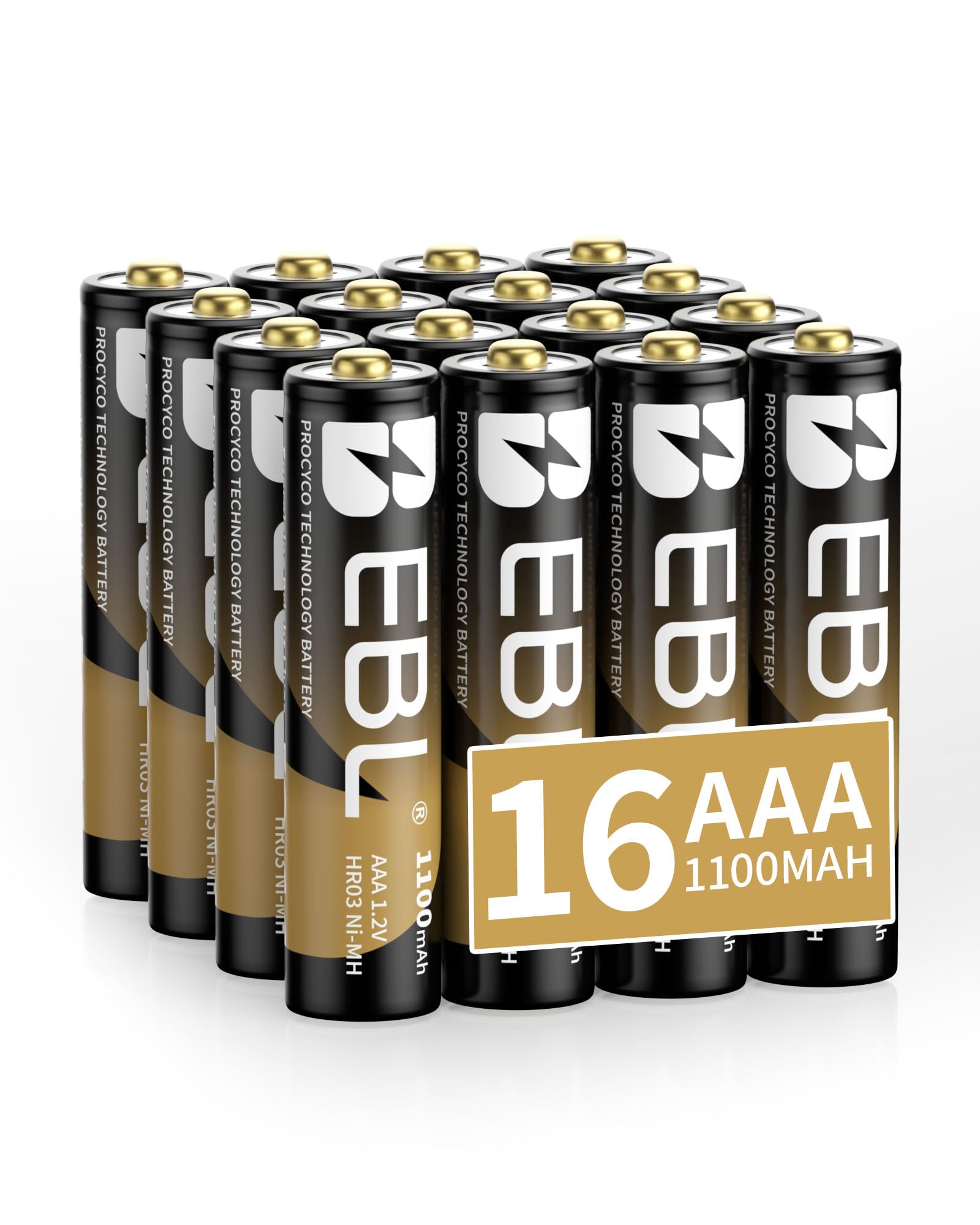
The EBL Gold Pro aims for the high-capacity budget segment with a bold 1100 mAh rating — the highest nominal capacity of any cell in this roundup. In practice, independent verification of that number is sparse, but user reports suggest they perform adequately for medium-drain devices like kids’ toys, solar garden lights, and wireless mice. The inclusion of a storage case and the 16-cell count make this an economical option for outfitting multiple devices at once.
The LSD claim of 90% retention after three years is aggressive and should be taken skeptically — more established brands like Eneloop make more conservative, proven claims. Some users report that the initial charge out of the box was weak and required a full conditioning cycle before performance stabilized. The cells are also noted to be slightly heavier than Eneloop equivalents, reflecting a different internal construction.
Customer service has been a mixed bag. While one reviewer reported a satisfactory resolution after a battery issue, others noted initial difficulty reaching support. For non-critical devices where absolute reliability is not paramount — think battery-powered nightlights or basic TV remotes — the EBL Gold Pro offers the highest mAh-per-dollar ratio in this list.
Why it’s great
- Industry-leading 1100 mAh capacity rating.
- Excellent per-cell cost in the 16-pack.
- Decent for medium-drain household use.
Good to know
- Cycle life and LSD claims unverified by users.
- Inconsistent initial charge out of the box.
FAQ
Can I use 1.2V NiMH batteries in devices designed for 1.5V alkalines?
How many times can I recharge a NiMH AAA battery before it wears out?
Why do my rechargeable AAA batteries seem to die faster than alkalines?
Final Thoughts: The Verdict
For most users, the best aaa rechargeable batteries winner is the Panasonic Eneloop Standard 8-Pack because it combines the longest cycle life with proven, consistent performance across the widest range of devices. If you need maximum capacity for a camera flash or high-drain gadget, grab the Eneloop Pro 4-Pack. And for a modern, charger-free experience with constant 1.5V output, nothing beats the Paleblue 4-Pack.

Mo Maruf
I created WellFizz to bridge the gap between vague wellness advice and actionable solutions. My mission is simple: to decode the research and give you practical tools you can actually use.
Beyond the data, I am a passionate traveler. I believe that stepping away from the screen to explore new environments is essential for mental clarity and physical vitality.