Our readers keep the lights on and my smoothie glass nicely filled. As an Amazon Associate, I earn from qualifying purchases.
Nothing kills the glow of a well-placed solar garden path faster than a battery that won’t hold a charge through a single overcast afternoon. Standard alkaline AA cells fail within weeks here because solar lighting involves a punishing cycle of trickle-charging during the day and deep-draining at night—conditions that demand a specific NiMH chemistry engineered for both low self-discharge and high cycle endurance. The difference between a lantern flickering out by midnight and one still glowing at dawn comes down to the milliamp-hour rating, the anti-leak design, and the cold-weather tolerance of the cell inside the compartment.
I’m Mohammad Maruf — the founder and writer behind WellFizz. I’ve spent years digging into the electrochemical specs, customer longevity reports, and real-world cycle tests of NiMH batteries to separate the outdoor-ready cells from the ones that belong in an indoor remote caddy.
Whether you are refreshing a dozen path lights or resurrecting an old spot that died after one season, the best aa rechargeable batteries for solar lights need to deliver consistent voltage under partial sun, survive freeze-thaw cycles, and refuse to leak when overcharged on a July afternoon.
How To Choose The Best AA Rechargeable Batteries For Solar Lights
Buying the wrong cells for solar fixtures is the most common mistake in this category. You need a battery engineered for intermittent charging, deep discharge, and outdoor temperature swings. Here are the three specs that matter most.
Prioritize Low Self-Discharge (LSD) NiMH Chemistry
Solar lights charge only during daylight hours. If your battery loses 20% of its charge sitting idle for two weeks, the light will dim significantly by the second cloudy day. Low Self-Discharge (LSD) NiMH cells retain 70–80% of their capacity even after a year of storage, making them the only practical choice for seasonal solar applications where the lights experience intermittent sun exposure and long periods of non-use.
Match the Capacity to Your Light’s Panel Size
A 2400 mAh cell sounds like the obvious winner, but stuffing a high-capacity battery into a fixture with a tiny solar panel creates a charging mismatch—the panel simply cannot replenish the drain within a single day. For most standard garden stake lights, a 1000–1200 mAh cell is the sweet spot because it matches the typical panel output. High-capacity cells (2000 mAh+) are best reserved for fixtures with larger panels or longer expected runtimes.
Choose Anti-Leak and Temperature-Tolerant Designs
Solar light compartments are rarely sealed from humidity, and the charge controller in budget fixtures can overcharge the battery on a long summer day. Cheap cells expand, leak potassium hydroxide, and destroy the light socket. Look for batteries with explicit outdoor durability claims, corrosion-resistant terminals, and a rated temperature range that includes both freezing winters and blistering sun. UL certification is a strong indicator of a well-built cell.
Quick Comparison
On smaller screens, swipe sideways to see the full table.
| Model | Category | Best For | Key Spec | Amazon |
|---|---|---|---|---|
| Amazon Basics 2400 mAh | Premium | High-drain solar fixtures with large panels | 2400 mAh capacity | Amazon |
| Amazon Basics 2000 mAh | Mid-Range | Daily household solar lights and remotes | 2000 mAh capacity | Amazon |
| Tenergy Solla | Mid-Range | Year-round outdoor solar garden lights | 1000 mAh, UL Certified | Amazon |
| Fuspower 1200 mAh | Budget | Budget-friendly replacement for 8-pack sets | 1200 mAh capacity | Amazon |
| Kruta Solar 1000 mAh | Budget | High-cycle solar lights needing 1200 recharge cycles | 1000 mAh, 1200 cycles | Amazon |
In‑Depth Reviews
1. Amazon Basics 12-Pack Rechargeable AA NiMH High-Capacity Batteries, 2400 mAh

This high-capacity 2400 mAh cell is the powerhouse of the lineup, ideal for solar fixtures that have a larger panel and demand runtime past midnight. Independent testing confirms the average capacity slightly exceeds the rated spec, and the NiMH chemistry delivers a consistent 1.2V plateau rather than the sagging curve you get from cheaper cells.
The trade-off for that extra capacity is a slightly larger physical diameter and length, which can be a tight fit in compact light casings—some users report it does not fit in roughly 25% of standard fixtures. It also sacrifices a bit of cycle life compared to standard 2000 mAh cells, rated at 400 recharge cycles versus 1000.
If you own solar lanterns or landscape spotlights with generous battery compartments and you want the longest per-night runtime, this Amazon Basics pack delivers performance that rivals premium Japanese cells at a fraction of the cost. The low self-discharge formulation means it holds 50% capacity after a year of storage, making it fine for seasonal use.
Why it’s great
- Highest capacity in the roundup at 2400 mAh, offering extended nighttime illumination.
- Consistent discharge plateau verified by multiple independent capacity tests.
- Excellent value compared to competing high-capacity NiMH cells.
Good to know
- Physically larger than standard AA cells, causing fitment issues in tight solar light compartments.
- Cycle life is rated at 400 recharges, lower than some standard-capacity alternatives.
- May not get fully charged by small solar panels; best matched with larger fixtures.
2. Amazon Basics 12-Pack Rechargeable AA NiMH Batteries, 2000 mAh

This is the most balanced cell in the entire category. At 2000 mAh, it offers ample capacity for most solar garden lights without overfacing the average 0.5W solar panel. Independent reviewers have measured real-world capacity averaging 2130 mAh after a break-in cycle, exceeding the rating by a small margin.
The low self-discharge specification is exceptional—retaining 80% capacity after two years of storage—which makes this pack perfect for seasonal lighting setups that go months between uses. The 1000-cycle rating gives these cells real longevity; most users report three to four seasons of reliable service before noticing any decline.
The only recurring complaint involves physical dimensions: these cells are approximately 1mm thicker than a standard alkaline Duracell, which can create a tight fit in some fairy light casings and small plastic compartments. For the vast majority of standard solar stake lights and path markers, though, the fit is fine and the performance is outstanding for the cost.
Why it’s great
- 2000 mAh capacity with real-world testing showing it often exceeds the rating.
- Top-tier low self-discharge: retains 80% charge after two years in storage.
- Rated for 1000 recharge cycles, offering excellent long-term economy.
Good to know
- Slightly thicker than standard alkaline cells, causing a tight fit in some compact light housings.
- Some units shipped from China may show slightly lower consistency than Malaysian-made batches.
- Not ideal for very small solar fixtures with minimal internal space.
3. Tenergy Solla Rechargeable NiMH AA Battery, 1000mAh, 12 Pack

Tenergy engineered the Solla series specifically to solve the two biggest failure modes of solar light batteries: overcharge leakage from long summer days and deep-discharge death from extended cloudy periods. The 1000 mAh capacity is deliberately conservative to match the output of standard garden solar panels, ensuring a full recharge cycle even in partial sun.
The stand-out feature here is the UL certification, which is rare in the battery category and indicates rigorous testing for leakage, thermal runaway, and electrical performance. The special electrolyte formulation is designed to withstand both freezing winter temperatures and blistering summer heat without expansion or corrosion at the terminals.
With a rated cycle life of 2000 charges—double that of many competitors—these cells can realistically deliver five years of service in outdoor lights before replacement is needed. The pre-charged state means they work immediately, and the slightly shorter physical height ensures good contact even in fixtures with worn springs.
Why it’s great
- UL Certified for safety, with anti-leak design tested for solar overcharge conditions.
- 2000-cycle lifespan offers the longest service life in this roundup.
- Optimized 1000 mAh capacity perfectly matches standard solar panel output.
Good to know
- Lower capacity means shorter runtime per night compared to 2000 mAh+ cells.
- Not recommended as a replacement for LiFePO4 solar batteries in larger systems.
- Occasional dud reported by users, though warranty support from the California team is responsive.
4. Kruta Rechargeable AA Battery for Outdoor Solar Lights, 12 Pack, 1000 mAh
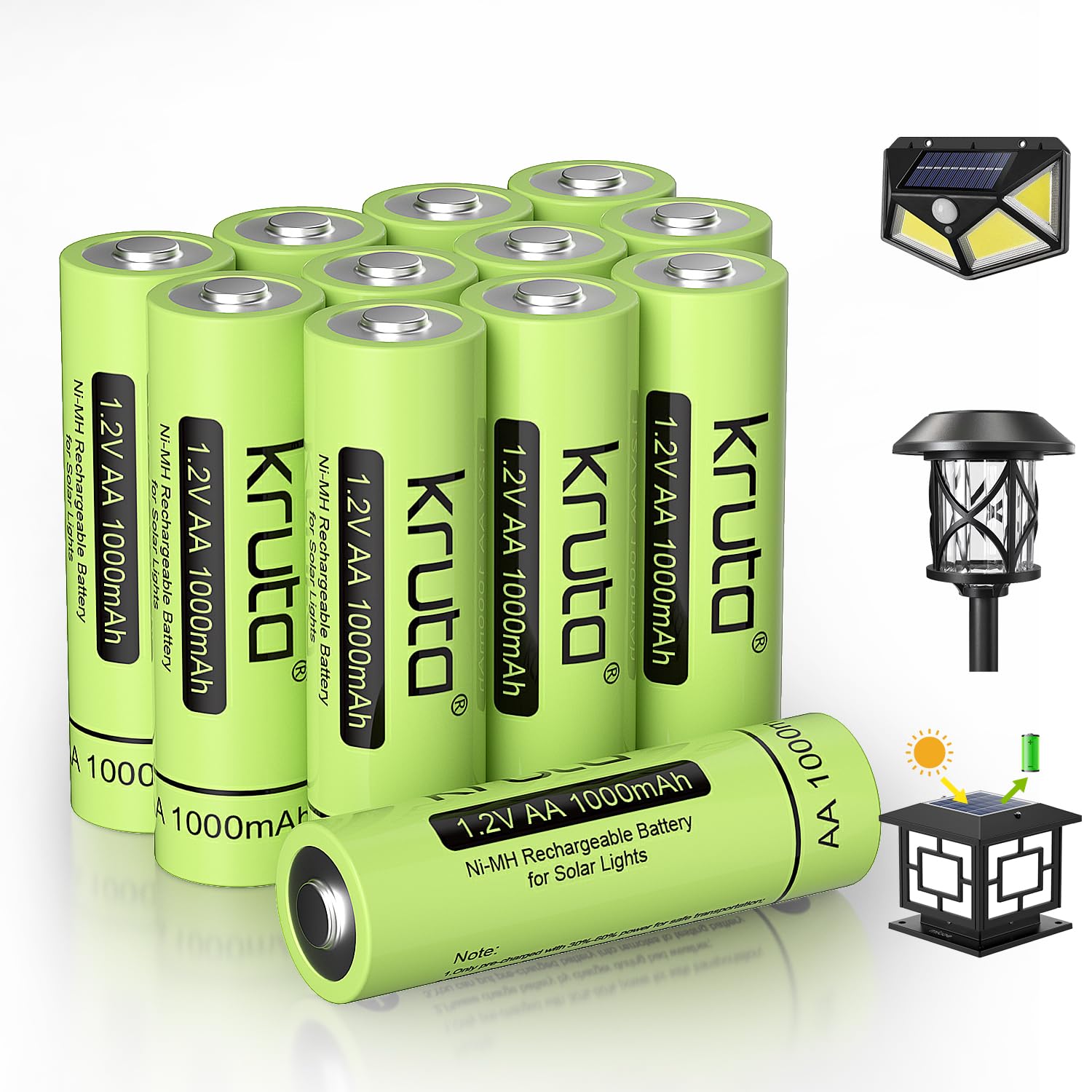
Kruta targets the cost-conscious buyer who wants a dedicated solar light cell without paying a premium.
One important nuance: these batteries ship with only 40% charge for transport safety, so you will need to fully charge them before first use. The instructions also recommend topping up every three months if the lights are in seasonal storage, which is standard care for NiMH chemistry but worth noting if you plan to stash them away all winter.
Users report that these cells revive dead solar lights back to full brightness, and the terminal height is tall enough to maintain contact even in older fixtures with compressed springs. The 1.2V output is consistent, and the cost per cell is low enough that replacing the whole set after a few seasons is still cheaper than buying alkaline disposables twice a year.
Why it’s great
- Rated for 1200 recharge cycles, offering solid longevity for the price point.
- 1000 mAh capacity is well-suited for standard solar garden stakes and path lights.
- Positive terminal is long enough to make firm contact in most fixture compartments.
Good to know
- Ships with only 40% pre-charge, requiring a full charge cycle before outdoor use.
- Periodic top-ups every 3 months are recommended to extend shelf life during storage.
- Lower capacity may not be sufficient for larger solar lanterns needing longer runtime.
5. Fuspower Ni-MH AA Rechargeable Batteries, 1200 mAh, 8 Count
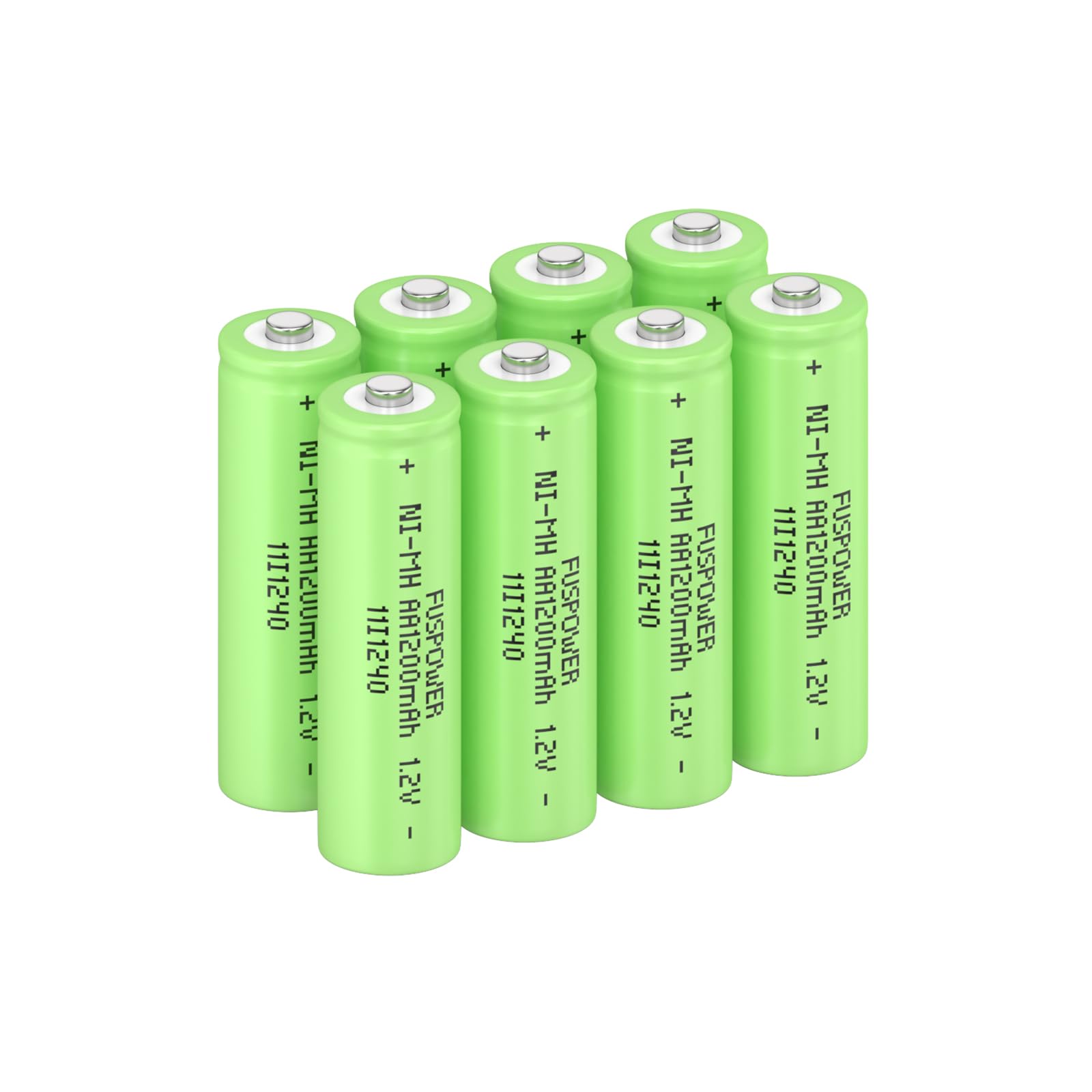
The Fuspower 1200 mAh cells occupy a useful middle ground between the ultra-budget 1000 mAh options and the high-capacity 2000 mAh packs. The extra 200 mAh over the Tenergy or Kruta cells can translate to roughly an extra hour of illumination per night, which makes a noticeable difference in lights positioned under partial shade.
These are standard NiMH LSD cells rated for 1000 recharge cycles, and the 1.2V voltage is stable throughout the discharge curve. Users have reported that these batteries revived non-working solar lanterns instantly and continued functioning strongly for weeks on end. The 8-count pack size is a good fit for someone refreshing a small set of lights without overbuying.
The key limitation is the lack of explicit outdoor or anti-leak claims in the product description. While NiMH chemistry is inherently safer than older NiCd cells, if your solar lights are exposed to extreme humidity or rain splash, you may want a cell with more explicit weatherproofing (like the Tenergy Solla). For standard dry-weather garden lights, this is a solid, budget-conscious pickup.
Why it’s great
- 1200 mAh capacity strikes a nice balance between runtime and solar panel rechargeability.
- Stable 1.2V discharge provides consistent light output throughout the evening.
- Good price for an 8-pack, suitable for smaller households with a handful of solar fixtures.
Good to know
- No explicit outdoor weatherproofing or anti-leak certification mentioned.
- 8-count pack may be too small for users refreshing a dozen or more lights.
- Requires a compatible NiMH charger; not compatible with Li-ion chargers.
FAQ
Can I use regular alkaline AA batteries in my solar lights?
Why did my 2400 mAh battery die faster than my 1000 mAh battery in my solar light?
Do all NiMH solar batteries fit the same?
Final Thoughts: The Verdict
For most users, the best aa rechargeable batteries for solar lights winner is the Amazon Basics 2000 mAh Pack because it offers the ideal balance of capacity, cycle life, and low self-discharge for the widest range of standard solar fixtures. If you want dedicated outdoor engineering with the highest cycle count and UL safety certification, grab the Tenergy Solla. And for high-drain solar lanterns with bigger panels that need the longest nightly runtime, nothing beats the Amazon Basics 2400 mAh High-Capacity Pack.

Mo Maruf
I created WellFizz to bridge the gap between vague wellness advice and actionable solutions. My mission is simple: to decode the research and give you practical tools you can actually use.
Beyond the data, I am a passionate traveler. I believe that stepping away from the screen to explore new environments is essential for mental clarity and physical vitality.