Our readers keep the lights on and my smoothie glass nicely filled. As an Amazon Associate, I earn from qualifying purchases.
The modern home runs on AA and AAA cells — remote controls, game controllers, wireless mice, flashlights, children’s toys. The cost and waste of single-use alkaline batteries adds up fast, but a poorly chosen charger can underperform or even damage your expensive rechargeable cells. A smart charger with independent channels, proper voltage detection, and safe termination logic transforms your relationship with household power.
I’m Mohammad Maruf — the founder and writer behind WellFizz. My buying guides are built on hours of cross-referencing technical specifications, examining real user feedback, and comparing charge algorithms to separate true value from marketing noise.
Whether you need a fast top-up for high-drain devices or a gentle trickle for overnight care, the best aa/aaa battery charger for your home depends on chemistry compatibility, charge speed, and per-slot intelligence — all of which this guide breaks down clearly.
How To Choose The Best AA/AAA Battery Charger
The charger you pick must match the battery chemistry you intend to use. Most consumer rechargeables are NiMH (nickel-metal hydride), but 1.5V lithium-ion cells are becoming popular for high-drain devices that need steady voltage. Mixing a lithium-ion cell into a NiMH-only charger can damage the charger or the battery — always check compatibility first.
Independent charging channels
A charger with independent bays — sometimes called isolated circuits — lets you charge one, two, three, or eight cells of varying charge levels at the same time. Series-connected chargers force you to insert batteries in pairs and can overcharge a full cell while finishing a depleted one. For households with a mix of partially used batteries, independent bays are essential.
Charge speed and safety termination
Fast charging (1-4 hours for four AA cells) is convenient, but only safe when the charger uses delta-V or temperature detection to know when a cell is full. Cheap chargers that rely on a fixed timer can overheat older batteries. Look for “automatic power-off,” “thermal protection,” or “individual LED indicators” in the specifications.
Power input and cable compatibility
USB-C input is now the standard. A charger that accepts USB-C means you can power it from a laptop, power bank, or any phone adapter — no bulky wall wart required. Make sure the included cable is long enough for your setup, and note whether an AC adapter is included or sold separately, especially for high-amperage quick charging.
Quick Comparison
On smaller screens, swipe sideways to see the full table.
| Model | Category | Best For | Key Spec | Amazon |
|---|---|---|---|---|
| Panasonic BQ-CC65 | Premium | Eneloop users, data tracking | 1.5-4 hr charge, LCD per-slot | Amazon |
| Amazon Basics 8-Bay | Mid-Range | Large households, bulk charging | 10 hr charge for 8 AA cells | Amazon |
| Dracutum Li-Ion Kit | Mid-Range | High-drain 1.5V devices | 2000+ cycles, 3 hr fast charge | Amazon |
| imuto Lithium Case | Mid-Range | Portable storage, travel | 2 hr quick charge, integrated case | Amazon |
| BEVIGOR 8-Bay | Budget | First-time rechargeable buyer | 4 hr charge, 8 independent bays | Amazon |
In‑Depth Reviews
1. Panasonic BQ-CC65 Super Advanced eneloop Quick Charger

The Panasonic BQ-CC65 is the most technically sophisticated charger on this list. Its four individual LCD panels display real-time voltage, charging time, and discharge mAh for each slot — data that serious eneloop users rely on to track cell health. A dedicated USB output port (5V/1A) also lets you charge a phone or earbuds directly, making this charger a compact power station.
Delta-V detection per slot means the charger terminates charging the instant each cell is full, preventing the overcharge damage that can shorten NiMH lifespan. The refresh mode discharges cells before recharging, which can restore older eneloop Pro batteries that have developed memory effects. Full four-cell charge finishes in about 4 hours for eneloop Pro cells, or 1.5 hours for standard eneloops.
This unit is optimized exclusively for NiMH chemistry — do not use it with lithium-ion cells. The price is higher than any other model here, but for users who own many eneloop Pro batteries and want per-cell diagnostics, the BQ-CC65 delivers unmatched control and charger intelligence.
Why it’s great
- Individual LCD shows voltage and mAh per bay
- Refresh mode revives older NiMH cells effectively
- USB output charges peripherals while batteries charge
Good to know
- Eneloop batteries not included — charger sold alone
- Higher cost than multi-bay competitors
- Only compatible with NiMH chemistry
2. Amazon Basics Rechargeable 8-Bay Charger with 16 Batteries
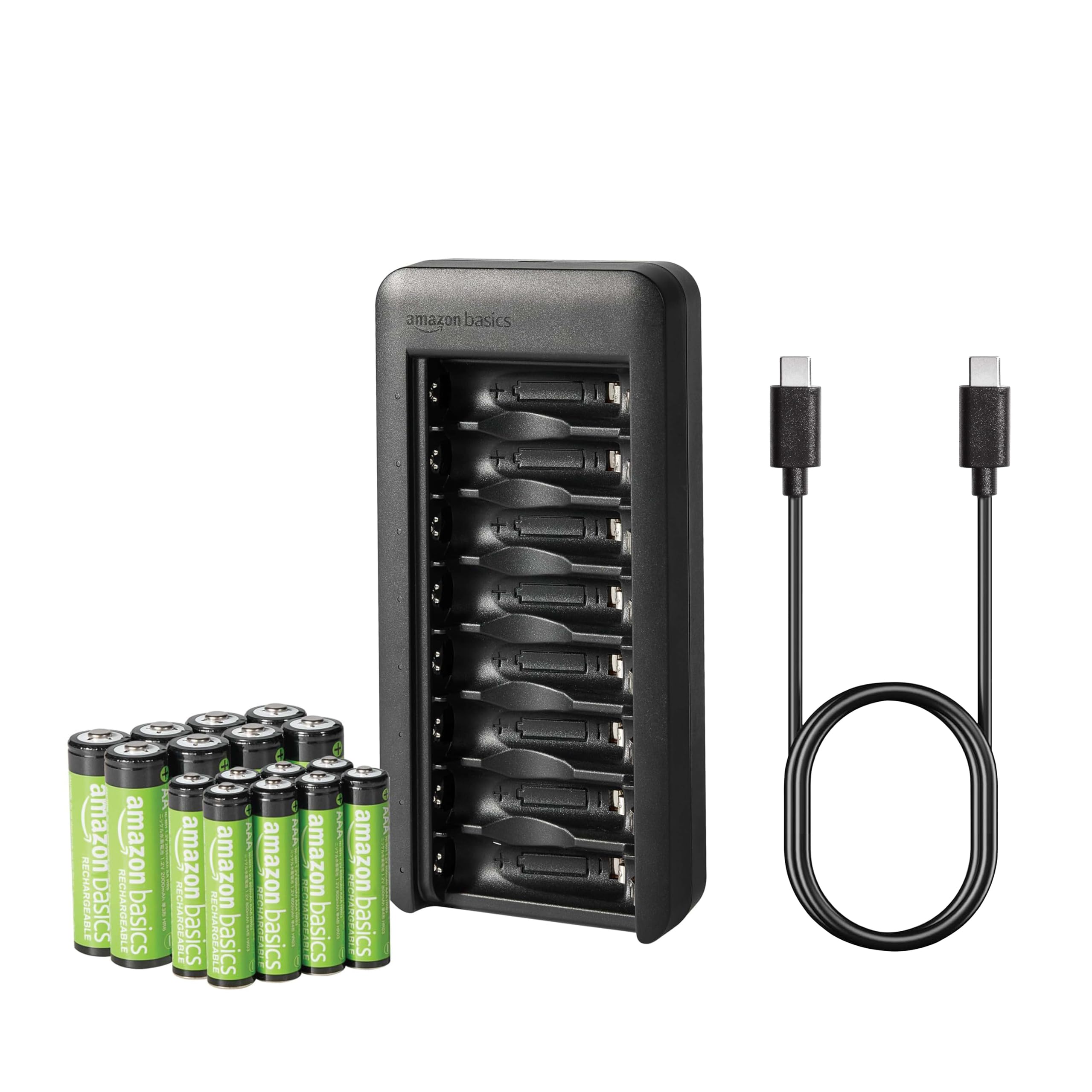
The Amazon Basics bundle is built for households that burn through batteries at a high rate. It includes eight AA 2000mAh and eight AAA 800mAh NiMH cells plus an 8-bay charger, all powered via USB-C. The bundled cells hold 80% capacity after 12 months of storage — a low self-discharge spec that matches premium eneloop performance at a fraction of the per-cell cost.
Each of the eight bays operates independently, so you can charge any combination of AA and AAA cells without worrying about matching pairs. The LED indicator blinks slow during charging, stays solid when full, and flashes fast to flag a defective or alkaline cell — a useful safety check. Full charge for all eight AA batteries takes about 10 hours, which is slower than premium chargers but acceptable for overnight cycles.
Note that the charger does not include an AC adapter. You need to supply your own USB-C power source, and with 8 amps of input draw, a standard 5W phone brick will charge much slower than a 15W or higher adapter. Some users report that loading more than two AA cells triggers inconsistent LED behavior, so cycle testing with a full set is recommended.
Why it’s great
- 16 total NiMH cells included — great value per cell
- Independent bays charge any mix of AA and AAA
- Low self-discharge keeps cells ready after months of storage
Good to know
- AC adapter not included; requires separate USB-C brick
- Full charge takes roughly 10 hours for 8 AA cells
- Some users report odd LED patterns with heavy AA loads
3. Dracutum Rechargeable Lithium AA/AAA Kit with Charger
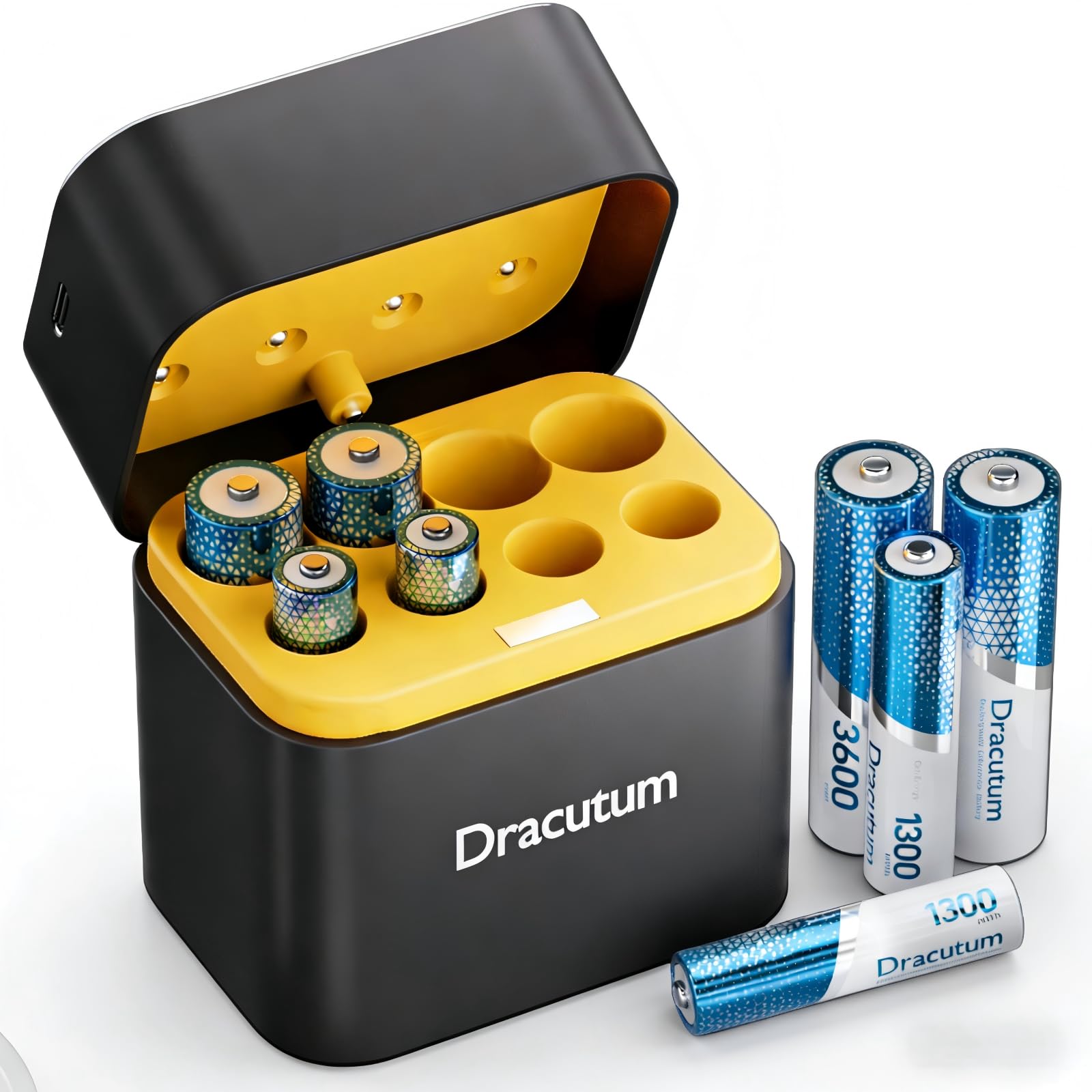
The Dracutum kit addresses a critical gap for high-drain devices: steady 1.5V output. Standard NiMH cells deliver around 1.2V, which can cause devices like Blink cameras, Xbox controllers, and door locks to drop into low-battery warning mode even when the cell has remaining capacity. These lithium-ion cells hold 1.5V throughout the entire discharge curve, keeping electronics operating at peak performance until the very end of battery life.
The charger charges all eight cells — four AA 3600mWh and four AAA 1300mWh — in roughly three hours via USB-C. The integrated LED uses a three-color system: flashing green for charging, solid green for full, flashing red for error detection. The charger case also doubles as a storage box, making this a compact travel companion. Each cell is rated for over 2000 charge cycles, which translates to years of replacement-free use.
A notable limitation is that this charger only works with lithium-ion batteries of this specific design, not with standard NiMH cells from other brands. Some users report that certain brands like Energizer lithium cells do not charge correctly. Check the compatibility chart before mixing cells. The 1-year warranty and US-based support are reassuring for early adopters of 1.5V lithium rechargeable systems.
Why it’s great
- Full 1.5V output keeps high-drain devices from early shutdown
- Charges all 8 cells in 3 hours via USB-C
- 2000+ cycle lifespan reduces long-term battery cost
Good to know
- Charger is incompatible with standard NiMH batteries
- Cannot charge certain other lithium brands reliably
- AC adapter not included in the package
4. imuto Rechargeable Lithium AAA/AA with Integrated Case Charger

The imuto system uses a clever dual-purpose design: the charger itself is a storage case that keeps batteries organized when not charging. The eight slots hold up to four AA and four AAA lithium-ion cells, and the entire unit closes into a compact box about the size of a glasses case — perfect for tossing into a travel bag or keeping in a kitchen drawer without clutter.
Charge speed is genuinely fast: the imuto charger finishes all eight cells in approximately two hours via the included USB-C to USB-C cable. The lithium cells deliver 3000mWh for AA and 1300mWh for AAA, with constant 1.5V output. Users report excellent performance in Roku remotes, gaming controllers, and flashlights, with runtime exceeding both standard rechargeables and disposable alkalines in high-drain scenarios.
The product has a few edges. One reviewer noted that a single AA battery died after about five recharge cycles, but customer service sent replacements. Another reviewer measured charged cells at 1.72V — slightly above the nominal 1.5V rating — though this did not cause issues in their devices. The integrated case design means you cannot charge or store batteries separately; the two functions are locked together.
Why it’s great
- Charger doubles as a storage case for clutter-free organization
- Full charge completes in about 2 hours for all 8 cells
- 1.5V constant output prevents low-battery warnings in sensitive devices
Good to know
- Battery failures reported after a few cycles, though support resolves issues
- Measured output voltage can exceed 1.5V slightly
- Charger and batteries are a single integrated system — not modular
5. BEVIGOR 8-Bay Smart Charger with 8 NiMH Batteries
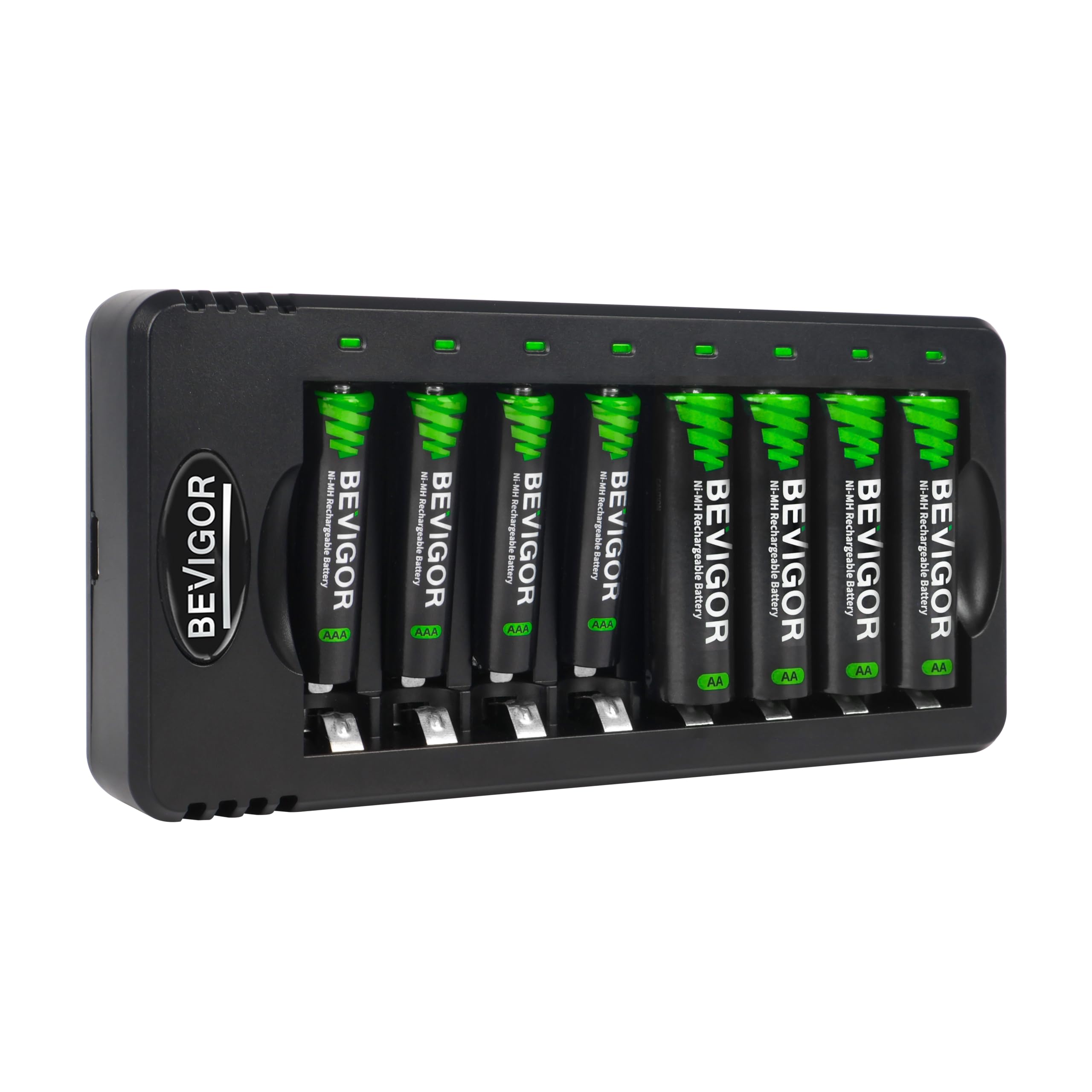
The BEVIGOR kit is the most budget-friendly entry into rechargeable AA/AAA systems. It includes an 8-bay smart charger, four AA 2800mAh cells, four AAA 1100mAh cells, and a USB-C cable. For users replacing disposable alkalines for the first time, this package removes the guesswork: everything needed to start saving money immediately is in the box.
The charger uses eight isolated charging circuits, so you can charge any combination of one to eight AA or AAA cells at the same time regardless of their remaining charge level. Trickle charge mode extends battery capacity after the main charge cycle completes, and automatic power-off with thermal protection prevents overheating. The red/green LED indicators show charging status, and full charge takes approximately 4 hours — competitive with mid-tier chargers.
The included NiMH batteries are rated for 1500 recharge cycles with low self-discharge that retains 80% capacity after three years of storage. Real-world users report that the batteries last over three weeks in speed lights and perform well in multiple devices. A couple of reviewers noted that battery life is not the best compared to premium brands, but at this price point the performance-to-cost ratio is excellent for light to moderate household use.
Why it’s great
- Complete kit with charger, batteries, and USB-C cable included
- 8 independent bays charge any mix of AA/AAA cells
- Trickle charge and thermal shutoff protect battery health
Good to know
- Battery life is good but not as long-lasting as premium NiMH cells
- No AC adapter included in the package
- Charger may feel less robust than aluminum-bodied competitors
FAQ
Can I charge lithium-ion and NiMH batteries in the same charger?
Why do some devices report low battery with NiMH but not with alkalines?
How many charge cycles can I expect from a NiMH battery?
What does ‘low self-discharge’ mean on a battery spec?
Is it safe to leave batteries in the charger overnight?
Final Thoughts: The Verdict
For most users, the best aa/aaa battery charger winner is the Amazon Basics 8-Bay Bundle because it delivers exceptional value with 16 NiMH cells, independent charging bays, and USB-C input at a mid-range price. If you need per-cell diagnostics and refresh capability for high-end eneloop Pro batteries, grab the Panasonic BQ-CC65. And for reliable 1.5V output in high-drain devices, nothing beats the Dracutum Lithium Kit.

Mo Maruf
I created WellFizz to bridge the gap between vague wellness advice and actionable solutions. My mission is simple: to decode the research and give you practical tools you can actually use.
Beyond the data, I am a passionate traveler. I believe that stepping away from the screen to explore new environments is essential for mental clarity and physical vitality.