Our readers keep the lights on and my smoothie glass nicely filled. As an Amazon Associate, I earn from qualifying purchases.
A decent A/V receiver anchors any home theater, but the sub-$500 bracket forces hard trade-offs between channel count, power output, and modern video features like HDMI 2.1. You need a unit that delivers clean amplification, correct surround decoding, and reliable 4K pass-through without blowing your budget on channels you don’t yet need.
I’m Mohammad Maruf — the founder and writer behind WellFizz. I spend my days dissecting receiver data sheets, cross-referencing real-world customer feedback, and comparing the fine print on HDMI specifications, room correction systems, and amplifier topologies to find the honest value in this crowded market.
After parsing hundreds of verified user reports and technical specifications, the current field of best a/v receiver under $500 models stacks up clearly — and the winner comes down to which compromises fit your room best.
How To Choose The Best A/V Receiver Under $500
Selecting a receiver in this price range means accepting some limitations while ensuring the features you actually use — HDMI inputs that match your sources, enough clean power for your speakers, and the right surround format — are not compromised.
Channel Count and Amplifier Power
A 5.1-channel receiver (five speakers plus one subwoofer) is the typical sweet spot. A 7.2 receiver adds two rear-surround or height channels, but often at the cost of lower wattage per channel. Look for receivers rated at 70–100 watts into 8 ohms with two channels driven — that’s the real-world measure, not the inflated 1 kHz single-channel spec.
HDMI Version and 4K / 8K Support
Under $500, most receivers offer 4K pass-through with HDR10, Dolby Vision, and HDCP 2.2 or 2.3. HDMI 2.1 with 4K120 or 8K60 is rare but appears on a few newer models — vital if you own a PS5 or Xbox Series X and want full bandwidth. eARC is a bigger practical win: it sends Dolby Atmos from your TV’s native streaming apps back to the receiver over a single HDMI cable.
Room Correction and Auto-Calibration
Automated calibration systems like YPAO, Audyssey MultEQ, and MCACC measure speaker distance, level, and frequency response using the included microphone. A decent room-correction system can salvage a challenging listening space — and models in this bracket vary hugely in calibration sophistication.
Quick Comparison
On smaller screens, swipe sideways to see the full table.
| Model | Category | Best For | Key Spec | Amazon |
|---|---|---|---|---|
| Denon AVR-X1700H | Renewed | 8K gaming with Dolby Atmos | 7.2 ch, 8K/60Hz pass-through | Amazon |
| Marantz NR1510 | Slim | Compact setup with phono input | 5.2 ch, slim 4-inch chassis | Amazon |
| Yamaha RX-V4A | Network | Multi-room streaming via MusicCast | 5.2 ch, 8K/60, eARC | Amazon |
| Yamaha RX-V385 | Entry | Reliable 5.1 for 4K movies | 5.1 ch, YPAO calibration | Amazon |
| Onkyo TX-8470 | Stereo | Vinyl and high-fidelity music | 2 ch, integrated phono stage | Amazon |
| JBL MA310 | Streaming | Bluetooth-centric 5.2 setup | 5.2 ch, BT 5.1 + LE | Amazon |
| Pioneer VSX-935 | Network | Dolby Atmos with HDMI 2.1 | 7.2 ch, 8K pass-through | Amazon |
| Denon AVR-S670H | Mid-Range | Easy 5.2 setup with phono | 5.2 ch, 8K/60, HEOS | Amazon |
| Sony STRDH590 | Value | Budget-friendly 5.2 starter | 5.2 ch, S-Force Pro | Amazon |
In‑Depth Reviews
1. Denon AVR-X1700H (Renewed)

The AVR-X1700H packs full 8K/60Hz and 4K/120Hz pass-through, three dedicated 8K inputs, and both Dolby Atmos and DTS:X decoding — features normally found at double the price. The Audyssey MultEQ room correction dials in speaker distance and frequency response with surprising accuracy for this tier. Users report exceptionally clean sound compared to older Sony and Pioneer units they owned previously, especially in 5.1 and 7.1 configurations.
Setup is guided by Denon’s award-winning on-screen assistant, and the rear panel uses color-coded speaker terminals that make wiring intuitive. The HEOS platform streams from Spotify, TIDAL, and Amazon Music HD across multiple rooms. Voice control via Alexa and Google Assistant is built in, and the phono input lets you connect a turntable without an external preamp.
The catch is that this unit is renewed — some users needed certified 48 Gbps HDMI cables to avoid picture dropouts, and power-line interference can cause intermittent signal loss in homes with unclean electricity. A few reviews mention that the first unit arrived DOA, though the replacement process was smooth. Still, at this feature density, the refurb condition is a minor trade-off.
Why it’s great
- Supports 8K/60Hz and 4K/120Hz for next-gen gaming
- Audyssey MultEQ room correction is effective for the price
- Seven channels, phono input, and HEOS streaming included
Good to know
- Renewed condition; some units arrive with dead display or HDMI faults
- Requires quality 48 Gbps HDMI cables for stable 8K/4K120 signal
2. Marantz NR1510

The Marantz NR1510 is just 4 inches tall, making it the go-to receiver for shallow AV cabinets or wall-mounted TVs. It delivers 50 watts per channel into 5 channels, which is modest on paper but audibly clean due to discrete amplifier circuitry. The slim chassis runs warm, so generous ventilation is mandatory. Users consistently praise the crystal-clear 5.1 sound at all volume levels and the half-decibel volume increments that allow precise level matching.
It includes an MM phono input, six HDMI inputs with HDCP 2.2, eARC, and Dolby Vision pass-through. The HEOS multi-room system works reliably, and Apple AirPlay 2 is built in. Setup requires an HDMI-connected TV for the graphical interface, which some may find limiting. The lack of 4K120 or VRR means this is not the right pick for HDMI 2.1 console gaming.
Multiple buyers noted that the HEOS skill for Alexa is finicky, but using an Echo connected via an analog input works fine. The NR1510 is a specialist’s receiver: if your priority is a compact footprint, clean stereo music, and plug-and-play home theater without next-gen gaming features, this is your best option.
Why it’s great
- Ultra-compact 4-inch height fits shallow media consoles
- Phono input and 0.5 dB volume steps for audiophile precision
- eARC and HEOS provide solid streaming and TV audio return
Good to know
- No HDMI 2.1; limited to 60 Hz 4K pass-through
- Runs warm; needs good ventilation
3. Yamaha RX-V4A

Yamaha’s RX-V4A brings genuine 8K/60 and 4K/120 HDMI 2.1 connectivity with eARC, plus MusicCast multi-room streaming and voice control via Alexa or Google Assistant. The 5.2-channel amplifier delivers clean, detailed power — users driving B&W and Klipsch towers report excellent clarity and separation. YPAO auto-calibration detects speaker polarity and sets distance and EQ with good results for a non-Audyssey system.
The MusicCast ecosystem supports Spotify Connect, TIDAL, Qobuz, Amazon Music HD, and Pandora directly, so streaming doesn’t need a separate device. The on-screen setup menu is functional but can feel clunky — several users mention that the remote has tiny buttons and setup instructions are unintuitive. Some units have HDMI switching issues where 4K video fails to pass to the display, requiring a hard reset or firmware update.
The biggest negative is reliability: a minority of buyers receive units with defective HDMI boards that require replacement. Yamaha support is generally good, but the quality control variance is higher than with Denon. If you get a solid unit, the V4A represents a strong mid-range value with future-proof 8K inputs and a robust streaming ecosystem.
Why it’s great
- HDMI 2.1 with 8K/60 and 4K/120 for future-proof gaming
- MusicCast multi-room streaming with broad service support
- YPAO calibration handles setup accurately
Good to know
- Some units have HDMI board defects (4K pass-through failure)
- Remote control is tiny with poor button labeling
4. Yamaha RX-V385

The RX-V385 is the classic entry-level workhorse: a straightforward 5.1-channel receiver with 4K HDR pass-through, Bluetooth, and YPAO auto-calibration. No Wi-Fi, no streaming apps, no HDMI 2.1 — just reliable surround decoding with Dolby TrueHD and DTS-HD Master Audio. Users report that it outperforms similarly priced Sony competitors, with warmer sound, better subwoofer output, and banana-plug binding posts on all five channels.
Dialogue clarity is a standout, even in complex movie soundtracks. The receiver also handles DSD64 audio files via USB, which is rare at this price. The 4 HDMI inputs (one with ARC) are enough for a basic source stack: cable box, streaming stick, game console, and Blu-ray player. The YPAO calibration mic is simple but effective for setting speaker distance and level.
Bluetooth is from an older generation so codec support is basic, and there is no eARC or HDMI 2.0b for 4K60 HDR on all inputs — only input 1 supports HDCP 2.2. The FM antenna wire included is inconvenient for tidy cable routing. For budget-focused buyers who prioritize sound quality and simplicity over streaming features, the RX-V385 is the smart play.
Why it’s great
- Excellent dialogue clarity and warm tonal balance
- 5-way binding posts accept banana plugs on all channels
- YPAO calibration is reliable and quick
Good to know
- No Wi-Fi, eARC, or HDMI 2.1; limited to 4K30 on two inputs
- Only 4 HDMI inputs; no Dolby Atmos support
5. Onkyo TX-8470

The TX-8470 is a two-channel stereo receiver, not a surround-sound AVR. It uses a dedicated amplifier design with gold-plated terminals and audio-grade capacitors to prioritize high-current output for music reproduction. The discrete op-amp phono stage supports both moving magnet and moving coil cartridges, making it ideal for vinyl enthusiasts. Users driving Klipsch floor-standing towers report dynamic, detailed sound with plenty of headroom.
Built-in Roon Ready certification, Wi-Fi, AirPlay 2, and Bluetooth mean streaming high-res audio from TIDAL and Deezer is seamless. The TX-8470 also includes a subwoofer pre-out and a loudness button — small touches that matter in a pure music system. The remote is large with tiny buttons, and Bluetooth pairing can be finicky. Multiple buyers found the setup manual confusing.
The main limitation is that this is a stereo-only device — there is no surround processing, no center channel, no height channels. If your use case is 100% music (especially vinyl) in a living room or dedicated listening space, the TX-8470 delivers exceptional two-channel fidelity that no sub-$500 AVR can match for stereo.
Why it’s great
- Discrete two-channel amp with high-current design for clean power
- MM/MC phono stage suitable for serious vinyl setups
- Roon Ready, Wi-Fi, AirPlay 2, and subwoofer pre-out
Good to know
- Stereo only — no surround, center, or height channel support
- Remote is oversized; Bluetooth pairing process is clunky
6. JBL MA310

JBL’s MA310 is a 5.2-channel receiver built for modern simplicity: four HDMI inputs with ARC, Bluetooth 5.1 with low-energy support, and 60 watts per channel into five speakers. The shallow chassis allows installation in tighter cabinets than many competitors. Users driving Polk floor-standing towers and in-wall RC65i speakers report impressive sound quality for the price, with clear dialogue and solid bass integration.
Setup can be frustrating for some — the initial firmware update is unresponsive until the unit is properly connected to network via HDMI ARC, and the small front-panel display is hard to read for configuration. Most adjustments must be done through the on-screen menu, not the receiver’s panel. Once dialed in, the auto on/off via HDMI CEC works reliably, and the Bluetooth range is excellent.
The lack of Wi-Fi, multi-room support, or HDMI 2.1 limits versatility. JBL also does not offer built-in streaming apps — you rely entirely on Bluetooth or external sources. For buyers seeking a simple surround receiver with good sound and minimal complexity, the MA310 works well, but it lacks the feature set of similarly priced Yamaha or Denon units.
Why it’s great
- Shallow design fits tight AV cabinets
- Clear, warm sound with good subwoofer integration
- Reliable HDMI-CEC and Bluetooth 5.1 with LE
Good to know
- No Wi-Fi, no streaming apps, no multi-room support
- Firmware updates can hang during initial setup
7. Pioneer VSX-935
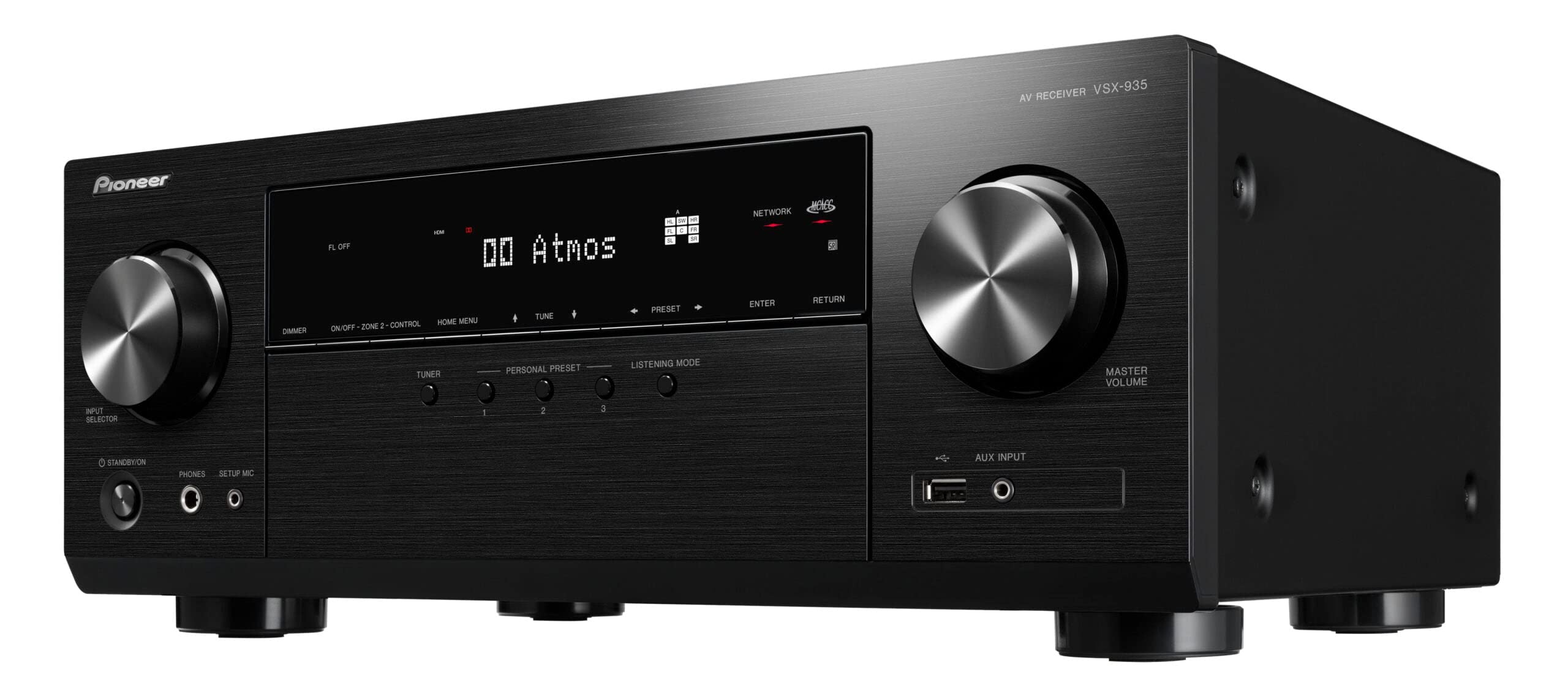
The VSX-935 brings Dolby Atmos and DTS:X decoding to a 7.2-channel network receiver with HDMI 2.1 featuring 8K pass-through and enhanced gaming features like VRR and ALLM. The amplifier delivers crisp, clear sound with good headroom — users upgrading from older Onkyo units note a significant jump in clarity and bass control. The unit supports dual-zone audio, letting you play music in a different room from the main theater.
It includes Wi-Fi, Bluetooth, AirPlay 2, Chromecast built-in, and the Pioneer remote app. The front-panel display is clear and adjustable with a dimmer. Dolby Atmos Height Virtualization creates a simulated height effect without ceiling speakers, which works reasonably well for casual listeners. Some unit-to-unit reliability issues appear: a few buyers received units with dead displays, and the Bluetooth implementation requires navigating multiple menus.
The VSX-935 lacks Audyssey or advanced room-correction — the included MCACC is basic compared to Yamaha’s YPAO or Denon’s Audyssey. The user interface feels dated, and volume ramps noticeably faster above 50 on the scale. If Atmos capability and 7-channel support for a projector setup are your priorities, this is a capable choice, but the Denon AVR-X1700H is more polished overall.
Why it’s great
- 7.2 channels with Dolby Atmos and DTS:X decoding
- HDMI 2.1 with 8K pass-through, VRR, and ALLM
- Dual-zone audio and Chromecast built-in
Good to know
- Room calibration is basic compared to YPAO or Audyssey
- Bluetooth menu navigation is clunky; some units have display issues
8. Denon AVR-S670H

The S670H is Denon’s basic 5.2-channel receiver with 8K/60 pass-through, HEOS multi-room, and a built-in phono stage. It includes Dolby TrueHD, Dolby Pro Logic II, and DTS Neo:6 upmixing, plus Audyssey MultEQ room correction. The amplifier outputs 75 watts per channel into 8 ohms, which is enough for most bookshelf and compact floor-standing speakers. Users driving KEF Q150s report solid, clean sound with good bass authority.
Setup is genuinely easy: the on-screen assistant works without an internet connection, and the remote controls both the AVR and TV over HDMI-CEC. The S670H supports HDR10+, Dolby Vision, HLG, VRR, ALLM, and QFT for gaming, though the 8K/60 input count is limited to one. The HEOS app is functional for multi-room streaming but some users experience lag and connection drops with Spotify Connect and AirPlay 2.
The main limitation is the 5.2-channel architecture — no 7-channel or Atmos support. The binding posts are pin-style for center and rear channels, not the full 5-way type on all channels. If you are building a simple 5.1 system and want reliable performance with HDMI 2.1 features at an accessible price, the S670H is the most polished entry-level Denon in the market.
Why it’s great
- 8K/60 pass-through with HDR10+, Dolby Vision, and VRR
- Audyssey MultEQ room correction included
- Phono input and HDMI-CEC control work seamlessly
Good to know
- 5.2 channels only; no Dolby Atmos or 7.1 support
- HEOS wireless streaming can experience lag and dropouts
9. Sony STRDH590
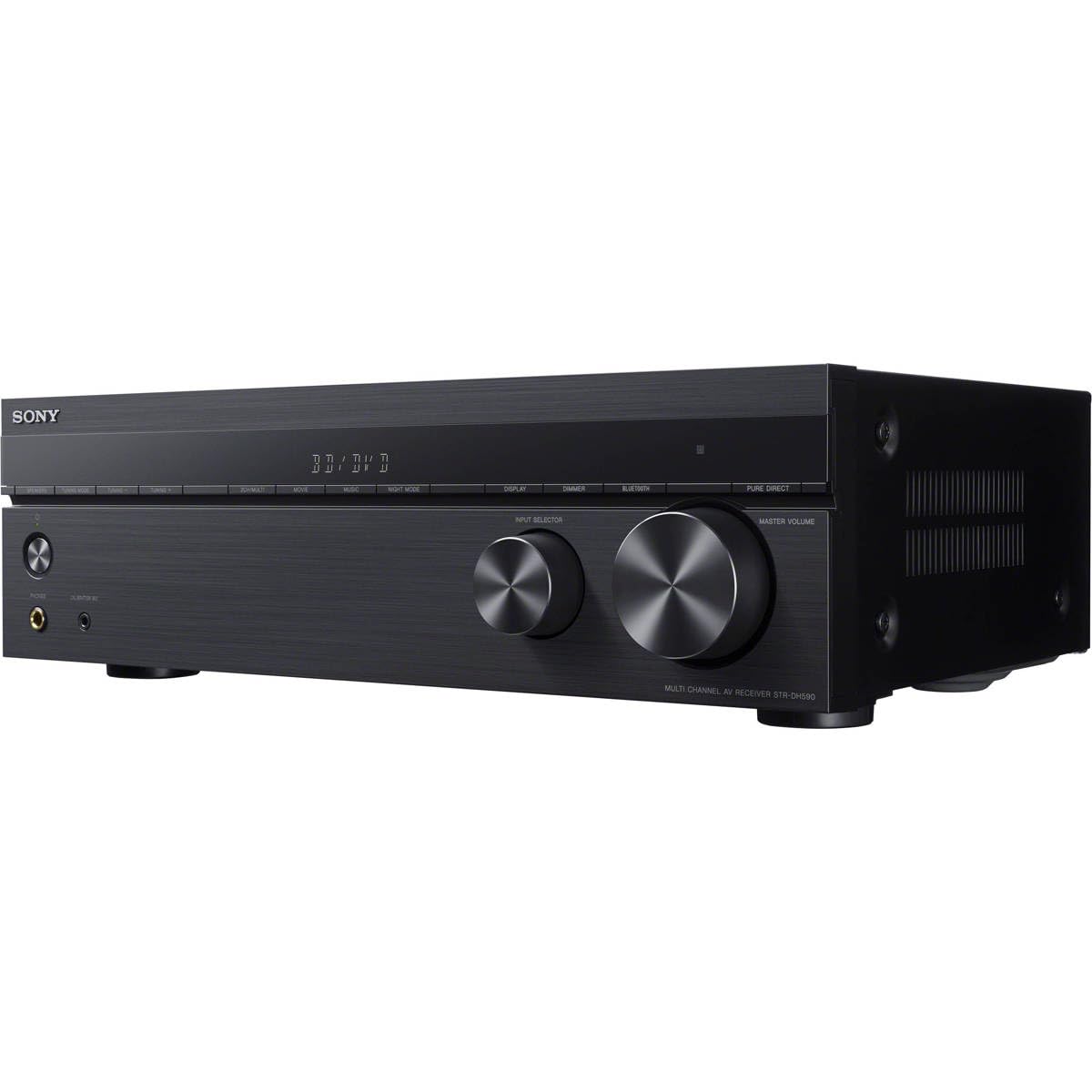
The STRDH590 is Sony’s most affordable 5.2-channel receiver, offering 4K HDR pass-through, Bluetooth, and S-Force PRO virtual surround for rooms where rear speakers aren’t feasible. The amplifier runs efficiently and stays cool compared to many competitors. Users driving older KEF and Radio Shack speakers note surprisingly solid stereo sound for the price, and the 4 HDMI inputs with ARC provide sufficient connectivity for basic setups.
The remote is simple and responsive, the front display is readable with adjustable brightness, and eARC integration with modern TVs is seamless — the AVR powers on and off automatically with the TV. The on-screen setup menus via HDMI are a step up from the dim front-panel of older budget receivers. The calibration microphone included with the unit sets speaker levels and distances effectively.
The STRDH590 lacks tone controls (no dedicated bass/treble knobs), relies on presets instead. There is no AM tuner, no phono input, and no Dolby Atmos support. The center and rear speakers use push-type connectors instead of binding posts, limiting cable options. For the absolute lowest entry point into 4K surround sound, this Sony works, but the Yamaha RX-V385 offers better sound and binding posts at a similar tier.
Why it’s great
- Budget-friendly 5.2-channel receiver with 4K HDR pass-through
- eARC integration powers on/off with TV automatically
- Runs cool and compact desktop footprint
Good to know
- No phono input, no tone controls, no Dolby Atmos
- Center/rear channels use pin-style connectors, not binding posts
FAQ
Can a sub-$500 A/V receiver handle a 4K120 gaming console?
Is Dolby Atmos possible without ceiling speakers?
Final Thoughts: The Verdict
For most users, the best a/v receiver under $500 winner is the Denon AVR-X1700H (Renewed) because it packs 8K support, Audyssey room correction, and seven channels with Atmos into a price that undercuts everything else. If you want a slim, music-focused unit with a phono stage, grab the Marantz NR1510. And for simple, reliable 5.1 surround without the frills, nothing beats the Yamaha RX-V385.

Mo Maruf
I created WellFizz to bridge the gap between vague wellness advice and actionable solutions. My mission is simple: to decode the research and give you practical tools you can actually use.
Beyond the data, I am a passionate traveler. I believe that stepping away from the screen to explore new environments is essential for mental clarity and physical vitality.