Our readers keep the lights on and my smoothie glass nicely filled. As an Amazon Associate, I earn from qualifying purchases.
Getting the staging right in a car audio system often comes down to one component: the amplifier. Every driver and passenger deserves clean, clear sound without distortion, and the key to that is distributing power correctly across multiple speakers, subwoofers, and tweeters without the hassle of stacking multiple amps. That is exactly where an eight-channel amplifier becomes the smartest solution.
I’m Mohammad Maruf — the founder and writer behind WellFizz. Over the years, I have parsed through thousands of customer reports, technical datasheets, and real-world durability tests to help buyers cut through marketing noise and find amplifiers that deliver measurable results in their specific vehicle or marine environment.
This guide breaks down the most reliable options available, covering everything from marine-grade build quality to digital signal processing capabilities, all to help you confidently select the right 8 channel amplifier for car audio upgrades.
How To Choose The Best 8 Channel Amplifier For Car
Buying an eight-channel amplifier means you are committing to powering multiple speakers — often four full-range speakers plus a subwoofer bridged across the remaining channels — so every decision point affects the entire system’s final output. The wrong choice leads to distortion, thermal shutdown, or blown speakers.
RMS Power Output vs. Peak Wattage
Peak wattage numbers are marketing figures that amplifiers can sustain for only a fraction of a second. The real metric is RMS power, which defines the continuous clean output the amplifier delivers. For an eight-channel unit, look for at least 50W RMS per channel at 4 ohms to drive most aftermarket speakers without clipping. If you plan to bridge channels for a subwoofer, check the bridged RMS rating at 4 ohms — that number determines your bass headroom.
Marine-Grade vs. Standard Build
Even if you are not installing on a boat, marine-grade construction — conformal coated circuit boards, stainless steel hardware, and corrosion-resistant heat sinks — offers better longevity in any vehicle exposed to humidity, temperature swings, or road salt. Standard car amplifiers lack this protection and may develop intermittent channel failures or oxidation over time, especially when mounted in doors, trunks, or under seats that see moisture.
DSP Integration vs. Analog Controls
Digital signal processing gives you independent control over equalization, crossover points, time alignment, and phase per channel. Analog controls limit you to global filters and gain adjustments. For complex multi-driver systems where you need to correct factory head unit signal issues or delay channels for sound staging, a DSP-equipped amp is worth the jump in cost. For a simpler install with standard speakers and a single sub, analog controls are more than sufficient.
Quick Comparison
On smaller screens, swipe sideways to see the full table.
| Model | Category | Best For | Key Spec | Amazon |
|---|---|---|---|---|
| JBL DSP4086 | DSP Amplifier | Precision sound tuning | RMS Power 8 Ch. | Amazon |
| Rockford Fosgate DSR1 | Signal Processor | Factory system integration | 245-Band EQ | Amazon |
| Rockville RXM8BTW | Marine Bluetooth | Boat & Jeep installations | 750W RMS Total | Amazon |
| Rockville ATOM 8B | Compact Marine | Tight spaces with Bluetooth | 880W RMS Total | Amazon |
| Pyle PLMRA830BT | Marine Bluetooth | Budget marine systems | 3000W Peak Power | Amazon |
| Rockville RXM8BTB | Car Bluetooth | Compact car installs | 95W x 8 @ 2Ω | Amazon |
| Pyle PLMRA820 | Marine Bridgeable | High-power budget systems | 3000W Peak Power | Amazon |
| Rockford Fosgate M2-750X5 | Marine Grade | Durable marine systems | 750W RMS / 5 Ch. | Amazon |
| Garmin Fusion Signature | Premium Marine | High-end marine audio | 1500W Peak / 6 Ch. | Amazon |
In‑Depth Reviews
1. JBL DSP4086 8-Channel Class D Amplifier with DSP

The JBL DSP4086 combines a Class D amplifier with a comprehensive digital signal processor, giving you full per-channel control over crossover slopes, time alignment, and equalization. It delivers enough clean RMS power to drive a full set of aftermarket speakers and a bridged subwoofer, all from a chassis that fits into tight factory radio cavities. The wired remote bass control lets you adjust subwoofer level from the driver’s seat without touching the tuning software.
Balanced differential inputs reject alternator whine and electrical noise better than standard RCA inputs, which makes this unit ideal for vehicles with complex factory electrical systems. The DSP tuning software is robust but does require a recent Windows laptop for initial programming — this is not a plug-and-play unit for casual installs. Once configured, the sound quality and staging precision outperform anything in its price range.
Customer feedback highlights that the DSP4086 can run slightly warm during extended high-volume use, so mounting it in a location with some airflow is recommended. The ability to run as a line driver for future amplifier expansion also adds long-term system flexibility. For anyone building a competition-level sound stage or integrating with a stock head unit, this is the top pick.
Why it’s great
- Full per-channel DSP tuning with 31-band EQ
- Balanced differential inputs reject noise effectively
- Compact chassis fits in tight factory locations
Good to know
- Requires Windows laptop for initial programming
- Some units reported intermittent power-on issues
2. Rockford Fosgate DSR1 8-Channel Interactive Signal Processor

The DSR1 is not a traditional amplifier — it is a signal processor that replaces the factory amplifier in Ford and Chrysler vehicles while adding eight channels of tuned output via the iDataLink Maestro interface. It processes high-level speaker inputs and converts them to low-level outputs with 245 bands of equalization for hyper-precise in-vehicle tuning. Bluetooth connectivity through the Perfect Tune app provides real-time adjustments from a phone or tablet without a wired connection.
Time alignment up to 10 milliseconds per channel allows you to delay each speaker signal so all audio reaches the driver’s ears simultaneously, eliminating the perception of unbalanced staging. The unit fits in a very compact surface-mount chassis and draws minimal current when idle. That said, the setup process involves multiple firmware updates in the correct sequence — missing a step can cause the device to lock up and require a reboot from an accessible mounting location.
Android users should note that the Perfect Tune app performs significantly better on iOS devices, with fewer interface lags and connection drops. The DSR1 is best suited for users who want to retain factory steering wheel controls, backup sensors, and chimes while adding high-end aftermarket amplification and speakers.
Why it’s great
- Retains factory controls with iDataLink integration
- 245-band EQ for exceptional tuning precision
- Compact size fits behind factory radio openings
Good to know
- Setup requires careful sequence of firmware updates
- Android app performance is notably inferior to iOS
3. Rockville RXM8BTW 8-Channel Marine Bluetooth Amplifier

The Rockville RXM8BTW delivers 750 watts RMS total across eight channels, dyno-certified at 65W x 8 at 4 ohms, with the ability to bridge to 190W x 4 at 4 ohms for subwoofer duty. Its marine-grade construction features conformal-coated circuitry and stainless steel terminals, making it resistant to salt spray, UV exposure, and moisture — ideal for boats, Jeeps, and vehicles with open-air exposure. The built-in Bluetooth with auto pairing allows direct streaming from a smartphone, effectively eliminating the need for a separate head unit in minimalist installations.
Real-world users report this amplifier sounding louder and pushing harder than a premium JL Audio M800/8v2 while costing significantly less, especially in marine environments with six coaxial speakers and two subwoofers. The 4CH/8CH input selector and adjustable crossovers give solid configuration flexibility, and the compact dimensions fit under most dashboards or helm consoles. A notable quirk is that the RCA line outputs do not pass signal from the Bluetooth input, preventing daisy-chaining to a second amplifier wirelessly — a limitation for multi-amp builds.
The included fuse assembly is known to be low-quality and may require immediate replacement with a higher-rated unit. Overall, the RXM8BTW offers exceptional power-per-dollar in environments that demand moisture resistance, though the RCA output limitation means careful planning if you intend to expand the system later.
Why it’s great
- Dyno-certified RMS ratings you can trust
- Marine-grade build handles humidity and salt spray
- Bluetooth input eliminates need for head unit
Good to know
- RCA outputs do not pass Bluetooth signal
- Included fuse is poor quality
4. Rockville Atom 8B 8-Channel Marine Amplifier

The Rockville Atom 8B pushes 880 watts RMS total, with each channel delivering up to 110W at 2 ohms, making it one of the highest-output compact eight-channel marine amplifiers in its tier. The slim chassis measures just 6.7 inches wide and 2 inches tall, fitting under seats or inside shallow compartments where standard amplifiers would not clear. A built-in voltage display lets you monitor your electrical system health directly from the amplifier casing.
Independent HPF and LPF crossovers for channel pairs 1-4 and 5-8, combined with adjustable bass EQ at 45Hz, give you flexible control over both full-range speakers and subwoofer channels without needing an upstream processor. The conformal-coated PCB and stainless steel hardware provide genuine corrosion resistance for wet environments. Several users have successfully used this amp to dramatically improve the clarity and volume of stock marine head units without adding a separate subwoofer — the high-passed channels run clean, and the low-passed channels handle bass reproduction competently.
Clarity at higher volume levels is acceptable for the price but not transparent when pushing the amplifier near its limits — a small amount of background hiss becomes audible. A small percentage of units have experienced internal short circuits within the first 48 hours of use, leading to channel failure and speaker damage. Despite this, the overall user satisfaction rate remains high due to the power output relative to the physical footprint.
Why it’s great
- Highest RMS output in a compact eight-channel chassis
- Built-in voltage display for system monitoring
- Independent crossovers for flexible configuration
Good to know
- Some units had early short circuit failures
- Clarity diminishes near maximum output
5. Pyle PLMRA830BT 8-Channel Marine Amplifier
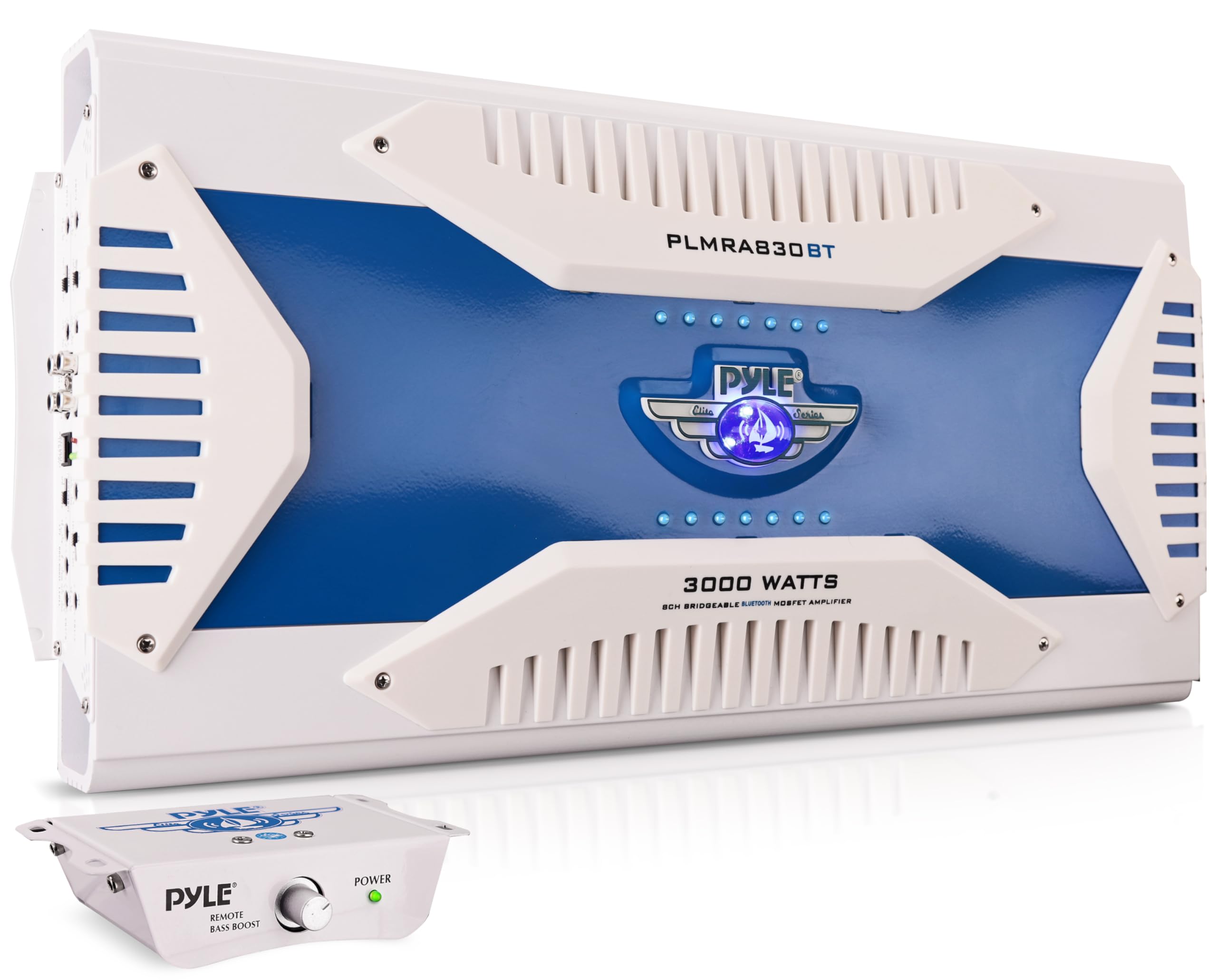
The Pyle PLMRA830BT offers 3000 watts of peak power with a MOSFET power supply in a marine-rated chassis, though the real-world RMS figure sits far below that number. It includes Bluetooth streaming, which many users rely on to bypass the factory head unit entirely on boats and pontoons. The amp is tri-mode configurable, meaning you can run it in 8-channel, 6-channel, or 4-channel mode with bridging options for subwoofer support.
User reports consistently mention that this amplifier sounds excellent for the cost, with clean output across six speakers plus a subwoofer in marine settings. The Bluetooth range is notably better than many competing units at similar price points, with reliable streaming through boat floors from a phone in the cabin. However, the power and ground terminals are undersized for 4 AWG wire, requiring careful fitting, and the mounting holes are open slots that can scratch painted surfaces during installation.
The most significant design limitation is the input/output signal split: channels 7 and 8 are dedicated to subwoofer output only, which means you cannot use a head unit’s dedicated subwoofer RCA output with these channels. This creates complications for installations that require two amplifiers, as you may need additional bass knobs or Y-adapter cables. Despite these quirks, for a single-amp marine system on a tight budget, the PLMRA830BT delivers solid volume and reliable Bluetooth connectivity.
Why it’s great
- Excellent Bluetooth range for marine environments
- Powers six speakers and a subwoofer comfortably
- MOSFET power supply for stable operation
Good to know
- Channels 7/8 are subwoofer-dedicated, limiting flexibility
- Power/ground terminals too small for 4 AWG wire
6. Rockville RXM8BTB 8-Channel Bluetooth Car Amplifier

The RXM8BTB is the car stereo version of Rockville’s popular eight-channel Bluetooth amplifier, delivering the same 95W x 8 at 2 ohms RMS in a chassis designed for standard vehicle interiors rather than marine environments. The compact dimensions at 6.7 x 2 x 11.5 inches suit under-dash installations in trucks, SUVs, and side-by-side vehicles like the Polaris RZR. The Class D topology keeps heat generation low, and the TI audio processing maintains signal integrity at moderate listening levels.
Bluetooth auto-pairing works reliably with both Android and iOS devices, allowing music streaming without a head unit in minimalist builds. The crossover controls are independent for channel groups 1-4 and 5-8, giving separate high-pass and low-pass filtering for front components and rear subwoofers. The signal-to-noise ratio exceeds 100dB, which keeps the amplifier quiet when no music plays — a meaningful advantage over cheaper eight-channel competitors.
Like its marine counterpart, the RXM8BTB does not pass Bluetooth audio signal to the RCA line outputs, so daisy-chaining additional amplifiers for subwoofers requires connecting from an external head unit instead of the built-in Bluetooth source. The amplifier lacks an onboard fuse and relies on an inline fuse provided in the kit, which is of acceptable quality but should be inspected before final installation. For a simple but powerful car audio system without the complexity of DSP or multi-amp wiring, this unit hits a sweet spot.
Why it’s great
- Compact enough to fit under most car dashboards
- Class D efficiency reduces heat and current draw
- Clean signal-to-noise ratio above 100dB
Good to know
- Bluetooth does not pass signal to RCA outputs
- No onboard fuse; rely on external inline fuse
7. Pyle PLMRA820 8-Channel Marine Amplifier
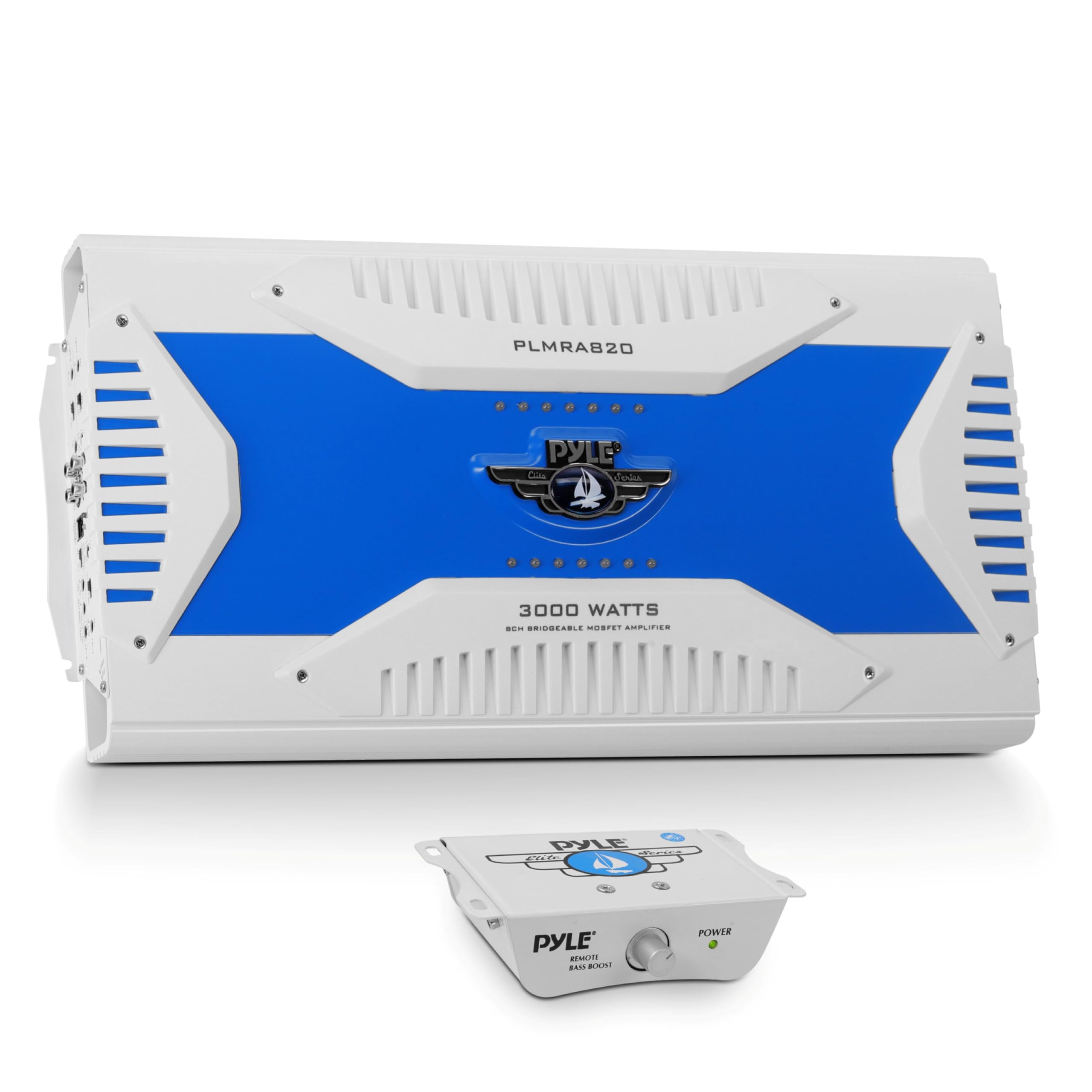
The Pyle PLMRA820 marine amplifier brings 3000 watts of peak power with a heavy-duty aluminum alloy heat sink and MOSFET power supply, intended for high-volume boat and vehicle audio systems. The amp is fully bridgeable, allowing you to combine channels to feed higher power to subwoofers or center channel speakers. Gold-plated speaker terminals resist corrosion in damp environments.
Users who have had positive experiences report that this amplifier powers six speakers and a subwoofer with ease, delivering enough volume to blow out older factory speakers. However, professional installers and experienced users have flagged significant reliability issues: multiple units have arrived with dead channels (channel 3 or channels 1/2 with extremely low output), suggesting inconsistent quality control. The input system is reportedly mono rather than stereo, which affects soundstage width when using the high-level inputs from a factory radio.
Mounting the PLMRA820 is also more difficult than expected — the chassis is physically large at 13 inches long and 27 inches wide with the mounting hardware, and the mounting holes are open slots that can mar paint during installation. The water resistance rating is lower than other marine amplifiers in the same tier, so mounting in a fully enclosed or ventilated location is strongly advised. For buyers on the strictest budget who need peak power numbers, this amp works when it works, but the failure rate gives reason to pause.
Why it’s great
- High peak wattage for loud bass applications
- Gold-plated terminals resist corrosion
- Bridging options for subwoofer flexibility
Good to know
- Reported high failure rate with dead channels
- Large physical footprint and difficult mounting holes
- Input system is mono, not stereo
8. Rockford Fosgate M2-750X5 Marine 5-Channel Amplifier

Rockford Fosgate’s M2-750X5 is a five-channel amplifier, not a true eight-channel unit, but it earns a mention because of its Element Ready marine construction and class-leading efficiency. Delivering 50W x 4 at 4 ohms plus 200W x 1 at 4 ohms for the subwoofer channel, this amp covers the most common 5-channel system configuration — four full-range speakers and a dedicated subwoofer — without any bridging complexity. The UV-resistant housing, conformal coated circuit board, and stainless steel mounting hardware make it one of the most durable marine amplifiers on the market.
The C.L.E.A.N. circuitry provides visual feedback during gain setup, helping installers set input sensitivity without distortion. The P.O.W.E.R. supply generates increasing output as the vehicle’s voltage rises, ensuring consistent performance whether the engine is idling or cruising at speed. Integrated Punch EQ delivers up to three times the bass output at the subwoofer channel, tuned to correct acoustic deficiencies caused by open-water environments or large vehicle cabins.
At higher volumes, the 5-channel limitation becomes apparent — you cannot run separate midrange and tweeter channels independently without external passive crossovers. A small number of marine users have reported failures after only two months in pontoon boats, though the vast majority praise its longevity and clean output. For dedicated marine audio systems requiring four speakers and a subwoofer, this is the most reliable choice available.
Why it’s great
- Element Ready marine construction with UV resistance
- C.L.E.A.N. circuitry prevents distortion during setup
- Punch EQ boosts bass by up to 3x
Good to know
- Only 5 channels, not a true eight-channel amplifier
- Requires external passive crossovers for bi-amping
9. Garmin Fusion Signature Series 6-Channel Marine Amplifier
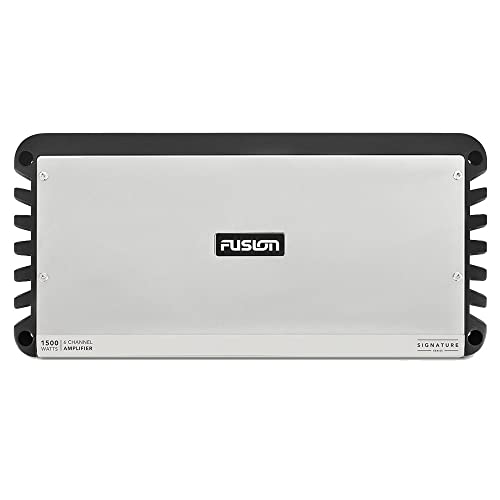
The Garmin Fusion Signature Series six-channel amplifier outputs 1500 watts peak through a Class D design with conformal coated PCBs and a rigid aluminum alloy heat sink, engineered specifically for the high-demand marine environment. Each channel can drive two speakers at 2 ohms, and bridging across two channels provides a 4-ohm subwoofer load. The amplifier accepts 12-volt and 24-volt electrical systems, making it compatible with both standard and high-voltage marine installations.
Build quality is exceptional, with a mirrored stainless steel chassis and heat sink design that effectively dissipates thermal load during extended listening sessions in direct sunlight. Users report the amplifier driving six satellite speakers, two tower speakers, and a subwoofer simultaneously without audible distortion. The plug-and-play connectivity with Fusion’s digital signal processing head units simplifies system integration, though the amplifier does not include onboard DSP — it requires an external Fusion DSP unit for advanced tuning.
Customer satisfaction is high, but the price point places this amplifier in the premium marine tier where buyers expect flawless operation. Some units have arrived non-functional, requiring a return process that can be slow depending on the seller. For boat owners building a complete Fusion ecosystem with tunable DSP elsewhere, the Signature amplifier delivers clean, powerful audio that withstands constant marine exposure.
Why it’s great
- Premium build with mirrored stainless steel chassis
- Excellent thermal dissipation for marine heat exposure
- Compatible with 12V and 24V electrical systems
Good to know
- Requires external DSP for advanced tuning
- Some units arrive non-functional
- Very high price for a six-channel amplifier
FAQ
Can I use a marine 8-channel amplifier in my car?
How do I bridge channels on an 8-channel amplifier correctly?
What is the difference between Class AB and Class D in 8-channel amps?
How much current does an 8-channel car amplifier draw?
Final Thoughts: The Verdict
For most users, the 8 channel amplifier for car winner is the JBL DSP4086 because it combines a powerful Class D amplifier with per-channel DSP tuning, giving you professional-level sound staging without requiring a separate processor. If you want reliable marine-grade construction with Bluetooth streaming, grab the Rockville RXM8BTW. And for a true factory-integration solution that retains your vehicle’s original controls and chimes, nothing beats the Rockford Fosgate DSR1.

Mo Maruf
I created WellFizz to bridge the gap between vague wellness advice and actionable solutions. My mission is simple: to decode the research and give you practical tools you can actually use.
Beyond the data, I am a passionate traveler. I believe that stepping away from the screen to explore new environments is essential for mental clarity and physical vitality.