Our readers keep the lights on and my smoothie glass nicely filled. As an Amazon Associate, I earn from qualifying purchases.
Walking into a freezing garage to work on a project or start your car is a productivity killer. A 7500-watt electric heater solves that instantly, delivering hard, forced-air heat to turn an uninsulated shop into a comfortable workspace in minutes—if you choose the right unit.
I’m Mohammad Maruf — the founder and writer behind WellFizz. I spend my time analyzing heater specs like BTU output, amperage draw, thermostat accuracy, and coverage ratings to separate real performance from marketing fluff.
Whether you’re fighting a polar vortex in a two-car garage or trying to keep a warehouse warm, finding the best 7500 watt garage heater means comparing duty cycles, build materials, and installation requirements before you buy.
How To Choose The Best 7500 Watt Garage Heater
A 7500W heater is a serious appliance. Choosing the wrong one means uneven heat, high bills, or a unit that fails when you need it most. Focus on these four criteria to narrow your search.
Electrical Requirements: 240V and Ampacity
Every 7500W heater needs a 240-volt circuit. Most pull 31.25 amps, so you need a 35- or 40-amp double-pole breaker and 8 AWG or 10 AWG wire depending on run length. Check your panel capacity before buying—if your garage is on a 20-amp line, you cannot run a 7500W unit without upgrading.
Heating Method: Forced Air vs. Radiant
Forced-air heaters use a fan to push air over a hot coil, warming the entire room quickly. Radiant heaters heat objects and people directly, leaving cold air pockets. For a whole garage, forced air is almost always the better choice—it eliminates stratification and keeps the floor warm.
Thermostat and Controls
Digital thermostats with remote control let you maintain a precise temperature without climbing a ladder. A unit with a 12-hour timer and ECO mode saves electricity by cycling off when the room reaches your set point. Basic models with no thermostat run the fan constantly, wasting power on cool air circulation.
Build Quality and Safety Certifications
Look for ETL or UL listing, overheat auto-shutoff, and a steel housing. Heavy-gauge steel resists dents and corrosion in a workshop environment. Units with adjustable louvers give you directional control, and a hardwired design eliminates the risk of a loose plug connection at high amperage.
Quick Comparison
On smaller screens, swipe sideways to see the full table.
| Model | Category | Best For | Key Spec | Amazon |
|---|---|---|---|---|
| TEMPWARE 7500W | Forced Air | Budget 2-car garage | 25,590 BTU, 31A draw | Amazon |
| Comfort Zone CZ230ER | Forced Air | Insulated pole barn | 1250 sq ft coverage | Amazon |
| Riseon 7500W | Forced Air | ECO mode savings | 3 power settings | Amazon |
| DR. INFRARED DR-975 | Forced Air | Subzero climates | 47-60A dual wattage | Amazon |
| VEVOR 7500W | Forced Air | Home theater conversion | 732 sq ft coverage | Amazon |
| Dura Heat EUH4000R | Forced Air | Portable use / RV | 12,800 BTU, 20A | Amazon |
| Dura Heat 240V | Forced Air | Small shed / shop | 500 sq ft, 20A | Amazon |
| Shinic Radiant 2-Pack | Radiant | Spot heating / workbench | 1500W per unit | Amazon |
| SereneLife Infrared | Infrared | Patio / outdoor dining | 1500W, 25 sq ft | Amazon |
In‑Depth Reviews
1. TEMPWARE 7500W Electric Garage Heater
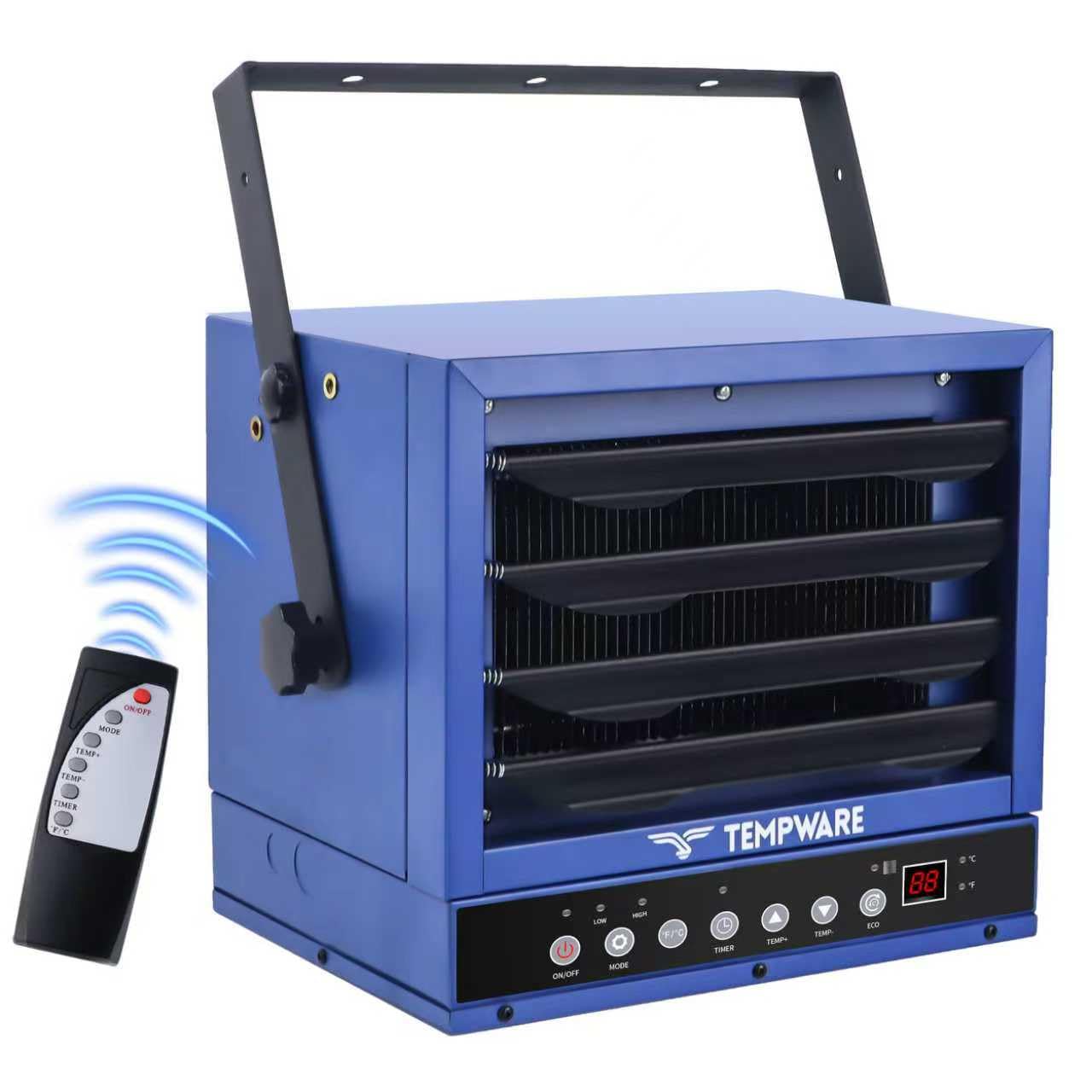
The TEMPWARE hits a rare balance of high output (25,590 BTU) and user-friendly controls. Its digital thermostat ranges from 45°F to 95°F, and the 12-hour timer lets you schedule morning warmups. At 31 amps, it demands a 40A breaker but covers up to 1,250 square feet—enough for a three-car garage. The adjustable louvers help push hot air down toward the floor instead of letting it pool at the ceiling.
Owners of 2- and 3-car garages report consistent heating even during polar vortex conditions. The remote control is a genuine convenience for overhead installations, letting you change settings without climbing a ladder. Build quality is solid: heavy-gauge steel housing that doesn’t flex under the weight of the fan motor. ETL certification adds peace of mind for continuous winter use.
One caveat: the thermostat can be slightly optimistic, causing the unit to cycle off before the floor feels warm. Pairing it with a ceiling fan to recirculate hot air solves the stratification issue. Also, you’ll need to supply your own power cord and batteries for the remote—minor preparation for a heater that outperforms its mid-range price.
Why it’s great
- Full digital thermostat with 1–12 hour timer
- Low and high heat settings (6,250W / 7,500W)
- Remote control works well from across the garage
Good to know
- Requires 240V hardwired installation by an electrician
- Thermostat may shut off before floor is fully warm
- No power cord included in the box
2. Comfort Zone Hard-Wired Ceiling Mount Heater CZ230ER

The Comfort Zone CZ230ER is built with heavy-gauge steel that shrugs off the bumps of a working shop. Its forced-air fan pushes 25,600 BTU across 1,250 square feet, and the adjustable louvers let you aim heat where it’s needed most. The digital thermostat is paired with a remote that makes overhead adjustments painless.
Users with insulated pole barns report maintaining 62°F when outside temps are in the 30s, with the heater cycling on only periodically. The unit’s 31.25-amp draw requires a 40A breaker and 8 AWG wire, but once installed, it runs reliably without tripping. The automatic overheat shutdown and power indicator light are straightforward safety features.
On the downside, some units lack power-loss memory—after a power outage, the heater resets to off, so you may come back to a cold garage. The internal thermostat can read inaccurately by a few degrees, leading users to set it higher than needed. Budget an extra for an external thermostat if precision matters.
Why it’s great
- Robust steel housing withstands workshop abuse
- Remote control and 12-hour timer for convenience
- Adjustable louvers provide directional airflow
Good to know
- No power-loss memory resets after outage
- Internal thermostat accuracy varies
- Hardwired installation required
3. Riseon 7500W Electric Garage Heater with Remote
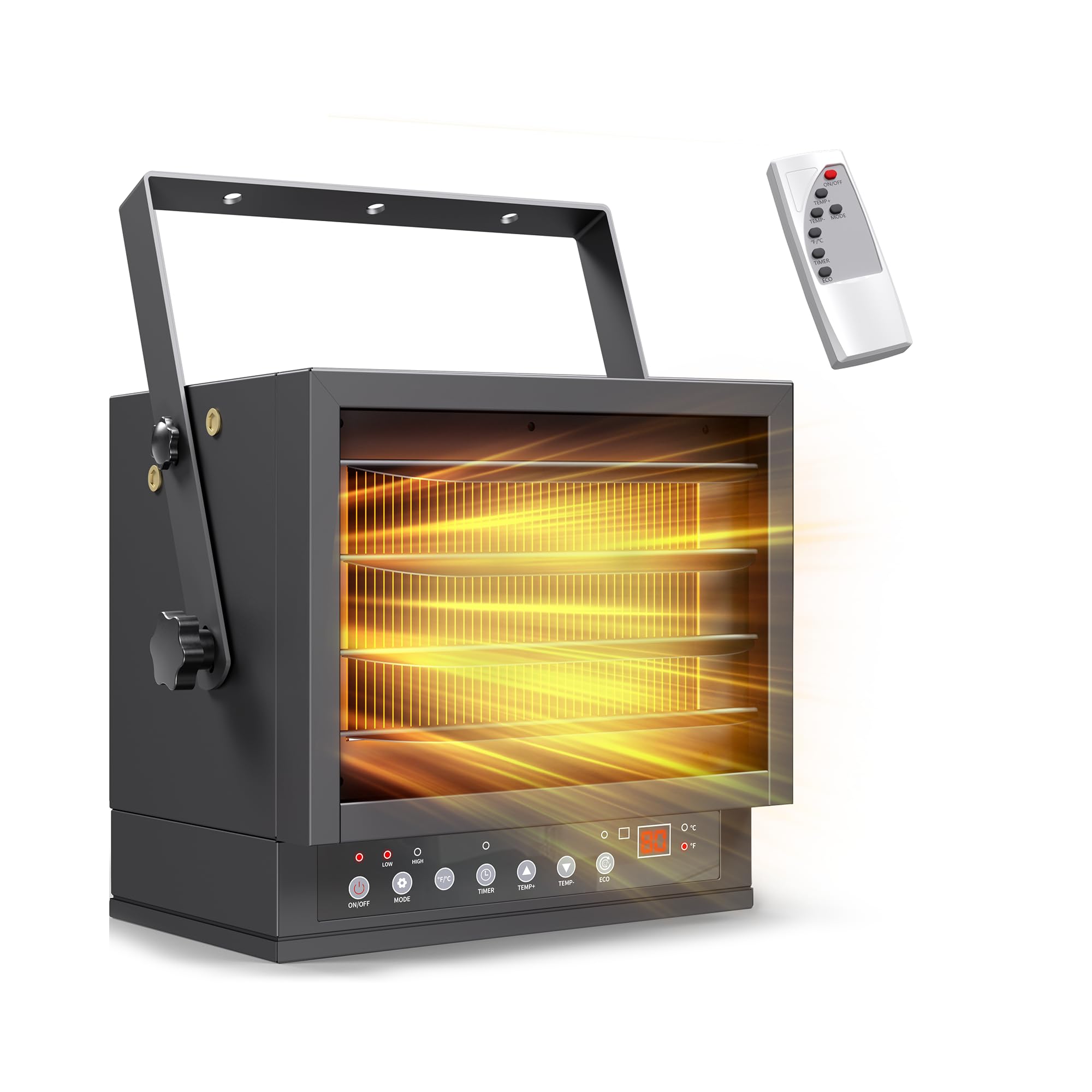
The Riseon 7500W heater stands out for its three power settings—7,500W, 6,250W, and fan-only—plus an ECO mode that modulates output based on room temperature. The LED touch screen and full-function remote give you control without walking across the shop. It covers up to 1,250 square feet with a 25,590 BTU output.
Customers using it to supplement mini-splits in 1,500-square-foot shops report they barely need the mini-splits anymore. The adjustable louvers (four sets) and multi-angle bracket make it easy to direct heat downward. The ETL certification and overheat auto-shutoff are standard but well-implemented.
One failure case reported the fan stuck on high and the thermostat overshooting to 85°F. While this appears isolated, it’s worth noting. Also, like most hardwired units, you’ll need an electrician to install a 40A circuit. For the price, the ECO mode alone can recoup the cost in monthly savings.
Why it’s great
- ECO mode automatically adjusts power to save electricity
- Three power settings plus fan-only summer mode
- LED touch screen and remote control included
Good to know
- Single review reported thermostat failure
- Hardwired installation requires 40A breaker
- No power cord supplied
4. DR. INFRARED HEATER DR-975 7500W

The DR. INFRARED DR-975 is a workhorse built for extreme cold. It runs on 240V single-phase power and offers dual wattage—4,700W or 7,500W—letting you dial back output when full power isn’t needed. The 5 adjustable louvers and enclosed motor are designed for continuous duty in shops, garages, and warehouses.
Users in Minnesota and Montana report heating a 20×40 insulated metal shop from freezing to 70°F within an hour, even with subzero outdoor temps. The unit is UL/CUL listed, and the remote-controlled thermostat holds temperature within ±1°F when paired with the optional external thermostat. Build quality is excellent: thick steel, fully enclosed motor, and a stout wall bracket.
The internal thermostat is known to be inaccurate—many owners install an aftermarket DR. INFRADER thermostat unit for precise control. Also, there’s no built-in on/off switch, so you must unplug or flip the breaker to kill power. The fan is audible but not intrusive for a shop environment. For brutal winters, this is the durable option.
Why it’s great
- Dual wattage (4,700W / 7,500W) for flexible output
- UL/CUL listed with fully enclosed motor
- Heats large insulated shops in under an hour
Good to know
- Internal thermostat needs external upgrade for precision
- No on/off switch—must unplug or break circuit
- Fan noise is moderate but noticeable
5. VEVOR 7500W Digital Fan Forced Shop Heater

The VEVOR 7500W heater uses SPCC cold-rolled steel for a housing that resists warping over long heating cycles. Its digital thermostat maintains temperature within 2°F, and the 9-hour timer adds scheduling flexibility. The unit covers 732 square feet and operates on a 240V circuit with a 31.25-amp draw.
Owners converting garages into home theaters praise its quiet fan and even heat distribution. One user maintained 72°F in a two-car garage when it was 19°F outside. The wall/ceiling mount design with adjustable louvers lets you aim heat away from sensitive equipment. The automatic fan delay function—where the fan runs briefly after the heating element shuts off—helps extract residual heat.
Some users report the mounting bracket feels less sturdy than premium competitors, though the heater itself performs well. The remote control doesn’t include batteries, so have a pair of AAA ready. For those covering a mid-sized garage with high-value insulation, this is a strong mid-range pick.
Why it’s great
- Cold-rolled steel housing resists deformation over time
- Quiet fan operation for noise-sensitive spaces
- Precise thermostat holds temperature within 2°F
Good to know
- Bracket feels slightly less robust than some competitors
- Remote batteries not included
- Hardwired installation required
6. Dura Heat EUH4000R Electric Forced Air Heater
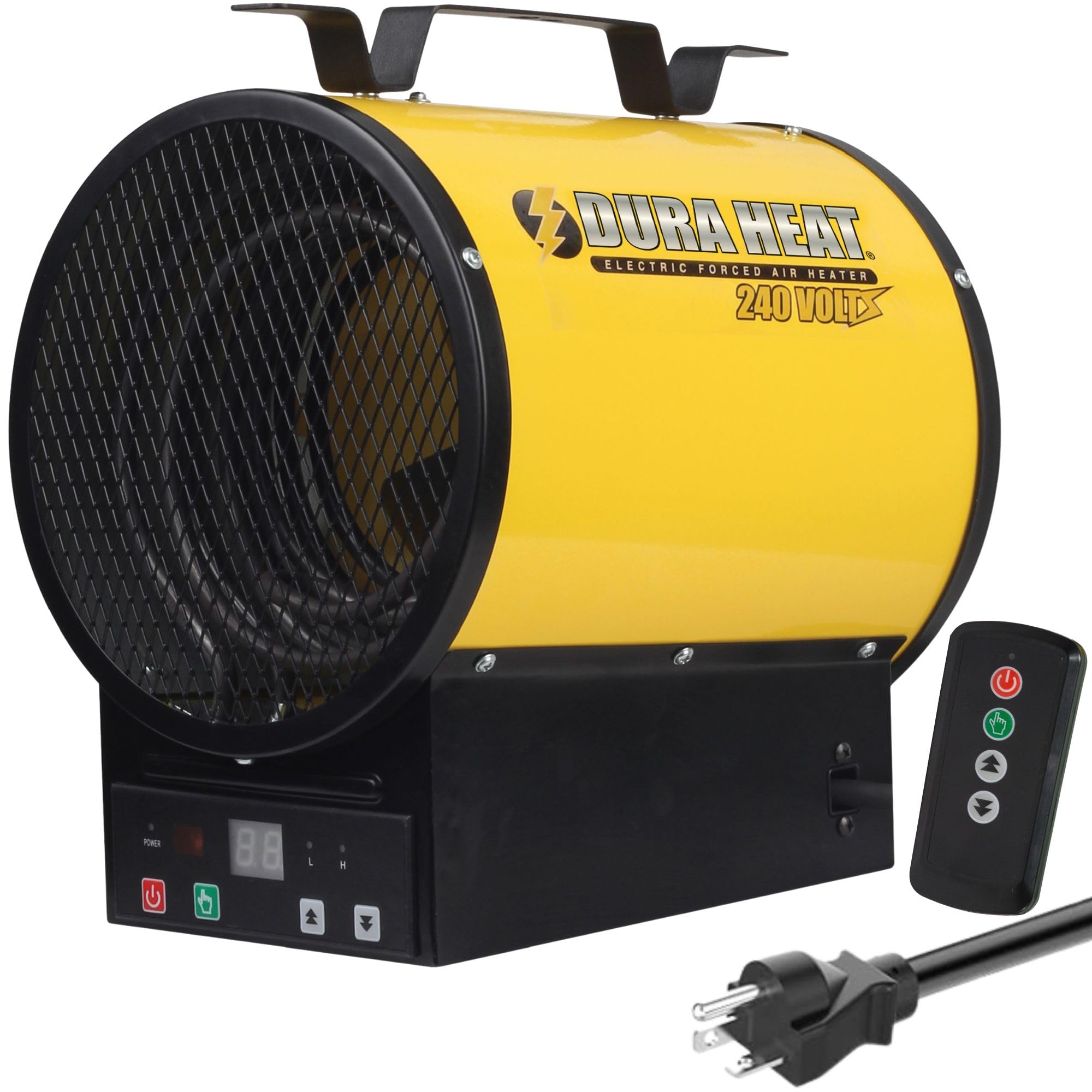
The Dura Heat EUH4000R is a 3,750W unit (12,800 BTU) that runs on a 20-amp 240V circuit, making it a lower-power alternative for those with limited electrical capacity. It comes with a NEMA 6-20P plug and a 6-foot cord, so you don’t need hardwiring—just plug into a compatible 240V outlet. The stainless steel heating element and fan-forced design heat up to 500 square feet.
Owners using it in RVs during Midwest winters report it running 24/7 without failure, even at -14°F. The remote control adjusts temperature from across the room, and the LCD shows intake temperature. Build quality feels solid with a heavy metal cabinet that won’t tip over easily. It includes a wall/ceiling mounting kit for permanent installation, but remains portable.
The fan runs constantly when the unit is on, even when the thermostat reaches set temp, which can blow cool air. Also, some units shipped with plastic button labels that crack over time. It’s not a true 7,500W heater, so adjust expectations—it’s best for smaller shops or as supplemental heat in a larger garage.
Why it’s great
- Plug-and-play with NEMA 6-20 outlet—no hardwiring
- Reliable stainless steel heating element
- Portable with included wall/ceiling bracket
Good to know
- Rated at 3,750W, not 7,500W
- Fan runs constantly even after reaching set temp
- Plastic button labels may degrade over time
7. Dura Heat 240V Electric Garage Heater (3,750W)
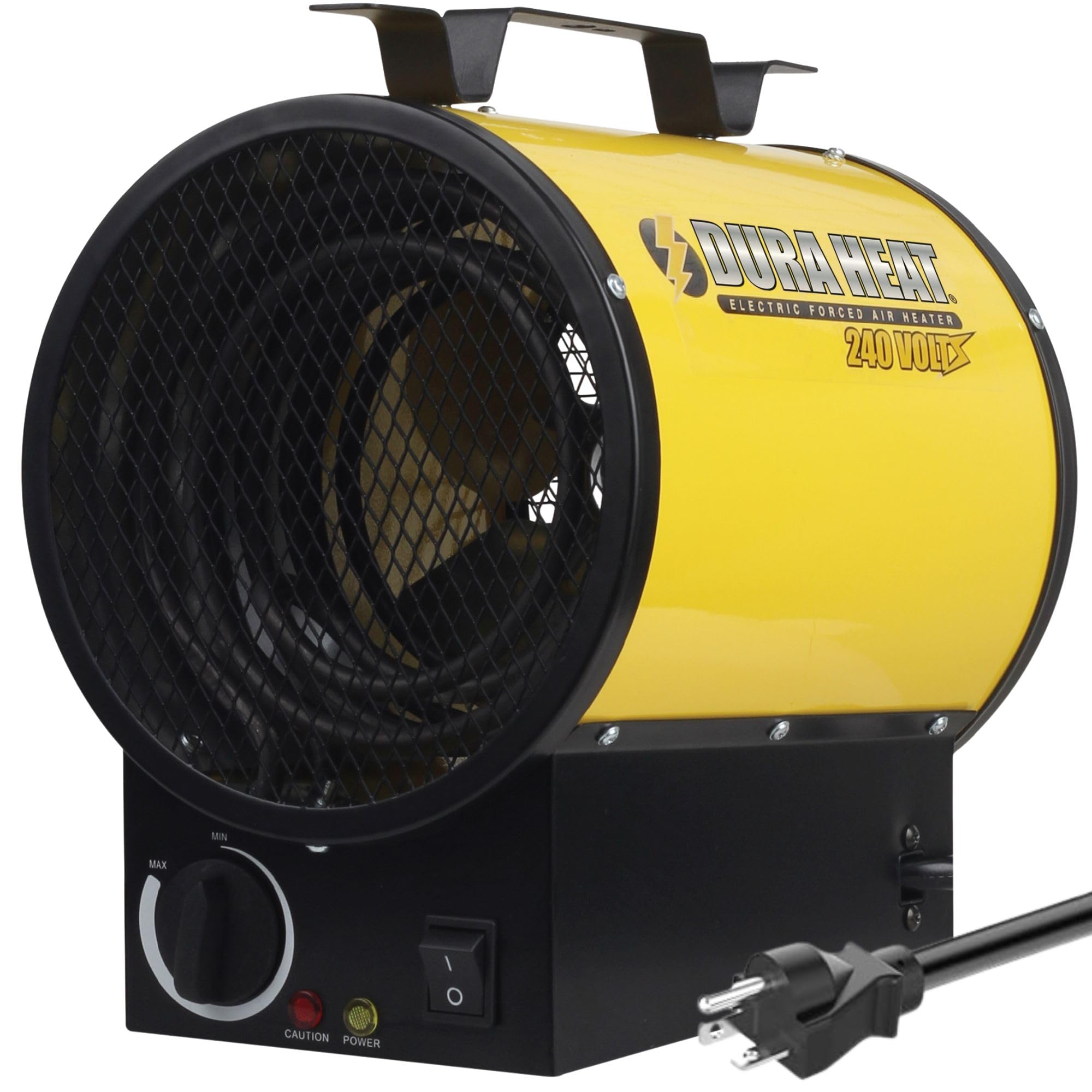
This Dura Heat model is a no-frills forced-air heater that runs on a 240V 20-amp circuit. It delivers 5,175 BTU and covers 500 square feet—ideal for a small workshop or shed. The cabinet-style design includes a wall/ceiling mounting bracket, and the fan pushes heat effectively through small spaces.
Buyers with uninsulated 16×16 shops report it can maintain comfort even at 39°F outside. The unit is sturdy and well-constructed for the entry-level price. Importantly, it requires a NEMA 6-20R outlet, not a standard 120V household plug.
The downside is significant: the fan runs whenever the unit is plugged in, regardless of the thermostat setting. This blows alternating warm and cool air, wasting electricity. A few owners report the heating coil failing after a few months of heavy use. If you need a low-cost solution for a very small space and can tolerate the constant fan, this works—otherwise, save for a digital model with better controls.
Why it’s great
- Low power draw (20 amps) works on modest circuits
- Sturdy cabinet build at an entry-level price
- Heats small uninsulated shops adequately
Good to know
- Fan runs constantly, wasting electricity
- No digital thermostat—single heat setting only
- Reported coil failures after extended use
8. Shinic 2-Pack Electric Garage Heaters (Radiant)

The Shinic 2-pack uses radiant quartz tubes to heat people and objects directly, rather than warming the air. Each unit offers 750W or 1,500W settings plus a built-in halogen work light, making them practical for workbenches and focused tasks. The pull-string switch cycles through five modes, including heat-only and heat-with-light combinations.
They mount to the ceiling with 90-degree rotation, saving floor space. Owners report that sitting directly under the heaters keeps them warm even in an otherwise cold garage—great for hobbies or kids playing. The ETL listing and overheat auto-off provide basic safety.
These are not whole-room heaters. They won’t warm a 400-square-foot garage uniformly. Some units arrived with loose screws, and a few failed after 6–7 uses. For the price, they work as spot warmers but lack the reliability and coverage of a forced-air 7,500W unit. Best paired with a larger heater to take the edge off near a work area.
Why it’s great
- Includes halogen work light for visibility
- Radiant heat feels warm instantly on skin
- Ceiling mount saves valuable floor space
Good to know
- Only warms objects directly in front—not the whole room
- Some units reported failure after a few uses
- Quality control on screws and assembly inconsistent
9. SereneLife Infrared Patio Heater

The SereneLife is a 1,500W infrared tower designed for patios and outdoor dining areas, not enclosed garages. Its 57-inch height delivers sun-like radiant heat that cuts through a breeze, covering about 25 square feet. The IP65 rating means it resists dust and water jets, and the aluminum alloy frame stands up to outdoor corrosion.
Two heat levels and a remote make it convenient, and the safety features—360-degree tip-over switch, overheat protection, mesh guard—are well-suited for areas with kids or pets. Owners praise its quiet, odorless operation compared to propane models.
This is not a 7,500W garage heater; it’s for spot-heating a deck or outdoor seating area. Assembly can be tricky without clear instructions, and a few units arrived dead due to plug defects. If you need garage warmth, skip this; if you want to extend patio season, it’s a solid choice.
Why it’s great
- Weather-resistant (IP65) for outdoor use
- Infrared heat is silent and odorless
- Remote control and two heat settings
Good to know
- Only covers 25 sq ft—not for heating a garage
- Assembly instructions are poor
- Occasional dead-on-arrival units reported
FAQ
Can I plug a 7500W garage heater into a standard 120V outlet?
How many square feet will a 7500W garage heater cover?
Is forced air or radiant heat better for a garage?
Do I need an electrician to install a hardwired garage heater?
What is the difference between ETL and UL certification?
Final Thoughts: The Verdict
For most users, the best 7500 watt garage heater winner is the TEMPWARE 7500W because it combines digital thermostat control, remote operation, and a 12-hour timer at a price that outperforms its mid-range position. If you want extreme cold performance and dual-wattage flexibility, grab the DR. INFRADER DR-975. And for a budget-friendly entry point that still delivers real heat for small spaces, nothing beats the Dura Heat EUH4000R.

Mo Maruf
I created WellFizz to bridge the gap between vague wellness advice and actionable solutions. My mission is simple: to decode the research and give you practical tools you can actually use.
Beyond the data, I am a passionate traveler. I believe that stepping away from the screen to explore new environments is essential for mental clarity and physical vitality.