Our readers keep the lights on and my smoothie glass nicely filled. As an Amazon Associate, I earn from qualifying purchases.
A 75-inch TV dominates a room, and finding one that delivers a genuinely cinematic picture without demanding a second mortgage requires cutting through the marketing noise. The gap between a screen that merely lights up and one that reproduces a film-grade image is defined by specific hardware choices—Mini-LED backlighting, native refresh rates, and intelligent upscaling engines—not just a big number beside the diagonal measurement.
I’m Mohammad Maruf — the founder and writer behind WellFizz. My research focuses on isolating the measurable specs that separate a long-term investment from a regrettable compromise, specifically analyzing backlight architectures, processor generations, and real-world HDR performance across the most popular 75-inch panels on the market.
After weeks of combing through technical data sheets and hundreds of verified owner experiences, I’ve narrowed the field to the models that justify their price with concrete performance. This is the definitive guide to the best 75 inch tv value in today’s crowded mid-range and premium landscape.
How To Choose The Best 75 Inch TV Value
Selecting a 75-inch television is a decision about how light is managed across a vast canvas. The panel technology, the density of the backlight zones, and the processing power behind the screen dictate the visual experience far more than the brand name. Here are the critical factors that define real-world value at this size.
Backlight Architecture: The Foundation of Contrast
A 75-inch screen amplifies every backlight flaw. Standard edge-lit panels struggle to maintain uniform brightness across such a wide area, often leaving washed-out corners. Full Array Local Dimming (FALD) zones are the baseline for acceptable contrast, but the number of zones matters—more zones mean finer control over blooming around bright objects against dark backgrounds. Mini-LED technology takes this further by packing hundreds or even thousands of tiny LEDs into the backlight, dramatically increasing zone count and enabling deeper black levels and brighter highlights without the halo effect.
Refresh Rate and Motion Handling
For sports and console gaming, the native panel refresh rate is the single most important spec. A true 120Hz or 144Hz panel renders fast-moving action with clarity and eliminates the blur and stutter found on standard 60Hz screens. Manufacturers often list “Motion Rate 480” or similar marketing terms that rely on backlight scanning—these are not equivalent to a native high-refresh panel. If you watch live sports, play action games, or connect a high-end PC, prioritize a model with a documented native 144Hz specification and Variable Refresh Rate (VRR) support.
HDR Performance and Peak Brightness
High Dynamic Range is the feature that makes a 75-inch screen truly immersive, but its effectiveness hinges on peak brightness. A panel that can sustain 600 nits or more—ideally 1,000 nits for real impact—will make HDR10, Dolby Vision, and HDR10+ content pop with specular highlights and realistic contrast. Check for support of both Dolby Vision IQ and HDR10+ Adaptive, as these formats adjust the picture based on ambient room lighting, a critical feature for a TV that will be used in various lighting conditions throughout the day.
The Processor: Upscaling is Not Optional
A 75-inch 4K screen magnifies lower-resolution content like cable TV, streaming, and older DVDs to a brutal degree. A weak processor makes standard-definition and even 1080p content look soft, noisy, and unflattering. Premium TVs from Samsung, Sony, and LG use dedicated AI neural processors that analyze each scene and intelligently reconstruct lost texture and detail. This upscaling capability is often the difference between a TV that looks good with everything you throw at it and one that only shines with pristine 4K material.
Quick Comparison
On smaller screens, swipe sideways to see the full table.
| Model | Category | Best For | Key Spec | Amazon |
|---|---|---|---|---|
| TCL T7 | QLED | Gaming & All-Around Value | Native 144Hz Panel | Amazon |
| Samsung QN70F | Mini-LED | AI-Powered Clarity | NQ4 AI Gen2 Processor | Amazon |
| LG QNED85A | Mini-LED | Color Volume & Gaming | Dynamic QNED Color | Amazon |
| Toshiba Z670 | Mini-LED | Cinematic HDR & Audio | Native 144Hz + Woofer | Amazon |
| Samsung Q80F | QLED | Bright Room Viewing | 100% Color Volume | Amazon |
| Sony BRAVIA 5 | Mini-LED | Reference Picture Quality | XR Processor + 4K HDR | Amazon |
| Samsung QN90D | Mini-LED | Premium Brightness & Sound | Neo Quantum HDR+ | Amazon |
| Hisense U6 | Mini-LED | High Brightness HDR | Up to 1000 Nits | Amazon |
| Amazon Ember | QLED | Alexa Integration | Wi-Fi 6 + Omnisense | Amazon |
| Sony BRAVIA 2 | LED | PS5 Gaming | 4K Processor X1 | Amazon |
| Roku Select QLED | QLED | Effortless Streaming | Roku Smart Interface | Amazon |
| Roku Select Bundle | OLED | Bundle Value | Bundled Protection Plan | Amazon |
| VIZIO V-Series | LED | Entry-Level Size | Full Array Backlight | Amazon |
In‑Depth Reviews
1. TCL T7 Series (75T7)

The TCL T7 Series strikes a nearly perfect balance between cutting-edge gaming specifications and everyday picture quality. Its QLED panel, powered by Quantum Dot technology, covers nearly the entire DCI-P3 color space, delivering vibrant and accurate colors that remain punchy even in rooms with ambient light. The standout feature is the native 144Hz refresh rate with Variable Refresh Rate (VRR) support, which makes it an exceptional partner for high-framerate PC gaming and next-gen consoles.
The TCL AIPQ Pro processor handles the heavy lifting of upscaling 1080p and 1440p content to the 4K canvas, and while it isn’t quite at the level of Sony’s XR chip, it does a commendable job of minimizing artifacts in fast-moving scenes. Motion Rate 480 with MEMC frame insertion further smooths out sports broadcasts, though purists may notice the soap opera effect and disable it. The FullView 360 metal bezel-less design gives the set a sleek, modern look that minimizes distractions.
Google TV provides a clean, customizable interface with built-in Chromecast and Apple AirPlay 2 support. Four HDMI inputs, including one with eARC, provide ample connectivity for a full entertainment system. The built-in Dolby Atmos audio is decent for the price, but pairing this panel with a dedicated soundbar will unlock its full potential. For the combination of a high-refresh panel, QLED color, and a comprehensive smart platform, the T7 is the benchmark for overall value.
Why it’s great
- Native 144Hz panel delivers buttery-smooth gaming and sports.
- QLED colors are vibrant and accurate across the brightness range.
- Bezel-less design looks far more premium than the price suggests.
Good to know
- Built-in speakers are adequate but benefit from an external soundbar.
- Slight screen glare visible in very bright rooms with direct lighting.
- Requires Google account setup before using HDMI inputs.
2. Samsung Neo QLED QN70F

The Samsung QN70F represents a significant step up in picture quality through its Mini-LED backlighting and the NQ4 AI Gen2 processor. The precision-controlled Mini LEDs deliver sharp contrast with minimal blooming, creating deep black levels and brilliant highlights that make HDR content truly shine. The AI processor uses 20 neural networks to upscale standard content to 4K, and the results are among the best in its class—low-resolution cable and streaming content appear sharper and more detailed than on cheaper panels.
Motion Xcelerator 144Hz ensures tear-free gaming and smooth sports playback, and the native refresh rate is backed by VRR support for console and PC connectivity. Samsung’s slim aesthetic is on full display here, with the AirSlim design allowing the TV to sit nearly flush against the wall. The Tizen OS interface is snappy and provides access to 2,700+ free channels via Samsung TV Plus, though some users may find the app layout less intuitive than Google TV or Roku.
The built-in sound is solid for daily use, with clear dialogue and decent volume, but it lacks the low-end punch for cinematic action scenes. The included solar-powered remote is an eco-friendly touch that eliminates the need for batteries. For those who prioritize intelligent upscaling and the refined contrast of a Mini-LED panel, the QN70F offers exceptional processing power at a reasonable premium over entry-level QLED sets.
Why it’s great
- NQ4 AI processor upscales lower-resolution content beautifully.
- Mini-LED backlight provides deep blacks with minimal blooming.
- Slim, flush-mount-friendly design for a clean installation.
Good to know
- Sound lacks bass; a soundbar significantly improves the experience.
- Tizen OS is fast but has a steeper learning curve than Roku.
- Solar remote can be slow to charge in low-light rooms.
3. LG QNED85A (75QNED85AUA)
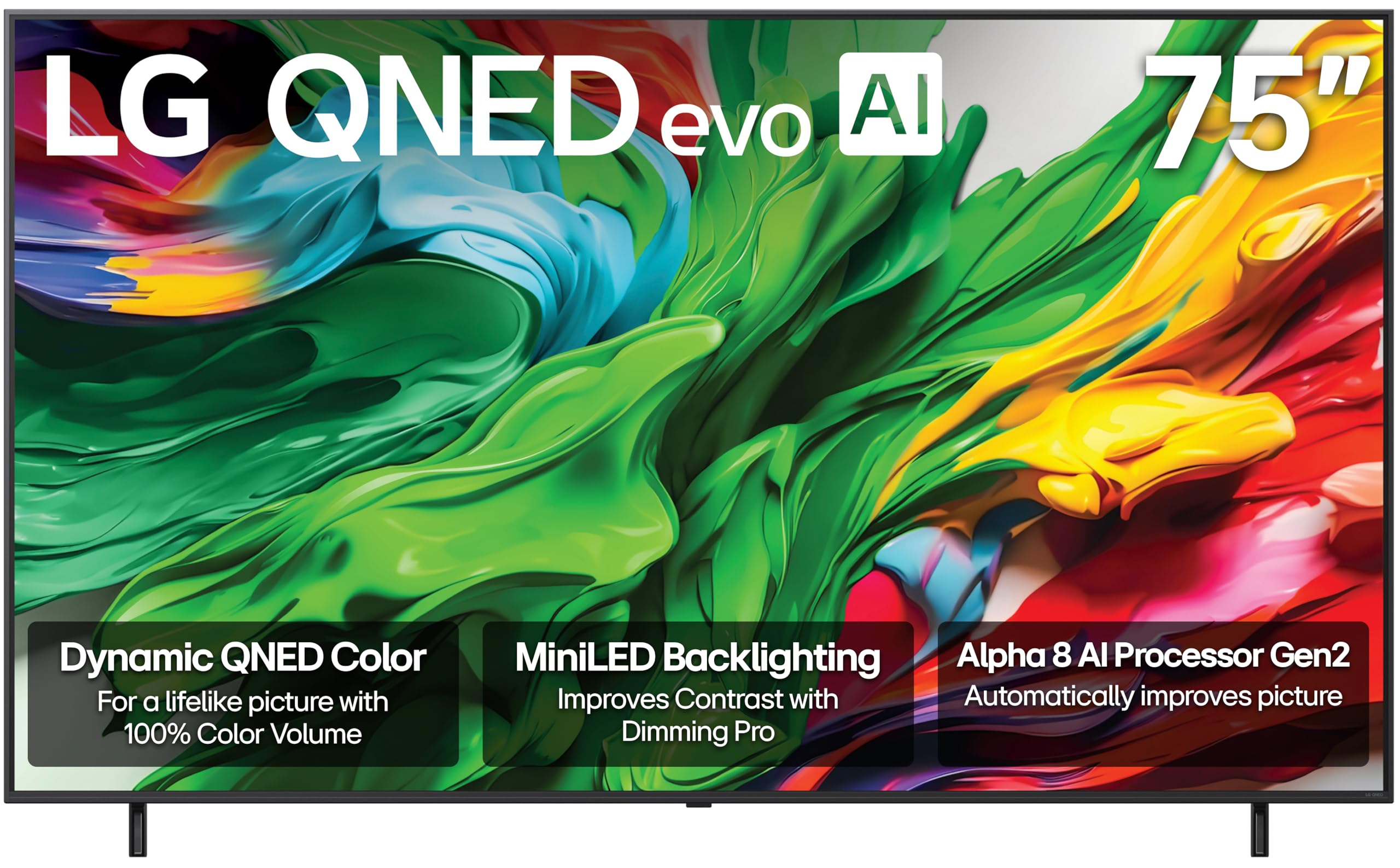
LG’s QNED85A is engineered for gamers who demand fluid motion and vibrant color. Its Dynamic QNED Color technology delivers 100% Color Volume, meaning the color remains accurate and intense even as the brightness increases—a critical feature for HDR gaming. The mini-LED Precision Dimming system offers a high number of individually controlled zones, producing excellent black levels and bright highlights that reduce blooming significantly compared to standard FALD sets.
The native 120Hz refresh rate with support for 144Hz VRR via the Game Optimizer dashboard gives players granular control over latency and motion settings. The Alpha 8 AI Processor Gen2 handles motion handling and upscaling competently, ensuring that non-4K content still looks presentable on the large screen. Filmmaker Mode accurately reproduces the director’s intent for movie nights, preserving original frame rates and colors.
webOS remains one of the most user-friendly smart TV platforms, offering quick access to major streaming apps and over 350 free LG Channels. The included remote lacks a dedicated mute button and a number pad, which can be frustrating for live TV users. The adjustable stand width is a clever feature that allows the TV to fit on a narrower media console without hanging over the edges. For gamers who want a fast, responsive panel with excellent color volume, the LG QNED85A is a top contender.
Why it’s great
- 100% Color Volume ensures accurate colors at any brightness.
- Game Optimizer provides quick access to gaming-specific settings.
- Adjustable stand width for flexible furniture placement.
Good to know
- Remote lacks mute button and number pad for live TV.
- Built-in sound is average; an external audio system is recommended for movies.
- Some users experience sound reverting to internal speakers after changing inputs.
4. Toshiba Z670 Series (75Z670R)

The Toshiba Z670 is a surprisingly well-rounded package that brings a near-premium viewing experience to a mid-range price point. Its Mini-LED with Full Array Local Dimming delivers impressive contrast, with deep blacks and bright, controlled highlights that make Dolby Vision IQ and HDR10+ Adaptive content look exceptional. The REGZA Engine ZRi Gen3, fine-tuned by Toshiba’s engineers in Japan, provides intelligent scene-by-scene optimization that enhances both picture and audio.
A native 144Hz refresh rate with Game Mode Pro and AMD FreeSync Premium ensures the panel is ready for fast-paced gaming without tearing or stutter. The QLED display produces over a billion shades of color, and the Total HDR Solution Pro supports every major HDR format, making it future-proof for disc and streaming content. The REGZA Power Audio Pro system with a dedicated bass woofer is a standout—it delivers rich, room-filling sound that reduces the immediate need for a soundbar, though a dedicated setup will still improve the experience.
Fire TV integration with Alexa built-in provides a seamless smart experience, particularly for users invested in the Amazon ecosystem. The minimalist design inspired by Japanese aesthetics looks clean and refined. The only minor complaint is the Bluetooth version 5.0, which is slightly older than the 5.2 or 5.3 found on competing models, though this has no practical impact on streaming audio quality. For a do-it-all set with excellent sound and cinematic HDR support, the Z670 is a strong investment.
Why it’s great
- Built-in bass woofer provides surprisingly good audio for a TV.
- Native 144Hz with FreeSync Premium for console and PC gaming.
- Dolby Vision IQ and HDR10+ Adaptive for accurate HDR in any light.
Good to know
- Bluetooth version 5.0 is a step behind some competitors.
- Fire TV interface may not appeal to users outside the Amazon ecosystem.
- Stand is wide, requiring a large media console for a stable setup.
5. Samsung QLED Q8F (Q80F)

The Samsung Q80F is designed for living rooms that receive significant daylight. Its QLED panel with 100% Color Volume ensures that colors remain vivid and true-to-life even in the brightest conditions, resisting the washout that plagues less capable sets. The Q4 AI processor provides solid upscaling, though it isn’t quite as sophisticated as the NQ4 chip found in the higher-tier Neo QLED models.
Motion handling is smooth thanks to a native 144Hz refresh rate and VRR support, making it suitable for both sports fans and casual gamers. The AirSlim design is minimalist and attractive, and the solar-powered remote is a nice touch. Samsung Tizen OS provides access to a vast library of free and paid content, and Alexa is built-in for voice control. The stand, however, has been noted as somewhat unstable for a 75-inch panel, so a wall mount or a secure, flat surface is recommended.
The most noticeable compromise for this price is the sound quality. Users report that the built-in speakers lack depth and richness, making dialogue sound thin during action sequences. A soundbar is essentially a requirement to get the most out of this set. The Q80F is an excellent choice for a bright room where raw contrast and color saturation are the highest priorities, but be prepared to budget for an audio upgrade.
Why it’s great
- 100% Color Volume maintains vibrant colors in bright rooms.
- Native 144Hz panel with VRR for smooth motion and gaming.
- Sleek, slim design with a rechargeable solar remote.
Good to know
- Sound quality is poor; a soundbar is a necessary addition.
- Stand can feel unstable; wall mounting is recommended for safety.
- Lacks the advanced AI upscaling of the more expensive Neo QLED models.
6. Sony BRAVIA 5 (K-75XR50)

The Sony BRAVIA 5 is where Mini-LED technology meets the industry’s best picture processing. The XR Processor with AI analyzes every frame in real-time, boosting color, contrast, and clarity to produce an image that feels almost three-dimensional. Its XR Backlight Master Drive precisely controls the thousands of Mini LEDs, creating a contrast ratio that rivals entry-level OLEDs, with spectacular highlights and pitch-black shadows that retain fine detail.
Color reproduction is handled by XR Triluminos Pro, which accesses billions of accurate real-world colors, making skin tones, foliage, and skies look natural and textured. The XR Motion Clarity system ensures blur-free action during fast-paced sports and movies without introducing the stroboscopic artifacts that plague cheaper motion smoothing. Exclusive features for the PlayStation 5, such as Auto HDR Tone Mapping and Auto Genre Picture Mode, make it the definitive companion for Sony’s console. Google TV provides a smooth, app-rich platform.
The built-in speakers are decent, but for a panel of this caliber, a proper surround sound system is necessary to match the visual immersion. The main drawback for some is that only two of the four HDMI ports support the full HDMI 2.1 bandwidth required for 4K 120Hz gaming. For videophiles who want the most accurate picture possible—especially for movie watching and PS5 gaming—the BRAVIA 5 is the reference standard in this price bracket.
Why it’s great
- XR Processor delivers the most accurate and lifelike picture in its class.
- Mini-LED backlight provides OLED-like contrast with higher brightness.
- Exclusive PS5 features optimize gaming automatically.
Good to know
- Only 2 of 4 HDMI ports are full HDMI 2.1 bandwidth.
- Premium price requires a commitment to a top-tier audio system.
- Built-in sound is good but doesn’t match the picture’s cinematic potential.
7. Samsung Neo QLED QN90D

The Samsung QN90D is a powerhouse of brightness and contrast, utilizing Quantum Matrix technology with Mini LEDs to deliver sensational HDR performance. Its Neo Quantum HDR+ processing creates stunning highlights and deep shadows, making it one of the best non-OLED sets for watching Dolby Vision content (though Samsung does not support Dolby Vision, relying instead on its own HDR10+ optimization). The Real Depth Enhancer Pro separates objects from the background, adding a convincing sense of three-dimensionality to the image.
Motion Xcelerator 144Hz provides the necessary fluidity for high-speed gaming, and Object Tracking Sound+ creates a virtual 3D audio bubble that follows the on-screen action—this is one of the best built-in audio systems found on any TV, rivaling mid-range soundbars. The NQ4 AI Gen2 processor handles upscaling expertly, and the Ultra Viewing Angle ensures consistent picture quality even when seating is off-center.
The build quality is exceptional, though the TV is heavy and requires careful handling during installation. It also lacks Dolby Vision support, which may be a dealbreaker for some movie enthusiasts who prefer the format’s dynamic metadata. For a premium all-around TV with unparalleled brightness, fantastic motion handling, and a genuinely impressive sound system, the QN90D justifies its higher price tag.
Why it’s great
- Object Tracking Sound+ creates an immersive audio experience.
- Extremely bright panel with excellent HDR highlight performance.
- Ultra Viewing Angle maintains color accuracy from all seats.
Good to know
- No Dolby Vision support; relies on HDR10+ for dynamic HDR.
- Very heavy, requiring a two-person installation effort.
- AI upscaling can introduce artifacts on very old 4:3 content.
8. Hisense U6 Series (75U65QF)
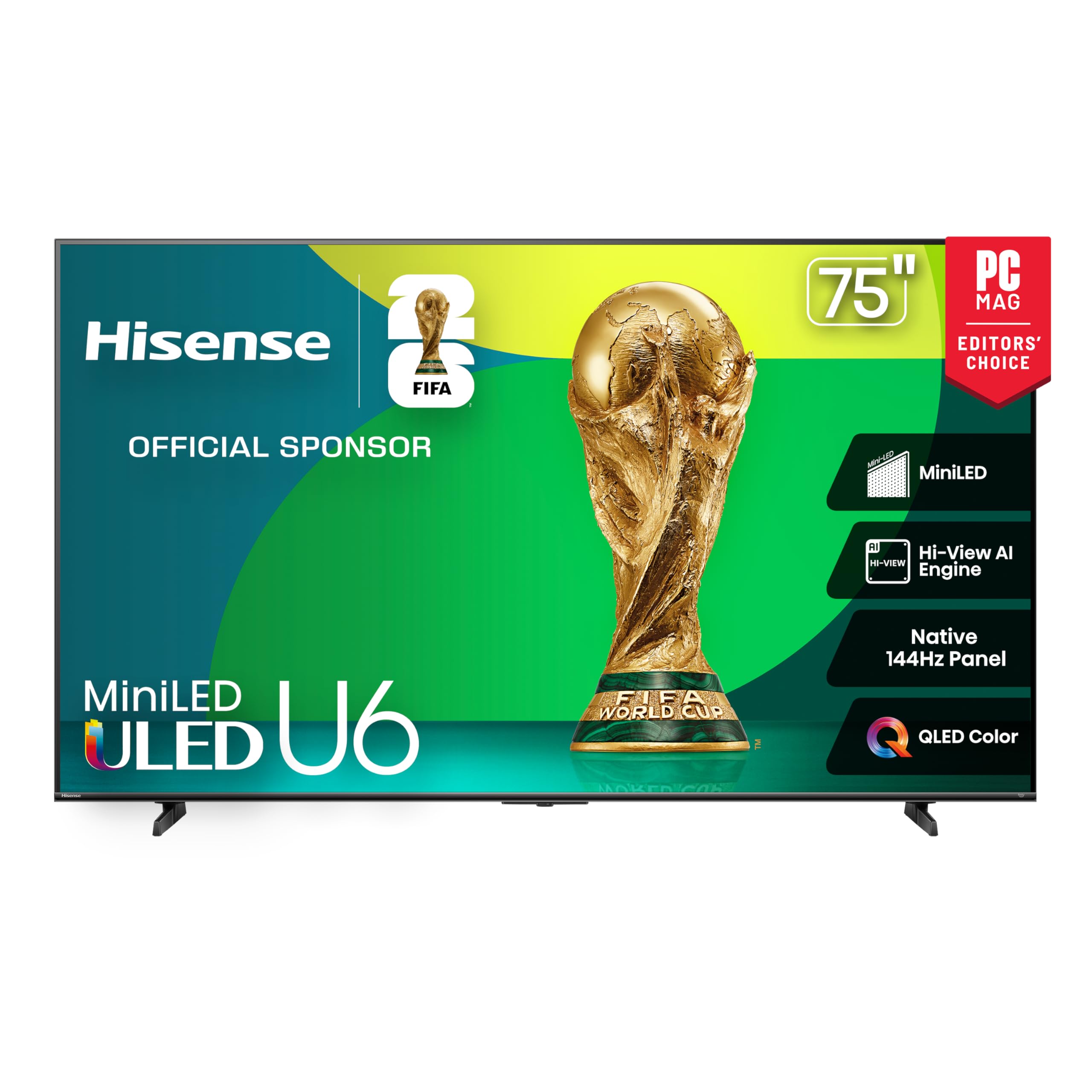
The Hisense U6 is a champion of brightness in its segment, capable of achieving up to 1000 nits of peak brightness. This makes its HDR performances—especially with Dolby Vision IQ and HDR10+ Adaptive—truly pop, with stunning specular highlights that bring sunlight, explosions, and reflections to life. The Mini-LED backlight, with up to 600 local dimming zones, provides excellent contrast control, though some minor blooming can be visible on very dark test patterns.
The native 144Hz panel with Game Mode Pro and AMD FreeSync Premium ensures a responsive and tear-free gaming experience. The built-in subwoofer is a significant differentiator: it delivers genuine low-end rumble that makes action movies and games feel more impactful without the need for an external subwoofer. The Hi-View AI Engine provides decent upscaling, though it doesn’t match the processing purity of Sony or Samsung’s higher-end chips. Fire TV provides a fast, app-rich interface with Alexa built-in.
The biggest limitation is that only two of the four HDMI ports support the full 144Hz bandwidth for HDMI 2.1 gaming. The U6 is also a heavy set, requiring two people for setup. For anyone who prioritizes raw brightness and HDR impact over absolute motion processing perfection, the Hisense U6 is one of the brightest and most feature-rich options available, delivering performance that often punches well above its tier.
Why it’s great
- Up to 1000 nits peak brightness for spectacular HDR highlights.
- Built-in subwoofer provides surprising bass for a TV.
- Native 144Hz with FreeSync Premium for smooth gaming.
Good to know
- Only 2 of 4 HDMI ports support full HDMI 2.1 bandwidth.
- Minor blooming visible on test patterns in dark rooms.
- Heavy; a two-person lift is required for installation.
9. Amazon Ember 75″ QLED Series
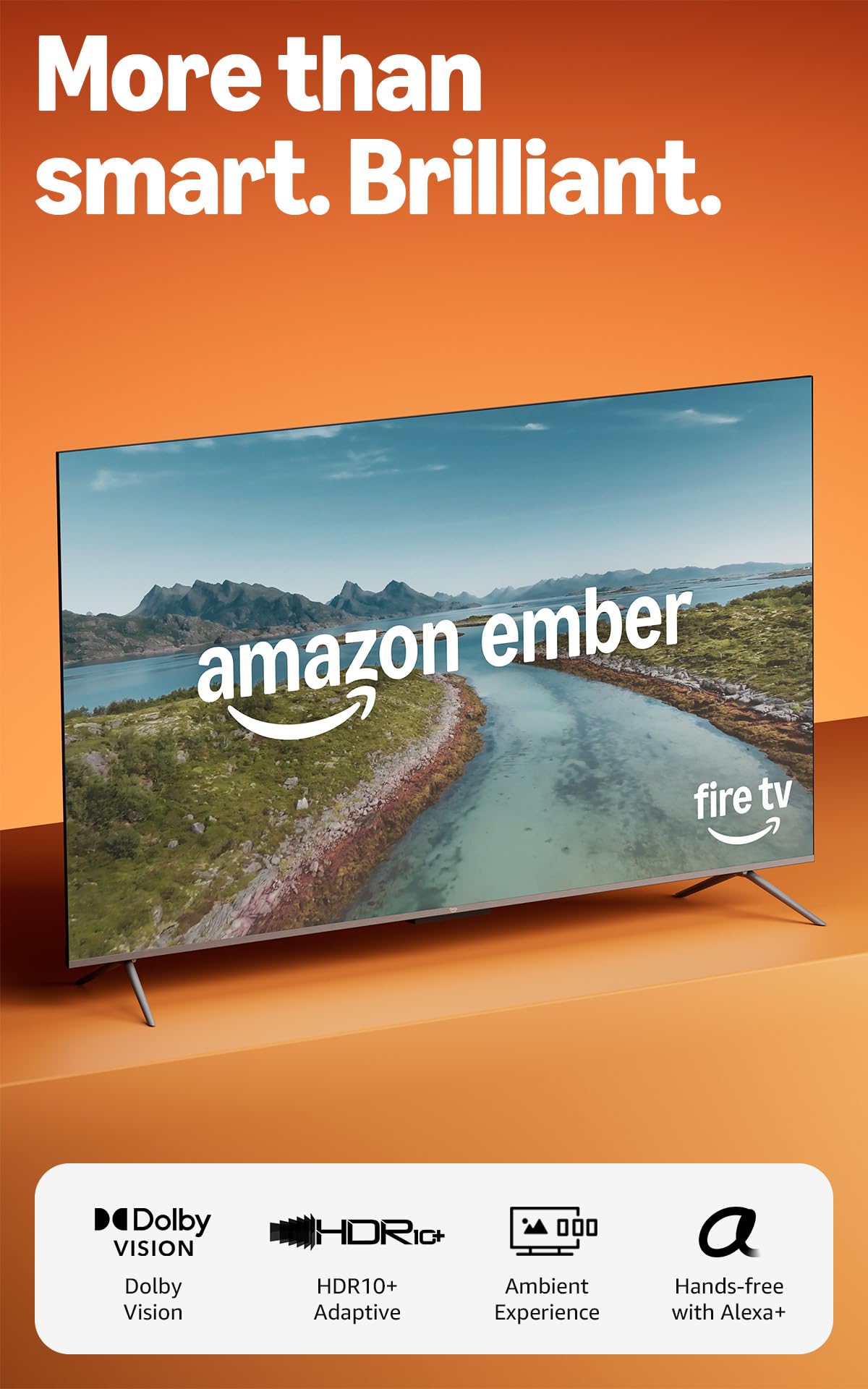
The Amazon Ember QLED Series is designed first and foremost for the Amazon ecosystem. Its integration with the new Alexa+ and Fire TV interface is the smoothest in the industry, allowing for hands-free voice control, smart home management, and natural language searches for content. The Omnisense technology wakes the display when you enter the room, showing artwork or turning on instantly—a clever convenience feature.
The 4K QLED display with Dolby Vision and HDR10+ Adaptive provides vibrant, punchy colors and good contrast, and the Full-array local dimming helps keep blacks deep. The quad-core processor and Wi-Fi 6 connectivity ensure apps load quickly and streaming remains stable. The built-in Dolby Audio is adequate for general viewing, but a soundbar is recommended for a more immersive experience, as the default 5.1 audio setting can cause sync issues with some apps.
The picture quality, while good, is not quite on par with the best QLED competitors in the same price range. Some users report that the upscaling of lower-resolution content is not as sharp as a Sony or Samsung panel. This TV is the right choice for the committed Alexa household that values seamless voice control and smart home integration over the absolute best picture processing available.
Why it’s great
- Best-in-class Alexa integration and hands-free voice control.
- Wi-Fi 6 for fast, reliable streaming connectivity.
- Omnisense technology for instant-on convenience.
Good to know
- Picture upscaling is not as good as Sony or Samsung processors.
- Default 5.1 audio can cause sync issues; manual stereo setting may be needed.
- Audio quality benefits significantly from an external soundbar.
10. Sony BRAVIA 2 II (K-75S20M2)

The Sony BRAVIA 2 II is a focused product for the PlayStation 5 owner who wants the console’s exclusive features—Auto HDR Tone Mapping and Auto Genre Picture Mode—in a large 75-inch format. The 4K Processor X1 delivers a natural, lifelike picture with sharp details, and the Motionflow XR technology effectively reduces blur during fast-paced gameplay and sports. It doesn’t have the deepest blacks in its class, but the overall picture quality is clean and well-balanced.
The Google TV interface provides smooth access to streaming apps, and the inclusion of Sony Pictures CORE with free movies adds value. The design is understated, and the remote is functional. The energy efficiency is commendable, consuming less power than older LCD models. The built-in sound is good for a standard LED TV, with clear dialogue, though it lacks the low-end punch for an immersive movie experience.
The main drawback is the standard LED backlight, which produces typical gray blacks in dark scenes compared to Mini-LED competitors. It also lacks Dolby Vision support, relying on HDR10. For a pure PS5 companion with brand-reliable reliability and excellent motion handling, it’s a solid choice, but buyers looking for deep contrast should look at the Mini-LED models higher up this list.
Why it’s great
- Exclusive PS5 features provide optimal game picture automatically.
- Motionflow XR delivers blur-free action for sports and gaming.
- Energy-efficient; uses less power than many older large TVs.
Good to know
- Standard LED backlight lacks the deep blacks of Mini-LED panels.
- No Dolby Vision support; limited to HDR10.
- Built-in audio is good but not cinematic.
11. Roku Select Series 75″ QLED
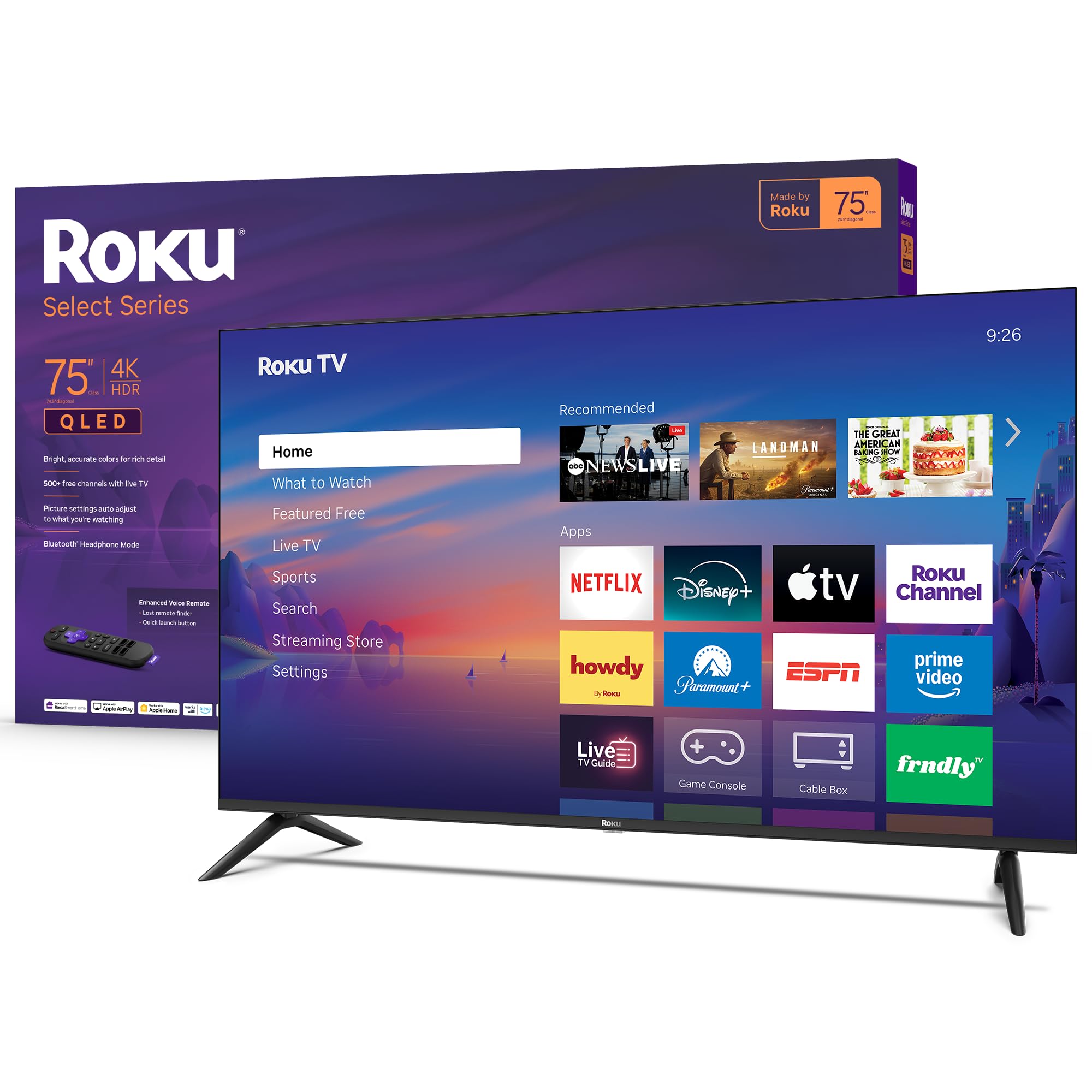
The Roku Select Series QLED is the champion of user-friendly streaming. Its legendary Roku OS is fast, intuitive, and receives regular updates, and the included voice remote with lost remote finder is genuinely useful. The QLED panel combined with HDR10 produces bright, accurate colors, and the Roku Smart Picture system automatically optimizes the picture mode for the content you’re watching, making it a truly set-and-forget experience.
The 60Hz refresh rate is a limitation for serious gamers, but for 95% of users who watch movies, TV shows, and sports, the motion handling is smooth and artifact-free. The direct LED backlight provides good uniformity, though it can’t match the black levels of a Full Array or Mini-LED set. The Bluetooth Headphone Mode is a thoughtful feature for late-night viewing, and the frameless design looks clean and modern.
The built-in sound is surprisingly robust, with clear dialogue and decent volume, often eliminating the immediate need for a soundbar. It supports Apple AirPlay and works with Alexa, Google Assistant, and Siri. For the user who values the simplest, most reliable smart TV experience over the absolute highest peak brightness or gaming refresh rate, the Roku Select Series is a brilliant no-compromise choice for daily enjoyment.
Why it’s great
- Roku OS is the fastest, most intuitive smart platform available.
- Voice remote with lost remote finder solves a common household pain point.
- Bluetooth Headphone Mode for private listening without a separate device.
Good to know
- 60Hz panel is not ideal for high-refresh-rate gaming.
- Direct LED backlight provides standard black levels, not deep ink blacks.
- No Dolby Vision; limited to HDR10 for HDR content.
12. Roku Select Series Bundle
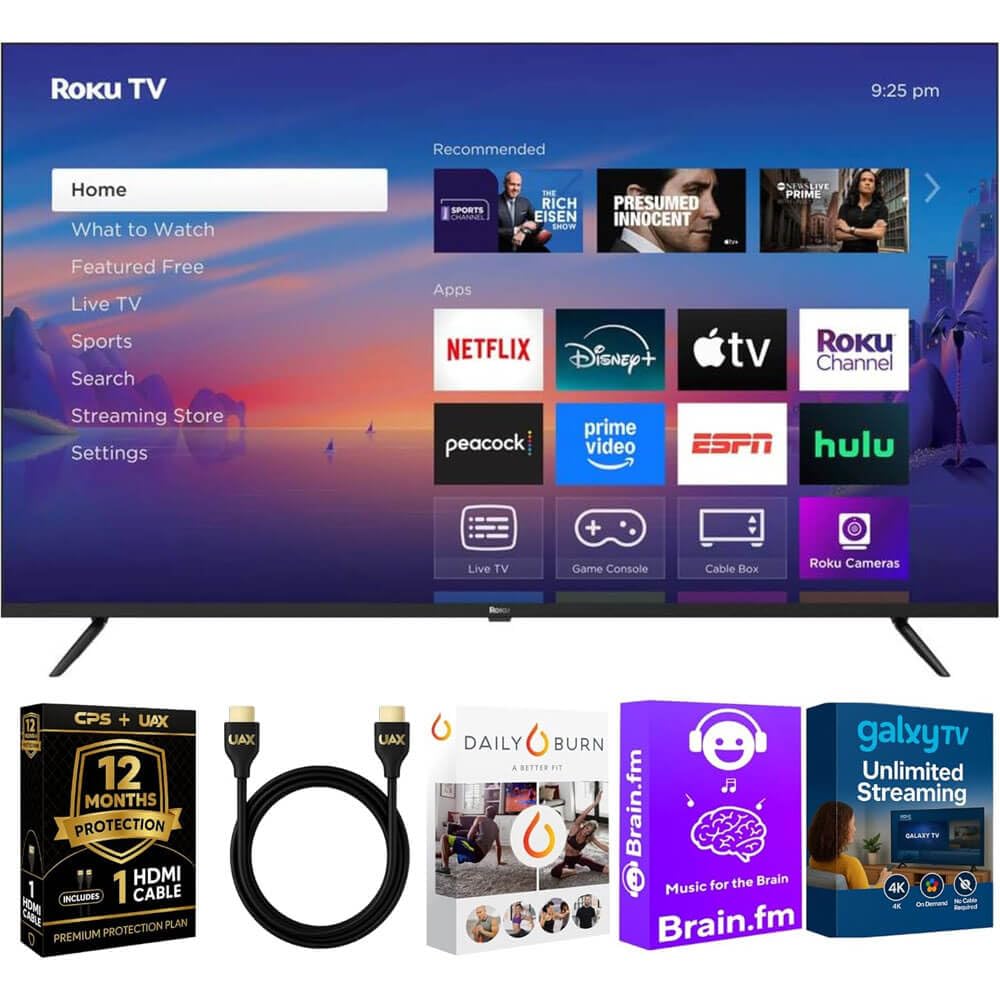
This bundle version of the Roku Select Series packages the TV with a 1-year CPS Protection Plan, HDMI cable, and screen cleaner. For a first-time large-screen buyer who values peace of mind, this bundled protection plan adds significant value. The core TV offers 4K UHD resolution with HDR10 support, providing a clear and colorful image for the size.
The Roku smart platform is incredibly easy to set up and use, with a responsive interface and quick access to thousands of channels. The 60Hz panel is adequate for movies and standard gaming, and the three HDMI ports provide solid connectivity. The self-luminous backlight technology is a bit misleading in the specs—this is an LED/LCD set, not OLED—but the picture is uniform and bright enough for any room. The built-in power cord is integrated into the back, which may confuse users during setup who are looking for a separate cable.
The main limitation is the picture quality, which some users find to be subpar compared to premium QLED models, with occasional softness or blurriness on certain content. This is a solid entry-level 75-inch TV for the pure streaming experience, and the bundled protection plan makes it a worry-free purchase for those on a tighter budget.
Why it’s great
- Includes a 1-year CPS Protection Plan for peace of mind.
- Simple, fast Roku interface is great for non-tech-savvy users.
- Good brightness for a standard 4K UHD panel.
Good to know
- 60Hz panel limits gaming performance.
- Picture quality is average; not as sharp as QLED models.
- Only 3 HDMI inputs; fewer than most competitors at this size.
13. VIZIO V-Series (V755-J04)

The VIZIO V-Series is the most accessible entry point into the 75-inch format. Its Full Array backlight provides superior light uniformity compared to edge-lit alternatives, ensuring that the screen’s large surface area is evenly lit. The 4K resolution with Dolby Vision Bright Mode and HDR10+ support delivers a solid HDR experience, with vibrant colors and decent black detail. The IQ Active Processor does a respectable job of upscaling HD content to fill the 4K grid.
Active Pixel Tuning adjusts contrast in over 2000 zones frame by frame, improving visual depth. The SmartCast platform provides access to major streaming apps and includes built-in Chromecast and Apple AirPlay for easy mobile casting. Bluetooth headphone support via the VIZIO mobile app is a useful feature for late-night viewing. The sound is decent but lacks bass, and a soundbar is a recommended addition.
The remote lacks a dedicated voice button, which is a minor inconvenience. Some users have reported occasional WiFi disconnection that requires a reboot. For the absolute lowest barrier to entry for a 75-inch screen with modern features like Dolby Vision and a Full Array backlight, the VIZIO V-Series offers remarkable screen real estate per dollar, but it is the most compromised option on this list in terms of processing power and gaming features.
Why it’s great
- Full Array backlight ensures good uniformity for the low price.
- Dolby Vision Bright Mode provides a decent HDR image.
- Lowest-cost option to get a 75-inch screen.
Good to know
- Sound is thin and lacks bass; a soundbar is needed.
- Remote has no voice control button.
- Occasional WiFi connectivity issues reported by some users.
FAQ
How much peak brightness do I need for good HDR on a 75-inch TV?
Is it better to buy a 75-inch QLED TV or a smaller OLED TV for the same price?
Does a 144Hz refresh rate matter if I only watch movies and sports?
Final Thoughts: The Verdict
For most users, the best 75 inch tv value winner is the TCL T7 Series because it combines a native 144Hz panel, vibrant QLED colors, and a comprehensive Google TV platform at a price that undercuts many competitors with fewer features. If you want the best AI upscaling and refined Mini-LED contrast, grab the Samsung Neo QLED QN70F. And for the purist seeking a cinematic reference image with the best picture processing on the market, nothing beats the Sony BRAVIA 5.

Mo Maruf
I created WellFizz to bridge the gap between vague wellness advice and actionable solutions. My mission is simple: to decode the research and give you practical tools you can actually use.
Beyond the data, I am a passionate traveler. I believe that stepping away from the screen to explore new environments is essential for mental clarity and physical vitality.