Our readers keep the lights on and my smoothie glass nicely filled. As an Amazon Associate, I earn from qualifying purchases.
Walking into a home theater that lacks depth — where sounds blend into a flat wall of noise — feels like a compromise that defeats the purpose of the build. A 7.2 receiver cracks that problem at its foundation by dedicating seven amplifier channels to precise speaker placement and two subwoofer outputs for balanced, room-filling low-end pressure that the 5.1 standard simply cannot deliver.
I’m Mohammad Maruf — the founder and writer behind WellFizz. My work centers on deep market analysis of audio hardware, decoding spec sheets, customer reliability data, and real-world performance patterns so you can filter marketing noise from the signal that matters.
After evaluating amplifier wattage, HDMI 2.1 bandwidth, room calibration accuracy, and multi-channel discrete power delivery across the entire price spectrum, the best path forward for most buyers is the 7.2 receiver that matches their speaker layout without overheating or dropping frames at 4K/120Hz.
How To Choose The Best 7.2 Receiver
The right 7.2 receiver hinges on three intersecting variables: the power your speakers need, the video bandwidth your display demands, and the room calibration system that tailors sound to your actual listening space. Ignore any one of these and your home theater underperforms.
Amplifier Power and Channel Integrity
Look at real-world wattage across all seven channels driven simultaneously — not just the spec-sheet peak for one channel. A receiver that claims in the manual but drops to half that when all channels work together will leave your center channel thin during loud action scenes. Also verify whether the unit allows discrete 7-channel output or forces you into a 5.1 setup plus Zone 2 when you want to bi-amp.
HDMI 2.1 and Gaming Features
If your setup includes a PlayStation 5, Xbox Series X, or a PC with a 40-series GPU, the receiver must support 40 Gbps HDMI 2.1 with VRR, ALLM, and QFT. Early 2021 units had known chipset bugs on the Panasonic board that caused black screens at 4K/120Hz — steer toward 2022 and newer revisions or confirmed fixed firmware.
Room Calibration Quality
Audyssey MultEQ XT32 (Denon/Marantz), YPAO R.S.C. with 3D (Yamaha AVENTAGE), and Sony’s Digital Cinema Auto Calibration IX each handle subwoofer integration and boundary gain differently. The best system for your room depends on whether you have symmetrical seating or an open floor plan. Most budget receivers strip out the full-bandwidth version of these calibration suites.
Quick Comparison
On smaller screens, swipe sideways to see the full table.
| Model | Category | Best For | Key Spec | Amazon |
|---|---|---|---|---|
| Pioneer VSX-935 | Mid-Range | Budget Atmos upgrade | 80W per channel | Amazon |
| Onkyo TX-NR6100 | Mid-Range | THX certified build | 210W per channel (1ch) | Amazon |
| Onkyo TX-NR5100 | Mid-Range | Gaming VRR/ALLM | 80W per channel | Amazon |
| Denon AVR-S770H | Mid-Range | All-around value | 75W per channel | Amazon |
| Denon AVR-S970H | Mid-Range | Phono input turntable | 90W per channel | Amazon |
| Yamaha RX-A2A | Premium | Surround:AI processing | 100W per channel | Amazon |
| Sony STR-AN1000 | Premium | 360 Spatial Sound Mapping | 165W per channel (6 ohms) | Amazon |
| JBL MA7100HP | Premium | Class D efficiency | 125W per channel | Amazon |
| Yamaha RX-A4A | Premium | High-end pre-outs | 110W per channel | Amazon |
| Sony STR-AZ1000ES | Premium | Custom integration | 100W per channel (8 ohms) | Amazon |
| Marantz Cinema 60 | Premium | HDAM circuit fidelity | 100W per channel | Amazon |
In‑Depth Reviews
1. Sony STR-AN1000 7.2 CH Surround Sound Home Theater 8K A/V Receiver

The Sony STR-AN1000 delivers a rare combination: a 7.2 channel amp with 165W per channel into 6 ohms plus Sony’s proprietary 360 Spatial Sound Mapping that synthesizes height channels so convincingly it often fools listeners into thinking ceiling speakers are present. The calibration algorithm measures nine points in the room to build a 3D sound map, making dialogue anchor precisely to the screen center even in asymmetrical layouts.
HDMI 2.1 support across all six inputs means you can wire a PS5, Xbox Series X, and a 4K/120Hz streaming device simultaneously without HDMI switch juggling. The unit includes eARC, VRR, and ALLM for tear-free gaming. The only gap is the lack of a phono input — vinyl enthusiasts will need an external preamp.
The on-screen graphical setup walks through speaker configuration step by step, and the front panel display, while compact, shows input and volume clearly. Pairing a pair of Sony SA-SW3 subwoofers yields smooth omnidirectional bass that fills a 15-by-20-foot room without hot spots.
Why it’s great
- 360 Spatial Sound Mapping creates immersive height effects without ceiling speakers
- Six HDMI 2.1 inputs with eARC and full gaming feature set
- Easy graphical setup with excellent calibration accuracy
Good to know
- No phono input for turntable connectivity
- Known issue with Apple TV 4K Dolby Vision passthrough not fully supported
- Front display text is small and difficult to read from seating distance
2. Marantz Cinema 60 7.2-Ch Receiver (100W X 7)

The Marantz Cinema 60 brings the brand’s signature HDAM (Hyper Dynamic Amplifier Module) discrete circuitry into the 7.2 category, delivering 100W per channel with current feedback that yields a warmer, more musical tonal character than typical class AB designs. The Audyssey MultEQ XT32 room correction handles up to eight measurement positions, applying filters across 512 times the frequency resolution of standard MultEQ.
Three of the six HDMI inputs support 8K/60Hz or 4K/120Hz passthrough with QFT, QMS, VRR, and ALLM. The phono input lets you connect a turntable directly, and the HEOS multi-room platform streams from Tidal, Spotify, and Pandora without adding a separate streamer. Dolby Height Virtualization works in 7.1, 5.1, or 2.1 mode without height speakers.
Setup requires a sequential firmware update process — skipping steps causes some features to remain locked. Once fully updated, the HDMI Control function works reliably with modern TVs. The build quality and thermal management keep the chassis cool even during extended 4K HDR gaming sessions.
Why it’s great
- HDAM discrete circuitry produces richer, more detailed sound than typical receivers
- Audyssey MultEQ XT32 provides professional-grade room correction
- Phono input and HEOS multi-room streaming included
Good to know
- Firmware updates require sequential installation — not plug-and-play
- Premium price bracket limits accessibility for budget builders
- Zone 2 is digital only with no analog video output
3. Sony STRAZ1000ES Premium ES 7.2 CH 8K A/V Receiver

The Sony STR-AZ1000ES belongs to the ES series — a heritage line engineered for custom installation and long-term reliability with oversized power supply capacitors and a rigid chassis that minimizes vibration. Rated at 100W plus 100W into 8 ohms across two channels, it delivers clean headroom for medium-efficiency speakers without strain, and the 360 Spatial Sound Mapping technology is the same found in Sony’s flagship processors.
IP control integration works natively with Crestron, Control4, and Savant systems, so integrators can script macros without adding third-party drivers. The six HDMI 2.1 inputs handle 8K/60Hz and 4K/120Hz, though HDR10+ is notably absent, which limits compatibility with some Samsung and Panasonic displays. The calibration microphone stand is a welcome inclusion over the flimsy cardboard stands found in other brands.
Thermal output is significant — the unit runs hot even at moderate volume, and many owners add an AC Infinity Aircom T10 fan to the stack. The sound signature leans analytical and precise, rewarding well-mixed Dolby Atmos content with pinpoint channel separation.
Why it’s great
- ES series build quality with oversized power supply for long-term reliability
- Native IP control for professional custom integration systems
- 360 Spatial Sound Mapping creates convincing 7.1.4 effect from 5.1.2 layout
Good to know
- No HDR10+ support limits compatibility with specific TV brands
- Runs hot — active cooling is recommended for closed cabinets
- Lacks QMS and QFT for advanced video switching
4. Yamaha RX-A4A AVENTAGE 7.2-Channel AV Receiver

The Yamaha RX-A4A sits in the AVENTAGE series — the brand’s top-tier line featuring an anti-resonance bottom chassis, high-quality DACs, and Surround:AI processing that analyzes audio scenes in real time and adjusts surround parameters for dialogue clarity or explosive dynamics. The 110W per channel rating is conservative; the unit drives 4-ohm loads without thermal shutdown during extended movie marathons.
All seven HDMI inputs support 8K60 and 4K120 at 40 Gbps, with eARC, VRR, and ALLM. The pre-outs for front left and right channels let you add an external power amp later, and the phono input accepts moving magnet cartridges. YPAO R.S.C. with 3D and precision EQ measures at multiple points to correct for boundary gain and seating position.
Firmware updates require a USB flash drive — a tedious process compared to network updates found on most competitors. Once set, the unit is largely invisible: the MusicCast app handles streaming from Tidal, Qobuz, and Spotify without issues, and the on-screen display overlays volume without dimming the video signal.
Why it’s great
- Surround:AI dynamically optimizes sound for dialogue and effects in real time
- Pre-outs for front channels enable future power amp upgrades
- Anti-resonance chassis reduces mechanical noise and vibration
Good to know
- Firmware updates require USB flash drive — no direct network update
- Setup menus are dense and require reading the manual for full options
- Surround:AI can push voice too far to the center on older stereo content
5. Yamaha RX-A2A AVENTAGE 7.2-Channel AV Receiver

The Yamaha RX-A2A brings AVENTAGE-grade build quality — including an anti-resonance chassis and high-grade audio components — to a more accessible point in the lineup. Rated at 100W per channel, it comfortably drives 6-ohm speakers with Yamaha’s clean, neutral tonal balance that neither brightens nor darkens the source material. The Surround:AI technology analyzes scene content and adjusts surround processing in real time without forcing the user into manual tinkering.
Three of the seven HDMI inputs support 8K60 and 4K120 at 40 Gbps, while the other four handle 4K60. YPAO R.S.C. with multipoint measurement calibrates for seating position asymmetries and corrects for early reflections. The MusicCast ecosystem streams from Spotify, Tidal, Amazon Music HD, and Qobuz, and the receiver is Roon Tested for high-res audio libraries.
Some owners report an intermittent no-signal issue with Sony X90L TVs that resolves with a full power cycle — likely an HDMI handshake quirk rather than a hardware defect. The remote lacks a backlight, which is a minor frustration in dark theater rooms. At sale pricing, this unit competes directly with Denon’s S-series while offering better long-term reliability reports.
Why it’s great
- AVENTAGE chassis with anti-resonance design for reduced mechanical noise
- Surround:AI real-time optimization enhances immersion without manual tuning
- Roon Tested and MusicCast multi-room support for high-res streaming
Good to know
- Intermittent HDMI handshake issue with certain Sony TVs
- Remote is not backlit — difficult to use in dark rooms
- No analog video inputs for legacy equipment
6. Denon AVR-S970H 8K Ultra HD 7.2 Channel AV Receiver

The Denon AVR-S970H bridges the gap between entry-level and enthusiast with 90W per channel across seven channels, a built-in phono preamp for turntables, and HEOS multi-room streaming that works with Pandora, Spotify, and Tidal. The unit runs noticeably cooler than similarly priced Onkyo models — infrared thermometer readings show around 80°F chassis temperature versus 92°F on comparable competitors.
Three of the eight HDMI inputs handle 8K/60Hz and 4K/120Hz passthrough with VRR, ALLM, and QFT for gaming. The on-screen setup menu is intuitive and includes a step-by-step speaker configuration guide. Zone 2 uses the rear surround channels, which limits the main room to 5.2 when powering a second zone — a trade-off common to this price tier.
Audio quality is described by owners as warm and clear, with a noticeable improvement in soundstage width compared to the previous AVR-S750H generation. The phono stage is adequate for entry-level moving magnet cartridges, though serious vinyl enthusiasts will still benefit from an external preamp.
Why it’s great
- 90W per channel with excellent thermal management — runs cooler than many competitors
- Built-in phono preamp for direct turntable connection
- HEOS multi-room streaming and intuitive on-screen setup
Good to know
- Zone 2 uses rear channels, limiting main room to 5.2
- No physical manual included — setup relies on on-screen guide
- Remote lacks fully programmable TV power button
7. Denon AVR-S770H 7.2 Ch Home Theater Receiver

The Denon AVR-S770H delivers an honest 75W per channel that translates to clean, undistorted output with 8-ohm speakers and surprisingly commanding bass from 6-ohm towers. The inclusion of Dolby Height Virtualization and DTS Virtual:X means you get atmospheric overhead effects from a standard 5.1 or 7.1 layout without installing ceiling speakers — a practical solution for renters or finished basements.
HDMI 2.1 support covers 8K/60Hz and 4K/120Hz with VRR, ALLM, and QFT for current-gen consoles. The HEOS platform enables multi-room audio using Denon Home speakers as wireless surrounds or standalone zones. Some firmware versions introduced random volume drops to near zero — Denon has addressed this through updates, but users should ensure their unit ships with the latest firmware.
Owners frequently report that the sound quality exceeds expectations for the class, with one reviewer noting it outperformed their previous higher-priced systems. The remote takes some time to learn, and the on-screen menus for advanced settings are dense, but the core setup — plug speakers, run Audyssey, enjoy — is straightforward.
Why it’s great
- Dolby Height Virtualization creates convincing overhead effects without ceiling speakers
- HEOS multi-room streaming and full HDMI 2.1 gaming feature set
- Warm, musical sound signature that outperforms its wattage rating
Good to know
- Known firmware bug caused random volume drops — check for latest update
- Complex advanced menu requires patience to navigate
- Zone 2 only works in 5.1+Zone2 mode, not full 7.2
8. JBL MA7100HP 7.2 Channel (125 Watt x 7) 8K High Performance AV Receiver
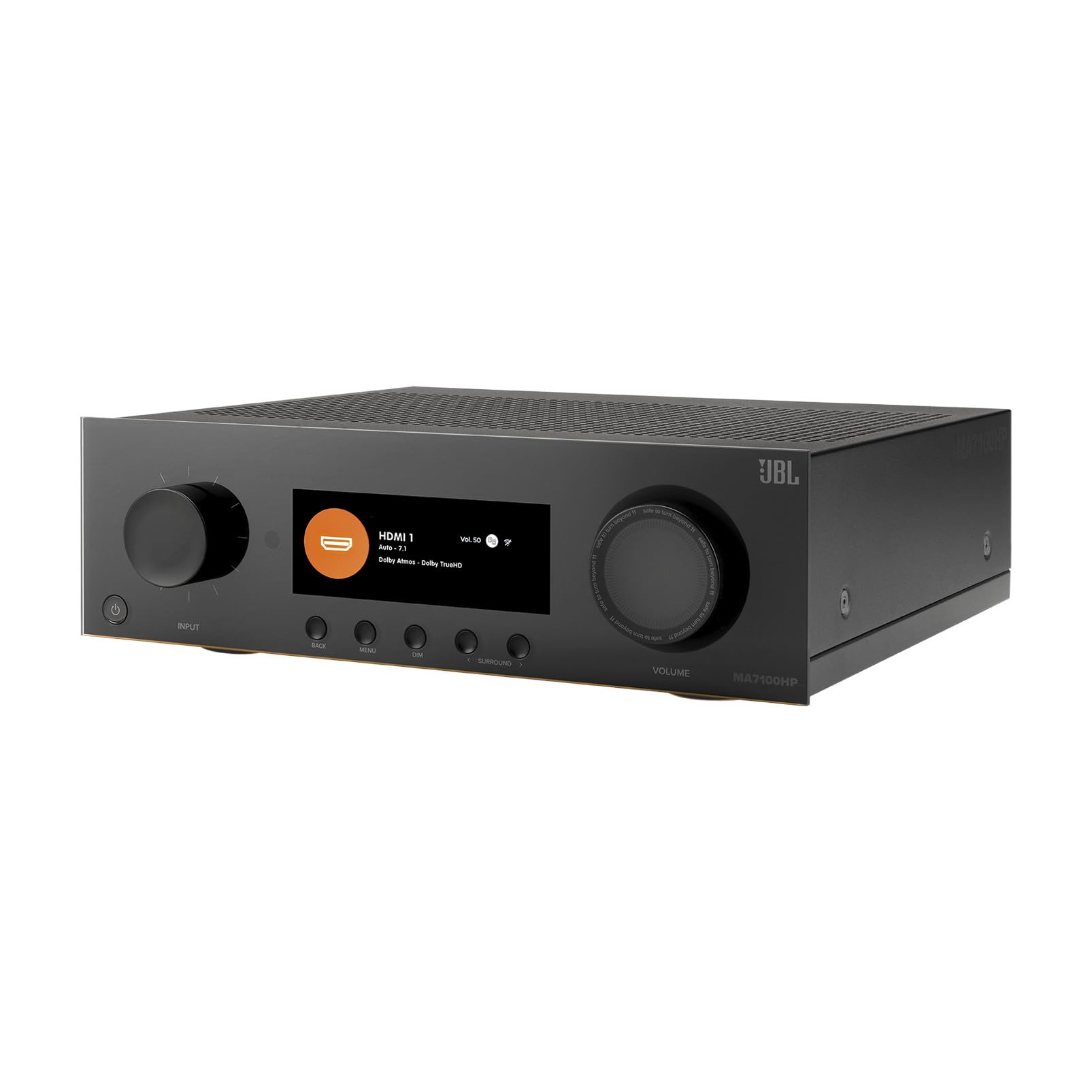
The JBL MA7100HP brings Class D amplification to the 7.2 category, delivering 125W per channel with the efficiency that keeps the chassis shallow enough to fit into standard AV racks without overheating. The high damping factor from the Class D design gives it tight control over woofer excursion, resulting in punchy bass response even with 4-ohm loads that would cause budget Class AB receivers to sag.
Six HDMI inputs and two outputs include eARC and support for Dolby Atmos and DTS:X in either 7.1 or 5.1.2 configurations. The unit lacks analog video inputs, making it unsuitable for converting legacy composite or component sources. The auto shut-off defaults to 20 minutes of inactivity — a setting that must be changed manually to avoid mid-movie silence.
The remote is not backlit, and owners have resorted to gluing a tactile dot on the volume button for dark-room navigation. JBL has not released a firmware update in the past year, and the unit does not properly downmix DTS-HD Master Audio to 2.1, which could be a dealbreaker for two-channel setups with a subwoofer.
Why it’s great
- 125W Class D amplification with high damping factor for tight bass control
- Shallow chassis design fits easily into standard AV racks
- Dolby Atmos and DTS:X support with eARC for 8K passthrough
Good to know
- Does not properly downmix DTS-HD Master Audio to 2.1
- Remote has no backlight — requires tactile modifications for dark use
- Firmware updates are infrequent; auto shut-off default is 20 minutes
9. Onkyo TX-NR6100 7.2 Channel THX Certified Network AV Receiver
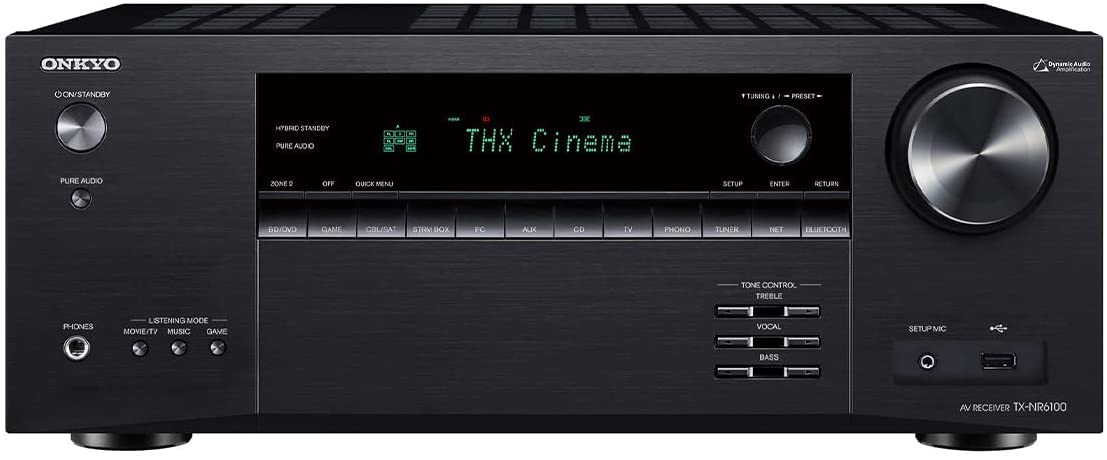
The Onkyo TX-NR6100 carries THX Select certification, meaning it meets stringent distortion and output standards for rooms up to 2,000 cubic feet — a real-world guarantee that most receivers at this tier lack. The 210W per channel rating (single-channel driven) translates to clean headroom even with low-sensitivity speakers like the average bookshelf monitor, though you should expect a 60-70W rating when all seven channels are driven simultaneously.
Three HDMI 2.1 inputs at 40 Gbps support 8K/60Hz and 4K/120Hz, plus VRR and ALLM for gaming. The unit includes discrete Zone 2 audio and video, saving you from running a separate HDMI cable to a second display. The Onkyo Controller app allows per-zone customization of sound modes, which is handy for situations where you want stereo in the backyard and Atmos in the main room.
Several owners report that the HDMI 2.1 functionality degraded over two years, eventually losing the ability to pass 4K/120Hz from an Xbox Series X. The fan is audibly louder than competitors, producing an audible click when the thermal sensor cycles it on during extended listening sessions. The remote is not backlit and feels flimsy compared to the chassis build.
Why it’s great
- THX Select certification ensures reliable performance for medium-sized rooms
- Discrete Zone 2 audio and video with per-zone customization via app
- Excellent channel separation and clarity with DTS:X and IMAX Enhanced support
Good to know
- HDMI 2.1 4K/120Hz functionality may degrade over time
- Audible fan noise and mechanical click during operation
- Non-backlit remote with a cheap plastic feel
10. Pioneer VSX-935 7.2 Channel Surround Sound Network Receiver
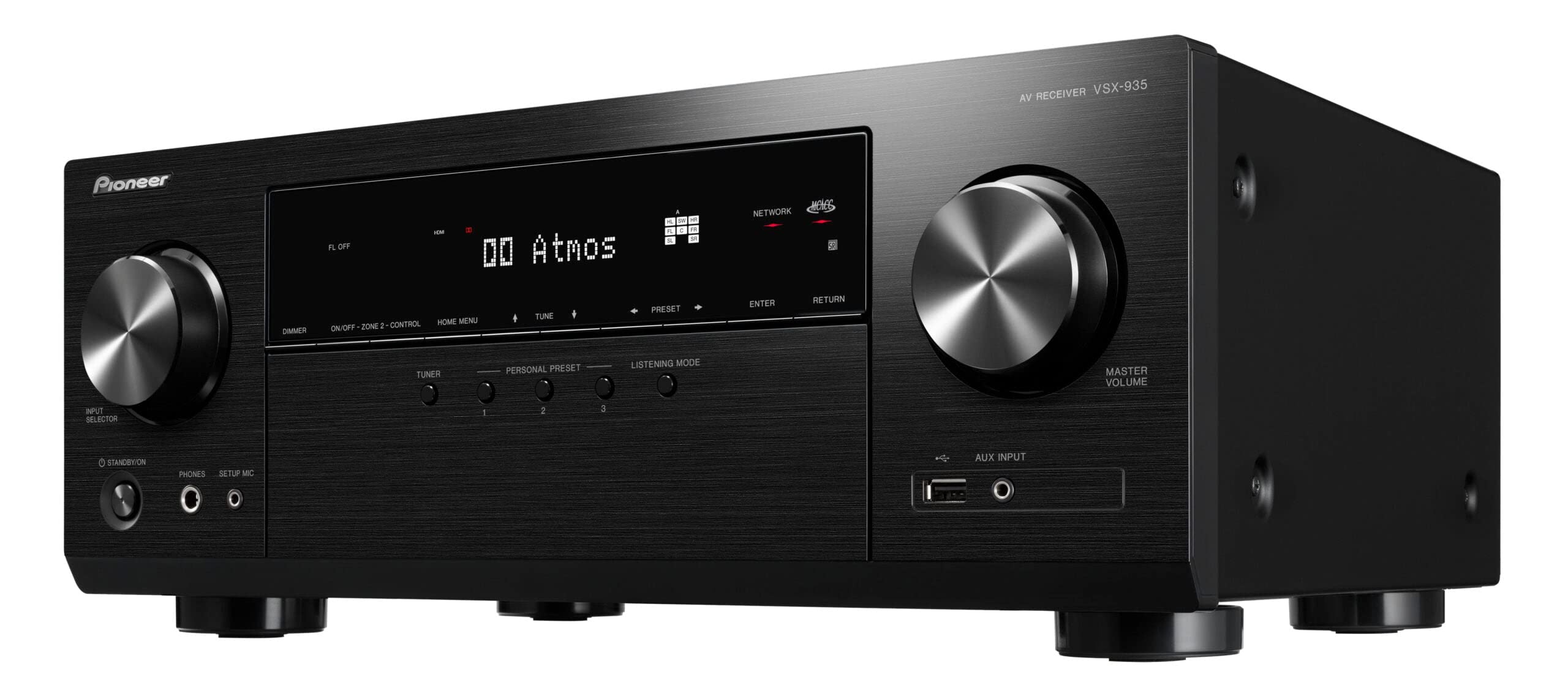
The Pioneer VSX-935 offers a genuine 7.2 channel layout with Dolby Atmos Height Virtualization at an accessible entry point — creating virtual height effects from a standard 5.1 or 7.1 configuration without adding ceiling speakers. The amplification is rated at 80W per channel (1 kHz, 1% THD, 8 ohms, 2 channels driven), which is modest but adequate for bookshelf speakers with sensitivity above 88 dB in small to medium rooms.
HDMI 2.1 is present with 8K passthrough and enhanced gaming features including VRR and ALLM. The receiver integrates with streaming music services via built-in Wi-Fi and supports DSD128 playback over the network. The RF remote is responsive and the front display is clear with a dimmer option for dark environments.
Bluetooth implementation is a weak point — the two-way Bluetooth is unreliable and buried in confusing menu layers with no dedicated button for quick access. Some units ship with display failures or require toggling unused settings to produce sound. The interface looks dated compared to the competition, and the firmware lacks advanced EQ or video processing controls.
Why it’s great
- Dolby Atmos Height Virtualization without ceiling speakers
- HDMI 2.1 with 8K passthrough and VRR for gaming
- RF remote with clear display and dimmer control
Good to know
- Bluetooth connectivity is unreliable and buried in menus
- Early units may have display or audio output defects
- No advanced EQ, compression, or video processing features
11. Onkyo TX–NR5100 7.2-Channel 8K Smart AV Receiver

The Onkyo TX-NR5100 targets gamers first with full HDMI 2.1 support including 4K/120Hz passthrough, Variable Refresh Rate, Auto Low Latency Mode, and Quick Frame Transport — all the features necessary for tear-free, low-lag console gaming. The 80W per channel rating is comparable to other entry-level 7.2 units, and the sound quality is described as clean with good channel separation for the price point.
The on-screen menu is easy to navigate, and the remote is simpler and more ergonomic than previous Onkyo designs. The speaker connections are odd — twist terminals on the front two channels and spring-loaded clips on the rest — which requires a mix of connection methods depending on which speakers you wire. The display is larger than the NR6100, making it easier to read from a distance.
Reliability is a serious concern: multiple owners report the unit failing within 18-24 months with no output to TV or connected devices. The unit is advertised as a 7.2 but physically includes only a single subwoofer pre-out, making it functionally a 7.1 receiver. Bluetooth has sync issues with low-latency headphones, and Airplay interferes with Bluetooth connectivity on Macs.
Why it’s great
- Full HDMI 2.1 gaming features at an entry-level price point
- Clean sound with good channel separation for movies and music
- User-friendly on-screen setup menu and larger display
Good to know
- Advertised as 7.2 but has only one subwoofer output — functionally a 7.1
- High failure rate within 18-24 months reported by multiple owners
- Speaker connections mix twist and spring-clip types inconsistently
FAQ
Can I use a 7.2 receiver with only 5 speakers?
Do I need ceiling speakers for Dolby Atmos on a 7.2 receiver?
Does the 7.2 receiver support two subwoofers for better bass?
Why does my 7.2 receiver show 7.1 in the setup menu?
How hot is too hot for a 7.2 receiver?
Final Thoughts: The Verdict
For most users, the 7.2 receiver winner is the Sony STR-AN1000 because it combines the most convincing virtual height processing with genuinely useful HDMI 2.1 connectivity and a room calibration system that transforms an average listening space. If you want a phono input and HDAM circuit fidelity for music-first listening, grab the Marantz Cinema 60. And for a commercial integration grade receiver with IP control and bulletproof ES build quality, nothing beats the Sony STR-AZ1000ES.

Mo Maruf
I created WellFizz to bridge the gap between vague wellness advice and actionable solutions. My mission is simple: to decode the research and give you practical tools you can actually use.
Beyond the data, I am a passionate traveler. I believe that stepping away from the screen to explore new environments is essential for mental clarity and physical vitality.