Our readers keep the lights on and my smoothie glass nicely filled. As an Amazon Associate, I earn from qualifying purchases.
Building a 7.1-channel home theater is a commitment to sonic accuracy, and the receiver you choose dictates whether every explosion, whisper, and score lands with the intended weight. A 7.1 receiver anchors a system with seven amplified channels and a dedicated subwoofer output—getting this wrong means muddy dialogue, hollow action scenes, or constant HDMI handshake headaches that no firmware update can fix.
I’m Mohammad Maruf — the founder and writer behind WellFizz. I’ve spent hundreds of hours analyzing circuit topologies, HDMI 2.1 compliance tables, and real-world calibration data to separate the receivers that deliver their rated power cleanly from the ones that overheat, glitch, or fall silent mid-movie.
After cross-referencing specs across eleven models ranging from mid-range workhorses to premium ES-series builds, this deep-dive guide identifies the best 7.1 receiver for your room size, speaker sensitivity, and gaming or cinema priorities.
How To Choose The Best 7.1 Receiver
A 7.1 receiver must handle seven channels of amplification, video switching, and room correction simultaneously. Focus on these four dimensions rather than brand loyalty or cosmetic features.
Power Output and Impedance Stability
Check the FTC-rated power per channel at 8 ohms with all seven channels driven, not just the two-channel figure manufacturers advertise in bold. A receiver that delivers 75W×7 cleanly will outperform a unit that claims 110W×2 but drops to 55W×7 under load. If your front speakers dip to 4 ohms, look for models with robust power supplies and heatsinks—units like the Denon AVR-S970H and Marantz Cinema 60 handle low-impedance loads without thermal shutdown.
HDMI 2.1 Bandwidth and Gaming Features
HDMI 2.1 inputs should support 40Gbps or 48Gbps data rates to pass 4K/120Hz or 8K/60Hz without chroma subsampling. Verify that Variable Refresh Rate (VRR) and Auto Low Latency Mode (ALLM) are active at the hardware level—some early receivers shipped with HDMI 2.1 chips that failed on these features and required hardware revisions. The Onkyo TX-NR6100 and Yamaha RX-V6A offer full HDMI 2.1 functionality for PS5 and Xbox Series X.
Room Correction and Calibration Depth
Room correction software is not a marketing gimmick; it measurably tames room modes and improves dialogue clarity. Audyssey MultEQ XT32 (found on Marantz Cinema 60) measures eight positions and applies high-resolution filters to each channel. YPAO R.S.C. with multipoint on the Yamaha RX-A2A accounts for reflection control, while Sony’s 360 Spatial Sound Mapping creates phantom height channels from physical speaker positions. Budget receivers often use basic EQ that only sets distance and level—skip those if your room has irregular walls or a subwoofer placed in a corner.
Physical Connectivity and Zone Flexibility
Count your source devices and subwoofer outputs. A true 7.1 receiver needs at least six HDMI inputs and dual subwoofer pre-outs for even bass distribution. If you plan to power speakers in a second room, look for a dedicated Zone 2 amplifier section that operates independently from the main 7.1 channels—some units, like the Denon AVR-S970H, borrow rear surround channels for Zone 2, reducing your main setup to 5.1.
Quick Comparison
On smaller screens, swipe sideways to see the full table.
| Model | Category | Best For | Key Spec | Amazon |
|---|---|---|---|---|
| Marantz Cinema 60 | Premium | Audiophile music & cinema | HDAM circuitry + Audyssey XT32 | Amazon |
| Sony STR-AZ1000ES | Premium | 360 Spatial Sound & custom integration | 100W×2 8Ω + 360SSM | Amazon |
| Denon AVR-S970H | Mid-Range | 8K gaming & HEOS multi-room | 90W×7 8Ω + 3× 8K inputs | Amazon |
| Yamaha RX-A2A | Mid-Range | Aventage build & natural tone | Surround:AI + YPAO R.S.C. | Amazon |
| Denon AVR-S770H | Mid-Range | Entry-level 8K with Dolby Height Virtualization | 75W×7 8Ω + HEOS | Amazon |
| JBL MA7100HP | Mid-Range | High-power Class D efficiency | 125W×7 Class D + 8K | Amazon |
| Onkyo TX-NR6100 | Mid-Range | THX Select gaming & 5.1.2 Atmos | THX Select + 210W/ch dynamic | Amazon |
| JBL MA710 | Mid-Range | Phono input & shallow cabinet | 110W×7 + moving magnet phono | Amazon |
| Sony STR-AN1000 | Mid-Range | Sony TV integration & DCAC IX | 165W×1 6Ω + Chromecast built-in | Amazon |
| Pioneer VSX-935 | Budget | Dolby Atmos Height Virtualization | HDMI 2.1 8K + Bluetooth | Amazon |
| Yamaha RX-V6A | Budget | Reliable 7.2 with MusicCast | 7× HDMI 2.1 + YPAO | Amazon |
In‑Depth Reviews
1. Marantz Cinema 60

The Cinema 60 sits at the top of this list because its HDAM (Hyper Dynamic Amplifier Module) discrete circuitry and current feedback topology deliver a warm, detailed soundstage that flatters both movies and two-channel music. Rated at 100W×7 into 8 ohms, it drives demanding 4-ohm loads without audible strain, and the Audyssey MultEQ XT32 room correction measures eight positions for precise filter resolution—something budget units cannot match.
HDMI connectivity includes three 8K/60Hz inputs with 40Gbps bandwidth, supporting Dolby Vision, HDR10+, VRR, ALLM, and QMS for next-gen gaming. The phono input handles moving magnet turntables directly, and the HEOS multi-room platform streams from Spotify, TIDAL, and Amazon Music HD without additional hardware. Owners consistently praise the clear dialogue and musicality, noting that the remote design feels premium rather than an afterthought.
Setup requires sequential firmware updates, and the unit runs warm under sustained loads, but the speaker timing and phase correction create an immersive bubble that justifies the premium tier. For anyone building a dedicated cinema room or high-fidelity music system, this is the anchor component.
Why it’s great
- HDAM discrete circuitry produces exceptionally musical, detailed sound far beyond typical receiver DAC stages.
- Audyssey MultEQ XT32 corrects room modes with eight measurement positions for accurate bass and smooth crossover integration.
- Phono input and HEOS streaming cover vinyl and digital sources without extra boxes.
Good to know
- Firmware updates must be applied sequentially; the process can take over an hour if the unit ships with old software.
- Running all seven channels at high volume for extended periods generates noticeable heat; adequate ventilation is mandatory.
2. Sony STR-AZ1000ES

The Sony STR-AZ1000ES brings the ES-series build philosophy—heavier power supply, reinforced chassis, and custom integration features—to a 7.2-channel package. Rated at 100W×2 into 8 ohms (1kHz, 0.9% THD), its real-party trick is 360 Spatial Sound Mapping, which analyzes physical speaker positions and creates phantom height and surround channels that make a 5.1.2 setup sound like a 7.1.4 array. Proprietary Digital Cinema Auto Calibration IX measures and corrects frequency response and speaker distances with a level of precision that rivals dedicated room-correction hardware.
HDMI 2.1 connectivity includes 6-in/2-out with 8K/60Hz and 4K/120Hz passthrough, Dolby Vision, HDR10, HLG, and IMAX Enhanced. The unit integrates with Sonos via a Port, supports Chromecast, AirPlay 2, and Spotify Connect, and includes Google Assistant for voice control. Owners upgrading from older Sony AVRs report a significant jump in voice clarity and dynamic headroom, with the front-cover plate and backlit remote adding to the polished feel.
The unit runs hot in normal operation—an external fan is recommended for closed cabinets. It also lacks HDR10+ support and QMS, so early adopters of Samsung displays may miss that format. For custom installers or serious home theater enthusiasts who want Sony’s immersive spatial processing, the AZ1000ES is a precision tool that outperforms its price bracket in sound imaging.
Why it’s great
- 360 Spatial Sound Mapping generates a convincing height layer from standard speaker positions, reducing the need for ceiling-mounted drivers.
- DCAC IX auto-calibration measures multiple points and corrects subwoofer distance errors that cheaper receivers miss.
- ES Series construction includes improved power supply filtering and a rigid chassis for cleaner amplification at high levels.
Good to know
- No HDR10+ passthrough; Samsung TV owners should check their HDR format compatibility before buying.
- High operating temperature requires a cooling solution (e.g., AC Infinity Aircom) if placed in an enclosed entertainment center.
3. Denon AVR-S970H

The Denon AVR-S970H delivers 90W×7 into 8 ohms with a robust power supply that runs cooler than its predecessor, making it a reliable workhorse for medium-sized rooms. It features three 8K/60Hz and one 4K/120Hz HDMI 2.1 inputs with full VRR, ALLM, QFT, and QMS support, so next-gen consoles connect without frame tearing. The built-in HEOS platform streams from Pandora, Spotify, TIDAL, and Amazon Music HD, and the phono input adds vinyl playback without an external preamp.
Denon’s setup assistant walks through speaker detection, distance measurement, and Audyssey MultEQ (standard version) calibration quickly. Owners note that eARC works flawlessly with LG and Sony TVs, and the onscreen graphical interface makes input renaming and speaker configuration far easier than the front-panel menus on older models. The unit also supports Dolby Atmos Height Virtualization and DTS Virtual:X, so a 5.1 setup gains phantom overhead effects without installing ceiling speakers.
Powered Zone 2 reduces the main zone to 5.1, and the remote lacks a programmable TV power button—minor trade-offs for the feature density at this tier. For buyers who want 8K gaming, HEOS multi-room, and solid amplifier section without jumping to flagship pricing, the S970H is the sweet spot.
Why it’s great
- 90W×7 delivers clean, dynamic headroom for most tower speakers in medium rooms, with thermal performance better than competitors at this price.
- Three 8K/60Hz inputs with full HDMI 2.1 gaming features cover multiple next-gen consoles and streaming devices simultaneously.
- Phono input and HEOS multi-room streaming eliminate the need for separate DACs or streamers for vinyl and digital libraries.
Good to know
- Powered Zone 2 borrows the rear surround channels; a 7.1 main setup cannot run Zone 2 simultaneously without losing two channels.
- No physical manual included; all documentation is digital, which may frustrate users who prefer paper during initial setup.
4. Yamaha RX-A2A

The RX-A2A belongs to Yamaha’s Aventage line—a tier defined by a fifth center foot for vibration damping, a high-quality DAC section, and a three-year warranty. Its Surround:AI technology analyzes each scene in real time and adjusts channel balance, dynamics, and frequency response to optimize dialogue clarity during quiet moments and impact during explosions. The YPAO R.S.C. with multipoint measurement accounts for room reflections, resulting in a natural soundstage that avoids the harshness some automatic calibration systems introduce.
HDMI connectivity includes 7-in/1-out with three inputs supporting 8K60B and 4K120AB, plus eARC, Dolby Vision, HDR10+, and HLG. MusicCast handles multi-room streaming from Spotify, TIDAL, Amazon Music HD, and SiriusXM, and the phono input supports moving magnet turntables. Owners upgrading from older Yamaha units report a clean, powerful sound with excellent channel separation and a remote that feels intuitive without a steep learning curve.
Some units have exhibited intermittent HDMI signal loss with certain Sony TVs that requires a power cycle to restore, and the MSRP at launch was high relative to feature overlap with the RX-V6A. When found on sale, the RX-A2A represents a genuine build-quality upgrade for listeners who prioritize a neutral, fatigue-free tonal balance.
Why it’s great
- Surround:AI dynamically optimizes sound in real time based on scene content, making action sequences more impactful without pumping or distortion.
- Aventage construction adds a fifth anti-vibration foot, heavier chassis, and premium DAC components for lower noise floor and better stereo separation.
- YPAO R.S.C. with multipoint measurement corrects for early reflections, resulting in a clean, natural sound that avoids the clinical EQ curve of some competitors.
Good to know
- Intermittent HDMI handshake loss with certain Sony TVs requires a full power cycle to restore picture.
- Priced at MSRP, it overlaps significantly with the RX-V6A; value improves dramatically when purchased on sale or refurbished.
5. Denon AVR-S770H

The Denon AVR-S770H packs 75W×7 into an 8K-ready chassis that supports Dolby Atmos, DTS:X, Dolby Height Virtualization, and DTS Virtual:X. The 8K/60Hz and 4K/120Hz HDMI 2.1 inputs with VRR, ALLM, and QFT cover current and future gaming consoles, while the built-in HEOS platform streams from Pandora, Spotify, and TIDAL. For its tier, the sound quality punches above the spec sheet—owners coming from older budget receivers report noticeably warmer, more detailed playback.
Setup is straightforward via the onscreen assistant, and the Audyssey MultEQ (standard) handles level, distance, and basic EQ correction. The remote includes dedicated input selectors, and voice control via Alexa lets you adjust volume and switch sources hands-free. The unit also supports Bluetooth and AirPlay 2, so music streaming from any device is seamless.
A small number of units have experienced random volume drops or no-picture issues after firmware updates, though these appear isolated. The menu system can feel overwhelming for first-time AVR buyers due to the sheer number of audio and video processing options. For a clean entry point into 8K home theater with solid amplification and full HDMI 2.1 support, the S770H is a reliable choice.
Why it’s great
- Full HDMI 2.1 support with 8K/60Hz and 4K/120Hz passthrough, VRR, ALLM, and QFT for lag-free gaming.
- Dolby Height Virtualization creates convincing overhead effects from a 5.1 or 7.1 layout without height speakers installed.
- HEOS multi-room streaming, Bluetooth, and AirPlay 2 cover every wireless audio source without a separate streamer.
Good to know
- Isolated reports of firmware-related volume drops and intermittent no-signal issues; ensure the unit runs the latest update.
- Extensive menu system with many audio processing options may overwhelm buyers who prefer a simpler, more automated setup experience.
6. JBL MA7100HP
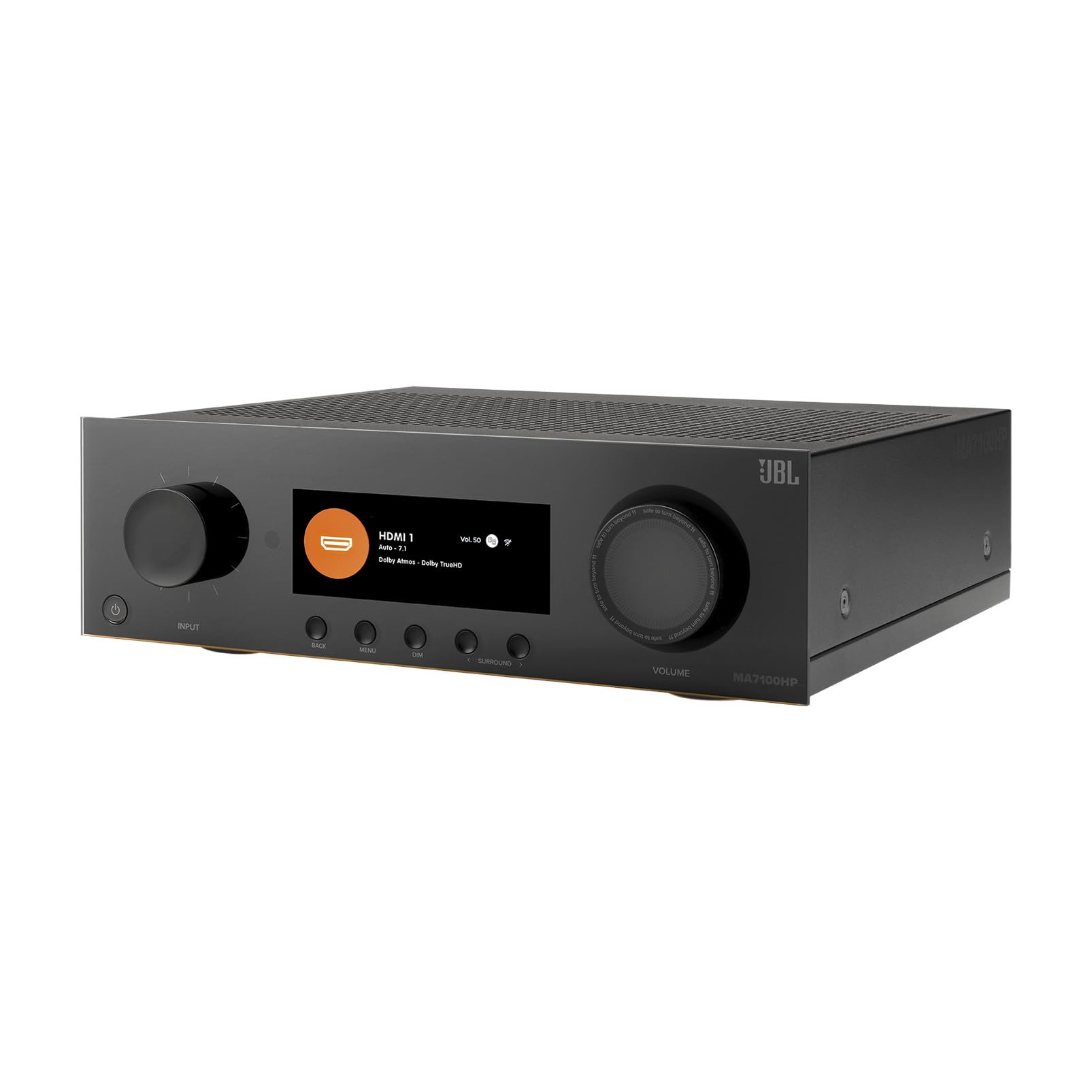
The JBL MA7100HP pushes 125W×7 via low-noise Class D amplification, making it one of the most powerful 7.1 receivers at this weight. Class D efficiency means it runs cooler than equivalent AB-class designs, and the 125W per channel into 8 ohms provides generous headroom for speakers that dip below 6 ohms. HDMI 2.1 connectivity includes 6-in/2-out with 8K/60Hz passthrough, eARC, Dolby Vision, and HDR10+ support.
Streaming options cover Bluetooth, Apple AirPlay 2, Google Chromecast, and Spotify Connect. The shallow cabinet depth (13.7 inches) fits media consoles that cannot accommodate the deeper chassis of traditional AVRs—a notable advantage for furniture-constrained setups. Owners driving Polk towers report effortless dynamics and a clean, detailed top end.
The remote is not backlit, which makes navigation in a dark theater room frustrating. Initial firmware updates required users to connect via a laptop for wireless configuration rather than completing setup entirely through the receiver display. For buyers who need high continuous power, 8K switching, and a compact footprint, the MA7100HP is a serious contender.
Why it’s great
- 125W×7 Class D amplification delivers high continuous power with lower heat output and better efficiency than traditional Class A/B designs.
- Shallow 13.7-inch chassis fits easily into standard media cabinets that cannot accommodate 15-inch-plus receiver depths.
- Apple AirPlay 2, Chromecast, and Spotify Connect provide three distinct wireless streaming pathways for users across iOS and Android ecosystems.
Good to know
- Remote lacks backlighting; users must resort to phone flashlight or tactile markers to navigate inputs in a dark theater room.
- Initial wireless setup may require a computer to configure network settings via a web interface rather than completing entirely on the receiver.
7. Onkyo TX-NR6100
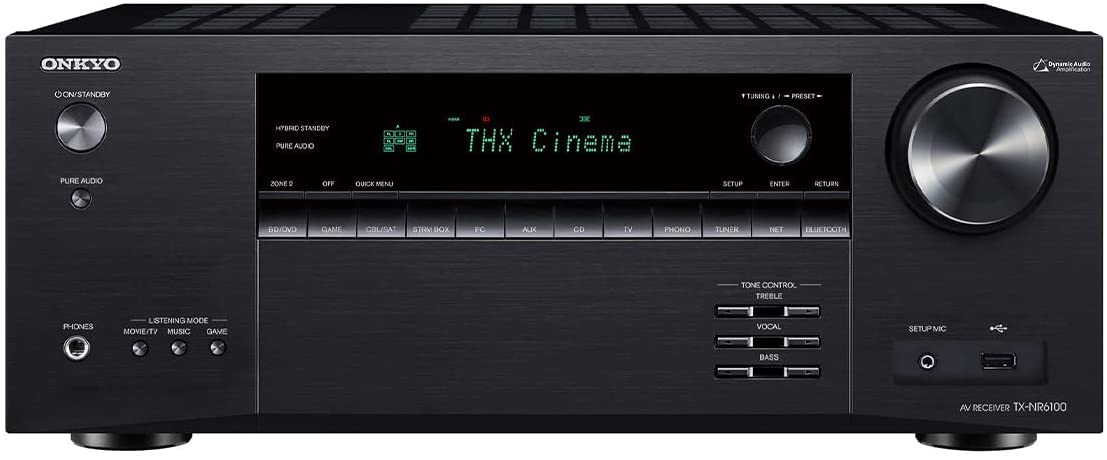
The Onkyo TX-NR6100 is THX Select certified, meaning its dynamic power output (rated 210W/ch) and distortion performance meet the rigorous standards for reference-level home theater playback in medium-sized rooms. It supports 5.2.2-channel Dolby Atmos and DTS:X, and the three HDMI 2.1 inputs operate at 40Gbps for full 4K/120Hz gaming on PS5 and Xbox Series X. Owners note that it runs louder and cleaner than similarly-priced Denon units when paired with Klipsch reference speakers.
The unit includes THX Spatial Audio, IMAX Enhanced certification, and discrete Zone 2 audio and video outputs. The onscreen interface is serviceable, and the Auto-Calibration system tunes levels and distances effectively—several users report excellent results with Klipsch and JBL speaker packages. The black finish and front-panel layout are understated and professional.
Some units have exhibited fan noise audible during quiet movie passages, and there are reports of HDMI 2.1 processor degradation over time causing 4K/120Hz dropout. The remote lacks backlighting and feels flimsy relative to the chassis. For PS5-first gamers who want THX guarantees and powerful amplification, the TX-NR6100 delivers raw performance at a competitive tier.
Why it’s great
- THX Select certification guarantees reference-level dynamic power, frequency response, and distortion specs for room sizes of approximately 2,000 cubic feet.
- Three dedicated 40Gbps HDMI 2.1 inputs ensure full 4K/120Hz VRR support for multiple gaming consoles without bandwidth compromise.
- IMAX Enhanced certification matches IMAX’s DCP master audio and video specifications for a theatrical experience in the home.
Good to know
- Fan noise can be audible during quiet scenes; placement outside the main listening axis or in a ventilated cabinet helps.
- Isolated reports of HDMI 2.1 processor failure after extended use causing 4K/120Hz dropout; warranty coverage is worth verifying.
8. JBL MA710

The JBL MA710 delivers 110W×7 of Class AB amplification with 8K/60Hz HDMI 2.1 switching, eARC, and a moving magnet phono input for direct turntable connection—an unusual and welcome inclusion at this tier. It supports Dolby Atmos and DTS:X up to 5.1.2, and streaming covers Apple AirPlay 2, Google Chromecast, and Bluetooth. The cabinet is noticeably shallower than competitors, fitting into consoles where depth is limited.
Owners driving Polk in-wall and tower setups report clean, balanced sound and easy integration with TV audio via HDMI ARC. The onscreen setup menu simplifies initial configuration, though initial firmware updates required a network-linked laptop for a small number of users. The phono stage performs admirably for the price, delivering quiet background floors and accurate channel imaging with moving magnet cartridges.
DTS-HD Master Audio does not downmix to 2.1 channels, which is a problem for two-channel-only setups using Blu-ray audio. The remote lacks backlighting, and the front panel has a bright glow that can be distracting near a projection screen in a dark room. For vinyl enthusiasts or those with constrained cabinetry, the MA710 offers a rare combination of phono support and 8K switching.
Why it’s great
- Built-in moving magnet phono input allows direct turntable connection without needing an external preamp, saving rack space and cost.
- Shallow cabinet depth (13.7 inches) fits media consoles and AV racks that cannot accept 15-17 inch deep receivers.
- 110W×7 Class AB amplification provides ample headroom for bookshelf and tower speakers in small to medium rooms.
Good to know
- DTS-HD Master Audio does not downmix to 2.1, making it unsuitable for stereo-only Blu-ray audio setups without additional processing.
- Remote is not backlit, and the front panel LED glow can be visually distracting in pitch-black theater environments.
9. Sony STR-AN1000

The Sony STR-AN1000 brings Digital Cinema Auto Calibration IX and 360 Spatial Sound Mapping to a mid-range 7.2-channel receiver priced to compete directly with Denon and Yamaha. Rated at 165W×1 into 6 ohms (1kHz, 0.9% THD), its amp section pairs well with the ELAC and Klipsch speakers owners commonly match. The DCAC IX auto-calibration measures speaker distances, levels, and frequency response with a guided onscreen wizard that Sony TV owners find particularly intuitive.
HDMI 2.1 connectivity includes 6-in/2-out with 8K/60Hz passthrough, Dolby Vision, HDR10, HLG, and IMAX Enhanced. Chromecast built-in, AirPlay 2, and Spotify Connect handle wireless streaming, and the “Works with Sonos” certification allows integration via a Sonos Port. The A.F.D. (Auto Format Direct) movie mode does a convincing job of simulating overhead effects in a 7.1 layout without height speakers.
The front display is small and difficult to read across the room, and the remote rarely shows the current sound field selection. Some users report that Apple TV 4K Dolby Vision passthrough fails intermittently—a known issue that Sony has addressed in firmware but may still affect specific source/display combinations. For Sony TV and projector owners seeking a cohesive brand ecosystem with excellent calibration tools, the STR-AN1000 is a well-matched partner.
Why it’s great
- Digital Cinema Auto Calibration IX walks through speaker configuration with a clear onscreen wizard that simplifies setup for non-professionals.
- 360 Spatial Sound Mapping and A.F.D. Movie mode create convincing surround immersion without requiring ceiling-mounted height speakers.
- Chromecast built-in and Sonos compatibility allow direct streaming from thousands of apps and integration with existing Sonos systems.
Good to know
- Apple TV 4K Dolby Vision passthrough can fail intermittently; users may need to toggle HDMI settings or apply firmware patches.
- Front panel display is small and placed low; the remote does not display the active sound field, making it hard to verify settings without the onscreen GUI.
10. Pioneer VSX-935
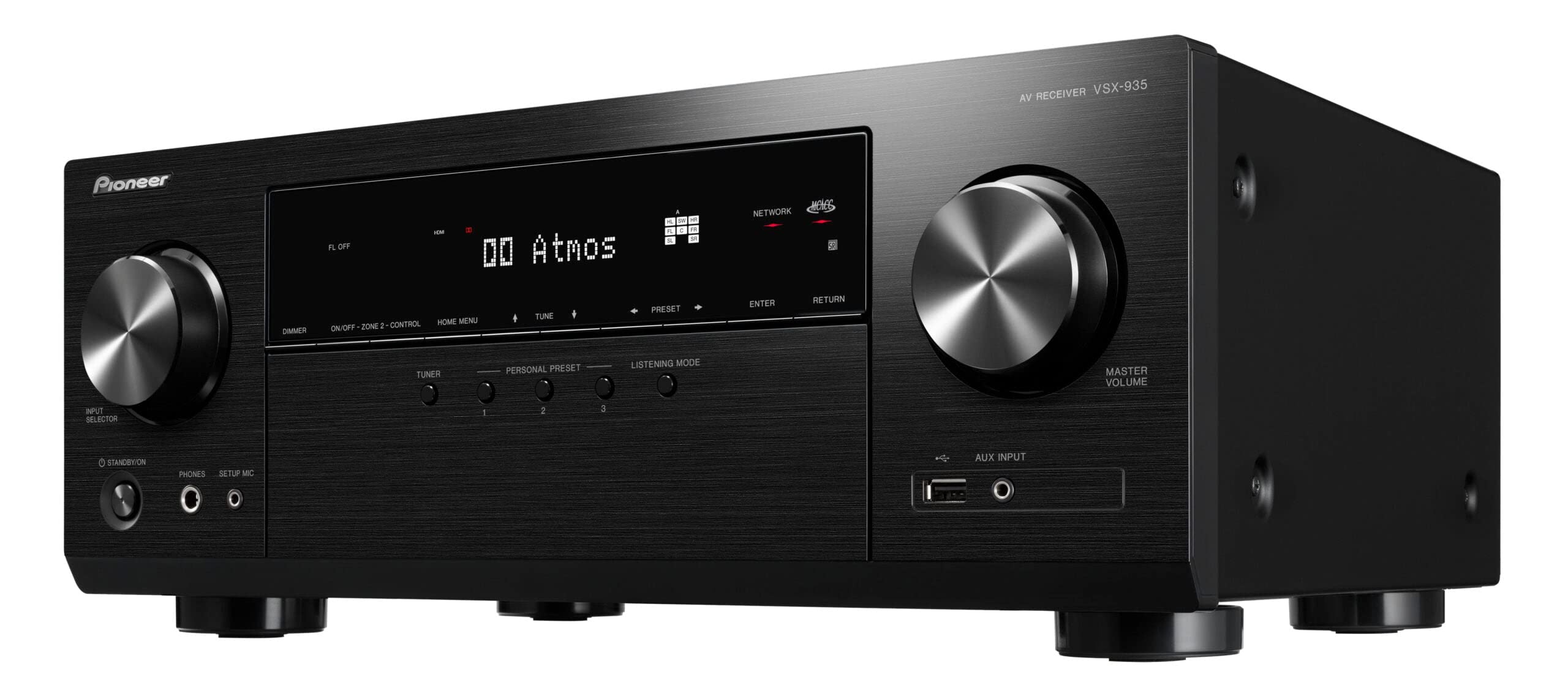
The Pioneer VSX-935 brings HDMI 2.1 with 8K/60Hz and 4K/120Hz to a budget-friendly chassis, making it one of the most affordable pathways to next-gen console compatibility. Its Dolby Atmos Height Virtualization creates a phantom height effect from standard speaker layouts, so owners can experience Atmos overhead cues without installing physical height speakers. The 7.2-channel amplifier section powers seven speakers and two subwoofers, and built-in Bluetooth handles streaming from phones and tablets.
Owners report crisp, clear audio with gradual volume ramping that avoids sudden loudness jumps. The RF remote works through cabinets, and the dual-zone output allows independent audio in a second room. The display is legible with a dimmer function for dark rooms.
The two-way Bluetooth feature is unreliable—users report difficulty pairing and find the interface for toggling Bluetooth input non-intuitive without a dedicated button. Some units have arrived DOA or experienced display failure, though the vendor replacement process was fast for affected buyers. For a low-cost entry into 8K switching and virtualized Atmos, the VSX-935 fills the gap but expects some firmware patience.
Why it’s great
- HDMI 2.1 with 8K/60Hz and 4K/120Hz passthrough provides modern gaming support at the lowest price point in this guide.
- Dolby Atmos Height Virtualization generates convincing overhead effects without installing extra height speakers, saving on installation costs.
- RF remote operates through closed cabinet doors, offering flexibility in furniture placement.
Good to know
- Two-way Bluetooth implementation is unreliable; pairing can be frustrating and the interface lacks a dedicated toggle button.
- Build quality includes some variance—DOA units and display failures have been reported, though replacements are handled efficiently.
11. Yamaha RX-V6A

The Yamaha RX-V6A is a 7.2-channel receiver that balances HDMI 2.1 bandwidth, MusicCast multi-room streaming, and straightforward setup at a price that attracts upgraders from older 5.1 systems. It features seven HDMI inputs (three supporting 8K60B and 4K120AB) with HDCP 2.3 and eARC, Dolby Atmos with Height Virtualization, DTS:X, YPAO room correction, and voice control via Alexa, Google Assistant, or Siri via AirPlay 2.
Owners commonly cite the 10-year expected lifespan of Yamaha receivers as a deciding factor, and the RX-V6A reinforces that reputation with reliable hardware and clean sound. Dialogue clarity in action scenes is noticeably improved over older models, and the MusicCast app streams from Pandora, Spotify, TIDAL, Deezer, and Amazon Music HD. The setup menu is simple enough for beginners but includes enough manual control for enthusiasts.
eARC implementation can be finicky with certain Sony Bravia TVs—the receiver may not auto-power on with the TV and sometimes fails to switch sound automatically. The learning curve for HDMI-CEC power sequencing is steep for less technical users. For a dependable mid-range receiver that supports modern gaming and streaming without unnecessary complexity, the RX-V6A is a safe, proven choice.
Why it’s great
- Seven HDMI inputs including three 8K60B/4K120AB ports provide ample connectivity for multiple gaming consoles, streaming devices, and cable boxes.
- MusicCast multi-room streaming covers major services and allows synchronized playback across up to 10 rooms using Yamaha speakers.
- Yamaha’s reputation for reliable hardware and consistent 10-year service life reduces the risk of premature failure common with some budget receivers.
Good to know
- eARC compatibility with Sony Bravia TVs can be inconsistent; auto-power-on and auto-input-switching may require manual intervention.
- HDMI-CEC power sequencing with external devices (Shield, TV, AVR) involves a learning curve and may require trial-and-error configuration.
FAQ
Can a 7.1 receiver drive 4-ohm speakers without overheating?
What is the real difference between Dolby Atmos Height Virtualization and physical height speakers?
Why does my 7.1 receiver sound different with Audyssey MultEQ XT32 versus YPAO R.S.C.?
Can I use Powered Zone 2 and still keep 7.1 surround sound in the main room?
Do I need an 8K-capable 7.1 receiver if my TV is only 4K?
Final Thoughts: The Verdict
For most users, the best 7.1 receiver winner is the Marantz Cinema 60 because its HDAM circuitry, Audyssey MultEQ XT32, and premium DAC section deliver a level of musicality and room correction that elevates both movies and stereo playback above any other unit in this guide. If you want 360 Spatial Sound Mapping and ES-series integration for a Sony-based theater, grab the Sony STR-AZ1000ES. And for the best blend of 8K gaming, HEOS streaming, and amplifier headroom at a mid-range tier, nothing beats the Denon AVR-S970H.

Mo Maruf
I created WellFizz to bridge the gap between vague wellness advice and actionable solutions. My mission is simple: to decode the research and give you practical tools you can actually use.
Beyond the data, I am a passionate traveler. I believe that stepping away from the screen to explore new environments is essential for mental clarity and physical vitality.