Our readers keep the lights on and my smoothie glass nicely filled. As an Amazon Associate, I earn from qualifying purchases.
You walk to the window, hold your phone to the sky, and still the call drops. That’s the reality of a weak home cellular signal — a daily frustration that impacts work calls, video streaming, and even basic texting. Unlike WiFi extenders that fix internet dead zones, a dedicated cellular amplifier grabs the faint signal from outside, amplifies it, and rebroadcasts it indoors so your phone stays connected without hunting for a bar.
I’m Mohammad Maruf — the founder and writer behind WellFizz. I’ve spent months analyzing FCC certification data, gain ratings, and coverage specs for dozens of home signal boosters to separate the models that genuinely deliver from those that just look good on paper.
Whether you live in a rural valley, work from a basement office, or just want reliable service in a metal-roofed home, this guide helps you pick the right best 5g signal booster for home based on your space, carrier, and outdoor signal strength.
How To Choose The Best 5G Signal Booster For Home
Choosing the right amplifier starts with measuring your weakest room and understanding the technology that turns a faint outdoor whisper into a reliable indoor connection. Below are the three specs that separate effective kits from expensive paperweights.
Gain Rating (dB) — The Real Indicator of Power
Gain is measured in decibels (dB), and it tells you how much the booster amplifies the incoming signal. Entry-level models hover around 50–60 dB and work best for single rooms or small apartments. Mid-range units deliver 65–72 dB and can cover 3,000–6,000 square feet. Premium 100 dB systems like the CEL-FI GO G41 cover entire multi-story homes up to 15,000 sq ft. Higher gain directly translates to broader coverage, but only if your outdoor signal is at least one bar — no booster creates signal from nothing.
Coverage Area vs. Realistic Expectation
Manufacturers advertise maximum coverage under ideal outdoor signal conditions — usually 5 bars outside. In real-world rural or suburban settings where outside signal is 1–3 bars, expect the indoor coverage to drop by 50–70 percent of the advertised number. A 6,500 sq ft booster may realistically cover only 2,000–3,500 sq ft if your nearest tower is miles away. Always assume conservative coverage and choose a model rated for at least double your home’s square footage.
Antenna Type: Directional vs. Omni
Directional Yagi antennas focus on one tower, delivering higher gain in that direction — ideal for homes with clear line-of-sight to a single tower. Omni-directional antennas pick up signal from all directions but offer less concentrated power. For most home installations in weak-signal areas, a directional Yagi antenna (included with most kits) provides the best results. Pair it with an app like Signal Supervisor or the weBoost app to find the exact tower location and aim the antenna precisely.
Quick Comparison
On smaller screens, swipe sideways to see the full table.
| Model | Category | Best For | Key Spec | Amazon |
|---|---|---|---|---|
| HiBoost 10K SL | Mid-Range | Large homes with AGC | 5,500 sq ft / LCD + App | Amazon |
| SureCall Flare 3.0 | Mid-Range | Small homes up to 1,500 sq ft | 3,500 sq ft / Yagi Antenna | Amazon |
| HiBoost 8K Mate | Mid-Range | Multi-room up to 8,000 sq ft | 8,000 sq ft / 2 Indoor Antennas | Amazon |
| weBoost Home Studio | Entry-Level | Single room or studio | 3,000 sq ft / 5G Ready | Amazon |
| HiBoost 15K Mate | Premium | 12,000 sq ft / Touchscreen | 12,000 sq ft / Color Touchscreen | Amazon |
| SureCall Fusion4Home Max | Premium | 6,500 sq ft / ERT tech | 6,500 sq ft / Patented ERT | Amazon |
| weBoost Home Complete | Premium | Whole home 7,500 sq ft | 7,500 sq ft / 100x boost | Amazon |
| HiBoost 15K 2.0 | Premium | 10,000 sq ft / 2 panel antennas | 10,000 sq ft / 72 dB gain | Amazon |
| CEL-FI GO G41 | Ultra | 15,000 sq ft / 100 dB gain | 15,000 sq ft / 100 dB gain | Amazon |
In‑Depth Reviews
1. HiBoost 10K SL (B09LCVM15S)

The HiBoost 10K SL strikes the strongest balance between coverage reach, smart features, and moderate investment. Rated for 5,500 sq ft, it uses a proprietary Signal Supervisor app and a built-in LCD screen that guide you through antenna alignment in real time — no guesswork. In real-world testing, users report boosting a scant 1-bar outdoor signal into 4–5 bars indoors, achieving 50+ Mbps downloads on Verizon 5G and 15+ Mbps on T-Mobile in 2,700 sq ft homes. The included directional Yagi antenna reaches distant towers effectively, and the through-window cable eliminates the need for drilling.
Its AGC (Automatic Gain Control) intelligently adjusts output to prevent oscillation and signal feedback, a common headache with cheaper kits. The metal chassis also helps shield against external interference. While it lacks support for band 71 (600 MHz) used by T-Mobile for long-range coverage, it covers bands 2/4/5/12/13/17/25 comprehensively, making it compatible with Verizon, AT&T, and most regional carriers. The 3-year warranty and US-based tech support add peace of mind.
For homes between 2,000 and 4,500 sq ft with at least 1 bar of outdoor signal, this is the most reliable all-rounder. The app-driven setup means even first-time installers can achieve optimal tower alignment without a contractor. If your home is larger or requires band 71 support, consider the 15K models, but for the vast majority of suburban and rural homes, the 10K SL delivers exceptional value.
Why it’s great
- Real-time LCD and app for antenna aiming
- AGC prevents oscillation without manual tweaking
- Drill-free window cable for easy installation
Good to know
- No support for T-Mobile band 71 (600 MHz)
- Coverage drops in multi-floor homes without careful antenna placement
2. SureCall Flare 3.0 (B07KBKYV1C)
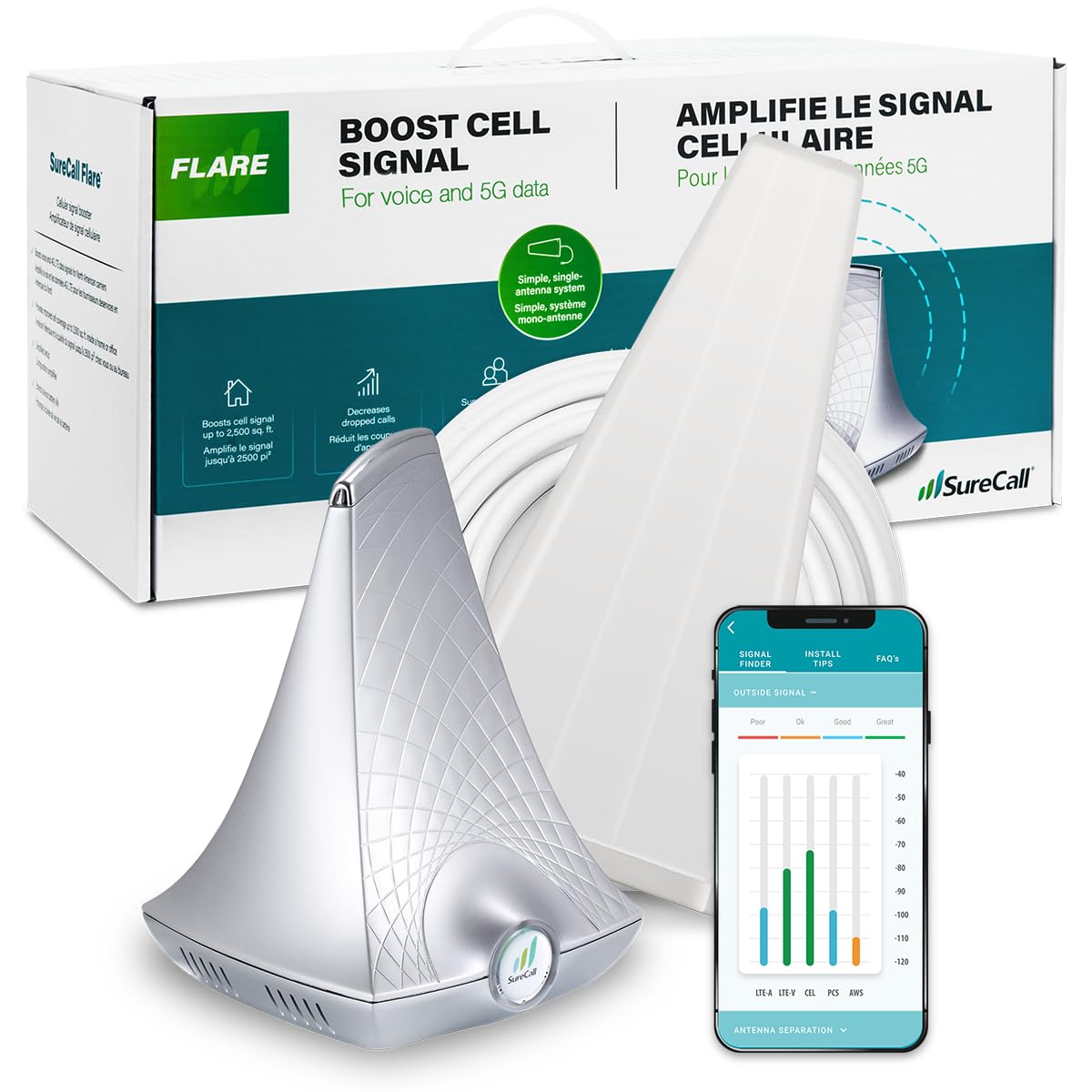
The SureCall Flare 3.0 is a compact, capable option specifically tuned for smaller homes or single-floor apartments. Its advertised 3,500 sq ft coverage is realistic only when 5 bars exist outside; with 1–2 bars outdoors, expect usable signal across roughly 500–1,500 sq ft — enough for a living room, home office, or master bedroom. The kit includes a Yagi directional antenna, 50 feet of coax cable, and a free SureCall app that helps you aim the antenna at the nearest tower using phone sensors.
Users report a dramatic turnaround: one reviewer in rural Alaska boosted AT&T from spotty to robust service after mounting the antenna on a rotatable pipe and aligning with OpenSignal. Another saw T-Mobile jump from unusable to 2–3 bars with flawless calls. The app-based alignment is genuinely helpful, though some users noted oscillation issues when the indoor and outdoor antennas were too close together — solved by maintaining at least 25 feet of vertical separation. The unit runs silently and stays cool during operation.
Where the Flare 3.0 falls short is with Verizon users who had dead signal outside — the booster needs some existing signal to amplify. It also won’t work miracles in metal barns or basements with zero outdoor reception. For its mid-range price, it’s a strong choice for anyone with a modest home and a single carrier they need to boost, but know that multi-floor coverage will require additional tweaking.
Why it’s great
- Compact form factor fits small spaces
- Free app-based antenna aiming tool included
- Made in USA with 3-year warranty
Good to know
- Realistic coverage drops to 500–1,500 sq ft with weak outdoor signal
- Occasional oscillation issues if antennas lack separation
3. HiBoost 8K Mate (B07VT2FHLP)

The HiBoost 8K Mate is designed for homes where dead zones span multiple rooms. Its dual-antenna system includes one built-in antenna in the main unit plus a separate indoor panel antenna — together rated for up to 8,000 sq ft. With a maximum gain of 70 dB, it lifts 1-bar fringe signals to 3–4 bars across 5–6 rooms. In real-world installations, a reviewer in a 4,500 sq ft, three-floor home with no line-of-sight to a tower eliminated dropped calls after mounting the outdoor antenna on a 50-foot cable run.
The LCD display and HiBoost app work in tandem to provide real-time gain readouts and antenna position feedback. The AGC technology automatically adjusts output to prevent signal loopback, a feature that saves hours of trial-and-error tuning. For band support, it covers 2/4/5/12/13/17/25, meaning it works with Verizon, AT&T, T-Mobile, and US Cellular, including 5G on DSS bands. The kit includes dual outdoor cables and a through-window cable, so no drilling is required.
The main limitation is the lack of band 71 (600 MHz), which T-Mobile relies on for long-range rural coverage. Users with strong T-Mobile 600 MHz signals may notice weaker improvement compared to Verizon or AT&T. Also, the 8,000 sq ft claim assumes 5 bars outside; at 1–2 bars, coverage drops to about 3,000–4,000 sq ft. For medium-to-large homes with multiple carriers, this is a versatile, well-supported option.
Why it’s great
- Built-in plus separate indoor antenna for multi-room coverage
- AGC and LCD simplify configuration
- Drill-free through-window cable included
Good to know
- Does not support T-Mobile band 71 (600 MHz)
- Installation still requires careful antenna placement for full coverage
4. weBoost Home Studio (B08PW22143)

The weBoost Home Studio is a well-known entry point for homeowners with a single problem room — think a back bedroom, basement office, or small apartment. Rated for 3,000 sq ft, its realistic coverage with weak outdoor signal is closer to 800–1,200 sq ft. The kit includes a directional outside antenna, a compact inside booster with a whip antenna, and two 30-foot low-loss cables. The unit is Made in the USA and FCC certified, giving it a trust advantage over lesser-known imports.
User feedback highlights its effectiveness for specific carriers: one reviewer improved AT&T from SOS/1 bar LTE to 2–3 bars 5G after mounting the outdoor antenna 20 feet up on a flagpole. Another boosted T-Mobile from half a bar with constant dropped calls to 5 bars in the target room and 4 bars 20 feet away. However, it works best as a single-room or studio solution — don’t expect whole-home coverage. Some users reported the booster runs warm to the touch, and return/refund issues were noted with one unhappy customer who saw no improvement.
For its price, the Home Studio delivers reliable performance for one or two simultaneous users in a contained space. If your home is larger than 1,500 sq ft or has multiple floors, you’ll likely outgrow it quickly. Consider the Home Complete model for broader coverage.
Why it’s great
- Proven weBoost brand trust and FCC approval
- Easy DIY setup with clear instructions
- Made in USA with durable build
Good to know
- Realistic coverage only for single rooms or studios
- Booster runs warm; some units may require replacement
5. HiBoost 15K Mate (B0DHFRYCN5)
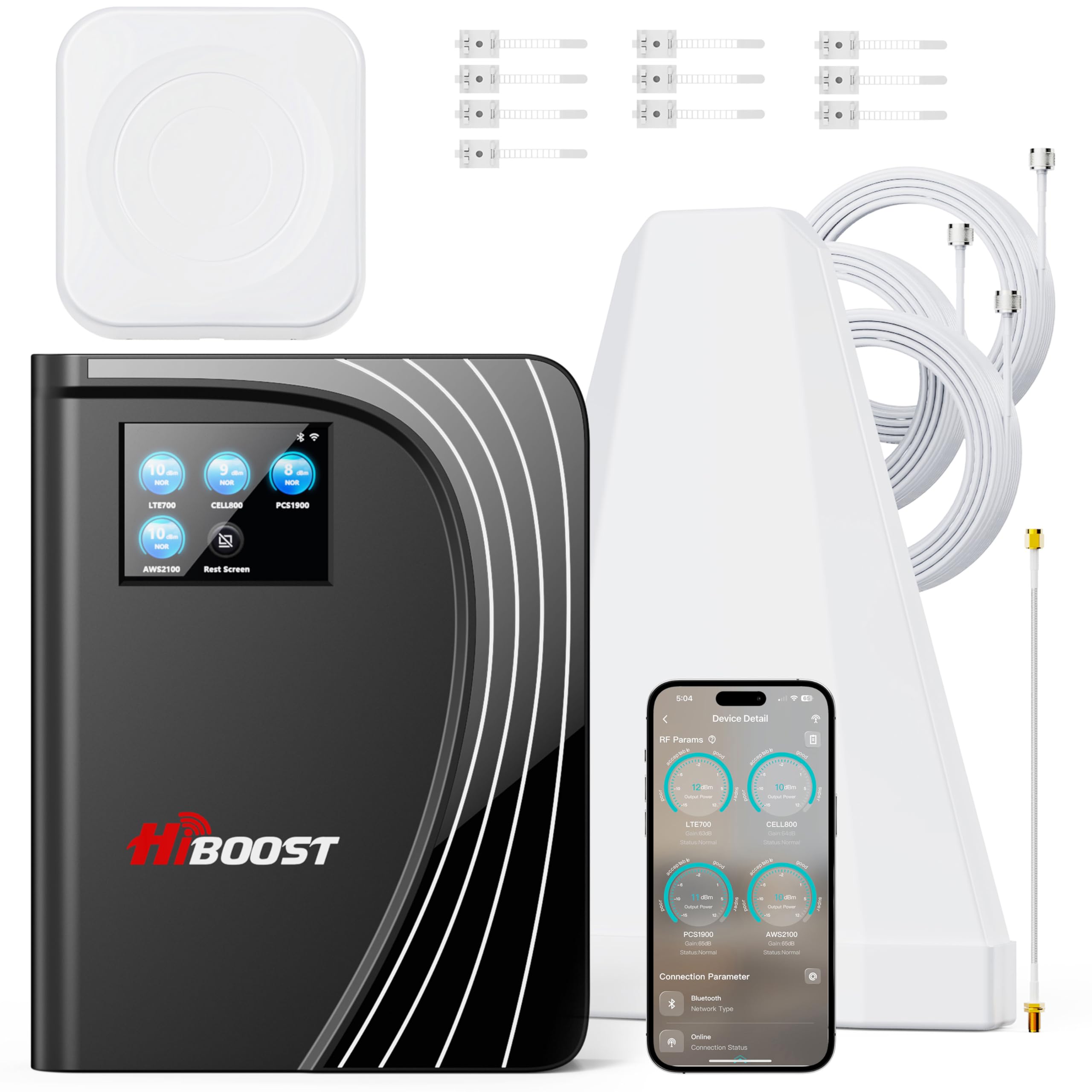
The HiBoost 15K Mate is the most feature-rich home booster in the lineup, boasting a color LCD touchscreen that lets you adjust gain, monitor signal strength, and troubleshoot without reaching for a phone. Rated for 12,000 sq ft with 72 dB max gain, it’s built for large two-story houses or open-plan homes with challenging layouts. The kit includes a built-in antenna plus one separate indoor panel, and the outdoor cable kit allows routing through a window without drilling. AGC technology automatically prevents self-oscillation — a huge time-saver.
Real-world performance is impressive: one user in a remote mountainous area went from 1 bar to 4–5 bars after installation, with crystal-clear calls and fast data. Another in high desert Arizona saw end to buffering on a PS5. The Signal Supervisor app provides real-time tower alignment feedback, and customer support (reportedly excellent) proactively follows up after installation. The unit supports bands 2/4/5/12/13/17/25, covering most US carriers including 5G DSS — though again, band 71 is absent.
Installation is not trivial — the antenna needs to be mounted high on a pole, and achieving vertical separation to avoid oscillation can be tricky in tight attics. The price reflects the added hardware and premium support, making it a longer-term investment for those who need full-house reliability. If your home is under 8,000 sq ft, the 10K SL or 8K Mate may suffice at a lower entry point.
Why it’s great
- Built-in touchscreen for immediate gain monitoring
- 72 dB max gain with AGC for stable operation
- Excellent proactive US-based support
Good to know
- Installation requires pole mounting and careful antenna separation
- No band 71 support for T-Mobile 600 MHz
6. SureCall Fusion4Home Max (B09FS6KB83)
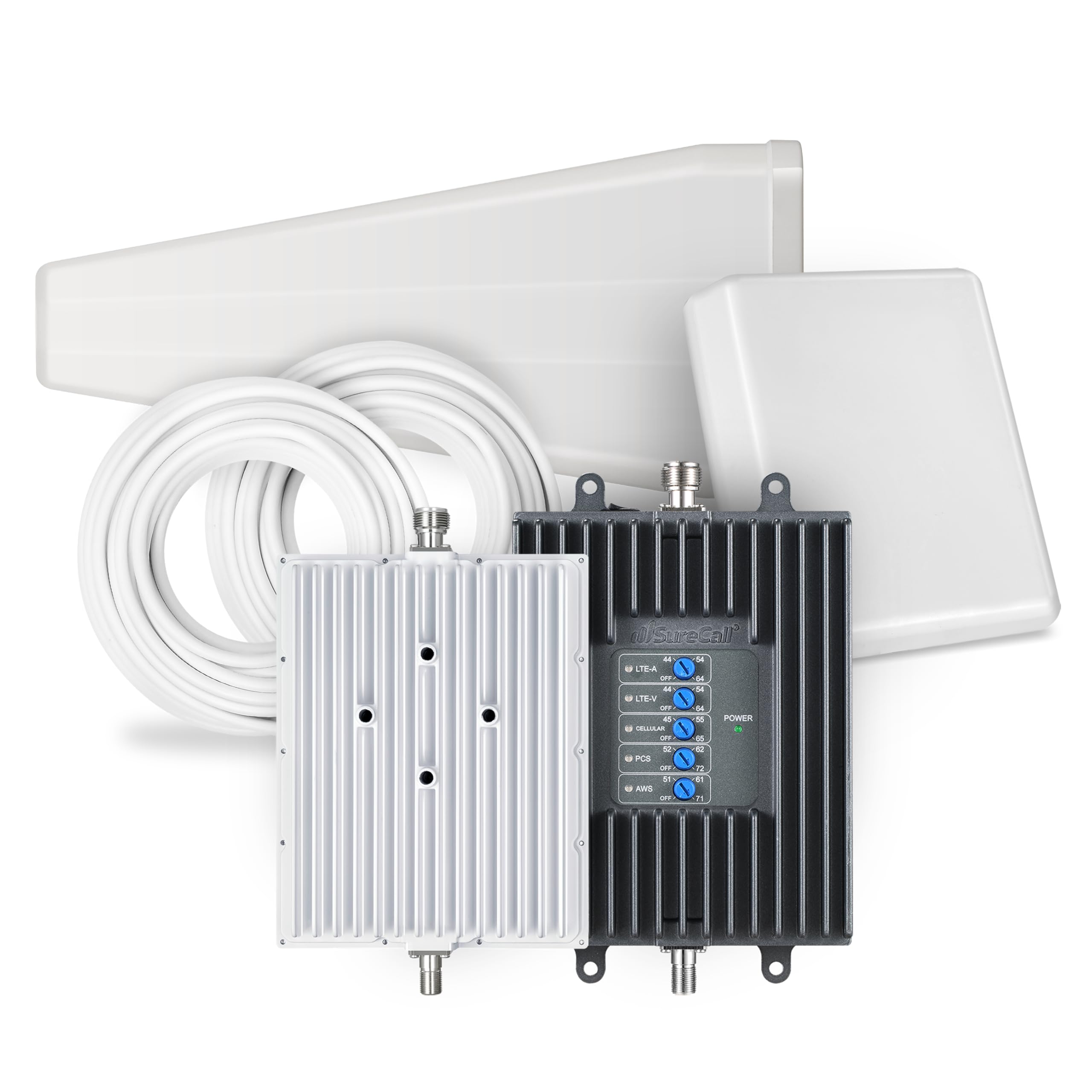
SureCall’s Fusion4Home Max uses a patented Extended Range Technology (ERT) that amplifies the signal at its strongest point outside the building before rebroadcasting it indoors. This approach yields a more consistent coverage footprint compared to conventional boosters that amplify whatever arrives at the antenna. Rated for up to 6,500 sq ft, it’s best suited for suburban homes with moderate outdoor signal (2–3 bars). The kit includes a Yagi directional antenna, panel indoor antenna, and 50 feet of coax.
In practice, a reviewer in suburban New Jersey boosted their signal by 15 dB, eliminating dropped calls after placing the outdoor antenna in the attic and the transmit antenna in the basement with proper separation. Another user in a metal pole barn — traditionally a nightmare for signal — reported stronger indoor signal than they got outside. The unit supports all US carriers including Verizon, AT&T, T-Mobile, and US Cellular, and it’s an authorized Verizon 5G distributor. The 3-year warranty and lifetime US-based support are reassuring.
The ERT technology does require careful alignment — the outdoor antenna must be aimed precisely at the nearest tower. The kit also lacks an app for alignment guidance, so you’ll need to use a third-party tool like OpenSignal or CellMapper. If you don’t have at least one bar outside, the Fusion4Home Max won’t help. It’s a solid middle-ground choice for homeowners who want SureCall’s reliability without jumping to the higher-priced 15K models.
Why it’s great
- Patented ERT for more consistent coverage
- Authorized Verizon 5G booster vendor
- 3-year warranty and lifetime US support
Good to know
- No app for antenna alignment; needs third-party tool
- Requires at least 1 bar outside to function
7. weBoost Home Complete (B07RQVVVQG)

weBoost markets the Home Complete as the strongest booster the FCC allows, offering up to 100x amplification and coverage for up to 7,500 sq ft. It comes with a directional outside antenna, an inside panel antenna with a drill-free wall mount, and a slender booster unit. The included weBoost app helps you locate the nearest cell tower and measure signal strength before and after installation — a helpful feature for optimizing placement.
User feedback is mixed. One Verizon user in a rural area achieved a 30 dB gain with 5 bars LTE and 25–30 Mbps downloads, praising the kit’s ease of setup. Some units have exhibited intermittent performance, requiring replacement; weBoost’s customer service is generally helpful, but return shipping can be a hassle.
The Home Complete is best for homeowners who have strong outdoor signal (3+ bars) and want to blanket a large single-story home. It works well with AT&T and Verizon, but Verizon users with weak outdoor signal may see limited improvement. If your home has metal framing, thick masonry, or multiple floors, consider the HiBoost 15K 2.0 for its dual indoor antennas and higher gain.
Why it’s great
- 100x max amplification (FCC maximum)
- weBoost app for tower finding and signal testing
- Strong brand trust and US-based support
Good to know
- Realistic coverage area much smaller than 7,500 sq ft with weak outside signal
- Some users report intermittent performance issues
8. HiBoost 15K 2.0 (B09YD7WGMT)

The HiBoost 15K 2.0 is an upgraded version of the 8K Mate, doubling the coverage to 10,000 sq ft and including two separate indoor panel antennas for multi-floor distribution. With a maximum gain of 72 dB, it can boost a 1-bar outdoor signal to usable levels across a two-story home. The kit also includes thicker 400-type outdoor cables that reduce signal loss over long runs — a practical upgrade for homes where the outdoor antenna must be placed far from the booster.
User reports align with HiBoost’s strong reputation: one owner in a forested valley went from no data to 25 Mbps downloads after pointing the Yagi antenna using the Signal Supervisor app. Another in a basement office saw signal jump from 1–2 bars to 4–5 bars on T-Mobile band 2 after support helped realign the antenna. The AGC, app guidance, and LCD display work together to eliminate most setup headaches. The 3-year warranty and responsive support (with follow-up texts) add confidence.
The primary drawback is again the absence of band 71 for T-Mobile long-range users. Also, the 10,000 sq ft rating is optimistic for very weak outdoor signals — realistically expect coverage of 4,000–6,000 sq ft in 1–2 bar conditions. The two indoor antennas require ceiling mounting for best results, which may be challenging for renters. For owners of large two-story homes with multiple carriers, this is one of the most capable consumer kits available.
Why it’s great
- Two indoor panel antennas for multi-floor coverage
- 400-type low-loss outdoor cables included
- App + LCD + AGC for easy optimization
Good to know
- No band 71 support for T-Mobile 600 MHz
- Indoor antennas may require ceiling mounting
9. CEL-FI GO G41 (B0CSJ5YK5K)
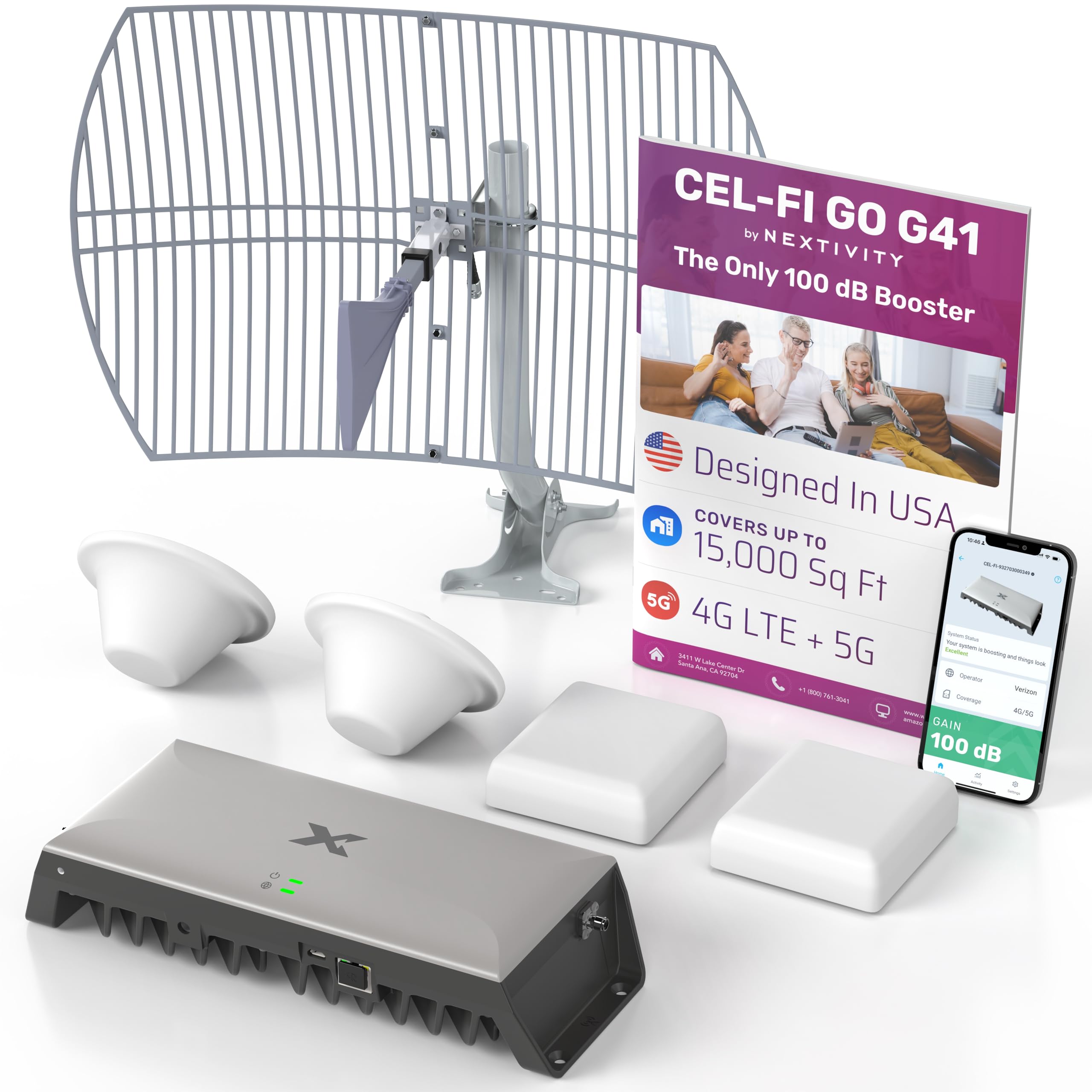
The CEL-FI GO G41 is in a class of its own. With a 100 dB gain — 30 dB more than typical home boosters — it can cover up to 15,000 sq ft, making it the only consumer option that genuinely handles entire multi-acre properties and large multi-story buildings. It uses the 4th generation IntelliBoost chipset, which supports 4G LTE, 5G DSS, and true 5G NR (New Radio) — not just 5G over 4G bands. This is the only unit in this guide that offers native 5G NR support, future-proofing your investment as carriers deploy standalone 5G.
The kit includes two dome antennas and two panel antennas, allowing you to mix and match for optimal indoor coverage. The outdoor antenna comes with a pole mount. The WAVE app provides advanced diagnostics, including real-time signal-to-noise ratio and carrier aggregation data. Performance is phenomenal: one reviewer took a rural home from -108 dBm to -75 dBm (full bars), enabling reliable streaming and hotspot usage throughout a two-story metal-roofed house. Another reported that the G41 succeeded where a WEBOOST had failed, pulling signal from a forested ridge.
The trade-offs are significant. The price is steep, installation requires a full day and careful antenna positioning, and the unit may not function correctly if your area is served by multiple base stations on different bands (carrier aggregation can cause the phone to ignore the booster). Customer support is reportedly excellent — the CEO personally helped one user — but you’re paying for that premium. For homes with zero service or massive coverage needs, nothing else comes close.
Why it’s great
- 100 dB gain — covers 15,000 sq ft with the right outdoor signal
- True 5G NR support (not just DSS)
- Includes both dome and panel antennas for flexible indoor placement
Good to know
- Highest price in the guide; installation takes a full day
- May struggle with carrier aggregation in areas served by multiple base stations
FAQ
Can a 5G booster work if I have zero outdoor signal?
Will a home booster interfere with my neighbors’ cell service?
How long does installation typically take for a DIY kit?
Do I need a separate booster for each carrier in my home?
Final Thoughts: The Verdict
For most users, the best 5g signal booster for home winner is the HiBoost 10K SL because it combines a generous 5,500 sq ft coverage rating, an intuitive app and LCD for easy alignment, and AGC technology that prevents oscillation — all without requiring a contractor. If you have a smaller home under 2,000 sq ft and want a simpler setup, grab the weBoost Home Studio. And for rural properties with zero service or sprawling floor plans, nothing beats the CEL-FI GO G41.

Mo Maruf
I created WellFizz to bridge the gap between vague wellness advice and actionable solutions. My mission is simple: to decode the research and give you practical tools you can actually use.
Beyond the data, I am a passionate traveler. I believe that stepping away from the screen to explore new environments is essential for mental clarity and physical vitality.