Our readers keep the lights on and my smoothie glass nicely filled. As an Amazon Associate, I earn from qualifying purchases.
When the grid goes dark or the campground demands power without the roar of a traditional open-frame unit, a 5000-watt inverter generator walks the line between raw output and civilized decibels. These units use advanced inverter circuitry to deliver clean sine-wave power safe for laptops, CPAP machines, and RV electronics—while enclosing the engine in sound-dampening shells that often cut noise levels by half compared to a contractor-grade generator.
I’m Mohammad Maruf — the founder and writer behind WellFizz. I’ve spent years analyzing portable power station specs, comparing inverter topologies, and cross-referencing real-user runtime data to identify which units actually deliver on their THD claims and fuel-efficiency promises.
After digging through the specs of eleven contenders—from dual-fuel EFI models to budget-conscious 4,500-watt portables—the consensus is clear: the best 5000 watt inverter generator balances clean power output, practical runtime, and a noise profile that won’t get you banned from your favorite campsite.
How To Choose The Best 5000 Watt Inverter Generator
A 5,000-watt inverter generator sits at a sweet spot: it can start a 15,000 BTU RV air conditioner and still have headroom for a refrigerator and lights, yet it often weighs under 110 pounds with wheels. But not every unit in this class delivers the same THD, runtime, or noise curve. Here’s what to check before you buy.
Real Wattage vs. Surge Wattage
Surge (peak) wattage handles the inrush current when a motor starts—usually 1.5 to 2 times the running wattage for a few seconds. A generator labeled “5,000 peak watts” might only have 3,900 running watts. Match the running wattage to your continuous load (add 20% buffer), and confirm the surge rating can handle your AC or sump pump’s locked-rotor amps.
Total Harmonic Distortion (THD)
Inverter generators typically produce THD below 3%, which is safe for smartphones, laptops, and variable-frequency drives on modern refrigerators. Open-frame conventionals often sit at 5-6% THD, which can buzz motors and overheat power supplies. A low THD rating (ideally 0.2-1.2%) is the primary reason to buy an inverter model over a traditional generator.
Fuel Type and Runtime
Gasoline is widely available, but propane offers longer shelf life and cleaner combustion. Dual-fuel units let you switch without a carburetor headache. At a 50% load, expect 8-12 hours from a 3.4-gallon tank with Eco Mode active. Electronic fuel injection (EFI) models adjust the air-fuel mixture automatically for better efficiency and altitude compensation.
Parallel Capability and Outlet Configuration
A TT-30R (30-amp RV outlet) is essential for direct camper hookup. If you plan to double your output later, confirm the unit supports parallel operation with a specific cable kit. Two 4,500-watt units in parallel can deliver over 7,000 running watts—enough for a larger home panel or a heavy-duty welder.
Quick Comparison
On smaller screens, swipe sideways to see the full table.
| Model | Category | Best For | Key Spec | Amazon |
|---|---|---|---|---|
| Westinghouse iGen5000c | Premium Inverter | RV & Home Backup | 52 dBA / 18-hr runtime | Amazon |
| Westinghouse iGen5000DFc EFI | Premium Dual-Fuel | Dual-Fuel & EFI Efficiency | 5000W gas / 4500W LPG | Amazon |
| Generac iQ5200 | Premium Inverter | RV & Quiet Operation | 5200W peak / dual-fuel | Amazon |
| PowerSmart PS5046CE | Mid-Range Inverter | Electric Start & CO Alarm | 4800W surge / 4000W rated | Amazon |
| WEN DF480iX | Mid-Range Dual-Fuel | Dual-Fuel Home Backup | 4000W rated / electric start | Amazon |
| AMERISUN AM5046C | Mid-Range Inverter | 5000W Output & CO Sensor | 5000W surge / 10-hr run | Amazon |
| WEN 56477i | Mid-Range Inverter | Lightweight & Quiet | 4800W surge / 224cc engine | Amazon |
| Champion 4000-Watt | Mid-Range Inverter | Lightest 4000W Unit | 48.1 lbs / 64 dBA | Amazon |
| PowerSmart PS5046CE (4800W) | Budget Inverter | Value Electric Start | 68 lbs / 3.4 gal tank | Amazon |
| maXpeedingrods MXR4000 | Budget Inverter | Bluetooth Monitoring | 48.5 lbs / 4000W surge | Amazon |
| ERAYAK 4500P | Budget Inverter | Ultra-Quiet & Lightweight | 54 lbs / 60.5 dBA | Amazon |
In‑Depth Reviews
1. Westinghouse iGen5000c
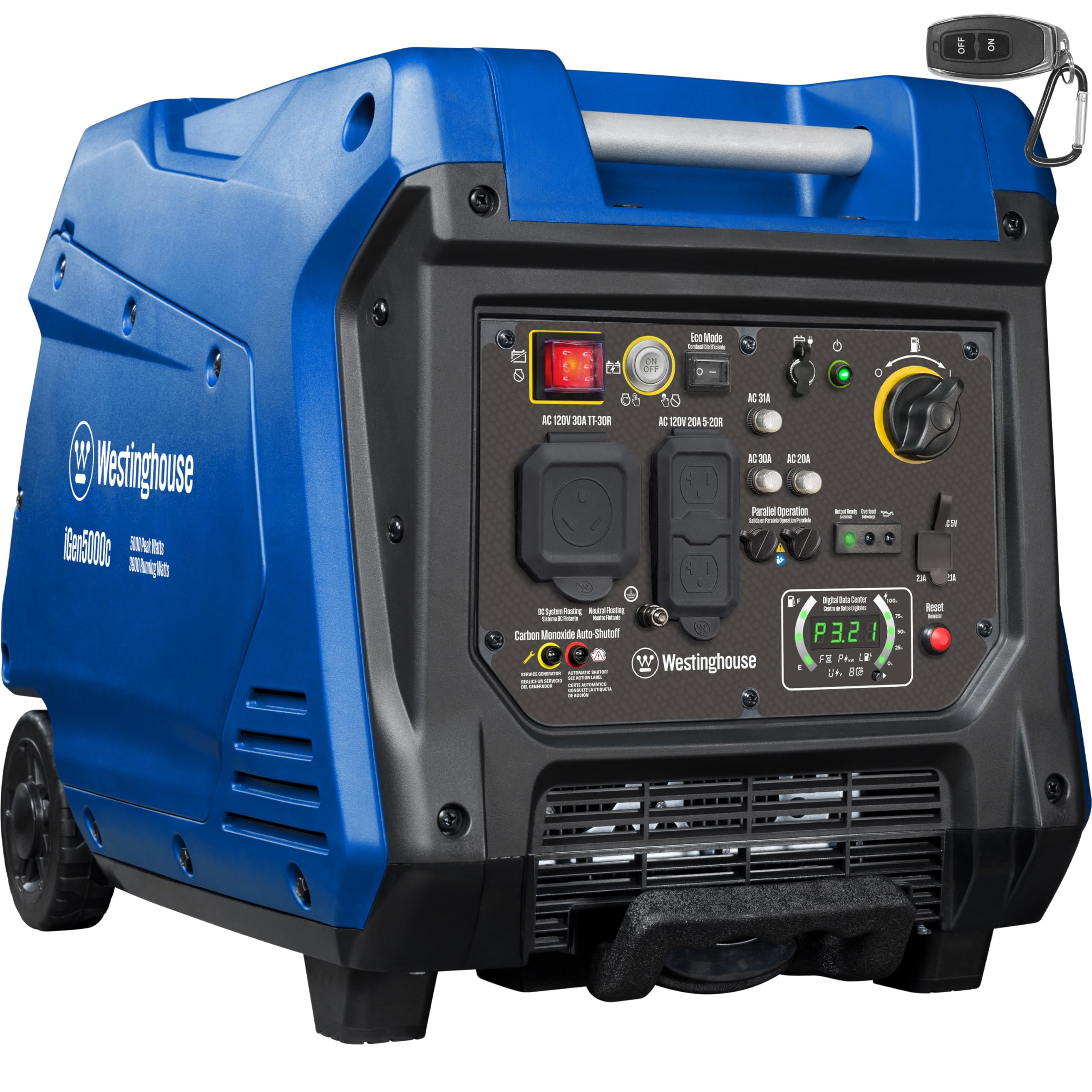
The Westinghouse iGen5000c dominates the 5,000-watt inverter class with a noise floor of just 52 dBA—quieter than a normal conversation. That whisper-quiet profile comes courtesy of a double-insulated acoustic enclosure and a low-tone muffler, making it the unit you can run at a campground without side-eye from your neighbors. The remote start key fob lets you fire it up from inside your RV or house, which is a game-changer during a midnight outage.
Under the hood, the 224cc engine delivers 5,000 peak watts and 3,900 rated watts with less than 3% THD, so your CPAP machine, laptop, and refrigerator all get stable sine-wave juice. The rotating digital display shows fuel level, power output, and remaining runtime—data that helps you plan refueling stops without guesswork. Eco Mode adjusts engine speed to match load, and at 25% load the 3.4-gallon tank stretches to an impressive 18 hours.
The telescoping handle and never-flat wheels make relocation simple despite the 105-pound curb weight. It comes with a TT-30R RV outlet, two 5-20R household outlets, and a pair of USB ports. The three-year warranty and nationwide service network add peace of mind that budget brands rarely match.
Why it’s great
- Industry-leading 52 dBA noise level
- Remote start key fob for convenience
- Up to 18 hours runtime on Eco Mode
Good to know
- Weighs 105 pounds without fuel
- Not dual-fuel; gasoline only
2. Westinghouse iGen5000DFc EFI
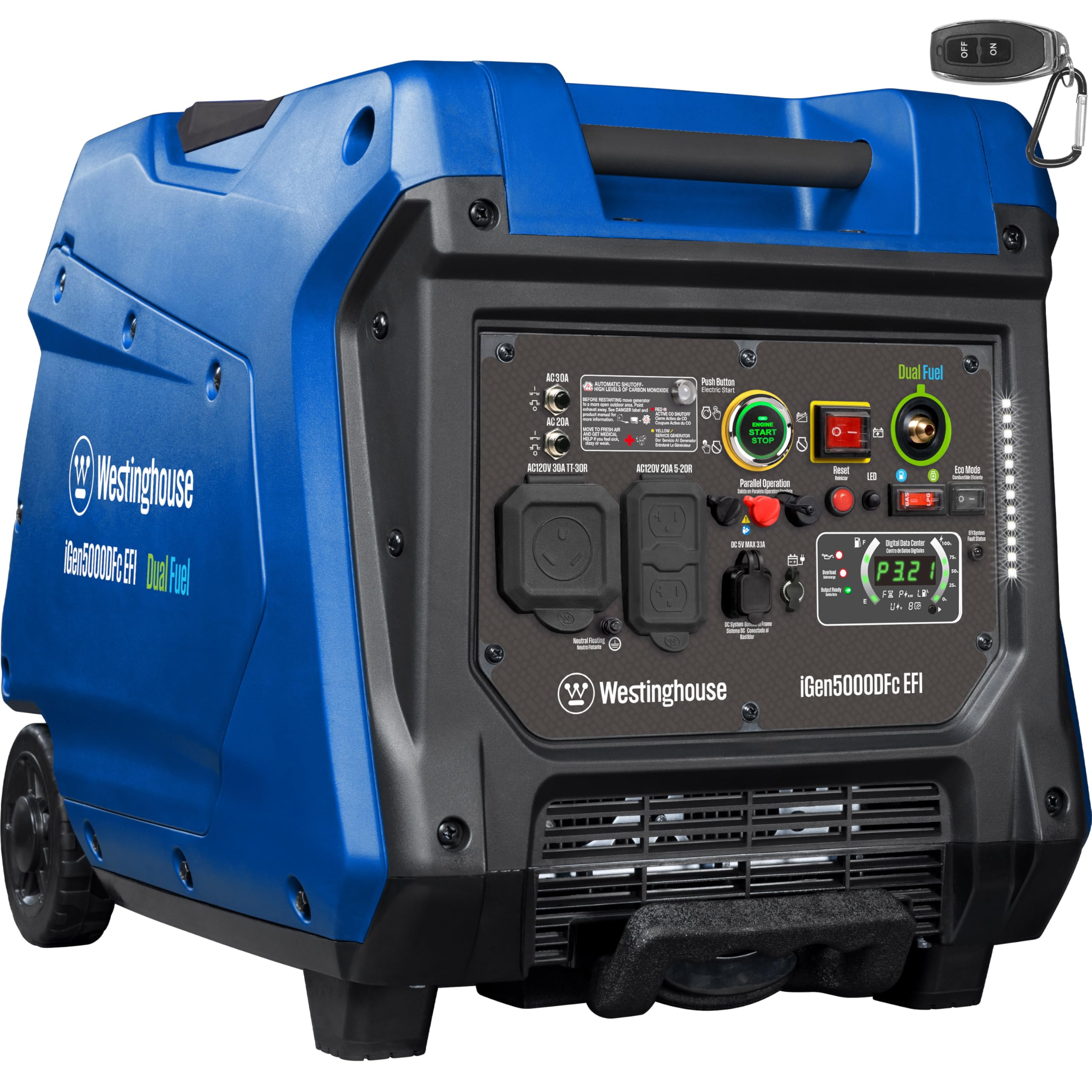
This is Westinghouse’s EFI-optimized dual-fuel flagship. The electronic fuel injection automatically adjusts the air-fuel mixture for cleaner combustion, better cold starts, and altitude compensation—meaning it runs smoothly at 8,000 feet without a jet kit. On gasoline it delivers 5,000 peak watts and 3,900 running watts; on propane it drops slightly to 4,500 peak and 3,500 running, but the trade-off is near-infinite fuel shelf life.
Noise output is rated at 61 dBA, which is still campground-friendly but not as hushed as the standard iGen5000c. The telescoping handle and never-flat wheels keep the 111-pound unit mobile, and the digital display reports fuel level, load percentage, and remaining runtime. The CO sensor auto-shuts the engine if carbon monoxide builds up—critical safety gear when running near a camper window or garage door.
Owners praise the seamless fuel selector switch and the fact that the unit starts on the first push of the button (or the key fob from 80 feet away). The three-year warranty and lifetime technical support backstop the higher initial investment. If you want fuel flexibility without the hassle of rejetting for elevation, this EFI model is the top pick.
Why it’s great
- EFI eliminates carburetor problems at altitude
- Dual-fuel flexibility with quick-change selector
- Remote key fob start included
Good to know
- 111 pounds is heavy for one-person carry
- Propane wattage is about 10% lower than gas
3. Generac iQ5200
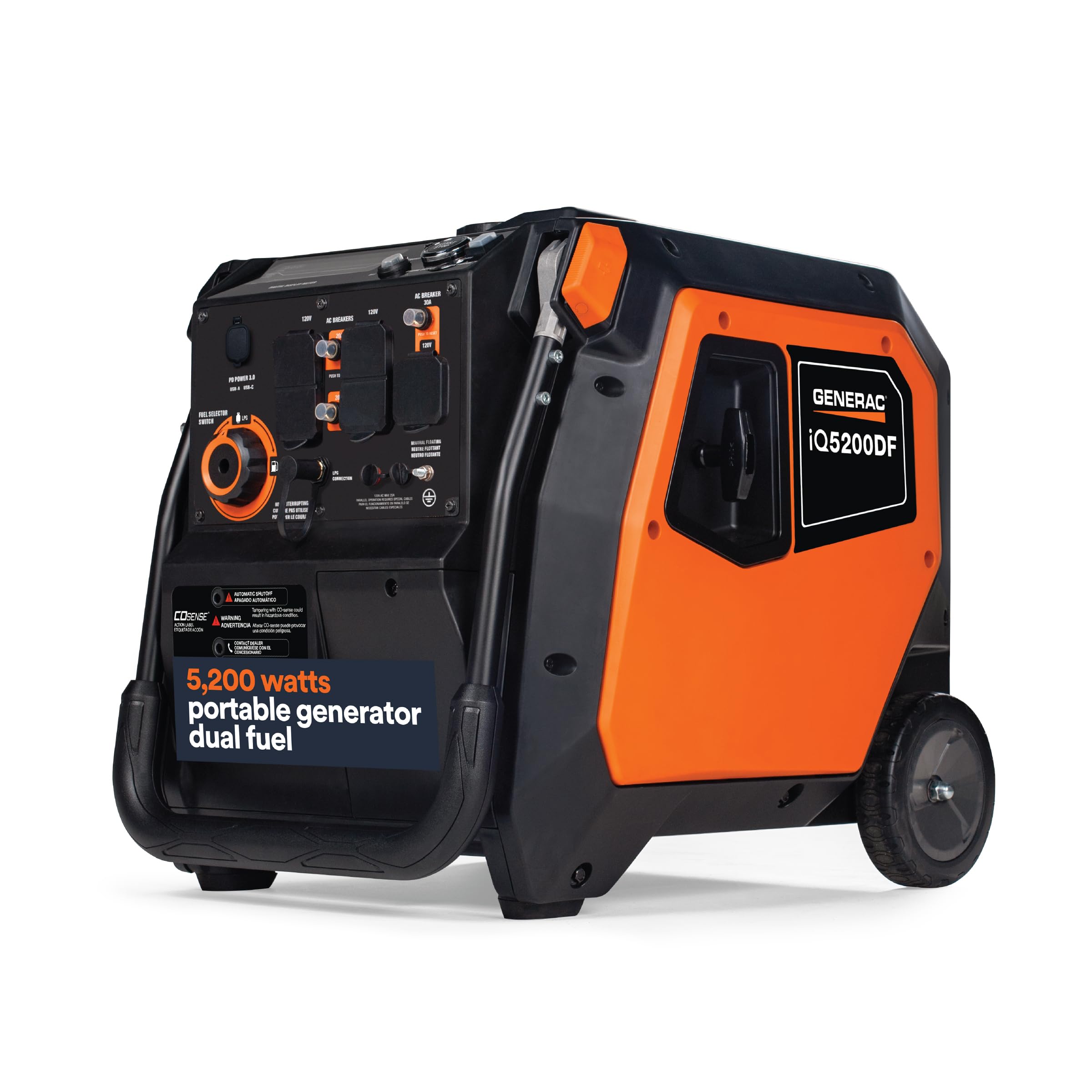
Generac brings its residential generator expertise into a portable package with the iQ5200. This dual-fuel inverter runs on gasoline (5,200 peak watts) or propane, and the fuel selector switch lets you swap sources without the engine sputtering. The fully enclosed case keeps the noise low enough for late-night use at a campground or an RV park without disturbing guests.
Electric start comes standard with a battery, so there’s no rope-pulling on cold mornings. The COsense technology is more sophisticated than a simple alarm: it actively monitors CO levels and shuts the engine down before concentrations become dangerous. LED indicators for low oil and overload status are easy to read at a glance.
Owners report 60+ hours of continuous run time during storm outages, with the unit handling a 40-foot camper’s AC, fridge, and lights without bogging down. Parallel-ready capability means you can double output with a second iQ5200. The 107-pound weight is manageable with the included wheel kit, and the build quality feels denser than the lighter budget competitors.
Why it’s great
- Dual-fuel with seamless switching
- COsense auto-shutdown for safety
- Proven Generac reliability and parts network
Good to know
- Some users report break-in oil consumption
- Dimensions are larger than comparable 5kW units
4. PowerSmart PS5046CE
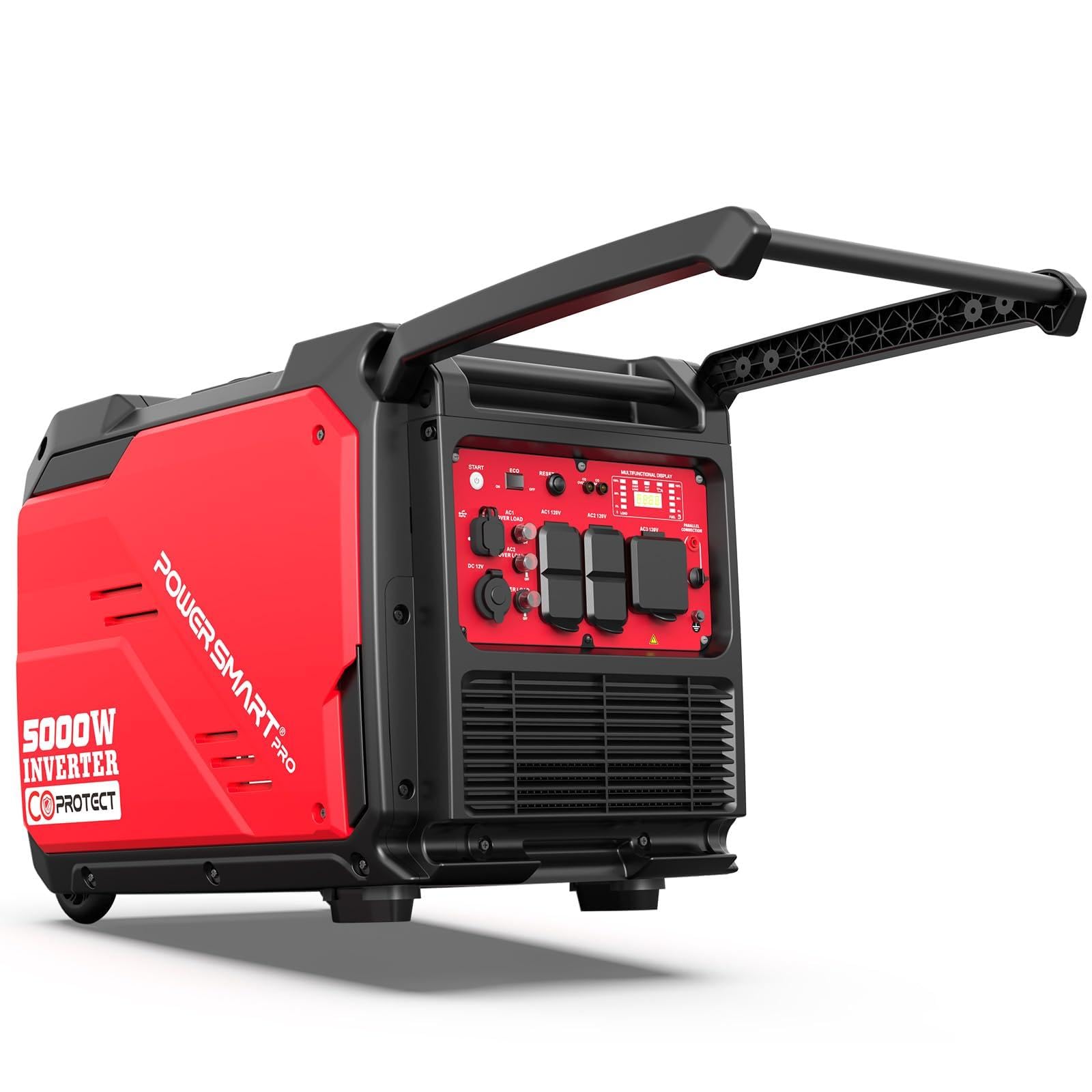
PowerSmart’s PS5046CE is a 5000-peak-watt inverter generator that brings electric start convenience to a more accessible tier. The 223cc OHV engine cranks with a push button (there’s also a manual recoil backup), and the integrated CO watchdog sensor automatically kills the engine if dangerous carbon monoxide accumulates—essential safety for garage or RV-adjacent placement.
The 3.43-gallon fuel tank delivers up to 10 hours of runtime at 50% load with Eco Mode engaged. Advanced inverter circuitry holds THD low enough for sensitive devices, and the panel includes one TT-30R RV outlet, two 120V household outlets, a 12V DC port, and dual USB ports. The 89-pound dry weight is 16 pounds lighter than the Westinghouse iGen5000c, though it lacks a telescoping handle—you get a fixed handle and wheel kit instead.
User feedback highlights the quiet 65 dBA operation and the fact that the unit starts reliably after storage if you use ethanol-free fuel and the fuel shutoff valve. The 2-year limited warranty and lifetime tech support are decent for this tier. If you want electric start and a CO sensor without stepping up to the premium price bracket, this is a strong contender.
Why it’s great
- Push-button electric start with manual backup
- CO watchdog auto-shutdown
- Lighter than many 5kW competitors
Good to know
- Fixed handle, not telescoping
- No dual-fuel option
5. WEN DF480iX
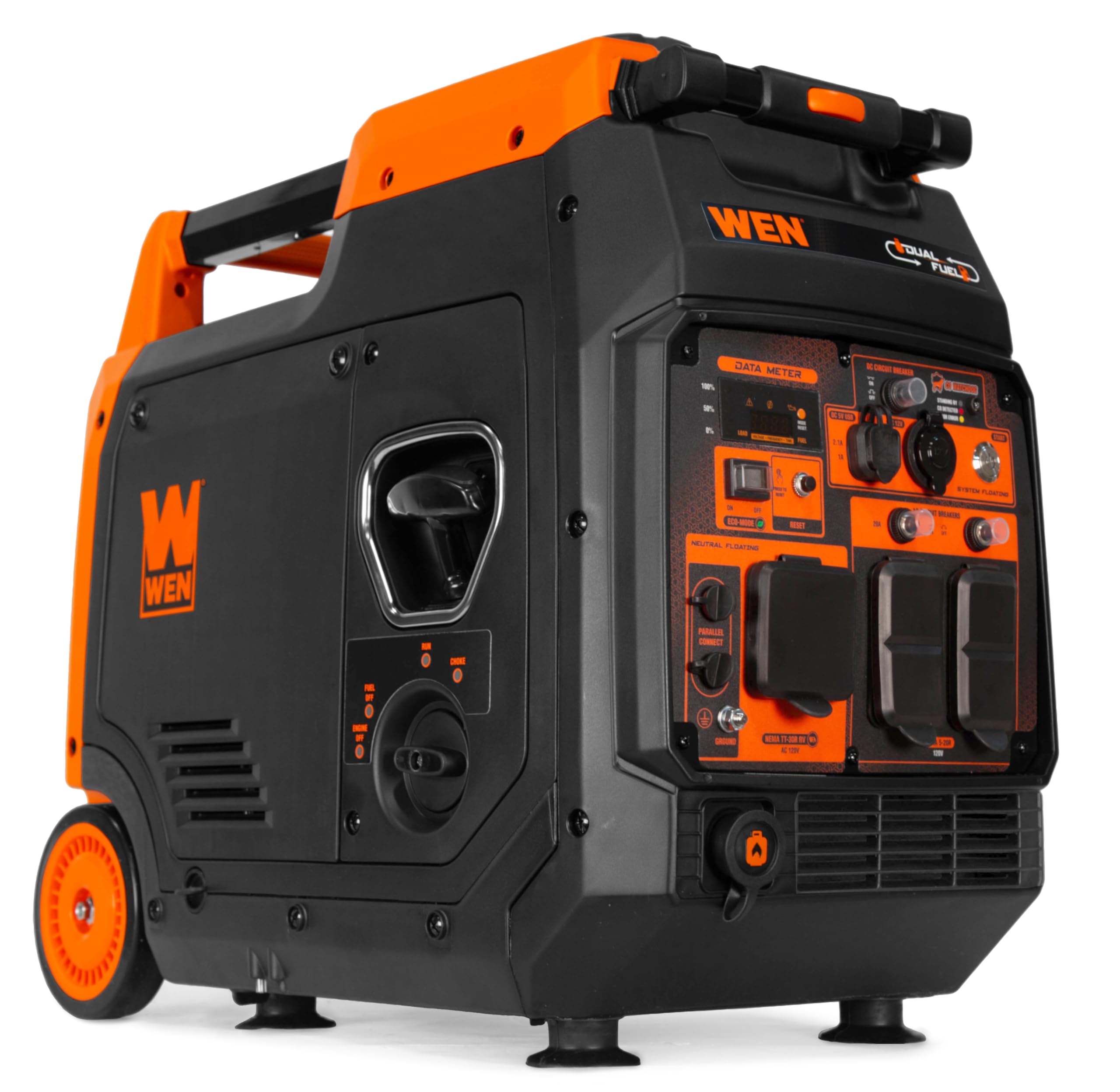
The WEN DF480iX pairs a 224cc dual-fuel engine with electric start and a CO Watchdog sensor at a price point that undercuts most dual-fuel inverters. On gasoline it delivers 4,800 surge watts and 4,000 rated watts; on propane it holds steady at 4,000 rated watts with a slight surge drop to 4,320. That means you can run a 15,000 BTU RV air conditioner on propane without worrying about carburetor varnish during off-season storage.
The telescoping pull handle and onboard wheels make the 78.5-pound chassis easy to roll across gravel or pavement. WEN’s fuel shutoff feature lets the carburetor run dry before shutdown, a design detail that dramatically extends the life of seals and jets. The noise level is conversational—owners say it’s similar to a window AC unit—and the pure sine wave output keeps sensitive electronics happy.
Break-in reports note the magnetic dipstick catches metal shavings (normal for a new engine), and the LLDPE battery connection panel could be better designed for reattachment after maintenance. The three-year warranty is generous for this price tier. If you prioritize propane flexibility and electric start without paying Westinghouse or Generac money, the DF480iX is the smart buy.
Why it’s great
- Dual-fuel with tool-free LPG quick-connect
- Fuel shutoff extends carburetor life
- Three-year warranty at a mid-range price
Good to know
- Wheels can rattle at idle
- Battery panel access is awkward
6. AMERISUN AM5046C
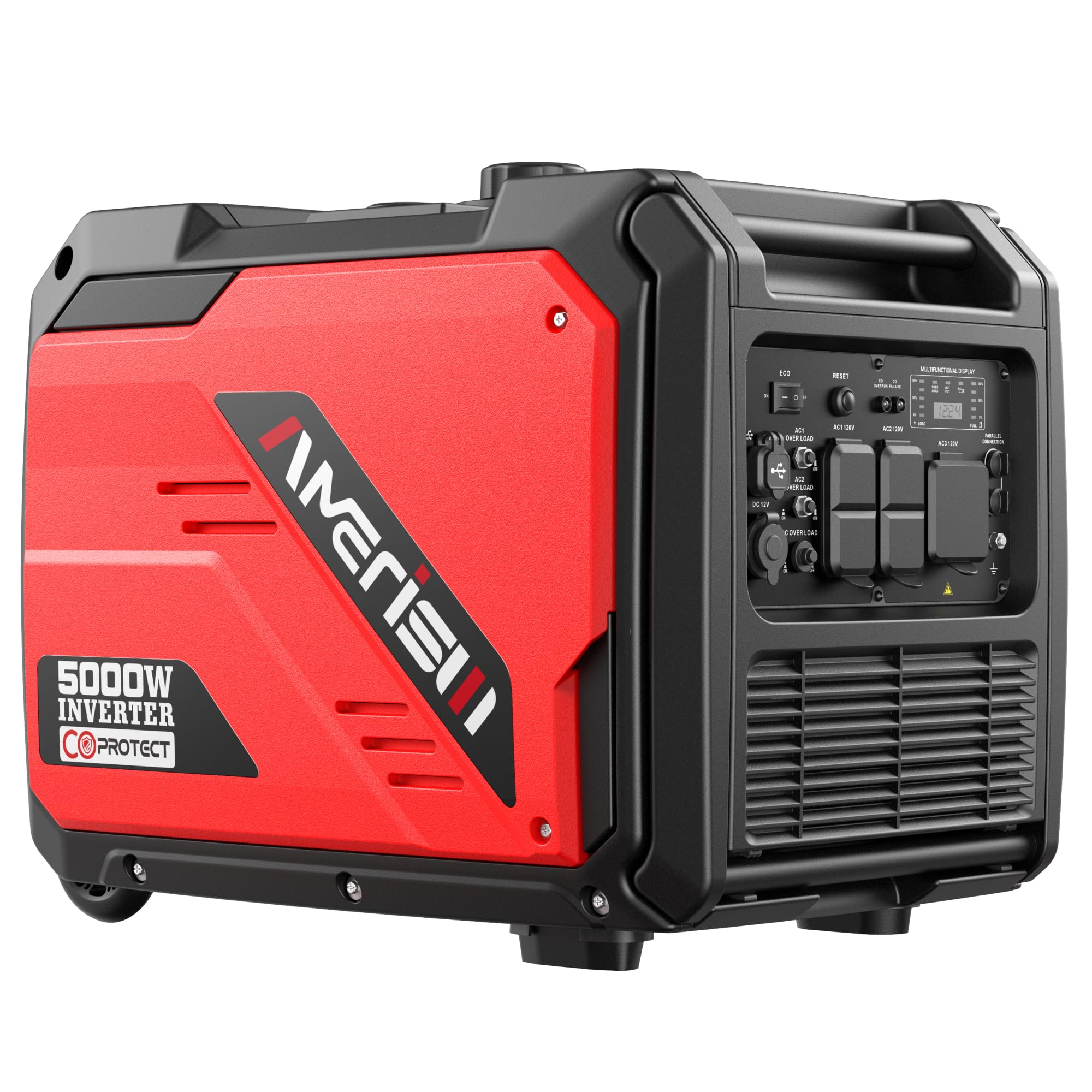
The AMERISUN AM5046C delivers a true 5,000 surge watts from its 223cc engine, and the CO sensor includes both an alarm and a failure indicator—a redundancy that’s rare at this price. The 3.43-gallon tank runs up to 10 hours at 50% load, and the 70 dBA noise rating is typical for this class: noticeable under full load but civil in Eco Mode.
The outlet panel is generous: four 120V 20A household outlets, one 120V 30A RV outlet (TT-30R), a 12V DC cigarette port, and two USB ports. Parallel-ready capability lets you gang two units for up to 10,000 surge watts. The wheel kit and carrying handle make the 63-pound unit surprisingly easy to maneuver—it’s lighter than the WEN 56477i despite a higher rated wattage.
Owners report that it starts reliably on the first or second pull even after months of storage (with stabilizer), and that it handles a full RV mini-split system for an entire weekend on a single tank. A few users note the unit is built in China despite marketing imagery that suggests US assembly, but the 2-year limited warranty provides adequate coverage. For the combination of power, portability, and safety sensors, this is a well-rounded pick.
Why it’s great
- Full 5,000 surge watts for heavy loads
- CO sensor with failure detection
- Four household outlets plus RV port
Good to know
- Not dual-fuel; gasoline only
- 70 dBA is louder than premium inverters
7. WEN 56477i

WEN’s 56477i is the lightest way to get 4,800 surge watts and 4,000 rated watts in this roundup. At 72.7 pounds with onboard wheels and a telescoping pull handle, it’s 30 pounds lighter than the Westinghouse iGen5000c while delivering comparable running wattage. That weight savings comes from a compact 224cc engine and a pared-down chassis that still manages to include a fuel shutoff valve—a WEN hallmark that prevents carburetor gumming between uses.
The Watchdog CO shutdown sensor adds a crucial safety layer, and the fuel shutoff maximizes engine lifespan by letting you run the carburetor dry before storage. The outlet panel includes four 120V household receptacles, one TT-30R RV outlet, a 12V DC port, and two USB ports. Noise levels are low enough to hold a conversation next to the unit, though not as hushed as the 52 dBA Westinghouse.
User reviews consistently praise the quiet operation and the fact that it starts on the first or second pull even after sitting for months. A nine-day power outage test saw it run wifi, TV, fridge, and freezer continuously. The three-year warranty adds confidence, though some owners wish it had an electric start option. If weight is your primary constraint and you don’t mind recoil starting, this is the unit to beat.
Why it’s great
- Lightest 4,800W inverter reviewed
- Fuel shutoff extends carburetor life
- CO watchdog auto-shutdown
Good to know
- Recoil start only (no electric)
- Not dual-fuel
8. Champion Power Equipment 4000-Watt

Champion has been a trusted name in portable power for decades, and this 4000-watt inverter generator proves why. At just 48.1 pounds, it’s the lightest unit in the roundup by a wide margin—nearly 25 pounds lighter than the next contender. The 149cc engine produces 4,000 starting watts and 3,000 running watts, which is enough for a 15,000 BTU RV AC plus lights and a fridge, but you’ll want to keep the total continuous load under 3,000 watts.
The 64 dBA noise rating is quiet for this output class, and the CO Shield auto shutoff system adds safety. Champion’s optional parallel kit lets you link two units to double the output, and the clean electricity (less than 3% THD) is certified safe for laptops and medical devices. The 1.6-gallon tank is smaller than most competitors, delivering up to 10 hours of runtime at 25% load.
Owners report that it starts on the first or second pull even after months of storage, and the 3-year limited warranty with free lifetime tech support is best-in-class. The TT-30R RV outlet and 5-20R household duplex outlet cover the basics, but the lack of a 12V port or USB-C may be an issue for modern device charging. Its real strength is portability: you can lift it with one hand.
Why it’s great
- Extremely light at 48.1 pounds
- Three-year warranty with lifetime support
- CO Shield auto shutoff
Good to know
- Only 3,000 running watts
- No USB or 12V ports
9. PowerSmart PS5046CE (4800W Model)
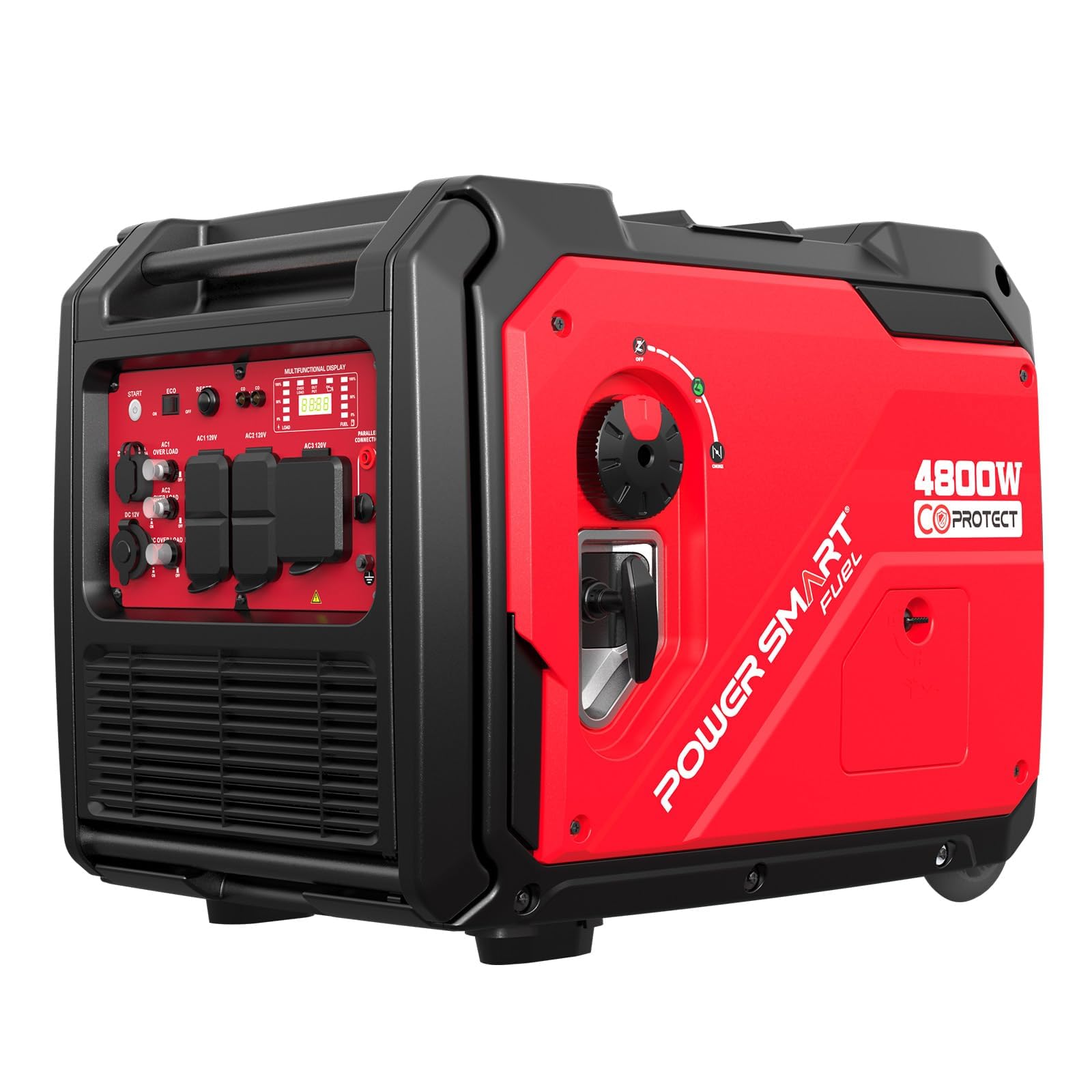
This entry-level model from PowerSmart delivers 4,800 surge watts and a one-touch electric start at a price that undercuts most competitors. The fully enclosed body keeps the 68-pound unit quiet enough for residential use, and the 3.4-gallon fuel tank offers about 5 hours of continuous runtime at full load—longer with Eco Mode active. The CO Shield sensor automatically shuts the generator down if carbon monoxide levels rise, a critical feature for home backup scenarios.
The outlet panel includes a dedicated 120V 30A RV outlet, two 120V 20A household outlets, and USB ports. Parallel-ready capability means you can connect two units for up to 9,600 surge watts. EPA and CARB compliance ensures it can be sold in all 50 states, and the 2-year limited warranty covers parts and labor.
Owner feedback is mixed: many praise the quiet operation and easy start, but a notable portion report failures after a few weeks of storage (dead 120V outlet, carburetor issues) and frustrating customer service experiences. This unit makes sense if you need electric start on a strict budget and are comfortable doing your own maintenance. For long-term reliability, consider stepping up to the similarly priced WEN 56477i or Champion 4000-watt.
Why it’s great
- Electric start under
- CO Shield safety sensor
- Parallel-ready for future expansion
Good to know
- Reliability concerns reported post-storage
- Customer service responsiveness is inconsistent
10. maXpeedingrods MXR4000

The maXpeedingrods MXR4000 brings a Bluetooth app data monitor to the budget inverter class—a feature usually reserved for premium units. The app displays power output, fuel level, voltage, frequency, runtime, and lets you toggle Eco Mode from your phone. That’s genuinely useful when the generator is parked outside your tent or under a covered patio and you want to check status without walking over.
The 145cc engine produces 4,000 peak watts and 3,200 running watts, which is enough for a 30-amp RV including AC startup. At 48.5 pounds, it’s one of the lightest in the roundup, though the form factor is compact enough to slide into a truck bed or SUV cargo area. The NEMA L5-30R RV outlet with included adapter, plus two household outlets and USB ports, cover the typical loadout. An LED light on the panel aids nighttime operation.
Users confirm it starts easily and runs a 13,500 BTU AC (with a 3,200W startup spike) alongside a fridge without tripping. The downsides: the Bluetooth app can be glitchy, and some units develop a vibration rattle from the inverter heat sink that requires DIY shimming. The 2-year warranty covers defects but doesn’t match Champion’s three-year coverage. If you want app connectivity on a budget, this is a compelling option.
Why it’s great
- Bluetooth app for remote monitoring
- Lightweight at just 48.5 pounds
- Compact footprint for travel
Good to know
- Bluetooth connectivity can be unreliable
- Heat sink rattle reported on some units
11. ERAYAK 4500P

The ERAYAK 4500P is the quietest unit in the budget tier at just 60.5 dBA—comparable to the premium Westinghouse iGen5000c at a fraction of the price. The 208cc engine produces 4,500 peak watts and 3,500 running watts with exceptional THD figures (0.2-1.2%), making it one of the cleanest power sources for sensitive electronics in any price bracket.
Fuel efficiency is a standout: at 25% load it burns just 0.21 gallons per hour, meaning a single tank can last well over 12 hours on light duty. The parallel-ready design supports 50A output when linked with a second unit (7,000W rated, 9,000W peak). The included toolkit, oil funnel, and TT-30R adapter reduce the accessory costs you often have to factor in separately.
At 54 pounds, it’s easy to load into a vehicle solo. Owner feedback is polarized: many praise its quiet operation, easy start, and fuel efficiency, while others report failures after 3-4 uses including pull-cord breakage and no-load shutdowns. The 3-year limited warranty with lifetime tech support is decent, but the recurring reliability complaints suggest this is a best-bet for occasional camping use rather than daily backup power. If your budget is tight and noise is your top priority, it’s worth considering—but know the quality lottery.
Why it’s great
- Ultra-quiet 60.5 dBA operation
- Very low THD (0.2-1.2%) for clean power
- Excellent fuel efficiency at light loads
Good to know
- Mixed reliability reports from long-term users
- Not returnable on Amazon after purchase
FAQ
Can a 5000-watt inverter generator run a 15000 BTU RV air conditioner?
What does “parallel capable” mean on an inverter generator?
Is propane or gasoline better for an inverter generator?
How often do I need to change the oil in a portable inverter generator?
Final Thoughts: The Verdict
For most users, the best 5000 watt inverter generator winner is the Westinghouse iGen5000c because it combines an industry-leading 52 dBA noise level, remote start convenience, 18-hour runtime, and proven three-year warranty support into one clean package. If you want dual-fuel flexibility with electronic fuel injection, grab the Westinghouse iGen5000DFc EFI for seamless propane/gasoline switching and altitude performance. And for a budget-conscious alternative that still delivers quiet operation and clean power, the WEN 56477i offers excellent value with its lightweight build, fuel shutoff, and CO watchdog sensor.

Mo Maruf
I created WellFizz to bridge the gap between vague wellness advice and actionable solutions. My mission is simple: to decode the research and give you practical tools you can actually use.
Beyond the data, I am a passionate traveler. I believe that stepping away from the screen to explore new environments is essential for mental clarity and physical vitality.