Our readers keep the lights on and my smoothie glass nicely filled. As an Amazon Associate, I earn from qualifying purchases.
Forgetting what a cold shower feels like starts with choosing the right gas-fired on-demand unit for your home. A tank-style 50-gallon water heater is a reliable workhorse, but a tankless version delivers endless hot water, recovers floor space, and typically runs at higher efficiency — the catch is dialing in the correct flow rate and BTU output for your household’s peak demand.
I’m Mohammad Maruf — the founder and writer behind WellFizz. This guide draws from hundreds of hours analyzing manufacturer spec sheets, warranty terms, and real-world user reviews for on-demand gas water heaters to give you a clear, data-backed buying decision.
Whether you are replacing a failing tank or building a new home, these detailed reviews of the best 50 gallon gas water heater alternatives will help you match capacity, fuel type, and installation requirements to your specific household needs.
How To Choose The Best 50 Gallon Gas Water Heater Alternative: Tankless
When you step away from the traditional tank and into the tankless world, the specs change. You are no longer measuring gallons of storage; you are measuring gallons per minute (GPM) of flow, BTU input, and energy factor. The right unit for your home depends on how many fixtures you run simultaneously, the temperature of your incoming ground water, and whether you prefer an indoor or outdoor install.
Flow Rate (GPM) — The True Capacity Metric
For a household replacing a 50-gallon tank, you need a unit that delivers 6.5 to 8.0 GPM to comfortably run two showers, a dishwasher, and a washing machine at the same time. Larger homes with 3+ bathrooms should aim for 8.4 GPM or higher. Colder incoming water (common in northern states) reduces effective GPM because the unit has to work harder to raise the temperature — this is where higher BTU ratings become essential.
BTU Output — Matching Climate to Performance
BTU (British Thermal Units) tells you how much raw heating power the burner can produce. Units in the 160,000 to 190,000 BTU range handle moderate climates with groundwater temperatures around 50-60°F. For areas where groundwater dips below 40°F in winter, a 199,000 BTU unit ensures you still get hot water at full flow without sacrificing temperature rise.
Venting Configuration — Indoor vs. Outdoor
Indoor units require a dedicated venting system (PVC, CPVC, or stainless steel) to exhaust combustion gases safely. Non-condensing models use standard Category III venting, while condensing units can use less expensive Schedule 40 PVC because the exhaust is cooler. Outdoor units eliminate the need for venting entirely, but they must be protected from freezing temperatures and direct weather exposure. Choose based on your available installation space and local building codes.
Quick Comparison
On smaller screens, swipe sideways to see the full table.
| Model | Category | Best For | Key Spec | Amazon |
|---|---|---|---|---|
| Rinnai RX199iN | Condensing | Large households, 7+ fixtures | 11.1 GPM, 199,000 BTU, UEF .98 | Amazon |
| Rinnai CX199iN | Commercial | High-demand residential or light commercial | 11.1 GPM, 199,000 BTU, 97% efficiency | Amazon |
| Rinnai RE199iN | Non-Condensing | Whole-house, large families | 9.8 GPM, 199,000 BTU | Amazon |
| A. O. Smith ATI-310CX3 | Non-Condensing | Hard water areas, scale prevention | 8.0 GPM, 190,000 BTU, X3 Scale Tech | Amazon |
| Rheem RTG-84XLN-3 | Non-Condensing | Outdoor installation, natural gas | 8.4 GPM, 180,000 BTU | Amazon |
| Rheem RTG-84DVLP-3 | Non-Condensing | Indoor installation, propane | 8.4 GPM, 180,000 BTU | Amazon |
| Rheem RTG-84XLP-3 | Non-Condensing | Outdoor installation, propane | 8.4 GPM, 180,000 BTU | Amazon |
| Rinnai RX130iN | Condensing | Indoor or outdoor, 4 fixtures | 7.1 GPM, 130,000 BTU, UEF .97 | Amazon |
| Rheem RTG-70DVLN-3 | Non-Condensing | Indoor, natural gas, 2-3 bath homes | 7.0 GPM, 160,000 BTU | Amazon |
| Rheem RTG-70DVLP-3 | Non-Condensing | Indoor, propane, 2-3 bath homes | 7.0 GPM, 160,000 BTU | Amazon |
In‑Depth Reviews
1. Rinnai RX199iN Condensing Smart Sense Tankless Water Heater

The Rinnai RX199iN is a condensing unit that achieves a UEF of .98 — the highest efficiency tier available in residential tankless water heaters. With an 11.1 GPM flow rate at a 199,000 BTU input, this unit can handle up to seven fixtures simultaneously, making it the best fit for large families or homes with multiple full bathrooms. Its condensing design captures heat from exhaust gases before venting them through inexpensive Schedule 40 PVC pipe, which also simplifies installation compared to Category III venting.
The Smart Sense gas control system allows the RX199iN to automatically detect and switch between natural gas and propane right through the settings menu — no conversion kit required. The Versa Vent system means this same unit can be installed indoors or outdoors, cutting down on inventory confusion. Users consistently praise the whisper-quiet operation and the ability to run several showers, the dishwasher, and washing machine without any temperature fluctuation once the water reaches the set point.
One real-world consideration is the delay in hot water reaching distant faucets, which is common in all tankless designs. Some users in larger homes have paired this unit with an external recirculation pump or the optional Controlr Wi-Fi module to reduce wait time. The Rinnai Central app is rated well for setup and diagnostics, but experienced DIYers report that the onboard panel is fully capable without the phone connection.
Why it’s great
- Highest residential efficiency at UEF .98 reduces gas bills significantly
- 11.1 GPM supports seven fixtures — ample for large households
- Condensing design uses standard PVC venting, lowering install cost
- Smart Sense auto-detects fuel type, indoor or outdoor installation
Good to know
- Premium price point compared to non-condensing models
- Hot water delivery delay to far faucets without recirculation loop
- Wi-Fi module sold separately
2. Rinnai CX199iN Condensing Smart Sense Commercial Tankless Water Heater

The CX199iN is Rinnai’s commercial-grade offering that carries the same 11.1 GPM and 199,000 BTU backbone as the RX199iN but adds higher duty-cycle components to handle more sustained demand. Its 97% thermal efficiency is nearly identical to the residential flagship, but the commercial designation makes it a stronger choice for homes with exceptionally high hot water usage or those adding a separate living unit, like an in-law suite or rental apartment.
Installation flexibility continues with the Versa Vent system and the Smart Sense fuel detection, allowing indoor or outdoor placement with either natural gas or propane. The CX199iN also offers an optional recirculation conversion kit, which can be installed to provide near-instant hot water at the furthest tap. Users upgrading from older Rinnai units (which can be 18+ years old) report a noticeable improvement in speed to temperature and significantly quieter operation.
The beefed-up construction is reflected in the slightly larger footprint — it is taller than some residential models and may require gas line and plumbing adjustments. While this unit is pricier than most residential options, owners of large households (8 or more people) report that the gas savings from the high efficiency offset the cost within the first year. A handful of users caution that professional installation is a must, as the gas supply line needs to be at least 3/4 inch to feed the burner properly.
Why it’s great
- Commercial-grade build for high, sustained demand
- 97% efficiency keeps operating costs low
- Versa Vent and Smart Sense allow indoor/outdoor NG/LP use
- Optional recirculation kit for near-instant hot water
Good to know
- Premium price bracket; overkill for small households
- Taller chassis may require plumbing reconfiguration
- Requires 3/4-inch gas line — verify existing supply
3. Rinnai RE199iN Non-Condensing Tankless Water Heater

The RE199iN is Rinnai’s non-condensing powerhouse that delivers an impressive 9.8 GPM — enough to supply a whole house with 3-4 bathrooms simultaneously. It uses standard Category III venting (stainless steel) instead of the PVC used by condensing units, but its upfront cost is significantly lower, making it a strong mid-range option for buyers who want Rinnai’s reliability without the premium of a condensing model. The 15-year limited warranty on the heat exchanger gives long-term peace of mind for this investment.
Users consistently report smooth installations when replacing older Rinnai units because the footprint and venting requirements are often compatible with the existing setup. The LED diagnostic display and service reminders help with maintenance, though the unit does not have built-in recirculation. For large families running multiple showers and appliances at once, this unit holds temperature well — owners note no cold bursts as long as the total GPM demand stays under the 9.8 limit.
The trade-off for the lower purchase price is efficiency: non-condensing models vent hotter exhaust, meaning some heat goes up the flue instead of into the water. Annual energy costs will be slightly higher compared to a UEF .98 condensing unit. Some users also mention the exhaust fan is noticeably louder than the newer condensing Rinnai units, so consider placement near bedrooms if noise sensitivity is a factor.
Why it’s great
- 9.8 GPM handles large households with multiple fixtures
- Lower upfront cost than condensing equivalents
- 15-year heat exchanger warranty
- Easy swap-in for existing Rinnai installations
Good to know
- Exhaust fan is louder than condensing models
- Requires Category III stainless steel venting
- No built-in recirculation port
4. A. O. Smith ProLine XE ATI-310CX3 Tankless Water Heater
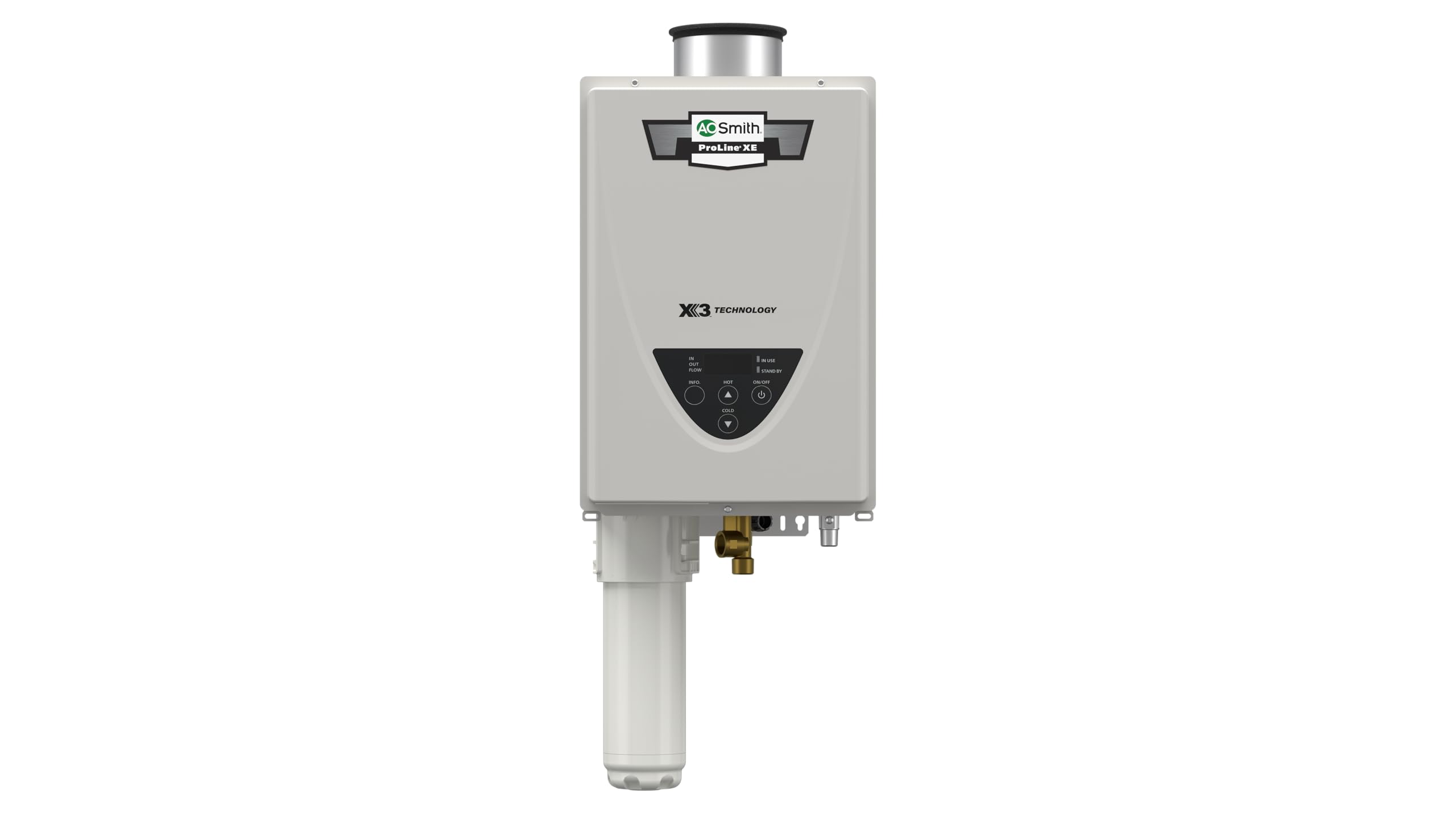
What sets the A. O. Smith ATI-310CX3 apart is its X3 Scale Prevention Technology, which eliminates the need for annual descaling and isolation valves — a major pain point for tankless owners in hard water regions. With an 8.0 GPM flow rate powered by a 190,000 BTU commercial-grade copper heat exchanger, this unit is well-suited for 2-3 bathroom homes. The copper heat exchanger delivers 25x better heat transfer compared to steel, translating to faster heat-up and stable water temperatures.
The unit runs quietly, as multiple verified purchasers note, and includes a propane conversion kit right in the box — a convenience many competing brands charge extra for. The integrated temperature controls and advanced diagnostics panel make setup straightforward for a qualified technician. Users report professional installations taking less than half a day, with plumbers praising the build quality and compact 20.5-inch height that fits tight spaces.
One nuance mentioned by users in warmer climates: if incoming water is already above 80°F, some shower balancing valves can trick the unit into shutting off because the internal thermostat sees a high inlet temperature. This is solved with a simple cold water restrictor, but it is worth knowing before installation. The warranty is solid at 15 years on the heat exchanger for residential use, matching Rinnai’s standard.
Why it’s great
- X3 scale prevention eliminates descaling maintenance
- Commercial-grade copper heat exchanger for superior heat transfer
- Includes propane conversion kit in the box
- Compact 20.5-inch height fits small spaces
Good to know
- May require cold water restrictor in warm inlet conditions
- 8.0 GPM is sufficient for 2-3 baths but not larger homes
- Professional installation strongly recommended
5. Rheem RTG-84XLN-3 High Efficiency Outdoor Tankless Water Heater
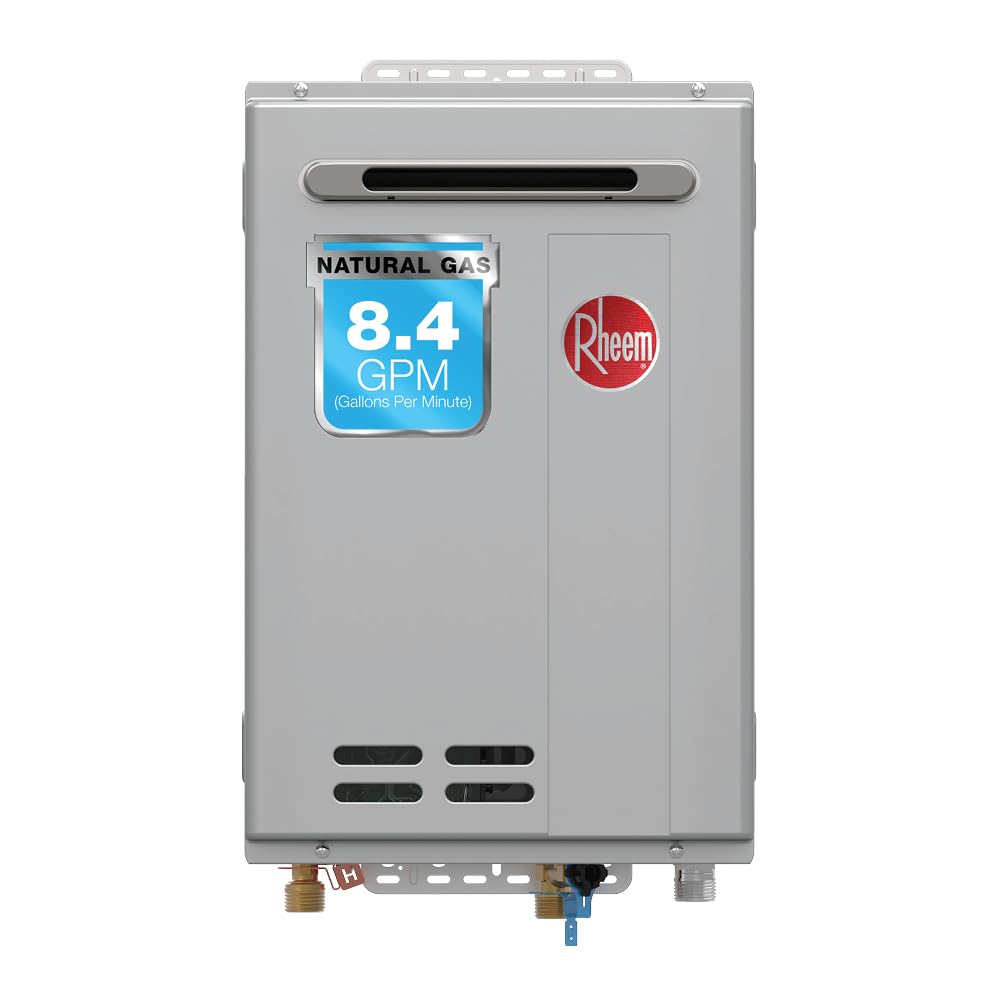
The Rheem RTG-84XLN-3 offers an 8.4 GPM flow rate with 180,000 BTU input in an outdoor-rated cabinet, making it a strong choice for homeowners who want to avoid cutting vents through their roof or sidewall. This non-condensing unit is designed to mount on an exterior wall, eliminating the need for Category III venting entirely and simplifying installation. Its compact 20.75-inch height and 39.25-pound weight make it one of the lighter and smaller units in its flow class.
Rheem’s Hot-Start programming is built in to prevent the cold water sandwich effect commonly experienced with tankless heaters when there are back-to-back showers. Verified purchasers running this unit in two-to-three-bathroom homes consistently report that it keeps up without noticeable temperature drops when the washing machine and shower run concurrently. The altitude adjustment feature is also appreciated by users in mountain communities who found that earlier units struggled at high elevation.
Because this is an outdoor model, you must protect it from direct exposure to rain and snow — it should be installed under an eave or in a sheltered spot. Some users note that the water takes slightly longer to heat up compared to a tank-style heater (typical for all tankless units), but once the burner engages, the hot water is continuous. The 1-year labor, 15-year heat exchanger, and 5-year parts warranty provide solid coverage for the mid-range price point.
Why it’s great
- Outdoor installation saves indoor space and venting costs
- Lightweight at 39.25 lbs for easy wall mounting
- Hot-Start programming prevents cold water bursts
- Altitude adjustment for high-elevation homes
Good to know
- Requires sheltered outdoor location from rain/snow
- Slower hot water arrival compared to tank-style units
- Non-condensing design means lower UEF than condensing models
6. Rheem RTG-84DVLP-3 Indoor Propane Tankless Water Heater
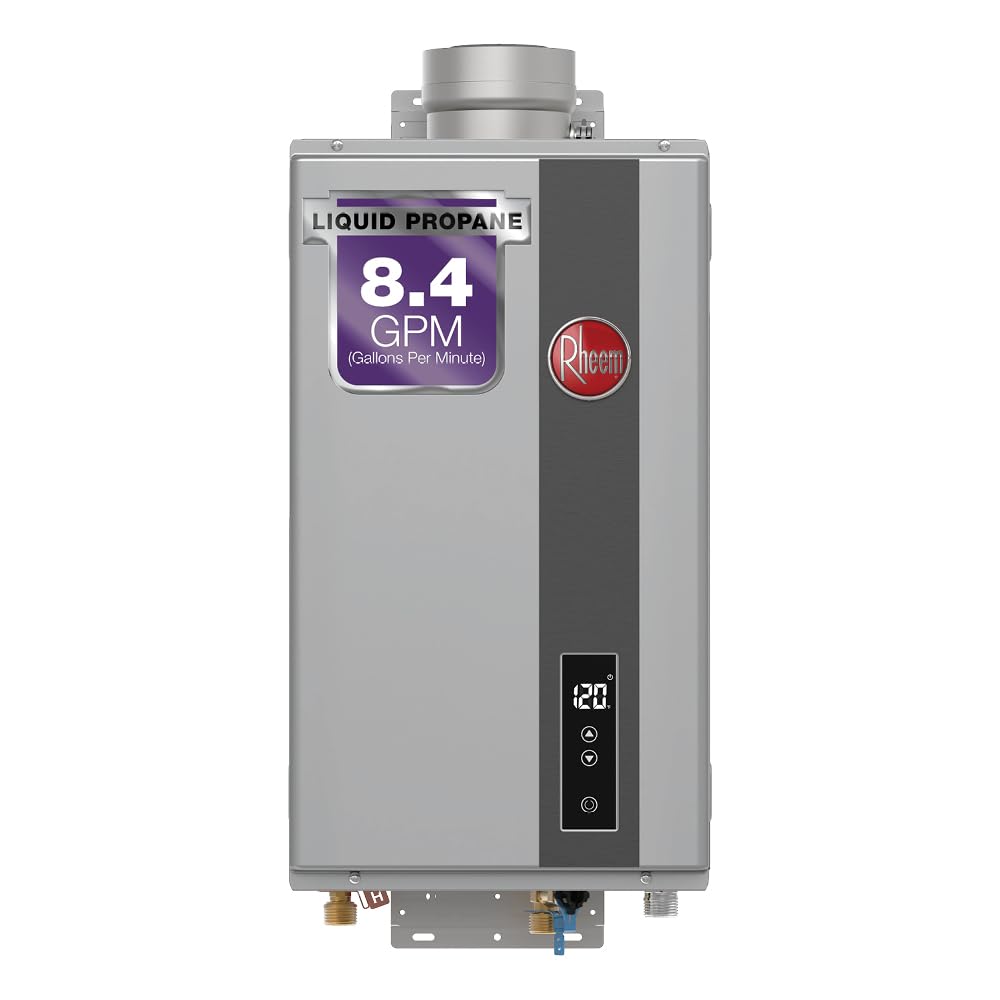
The RTG-84DVLP-3 is the liquid propane sibling of the outdoor model above, designed specifically for indoor installation. Its 8.4 GPM capacity at 180,000 BTU is the same power plant, making it equally capable of handling 2-3 bathroom homes with propane as the fuel source. The non-condensing design requires Category III venting, but users appreciate that Rheem’s venting kits are readily available and straightforward for qualified installers.
Customer feedback highlights the transition from an old tank-style water heater to this Rheem as a major convenience upgrade — no more scheduling showers around recovery time. The Hot-Start feature is specifically called out as effective at eliminating cold temperature fluctuations during back-to-back uses. Owners of the propane version also note that the gas gauge on their tank barely moves, indicating efficient combustion even after installing the unit in mid-sized homes.
There are mixed reviews on long-term reliability, with a few users reporting error codes and premature failure within 6 months. The stainless steel heat exchanger carries a 15-year warranty for residential use, which provides some protection against manufacturing defects. Consistent professional installation and proper gas line sizing (3/4 inch minimum) are critical to avoiding operational issues.
Why it’s great
- 8.4 GPM with propane fuel — ideal for off-gas-grid homes
- Hot-Start programming eliminates cold water sandwich
- Efficient propane consumption — users report minimal tank gauge drop
- Stainless steel heat exchanger with 15-year warranty
Good to know
- Requires Category III venting for indoor installation
- Some early failure reports — proper gas line sizing essential
- Slower temperature ramp than condensing units
7. Rheem RTG-84XLP-3 Outdoor Propane Tankless Water Heater
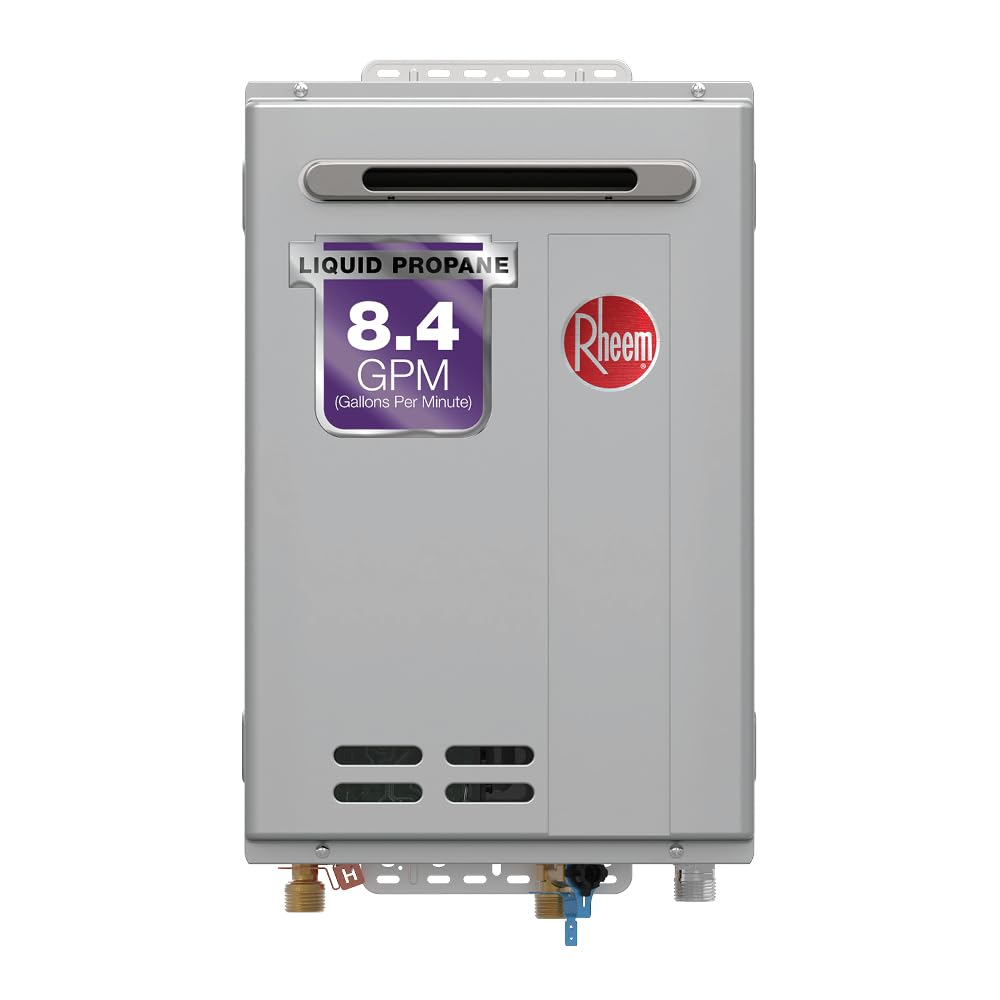
The RTG-84XLP-3 fills the specific niche of an outdoor propane tankless water heater, making it a favorite for cabins, rural homes, and properties where running a vent through the wall is impractical. It shares the same 8.4 GPM / 180,000 BTU internal specs as its indoor counterpart but in a weather-resistant outdoor cabinet that weighs just 39.25 pounds. Eliminating the venting requirement reduces installation complexity and cost significantly.
Users report that the unit provides excellent hot water supply for 2-3 bathroom homes, and the outdoor placement frees up valuable floor space that would otherwise be occupied by a tank. The unit includes Rheem’s Hot-Start programming and altitude adjustment, both of which are appreciated by owners. Some verified purchasers note that adding an external recirculation pump and timer dramatically reduces water waste while waiting for hot water in larger homes.
However, a notable subset of reviewers report persistent Error Code 11 (ignition failure) on this specific model, with some users unable to resolve the issue even after replacing the propane regulator. This appears to be a batch-specific problem, as the majority of reviews are positive, but it is a risk to consider. If you are in a remote or rural area, make sure your propane tank has a high-capacity regulator (not a standard BBQ regulator) to supply enough gas pressure for the 180,000 BTU burner.
Why it’s great
- Outdoor LP installation eliminates venting costs and indoor space waste
- Lightweight 39.25 lbs for easy mounting
- Hot-Start and altitude adjustment features included
- Frees up indoor floor space
Good to know
- Error Code 11 reported by some users — batch quality concern
- Requires high-capacity propane regulator for proper operation
- Must be sheltered from direct rain and snow
8. Rinnai RX130iN Condensing Smart Sense Tankless Water Heater

The RX130iN is the smaller sibling in Rinnai’s condensing lineup, delivering 7.1 GPM at 130,000 BTU with an impressive UEF of .97. This unit is ideal for homes with 2-3 bathrooms and moderate simultaneous demand, or for buyers who want Rinnai’s top-tier efficiency at a more accessible price than the big 11.1 GPM models. Its lower BTU rating means it is best suited to warmer climates where groundwater temperatures are above 50°F — in cold northern regions, the flow rate will be effectively reduced.
Like the larger RX199iN, this unit uses Versa Vent technology for indoor or outdoor installation and Smart Sense gas control for automatic fuel-type detection. Users who installed this in alpine climates report it handles two showers plus a dishwasher in 10°F weather without issues, as long as the incoming water temperature is accounted for. The Quick Flush feature simplifies maintenance, and the compact size (19 x 31 inches) makes it easy to mount in tight utility spaces.
A few users note that this unit takes about 50% longer to bring water up to temperature compared to their previous tankless heater, which is consistent with the lower BTU rating. The trade-off is exceptional efficiency that translates to noticeably lower gas bills. Professional installation is recommended, especially if you need to upgrade the gas line to 3/4 inch. The unit does not include flush valves or a pressure relief valve in the box, so budget an extra for these essentials.
Why it’s great
- UEF .97 condensing efficiency for low gas consumption
- Indoor/outdoor installation flexibility with Versa Vent
- Smart Sense automatically detects NG or LP fuel
- Compact design for tight installation spaces
Good to know
- 130,000 BTU limits performance in very cold groundwater regions
- Slower heat-up time than higher BTU units
- No flush valves or pressure relief included
9. Rheem RTG-70DVLN-3 Indoor Natural Gas Tankless Water Heater
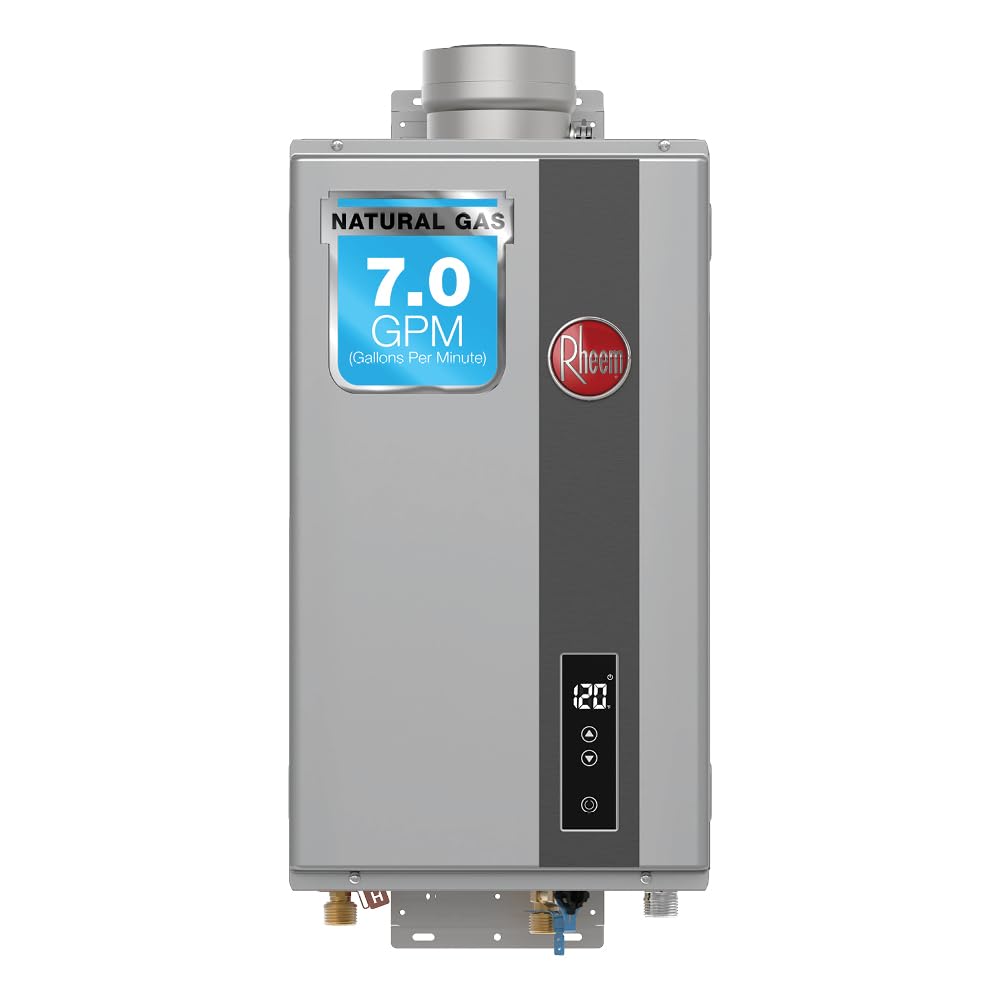
The RTG-70DVLN-3 is Rheem’s entry-level 7.0 GPM indoor natural gas tankless unit. At 160,000 BTU, it provides enough hot water for 2-3 bathroom homes with moderate simultaneous usage — think two showers running with the dishwasher. This is a non-condensing model that requires Category III venting, but its lower upfront cost makes it an attractive option for homeowners who want to go tankless without spending into the premium tier.
Users consistently praise this unit for its reliable performance with older, undersized piping — a common pain point in older homes where upgrading the plumbing is prohibitively expensive. The Hot-Start programming prevents the cold water sandwich, and the altitude adjustment works well for homes above 5,000 feet. Verified purchasers report smooth DIY installations when they follow Rheem’s venting guidelines carefully, though professional installation is always recommended for gas appliances.
The main complaint across reviews is the time it takes for hot water to reach the faucet, with some users noting a 30-60 second delay depending on the distance from the heater to the fixture. This is inherent to all tankless designs, but it is more noticeable with the 7.0 GPM unit when the flow rate is pushed near its limit. The warranty package (1 year labor, 15 year heat exchanger, 5 year parts) matches the industry standard and provides adequate protection for the mid-range price.
Why it’s great
- Budget-friendly entry into tankless with reliable Rheem build
- Works well with undersized or older household piping
- Altitude adjustment for high-elevation homes
- Solid 15-year heat exchanger warranty
Good to know
- 7.0 GPM may struggle with 3+ simultaneous fixtures
- Noticeable delay for hot water at far faucets
- Non-condensing — requires Category III venting
10. Rheem RTG-70DVLP-3 Indoor Propane Tankless Water Heater
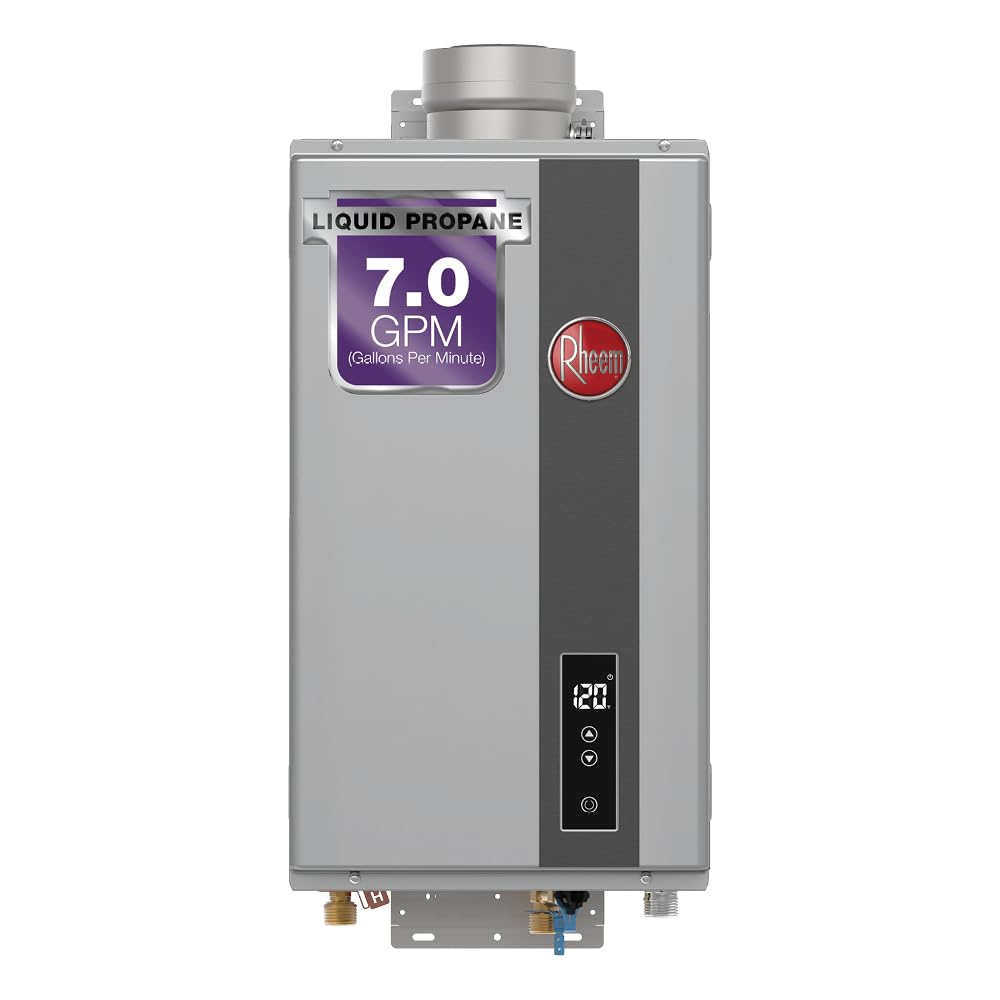
The RTG-70DVLP-3 is the propane version of the entry-level Rheem, offering the same 7.0 GPM at 160,000 BTU in an indoor-rated cabinet for homes using liquid propane. It fills the same role — providing endless hot water for a 2-3 bathroom home at a budget-friendly entry point — but with the fuel flexibility needed for properties without natural gas hookups. Like the natural gas sibling, it is a non-condensing design requiring Category III venting.
DIY-installing users have reported success using Rheem’s venting kit and connecting to a 100-pound propane tank with a 3/4-inch black iron pipe and a high-quality regulator. One family of six (two adults, four children with long showers) reported that a 100-pound tank lasted about a month, which is reasonable for a 7.0 GPM unit. The Hot-Start programming again helps prevent cold bursts during back-to-back showers, a common concern for tankless new converts.
However, this model has a higher rate of critical negative reviews than its natural gas counterpart. Complaints include ignition failures, loud operation, and what one reviewer called “cold spots” throughout the water flow. Some of these issues appear to be linked to insufficient gas line sizing or incorrect regulators — using a standard BBQ regulator on a 160,000 BTU unit will cause starved flow and ignition problems. If you choose this unit, ensure your plumber installs a house-type high-capacity regulator and a proper 3/4-inch gas line.
Why it’s great
- Budget-friendly propane tankless option for off-gas-grid homes
- Hot-Start programming minimizes cold water sandwich
- Works with undersized plumbing for retrofit installations
- Compact indoor design saves floor space
Good to know
- Higher rate of negative reviews — batch quality or install-dependent
- Requires high-capacity regulator, not standard BBQ type
- Some users report noisy operation and ignition error codes
- 7.0 GPM capacity limits simultaneous high-demand use
FAQ
What size tankless water heater replaces a 50 gallon tank?
Can a tankless water heater supply enough hot water for a large family?
What venting does a non-condensing tankless water heater require?
Why does my tankless water heater take so long to deliver hot water?
Can I install a tankless water heater myself?
Final Thoughts: The Verdict
For most users, the best 50 gallon gas water heater winner is the Rinnai RX199iN because its 11.1 GPM flow rate, UEF .98 condensing efficiency, and indoor/outdoor installation flexibility cover the widest range of household sizes and climates. If you want the ultimate built-in scale prevention for hard water, grab the A. O. Smith ATI-310CX3. And for a budget-minded entry that still delivers Rinnai reliability, the Rinnai RX130iN gives you condensing efficiency at a smaller price.

Mo Maruf
I created WellFizz to bridge the gap between vague wellness advice and actionable solutions. My mission is simple: to decode the research and give you practical tools you can actually use.
Beyond the data, I am a passionate traveler. I believe that stepping away from the screen to explore new environments is essential for mental clarity and physical vitality.