Our readers keep the lights on and my smoothie glass nicely filled. As an Amazon Associate, I earn from qualifying purchases.
The heart of any home cinema is the receiver, but a 5.2 channel setup is a specific beast. You’re not just buying volume; you’re buying clarity, control, and the ability to make two subwoofers disappear into the room. The line between a good movie night and a genuinely immersive experience runs straight through this component.
I’m Mohammad Maruf — the founder and writer behind WellFizz. This guide comes from hundreds of hours pouring over technical sheets, decoding customer firmware complaints, and separating genuine performance specs from marketing noise that plagues the AV receiver market.
Whether you’re upgrading from a soundbar or building your first dedicated space, finding the best 5.2 receiver means understanding how HDMI 2.1 bandwidth, room correction, and power delivery actually work together to serve your specific speakers and room.
How To Choose The Best 5.2 Receiver
A 5.2 receiver is a precision tool, not a blunt object. You are paying for the ability to manage two independent subwoofer channels, which requires far more sophisticated signal processing than a single sub output. The wrong choice here leaves your bass muddy, your dialogue mumbled, and your gaming input lagging.
Power vs. Sensitivity: The Real Equation
A receiver rated at 75 watts per channel might drive a pair of 90dB sensitive speakers to ear-splitting levels, while a 100-watt receiver can struggle with 86dB speakers. The spec to watch is power into 8 ohms with both channels driven, and the damping factor which controls low-frequency driver control. High-end units like the Onkyo TX-RZ30 deliver massive current reserves that make low-sensitivity speakers sing.
Room Correction Is Non-Negotiable for Dual Subs
Without proper room correction, two subwoofers can cancel each other out at your listening position, creating nulls that destroy punch. YPAO (Yamaha), AccuEQ (Pioneer/Onkyo), and Audyssey MultEQ XT32 (Denon/Marantz) are not equal. The Onkyo TX-RZ30 ships with Dirac Live, which is widely considered the most flexible and precise system for taming room modes and integrating dual subwoofers seamlessly.
HDMI 2.1: Future-Proofing for Gamers
If you own a PlayStation 5 or Xbox Series X, HDMI 2.1 bandwidth (40Gbps+) is critical for 4K at 120Hz with variable refresh rate. Models like the Yamaha RX-V6A and Pioneer VSX-935 include these ports, while the Marantz NR1510 tops out at 4K/60Hz. For pure movie streaming without gaming, HDMI 2.0b with eARC is still fully capable of Dolby Atmos TrueHD.
Quick Comparison
On smaller screens, swipe sideways to see the full table.
| Model | Category | Best For | Key Spec | Amazon |
|---|---|---|---|---|
| Onkyo TX-RZ30 | Premium Flagship | Best Overall Performance | Dirac Live + 100W/ch (8 ohms) | Amazon |
| Marantz Cinema 70S | Premium Slim | Compact High-End Setup | HDAM + 50W/ch (8 ohms) | Amazon |
| Denon AVR-S670H | Mid-Range | Best Value Feature Set | HEOS + 75W/ch (8 ohms) | Amazon |
| Onkyo TX-NR6100 | Mid-Range | THX Certified Gaming Rig | THX Select + 210W dynamic/ch | Amazon |
| Yamaha RX-V6A | Mid-Range | MusicCast Multi-Room | YPAO R.S.C. + 7.2 expandable | Amazon |
| Marantz NR1510 | Mid-Range Slim | Ultra-Compact 5.2 System | 4″ tall + phono input | Amazon |
| JBL MA510 | Mid-Range | 8K Passthrough Simplicity | 75W/ch + Chromecast/Airplay | Amazon |
| Pioneer VSX-935 | Mid-Range | Budget Atmos Virtualization | Dolby Height Virtualization | Amazon |
| Yamaha RX-V4A | Entry-Level | Best Budget for Music | MusicCast + 8K60 support | Amazon |
| Sony STRDH590 | Entry-Level | Simplest Setup Experience | S-Force PRO + 4K ARC | Amazon |
| JBL MA310 | Entry-Level | Affordable JBL Integration | 60W/ch + shallow chassis | Amazon |
In‑Depth Reviews
1. Onkyo TX-RZ30 9.2-Channel AV Receiver

The TX-RZ30 is the definitive top-tier choice for a 5.2 configuration, despite being a 9.2 channel receiver. Its custom low-noise power transformers and smoothing capacitors deliver a frequency response from 5 Hz to 100 kHz, giving dual subwoofers the authority to pressurize a room without distortion. The included Dirac Live Full Bandwidth license is a game-changer for integrating two independent subwoofers, automatically measuring and correcting phase and timing issues that smaller receivers leave for you to guess at.
Owner reports consistently highlight the clarity and soundstage improvement over previous Denon and Onkyo models. The Klipsch Optimize Mode automatically sets precise crossover values for Reference Premiere speakers, making pairing straightforward. The unit runs slightly warmer than average, so a ventilated cabinet is recommended. For 5.2 setups, the remaining channels can be assigned to Zone 2 or bi-amping front speakers.
The combination of Dirac Live, a 100-watt per channel discrete amplifier section, and THX certification makes this the most capable receiver in this lineup for critical listeners. The dual subwoofer outputs each receive independent EQ through Dirac, solving the cancellation null problem that plagues many 5.2 rigs. If budget allows, this is the benchmark.
Why it’s great
- Dirac Live Full Bandwidth license included, transforms subwoofer integration
- 100W per channel into 8 ohms with high current reserve for low-sensitivity speakers
- 9.2 channel flexibility allows bi-amping or Zone 2 in a 5.2 setup
Good to know
- Runs hot; adequate ventilation is mandatory
- Firmware update required out of box for full functionality
2. Marantz Cinema 70S 7.2-Ch Receiver

The Cinema 70S packs Marantz’s legendary HDAM (Hyper Dynamic Amplifier Module) discrete circuitry into a chassis that is nearly half the height of traditional receivers. At 50 watts per channel into 8 ohms, it is not a brute-force amp, but its current feedback design provides exceptional detail and warmth that makes music sound richer than the spec sheet suggests. For a 5.2 setup in a medium-sized room with efficient speakers, this is more than adequate.
Dolby Atmos Height Virtualization and DTS Virtual:X create overhead effects without height speakers, which is a useful trick for 5.2 users who cannot install ceiling channels. The Audyssey MultEQ XT32 room correction is excellent at smoothing bass response from the two subwoofer outputs. Owners consistently praise the ease of setup and the immediate improvement in dialogue clarity compared to older receivers.
The 4K/120Hz and 8K/60Hz pass-through makes it fully compatible with the latest gaming consoles, though the slim chassis limits the power transformer size. Pair this with speakers rated at 88dB sensitivity or higher for best results. The HEOS multi-room streaming is reliable and integrates seamlessly with Spotify and TIDAL.
Why it’s great
- HDAM circuitry delivers warm, detailed sound signature
- Audyssey MultEQ XT32 room calibration handles dual subs well
- Slim 4-inch tall chassis fits tight AV cabinets
Good to know
- 50W per channel limits pairing with low-sensitivity speakers
- Network app control can be inconsistent
3. Denon AVR-S670H 5.2 Ch Home Theater Receiver

The AVR-S670H is the sweet spot for buyers who want modern features without paying for premium branding. It delivers 75 watts per channel into 8 ohms, which is ample power for most bookshelf and tower speakers in a 5.2 layout. The inclusion of 8K/60Hz and 4K/120Hz pass-through with HDCP 2.3 ensures compatibility with the latest streaming devices and gaming consoles.
HEOS multi-room support allows you to stream music to other Denon or Marantz wireless speakers, and the built-in Bluetooth and Wi-Fi make setup straightforward. Owners report that the Audyssey speaker calibration (the basic version) works well for a 5.2 setup, correcting distance and level automatically. The phono input is a welcome addition for vinyl enthusiasts building a hybrid system.
The main caveat is that the basic Audyssey version does not offer the detailed EQ control of the XT32 found on higher-tier models, but for the price point it is remarkably effective. The unit is well-built and runs at a reasonable temperature. For a dedicated 5.2 system without plans to expand, this is a smart, balanced investment.
Why it’s great
- Excellent value with 8K/60Hz and 4K/120Hz support
- Phono input for turntable integration
- Easy setup with on-screen calibration
Good to know
- Basic Audyssey lacks detailed EQ fine-tuning
- HEOS wireless streaming can have occasional lag
4. Onkyo TX-NR6100 7.2 Channel THX Certified Network AV Receiver
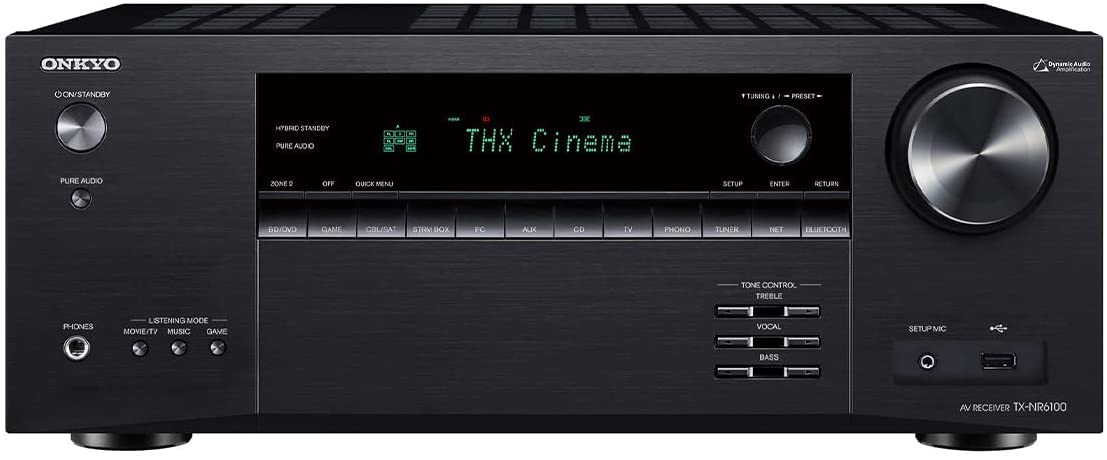
The TX-NR6100 brings THX Select certification to a 5.2.2 configuration, meaning it has been independently tested to deliver reference-level sound in a medium-sized room. Its dynamic power rating of 210 watts per channel (6 ohms, 1 kHz, 10% THD) indicates massive current headroom for explosive movie scenes and game audio. The HDMI 2.1 ports (40Gbps) support 4K/120Hz for the Xbox Series X and PS5 with VRR and ALLM.
Owners consistently highlight the excellent upscaling and seamless HDMI switching, as well as the powerful amplifier that easily drives Klipsch and KEF speakers to high volumes without strain. The built-in AccuEQ room calibration does a solid job with dual subwoofers, though it lacks the granularity of Dirac Live. The unit includes IMAX Enhanced certification for those with compatible discs and streaming services.
The remote is notably flimsy, and some units have reported HDMI 2.1 failure after extended use. The fan can be audible in quiet passages. For a pure gaming and movie 5.2 system where power and THX assurance are the priority, this is a compelling mid-range option.
Why it’s great
- THX Select certification ensures reference-level performance
- Full HDMI 2.1 bandwidth for 4K/120Hz gaming
- High dynamic power headroom for explosive sound
Good to know
- Some reports of HDMI 2.1 port failure over time
- Audible fan noise in quiet scenes
5. YAMAHA RX-V6A 7.2-Channel AV Receiver with MusicCast

The RX-V6A is Yamaha’s most popular mid-range offering, and for good reason. Its YPAO R.S.C. (Reflected Sound Control) room correction is one of the few systems that measures and corrects early reflections, a common problem in rooms with hard floors or large windows. This directly translates to better dialogue clarity and soundstage precision in a 5.2 setup.
MusicCast multi-room support is among the best in the industry, with native support for Pandora, Spotify, TIDAL, Qobuz, and Amazon Music HD. Owners praise the high slew rate amplifier design which provides detailed, dynamic sound that works well with both music and movies. The seven HDMI inputs (three 8K, four 4K) offer generous connectivity for all modern sources.
The learning curve for the initial setup is steeper than some competitors, and the remote has small buttons that can be frustrating. The dual subwoofer outputs are treated as a summed mono signal, not independently EQ’d, which is a limitation for serious 5.2 builders. For music lovers and multi-room users, this is a strong mid-range pick.
Why it’s great
- YPAO R.S.C. corrects early reflections for precise soundstage
- MusicCast multi-room support with extensive streaming services
- High slew rate amplifier for detailed dynamics
Good to know
- Dual sub outputs are summed mono, not independent
- Remote has small, hard-to-feel buttons
6. Marantz NR1510 UHD AV Receiver – Slim 5.2 Channel

At just 4 inches tall, the NR1510 is the smallest 5.2 channel receiver in this guide, but it does not sacrifice connectivity. It includes a built-in MM phono preamp for vinyl turntables, six HDMI inputs with HDCP 2.2, and HEOS wireless multi-room streaming. It delivers 50 watts per channel into 8 ohms, which is best matched with high-efficiency speakers.
Owners consistently describe the sound quality as phenomenal for its size, noting that it breathes new life into older speakers. The Audyssey MultEQ room calibration is effective for a single listening position, and the setup assistant is genuinely user-friendly. The compact size runs surprisingly cool compared to larger receivers, making it suitable for enclosed entertainment centers.
The biggest limitation is the lack of HDMI 2.1 — it tops out at 4K/60Hz. It also lacks height channel support for Dolby Atmos, but for a pure 5.2 music and home theater system without gaming at 120Hz, this remains a top-tier compact solution. The USB port stays powered even when the unit is off, which is a minor convenience for charging.
Why it’s great
- Ultra-compact 4-inch tall chassis fits any cabinet
- Built-in MM phono input for turntables
- Runs cool, safe for enclosed spaces
Good to know
- No HDMI 2.1; limited to 4K/60Hz
- No Dolby Atmos height channel support
7. JBL MA510 5.2 Channel (75 Watt x 5) 8K AV Receiver

The MA510 is JBL’s mid-range 5.2 channel receiver that offers a clean, modern feature set with 8K/60Hz and 4K/120Hz eARC support. Its 75 watts per channel into 8 ohms is conservative but clean, and the shallow 4.3-inch chassis is a good fit for media consoles where depth is limited. Native 5-channel Dolby and DTS decoding provides straightforward surround sound without unnecessary complexity.
Network streaming via Apple Airplay 2, Google Chromecast, and Bluetooth 5.1 makes it versatile for multi-platform households. Owners report excellent sound quality driving Polk and Athena speakers, with clear dialogue and punchy bass. The on-screen setup menu is considered one of the easiest to navigate, though the initial firmware update is required and can cause initial confusion.
The remote lacks a backlight, which is a common complaint in dark home theater environments. The auto shut-off timer defaults to 20 minutes and must be manually changed in the menu. The MA510 also does not support mixing down DTS-HD Master Audio to 2.1 for simpler speaker configurations. For a straightforward, high-value 5.2 receiver with 8K passthrough, it delivers.
Why it’s great
- 8K/60Hz and 4K/120Hz eARC support included
- Shallow chassis fits tight media consoles
- Easy on-screen setup with intuitive menus
Good to know
- Remote is not backlit; difficult in dark rooms
- Does not downmix DTS-HD Master to 2.1
8. Pioneer VSX-935 7.2 Channel Surround Sound Network Receiver
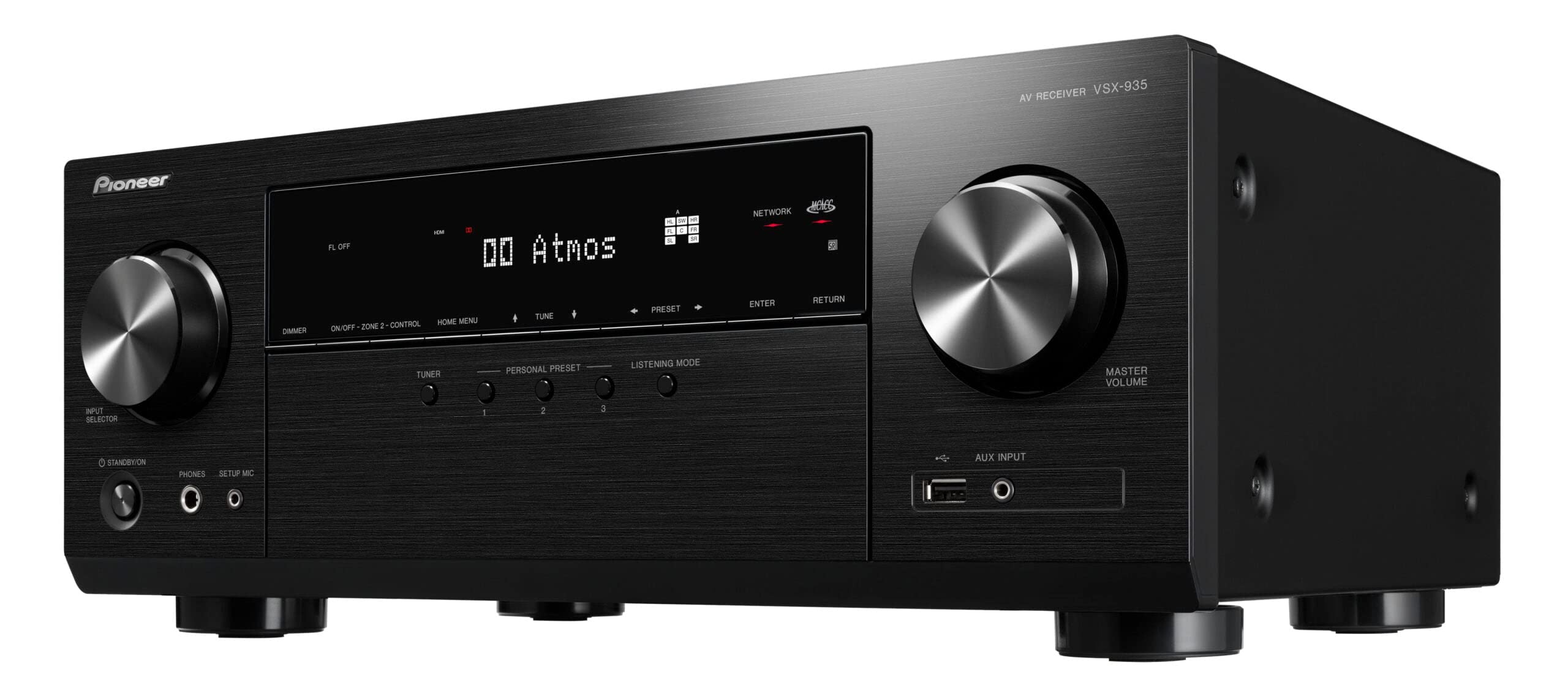
The VSX-935 is a 7.2 channel receiver that works perfectly in a 5.2 configuration, with the extra channels available for bi-amping front speakers or powering a second zone. It supports HDMI 2.1 with 8K/60Hz and 4K/120Hz pass-through, making it gaming-friendly. The Dolby Atmos Height Virtualization is a key feature for 5.2 users who want overhead effects without installing ceiling speakers.
Owners consistently praise the crisp, clean sound quality and the RF remote that works without line-of-sight. The clear display with adjustable dimmer is a small but appreciated touch. The MCACC room calibration system provides good baseline EQ, though it is not as sophisticated as Dirac or YPAO R.S.C.
The biggest pain point is the unreliable Bluetooth functionality, which has no dedicated button and requires navigating through menus. Some units have arrived with defects, though most are resolved under warranty. The on-screen interface looks dated. For value-conscious buyers seeking Atmos virtualization and HDMI 2.1 in a 5.2 system, this is a solid mid-range pick.
Why it’s great
- Dolby Atmos Height Virtualization for 5.2 without ceiling speakers
- Full HDMI 2.1 bandwidth for 4K/120Hz gaming
- RF remote works without line-of-sight
Good to know
- Bluetooth implementation is unreliable and menu-heavy
- MCACC room correction is basic compared to competitors
9. YAMAHA RX-V4A 5.2-Channel AV Receiver with MusicCast

The RX-V4A is the entry point into Yamaha’s MusicCast ecosystem, offering the same powerful multi-room streaming platform as its more expensive siblings. It delivers 80 watts per channel into 8 ohms, which is surprisingly robust for this price tier. The inclusion of 8K/60B and 4K/120AB HDMI 2.1 inputs is rare at this level, making it a future-proof budget option for gamers.
YPAO automatic room calibration provides quick and effective speaker setup, and the Spotify Connect and AirPlay 2 integration are seamless. Owners driving sensitive speakers like Klipsch report excellent detail and clarity, with enough power for a medium-sized room. The mic calibration is praised for detecting wiring phase issues automatically.
The major drawback is the HDMI switching reliability, with some users experiencing failure to pass video signals or audio via ARC. The remote is small and the buttons are hard to differentiate by touch. The dual subwoofer outputs are a single summed signal, not independently configurable. For a budget-conscious 5.2 build with MusicCast, this is a strong contender.
Why it’s great
- MusicCast multi-room platform at a budget price point
- HDMI 2.1 inputs with 8K/60 and 4K/120 support
- YPAO calibration detects wiring phase errors
Good to know
- HDMI switching can be unreliable for some users
- Dual sub outputs are summed mono, not independent
10. Sony STRDH590 5.2 Channel Surround Sound Home Theater Receiver
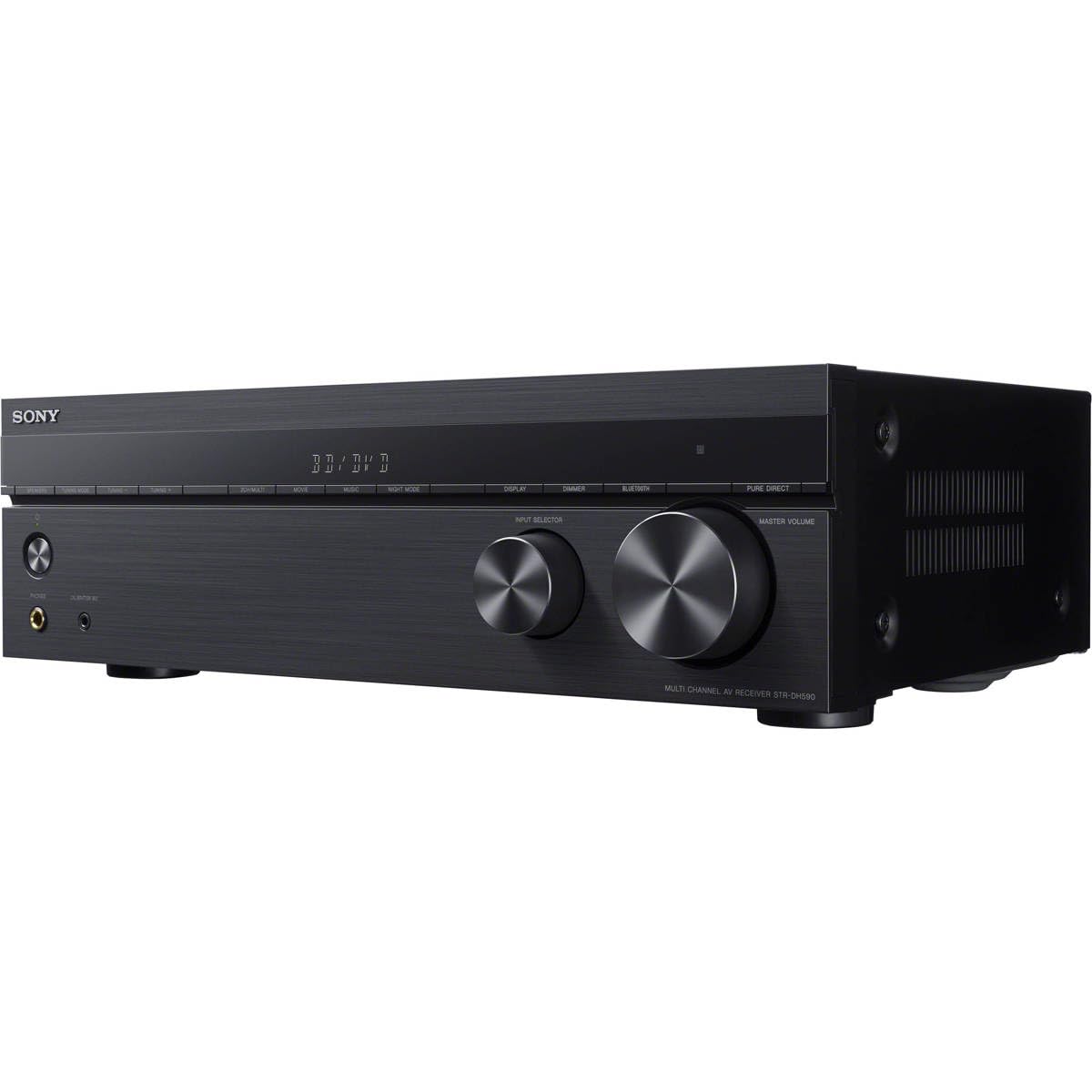
The STRDH590 is Sony’s straightforward 5.2 channel receiver designed for simplicity and reliability. It delivers 725W total system power (145W per channel into 6 ohms at 1 kHz, 0.9% THD) which translates to adequate volume for most living rooms. The S-Force PRO virtual surround sound creates a convincing soundfield from just a 2.0 speaker setup, which is a useful feature for users who start with a basic configuration.
Four HDMI inputs with HDCP 2.2 support 4K HDR pass-through with Dolby Vision, and the Bluetooth standby feature allows the receiver to wake from your phone. The included calibration microphone makes auto-speaker setup a plug-and-play experience. Owners driving vintage KEF and Radio Shack speakers report excellent sound quality that revives older equipment.
The FM antenna wire is inconvenient, and there is no AM tuner or B speaker outputs. The input jacks on the rear panel are tightly spaced, making thick speaker cables difficult to manage. There is no dedicated dialogue enhancement mode, and dynamic compression must be accessed through the amplifier menu. For a budget-friendly, no-fuss 5.2 entry point, this is a reliable choice.
Why it’s great
- Simple plug-and-play setup with auto calibration mic
- S-Force PRO virtual surround for 2.0 speaker systems
- Reliable 4K HDR pass-through with Dolby Vision
Good to know
- Rear panel input jacks are tightly spaced
- No dedicated dialogue enhancement mode
11. JBL MA310 5.2 Channel (60 Watt x 5) 4K AV Receiver

The MA310 is JBL’s entry-level 5.2 channel receiver, built around a 60 watts per channel amplifier section. It is designed for users who want JBL’s brand reliability and a shallow chassis (5.1 kg weight) without paying for 8K passthrough or advanced streaming features. Four HDMI inputs with ARC support connect to modern TVs, gaming consoles, and streaming devices at 4K resolution.
Owners driving in-wall Polk speakers report that the receiver delivers clean, punchy sound that outperforms its modest power rating. The Bluetooth 5.1 with Low Energy provides stable wireless audio streaming from phones and tablets. The on-screen setup guide is praised for its clarity, though the initial firmware update process can be frustrating for less technical users.
The remote lacks a backlight, which is a significant limitation for home theater use. The unit’s front panel has a bright blue glow that some users find distracting. The auto shut-off timer defaults to 20 minutes and must be manually disabled. For a straightforward, no-nonsense 5.2 receiver at the most accessible price point, this is a capable starting point.
Why it’s great
- Compact and lightweight design (5.1 kg)
- Bluetooth 5.1 with Low Energy for stable streaming
- Clean, straightforward sound for its power class
Good to know
- Remote is not backlit; frustrating in dark rooms
- Bright front panel LED can be distracting
FAQ
What does 5.2 mean in a home theater receiver?
Can I use a 7.2 receiver in a 5.2 setup?
Do I need HDMI 2.1 for a 5.2 receiver?
What is the benefit of independent subwoofer EQ in a 5.2 system?
How much power do I really need for a 5.2 system?
Final Thoughts: The Verdict
For most users, the best 5.2 receiver winner is the Onkyo TX-RZ30 because its Dirac Live room correction and high-current amplifier solve the two hardest problems in a 5.2 setup: subwoofer integration and speaker control. If you want a compact, high-end system with exceptional warmth, grab the Marantz Cinema 70S. And for a budget-friendly 5.2 build with reliable features and easy setup, nothing beats the Denon AVR-S670H.

Mo Maruf
I created WellFizz to bridge the gap between vague wellness advice and actionable solutions. My mission is simple: to decode the research and give you practical tools you can actually use.
Beyond the data, I am a passionate traveler. I believe that stepping away from the screen to explore new environments is essential for mental clarity and physical vitality.