Our readers keep the lights on and my smoothie glass nicely filled. As an Amazon Associate, I earn from qualifying purchases.
Building a dedicated 5.1 surround sound system is the single biggest upgrade you can make to your home cinema experience, unlocking a level of audio immersion that no soundbar, regardless of virtual processing, can truly replicate. You are moving from hearing audio to placing individual footsteps, rain showers, and dialogue within a three-dimensional space around you, a shift that fundamentally changes how you watch movies, play games, and listen to music.
I’m Mohammad Maruf — the founder and writer behind WellFizz. My research dives deep into amplifier continuous power ratings, driver materials like Terylene tweeters and IMG woofers, and the real-world performance of THX-certified signal paths to separate genuine engineering from marketing claims.
This guide covers nine distinct configurations, from high-sensitivity tower systems to compact satellite arrays, so you can confidently select the best 5.1 surround sound system for your room size and listening habits.
How To Choose The Best 5.1 Surround Sound System
Choosing a 5.1 system requires balancing the sensitivity of your speakers, the continuous power output of your receiver, and the physical dimensions of your room. A mismatch in any of these three areas will leave you with either a system that clips before it gets loud or one that cannot fill the space without distortion.
Match Sensitivity to Amplifier Power
Speaker sensitivity is measured in decibels (dB) of output from one watt at one meter. A 90dB speaker needs only one watt to reach moderate volumes, while an 86dB speaker requires double the power for the same volume. Choose a receiver whose continuous power rating (not peak) aligns with your speakers’ sensitivity to avoid distortion at higher listening levels.
Understand Driver Materials and Cabinet Design
The tweeter material — Terylene, aluminum, or silk — determines how crisp and fatigue-free the high frequencies sound. A woofer’s cone material (polypropylene, IMG, or woven glass fiber) affects midrange warmth and punch. MDF cabinets with internal bracing reduce resonance and unwanted vibration, delivering cleaner audio at louder volumes.
Timbre Matching Across Channels
As sound pans from the left front to the center and then to the surround channels, every speaker in the chain should share the same sonic signature. Timbre-matched series from one brand ensure that the voice, footsteps, or car engine sound identical as they move around you, making the soundscape feel natural and unbroken.
Quick Comparison
On smaller screens, swipe sideways to see the full table.
| Model | Category | Best For | Key Spec | Amazon |
|---|---|---|---|---|
| Klipsch Reference 5.1 Pack | Full Package | Large rooms and floorstanding power | 96dB sensitivity, 400W sub | Amazon |
| Fluance Elite SX51WR | Full Package | Timbre-matched 3-way tower system | 10″ sub, 3-way towers | Amazon |
| Definitive ProCinema 6D | Satellite System | Compact spaces needing big bass | 250W sub with BDSS drivers | Amazon |
| Klipsch Cinema Dolby Atmos 5.1.4 | Full Package | Height effects from satellites | 10″ sub, up-firing drivers | Amazon |
| Denon AVR-S670H | AV Receiver | 8K passthrough and HEOS streaming | 75W x 5, 8K HDMI | Amazon |
| Onkyo TX-NR6100 | AV Receiver | THX Certified and 8K gaming | 210W/ch dynamic, THX Select | Amazon |
| Yamaha RX-V385 | AV Receiver | Entry-level with YPAO calibration | 5.1 ch, 4K passthrough | Amazon |
| Polk ES15 Pair | Bookshelf Pair | Desktop or front-channel clarity | 5.25″ woofer, Power Port | Amazon |
| Polk ES10 Pair | Bookshelf Pair | Surround or elevation channels | 4″ woofer, Power Port | Amazon |
In‑Depth Reviews
1. Klipsch Reference 5.1 Home Theater Pack

The Klipsch Reference 5.1 Pack delivers the highest sensitivity in this guide at 96dB, meaning it produces massive volume from relatively modest amplifier power. The R-620F floorstanding towers use Tractrix horn-loaded tweeters that project high frequencies with precision, while the dual 6.5-inch IMG woofers handle midbass punch cleanly. The R-12SW subwoofer fires a 400-watt, 12-inch driver that pressurizes medium to large rooms with authority.
Surround duties are handled by the R-41M bookshelf speakers, which share the same horn geometry and copper-spun cone material as the towers, ensuring seamless timbre matching as sound moves from front to rear. The R-52C center channel keeps dialogue locked to the screen without sibilance or muddiness. Gold-plated binding posts make secure connections easy with banana plugs or bare wire.
One caution: the plastic mounting screws for the floorstanding speaker bases are brittle and prone to snapping. Several users recommend discarding them and using hardware-store replacements. Once assembled, the system delivers a dynamic, theater-like soundstage that rewards high-bitrate Dolby TrueHD and DTS-HD Master Audio tracks.
Why it’s great
- 96dB sensitivity requires less amplifier power for room-filling sound
- Timbre-matched Tractrix horns across all five channels
- 12-inch, 400W subwoofer delivers deep, tactile bass
Good to know
- Included floorstanding base screws are weak and should be replaced
- 12-inch sub can overpower smaller rooms under 300 square feet
2. Fluance Elite High Definition 5.1 System

The Fluance Elite SX51WR uses a true three-way floorstanding tower design, separating the tweeter, dedicated midrange driver, and woofers into independent acoustic chambers within a braced MDF cabinet. This architecture reduces intermodulation distortion, allowing the midrange to stay clean even when the woofers are pushing hard during explosion-heavy scenes. The natural walnut woodgrain veneer adds a furniture-grade aesthetic that blends into living rooms.
The DB10 powered subwoofer uses a 10-inch driver in a rear-ported enclosure that produces tight, controlled bass rather than boomy one-note thump. After a 20-hour break-in period, the system’s sound opens up, with smoother highs and better-defined low-frequency extension. The surround speakers are two-way designs with a 5-inch woofer, and the center channel uses dual 5-inch woofers for wide horizontal dispersion.
Fluance backs the passive speakers with a lifetime parts and labor warranty, which is exceptional at this tier. The system ships with isolation spikes for the floorstanding towers, though the subwoofer’s auto-on circuit can occasionally trigger on low-level signals. Pair it with a mid-range receiver like the Onkyo TX-NR6100 for optimal power matching.
Why it’s great
- Three-way tower design reduces distortion and improves clarity
- Lifetime warranty on passive speakers
- Natural wood veneer fits home decor
Good to know
- Break-in period of around 20 hours required for optimal sound
- Subwoofer auto-on may be overly sensitive on idle signals
3. Definitive Technology ProCinema 6D

The Definitive Technology ProCinema 6D proves that compact satellite systems can deliver genuine high-fidelity surround sound without occupying half your room. Each satellite and the center channel use Definitive’s patented Balanced Double Surround System (BDSS) drivers, which increase cone excursion by up to 6dB compared to standard drivers of the same size. Passive bass radiators are integrated into each satellite, extending low-frequency response down to an impressive 45Hz given the 3.25-inch woofer dimensions.
The powered subwoofer houses a forward-firing 250-watt amplifier driving a long-throw 8-inch driver, with dual 8-inch passive radiators on the side panels. This arrangement produces bass output that belies the system’s physical footprint, pressurizing rooms up to 400 square feet with authority. The center channel’s three-driver array (tweeter plus two BDSS woofers) delivers vocal clarity that stays intelligible even during dense action sequences.
Installation is straightforward: the satellites include keyhole slots for wall mounting, and the subwoofer has adjustable crossover and phase controls. The primary trade-off is maximum SPL — the small drivers will compress earlier than floorstanding towers at extreme volumes, so this system suits listening levels between moderate and loud rather than reference-level.
Why it’s great
- BDSS drivers and passive radiators extend bass beyond size expectations
- Compact footprint with wall-mounting options
- Adjustable crossover and phase on subwoofer
Good to know
- Satellites compress at very high volume levels
- Requires an AV receiver for operation
4. Klipsch Reference Cinema Dolby Atmos 5.1.4

This Klipsch Reference Cinema system is built around Dolby Atmos height effects, with four satellite speakers each containing a dedicated up-firing driver. Unlike systems that only have two up-firing front speakers, this configuration places height drivers in both the front and rear satellites, creating a true 5.1.4 bubble of overhead sound. The Tractrix horn-loaded aluminum tweeters ensure that overhead effects like rain, helicopter rotors, and footsteps above are crisp and spatially accurate.
The 10-inch, all-digital subwoofer amplifier delivers punchy low-end that tightens up after a few hours of use. The satellites are larger than typical compact designs, but the plastic cabinet construction keeps weight manageable for wall mounting. The system uses push-lock binding posts that work best with small banana plugs rather than bare wire, and no speaker wire is included in the box.
To extract the full Dolby Atmos effect, you will need a 7.1 or 9.1-capable AV receiver — use the front-specific height outputs for the main up-firing speakers. Crossover settings from the receiver should be set around 80-90Hz for the satellites and 120Hz for the up-firing drivers to keep bass out of the height channels.
Why it’s great
- Four up-firing Atmos speakers for genuine overhead immersion
- Tractrix horn tweeters provide clear, directional highs
- 10-inch subwoofer with solid low-end extension
Good to know
- No speaker wire included — requires 16-gauge wire or banana plugs
- Plastic cabinets do not match the fit and finish of pricier Klipsch wood veneer models
5. Denon AVR-S670H 5.2 Channel Receiver

The Denon AVR-S670H is a 5.2-channel receiver rated at 75 watts per channel (8 ohms, 20Hz–20kHz, two channels driven) and built on Denon’s proven low-noise amplifier platform. It supports 8K/60Hz and 4K/120Hz passthrough with HDR10+, Dolby Vision, and Dynamic HDR, making it fully compatible with the latest gaming consoles and streaming devices. The HEOS wireless multi-room system lets you stream from Spotify, TIDAL, and TuneIn directly to the receiver or to other HEOS-enabled speakers.
Audyssey MultEQ room calibration comes standard, using the included microphone to measure speaker distances, levels, and equalization across multiple listening positions. This automatic correction significantly improves dialogue clarity and bass integration in imperfect rooms. The receiver also features a phono input for turntable users — a rarity at this price tier.
HDMI ARC/eARC simplifies connection to modern TVs: switching the TV on triggers the receiver automatically with a short delay. The HEOS wireless streaming, however, has reported occasional lag and connection drops, making wired ethernet the more reliable option for high-resolution audio. Overall, this is a clean, modern hub for a 5.1 system.
Why it’s great
- 8K/60Hz and 4K/120Hz passthrough with full HDR support
- Audyssey MultEQ room calibration improves sound in challenging spaces
- Phono input for vinyl enthusiasts
Good to know
- HEOS wireless streaming can be unreliable; wired network is recommended
- Only 5.2 channels — cannot expand to 7.1 without upgrading
6. Onkyo TX-NR6100 7.2 Channel Receiver
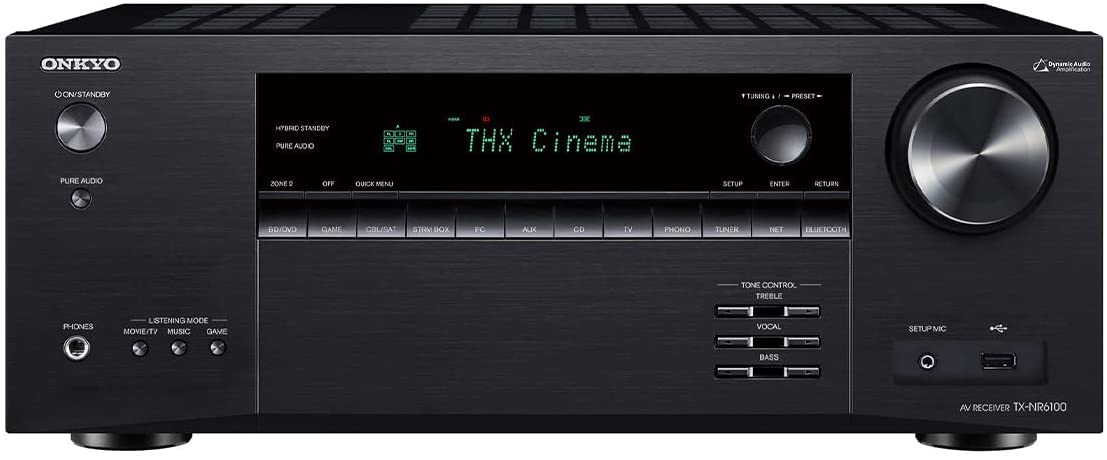
The Onkyo TX-NR6100 is THX Select Certified, meaning it meets strict performance standards for reference-level playback in rooms where the screen-to-listener distance is about 3 to 4 meters. Its dynamic audio amplification system is rated at 210 watts per channel, but the real-world advantage is high current delivery into 4-ohm and 6-ohm loads, which suits demanding tower speakers like the Klipsch Reference series. Three HDMI 2.1 inputs support 40Gbps bandwidth for uncompressed 4K/120Hz gaming.
Dolby Atmos and DTS:X processing supports 5.2.2 configurations, and the receiver includes IMAX Enhanced decoding for compatible discs and streaming content. Onkyo’s AccuEQ calibration with AccuReflex technology aligns the phase of up-firing Atmos speakers with the direct speakers, reducing cancellation at the crossover point. The front-panel display is bright and clear, and the unit includes a dedicated Zone 2 output for multi-room audio.
Some users report that the cooling fan produces an audible hum in very quiet passages, and the remote lacks a backlight. Additionally, a small number of long-term owners have experienced HDMI board failures. THX certification and robust amplifier topology make this a strong choice for high-sensitivity speaker systems, but careful ventilation is required.
Why it’s great
- THX Select Certified for reference-level performance
- High current output for demanding 4-ohm speakers
- Three 40Gbps HDMI 2.1 inputs for gaming consoles
Good to know
- Cooling fan can be audible during quiet scenes
- Limited reports of HDMI board failure after extended use
7. Yamaha RX-V385 5.1 Channel Receiver

The Yamaha RX-V385 is a straightforward 5.1-channel receiver that focuses on the essentials: clean amplification, reliable HDMI switching, and YPAO auto-calibration. It provides four HDMI 2.0 inputs with HDCP 2.2 and one output, supporting 4K Ultra HD passthrough with HDR10, Dolby Vision, and Hybrid Log-Gamma. The amplifier section uses Yamaha’s discrete power stage, producing warm, clear sound across all channels without the harshness common in older budget-class receivers.
Bluetooth connectivity is built-in for streaming from phones and tablets, though it does not include Wi-Fi or multi-room capabilities. The YPAO calibration uses the included microphone to set speaker distances and levels, and it works well enough to correct basic placement errors. The setup menu is displayed on-screen, which simplifies configuration compared to receivers that rely solely on front-panel menus.
One limitation is the lack of front-channel pre-outs, meaning you cannot use the RX-V385 as a processor with external amplifiers. The on-screen manual is available only via QR code — no printed manual is included. For entry-level 5.1 systems paired with high-sensitivity speakers, this receiver delivers reliable performance without wasted complexity.
Why it’s great
- YPAO calibration improves sound in most rooms
- 4K HDR passthrough with HDCP 2.2
- Warm, clean amplifier sound for music and movies
Good to know
- No front pre-outs for external amplification
- Only four HDMI inputs; no eARC support
8. Polk Signature Elite ES15 Speakers (Pair)

The Polk ES15 bookshelf speakers use a 1-inch Terylene tweeter and a 5.25-inch dynamic balance woofer, with Polk’s patented Power Port technology extending downward into the cabinet. This flared port design reduces turbulence and port noise, delivering 3dB more bass output than a conventional port at the same frequency. The result is surprisingly deep low-end for a bookshelf speaker — usable down to about 50Hz in-room — which can serve as a full-range front channel in a smaller system or as a high-quality surround speaker.
The cabinets are built from thick MDF with internal bracing, and the magnetic grilles attach cleanly without visible mounting pins. Sensitivity is rated at 88dB, making the ES15 relatively easy to drive with lower-power receivers like the Yamaha RX-V385. The walnut veneer finish adds a touch of warmth to the room.
Bass does roll off sharply below 80Hz, so a properly integrated subwoofer is essential for full-range 5.1 playback. Some users note that the front port demands a few inches of clearance from the back wall to avoid bass bloat. As a paired component, these are best integrated into a broader Signature Elite series system for timbre-matched sound.
Why it’s great
- Power Port delivers louder, cleaner bass than conventional ported designs
- 88dB sensitivity pairs well with moderate-power receivers
- Solid MDF cabinet with magnetic grilles
Good to know
- Bass rolls off sharply below 80Hz — subwoofer required
- Needs clearance from wall to avoid bass bloat
9. Polk Signature Elite ES10 Speakers (Pair)

The Polk ES10 is the smaller sibling in the Signature Elite series, pairing a 1-inch Terylene tweeter with a 4-inch woofer in a compact enclosure. Despite its modest size, the same Power Port technology is present, producing noticeably cleaner low-end than most speakers in this form factor. The cabinet is constructed from MDF and is available in a striking black finish or a contemporary walnut option.
These speakers excel as rear surround or elevation channels in a full 5.1 or Dolby Atmos setup, where their small footprint allows easy wall mounting via keyhole slots or screw inserts. Their timbre is matched to the ES15 and the larger ES60 towers, so pans from front to back remain sonically seamless. With 88dB sensitivity, they integrate easily with any of the receivers listed in this guide.
Used as primary front speakers, the 4-inch woofer limits dynamic range and deep bass extension — they are not designed to carry the full frequency load. Some users feel the price point per pair is high for the physical size, though sound quality and build justify it for dedicated surround use. Combined with the ES35 center channel and a subwoofer, these create a cohesive, high-resolution 5.1 system.
Why it’s great
- Power Port delivers surprising bass for a 4-inch woofer
- Timbre-matched to full Polk Elite series for seamless integration
- Compact size with flexible wall-mounting options
Good to know
- 4-inch woofer limits output as main front channels
- Price per pair is relatively high for a surround-specific speaker
FAQ
Do I need a subwoofer for a 5.1 system to sound good?
Are up-firing Atmos speakers as effective as ceiling-mounted ones?
What gauge speaker wire should I use for long runs?
Can I mix speakers from different brands in a 5.1 system?
Final Thoughts: The Verdict
For most users, the best 5.1 surround sound system winner is the Klipsch Reference 5.1 Pack because it combines 96dB sensitivity towers, a 400-watt sub, and timbre-matched horns for a dynamic, theater-like experience. If you want a compact system that still delivers impressive bass, grab the Definitive Technology ProCinema 6D. And for a complete, furniture-grade package with a lifetime warranty, nothing beats the Fluance Elite SX51WR.

Mo Maruf
I created WellFizz to bridge the gap between vague wellness advice and actionable solutions. My mission is simple: to decode the research and give you practical tools you can actually use.
Beyond the data, I am a passionate traveler. I believe that stepping away from the screen to explore new environments is essential for mental clarity and physical vitality.