Our readers keep the lights on and my smoothie glass nicely filled. As an Amazon Associate, I earn from qualifying purchases.
True 5.1 surround sound is the gold standard for home audio. But separating systems that deliver room-filling immersion from those that merely claim to requires looking past the marketing to the core engineering — the channel count, the subwoofer’s ability to hit deep frequencies, and how accurately those rear satellites place sound behind you. This guide puts those metrics front and center.
I’m Mohammad Maruf — the founder and writer behind WellFizz. I’ve spent hundreds of hours analyzing the technical specifications, real-world performance, and user feedback across the most compelling 5.1 soundbar systems on the market to cut through the noise and deliver a clear, data-driven verdict.
Every system reviewed here earns its spot by meeting exacting standards for audio fidelity, channel separation, and value. This guide to the best 5.1 soundbar options focuses on the concrete specs that define real surround performance.
How To Choose The Best 5.1 Soundbar
Choosing a 5.1 soundbar means understanding channel layout, subwoofer performance, and codec support. A system with physical rear speakers and a dedicated center channel delivers authentic surround effects that virtual processing cannot replicate. Look for at least one HDMI input with eARC support to handle lossless audio formats like Dolby TrueHD.
Channel Count and Speaker Configuration
A true 5.1 system includes left, center, and right front channels, two rear surround channels, and a subwoofer for the low-frequency effects (.1) channel. Confirm that the system ships with dedicated rear speakers — some models use virtual processing to simulate rear channels, which dilutes the surround experience.
Subwoofer Driver Size and Power
Subwoofer driver diameter directly affects bass depth and pressure. An 8-inch driver typical in premium systems can reproduce frequencies down to 40Hz, while a 10-inch driver in high-end models can reach 28Hz or lower — delivering the tactile rumble that defines cinematic explosions and music with sub-bass content. Wireless subwoofers offer placement flexibility, but their connection stability and latency matter just as much as driver size.
Dolby Atmos and DTS:X Support
Not all 5.1 soundbars decode Dolby Atmos or DTS:X object-based audio. A system that decodes these metadata-rich formats can create a more convincing three-dimensional soundstage, even without dedicated up-firing speakers. For the fullest experience, look for systems with up-firing drivers that physically bounce sound off the ceiling.
Quick Comparison
On smaller screens, swipe sideways to see the full table.
| Model | Category | Best For | Key Spec | Amazon |
|---|---|---|---|---|
| ULTIMEA Poseidon D60 | Mid-Range | Budget-friendly true 5.1 immersion | 410W, 5.25″ subwoofer driver | Amazon |
| Samsung HW-B750D/ZA | Mid-Range | Samsung TV owners and dialogue clarity | Dolby Audio, Adaptive Sound | Amazon |
| Amazon Fire TV Soundbar Plus | Mid-Range | Simple setup with Fire TV devices | Dolby Atmos, dedicated center channel | Amazon |
| Hisense AX5140Q | Mid-Range | 5.1.4 channel with up-firing Atmos | 5.1.4 ch, 6.5″ subwoofer, 40Hz | Amazon |
| ULTIMEA Skywave X50 | Premium | Wireless rear setup with deep bass | 760W, 8″ subwoofer, 28Hz, GaN amp | Amazon |
| JBL Bar 500MK2 | Premium | Thunderous bass and crisp dialogue | 750W, 10″ subwoofer, MultiBeam 3.0 | Amazon |
| Polk Audio MagniFi Max AX SR | Premium | Large room filling 7.1.2 sound | 7.1.2 ch, 10″ subwoofer, SDA 3D | Amazon |
| Sonos Arc Ultra | Premium | Ecosystem build and spatial audio purity | 9.1.4 ch, Sound Motion, AI dialogue | Amazon |
| Samsung Q990D | Premium | Ultimate wireless Atmos flagship | 11.1.4 ch, Wireless Dolby Atmos | Amazon |
In‑Depth Reviews
1. ULTIMEA Poseidon D60

The ULTIMEA Poseidon D60 delivers a true 5.1 channel configuration with two wired surround speakers and a wireless subwoofer at a price point that undercuts most competitors. Its 410W peak power and Dolby Atmos decoding create a convincing 3D sound bubble, with the dedicated center channel sharpening dialogue so whispers and conversations remain intelligible even during action-heavy scenes. The included 5.25-inch subwoofer driver uses BassMX technology to extend low-end punch well below what standard TV speakers can manage.
Setup is genuinely straightforward — the rear speakers connect via 20-foot cables that allow flexible placement around furniture, while the subwoofer pairs wirelessly with the main bar. Three EQ modes let you tailor the sound signature for movies, music, or dialogue-heavy content. The HDMI eARC input supports high-resolution Atmos streams from streaming services and Blu-ray sources, ensuring you get full lossless audio quality from compatible content.
User feedback consistently praises the system’s ability to fill medium-sized living rooms with immersive surround effects without requiring a receiver or complex calibration. The main complaint notes that the front bar can sound a touch quieter than the rear speakers at default levels, but the included remote lets you adjust surround and bass balance independently to dial in the perfect mix for your space.
Why it’s great
- True physical rear speakers create authentic surround separation.
- Dolby Atmos decoding adds height perception to the soundstage.
- HDMI eARC passthrough delivers lossless multi-channel audio.
Good to know
- Rear speakers are wired, requiring cable management.
- Front bar output can be quieter than rear channels at default settings.
2. Samsung HW-B750D/ZA

The Samsung HW-B750D brings a complete 5.1 channel package with a wireless subwoofer and Samsung’s Adaptive Sound technology that analyzes content in real time to optimize dialogue clarity and surround effects. The built-in center speaker ensures voices cut through action sequences without sounding thin or harsh. DTS Virtual:X processing expands the soundstage without requiring additional speakers, making it a strong option for rooms where you cannot place rear satellites.
Bass Boost mode lets you dial in additional low-end punch from the included subwoofer, and the system pairs seamlessly with Samsung TVs to enable features like Q-Symphony and One Remote control. Bluetooth Multi-Connection allows two devices to share playback control, which is convenient for households where multiple people stream music. Game Mode reduces audio latency and uses directional sound to help you pinpoint in-game action.
Customers report that the unit integrates nearly flawlessly with Samsung televisions, with the subwoofer syncing automatically. Some users note that the subwoofer enclosure lacks the refined finish of higher-priced models, but the bass performance remains impressive for movies and music. The system’s Night Mode compresses bass to avoid disturbing others, a practical feature for apartment dwellers.
Why it’s great
- Adaptive Sound automatically balances dialogue and effects.
- Seamless integration with Samsung TV ecosystem and remote.
- Game Mode delivers low-latency directional audio.
Good to know
- Subwoofer design is utilitarian compared to premium alternatives.
- Does not include physical rear speakers for true 5.1 separation.
3. Amazon Fire TV Soundbar Plus

The Amazon Fire TV Soundbar Plus configures a genuine 5.1 system with a wireless subwoofer and two wireless surround speakers, creating dedicated left, center, and right front channels for precise dialogue and effects placement. Its support for both Dolby Atmos and DTS:X means it can decode the two main object-based audio formats, rendering a multidimensional sound field that improves immersion beyond standard 5.1 mixes. The dedicated center dialogue channel uses a five-level boost that can be adjusted via the included remote.
Setup is designed for simplicity — the subwoofer and rear speakers are pre-paired to the soundbar, so powering them on creates an instant mesh network. HDMI eARC connectivity ensures compatibility with modern TVs and streaming devices. Movie, Music, Sports, and Night modes allow quick optimization, and the system works with Fire TV interfaces for unified control. Bluetooth streaming from phones or tablets is also supported.
Reviews highlight the system’s exceptional dialogue clarity and ease of use, with multiple customers noting that voices sound noticeably sharper than their previous soundbars. The surround speakers produce clean rear-channel effects, though the system lacks up-firing drivers for overhead Atmos content. Some buyers mentioned that the subwoofer benefits from being placed at least twelve inches from a wall to avoid muddy bass.
Why it’s great
- True wireless rear speakers for easy placement.
- Dolby Atmos and DTS:X dual-codec support.
- Dialogue boost with five adjustable levels.
Good to know
- No up-firing Atmos drivers for overhead effects.
- Subwoofer requires clearance from walls for optimal bass.
4. Hisense AX5140Q
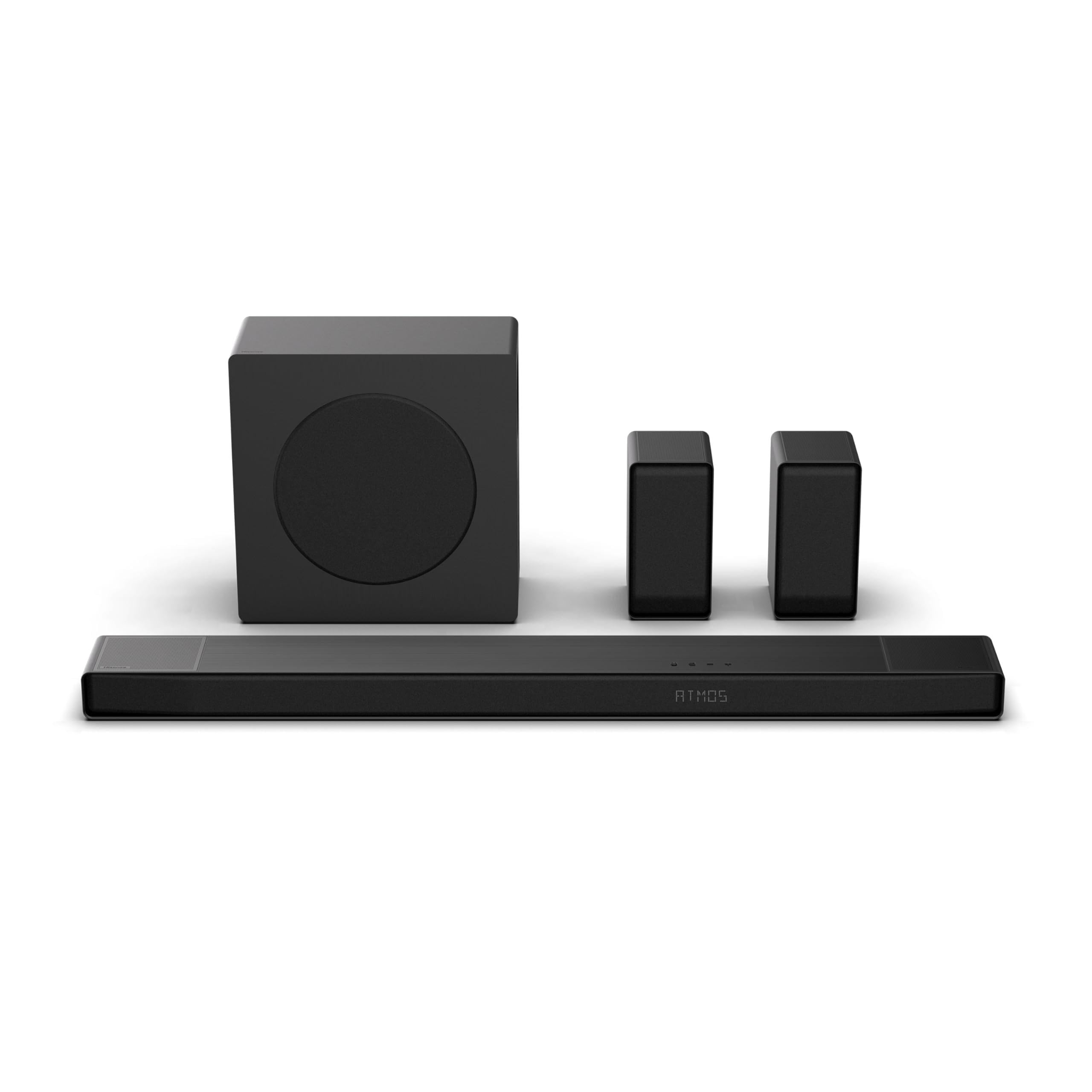
The Hisense AX5140Q elevates the 5.1 format to a 5.1.4 configuration by adding two up-firing drivers that physically direct sound toward the ceiling for overhead Atmos effects. This design creates a true height layer, making rain, helicopter rotors, and ambient ceiling reflections feel like they originate from above rather than just the front plane. The 6.5-inch wireless subwoofer reaches down to 40Hz, delivering deep bass without overwhelming the midrange.
HDMI eARC passes through 4K HDR video without signal degradation, so you can connect a game console or Blu-ray player directly to the soundbar without losing video quality. Seven EQ presets — including Movie, Music, Voice, and Night modes — let you tailor the sound signature instantly. Room calibration using the remote helps adjust for room acoustics, and Bluetooth 5.3 provides stable wireless streaming with low latency.
Customers consistently praise the immersive surround and height effects, particularly for Dolby Atmos content. The wireless subwoofer and rear speaker setup keeps cable clutter to a minimum. Some users note that while the up-firing drivers add noticeable height, they do not match the overhead presence of dedicated ceiling-mounted speakers. The system works particularly well with Hisense TVs for seamless HDMI-CEC control.
Why it’s great
- Up-firing drivers provide genuine overhead Atmos effects.
- Seven EQ presets and room calibration for tailored sound.
- 4K HDR passthrough via HDMI eARC.
Good to know
- Height effects are less powerful than dedicated in-ceiling speakers.
- Rear speakers may feel underpowered in very large rooms.
5. ULTIMEA Skywave X50
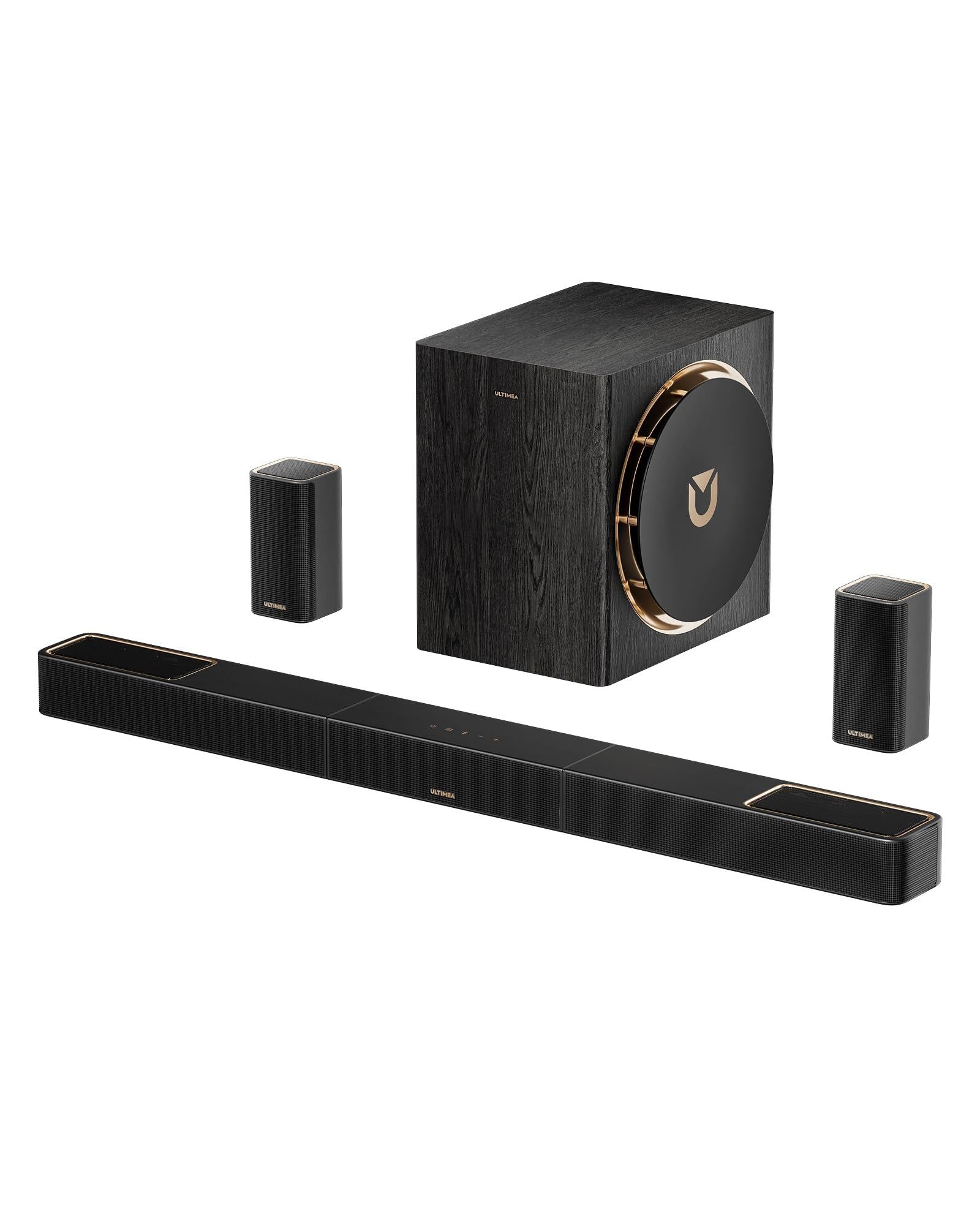
The ULTIMEA Skywave X50 is a fully wireless 5.1.4 system that uses dual 5GHz RF transmission to connect the rear speakers and 8-inch subwoofer to the main soundbar without any audio cables. Its Gallium Nitride amp delivers 760W peak power with 98% efficiency, generating clean headroom that keeps distortion below 0.5% even at high volume levels. The subwoofer uses Gravus Ultra-Linear Bass technology to reach down to 28Hz, producing tactile sub-bass that can be felt through furniture.
The NEURACORE multi-channel audio engine processes 24-bit/192kHz high-resolution audio across up to 17 channels, enabling precise pinpointing of sound objects. HDMI eARC and 4K HDR passthrough ensure video quality stays pristine. The system’s metal grille, rose gold accents, and wood-crafted subwoofer cabinet blend modern design with acoustic optimization. App control via the Ultimea app lets you adjust individual speaker levels and EQ presets.
Buyers consistently report that the wireless connection remains stable without dropouts, and the subwoofer delivers deep, room-shaking bass. The system is praised for its straightforward plug-and-play setup, with automatic pairing between all components. Some users note that the remote control is basic, but the app compensates with granular control. The system’s size is compact, making it suitable for medium to large living rooms.
Why it’s great
- Completely wireless rear speakers and subwoofer for minimal cable clutter.
- GaN amplifier delivers high power with low heat and distortion.
- Subwoofer reaches 28Hz for deep, tactile bass.
Good to know
- Remote control lacks advanced features; app provides full control.
- Premium price point reflects the advanced wireless technology.
6. JBL Bar 500MK2
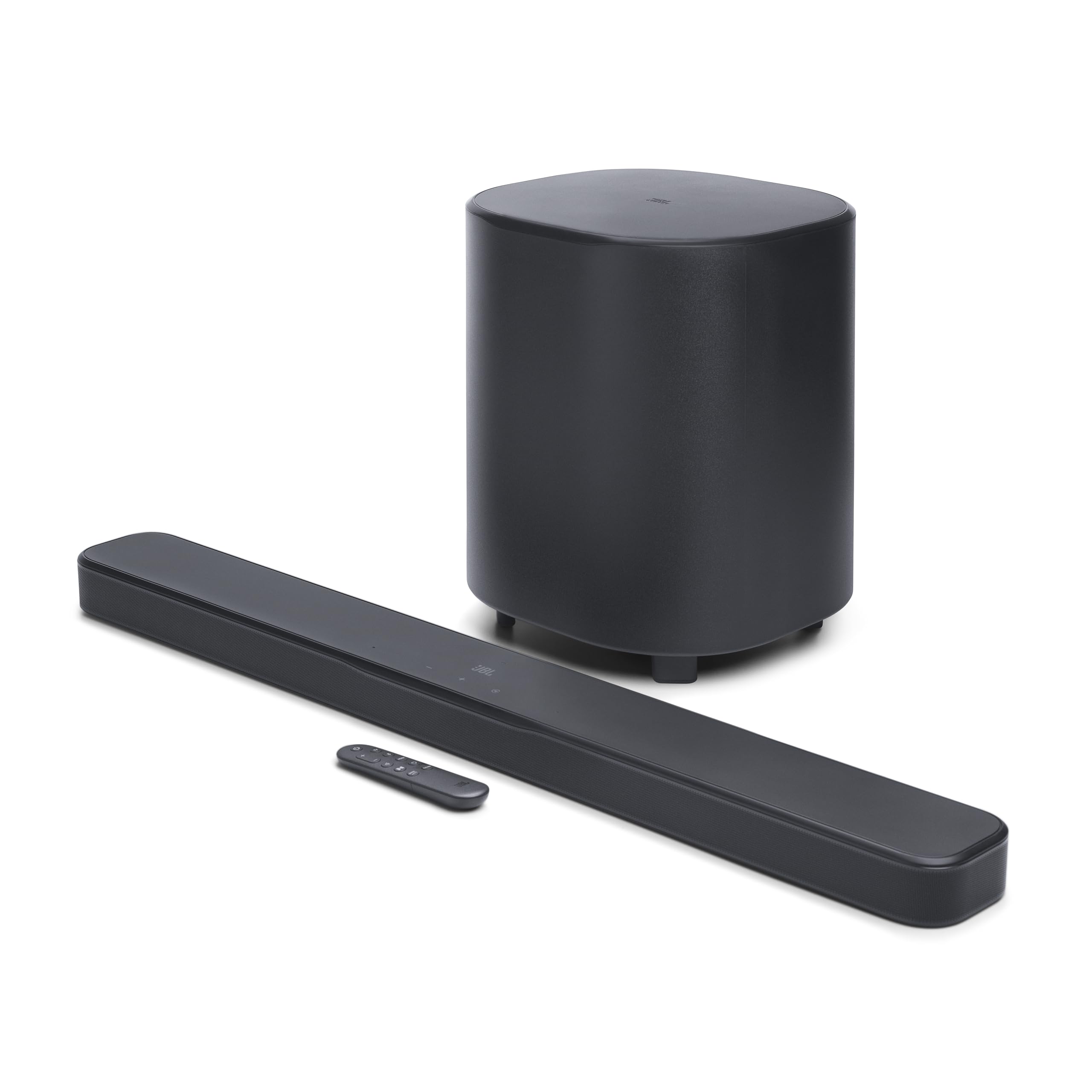
The JBL Bar 500MK2 produces 750W of total system power through a 5.1 channel layout centered around a massive 10-inch wireless subwoofer. This driver moves enough air to reproduce frequencies down to 20Hz, creating the kind of deep, chest-thumping bass that makes action scenes and music feel physically present. MultiBeam 3.0 technology uses multiple sound beams to create a wide cinema-like soundstage, even without rear satellite speakers, by reflecting audio off side walls.
PureVoice 2.0 automatically detects scene dynamics and raises dialogue clarity without boosting background effects, ensuring whispered lines remain audible during explosions. HDMI eARC with 4K Dolby Vision passthrough keeps video quality uncompromised. The system supports AirPlay, Google Cast, Spotify Connect, Tidal Connect, and Roon Ready for multi-room streaming. Easy Sound Calibration uses the built-in microphone to analyze the room’s acoustics and adjust the soundbar’s output for optimal surround effects.
User reviews emphasize the system’s exceptional bass power and wide soundstage, with several noting that it competes with much more expensive systems from Sonos and Bose. The subwoofer connects wirelessly with robust reliability. Some customers mention that the app requires WiFi for bass and treble adjustments, which can be inconvenient in setups where the soundbar isn’t connected to the internet. A few users note that the sound can be slightly bright at very high volumes.
Why it’s great
- 10-inch subwoofer delivers deep, distortion-free bass down to 20Hz.
- PureVoice 2.0 keeps dialogue clear in complex sound mixes.
- MultiRoom audio compatibility with major streaming platforms.
Good to know
- App-based EQ requires WiFi connection.
- Sound can feel bright at maximum volume levels.
7. Polk Audio MagniFi Max AX SR

The Polk Audio MagniFi Max AX SR bundle delivers a 7.1.2 channel configuration that extends beyond standard 5.1 by adding two up-firing drivers for overhead Dolby Atmos and DTS:X effects, plus LR and RR surround speakers. Polk’s patented SDA 3D technology processes the multi-channel feed to create a cohesive sound bubble that fills large rooms — multiple buyers report excellent results in spaces exceeding 25 feet by 30 feet. The included 10-inch wireless subwoofer produces deep, effortless bass that integrates smoothly with the rest of the frequency range.
VoiceAdjust technology independently boosts the center channel to improve dialogue clarity without affecting the soundtrack’s balance. Three HDMI inputs with eARC support allow connecting multiple source devices directly to the soundbar, making it a true hub for your entertainment system. Wireless streaming through Wi-Fi, Bluetooth, Apple AirPlay 2, Chromecast, and Spotify Connect enables whole-home audio integration.
Customers praise the system’s ability to handle both movies and music with authority, noting that the All Stereo mode works especially well for sports and concerts. Setup is simple without requiring a mobile app. Some users mention that the up-firing speakers provide subtle height cues but may not deliver the dramatic ceiling effect that dedicated height channels in a full receiver system produce.
Why it’s great
- 7.1.2 channel count with dedicated up-firing drivers enhances height effects.
- Three HDMI inputs provide flexible device connectivity.
- VoiceAdjust technology independently balances dialogue clarity.
Good to know
- Up-firing height effects are more subtle than in-ceiling speakers.
- System size may be large for very small TV stands.
8. Sonos Arc Ultra

The Sonos Arc Ultra utilizes Sonos’s own Sound Motion technology — a new acoustic architecture that employs tightly packed drivers and advanced signal processing to create a 9.1.4 spatial audio experience from a single soundbar cabinet. It decodes Dolby Atmos to precisely place sounds in a three-dimensional space, with AI-driven Speech Enhancement that analyzes vocal frequencies to clarify dialogue without boosting noise. The bar’s elegant, low-profile design uses a metal grille and discrete touch controls.
Setup uses a single HDMI eARC connection and step-by-step guidance through the Sonos app. Trueplay tuning automatically analyzes room acoustics using the microphone on a compatible iOS or Android device. The system supports Wi-Fi, Bluetooth, Apple AirPlay 2, and Spotify Connect for music streaming. Voice control via Sonos Voice Control or Amazon Alexa is built-in. The Arc Ultra can be expanded with a Sonos Sub for deeper bass and Era 300 speakers for true rear surround channels.
Users consistently describe the Arc Ultra as the best-sounding single-bar solution they have heard, with a wide soundstage and excellent dialogue clarity. The system works well in smaller rooms even without the optional subwoofer. Critics note the premium entry price and that the full surround experience requires purchasing additional speakers. Some users report that the system integrates well with the broader Sonos multi-room ecosystem but lacks compatibility with older Play:1 speakers.
Why it’s great
- Sound Motion technology creates a convincing 9.1.4 soundstage from a single bar.
- AI-driven Speech Enhancement clarifies dialogue without distortion.
- Trueplay room calibration optimizes sound for your specific space.
Good to know
- Full surround immersion requires purchasing additional sub and rear speakers.
- No built-in HDMI inputs for connecting source devices directly.
9. Samsung Q990D

The Samsung Q990D is the most complete 5.1-adjacent system on this list, delivering an 11.1.4 channel configuration with eleven front-facing speakers, one subwoofer, four up-firing channels, and a rear speaker kit that includes both up-firing and side-firing drivers. This array creates the most convincing overhead soundstage achievable without in-ceiling installation. Wireless Dolby Atmos transmission eliminates HDMI cable runs between the soundbar and rear speakers, one of the few systems to offer this feature.
SpaceFit Sound Pro automatically calibrates the audio to your room’s acoustics by analyzing how sound reflects off walls and furniture. Q-Symphony synchronizes the soundbar with a compatible Samsung TV’s built-in speakers to increase the total channel count. Adaptive Sound analyzes content in real time to prioritize dialogue, while Game Mode Pro uses the up-firing channels and acoustic beam for 3D optimized directional audio. Built-in Alexa, Chromecast, and AirPlay 2 provide smart assistant and streaming flexibility.
Owners overwhelmingly describe the Q990D as the best soundbar they have ever experienced, with dialogue precision, bass power, and surround envelopment that rival dedicated home theater systems. The rear speakers include forward, side, and ceiling-firing drivers, creating a truly spherical sound field. Some Samsung TV users report a recurring one-second audio dropout over eARC with certain LG OLED models, a known compatibility quirk that may require using standard ARC instead.
Why it’s great
- 11.1.4 channels deliver the most immersive soundstage available in a soundbar.
- Wireless Dolby Atmos connection to rear speakers eliminates cable runs.
- Q-Symphony integrates with Samsung TV speakers for enhanced output.
Good to know
- Requires Samsung TV for full Q-Symphony and Adaptive Sound features.
- Compatibility issues with LG OLED TVs can cause audio dropouts.
FAQ
Do I need a 5.1 soundbar if my TV already has built-in speakers?
Can I use a 5.1 soundbar without the rear speakers?
Do I need HDMI eARC for a 5.1 soundbar?
Final Thoughts: The Verdict
For most users, the best 5.1 soundbar winner is the ULTIMEA Poseidon D60 because it delivers genuine surround separation with physical rear speakers, Dolby Atmos decoding, and powerful bass at a price that undercuts virtually all competitors. If you want uncompromising overhead immersion with up-firing drivers, grab the Hisense AX5140Q. And for the ultimate wireless flagship experience with full 11.1.4 channels and no cable clutter, nothing beats the Samsung Q990D.

Mo Maruf
I created WellFizz to bridge the gap between vague wellness advice and actionable solutions. My mission is simple: to decode the research and give you practical tools you can actually use.
Beyond the data, I am a passionate traveler. I believe that stepping away from the screen to explore new environments is essential for mental clarity and physical vitality.