Our readers keep the lights on and my smoothie glass nicely filled. As an Amazon Associate, I earn from qualifying purchases.
The heart of any home theater is the receiver, the central hub that decodes your movie soundtracks, switches your video sources, and delivers clean, dynamic power to your speakers. A 5.1 receiver remains the sweet spot for most rooms, offering the classic surround sound layout—front left, center, front right, two rear surrounds, and a subwoofer—without the complexity and cost of a full Atmos system. But not all 5.1 receivers are created equal, and the difference between a muddy, underpowered unit and one that brings a film’s soundstage to life comes down to specific, measurable specs.
I’m Mohammad Maruf — the founder and writer behind WellFizz. I’ve spent years analyzing market trends, poring over amplifier schematics, and correlating user data with technical specifications to separate genuine performance from marketing claims in the AV receiver space.
Whether you are building your first system or upgrading from an older unit, finding the best 5.1 receiver requires understanding how power ratings, HDMI standards, and room correction software translate into your daily listening experience.
How To Choose The Best 5.1 Receiver
Your receiver is the command center of your system, so choosing the wrong one can bottleneck every other component. Here are the three non-negotiable areas to evaluate before you commit to a purchase.
Power Output and Speaker Matching
Look for receivers with a real-world power rating between 75 and 100 watts per channel into 8 ohms, measured with two channels driven. This range gives you clean headroom for dynamic movie peaks without straining your speakers. Budget-tier units often quote wattage into 6 ohms at 1 kHz, which inflates the number but doesn’t translate to real-world control—especially if you own bookshelf or floor-standing speakers that dip in impedance.
HDMI Connectivity and Video Features
At minimum, your receiver should support HDMI 2.0 with HDCP 2.2 for full 4K HDR pass-through, including Dolby Vision and HDR10+. If you plan on gaming with a PlayStation 5 or Xbox Series X, HDMI 2.1 with 4K/120Hz and VRR is the spec to lock in. eARC is also critical—it lets you send uncompressed Dolby TrueHD and DTS-HD Master Audio from your TV’s streaming apps back to the receiver without a separate optical cable.
Room Correction Software
No room has perfect acoustics. A receiver with automatic room calibration, such as YPAO or Audyssey, measures your speaker distances, levels, and frequencies, then applies filters to compensate for reflective walls, furniture, and odd room shapes. This single feature often makes the biggest audible difference, transforming a bright, harsh sound into a balanced, immersive one. Premium systems like Dirac Live take this a step further with more granular control over the correction curve.
Quick Comparison
On smaller screens, swipe sideways to see the full table.
| Model | Category | Best For | Key Spec | Amazon |
|---|---|---|---|---|
| Denon AVR-S970H | Premium | High-power 7.2 with 8K gaming | 90W x 7, 8K/60Hz, Audyssey | Amazon |
| Onkyo TX-NR7100 | Premium | Dirac Live room correction | 100W x 9, Dirac Live, THX | Amazon |
| Yamaha RX-V6A | Mid-Range | 7.2 with MusicCast multi-room | 100W x 7, YPAO R.S.C., 8K | Amazon |
| Onkyo TX-NR6100 | Mid-Range | THX Certified 5.1.2 Atmos | 210 W/Ch, THX, 8K HDMI 2.1 | Amazon |
| Denon AVR-S670H | Mid-Range | Budget-friendly 8K with phono input | 75W x 5, 8K/60Hz, HEOS | Amazon |
| Pioneer VSX-935 | Mid-Range | 7.2 with Dolby Atmos Height Virtualization | 80W x 7, 8K, Wi-Fi | Amazon |
| Cambridge Audio AXR100 | Premium | Pure 2-channel stereo with phono stage | 100W x 2, FM/AM, Sub out | Amazon |
| Yamaha RX-V4A | Mid-Range | 5.2 with MusicCast and Voice Control | 80W x 5, 8K/60Hz, YPAO | Amazon |
| Sony STRDH590 | Budget | Entry-level 5.2 with Bluetooth | 725W total, 4K HDR, S-Force | Amazon |
In‑Depth Reviews
1. Denon AVR-S970H 8K Ultra HD 7.2 Channel

The Denon AVR-S970H is the rare receiver that balances high power output with genuine ease of use. Its 90 watts per channel into 7 channels gives you the headroom to fill a medium-sized room with clear, dynamic audio, whether you’re running a 5.2.2 Atmos setup or a traditional 7.1 layout. The Audyssey MultEQ room correction takes the guesswork out of calibration, measuring your speaker positions and applying filters that tame room-induced peaks and nulls.
On the video side, the S970H includes three 8K/60Hz HDMI 2.1 inputs, along with VRR, ALLM, and QFT support for smooth, tear-free gaming. The HEOS multi-room platform allows you to stream Spotify, TIDAL, and other services to compatible speakers around your home, all controllable through a single app. The built-in phono input also makes it an easy hub for turntable users who want to integrate vinyl into their system.
Some users note that using the powered Zone 2 feature borrows from the rear surround channels, reducing a 7.2 setup to 5.2. The HEOS app can block Bluetooth headphone streaming when playing online music, which is a minor software limitation. Still, for the combination of power, room correction, and future-proofed HDMI ports, the S970H stands as a top-tier choice in its class.
Why it’s great
- Robust 90W per channel into 8 ohms
- Audyssey MultEQ provides excellent room calibration
- Three 8K HDMI 2.1 inputs with VRR/ALLM
- Built-in phono stage for turntables
Good to know
- Zone 2 reduces main channels from 7 to 5
- HEOS software can conflict with Bluetooth headphone use
- Remote lacks a programmable TV power button
2. Onkyo TX-NR7100 9.2-Channel AV Receiver
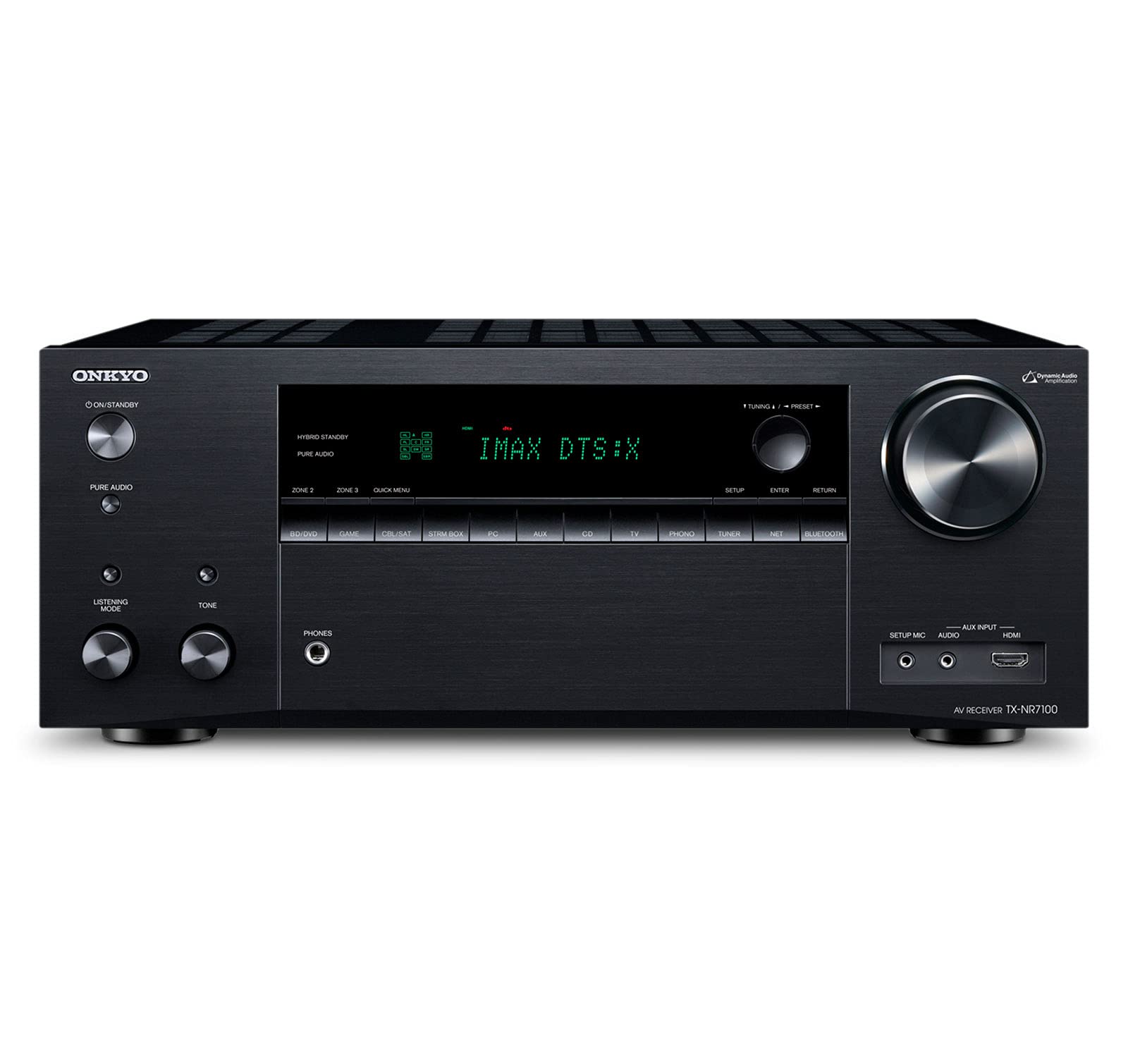
The Onkyo TX-NR7100 brings professional-grade room correction to the home theater market with its inclusion of Dirac Live out of the box. This software measures your listening environment with a calibrated microphone and applies corrective filters that can dramatically tighten bass response and improve soundstage precision. For buyers who want the most neutral, accurate sound possible from their speakers, this is the defining feature set.
On connectivity, it offers nine channels of processing with three HDMI outputs supporting 8K/60Hz and 4K/120Hz. The Works with Sonos certification means it can join an existing Sonos ecosystem seamlessly, and the bi-directional Bluetooth allows you to stream to or from the receiver using aptX HD codecs. With THX Select certification, you have verified performance standards for dynamic range and distortion control in a medium-sized room.
The remote control lacks a backlight, and some users report occasional HDMI handshake glitches that require a power cycle. The unit also runs noticeably warm, so ensure proper ventilation in your AV cabinet. For those who prioritize acoustic precision and are willing to invest time in the Dirac setup, the TX-NR7100 delivers an unmatched level of calibration control for its price tier.
Why it’s great
- Dirac Live room correction provides studio-grade calibration
- THX Select and Dolby Atmos certified
- Three HDMI 2.1 outputs with VRR/ALLM
- Bi-directional Bluetooth with aptX HD
Good to know
- Remote is not backlit
- Runs warm under load—needs ventilation
- Occasional HDMI handshake issues reported
3. Yamaha RX-V6A 7.2-Channel AV Receiver

The Yamaha RX-V6A is a 7.2-channel receiver that packs an impressive array of streaming and smart home features into a sleek chassis. Its YPAO R.S.C. (Reflected Sound Control) room correction with multipoint measurement fine-tunes speaker timing and frequency response, ensuring your system sounds balanced regardless of your room’s geometry. The MusicCast platform gives you multi-room audio control across compatible Yamaha devices, with support for Pandora, Spotify, TIDAL, and Amazon Music HD.
On the video side, the V6A offers three 8K/60Hz and four 4K/120Hz HDMI 2.1 inputs, making it fully compatible with the latest gaming consoles. It also supports Dolby Atmos with Height Virtualization and DTS:X, which can simulate overhead effects from a standard 5.1 speaker layout. The unit features voice control via Alexa, Google Assistant, and Siri through AirPlay 2.
The setup process has a steep learning curve, and some users find the on-screen menus less intuitive than competitors. The eARC functionality may require a firmware update to work reliably with certain TV brands. Still, the combination of robust streaming support, gaming-ready HDMI ports, and capable room correction makes the V6A a versatile all-rounder for multi-purpose entertainment systems.
Why it’s great
- YPAO R.S.C. with multipoint measurement
- Seven HDMI inputs with 8K/60Hz and 4K/120Hz
- MusicCast multi-room audio platform
- Dolby Atmos Height Virtualization for 5.1 setups
Good to know
- On-screen menus feel dated and less intuitive
- eARC may need firmware updates to work properly
- Learning curve for initial setup and configuration
4. Onkyo TX-NR6100 7.2 Channel THX Certified
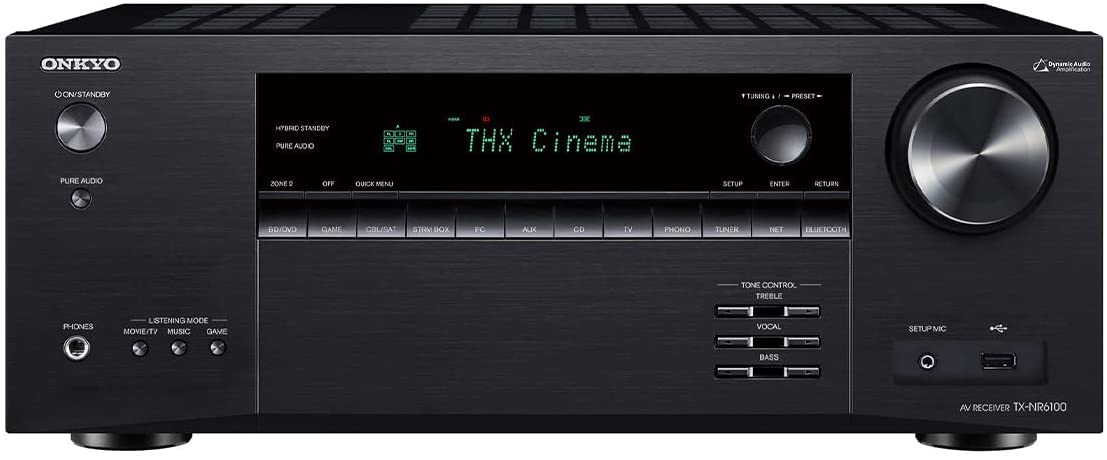
The Onkyo TX-NR6100 brings THX Select certification to the mid-range, guaranteeing that it meets rigorous standards for distortion, dynamic range, and power delivery in a medium-sized room. Its Dynamic Audio Amplification system is rated for 210 watts per channel, though this is measured at 6 ohms with a single channel driven—real-world performance still offers ample headroom for most bookshelf and tower speaker pairs in a 5.1.2 Atmos configuration.
The receiver includes three HDMI 2.1 inputs with 40Gbps throughput, supporting 8K/60Hz and 4K/120Hz for the latest gaming consoles. It also features discrete Zone 2 audio and video, allowing you to watch a movie in the main room while the kids view a separate source in another room. The unit’s onboard streaming includes Spotify, TIDAL, and Deezer, and it is compatible with Apple HomeKit and Google Assistant for voice control.
Long-term reliability has been a concern for some owners, with reports of HDMI and network issues emerging after two years of use. The rear surround and height speaker terminals use spring clips rather than binding posts, which can be less secure with thicker speaker wire. For buyers who prioritize THX certification and multi-zone flexibility at a reasonable cost, the TX-NR6100 remains a compelling option.
Why it’s great
- THX Select certification for verified performance
- Three HDMI 2.1 inputs with 40Gbps
- Discrete Zone 2 audio and video
- Powerful dynamic amplification for 5.1.2 Atmos
Good to know
- Some users report reliability issues after two years
- Rear speaker terminals use spring clips, not binding posts
- Remote control lacks a backlight
5. Denon AVR-S670H 5.2 Ch Home Theater Receiver

The Denon AVR-S670H delivers a surprisingly robust feature set at an entry-to-mid-range price point, making it an excellent starting point for building a 5.1 system. Its 75 watts per channel into 5 channels is sufficient to drive most bookshelf and center channel speakers to reference levels in a small to medium-sized room. The inclusion of 8K/60Hz and 4K/120Hz pass-through with HDR10+, Dolby Vision, and HLG ensures you are not immediately obsolete when you upgrade your TV.
Setup is notably smooth thanks to Denon’s guided on-screen assistant and the Audyssey MultEQ calibration microphone, which automatically adjusts speaker levels, distances, and crossover points. The built-in phono input is a welcome addition for vinyl enthusiasts who want a unified hub. The HEOS platform allows for multi-room streaming, though some users find the app less stable than wired connections for high-resolution audio.
The back panel has only four HDMI inputs, which may feel tight if you have multiple game consoles, a streaming box, and a Blu-ray player. The Wi-Fi and Bluetooth antennas are fixed, limiting placement options for the receiver in a closed cabinet. For someone looking for a future-proofed 5.1 receiver with easy setup and clean sound, the S670H is a smart place to start.
Why it’s great
- 8K/60Hz and 4K/120Hz pass-through with HDR10+
- Audyssey MultEQ for easy, accurate room calibration
- Built-in phono input for turntables
- Streamlined on-screen setup assistant
Good to know
- Only four HDMI inputs may limit expansion
- Fixed Wi-Fi/Bluetooth antennas limit cabinet placement
- HEOS wireless streaming can be less stable than wired
6. Pioneer VSX-935 7.2 Channel Surround Sound Receiver
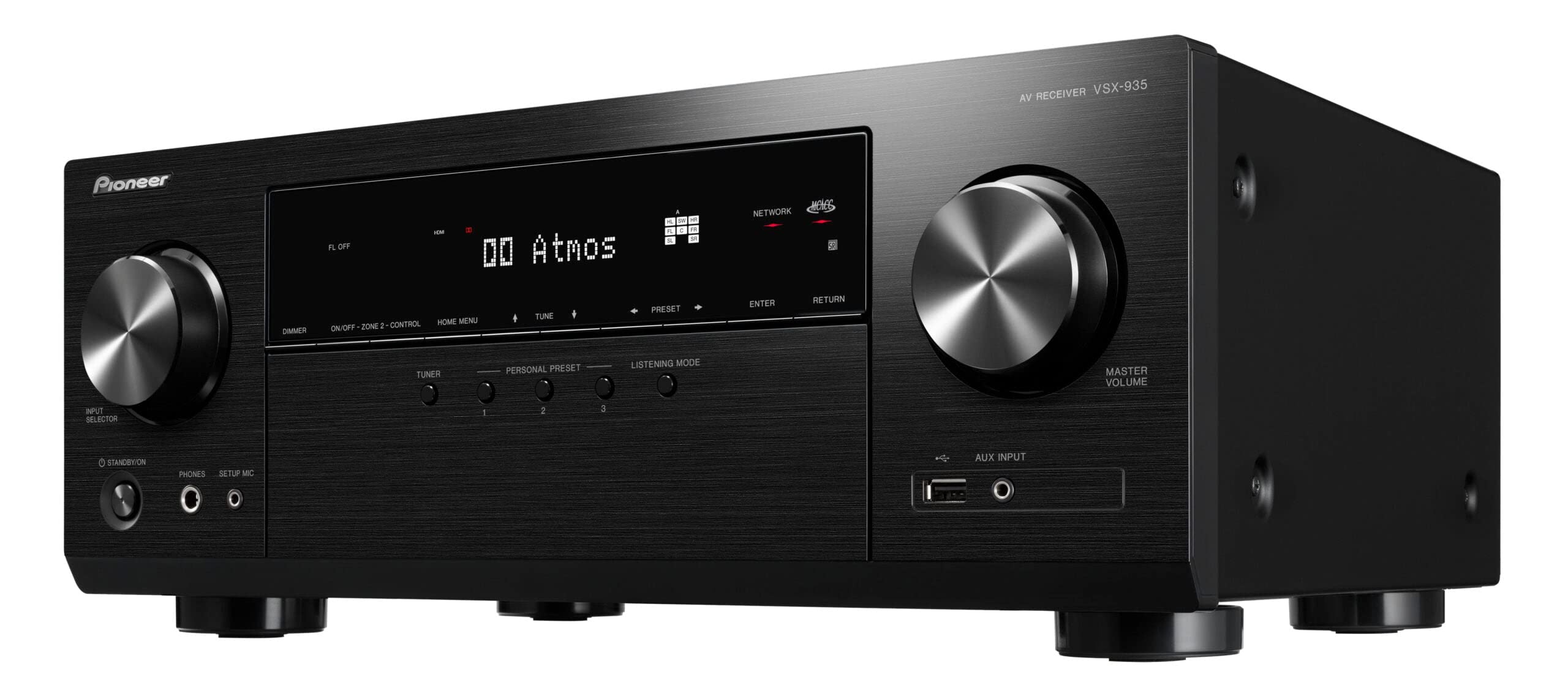
The Pioneer VSX-935 is a 7.2-channel network receiver that leverages Dolby Atmos Height Virtualization to simulate overhead effects from a standard speaker layout, making it an ideal choice for rooms where ceiling speakers are impractical. The virtualization algorithm processes height metadata and uses psychoacoustic filtering to trick your ears into hearing sounds above the listening position, delivering a more immersive experience without in-ceiling installation.
Connectivity includes HDMI 2.1 ports supporting 8K/60Hz and 4K/120Hz, plus enhanced gaming features like VRR and ALLM. The receiver is Wi-Fi and Bluetooth enabled for streaming from Spotify, TIDAL, and Deezer. The included RF remote offers better range and reliability than standard IR remotes, particularly when the receiver is tucked away inside a cabinet. The dual subwoofer outputs give you flexibility for systems with two subs to even out bass response across multiple seats.
Some users have experienced firmware-related issues, including HDMI handshake failures and glitchy network connections. The USB port is the only method for firmware updates, which can be inconvenient compared to over-the-air updates. For buyers seeking a feature-rich receiver with virtual Atmos capabilities and gaming-ready HDMI, the VSX-935 deserves consideration.
Why it’s great
- Dolby Atmos Height Virtualization for overhead effects without ceiling speakers
- RF remote provides reliable control through cabinets
- HDMI 2.1 with 8K/60Hz and gaming features
- Dual subwoofer outputs for balanced bass
Good to know
- Firmware updates require USB connection
- Some users report HDMI handshake issues
- Network connectivity can be glitchy
7. Cambridge Audio AXR100 FM/AM Stereo Receiver

The Cambridge Audio AXR100 is a stereo receiver designed for those who prioritize two-channel music reproduction over multi-channel movie soundtracks. Its 100 watts per channel into 8 ohms uses a robust toroidal transformer and custom capacitors to deliver clean, warm power that pairs exceptionally well with bookshelf and floor-standing speakers. The built-in phono stage supports both moving magnet and moving coil cartridges, making it a serious hub for vinyl enthusiasts.
Beyond analog inputs, the AXR100 includes two digital optical and one coaxial input, along with a dedicated subwoofer pre-out for integrating a powered sub into your stereo system. The FM/AM tuner with RDS is a functional addition for radio listeners. The Bluetooth receiver uses aptX for higher-quality wireless streaming from smartphones and computers, and the front-panel 3.5mm auxiliary input accommodates portable music players.
The remote control buttons are mushy and difficult to read in low light. The AXR100 lacks HDMI inputs entirely, so it cannot serve as a video switching hub. For a dedicated music system where multi-channel surround is not required, the AXR100 offers exceptional sound quality and build.
Why it’s great
- 100W per channel into 8 ohms with toroidal transformer
- High-quality built-in phono stage for MM/MC cartridges
- Dedicated subwoofer pre-out for 2.1 systems
- Warm, detailed sound signature ideal for music
Good to know
- No HDMI inputs for video switching
- Bluetooth range is limited and prone to dropouts
- Remote control is mushy and hard to read in dim light
8. Yamaha RX-V4A 5.2-Channel AV Receiver

The Yamaha RX-V4A is a 5.2-channel receiver that brings YPAO room calibration and MusicCast multi-room streaming to a more compact, affordable package. Its YPAO microphone perfectly adjusts speaker timing and polarity, catching reversed wire connections that would otherwise degrade sound quality. This makes it an excellent choice for first-time surround sound builders who want automated setup assistance.
Video support includes 4K/60Hz, 4K/120Hz, and 8K/60Hz via HDMI 2.1, along with Dolby Vision, HLG, and BT.2020 pass-through. The four HDMI inputs are sufficient for a streaming device, game console, and cable box. The receiver integrates with Alexa and Google Assistant for hands-free volume control and input switching, and the MusicCast app provides a clean interface for streaming from TIDAL, Spotify, and Qobuz.
Some users report that the HDMI switching can be intermittent, failing to detect signals from certain sources. The remote control has small buttons with poor tactile feedback, and the on-screen menus can feel sluggish. Despite these quirks, the RX-V4A delivers solid, clean amplification for a 5.1 system, particularly when paired with efficient speakers.
Why it’s great
- YPAO calibration detects reversed speaker wires and optimizes timing
- MusicCast multi-room streaming with broad service support
- HDMI 2.1 with 8K/60Hz and Dolby Vision pass-through
- Voice control via Alexa, Google Assistant, and Siri
Good to know
- Some HDMI switching issues reported with certain sources
- Remote control has small, hard-to-feel buttons
- On-screen menus can feel slow to navigate
9. Sony STRDH590 5.2 Channel Surround Sound Home Theater Receiver
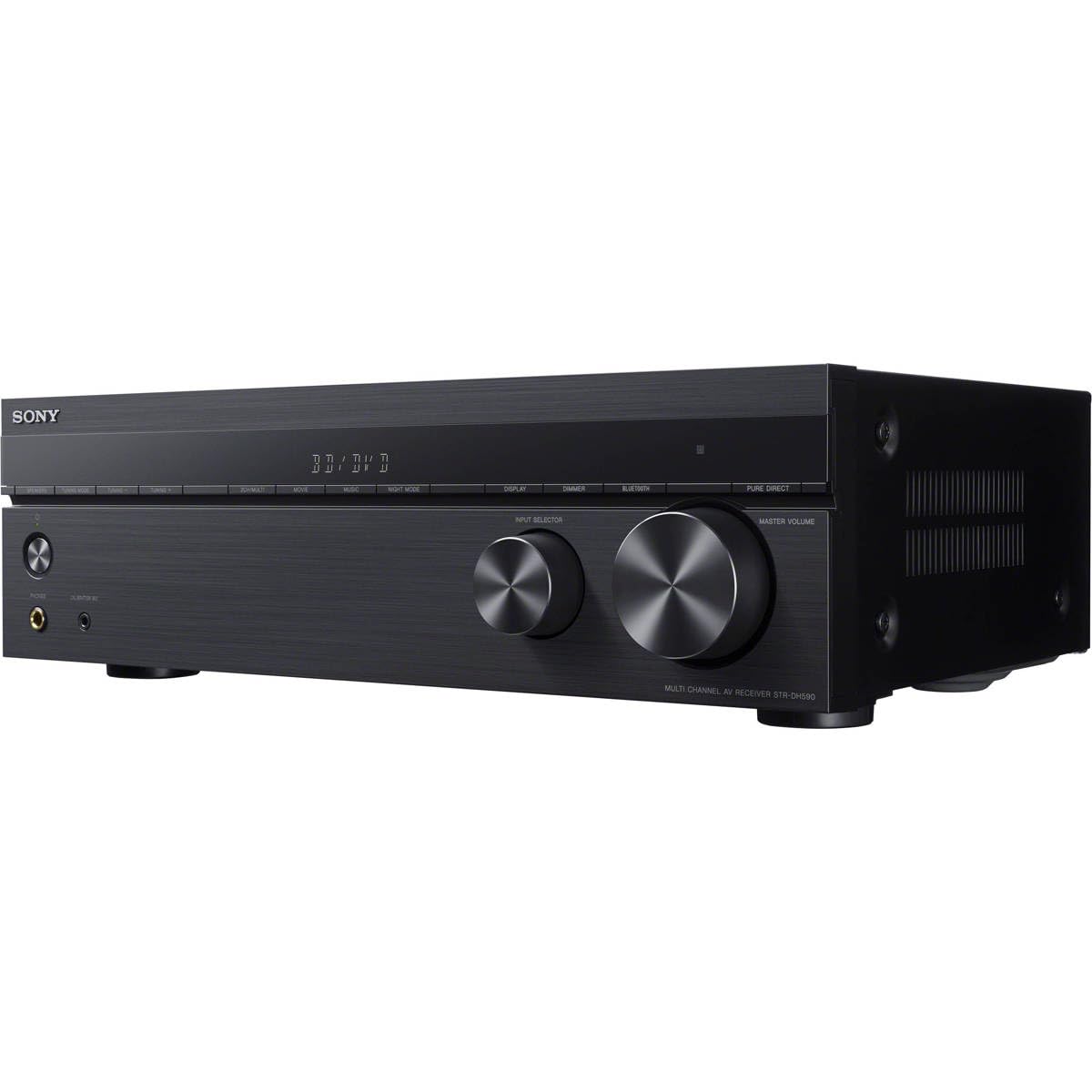
The Sony STRDH590 is a straightforward 5.2-channel receiver built for buyers who need the fundamentals of surround sound without paying for features they will not use. Its S-Force PRO virtual surround technology can deliver a convincing sound field with as few as two speakers, making it a flexible option for room layouts where rear speakers are difficult to place. The 725-watt total power rating is distributed across five channels, providing enough output for small to medium rooms.
The receiver features four HDMI inputs with HDCP 2.2 support for 4K HDR pass-through, including Dolby Vision and Hybrid Log-Gamma. Bluetooth connectivity allows for wireless music streaming from phones and tablets, and the Bluetooth Standby feature lets you wake the receiver from your device. The included FM radio tuner is a simple addition for local broadcast listening.
The speaker terminals for the center and rear channels use spring clips rather than binding posts, limiting your cable termination options to bare wire or pin connectors. The user interface for setup is displayed on the front panel rather than overlaid on your TV, which makes menu navigation less convenient. For someone assembling a budget 5.1 system with basic requirements, the STRDH590 is a functional starting point.
Why it’s great
- S-Force PRO virtual surround works with only two speakers
- Four HDMI inputs with HDCP 2.2 and 4K HDR
- Bluetooth Standby feature for convenient wake-up
- FM radio tuner included for local broadcasts
Good to know
- Center/rear terminals are spring clips, not binding posts
- Setup menus are displayed on the front panel, not TV
- No dedicated dialogue enhancement or clear voice technology
FAQ
Can I use a 5.1 receiver with only two speakers?
What is the difference between HDMI ARC and eARC on a 5.1 receiver?
Do I need a subwoofer for a 5.1 receiver to sound good?
Will a 5.1 receiver work with 4 ohm speakers?
Final Thoughts: The Verdict
For most users, the best 5.1 receiver winner is the Denon AVR-S970H because it delivers the strongest balance of clean power delivery, advanced Audyssey room correction, and future-proofed HDMI 2.1 support at a price that undercuts comparable premium units. If you value the most scientifically precise room calibration available, grab the Onkyo TX-NR7100 with Dirac Live. And for a straightforward 5.1 system with excellent streaming features and YPAO calibration, nothing beats the value of the Yamaha RX-V6A.

Mo Maruf
I created WellFizz to bridge the gap between vague wellness advice and actionable solutions. My mission is simple: to decode the research and give you practical tools you can actually use.
Beyond the data, I am a passionate traveler. I believe that stepping away from the screen to explore new environments is essential for mental clarity and physical vitality.