Our readers keep the lights on and my smoothie glass nicely filled. As an Amazon Associate, I earn from qualifying purchases.
The leap from a standard 1080p projector to a native 4K model isn’t just about resolution—it’s about reclaiming the cinematic experience in your own space. You’re not just buying a light thrower; you’re buying a system that must balance contrast, color accuracy, light output, and lens quality to deliver a picture that rivals a flat-panel TV. The wrong choice leads to washed-out daytime viewing, distracting fan noise during quiet scenes, and a frustrating setup process that kills the magic.
I’m Mohammad Maruf — the founder and writer behind WellFizz. I analyze consumer projection technology by cross-referencing laser light engine specifications, native contrast ratios, and real-world lumen performance against user longevity reports to separate genuine home theater tools from over-marketed gimmicks.
Whether you are outfitting a dedicated media room or building a flexible living-room setup, finding the best 4k movie projector requires understanding how triple laser engines, optical zoom ranges, and HDR tone mapping interact with your specific lighting conditions and screen size.
How To Choose The Best 4K Movie Projector
Navigating the current projector market means decoding marketing fluff around “4K,” “laser,” and “lumens.” For a dedicated movie-watching setup, three specs define the experience: the native light source (LED, single laser, or triple laser), the optical system (lens zoom vs. digital zoom), and the HDR handling capability. Your room’s ambient light control dictates the brightness floor, while your screen size determines the necessary throw ratio.
Decoding the Light Engine: LED vs. Single Laser vs. Triple Laser
Cheaper LED projectors struggle with color volume and peak brightness, often pushing a magenta or green tint in HDR mode. Single laser (ALPD) improves brightness and lifespan but introduces noticeable speckle on certain screen materials. Triple laser (RGB) projectors, like the Hisense C2 or JMGO N1S, eliminate the color wheel entirely, removing the rainbow effect (RBE) and covering over 100% of the BT.2020 color space. For movie purists, a triple laser engine is the only way to achieve the color saturation and contrast of a commercial cinema.
Why Optical Zoom and Lens Shift Matter for Home Theater
Many budget-friendly 4K projectors rely on digital zoom, which crops into the image and destroys resolution. An optical zoom lens (like the 1.67x on the Hisense C2 Ultra or the 0.9-1.5x on the Valerion Pro2) allows you to fill your screen without moving the projector, preserving 100% of the pixel data. Lens shift (vertical/horizontal) is crucial for ceiling-mounted setups; without it, you must tilt the projector and rely on keystone correction, which introduces scaling artifacts and reduces contrast.
Understanding HDR Tone Mapping in Projectors
A 4K movie projector with Dolby Vision or HDR10+ is only as good as its tone mapping engine. Projectors cannot reach the 1,000-nit peaks of an OLED TV, so the processor must intelligently compress the dynamic range. Look for models with dynamic tone mapping (like the Epson 5050UB or Valerion Pro2) that adjust the brightness curve frame-by-frame, preventing clipped highlights or muddy shadows in dark scenes. Static mapping, common in entry-level models, often results in a washed-out image that defeats the purpose of HDR.
Quick Comparison
On smaller screens, swipe sideways to see the full table.
| Model | Category | Best For | Key Spec | Amazon |
|---|---|---|---|---|
| Valerion VisionMaster Pro2 | Triple Laser DLP | Cinematic HDR & Gaming | 15,000:1 Contrast | Amazon |
| Epson 5050UB | 3LCD Pixel-Shift | Dedicated Media Room | 1,000,000:1 Dynamic Contrast | Amazon |
| NexiGo Aurora Pro MKII | UST Triple Laser | Ultra Short Throw Setup | 30,000:1 Contrast (SAE) | Amazon |
| Hisense C2 Ultra | Triple Laser DLP | Bright Room & Large Screen | 3,000 ANSI Lumens | Amazon |
| Hisense C2 | Triple Laser DLP | Versatile Living Room | 1700:1 Native Contrast | Amazon |
| AWOL VISION LTV-3000 Pro | UST Triple Laser | 3D & Center Channel Audio | 2000 Lumens, 0.25:1 Throw | Amazon |
| Dangbei DBOX02 | ALPD Laser DLP | Daylight Viewing | 2,450 ISO Lumens | Amazon |
| NEBULA Cosmos 4K SE | LED + Laser Hybrid | Portable 4K with Netflix | 1,800 ANSI Lumens | Amazon |
| ViewSonic PX701-4K | DLP Pixel-Shift | High Refresh Rate Gaming | 240Hz, 4.2ms Input Lag | Amazon |
| XGIMI Horizon Pro | LED DLP | Easy Living Room Setup | 1,500 ISO Lumens | Amazon |
| JMGO N1S 4K | Triple Laser DLP | Compact & Portable 4K | 1100 ISO Lumens, Gimbal | Amazon |
In‑Depth Reviews
1. Valerion VisionMaster Pro2

The Valerion VisionMaster Pro2 hits the sweet spot where contrast, brightness, and motion handling converge. Its triple laser engine delivers a 15,000:1 native contrast ratio with Enhanced Black Level (EBL) technology, producing inky blacks that are rare in this price tier. The 0.9-1.5x optical zoom allows flexible placement without digital cropping, preserving the 4K pixel structure for a crisp 144-inch image.
Gamers will appreciate the 4ms input lag at 1080p 240Hz, but the real star is the HDR10+ dynamic tone mapping, which adjusts brightness frame-by-frame to prevent clipping in high-contrast movies. The built-in Google TV OS with 4GB of RAM ensures the interface stays snappy, and the AirPlay 2 support makes streaming from an iPhone seamless.
While the fan remains quiet in eco mode, users should note the slight upward projection angle inherent in the lens design, which is best countered by a floor mount or low stand. For a dedicated home theater room with controlled lighting, this projector rivals units costing twice as much.
Why it’s great
- Exceptionally deep black levels from 15,000:1 native contrast.
- Optical zoom range (0.9-1.5x) offers flexible placement without resolution loss.
- Dolby Vision & HDR10+ with frame-by-frame dynamic tone mapping.
Good to know
- Requires a low table or floor mount due to upward lens angle.
- Minor rainbow effect may appear in rare high-contrast scenes.
2. Epson Home Cinema 5050UB

The Epson 5050UB remains a benchmark for pure contrast in the under- market. Its 3LCD design with a dynamic iris achieves an impressive 1,000,000:1 dynamic contrast ratio, delivering shadow detail that triple-laser DLP projectors often struggle to match. The motorized lens with horizontal/vertical shift and lens memory makes it the easiest projector to install in a ceiling-mounted theater with a 2.35:1 screen.
Despite being a pixel-shifting 4K solution (1920×1080 panels shifted), the advanced processor creates a perceptibly sharp image that rivals native 4K DLP models in most movie content. The HDR processor handles 10-bit color depth faithfully, though it lacks the dynamic tone mapping of newer laser models. Users report excellent longevity, with many units running flawlessly for over 3,000 hours.
Be prepared for the size—it weighs 24.7 lbs and requires a hefty mount. The 11-second HDMI handshake delay when switching to 4K HDR content is a minor annoyance, but the superior black floor and natural color reproduction make it a top choice for serious cinephiles.
Why it’s great
- Best-in-class contrast with deep, cinematic blacks via dynamic iris.
- Motorized lens with memory for 16:9 and 2.35:1 aspect ratios.
- Zero rainbow effect due to 3LCD light engine.
Good to know
- Very large and heavy, requiring a substantial ceiling mount.
- Pixel-shifting design does not resolve true 4K detail on test patterns.
3. NexiGo Aurora Pro MKII

If you cannot ceiling-mount a projector, the NexiGo Aurora Pro MKII is the premier ultra-short-throw choice. With a 0.21:1 throw ratio, it can produce a 150-inch image from mere inches away from the wall. The ALPD 5.0 triple laser engine delivers 2,400 lumens and covers 107% of BT.2020, producing a color volume that competes with high-end laser TVs.
Its standout feature is the Scene Adapt Engine (SAE), which combines a dynamic iris with laser dimming to achieve a 30,000:1 contrast ratio. This system adjusts the laser output in real-time, deepening black levels without the pumping artifacts common in bulb-based projectors. Gamers benefit from 4.2ms input lag at 1080p 120Hz, making it viable for fast-paced console gaming.
Some users report that the built-in 60W speakers are adequate for casual viewing but recommend an external sound system for serious movies. The remote sensor is quite sensitive, requiring accurate pointing. Overall, it is a fantastic solution for a living room where a traditional projector can’t fit.
Why it’s great
- Ultra-short throw places easily on a media console for up to 150 inches.
- Dynamic laser dimming provides impressive black levels for a UST.
- Supports Dolby Vision and HDR10+ with robust tone mapping.
Good to know
- Best image quality is achieved with a dedicated ALR screen.
- Some users report overheating and fan noise in high-altitude modes.
4. Hisense C2 Ultra

The Hisense C2 Ultra is engineered for spaces where ambient light is a constant challenge. Its triple laser engine produces a staggering 3,000 ANSI lumens, allowing it to maintain a punchy HDR image even with windows partially open. The 1.67x optical zoom and 0.9-1.5:1 throw ratio give excellent placement flexibility, and the motorized gimbal allows 135° of vertical tilt.
With Dolby Vision and IMAX Enhanced certification, the C2 Ultra delivers studio-grade color processing. The 4K AI Upscaler is particularly effective, breathing new life into 1080p Blu-rays and older streaming content. The 240Hz refresh rate with under 12ms input lag makes it a strong contender for both movie nights and competitive gaming.
The built-in JBL speakers with DTS Virtual:X provide room-filling sound, though serious viewers will still want a dedicated audio system. The VIDAA OS is responsive, though the static banner ad on the home screen may annoy some. For a bright living room setup, the C2 Ultra is a powerhouse.
Why it’s great
- Industry-leading 3,000 ANSI lumens for daytime viewing.
- 1.67x optical zoom preserves 4K resolution across different screen sizes.
- IMAX Enhanced and Dolby Vision certification for cinematic HDR.
Good to know
- Native contrast is lower than the Valerion or Epson, requiring dynamic iris.
- Black levels struggle in rooms with direct ambient light.
5. Hisense C2

The Hisense C2 brings 90% of the C2 Ultra’s laser technology at a significantly lower entry point. With 2,000 ANSI lumens and a 1700:1 native contrast ratio, it delivers a vibrant, detailed image that handles moderate ambient light well. The 360° gimbal design simplifies ceiling or wall projection, and the auto-focus system works reliably in most environments.
The triple laser engine covers 110% of BT.2020, producing rich, natural colors without the rainbow effect. The 240Hz refresh rate with 12ms input lag makes it surprisingly capable for gaming, and the DTS Virtual:X audio processing provides clear dialogue. The sound by JBL is genuinely usable for movie watching.
The main compromise is black level performance in a pitch-black room—it does not reach the depths of the Valerion or Epson 5050UB. Additionally, the built-in VIDAA OS, while fast, has a static banner ad. For a versatile, portable 4K laser projector that performs admirably in a mixed-use living room, the C2 is a fantastic buy.
Why it’s great
- Excellent triple laser color accuracy at a mid-range price point.
- Flexible 360° gimbal mount for easy wall or ceiling projection.
- Bright enough for well-lit rooms with 2,000 ANSI lumens.
Good to know
- Native blacks are not as deep as projectors with dynamic iris.
- Requires more distance than previous models to fill a 100-inch screen.
6. AWOL VISION LTV-3000 Pro

The AWOL LTV-3000 Pro is a unique hybrid that functions both as a UST laser TV and a dedicated 3D projector. It is the world’s first UST projector with a built-in center channel speaker mapping, which projects dialogue directly from the screen area—a clever trick that makes dialogue clearer without a separate soundbar. The triple laser engine delivers 107% BT.2020 coverage with Dolby Vision and HDR10+.
3D enthusiasts will find this projector exceptional. It supports active shutter 3D with minimal crosstalk, and the brightness drop is far less severe than on bulb-based 3D projectors. The 0.25:1 throw ratio means it projects a 100-inch image from just 8.5 inches away, making it a viable TV replacement.
Setup is finicky—the fixed throw ratio means you need a specific cabinet depth, and the lack of auto-focus requires a physical adjustment of the slider. The built-in audio is surprisingly good, but for the best experience, pairing it with an ALR screen is essential to combat ambient light.
Why it’s great
- Best-in-class 3D performance with low crosstalk on a UST platform.
- Built-in center channel speaker mapping enhances dialogue clarity.
- Covers 147% DCI-P3 for incredibly vibrant color reproduction.
Good to know
- No auto-focus; must manually adjust lens slider for sharpness.
- Best image requires a dedicated ALR screen for daytime viewing.
7. Dangbei DBOX02

The Dangbei DBOX02 uses ALPD (Advanced Laser Phosphor Display) technology to deliver a powerful 2,450 ISO lumens—enough to throw a clear 120-inch image even during daylight. The ALPD engine eliminates the speckle effect common in some triple laser designs, providing a smooth, consistent image that looks great out of the box.
Google TV with official Netflix licensing means you can stream 4K content directly without a dongle, and the InstanPro AI setup system (auto-focus, keystone, obstacle avoidance) makes it one of the easiest projectors to set up. The dual 12W speakers with Dolby Audio and DTS:X provide full-bodied sound that fills a medium-sized room.
The out-of-box image settings are overly aggressive with motion smoothing, so you will want to switch to Filmmaker Mode immediately. Some users note a slight light leak around the lens bezel and non-adjustable legs that require a small stand for leveling. For the brightness and built-in smart features, the DBOX02 is a compelling all-in-one package.
Why it’s great
- Very high 2,450 ISO lumens for daytime and outdoor use.
- Officially licensed Netflix and Google TV built in.
- ALPD laser eliminates speckle and provides smooth color.
Good to know
- Out-of-box picture settings need calibration; motion smoothing is too aggressive.
- Noticeable rainbow effect can occur in high-contrast scenes.
8. NEBULA Cosmos 4K SE

The NEBULA Cosmos 4K SE uses a unique HybridBeam technology that combines LED and laser light sources to achieve 1,800 ANSI lumens in a compact chassis. This makes it one of the most portable true 4K projectors available, easily fitting into a backpack with its included EPP case. The Dolby Vision support ensures vibrant HDR reproduction despite the smaller light engine.
The NebulaMaster Image Engine enhances contrast and grayscale, delivering a picture that punches above its brightness rating. The IEA 4.0 intelligent setup (auto-focus, keystone, obstacle avoidance) works quickly, making it ideal for users who move the projector between rooms or take it outdoors. Google TV with native 4K Netflix support eliminates the need for an external stick.
Because it is a hybrid light source, the black levels in a completely dark room are not competitive with dedicated triple-laser units. The built-in speakers are good for a portable unit but lack the bass required for action movies. For a flexible, travel-friendly 4K cinema solution, the Cosmos 4K SE is unmatched.
Why it’s great
- Portable design with carrying case for easy transportation.
- Dolby Vision and 1,800 ANSI lumens for a bright HDR picture.
- Google TV with native 4K Netflix and auto-setup features.
Good to know
- Hybrid light engine cannot match native contrast of triple laser projectors.
- Bluetooth audio pairing can have a microsecond delay.
9. ViewSonic PX701-4K

The ViewSonic PX701-4K is built for low-latency gaming without sacrificing movie quality. With a 240Hz refresh rate at 1080p and a 4.2ms input lag, it is one of the fastest projectors on the market for competitive gaming. The 3,200 ANSI lumens make it incredibly bright, ensuring that fast action remains clear even in rooms with ambient light.
The SuperColor technology delivers a wide color gamut, and the HDR/HLG compatibility provides a solid HDR experience. The auto V-keystone and 4-corner adjustment make setup flexible, though the 1.1x optical zoom is limited compared to higher-end models. It projects a 100-inch image from 10.9 feet, requiring careful placement.
The lamp-based light source is a downgrade from laser models. Users report the bulb can fail before the advertised lifespan, and the fan noise in high-altitude mode is noticeable. For a dedicated gaming projector that also handles 4K movies well, the PX701-4K offers incredible value for its performance tier.
Why it’s great
- Ultra-low 4.2ms input lag and 240Hz refresh rate for competitive gaming.
- Very high 3,200 ANSI lumens for bright, punchy images.
- Supports 3D playback for an additional layer of immersion.
Good to know
- Lamp-based light source has a shorter lifespan than laser and LED systems.
- Lens has limited 1.1x optical zoom, restricting placement flexibility.
10. XGIMI Horizon Pro

The XGIMI Horizon Pro has been a staple in the living room projector space for good reason. Its 1,500 ISO lumens and intelligent screen adaption technology (auto keystone, auto focus, obstacle avoidance) make it one of the easiest projectors to set up in any room. The built-in Harman Kardon speakers provide genuinely good sound quality that can fill a medium room.
Android TV 10.0 offers access to thousands of apps, though the lack of native Netflix support means you will need a streaming stick for that service. The X-VUE 2.0 image engine with MEMC motion compensation keeps fast action smooth, and the HDR10 and HLG support produce a satisfying picture. The low blue light certification from TÜV Rheinland makes it a better choice for family rooms with children.
The LED light source is rated for a long lifespan, but the brightness can feel underwhelming compared to the laser competition. Some users report that the auto-focus drifts slightly during long viewing sessions. For a user-friendly, hassle-free 4K projector that prioritizes sound and convenience, the Horizon Pro remains a strong contender.
Why it’s great
- Exceptional ease of use with reliable auto-keystone and focus.
- Harman Kardon speakers provide premium built-in audio.
- Low blue light certification is safer for family viewing.
Good to know
- No native Netflix app; requires an external streaming device.
- 1,500 ISO lumens may struggle in bright daylight conditions.
11. JMGO N1S 4K
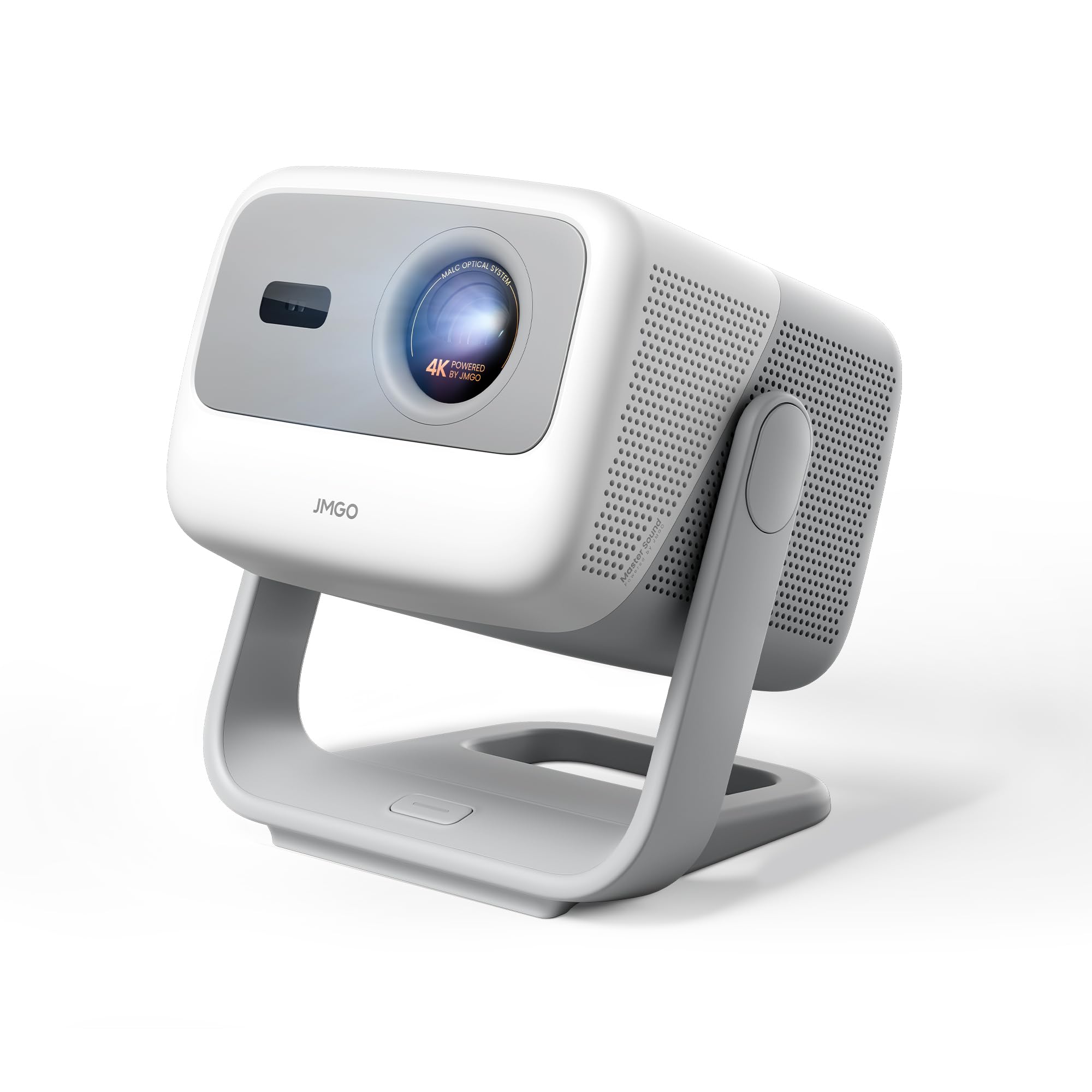
The JMGO N1S 4K proves you don’t need a large chassis to get a triple laser engine. This compact projector weighs just 4.4 lbs and features an integrated gimbal with 127° vertical rotation, making it incredibly easy to aim at walls or ceilings. The MALC 2.0 triple laser technology covers 110% BT.2020 and eliminates the rainbow effect completely.
The Google TV OS with official Netflix support provides a seamless streaming experience out of the box. The 17ms input lag and MEMC motion compensation make it surprisingly capable for casual gaming with a console. The 10W Dolby Audio speakers provide clear sound for its size, though they lack the bass for action-heavy movies.
The 1,100 ISO lumens limit this projector to dark room use—in any ambient light, the image washes out quickly. The OS is occasionally laggy when navigating 4K HDR content. For a portable, high-color-quality 4K projector that you can take camping or move from bedroom to living room, the N1S is a fantastic choice.
Why it’s great
- Ultra-portable 4.4 lbs design with a built-in adjustable gimbal.
- True triple laser engine with 110% BT.2020 and zero rainbow effect.
- Officially licensed Google TV with Netflix built in.
Good to know
- 1,100 ISO lumens require a completely dark room for best results.
- Google TV interface can lag when processing 4K HDR content.
FAQ
What is the difference between a pixel-shifting 4K and a native 4K projector?
Can I use a 4K movie projector in a room with windows and ambient light?
How important is the throw ratio when choosing a 4K movie projector?
What is the rainbow effect (RBE) and should I be worried about it?
Do I need an external soundbar with my 4K projector?
Final Thoughts: The Verdict
For most users, the best 4k movie projector winner is the Valerion VisionMaster Pro2 because it uniquely combines a high native contrast ratio (15,000:1), a flexible optical zoom lens, and robust dynamic HDR tone mapping into a portable triple-laser chassis. If you want a UST solution for a small living room, grab the NexiGo Aurora Pro MKII. And for a true high-contrast cinema experience in a dedicated dark room, nothing beats the Epson Home Cinema 5050UB.

Mo Maruf
I created WellFizz to bridge the gap between vague wellness advice and actionable solutions. My mission is simple: to decode the research and give you practical tools you can actually use.
Beyond the data, I am a passionate traveler. I believe that stepping away from the screen to explore new environments is essential for mental clarity and physical vitality.