Our readers keep the lights on and my smoothie glass nicely filled. As an Amazon Associate, I earn from qualifying purchases.
Pushing a display with over eight million pixels demands a graphics card that can brute-force its way through high-fidelity textures, complex shaders, and real-time ray tracing without choking. The wrong GPU at 4K resolution means stuttering frames, disabled graphical features, and a disappointing experience that makes your expensive monitor feel like a wasted investment. Choosing the correct silicon for this resolution requires understanding memory bandwidth, core counts, and architecture-specific features that directly translate to playable frame rates.
I’m Mohammad Maruf — the founder and writer behind WellFizz. I’ve spent years analyzing GPU architectures, decoding benchmark data, and filtering through consumer reports to identify which cards actually deliver on the 4K promise without unrealistic expectations.
This guide dissects the top contenders across performance tiers to help you identify the best 4k gaming gpu for your specific build, budget, and target frame rate.
How To Choose The Best 4K Gaming GPU
Selecting a GPU for 4K gaming isn’t about picking the most expensive model — it’s about matching silicon capabilities to your target resolution, refresh rate, and game library. The wrong choice can leave you with a card that either fails to fill your monitor’s pixel count or costs double what you actually need to spend.
VRAM Capacity and Memory Bandwidth
4K textures require significantly more video memory than 1440p or 1080p. A card with 12GB of VRAM can suffice for many current titles, but 16GB offers a safer buffer for upcoming releases and texture-heavy mods. Memory bandwidth — measured in GB/s and determined by the memory type (GDDR6, GDDR6X, GDDR7) and bus width (192-bit vs. 256-bit) — dictates how quickly the GPU can feed pixel data to your display. A wider bus and faster memory directly translate to smoother 4K performance in open-world and simulation games.
Upscaling and Ray Tracing Hardware
Native 4K rendering is demanding, which makes upscaling technologies like NVIDIA DLSS and AMD FSR essential for achieving high frame rates. DLSS 3 and DLSS 4 use dedicated Tensor Cores to generate frames intelligently, while FSR leverages spatial upscaling across a broader range of hardware. Ray tracing performance depends on dedicated RT cores — both NVIDIA’s 3rd and 4th Gen RT Cores and AMD’s 3rd Gen units — that handle light calculations without crippling rasterization frame rates. Prioritize a card with mature upscaling support if you play titles like Cyberpunk 2077 or Alan Wake 2.
Physical Size and Power Requirements
High-end 4K GPUs are physically large — many exceed 11 inches in length and occupy 2.5 to 3 slots, which can create clearance issues in smaller cases. Power draw ranges from 250W on mid-range 4K cards to over 450W on flagship models, requiring a power supply with sufficient wattage and the correct PCIe power connectors (8-pin, 12VHPWR). Always confirm your case dimensions and PSU specifications before purchasing, as an ill-fitting card or insufficient power delivery can derail an otherwise compatible build.
Quick Comparison
On smaller screens, swipe sideways to see the full table.
| Model | Category | Best For | Key Spec | Amazon |
|---|---|---|---|---|
| PNY RTX 5070 | Mid-Range NVIDIA | 1440p & light 4K | 12GB GDDR7 | Amazon |
| ASUS RTX 5070 Prime | Mid-Range NVIDIA | SFF builds & 1440p | 12GB GDDR7 | Amazon |
| GIGABYTE RX 9070 XT | Mid-Range AMD | Value 4K gaming | 16GB GDDR6 | Amazon |
| ASRock RX 9070 XT Steel Legend | Mid-Range AMD | White builds & 1440p | 16GB GDDR6 | Amazon |
| ASUS Prime RX 9070 XT | Premium AMD | Reliable 4K gaming | 16GB GDDR6 | Amazon |
| XFX Swift RX 9060 XT | Entry-Level | 1080p & light 1440p | 16GB GDDR6 | Amazon |
| GIGABYTE RTX 4070 | Mid-Range NVIDIA | Energy-efficient 4K | 12GB GDDR6X | Amazon |
| MSI RTX 5070 Ti Gaming Trio | Premium NVIDIA | High-FPS 1440p & 4K | 16GB GDDR7 | Amazon |
| PNY RTX 4080 Super | High-End NVIDIA | Native 4K gaming | 16GB GDDR6X | Amazon |
| EVGA RTX 3090 Ti FTW3 | Last-Gen Flagship | High VRAM workloads | 24GB GDDR6X | Amazon |
| VIPERA RTX 4090 FE | Flagship | Uncompromised 4K ultra | 24GB GDDR6X | Amazon |
In‑Depth Reviews
1. PNY NVIDIA GeForce RTX 5070 Epic-X ARGB OC Triple Fan
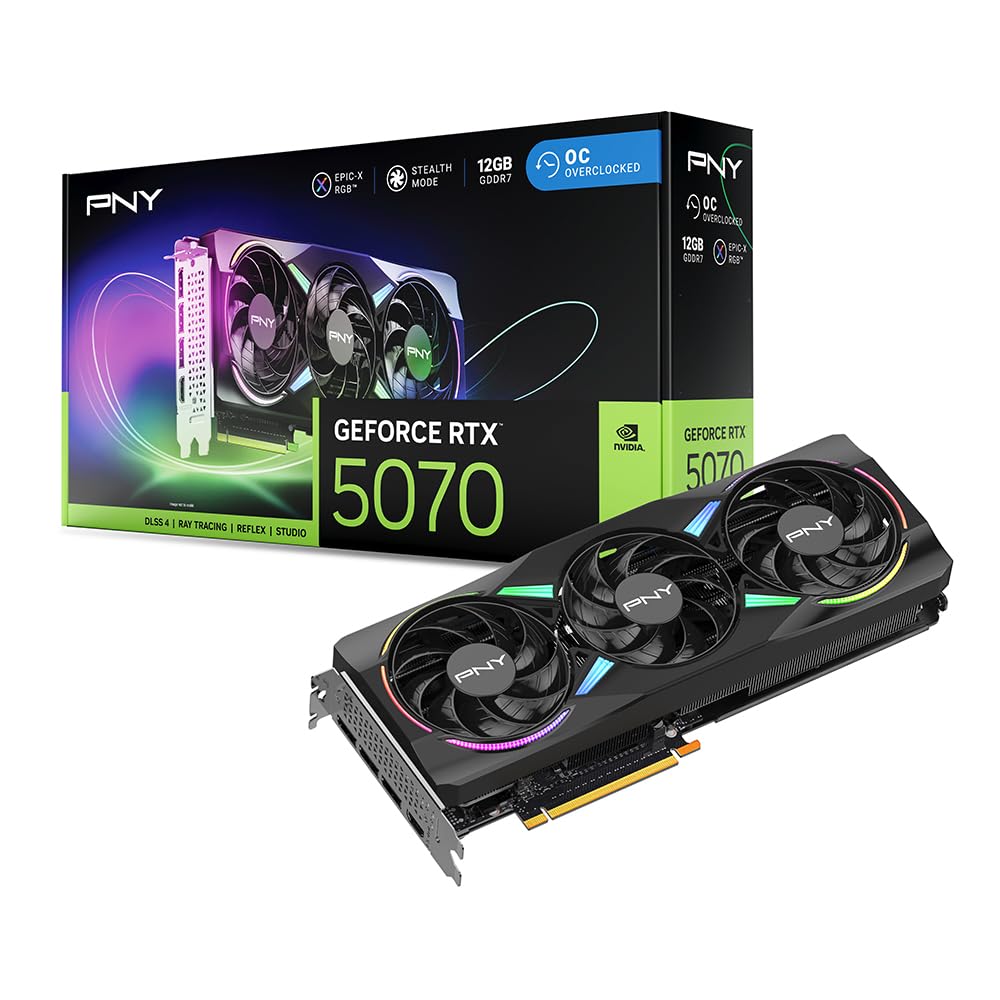
The PNY RTX 5070 marks a significant generational leap with its Blackwell architecture and GDDR7 memory, offering 28 Gbps memory speed over a 192-bit interface. This translates to a 672 GB/s memory bandwidth that handles 4K textures with headroom to spare, while the 6,144 CUDA cores and 4th Gen RT Cores deliver ray tracing performance that surpasses the previous 4070 Super generation. The triple-fan Epic-X cooler with ARGB lighting keeps thermals in check during extended sessions, and the card’s SFF-ready 2.4-slot profile makes it compatible with compact builds that traditionally struggle to house high-performance hardware.
Real-world tests show this card excels at 1440p with DLSS 4 enabled, producing high frame rates in competitive titles while maintaining excellent thermals at around 67°C under load. The 12GB VRAM buffer is adequate for current 4K gaming, though future-proofing enthusiasts may want more capacity for upcoming texture-heavy releases. The dual 8-pin to 12VHPWR adapter ensures compatibility with most mid-range power supplies, and the card’s 250W TDP keeps power draw manageable without requiring a PSU upgrade for most systems.
The DLSS 4 suite is the headline feature here — Frame Generation and Ray Reconstruction work together to boost 4K frame rates in supported titles by up to 4x compared to native rendering, making ray tracing at high resolutions practical for the first time in this price tier. The included Reflex technology reduces system latency, which competitive gamers will appreciate, and the card runs quietly thanks to the optimized fan curve that keeps noise levels low even during intensive rendering.
Why it’s great
- GDDR7 memory delivers excellent bandwidth for 4K textures
- DLSS 4 provides massive performance uplift in supported games
- Compact 2.4-slot design fits most SFF cases
Good to know
- 12GB VRAM may limit future 4K texture loads
- Requires 12VHPWR adapter cable for power
2. MSI NVIDIA GeForce RTX 5070 Ti 16G Gaming Trio OC Plus

The MSI Gaming Trio OC Plus steps up to a 256-bit memory interface paired with 16GB of GDDR7 memory running at 28 Gbps, providing a substantial bandwidth advantage over the standard RTX 5070. This wider bus is critical for 4K gaming because it allows the GPU to feed the display with high-resolution texture data more efficiently, reducing frame time inconsistencies in open-world titles. The TRI FROZR 4 cooling system with three STORMFORCE fans uses textured blades and double ball bearings to maintain quiet operation even when pushing the 250W TDP to its limit.
The 4th Gen RT Cores and DLSS 4 support make this card particularly strong for ray-traced gaming at 4K, where it can maintain playable frame rates with features like Path Tracing enabled in Cyberpunk 2077. The factory overclock provides a performance boost out of the box, and the card’s metal backplate with perforated design helps dissipate heat effectively while reinforcing the PCB against sag. At 338mm long, this card requires a spacious case, and the recommended 650W PSU with a 16-pin connector is necessary for stable operation.
Content creators will appreciate the HEVC encoding capabilities that handle professional video workflows with ease — the 5070 Ti processes 10-bit 4:2:2 HEVC files that caused issues on older cards, making it a viable choice for hybrid gaming and productivity builds. The zero RPM mode keeps fans completely silent during light loads, and the RGB lighting can be synchronized with other MSI components for a cohesive aesthetic. The card’s 2.5-slot design strikes a good balance between cooling performance and case compatibility.
Why it’s great
- Wider 256-bit bus improves 4K texture streaming
- 16GB GDDR7 provides future-proof VRAM capacity
- Excellent HEVC encoding for content creation
Good to know
- Large 338mm length requires spacious case
- Premium pricing over standard 5070 models
3. GIGABYTE Radeon RX 9070 XT Gaming OC 16G

The GIGABYTE RX 9070 XT Gaming OC delivers flagship-level 4K performance at a mid-range price point, thanks to AMD’s RDNA 4 architecture and the 16GB GDDR6 memory buffer. The WINDFORCE cooling system with Hawk fans and server-grade thermal conductive gel keeps temperatures under 65°C even during extended gaming sessions, while the boost clock reaching 3060 MHz ensures the card extracts every ounce of performance from the silicon. The 256-bit memory interface provides 20 Gbps effective memory speed, delivering the bandwidth needed for smooth 4K texture streaming.
Real-world performance benchmarks show this card achieving over 60 FPS at 4K ultra settings in most AAA titles without upscaling, and FSR 4.1 pushes frame rates significantly higher in supported games. The card is surprisingly compact at 11.34 inches, making it compatible with a wider range of cases than many competing 4K GPUs. The dual BIOS feature allows users to switch between performance and silent modes, and the subtle RGB lighting provides aesthetic customization without the gaudy look of some competitors.
The RX 9070 XT excels in rasterization performance, often matching or exceeding the RTX 5070 Ti in non-ray-traced workloads at a lower price point. While ray tracing performance has improved significantly with RDNA 4, it still trails NVIDIA’s 4th Gen RT Cores in heavy path-traced scenes. The card requires two 8-pin PCIe power connectors and a recommended 750W PSU, which is standard for this performance tier. Linux gamers will appreciate the excellent driver support, with users reporting seamless operation on distributions like Fedora and Ubuntu.
Why it’s great
- Excellent 4K rasterization performance for the price
- 16GB VRAM provides ample room for large textures
- Compact size fits more case configurations
Good to know
- Ray tracing trails NVIDIA equivalents
- Linux driver support is excellent
4. ASUS SFF-Ready Prime NVIDIA GeForce RTX 5070

The ASUS Prime RTX 5070 is specifically engineered for small-form-factor builds, featuring a 2.5-slot design that fits in cases where larger cards simply won’t work. The Axial-tech fans with a smaller hub and longer blades increase downward air pressure, ensuring effective cooling despite the compact footprint. The phase-change GPU thermal pad improves heat transfer efficiency, keeping GPU temperatures around 60-65°C under load, which is impressive for a card of this size class. The 12GB GDDR7 memory and Blackwell architecture deliver performance that comfortably handles 1440p gaming and light 4K workloads.
The Dual BIOS feature gives users flexibility between a quiet operation profile and a performance-oriented mode, with the silent BIOS maintaining fan-off operation during less demanding tasks. At 12 inches long, this card still requires careful case selection for extremely compact ITX builds, but it’s significantly shorter than many RTX 5070 competitors. The card ships with a speedsetup manual that simplifies installation, and the phase-change thermal pad ensures long-term thermal reliability without the pump-out issues that can plague traditional thermal paste.
Users report excellent compatibility with Ryzen 7800X3D processors for 1440p competitive gaming, with the card maintaining high frame rates in titles like Warzone and Apex Legends. The DLSS 3.5 and 4 support provides headroom for ray tracing at 1440p, making this a well-rounded choice for gamers who want Blackwell features without the bulk. The card requires a PSU with two 8-pin connectors and the included 16-pin adapter, and its power draw is modest enough that most 650W power supplies can handle it without issues.
Why it’s great
- Specifically engineered for SFF compatibility
- Phase-change thermal pad improves long-term cooling
- Dual BIOS for flexible operation modes
Good to know
- 12GB VRAM limits future 4K potential
- 12-inch length still requires case checking
5. PNY GeForce RTX 4080 Super 16GB Verto OC Triple Fan

The PNY RTX 4080 Super represents the sweet spot for native 4K gaming, with 10,240 CUDA cores and 16GB of GDDR6X memory on a 256-bit bus delivering 736 GB/s of bandwidth. This configuration handles 4K ultra settings in virtually every current title without relying on upscaling, making it the ideal choice for purists who want native resolution performance. The 2295 MHz base clock and 2565 MHz boost clock ensure consistent frame rates, and the triple-fan Verto cooler keeps temperatures under 70°C even during demanding ray-traced workloads.
The card’s all-black, no-RGB design appeals to builders who prefer a clean, professional aesthetic without distracting lighting. The included anti-sag support bracket is essential given the card’s 13-inch length and substantial weight, though users should verify motherboard compatibility as the bracket may conflict with certain board layouts. The 12VHPWR power connector requires three 8-pin PCIe cables, which can be awkward in cable management but ensures stable power delivery for the card’s 320W TDP.
DLSS 3 Frame Generation transforms this card into a 4K beast, allowing it to achieve triple-digit frame rates in titles like Cyberpunk 2077 with ray tracing enabled. The AV1 encoding support benefits content creators who stream or record gameplay, and the card’s performance at 3840×1600 ultrawide resolutions is particularly impressive. The primary caveat is the card’s size — it requires a full-tower or large mid-tower case, and the included support bracket may not be compatible with all motherboards, requiring alternative anti-sag solutions in some builds.
Why it’s great
- Native 4K performance without needing upscaling
- Clean, professional design without RGB
- Excellent DLSS 3 Frame Generation support
Good to know
- Very large card requires spacious case
- Anti-sag bracket may conflict with some motherboards
6. GIGABYTE GeForce RTX 4070 WINDFORCE OC 12G

The GIGABYTE RTX 4070 Windforce OC is the efficiency king of the 4K-capable GPU lineup, with a power draw of just 175W under typical 1440p gaming loads — roughly half the consumption of competing high-end cards. This makes it an excellent choice for users who want to upgrade without replacing their power supply, as it runs on a single 8-pin PCIe connector. Despite its modest power requirements, the 12GB GDDR6X memory and 3rd Gen RT Cores deliver playable 4K performance in many titles, especially when leveraging DLSS 3 Frame Generation.
The Windforce 3X cooling system with its triple-fan design keeps idle temperatures around 30-37°C and load temperatures at a cool 47°C, making it one of the coolest-running cards in its class. The Dual BIOS feature allows users to choose between a performance-optimized profile and a quiet operation mode, and the card’s compact 10.28-inch length fits in most mid-tower cases without clearance issues. The protection metal backplate prevents PCB sag, and the included anti-sag bracket provides additional support for long-term reliability.
At 4K resolution, this card achieves 60+ FPS in well-optimized titles like GTA V and Call of Duty, while more demanding games like Cyberpunk 2077 require DLSS to maintain playable frame rates. The card’s real strength is thermal efficiency — it runs significantly cooler than the AMD Radeon RX 6750 XT while consuming nearly half the power. The lack of RGB lighting makes it ideal for users who prefer a stealthy build, and the fan noise remains imperceptible even under sustained load. This is a card that prioritizes efficiency and silence over raw brute force.
Why it’s great
- Extremely efficient 175W power draw
- Runs very cool and quiet under load
- Compatible with most existing PSUs
Good to know
- 12GB VRAM limits 4K texture headroom
- Requires DLSS for demanding 4K titles
7. ASUS Prime AMD Radeon RX 9070 XT 16GB OC Edition

The ASUS Prime RX 9070 XT OC Edition is a well-engineered 4K gaming card that emphasizes reliability and performance consistency over flashy aesthetics. The Axial-tech fans with dual-ball bearings are rated to last twice as long as standard sleeve bearing designs, and the phase-change GPU thermal pad maintains optimal heat transfer over years of use without degrading. The 2.5-slot design at 311mm length fits most mid-tower cases, and the card’s 16GB GDDR6 memory provides the VRAM capacity needed for 4K textures without compromise.
Under load, this card draws around 180-190W while maintaining temperatures of 55-59°C, which is impressive efficiency for a high-performance 4K GPU. The 0dB technology stops fans completely during light gaming sessions, making it effectively silent for less demanding titles. The card ships without RGB lighting, which some users will appreciate for its clean, professional appearance, and the Dual BIOS feature provides flexibility for tuning between quiet and performance modes.
Linux compatibility is excellent, with users reporting seamless operation on Xubuntu 22.04 and other distributions without needing proprietary drivers. The card’s ray tracing performance has improved substantially over previous AMD generations, though it still trails NVIDIA in heavy path-traced workloads. The card requires three PCIe power connectors, which is unusual for this performance tier and requires careful PSU planning. The ASUS warranty and customer support reputation is a concern noted by users, so purchasing through a reliable retailer with good return policies is recommended.
Why it’s great
- Excellent Linux driver support out of the box
- Very efficient power draw for 4K performance
- Dual-ball bearings and phase-change pad ensure longevity
Good to know
- Requires three PCIe power connectors
- Ray tracing performance trails NVIDIA
8. XFX Swift AMD Radeon RX 9060 XT OC Gaming Edition 16GB
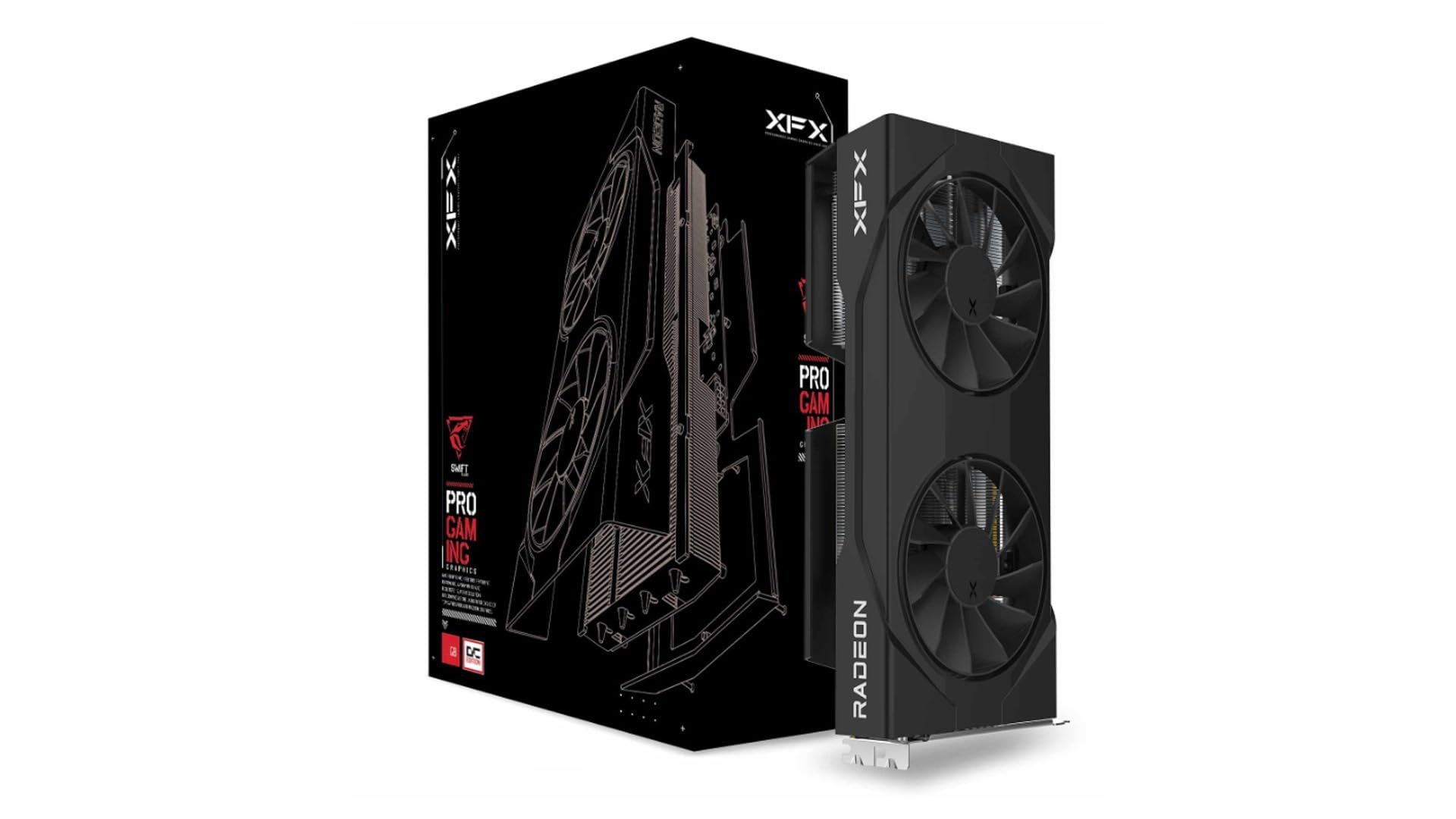
The XFX Swift RX 9060 XT is an entry-level 4K-capable GPU that offers exceptional value for budget-conscious gamers, pairing 16GB of GDDR6 memory with RDNA 4 architecture at a very accessible price point. The SWFT Dual Fan cooling solution effectively manages thermals, keeping temperatures around 60°C under load, and the boost clock reaching 3320 MHz ensures the card performs well within its power envelope. The 1900 MHz base clock provides a solid foundation for 1440p gaming, with 4K performance available in less demanding titles or with FSR upscaling.
Timespy benchmarks around 17000 place this card solidly in the upper-mid-range segment, offering smooth 1080p and 1440p gaming at max settings in the vast majority of modern AAA titles. The card’s compact 10.63-inch length makes it one of the most case-friendly options in this list, fitting easily into most mid-tower and some smaller builds. The dual DisplayPort and single HDMI configuration provides adequate connectivity for most setups, though users with three or more displays may need to utilize motherboard outputs for additional monitors.
Power efficiency is a strong point — the card runs cool and quiet even under sustained load, making it suitable for systems where noise is a concern. The 16GB VRAM buffer is generous for this price tier, providing headroom for high-resolution texture packs and future game releases. Users upgrading from older GPUs will notice a substantial performance improvement, with the card handling 1440p ultrawide comfortably in most titles. The primary limitation is the 4K performance ceiling — this card is best suited for 1440p gaming with the option to try 4K in optimized titles rather than as a dedicated 4K gaming solution.
Why it’s great
- Exceptional value for 16GB VRAM at this price
- Compact size fits most case configurations
- Runs cool and quiet under load
Good to know
- Limited 4K performance in demanding titles
- Only 3 display outputs (2 DP, 1 HDMI)
9. ASRock Radeon RX 9070 XT Steel Legend 16GB

The ASRock RX 9070 XT Steel Legend is designed for builders who want a visually striking GPU that also delivers serious 4K performance, featuring a white and silver color scheme with Polychrome SYNC RGB lighting. The triple-fan cooling system with striped ring fans and air-deflecting fins maintains excellent thermals, and the 0dB Silent Cooling mode stops fans completely at low temperatures for silent operation during less demanding tasks. The reinforced metal frame and stylish metal backplate provide structural rigidity that prevents PCB sag, a common issue with large GPUs.
With a boost clock up to 2970 MHz and game clock at 2400 MHz, the Steel Legend delivers consistent 1440p max settings performance and capable 4K gaming. The 256-bit memory interface running at 20 Gbps provides the bandwidth needed for smooth 4K texture streaming, and the 16GB VRAM buffer ensures compatibility with high-resolution texture packs. The card’s 2.9-slot design makes it one of the thicker options, requiring careful case selection and potentially interfering with adjacent PCIe slots.
The PCIe 5.0 interface ensures maximum bandwidth compatibility with the latest motherboards, and the triple DisplayPort 2.1a plus HDMI 2.1b outputs support up to four displays at resolutions up to 7680×4320. The ASRock Polychrome SYNC software enables RGB customization, though some users report connectivity issues with the lighting software. Undervolting via AMD Adrenaline can improve frame rates and reduce temperatures, and the card responds well to manual tuning. The reinforced metal construction gives the card a premium feel that justifies the premium positioning.
Why it’s great
- Striking white and RGB aesthetic for themed builds
- Reinforced metal frame prevents sag
- Excellent 1440p and capable 4K performance
Good to know
- Large 2.9-slot design limits case compatibility
- RGB software has reported connectivity issues
10. EVGA GeForce RTX 3090 Ti FTW3 Ultra Gaming 24GB

The EVGA RTX 3090 Ti FTW3 Ultra Gaming remains a formidable 4K GPU even years after its release, leveraging 24GB of GDDR6X memory on a 384-bit bus for massive bandwidth that handles 4K textures effortlessly. The vapor chamber cooling with triple fans and 9 iCX3 thermal sensors keeps temperatures under 65°C, which is remarkable for a card with a 450W+ TDP. The all-metal die-cast backplate and pre-installed ARGB lighting give it a premium feel that EVGA was known for before exiting the GPU market.
The 24GB VRAM buffer makes this card uniquely suited for workloads that exceed the capacity of current-generation cards, such as large language model inference, 8K video editing, and heavy 3D rendering. In 4K gaming, the 3090 Ti maintains 144Hz in well-optimized titles like Warzone with DLSS enabled, and it handles max settings at 3440×1440 ultrawide resolutions with ease. The FTW3 cooler is widely regarded as the best air cooler ever produced for a GPU, and the card boosts to 2070 MHz out of the box without manual tuning.
The primary drawbacks are power consumption and heat output — the 450W+ TDP generates significant room heat and requires a robust cooling solution in the case. The card is physically massive at 11.81 inches and 2.5 slots thick, and EVGA recommends a 1000W PSU for stable operation. The fan noise under load is noticeable, and the price-to-performance ratio is poor compared to modern alternatives like the RTX 4080 Super. However, for users who need the 24GB VRAM for professional workloads, this card offers capability that current mid-range cards cannot match.
Why it’s great
- Massive 24GB VRAM for professional workloads
- Excellent vapor chamber cooling keeps temps under 65°C
- Build quality is among the best ever produced
Good to know
- Very high 450W+ power consumption
- Poor price-to-performance vs. modern GPUs
11. VIPERA NVIDIA GeForce RTX 4090 Founders Edition

The VIPERA RTX 4090 Founders Edition represents the absolute pinnacle of consumer GPU performance, with 24GB of GDDR6X memory on a 384-bit bus and the full Ada Lovelace architecture with 16,384 CUDA cores. The 2520 MHz boost clock and 2.23 GHz memory clock deliver native 4K performance that can push over 60 FPS in even the most demanding ray-traced titles without upscaling, making it the only card that can truly max out high-refresh-rate 4K monitors at ultra settings. The thermal solution in the Founders Edition is remarkably effective given the card’s 450W TDP, keeping temperatures manageable during extended gaming sessions.
In real-world use, the 4090 achieves over 100 FPS in Cyberpunk 2077 at 4K with ray tracing enabled and DLSS set to Quality, a feat that no other consumer card can match. The card excels in creative workloads too — Blender rendering, Unreal Engine 5 development, and high-poly 3D modeling benefit from the massive CUDA core count and 24GB VRAM buffer. The card’s size is substantial at 11.97 inches, but the Founders Edition’s unique dual-flow-through cooler design exhausts heat effectively through the rear and top of the case, improving overall system thermals.
The 4090 is priced at a significant premium that places it out of reach for most gamers, but for those who demand uncompromised 4K performance and have the budget to match, it delivers an experience that no other card can replicate. The card requires a high-quality 1000W PSU with the appropriate 12VHPWR connector, and physical clearance must be carefully verified as the card’s height and length can conflict with side panels and front-mounted radiators. The Founders Edition’s build quality is exceptional, with premium materials and a clean design that looks professional in any build. For professional users doing LLM work, 3D rendering, or 8K video editing, this card pays for itself in reduced render times.
Why it’s great
- Unmatched 4K ray tracing performance
- 24GB VRAM handles the most demanding workloads
- Excellent thermal design exhausts heat effectively
Good to know
- Very high investment for most users
- Requires powerful 1000W PSU and spacious case
FAQ
Is 12GB of VRAM enough for 4K gaming in 2025?
Should I prioritize rasterization or ray tracing performance for 4K gaming?
What power supply wattage do I need for a 4K gaming GPU?
Final Thoughts: The Verdict
For most users, the best 4k gaming gpu winner is the PNY RTX 4080 Super because it delivers native 4K performance without relying on upscaling, has ample 16GB VRAM for future titles, and provides excellent DLSS 3 support for demanding ray-traced games. If you prioritize value and efficient power draw, grab the GIGABYTE RX 9070 XT Gaming OC for its impressive 4K rasterization and 16GB buffer at a competitive price point. And for uncompromised 4K performance with the ability to max out every setting in any game, nothing beats the VIPERA RTX 4090 Founders Edition — the only card that truly future-proofs your 4K gaming for years to come.

Mo Maruf
I created WellFizz to bridge the gap between vague wellness advice and actionable solutions. My mission is simple: to decode the research and give you practical tools you can actually use.
Beyond the data, I am a passionate traveler. I believe that stepping away from the screen to explore new environments is essential for mental clarity and physical vitality.