Our readers keep the lights on and my smoothie glass nicely filled. As an Amazon Associate, I earn from qualifying purchases.
Stabilizing a high-resolution camera on a lightweight flying machine that fights wind, signal drops, and vibration is the defining engineering challenge of the consumer drone market. A 4K camera is only as good as the gimbal, the propulsion system, and the transmission link that support it—ignore any one of these, and your 4K footage will look like a shaky home video from 2005.
I’m Mohammad Maruf — the founder and writer behind WellFizz. My process for this guide involved cross-referencing the actual Sony and CMOS sensor specs, gimbal axis counts, flight time metrics from flight logs, and transmission distance data across the mid-range and premium tiers to find which drones actually deliver sharp, usable 4K footage in real-world conditions.
Whether you are a travel content creator or a hobbyist looking for your first serious aerial platform, finding the best 4K drones requires understanding how each component—from the brushless motor wind rating to the electronic image stabilization algorithm—works together to produce stable video.
How To Choose The Best 4K Drone
Choosing a 4K drone isn’t just about pixel count. The camera sensor, the mechanical stabilization system, and the transmission technology all define whether you get smooth, cinematic footage or a shaky, unusable mess. This section breaks down the critical specs you need to evaluate before making a purchase.
Gimbal Quality: 2-Axis vs. 3-Axis vs. EIS
A 3-axis mechanical gimbal physically stabilizes the camera on the pitch, roll, and yaw axes, keeping your 4K footage steady even during aggressive turns or gusty wind. 2-axis gimbals handle pitch and roll only, which means you will see obvious lateral wobble during yaw movements. Electronic Image Stabilization (EIS) is purely digital—it crops the frame to compensate for shake, but it cannot match the smoothness of a mechanical gimbal, especially during rapid motion. For professional-looking 4K video, prioritize a drone with a 3-axis mechanical gimbal.
Flight Time and Battery Strategy
Advertised flight times like “93 minutes” refer to the total possible flight time with multiple batteries—not one continuous session. A single battery’s real-world flight time, factoring in wind and camera use, typically ranges from 15 to 31 minutes. Consider how many batteries come in the package and whether the charging hub supports fast parallel charging. For a full day of shooting, a kit with three batteries and a rapid charger is far more practical than a drone with a single long-flight battery.
Transmission Range and Latency
The transmission system determines how far you can fly and how responsive your live feed will be. A “4km” or “6km” range is the theoretical maximum in open air, you will get about half that in suburban or tree-dense areas. Low latency (under 200ms) is essential for framing shots in First Person View (FPV). Wi-Fi-based transmission is cheaper but suffers from lag and dropouts at longer distances, while proprietary digital transmission systems (like DJI’s OcuSync or Holy Stone’s Wi-Fi Repeater tech) offer smoother, more reliable performance.
Camera Sensor and Aperture
The sensor size and aperture directly affect low-light performance and image quality. A 1/1.3-inch CMOS sensor (like the one in the DJI Flip) captures significantly more light than a standard 1/2.3-inch sensor. A wider aperture (f/1.8 or f/1.7) also helps in low light. Don’t just look at the resolution number; look at the physical sensor size and aperture rating to judge how your 4K footage will look at dusk or in shaded areas.
Quick Comparison
On smaller screens, swipe sideways to see the full table.
| Model | Category | Best For | Key Spec | Amazon |
|---|---|---|---|---|
| DJI Flip (RC-N3) | Premium | Best Overall 4K Video Quality | 1/1.3-inch CMOS, 4K/60fps HDR | Amazon |
| Bwine F7MINI 4K(RC3) | Mid-Range | Best Built-in Screen Controller | 5.5″ 1080P screen, 48MP photo | Amazon |
| Holy Stone HS790 | Mid-Range | Best Value 3-Axis Gimbal | 3-axis mech gimbal, 6K photo | Amazon |
| HOVERAir X1 PRO | Premium | Best Hands-Free Action Camera | 42 KM/H follow, 192g, 4K/60fps | Amazon |
| Bwine F7GB2 Pro | Mid-Range | Best Flight Time Bundle | 75 mins total (3 batts), 3-axis gimbal | Amazon |
| K600PRO (Karuisrc) | Premium | Best Long Range GPS | 15KM transmission, 55 min flight | Amazon |
| Holy Stone HS600 | Mid-Range | Best Budget 2-Axis Gimbal | 2-axis gimbal, 20,000ft range | Amazon |
| DJI Neo 2 Fly More | Mid-Range | Best Beginner Palm Control | 151g, omnidirectional obstacle sensing | Amazon |
| Potensic ATOM SE | Budget | Best Entry-Level Value | Under 249g, 4K EIS, 93 min total | Amazon |
In‑Depth Reviews
1. DJI Flip (RC-N3)

The DJI Flip leverages a 1/1.3-inch CMOS sensor—significantly larger than the 1/2.3-inch sensors found in most drones at this price point. This larger sensor captures more light, enabling true HDR 4K/60fps video that maintains detail in both shadow and highlight areas. The larger sensor combined with a 3-axis mechanical gimbal produces smoother, more color-rich footage than any drone in this guide, making it the clear choice for anyone who values image quality above all else.
Weighing under 249g, the Flip avoids FAA registration and Remote ID requirements entirely. The full-coverage carbon fiber propeller guards provide a safety net for beginners, while the 31-minute max flight time (per battery) is competitive with larger drones. Subject tracking (ActiveTrack) works reliably, keeping your subject centered even as you move through varied terrain. The included RC-N3 controller provides a stable transmission link—no phone required, though you can connect one for live view.
The one real limitation is obstacle avoidance: the Flip only has forward-facing sensors, not omnidirectional coverage. This means you must be careful during lateral or backward flight. Also, the full-coverage guards add a bit of bulk, so it’s not the most compact option for backpack travel. But if you need the best 4K image quality from a lightweight, FAA-friendly platform, this is the drone to beat.
Why it’s great
- Best-in-class 1/1.3″ sensor for superior low-light and HDR video
- Under 249g avoids FAA registration completely
- Subject tracking and palm takeoff/landing simplify shooting
Good to know
- Only forward-facing obstacle sensors—no omnidirectional protection
- Carbon fiber guards add slight bulk; not the most portable
- Single battery included; Fly More Combo adds cost
2. Bwine F7MINI 4K(RC3)
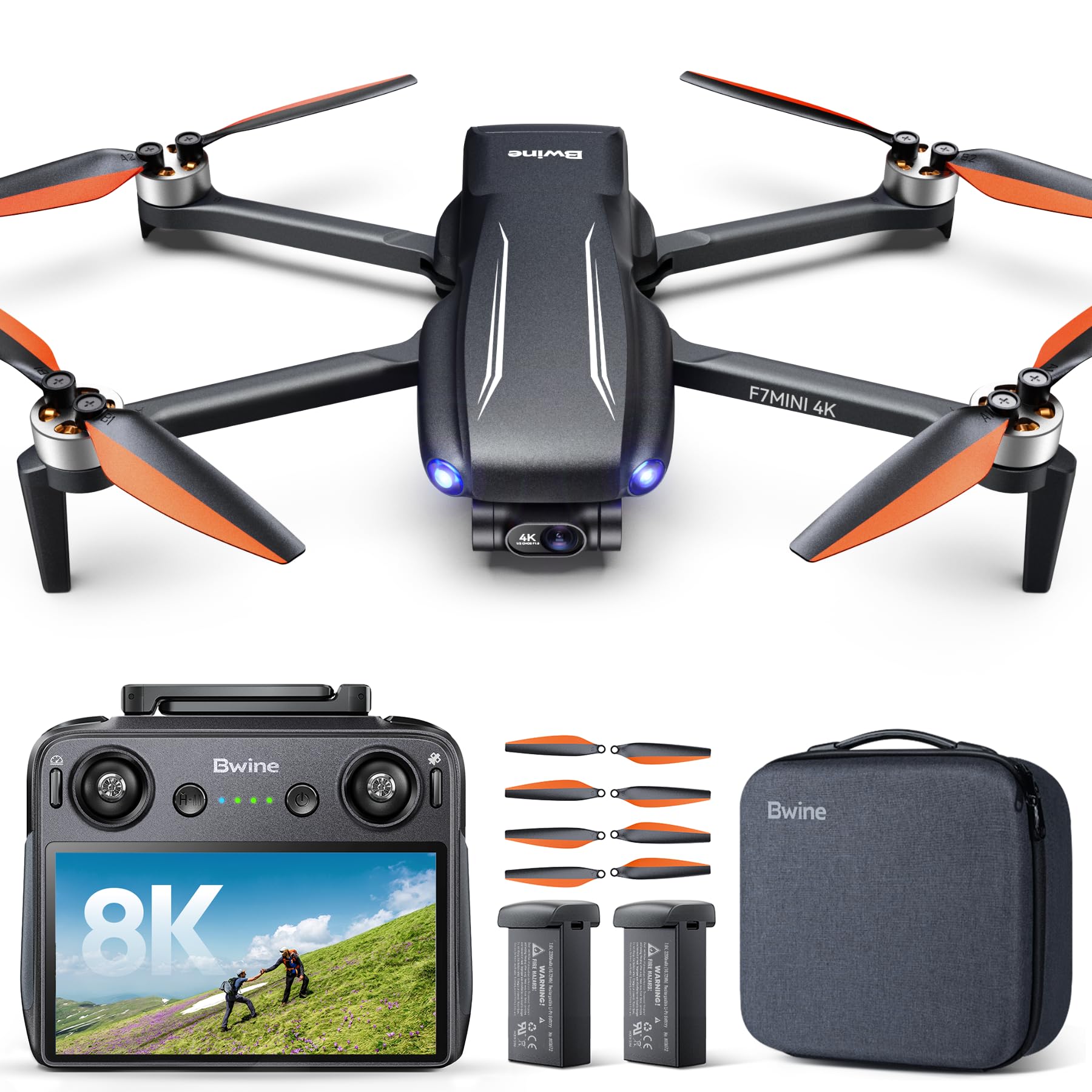
The Bwine F7MINI 4K(RC3) eliminates the single most frustrating part of drone flying: fumbling with your phone to connect to the controller. Its built-in 5.5-inch 1080P touchscreen (60Hz, 500 nits) offers a crisp, sun-readable live view without needing a phone connection or app setup. The 32GB of internal storage means you can shoot and save directly to the controller—a major workflow advantage for filmmakers who want to review footage immediately.
On the camera side, the 3-axis brushless gimbal and EIS work together to keep 8K photos and 4K video steady even in moderate wind. The 48MP sensor with an f/1.8 aperture produces good detail in well-lit conditions. The 20,000ft real-time transmission range (stable to about 4.5km in urban tests) provides plenty of distance for landscape shooting. With two batteries offering 32 minutes each, you get a solid 64 minutes of total flight time.
Weighing under 249g, it requires no FAA registration. The GPS auto-return works reliably, and the drone locator (120dB buzzer) is a thoughtful feature for beginners. The main trade-off is that the camera, while good, doesn’t match the dynamic range of the DJI Flip’s larger sensor, especially in low light. If you prioritize a self-contained, screen-based flying experience with very good 4K video, the Bwine F7MINI is a strong contender.
Why it’s great
- Built-in 5.5″ 1080P screen eliminates phone dependency
- Under 249g, no FAA registration required
- 32GB internal storage plus f/1.8 aperture for solid low-light shots
Good to know
- Camera dynamic range lags behind larger 1/1.3″ sensor drones
- File transfer from controller to phone is slow
- Transmission range may drop in dense urban areas
3. Holy Stone HS790
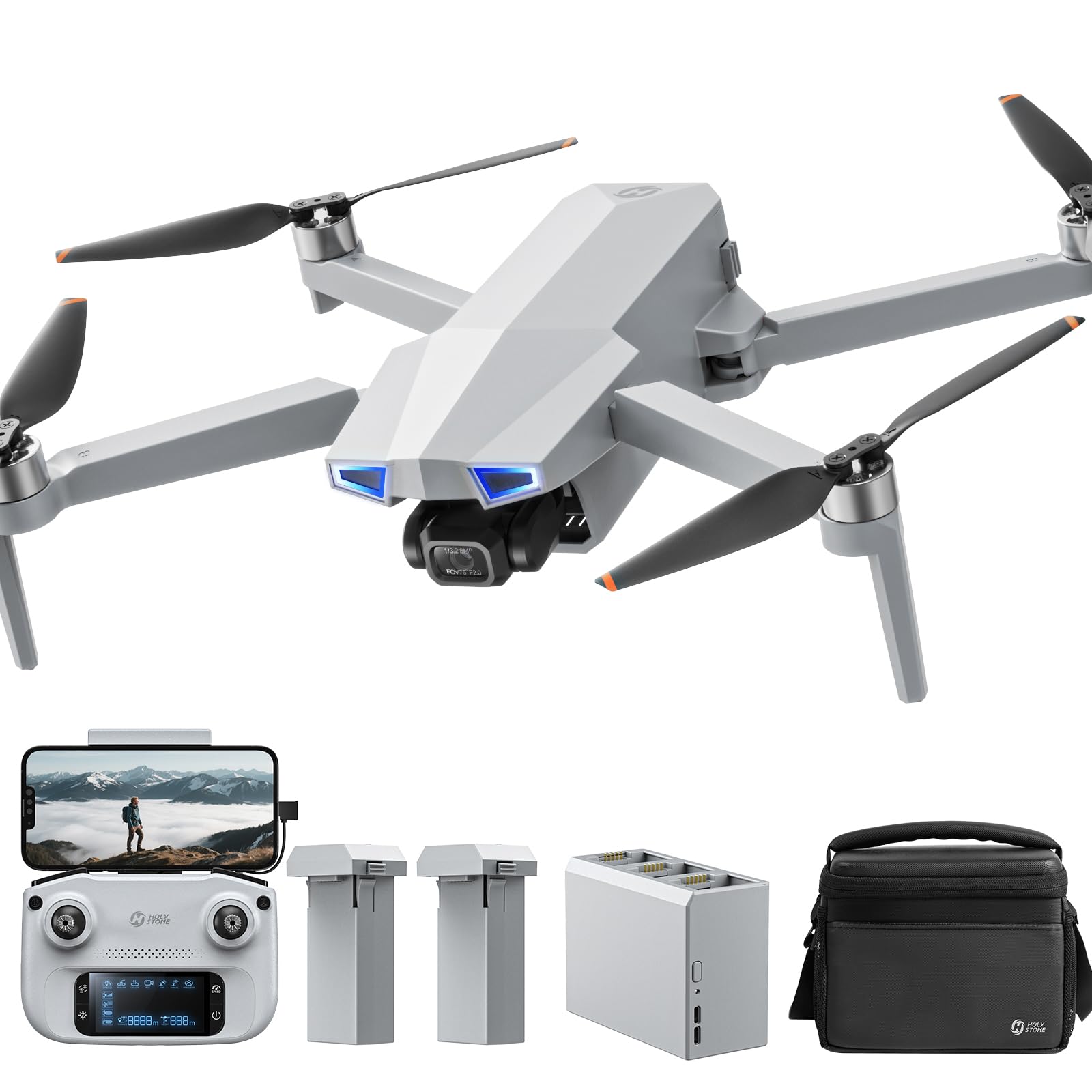
The Holy Stone HS790 brings a 3-axis mechanical gimbal—typically reserved for more expensive drones—into the mid-range price bracket. This gimbal delivers smooth, cinema-like stabilization during 4K/30fps video recording, even in wind up to Level 6. The 6K photo mode is a bit of marketing gloss, but the 4K video quality is genuinely good for its class, with the gimbal eliminating the jitter that plagues 2-axis gimbal setups.
The integrated Wi-Fi Repeater in the controller extends transmission range to a theoretical 30,000 feet, though real-world performance in suburban areas is closer to half that. The two included batteries (3,200mAh each) provide a total flight time of 60 minutes, and the Smart PD Charging Hub doubles as a power bank for charging other devices. The built-in Remote ID ensures FAA compliance without needing an external module.
The app (HT FLY) can feel buggy, and the gimbal struggles to keep up during fast, aggressive yaw turns. The camera also doesn’t support RAW photos, limiting post-processing flexibility. For the price, though, you get 3-axis gimbal stabilization that typically costs significantly more. If smooth 4K video on a budget is the priority, the HS790 is the top choice.
Why it’s great
- 3-axis mechanical gimbal for smooth, jitter-free 4K video
- 30,000ft transmission range via Wi-Fi Repeater
- Smart PD Charging Hub doubles as power bank
Good to know
- App software can be glitchy and slow
- Gimbal struggles during fast, tight turns
- No RAW photo capture; only JPEG output
4. HOVERAir X1 PRO

The HOVERAir X1 PRO takes a completely different approach from traditional drone designs. It is a fully enclosed, foldable flying camera that weighs only 192g—no FAA registration needed. Instead of a separate controller, you control it entirely through app, voice commands, or pre-set flight modes. The 4K/60fps vertical and horizontal shooting capability, along with a 2-axis gimbal plus EIS and horizon leveling (HL), makes it ideal for fast-paced action sports where you need hands-free tracking.
The standout feature is the tracking performance: the OmniTerrain system allows all-terrain flight over snow, water, and cliffs, and the follow speed of 42 KM/H (26 mph) means it can keep up with cyclists and skiers. The 104° FOV lens provides a dynamic perspective. Internal storage is 32GB with support for external SD cards up to 1TB. The rear ToF proximity sensor provides collision detection at speeds up to 1.5m/s.
The 2-axis gimbal (pitch and roll) means it doesn’t have the yaw stability of a 3-axis system—you will notice some wobble during complex orbits or fast yaw movements. Battery life per charge is around 15-17 minutes in active tracking mode, which is short but typical for ultraportables. It is also not designed for traditional manual piloting. If you want a self-contained, pocketable action camera that shoots excellent 4K automatically, this is your best bet.
Why it’s great
- Fully enclosed, pocketable design; no controller needed
- 42 KM/H follow speed perfect for cycling and skiing
- OmniTerrain handles snow, water, and cliff environments
Good to know
- 2-axis gimbal shows wobble during yaw movements
- Short flight time (~15 min) during active tracking
- Not designed for traditional manual piloting
5. Bwine F7GB2 Pro

The Bwine F7GB2 Pro comes with three 2,600mAh batteries, giving you a total of 75 minutes of flight time—the highest total in this guide. Each battery provides approximately 25 minutes of real-world flight in moderate wind. The 3-axis gimbal keeps the 4K video stable, while the larger CMOS sensor and 120° FOV lens capture wide, detailed footage. The one-click detachable camera makes storage and transport easier, and the included hard shell case protects everything during travel.
The 1806 brushless motor offers Level-6 wind resistance, meaning it can fly confidently in winds up to about 25 MPH. The 3,000m control range (transmission up to 10,000ft) provides ample distance for most recreational flying. The GPS system features auto-return on low battery or signal loss, plus Follow Me, Waypoint, and Orbit modes. The remote control’s overlay display shows telemetry data directly on the screen, which is helpful for monitoring battery and distance.
The remote screen is difficult to read in direct sunlight, which is a common complaint. The camera also shows distortion during fast turns, and the 4K video processing can struggle in low-light conditions. The drone weighs 550g, meaning it exceeds the 249g threshold and requires FAA registration. If total flight time and a high-quality 3-axis gimbal at a reasonable price are your main requirements, the F7GB2 Pro delivers exceptional value.
Why it’s great
- 75 minutes total flight time with 3 batteries
- 3-axis gimbal for steady 4K video in wind
- Level-6 wind resistance and hard case included
Good to know
- Weighs 550g—requires FAA registration
- Remote screen hard to read in bright sun
- Minor camera distortion during fast turns
6. K600PRO (Karuisrc)
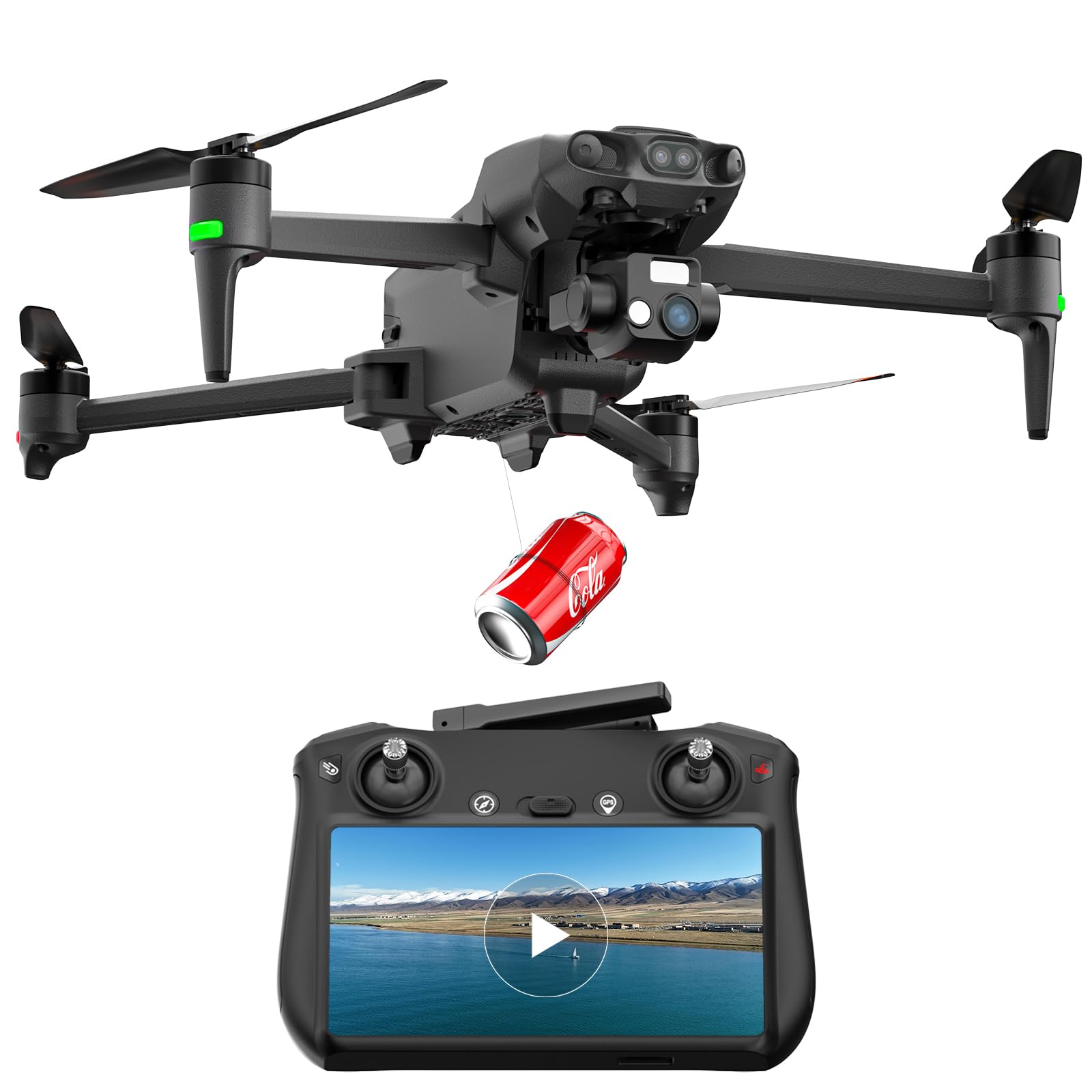
The K600PRO is designed for pilots who want maximum transmission distance without sacrificing stability. The 15km HD FPV transmission range is the longest in this guide, making it suitable for long-distance surveying, farmland inspection, or just exploring distant landscapes. The 11.1V 3,500mAh battery provides a 55-minute flight time (per battery), which is excellent for a single-session shoot.
The 4K camera is paired with a 3-axis gimbal, and the 50x zoom (digital) allows you to inspect faraway subjects without closing distance physically. The built-in 5.5-inch touchscreen controller provides a clear live view without a phone, and the 16GB SD card slot handles internal storage. GPS functions—return-to-home, follow me, orbit, and waypoint—are all present and work reliably. The TOF and 6 high-precision GPS sensors improve low-altitude flight stability.
The 4K video quality is good but not premium—the image processing isn’t as refined as DJI’s, and low-light performance is mediocre due to the smaller sensor. The drone is also heavy (730g), requiring FAA registration. Some users report that the controller’s touchscreen interface can be slow to respond. If you need extreme range and long flight time above absolute image quality, the K600PRO is a compelling choice.
Why it’s great
- 15km transmission range for long-distance FPV
- 55-minute flight time per battery
- Built-in touchscreen controller eliminates phone
Good to know
- Image processing and low-light performance are average
- Heavy design (730g) requires FAA registration
- Controller touchscreen can be sluggish
7. Holy Stone HS600

The Holy Stone HS600 is a solid entry point for pilots who want a 2-axis gimbal and 4K EIS without paying for a 3-axis system. The 2-axis gimbal stabilizes pitch and roll, reducing the most common sources of shake, though yaw movements will introduce some side-to-side wobble. At 197g, it is one of the lightest drones in this guide, well under the 249g threshold for FAA registration.
The transmission range of 20,000 feet (via Wi-Fi Repeater) is competitive for the mid-range, and the integrated Remote ID ensures FAA compliance without extra modules. The Level-6 wind resistance combined with brushless motors means it can handle breezy conditions. The GPS intelligent return-to-home works effectively, and the one-key takeoff/landing simplifies operation for beginners.
The 2-axis gimbal means this is not the drone for complex cinematic shots with rapid yaw movement. The separate Wi-Fi app connection process can be finicky, and some users report difficulty connecting on the first attempt. The camera sensor (Sony-based) produces decent 4K footage in good light, but it is noticeably less sharp than the 3-axis gimbal competitors. For a lightweight, registration-free 4K drone with gimbal stabilization, the HS600 is a good value choice.
Why it’s great
- Under 197g—lightest drone requiring no FAA registration
- 2-axis gimbal reduces pitch/roll shake for smoother video
- 20,000ft transmission range with integrated Remote ID
Good to know
- 2-axis gimbal shows yaw wobble during turns
- Wi-Fi app connection can be tricky initially
- 4K image sharpness is lower than 3-axis gimbal models
8. DJI Neo 2 Fly More Combo
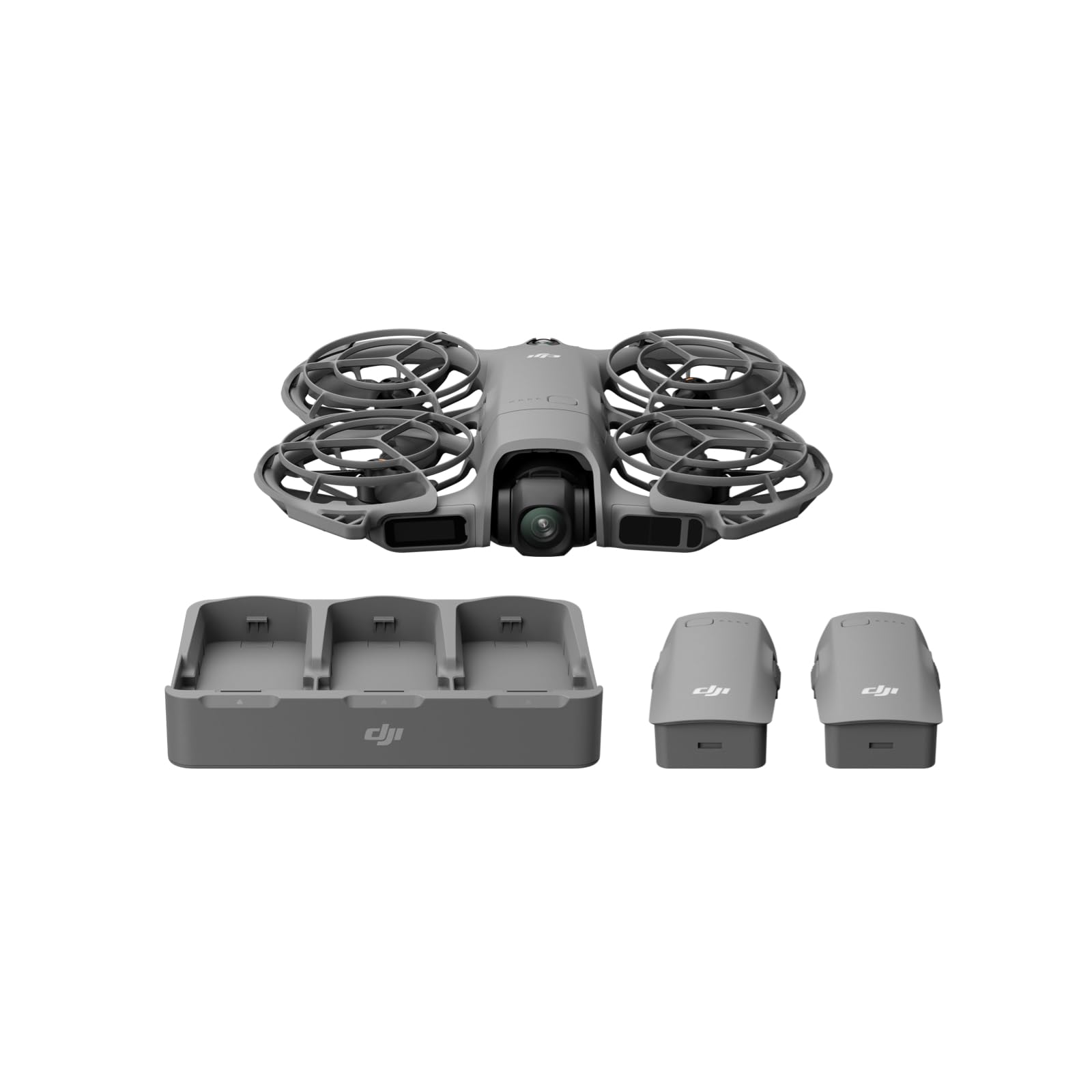
The DJI Neo 2 is the lightest drone in this guide at just 151g, making it the most portable option and completely avoiding FAA registration. The Fly More Combo includes three batteries, a charging hub, and propeller guards. The defining feature is palm takeoff/landing and gesture control—you can launch, control, and land the drone entirely with hand movements, no controller required. This makes it an excellent option for selfies, family gatherings, and casual travel footage.
The 4K imaging is good for its size, with ActiveTrack keeping subjects in focus reliably. The omnidirectional obstacle sensing provides a safety net for beginners, avoiding collisions in all directions. The 31-minute flight time per battery (though real-world is closer to 20-25 minutes) is solid for a micro drone. The remote controller (included in the bundle) has a built-in screen, eliminating the need for a phone connection.
The lack of a 3-axis gimbal is the main limitation: it relies solely on EIS for stabilization. While DJI’s EIS is excellent, it cannot fully compensate for the lack of a mechanical gimbal, and footage during fast movement will show more micro-jitter than gimbal-equipped drones. The camera also lacks advanced manual controls for exposure and ISO. If you prioritize portability, simplicity, and obstacle avoidance over professional-grade stabilization, the Neo 2 is an outstanding choice.
Why it’s great
- Ultra-light (151g) with palm takeoff and gesture control
- Omnidirectional obstacle sensing for beginner safety
- 3-battery Fly More Combo for extended shooting sessions
Good to know
- No mechanical gimbal—relies solely on EIS for stabilization
- No advanced manual camera controls
- EIS cannot match 3-axis gimbal smoothness in wind
9. Potensic ATOM SE

The Potensic ATOM SE is the most affordable drone in this guide that still captures genuine 4K video. It uses a 1/3-inch Sony CMOS sensor paired with ShakeVanish EIS technology to stabilize footage. While this is digital stabilization—not a mechanical gimbal—it does a respectable job of reducing the most distracting vibrations and jello effect in calm conditions. The 118° FOV and vertical camera tilt range (+20° to -90°) give you solid framing flexibility.
Weighing under 249g, you can fly it without FAA registration or Remote ID. The 60W parallel charging hub can charge all three batteries at once in 1.5 hours, and the total flight time of 93 minutes (three batteries) is excellent for the price. The PixSync 2.0 transmission system provides up to 4km of range, which is competitive with more expensive drones. The beginner mode, GPS auto-return, and waypoint flight features work reliably and make this a true starter drone.
The lack of a mechanical gimbal means you will see significant wobble during turns, aggressive maneuvers, or gusty conditions. The 4K footage is soft compared to gimbal-equipped drones—fine for sharing on social media but not professional work. The plastic build is functional but feels less premium than the DJI or Holy Stone options. For someone buying their first 4K drone on a strict budget, the ATOM SE is an exceptional entry point.
Why it’s great
- Under 249g with no FAA registration needed
- 93-minute total flight time with 3-battery kit
- 60W fast parallel charging hub for quick turnaround
Good to know
- No mechanical gimbal—EIS only, wobble in turns
- 4K footage is soft, not suitable for professional use
- Plastic build lacks premium feel
FAQ
Does a 3-axis gimbal make a big difference for 4K video quality?
How is flight time measured for multi-battery kits?
Can I legally fly a 4K drone under 249g anywhere?
Does 4K/30fps look better than 4K/60fps for drone footage?
What is the most important spec for 4K drone beginners?
Final Thoughts: The Verdict
For most users, the clear winner in the best 4k drones category is the DJI Flip (RC-N3) because its larger 1/1.3-inch sensor and 4K/60fps HDR video produce genuinely superior image quality, and the under-249g design eliminates FAA registration hassle. If you want a self-contained flying experience with a built-in controller screen that frees you from phone dependency, the Bwine F7MINI 4K(RC3) is the best alternative. And for extreme transmission distance combined with long flight time, the K600PRO provides a 15km range that no other drone in this guide can match.

Mo Maruf
I created WellFizz to bridge the gap between vague wellness advice and actionable solutions. My mission is simple: to decode the research and give you practical tools you can actually use.
Beyond the data, I am a passionate traveler. I believe that stepping away from the screen to explore new environments is essential for mental clarity and physical vitality.