Our readers keep the lights on and my smoothie glass nicely filled. As an Amazon Associate, I earn from qualifying purchases.
Choosing a 4K camera today means navigating a market flooded with specifications that sound impressive but often obscure what actually matters for your specific work. The real divide isn’t between mirrorless and DSLR—it’s between a camera that handles rolling shutter gracefully, offers a codec that survives heavy grading, and delivers a color science that saves hours in post versus one that simply checks boxes on a spec sheet.
I’m Mohammad Maruf — the founder and writer behind WellFizz. I’ve spent years analyzing sensor architectures, codec efficiency, and real-world autofocus behavior to separate marketing language from measurable performance across hundreds of camera models.
Whether you’re building a YouTube studio, shooting a documentary, or stepping into professional filmmaking, this guide breaks down the best 4k camera options across every serious price tier with concrete, category-specific reasoning you can actually use.
How To Choose The Best 4K Camera
The 4K camera market spans from PTZ streaming units to cinema rigs, and the wrong choice often costs more in accessories and post-production time than the initial body price. Understanding where your actual workload lives—studio, run-and-gun, professional cinema, or hybrid photo/video—is the first and most important filter.
Sensor Size and Crop Factor for 4K
Full-frame sensors deliver shallower depth of field and better low-light performance, but many cameras crop into the sensor for 4K recording, negating those advantages. The Sony a7 III uses full sensor width for 4K, while the Canon EOS R6 Mark II oversamples from 6K for sharper results. Micro Four Thirds cameras like the Panasonic G85 and OM System E-M10 Mark IV offer deeper depth of field, making them easier to keep focus while moving—a serious advantage for solo vloggers and event coverage.
Codec Choice and Bit Depth
A 4K camera recording in 8-bit 4:2:0 will produce banding when you push shadows or grade aggressively, especially in skies or gradients. The Blackmagic Pocket Cinema Camera 4K and 6K Pro record 12-bit Blackmagic RAW, giving you the latitude to recover highlights and shape color without artifacts. The Panasonic LUMIX S5 offers 10-bit internal recording at 4K 60p, a rare feature at its price point. If you grade your footage, 10-bit or higher is non-negotiable.
Autofocus Reliability for Video
Continuous autofocus in video separates usable consumer cameras from workflow-friendly tools. The Sony a7 III and Canon R6 Mark II offer phase-detection systems that track faces and eyes across the frame with minimal hunting. Panasonic’s contrast-detect system in the G85 and S5 is slower and can pulse in low light. Cinema cameras like the Blackmagic Pocket line offer no continuous autofocus—you pull focus manually or rely on external follow focus systems. Know your shooting style before choosing.
Quick Comparison
On smaller screens, swipe sideways to see the full table.
| Model | Category | Best For | Key Spec | Amazon |
|---|---|---|---|---|
| OBSBOT Tail Air | PTZ Streaming | AI tracking & live streaming | 4K 30fps, 320° pan | Amazon |
| Panasonic LUMIX G85 | Entry Mirrorless | Budget hybrid shooting | 16MP, 5-axis IBIS | Amazon |
| OM System E-M10 IV | Compact Mirrorless | Travel & selfie photography | 20MP, 4.5-stop IBIS | Amazon |
| Sony ZV-E10 | Vlogging Mirrorless | Product showcase & vlogs | 24.2MP APS-C, 425 AF points | Amazon |
| Nikon D7500 | DSLR | Sports & action photography | 20.9MP, 8 fps burst | Amazon |
| Blackmagic Pocket 4K | Cinema Camera | Professional filmmaking | 4/3″ sensor, 13 stops DR | Amazon |
| Panasonic LUMIX S5 | Full-Frame Mirrorless | Cinematic hybrid work | 24.2MP, 6.5-stop IBIS | Amazon |
| Sony a7 III | Full-Frame Mirrorless | Low-light & event shooting | 24.2MP, 693 AF points | Amazon |
| Canon 5D Mark IV | Full-Frame DSLR | Professional stills & video | 30.4MP, 7 fps burst | Amazon |
| Canon R6 Mark II | Full-Frame Mirrorless | Fast action & professional hybrid | 24.2MP, 40 fps e-shutter | Amazon |
| Blackmagic Pocket 6K Pro | Cinema Camera | High-end film & commercial work | Super 35, 13 stops DR | Amazon |
In‑Depth Reviews
1. Sony a7 III

The Sony a7 III remains a benchmark in the full-frame mirrorless category because it combines a back-illuminated 24.2MP Exmor R sensor with 693 phase-detection AF points covering 93% of the frame—a system that tracks eyes and faces with near-zero hunting during 4K video. Its 15-stop dynamic range and 14-bit uncompressed RAW output give you the latitude to grade liberally without banding, and the 4K footage oversampled from the full sensor width delivers exceptional sharpness and low noise.
Battery life is a standout feature at roughly 710 shots per charge using the NP-FZ100 pack, which is nearly triple what many mirrorless competitors offer. The in-body stabilization works well for handheld static shots, though it doesn’t match the 6.5-stop performance of the LUMIX S5. The kit 28-70mm f/3.5-5.6 lens is adequate for general use, but you’ll want to upgrade to a faster prime to unlock the sensor’s low-light potential.
Where the a7 III falls short is its menu system—Sony’s labyrinthine interface requires dedicated learning time—and the lack of a fully articulating screen makes it less ideal for self-recording. Rolling shutter is present in 4K at a level that’s manageable for most work but noticeable in fast pans. It’s a hybrid camera that leans heavily toward video capability while still delivering class-leading stills, making it the most versatile single-body solution for serious creators.
Why it’s great
- Industry-leading phase-detection autofocus for video
- 15-stop dynamic range with clean shadow recovery
- Exceptional battery life for full-frame mirrorless
Good to know
- Menu navigation remains complex and non-intuitive
- No fully articulating touchscreen for vlogging
- Rolling shutter visible in fast panning shots
2. Blackmagic Pocket Cinema Camera 6K Pro

The Blackmagic Pocket Cinema Camera 6K Pro is built for filmmakers who demand raw recording flexibility and robust color science in a compact body. Its Super 35 sensor captures 6144 x 3456 resolution at up to 60 fps in 12-bit Blackmagic RAW, providing the latitude to push shadows and adjust white balance dramatically without introducing artifacts. The built-in 2, 4, and 6-stop ND filters are a pro-level feature that eliminates the need for external matte boxes when shooting outdoors.
The adjustable 5-inch HDR LCD tilts to accommodate high and low angles, though its brightness tops out around 2000 nits and can be challenging to view in direct sunlight without a hood. Recording to both CFast 2.0 and SD UHS-II cards, with USB-C external SSD support, gives you flexible media workflows. Battery life using the included NP-F570 is roughly 45 minutes of continuous 4K recording, so expecting to carry four or five spares for a full production day is realistic.
There is no continuous autofocus here—you rely entirely on manual pull focus, which is standard for cinema work but a hard no-go for solo run-and-gun shooting. The auto exposure system lacks a true auto ISO mode, causing abrupt exposure jumps when moving between lighting conditions. For controlled studio and narrative shoots, this camera produces footage that competes with bodies costing twice as much, but it demands a deliberate, non-spontaneous shooting approach.
Why it’s great
- 12-bit Blackmagic RAW with 13 stops of dynamic range
- Built-in 2/4/6-stop ND filters for outdoor shooting
- Adjustable HDR LCD for flexible framing angles
Good to know
- No continuous autofocus—manual pull focus required
- Battery life under one hour necessitates multiple spares
- Auto exposure lacks true auto ISO causing exposure jumps
3. Panasonic LUMIX S5

The Panasonic LUMIX S5 delivers full-frame 4K 60p with 10-bit internal recording, a feature set typically reserved for cameras costing twice as much. Its 24.2MP sensor, paired with Dual Native ISO technology, produces clean footage up to ISO 4000 that retains detail and color accuracy in low-light environments. The 5-axis in-body stabilization (rated at 6.5 stops with compatible lenses) lets you shoot handheld walking shots that look gimbal-stabilized—a major advantage for documentary and event work.
V-Log and V-Gamut are included out of the box, giving you over 14 stops of dynamic range and a wide color gamut that matches the Varicam series for color grading consistency across projects. The contrast-detect autofocus, while improved over earlier Panasonic bodies, hunts in low-light conditions and lacks the reliability of Sony’s phase-detection system. If your work requires consistent follow-focus during moving shots, the S5 will frustrate you—but if you pull focus manually or shoot locked-down interviews, this is one of the best values on the market.
The body is compact for a full-frame camera at 714 grams, and the L-Mount ecosystem provides access to Leica, Sigma, and Panasonic lenses. The included 20-60mm kit zoom is surprisingly sharp up to 35mm, though it becomes soft beyond that range. Battery life runs about 90 minutes of continuous 10-bit recording, which is decent for the class. The lack of a headphone jack and the single UHS-II card slot are notable omissions that limit professional audio monitoring and backup workflows.
Why it’s great
- 10-bit 4K 60p internal recording at a competitive price point
- Excellent 6.5-stop in-body stabilization for handheld video
- V-Log/V-Gamut with 14+ stops for serious color grading
Good to know
- Contrast-detect autofocus hunts in low-light conditions
- No headphone jack for audio monitoring
- Single UHS-II card slot limits backup recording options
4. Canon EOS R6 Mark II

The Canon EOS R6 Mark II redefines hybrid performance with a 24.2MP full-frame sensor that oversamples 6K to produce uncropped 4K 60p footage with remarkable sharpness and minimal aliasing. Its Dual Pixel CMOS AF II system uses deep learning to detect people, animals, vehicles, and even aircraft with precision that feels predictive rather than reactive. The 40 fps electronic shutter burst with full AF/AE tracking makes it the fastest full-frame camera for action in this guide.
The 8-stop in-body image stabilization is class-leading, allowing handheld 4K footage that stays smooth even at telephoto focal lengths. The body is weather-sealed against dust and moisture, and the vari-angle touchscreen provides flexible composition for overhead or ground-level shots. Canon’s menu system is arguably the most intuitive in the mirrorless space, with logical sub-menus and a quick menu that gives you instant access to critical settings during a shoot.
Heat management allows up to 6 hours of continuous Full HD recording and roughly 40 minutes of 4K 60p before throttling in warm environments. The body includes dual UHS-II SD card slots for simultaneous recording and backup, plus a USB-C 10Gbps port for fast file transfers. The main limitation is the lack of a built-in flash—you’ll need an external hotshoe unit for stills work. It’s the most well-rounded professional hybrid on this list, excelling in both photo-first and video-first workflows.
Why it’s great
- 6K oversampled 4K 60p with exceptional sharpness
- Deep-learning AF with comprehensive subject detection
- 8-stop IBIS and weather-sealed body for run-and-gun use
Good to know
- 4K 60p recording limited to 40 minutes before thermal throttling
- No built-in flash—external unit required for stills
- Premium price point for body-only configuration
5. Blackmagic Pocket Cinema Camera 4K

The Blackmagic Pocket Cinema Camera 4K remains the most affordable entry point into professional cinema workflows, offering a 4/3-inch sensor with 13 stops of dynamic range and dual native ISO up to 25,600. It records 12-bit Blackmagic RAW and Apple ProRes up to 4K 60fps, giving you the flexibility to adjust exposure and white balance in post without destroying image quality. The MFT lens mount gives you access to a vast range of adapted and native optics, including vintage glass that produces unique character.
The 5-inch LCD monitor is bright and touch-responsive, providing a large composition view that eliminates the need for an external monitor in most scenarios. USB-C connectivity allows direct recording to external SSDs, which is significantly cheaper and more reliable than CFast cards. The built-in mini XLR input with phantom power enables professional audio capture directly into the camera, a feature absent in almost all mirrorless cameras at this price level.
The weaknesses are well-documented: no continuous autofocus, poor battery life around 30 minutes per LP-E6 pack, and a 1080p crop of roughly 2.8x that makes the camera impractical for wide-angle work without speed boosters. The screen is also hard to see in direct sunlight at its 250-nit brightness. For narrative, interview, and documentary work where you control the environment, this camera produces cinema-grade footage that outclasses many cameras at three times its price.
Why it’s great
- 12-bit Blackmagic RAW with 13 stops of dynamic range
- Mini XLR input with phantom power for pro audio
- USB-C SSD recording for low-cost, reliable media
Good to know
- No continuous autofocus—manual focus only
- Battery life approximately 30 minutes per LP-E6 pack
- Heavy 1080p crop factor limits wide-angle lens options
6. Canon EOS 5D Mark IV
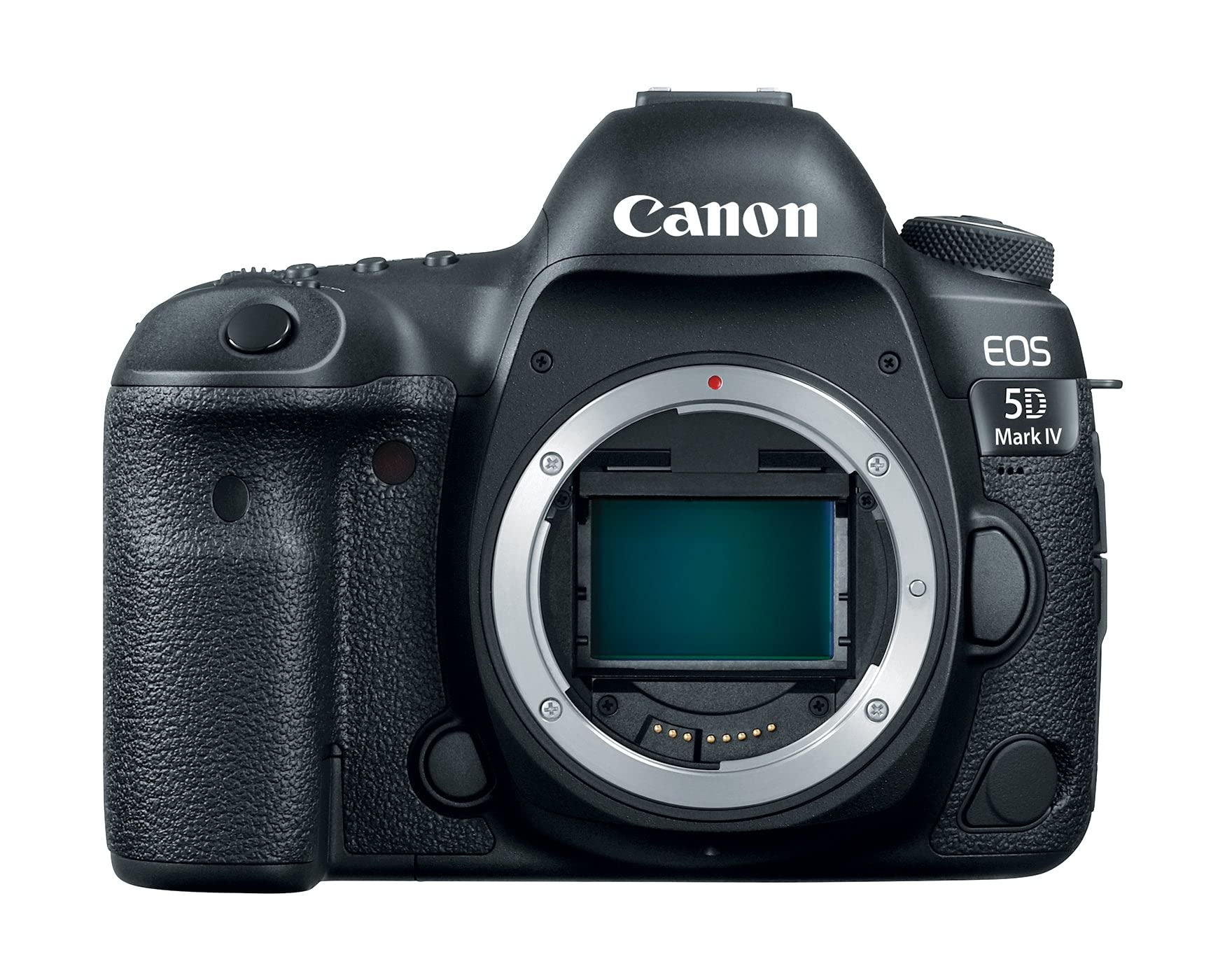
The Canon EOS 5D Mark IV is a full-frame DSLR that has earned its reputation as a professional workhorse through reliability and exceptional still-image quality from its 30.4MP CMOS sensor. The DIGIC 6+ processor enables 7 fps continuous shooting and an ISO range expandable to 102,400, delivering clean files at high sensitivities that have made it a staple for event and wedding photographers. Dual Pixel CMOS AF provides smooth, responsive autofocus during live view and video recording, a rarity in DSLR bodies.
4K video is captured in Motion JPEG at 30 or 24 fps, which produces high-quality footage but results in enormous file sizes—a 30-minute clip can exceed 60 GB. The 4K crop factor of 1.74x makes wide-angle shooting challenging, requiring specialized lenses to achieve standard field of view. The touchscreen interface is responsive and intuitive, and the optical viewfinder remains preferred by many photographers who dislike EVF lag and blackout.
Built-in Wi-Fi and GPS are useful for location-tagged file transfers, though GPS drains the LP-E6N battery noticeably. The main drawbacks are the dated 4K codec that creates storage and workflow inefficiencies, and the lack of a flip-out screen, which limits flexibility for overhead or low-angle composition. It is a stills-first camera with video capability, best suited for photographers who need occasional 4K rather than video-centric creators.
Why it’s great
- 30.4MP full-frame sensor with excellent high-ISO performance
- Dual Pixel CMOS AF for smooth live view focusing
- Proven reliability as a professional event workhorse
Good to know
- 4K uses Motion JPEG producing extremely large file sizes
- 1.74x crop factor in 4K mode limits wide-angle options
- No articulating screen for flexible composition
7. OM System Olympus E-M10 Mark IV

The OM System E-M10 Mark IV pairs a 20MP Live MOS sensor with 5-axis in-body image stabilization rated at 4.5 stops, allowing handheld exposures of one second or longer without blur. Its compact form factor, when paired with the 14-42mm EZ pancake lens, fits into a jacket pocket, making it a true everyday carry for travel and street photography. The flip-down monitor activates a dedicated selfie mode that automatically adjusts settings for vlogging, though the 4K video is capped at 30 fps and lacks log profiles for grading.
The 121-point contrast-detect autofocus is quick in good lighting but struggles in low-contrast scenes, and there is no phase-detection coverage for continuous tracking during video. The 16 Art Filters, including a new Instant Film option, add creative in-camera looks that reduce editing time for casual users. Battery life is rated at 360 shots per charge, which is modest but acceptable for a compact mirrorless.
The menu system is logically organized and includes a beginner-friendly mode with explanatory overlays. The lack of USB-C charging is a notable omission in 2024, and the Wi-Fi app connection is slow compared to modern implementations. It delivers excellent still-image quality for its size and price, but video creators will find the autofocus limitations and missing video tools a significant barrier.
Why it’s great
- Compact enough for jacket pocket with pancake lens
- 4.5-stop 5-axis IBIS for handheld long exposures
- Flip-down screen with dedicated selfie mode
Good to know
- Contrast-detect AF struggles in low light for video
- No USB-C charging—uses older micro-USB standard
- 4K video limited to 30 fps without log profiles
8. Sony ZV-E10

The Sony ZV-E10 is an APS-C mirrorless camera built from the ground up for vloggers, pairing a 24.2MP Exmor CMOS sensor with 425 phase-detection AF points for reliable face and eye tracking during video. It downsamples 4K from a 6K readout with full pixel readout and no binning, producing footage that is visibly sharper and more detailed than competing entry-level cameras. The Product Showcase Setting instantly shifts focus from your face to an object held up to the lens, a feature that eliminates the need for manual focus switching during product reviews.
The Background Defocus button provides a one-touch toggle between deep and shallow depth of field, giving you immediate control over subject isolation without navigating menus. The 3.5mm microphone input allows external audio, and the included windscreen reduces handling noise during outdoor recording. The camera can be used as a UVC webcam via a single USB cable, making it seamless for live streaming without additional capture hardware.
There is no in-body image stabilization, so you must rely on lens-based stabilization or a gimbal for smooth handheld footage. The rolling shutter is severe in 4K, producing noticeable skew during fast pans, and the 4K 30p crop limits the effectiveness of the product showcase AF feature. Battery life is roughly 25 minutes of continuous 4K recording with the NP-FW50 pack, requiring multiple spares for any extended shoot. It’s a purpose-built vlogging tool that excels in its intended use case but has limited versatility.
Why it’s great
- 6K oversampled 4K with full pixel readout for sharp video
- Product Showcase Setting for seamless focus transitions
- USB UVC mode for plug-and-play live streaming
Good to know
- No in-body stabilization—requires gimbal or OSS lens
- Severe rolling shutter during fast pans in 4K
- Very short battery life at 25 minutes of 4K recording
9. Nikon D7500

The Nikon D7500 is a 20.9MP APS-C DSLR that inherits the 180K-pixel RGB metering sensor and 51-point AF system from the professional D500, delivering class-leading autofocus performance for fast-moving subjects. Its 8 fps continuous shooting buffer can capture up to 50 RAW images before slowing, making it ideal for sports, wildlife, and action photography. The EXPEED 5 processor enables 4K UHD video at 30 fps with stereo sound, power aperture control, and 4K time-lapse functionality built in.
The 18-140mm f/3.5-5.6 VR kit lens provides a versatile 27-210mm equivalent focal range with optical stabilization, giving you coverage from wide-angle to telephoto without lens changes. The 3.2-inch tilting LCD has touch functionality for focus point selection and menu navigation, though it lacks a fully articulating mechanism for self-recording. The optical viewfinder remains bright and clear with minimal lag, a significant advantage over EVF cameras for fast-action tracking.
Being a 2017 model, the D7500 lacks modern features like USB-C, IBIS, and eye-detection autofocus for video. It uses a single SD card slot, limiting backup and overflow flexibility for professional work. The camera is heavier and bulkier than modern mirrorless alternatives. It remains a capable stills camera with competitive 4K video, but its design favors traditional photography workflows over content creation.
Why it’s great
- D500-derived 51-point AF with excellent subject tracking
- 8 fps burst with 50 RAW frame buffer for action
- Versatile 18-140mm VR kit lens covers wide to telephoto
Good to know
- No in-body stabilization—relies on lens VR
- Single SD card slot with no backup capability
- Heavier and bulkier than modern mirrorless alternatives
10. OBSBOT Tail Air

The OBSBOT Tail Air is a 4K PTZ streaming camera that packs AI-powered tracking and multiple connectivity options into a body smaller than a cola can. Its gimbal rotates 320° horizontally and 180° vertically, allowing a single operator to cover an entire room without manually repositioning the camera. The upgraded AI tracking system now recognizes humans, animals, and objects, with gesture controls that let you trigger tracking or zoom without a remote.
Connectivity options include Micro HDMI, USB-C, Ethernet, and Wi-Fi, with support for RTMP, RTSP, and VISCA protocols for direct streaming to YouTube, Facebook, and Twitch. NDI support is available with an additional license purchase, enabling low-latency video over local networks. The companion Obsbot Start app gives you full control over AI Director modes, preset positions, and manual image settings including ISO, shutter speed, and white balance.
The critical reliability concern is battery dependency: the internal battery cannot be bypassed or replaced when it fails, and multiple user reports indicate failure after 13-15 months, rendering the camera inoperable even when plugged into power. The 4K recording is limited to 30 fps, and the 4x digital zoom degrades image quality at longer focal lengths. For temporary streaming setups where reliability over years is not critical, the feature set is compelling, but the battery design flaw should give pause for permanent installations.
Why it’s great
- AI tracking for humans, animals, and objects via gesture control
- Multiple connectivity options including NDI, HDMI, and RTMP
- Compact, portable body with 320° pan and 180° vertical rotation
Good to know
- Internal battery fails after 13-15 months with no replacement option
- 4x digital zoom reduces image quality at telephoto range
- 4K recording limited to 30 fps
11. Panasonic LUMIX G85

The Panasonic LUMIX G85 is a 16MP Micro Four Thirds mirrorless camera that brings class-leading dual image stabilization to the entry-level segment. Its 5-axis in-body stabilization works simultaneously with lens-based Power O.I.S. to produce handheld footage that rivals gimbal-stabilized video, making it the most cost-effective option for smooth run-and-gun shooting. The sensor removes the low-pass filter, resulting in sharper fine-detail resolution than typical 16MP MFT sensors.
The 4K video recording at 30 fps is complemented by Panasonic’s 4K Photo and Post Focus features, which let you extract 8MP still frames from video bursts and adjust focus point after capture. The 12-60mm kit lens offers a 24-120mm equivalent zoom range with excellent optical quality, and the contrast-detect autofocus with DFD technology provides fast, accurate focusing in good lighting. The weather-sealed body and ergonomic grip make it comfortable for long shooting days in variable conditions.
Where the G85 shows its age is in autofocus performance in low light—it struggles to find focus in dim environments and pulses noticeably during 4K video recording. The EVF resolution at 2.36 million dots is adequate but not class-leading, and the Wi-Fi transfer app functionality is slow and unreliable. For beginners or budget-conscious creators who need smooth stabilization and good image quality, the G85 remains a solid entry point, but the autofocus limitations become apparent in controlled studio work.
Why it’s great
- Class-leading dual stabilization for smooth handheld footage
- Weather-sealed body with intuitive controls and ergonomic grip
- Post Focus feature allows focus point adjustment after capture
Good to know
- Contrast-detect AF hunts and pulses in low-light video
- No headphone jack for audio monitoring during recording
- Wi-Fi transfer app is slow and unreliable
FAQ
What does 4K oversampling mean and why does it matter?
Is in-body image stabilization essential for handheld 4K video?
Why do some 4K cameras crop into the sensor during video recording?
Final Thoughts: The Verdict
For most users looking for the best 4k camera, the winner is the Sony a7 III because it combines full-frame image quality, reliable phase-detection autofocus, and strong battery life into a single hybrid body that handles both photo and video work at a professional level. If you want superior stabilization and 10-bit internal recording without upgrading lenses, grab the Panasonic LUMIX S5. And for professional filmmaking where codec flexibility and color science are non-negotiable, nothing beats the Blackmagic Pocket Cinema Camera 6K Pro.

Mo Maruf
I created WellFizz to bridge the gap between vague wellness advice and actionable solutions. My mission is simple: to decode the research and give you practical tools you can actually use.
Beyond the data, I am a passionate traveler. I believe that stepping away from the screen to explore new environments is essential for mental clarity and physical vitality.