Our readers keep the lights on and my smoothie glass nicely filled. As an Amazon Associate, I earn from qualifying purchases.
Stepping up to a 43-inch 4K smart TV means balancing screen real estate with room fit, but the real battle happens inside the panel—where HDR formats, refresh rates, and processor power determine whether your favorite shows look cinematic or merely adequate.
I’m Mohammad Maruf — the founder and writer behind WellFizz. I’ve spent years dissecting display specifications, from quantum dot layers to motion interpolation engines, to separate marketing claims from measurable picture quality in this competitive size class.
After analyzing nine models across QLED, Crystal UHD, and standard LED backlight architectures, this guide delivers a clear verdict on what defines the best 43 inch 4k smart tv for your living room, gaming setup, or bedroom.
How To Choose The Best 43 Inch 4K Smart TV
Choosing a 43-inch 4K TV involves more than just screen size. The panel technology, HDR support, gaming features, and smart platform all contribute to the final viewing experience. Here are the key factors to consider.
Panel Technology: QLED vs. Crystal UHD vs. Standard LED
QLED (Quantum Dot LED) panels use a layer of quantum dots to produce a wider color gamut and higher peak brightness compared to standard LED or even Crystal UHD displays. For a bedroom or living room with ambient light, a QLED panel delivers noticeably punchier colors and better HDR reproduction. Crystal UHD, found in Samsung models, is a marketing term for a standard LED panel with enhanced color processing—good but not as vibrant as true QLED.
HDR Support and Brightness
Dolby Vision IQ and HDR10+ Adaptive are the premium HDR formats, adjusting brightness and tone mapping based on room lighting. A TV supporting both ensures compatibility with the widest range of content on Netflix, Prime Video, and Disney+. Standard HDR10 is the baseline, but without dynamic metadata, it can’t adapt scene-by-scene.
Gaming Readiness: VRR, ALLM, and Refresh Rate
If you plan to connect a PlayStation 5 or Xbox Series X, look for HDMI 2.1 features like Variable Refresh Rate (VRR) and Auto Low Latency Mode (ALLM). These eliminate screen tearing and minimize input lag. A 60Hz panel is standard for the 43-inch class, but models with Motion Rate 120 use frame interpolation to smooth fast-paced action.
Smart Platform Ecosystem
The operating system dictates app availability, update frequency, and ease of navigation. Fire TV excels for Alexa households and Prime Video integration. Roku offers the most intuitive, ad-light interface. Google TV shines for Android users and Google Assistant. Samsung Tizen is polished but limited to Samsung services. Choose the platform that aligns with your existing smart home devices.
Quick Comparison
On smaller screens, swipe sideways to see the full table.
| Model | Category | Best For | Key Spec | Amazon |
|---|---|---|---|---|
| Amazon Fire TV 43″ Omni QLED | QLED | Alexa smart home integration | Dolby Vision IQ, HDR10+ Adaptive | Amazon |
| Sony BRAVIA 2 II 43″ | LED | PlayStation 5 gaming | 4K X1 Processor, PS5 Auto HDR | Amazon |
| Samsung 43″ Crystal UHD U8000H (2026) | Crystal UHD | Free Samsung TV Plus content | Crystal Processor 4K, Motion Xcelerator | Amazon |
| Samsung 43″ Crystal UHD U8000F (2025) | Crystal UHD | MetalStream design, Knox security | 4K Upscaling, Alexa built-in | Amazon |
| Westinghouse 43″ Roku QLED | QLED | Roku users wanting QLED color | QLED, HDR10+, Dolby Vision | Amazon |
| Hisense 43″ QD6 QLED (2025) | QLED | Budget-friendly QLED gaming | VRR, ALLM, Motion Rate 120 | Amazon |
| Hisense 43″ E6 Hi-QLED | Hi-QLED | Balanced QLED with HDR10+ Adaptive | Hi-QLED, Dolby Vision, Total HDR | Amazon |
| Westinghouse 43″ Xumo TV | LED | Free Xumo Play channels | 4K UHD, Dolby Vision, HDR10 | Amazon |
| Roku Select Series 43″ (2026) | LED | Simplest Roku interface | Roku TV, Bluetooth Headphone Mode | Amazon |
In‑Depth Reviews
1. Amazon Fire TV 43″ Omni QLED Series
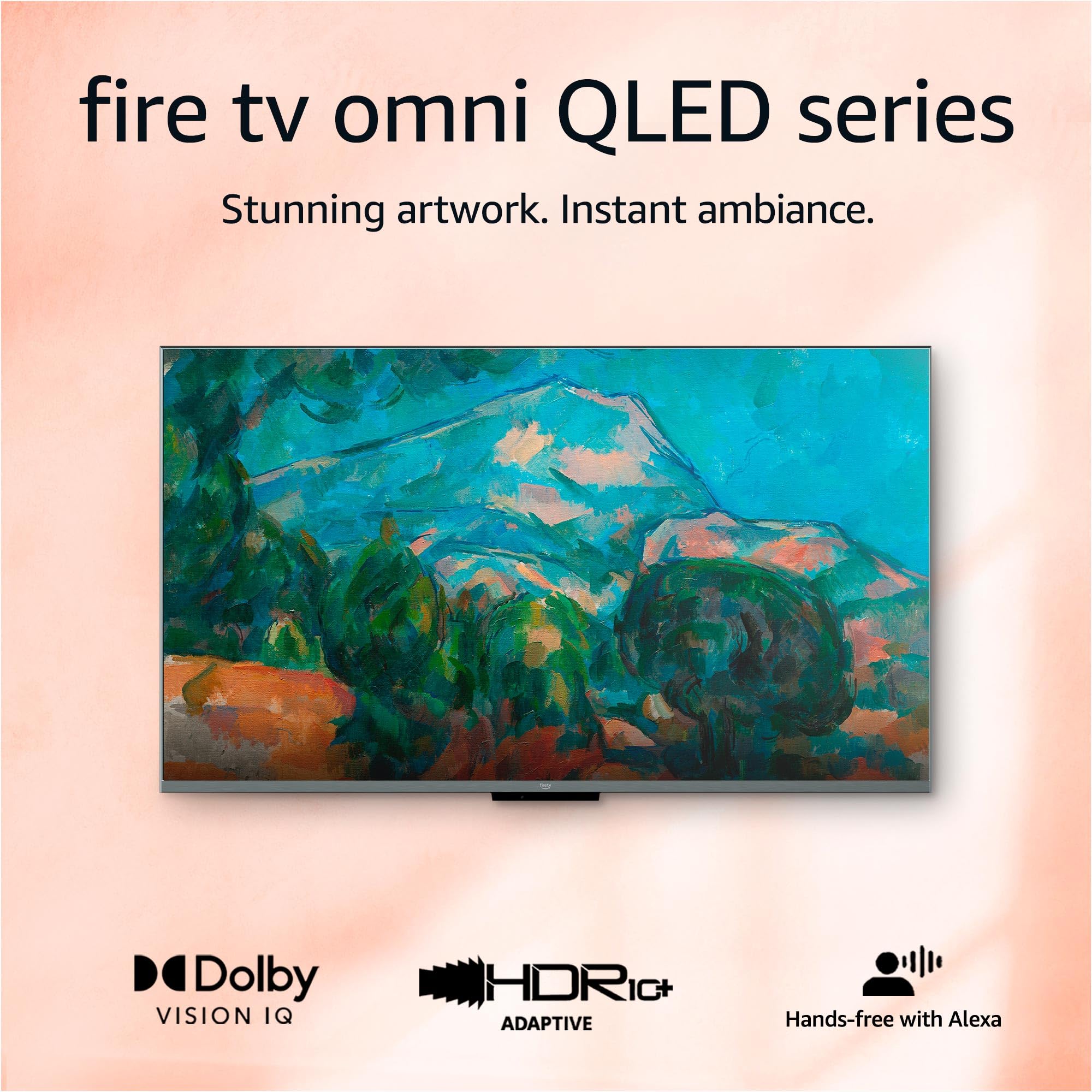
The Omni QLED Series combines a quantum dot panel with Dolby Vision IQ and HDR10+ Adaptive, making it one of the most HDR-versatile 43-inch displays available. The Adaptive Brightness sensor automatically adjusts the picture based on room lighting, preserving shadow detail in dark scenes without washing out highlights during daytime viewing. Hands-free Alexa controls are built directly into the TV via an array of microphones, letting you launch apps, search content, or control smart home devices without touching the remote.
Under the panel, the Fire TV platform delivers deep integration with Prime Video and Alexa routines, but the interface can feel sluggish compared to a dedicated streaming box. Users report occasional app installation glitches that require a restart. The 60Hz panel is standard for the class, and while not designed for competitive high-frame-rate gaming, it supports ALLM for responsive controller input. The four HDMI inputs include eARC for connecting a soundbar or AV receiver.
Ambient Experience mode turns the TV into an art display, showing over a thousand free pieces of artwork or personal photos when idle. This feature, combined with the hands-free Alexa microphones, makes the Omni QLED a strong candidate for a living room hub where voice control and smart home integration are priorities. Picture calibration out of the box tends toward the “soap opera” effect, but a few minutes in the settings menu corrects this.
Why it’s great
- Dolby Vision IQ + HDR10+ Adaptive support for dynamic HDR.
- Hands-free Alexa with physical microphone disconnect switch.
- Ambient Experience mode for art and photo display.
- Four HDMI inputs including eARC.
Good to know
- Fire TV interface can feel laggy during navigation.
- Some units experience app installation issues requiring a restart.
- Out-of-box picture needs calibration to remove motion smoothing.
- Speakers are dull; pairing with Echo devices or a soundbar is recommended.
2. Sony BRAVIA 2 II 43 Inch 4K (K-43S20M2)
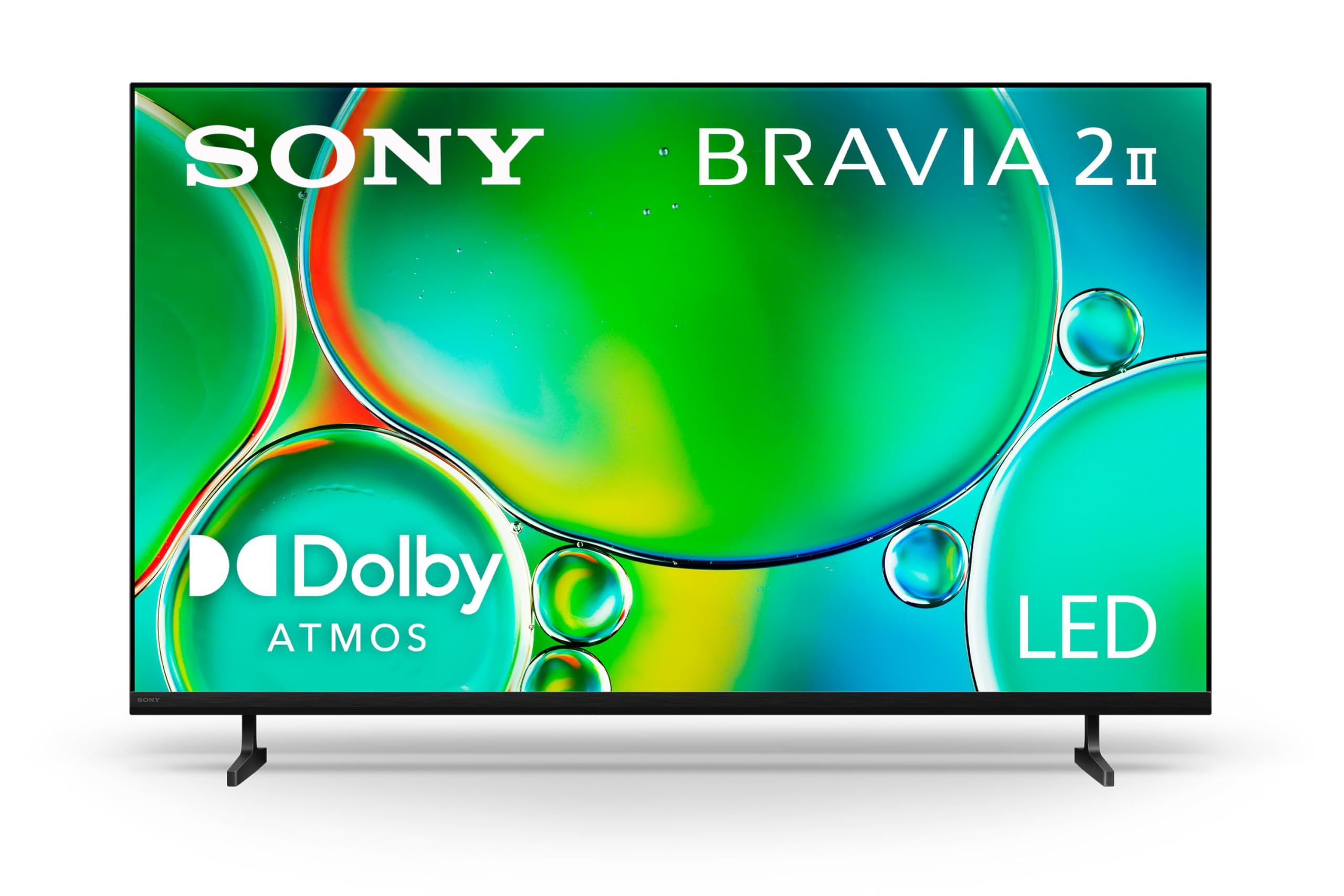
Sony’s 4K Processor X1 drives this 43-inch BRAVIA 2 II, delivering natural color reproduction and sharp detail through 4K XR-Reality PRO upscaling. The processor analyzes each scene and enhances texture and edges, making lower-resolution streaming content appear closer to native 4K than typical upscaling engines. Motionflow XR handles fast-paced sequences with minimal blur, which is especially noticeable during sports and action movies.
Exclusive PlayStation 5 features set this model apart: Auto HDR Tone Mapping and Auto Genre Picture Mode automatically optimize the TV’s settings when it detects a PS5 signal. This means HDR game tones are calibrated instantly, and the TV switches to low-latency game mode without manual menu diving. The Game Menu consolidates all gaming-related picture settings into a single overlayed menu, including a black equalizer for spotting enemies in dark corners.
Google TV serves as the smart platform, offering broad app support and Google Cast functionality. The interface is clean but can default to the home screen each time the TV powers on, which some users find annoying for linear TV viewing. Dolby Atmos pass-through via HDMI eARC is supported, though the built-in speakers are adequate rather than impressive. Sony Pictures CORE app grants access to a library of Sony movies, adding extra value for film enthusiasts.
Why it’s great
- 4K Processor X1 with excellent upscaling from lower-resolution sources.
- PS5 exclusive Auto HDR Tone Mapping and Auto Genre Picture Mode.
- Game Menu overlay for quick gaming picture adjustments.
- Motionflow XR delivers blur-free fast-motion handling.
Good to know
- Google TV defaults to home screen on startup, not last input.
- Built-in speakers are serviceable but benefit from a soundbar.
- Some units reported Wi-Fi dropout requiring router reset.
- Premium price tier for a standard LED panel.
3. Samsung 43-Inch Crystal UHD U8000H (2026 Model)
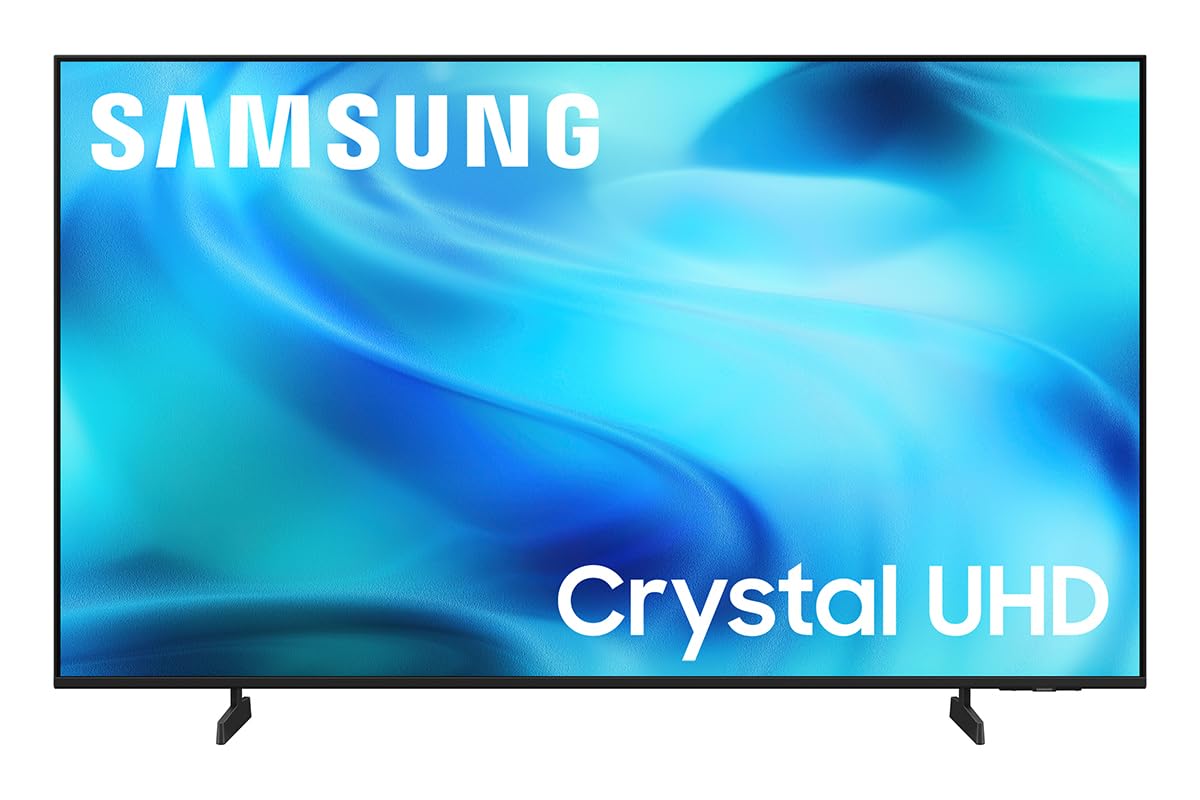
The Crystal Processor 4K inside the U8000H series powers color mapping and upscaling to deliver a clear, vibrant 1080p-to-4K conversion. While the panel is standard LED-backlit LCD rather than QLED, the processor’s Color Booster technology enhances saturation to make content pop. Motion Xcelerator estimates and adjusts frame transitions in real time, smoothing sports and action sequences up to 4K 60Hz without the artifacts common to aggressive frame interpolation.
Samsung TV Plus provides over 750 free subscription-free channels, covering news, sports, and movies, which is a major draw for cord-cutters. The Tizen smart platform is responsive and integrates well with Samsung mobile devices, but it lacks the app breadth of Google TV or Roku. Bluetooth 5.3 support enables low-latency headphone pairing, and the slim bezel design with a metal sheet construction gives it a more premium aesthetic than the price suggests.
Setup requires a Samsung account and forced app installation, a process some reviewers found time-consuming. The remote control is minimalistic and sleek but can feel overly sensitive with a slight lag. For users not invested in the Samsung ecosystem, the app selection feels slightly curated compared to competitors. Still, the combination of free content and a polished processor makes this a strong mid-range contender.
Why it’s great
- Crystal Processor 4K offers solid upscaling and color mapping.
- 750+ free channels via Samsung TV Plus with no subscription.
- Motion Xcelerator smooths fast content without distracting artifacts.
- Slim metal-sheet design with minimal bezel.
Good to know
- Tizen app store has fewer apps than Google TV or Roku.
- Standard LED panel lacks quantum dot color vibrancy.
- Setup process is longer due to forced account and updates.
- Remote control has slight input lag.
4. Samsung 43-Inch Crystal UHD U8000F (2025 Model)

The 2025 U8000F shares the Crystal UHD DNA with its 2026 sibling but differentiates through its MetalStream design, using a single metal sheet for the chassis and a slim bezel. This gives it a distinct build quality that feels denser and more premium than many plastic-bodied competitors at a similar price. The 4K upscaling engine is effective for streaming and broadcast content, though it lacks the scene-by-scene intelligence of Sony’s X1 processor.
Samsung Knox security provides triple-layer protection against phishing sites and malicious apps, a feature absent from most budget TVs. Alexa is built in, allowing voice control for content search and smart home commands without an external device. The Tizen interface is snappy, though the forced phone app setup during initial configuration frustrated some users. Once past setup, the TV performs reliably with a bright, clear picture.
Gaming support includes a basic Game Mode that reduces input lag, but there is no VRR or ALLM for HDMI 2.1 features. The 60Hz refresh rate handles most console titles adequately, but competitive players will notice the lack of variable refresh. Sound quality from the built-in speakers is clear enough for casual viewing, but the TV excels as a driver for external speakers or a soundbar via the optical or HDMI ARC connection.
Why it’s great
- MetalStream construction offers a premium build at a mid-range price.
- Knox security protects against phishing and malicious apps.
- Alexa built-in for hands-free voice control.
- Bright, vivid picture with good out-of-box color.
Good to know
- No VRR or ALLM support for advanced gaming features.
- Setup requires Samsung phone app and mandatory updates.
- Standard LED panel brightness is adequate but not stunning.
- Tizen platform has fewer streaming app options.
5. Westinghouse 43″ Roku TV QLED
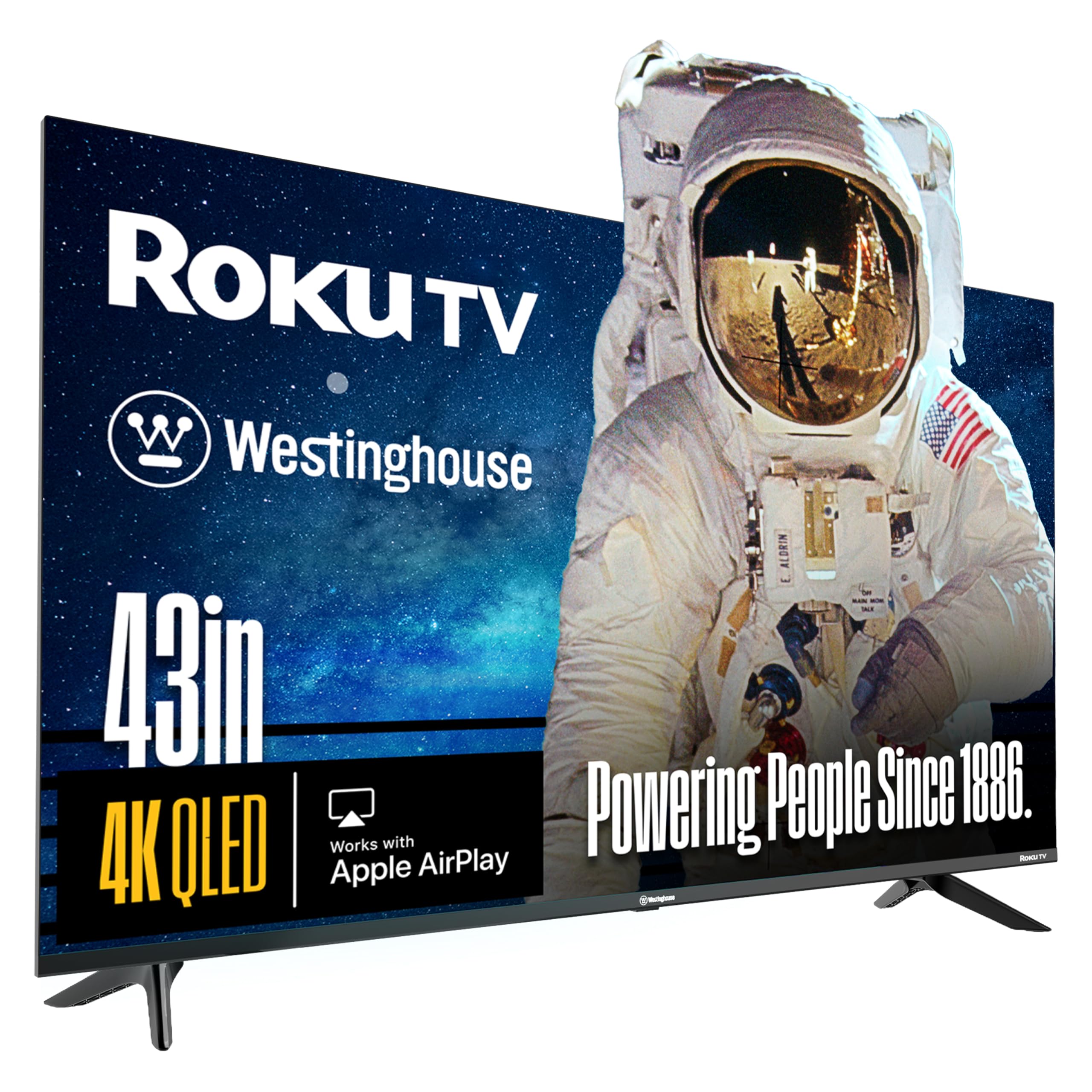
This Westinghouse model brings quantum dot color to the Roku platform, which is a rare combination in the 43-inch class. The QLED panel delivers noticeably wider color gamut and higher peak brightness than the brand’s standard LED offerings, making HDR content from Dolby Vision and HDR10+ sources look vibrant. The edgeless bezel design pushes the image to the very edge of the screen, creating a more immersive viewing experience for its physical footprint.
Roku’s operating system remains the gold standard for simplicity and speed. The Roku Voice Remote allows push-to-talk search across thousands of channels, and the Roku mobile app adds private listening and casting. The 4 HDMI inputs provide ample connectivity for gaming consoles and streaming devices. Contrast ratio exceeds 5000:1, which gives deeper black levels compared to many budget-level LED TVs in this size.
Some users reported video stream failures after a few months, where audio works but video takes minutes to appear. This appears to be a firmware-related issue and not universal, but it’s a risk to consider. The smart home compatibility with Apple HomeKit, Alexa, and Google Assistant gives this TV strong multi-ecosystem integration. For Roku loyalists wanting better color performance, this is the most natural upgrade path.
Why it’s great
- QLED panel with wide color gamut and high contrast ratio.
- Roku OS is fast, intuitive, and has a massive app library.
- Edgeless bezel design for an expansive look.
- Compatible with Apple HomeKit, Alexa, and Google Assistant.
Good to know
- Some units develop video stream delay issues after months of use.
- Roku’s voice search is push-to-talk, not always-listening.
- Build quality is plastic-heavy compared to Samsung MetalStream models.
- No VRR or ALLM for advanced gaming.
6. Hisense 43″ QD6 Series QLED (2025 Model)
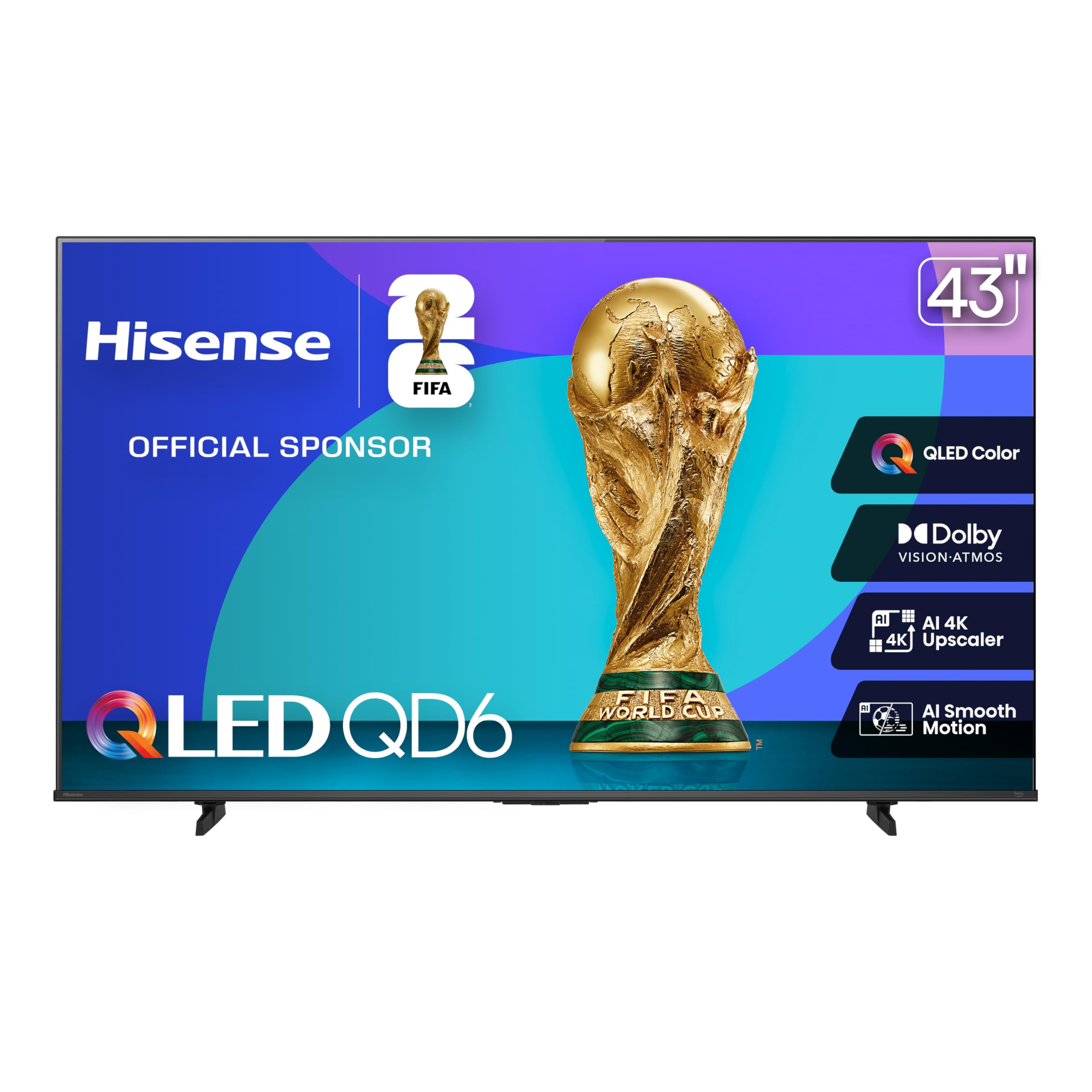
The Hisense QD6 is the most feature-packed budget QLED option in this roundup, offering VRR, ALLM, and Motion Rate 120—specs typically reserved for higher price tiers. The quantum dot layer displays over a billion color shades, and the AI 4K Upscaler uses machine learning to sharpen low-resolution content, reducing softness in compressed streams. Dolby Vision and Dolby Atmos bring cinema-grade HDR and spatial audio to the bedroom or small living room.
Game Mode Plus with VRR eliminates screen tearing during console gameplay, and ALLM automatically switches the TV to low-latency mode when a gaming signal is detected. The AI Smooth Motion with MEMC (Motion Estimation, Motion Compensation) inserts intermediate frames to reduce blur during fast sports or action sequences. Fire TV provides a unified home screen with Alexa voice integration, though the interface can feel advertisement-heavy.
Some early units exhibited software instability, including random black screens and boot loops, though firmware updates appear to have resolved these issues for most users. The lack of a headphone jack on the 43-inch model is a notable omission for private late-night viewing. Wi-Fi 5 limits wireless transfer speeds compared to newer standards, but streaming 4K content remains smooth with a stable connection.
Why it’s great
- VRR and ALLM support for tear-free, low-lag console gaming.
- QLED panel with quantum dot color and high brightness.
- AI 4K Upscaler improves lower-resolution content effectively.
- Dolby Vision and Dolby Atmos for immersive HDR and sound.
Good to know
- Fire TV interface has forced ads and some software bugs.
- No 3.5mm headphone jack on the 43-inch version.
- Some units required replacement due to software instability.
- Wi-Fi 5, not Wi-Fi 6.
7. Hisense 43″ E6 Cinema Series Hi-QLED
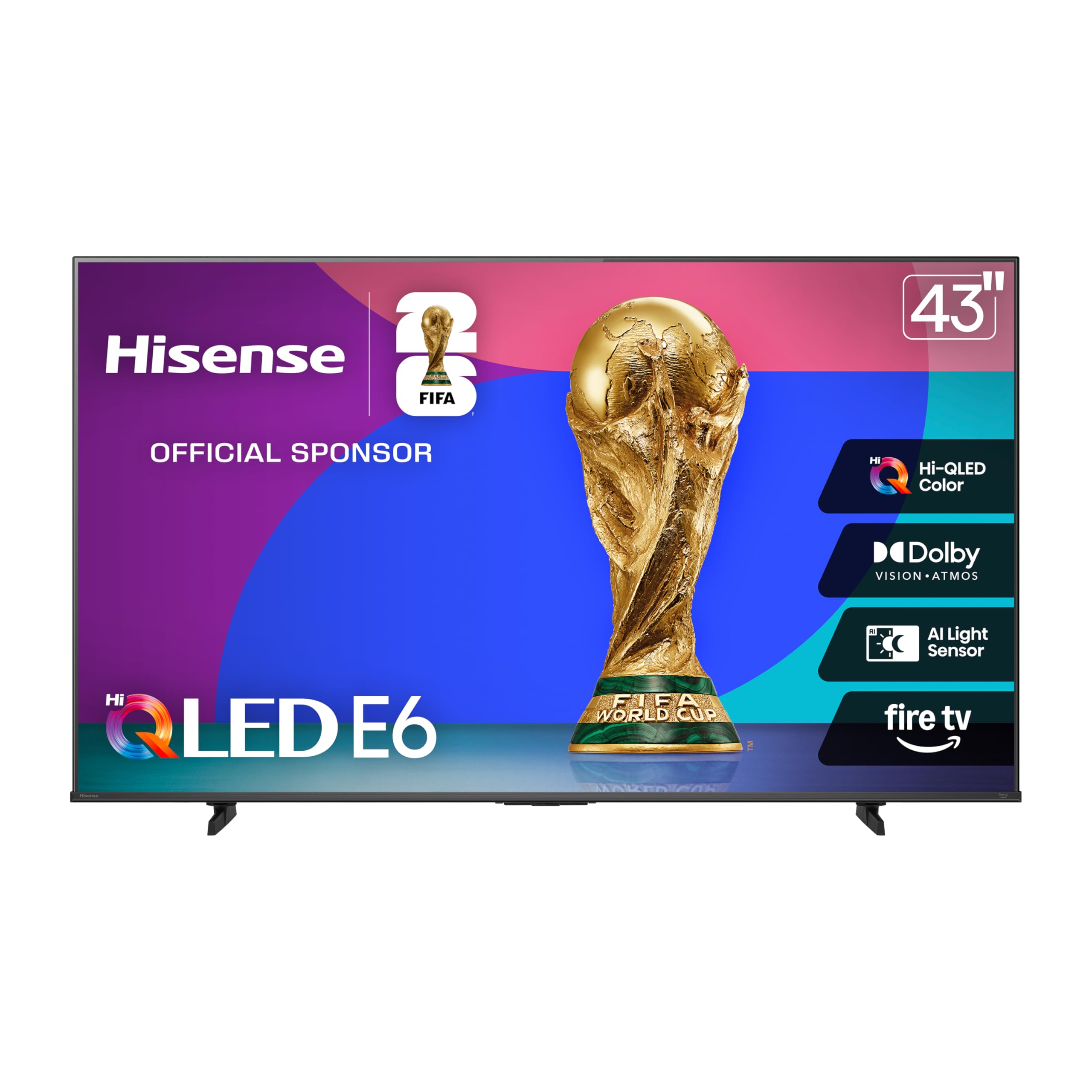
The E6 Cinema Series uses Hisense’s Hi-QLED technology, which combines a quantum dot layer with a Total HDR Solution covering Dolby Vision, HDR10+ Adaptive, HDR10, and HLG. This means the TV automatically adjusts tone mapping based on the content format and room conditions, delivering consistent HDR performance regardless of the source. The AI Light Sensor further refines brightness and contrast in real time, preserving shadow detail during dark movie scenes without crushing blacks.
Motion Rate 120 provides smooth motion handling for sports and action content, though it’s frame interpolation rather than a true 120Hz panel. The Fire TV platform is identical to the QD6 series—fast for app launching but cluttered with promoted content. The voice remote with Alexa is responsive, and AirPlay 2 support lets iPhone users stream directly without extra hardware.
Reviewers consistently praise the picture quality, calling it “crystal clear” with “gorgeous colors.” The initial cold boot takes 30 to 60 seconds, which is longer than Roku competitors but typical for Fire TV OS. Some users noted occasional app freezing with the sound still playing, likely a Wi-Fi handoff issue rather than a panel defect. For buyers wanting maximum HDR format support in a budget QLED, the E6 is the most complete package.
Why it’s great
- Total HDR Solution supports every major HDR format including HDR10+ Adaptive.
- Hi-QLED panel with quantum dot color and AI Light Sensor.
- Dolby Vision and Dolby Atmos for cinematic experience.
- AirPlay 2 and Apple Home compatibility included.
Good to know
- Fire TV OS is slower to boot (30-60 seconds) than Roku.
- Menu navigation can feel sluggish with occasional app freezes.
- Stand design is functional but not premium.
- No HDMI 2.1 full bandwidth; VRR not listed for this model.
8. Westinghouse 43-inch Xumo TV
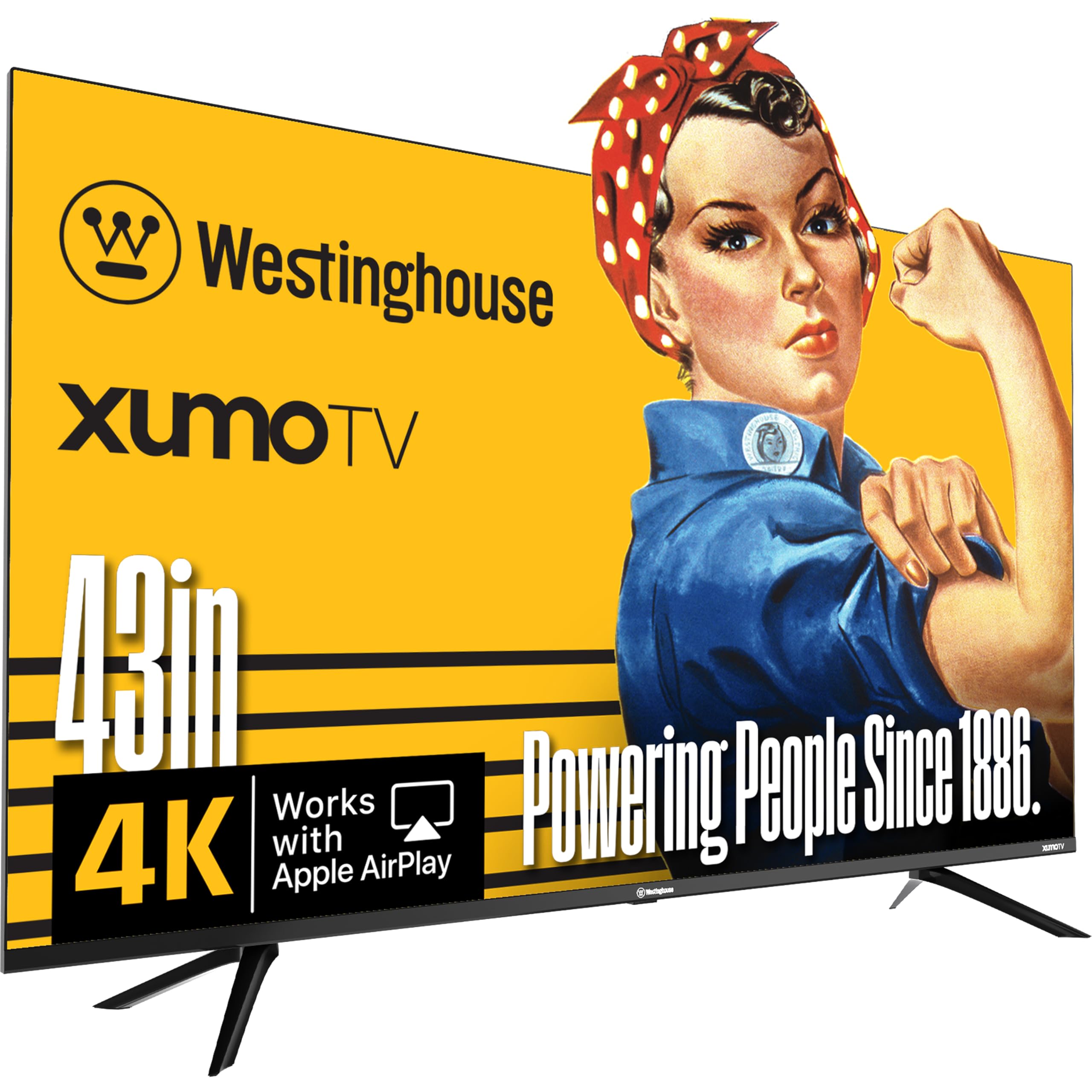
The Westinghouse Xumo TV targets cord-cutters with its built-in Xumo Play platform, offering 350+ free live channels and 70,000+ on-demand movies and shows without any subscription. The 43-inch 4K UHD panel supports Dolby Vision and HDR10, enhancing contrast and color accuracy for streaming content. The edgeless design minimizes bezel distraction, and the built-in speakers deliver surprisingly clear stereo sound at low volumes, approaching a surround-like quality for a built-in setup.
Connectivity is generous for the price: 3 HDMI ports, 1 USB input, Composite Video, and Optical Digital Audio. Bluetooth 5.1 allows wireless pairing with soundbars or headphones, and Apple AirPlay is supported for iOS device mirroring. The universal voice search works across multiple apps, reducing the need to navigate each service individually. The Xumo OS is unobtrusive and boots quickly, though its app selection is narrower than Roku or Google TV.
Some units arrived with minor bezel damage suggesting returned stock, so inspect packaging upon delivery. A single reviewer reported blackout issues during streaming on Prime Video and YouTube, but this appears to be an outlier rather than a systemic flaw. The absence of a browser app and limited app customization options may frustrate power users. For viewers who primarily want a straightforward 4K TV with free live TV and minimal interface complexity, this is a compelling entry-level pick.
Why it’s great
- 350+ free live channels and 70,000+ on-demand titles with Xumo Play.
- Dolby Vision and HDR10 support for enhanced picture quality.
- Strong built-in speakers with clear stereo separation at low volume.
- Bluetooth 5.1 and Apple AirPlay included.
Good to know
- Xumo OS has fewer apps than Roku, Google TV, or Fire TV.
- No browser app available.
- Some units may have cosmetic bezel damage from returns.
- Occasional streaming blackout reported on certain services.
9. Roku Select Series 43-Inch (2026 Model)
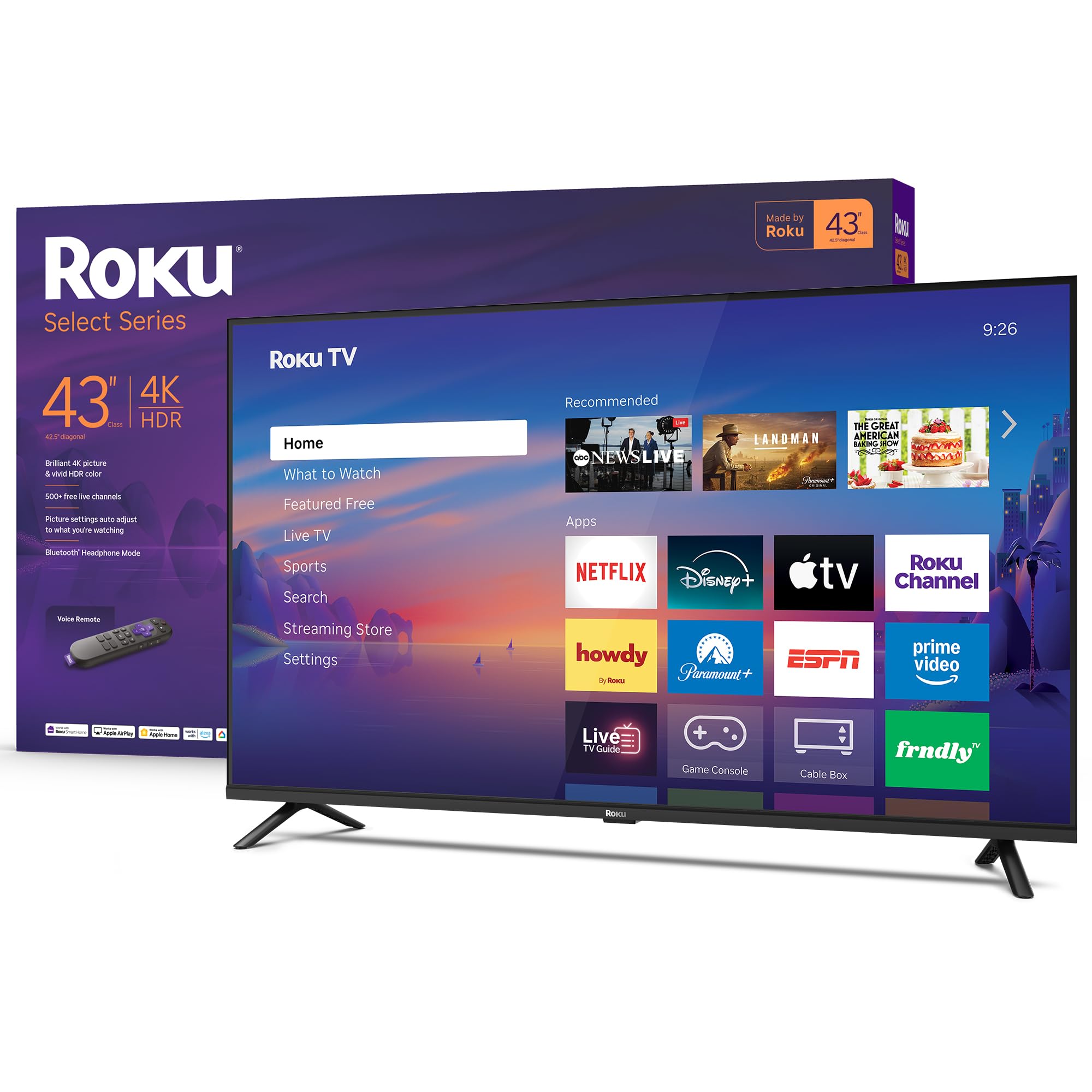
The Roku Select Series is designed around the principle that a smart TV should be simple. The operating system boots quickly, apps launch with minimal delay, and the home screen organizes content without aggressive advertising. The 43-inch 4K panel with HDR10 support delivers sharp detail and satisfying color, though it lacks the quantum dot vibrancy of QLED competitors. Roku’s Smart Picture technology automatically cleans up incoming signals and selects the appropriate picture mode based on content type.
Bluetooth Headphone Mode is a standout feature, allowing you to pair wireless headphones directly with the TV for private listening—perfect for late-night viewing without waking others. The voice remote supports search via Roku Voice, Siri, Alexa, or Google Assistant, giving you flexibility across smart home ecosystems. Apple AirPlay is built in for easy streaming from iOS devices. The direct LED backlight provides decent uniformity without the blooming sometimes seen in edge-lit panels.
The 60Hz refresh rate will show block edges on fast-moving sports content, a limitation shared by most TVs in this price class. There is no 3.5mm headphone jack, but Bluetooth Headphone Mode effectively replaces it. Some users wished the stand legs were positioned at the center rather than the edges for narrower furniture. For buyers who prioritize a frustration-free smart TV experience over the latest HDR formats, the Roku Select Series delivers exactly that.
Why it’s great
- Roku OS is the fastest, most intuitive smart TV platform available.
- Bluetooth Headphone Mode for private listening without external adapters.
- Voice remote works with Roku Voice, Siri, Alexa, and Google Assistant.
- Direct LED backlight with good uniformity and minimal blooming.
Good to know
- Standard LED panel lacks the color saturation of QLED alternatives.
- 60Hz refresh rate shows motion artifacts in fast sports content.
- No 3.5mm headphone jack; relies on Bluetooth for private audio.
- Stand legs are positioned at the edges, not center.
FAQ
Is a 43-inch 4K TV too small to notice the difference from 1080p?
Do I need HDMI 2.1 for a 43-inch 4K TV?
Which smart TV platform is best for a 43-inch bedroom TV?
Does QLED on a 43-inch TV really make a difference compared to standard LED?
Final Thoughts: The Verdict
For most users, the best 43 inch 4k smart tv winner is the Amazon Fire TV 43″ Omni QLED because it combines a vibrant quantum dot panel with the broadest HDR format support—Dolby Vision IQ and HDR10+ Adaptive—and hands-free Alexa integration that transforms the TV into a smart home hub. If you prioritize PlayStation 5 gaming with exclusive Auto HDR Tone Mapping, grab the Sony BRAVIA 2 II. And for a no-compromise, dead-simple streaming experience, nothing beats the Roku Select Series 43-Inch.

Mo Maruf
I created WellFizz to bridge the gap between vague wellness advice and actionable solutions. My mission is simple: to decode the research and give you practical tools you can actually use.
Beyond the data, I am a passionate traveler. I believe that stepping away from the screen to explore new environments is essential for mental clarity and physical vitality.