Our readers keep the lights on and my smoothie glass nicely filled. As an Amazon Associate, I earn from qualifying purchases.
A single-lens dash cam captures what is in front of you, but a hit-and-run from the side, a scratch in a parking lot, or an incident inside your vehicle remains completely unrecorded. Four-channel 360-degree systems solve that by stitching together the front, rear, left, and right perspectives into a single digital safety net. These cameras now deliver dual STARVIS 2 sensors, 5.8GHz Wi-Fi, and buffered parking modes that activate the moment your engine stops — turning your car into a fortress with eyes on every angle.
I’m Mohammad Maruf — the founder and writer behind WellFizz. I’ve spent countless hours dissecting the specifications, real-customer feedback, and real-world installation quirks of multi-channel dash cams to separate the systems that actually deliver full coverage from those that leave dangerous gaps. This guide ranks the top options purely on hardware capability, video clarity, and long-term reliability.
Whether you drive for a rideshare service, manage a fleet, or simply want the most complete evidence in an accident, this analysis covers six categories of performance to help you choose the best 360 dash cam for your specific vehicle and driving habits.
How To Choose The Best 360 Dash Cam
Choosing a multi-channel dash cam is different from buying a standard front-facing unit. You must consider not just resolution but also lens field-of-view overlap, interior cabin coverage, parking-mode power draw, and the quality of the image sensor itself. A low-cost four-channel system with cheap sensors will record four fuzzy streams — useless as evidence. Here are the critical factors to evaluate before buying.
Channel Count and Lens Field of View
Three-channel systems cover front, rear, and cabin, but they miss the sides of your vehicle entirely. Four-channel systems add left and right cameras — usually mounted on the main unit — that capture side windows and blind spots. The field of view matters as much as the number of channels. Standard lenses at 150 degrees leave gaps near the A-pillars. Look for front cameras with at least 170 degrees or, ideally, fisheye lenses that approach 210 degrees for a true bird’s-eye stitch.
Image Sensor Generation and Night Vision
STARVIS 2 sensors from Sony are the current gold standard. The IMX678 and IMX675 sensors found in premium units offer dramatically better low-light performance, wider dynamic range, and reduced motion blur compared to older STARVIS or generic CMOS sensors. Infrared (IR) LEDs on cabin and side cameras are essential for zero-light recording. Without IR, your interior camera is useless once the sun goes down, which defeats the purpose of a 360-degree system for rideshare drivers and overnight parking monitoring.
Parking Mode and Hardwire Requirements
A true 360 dash cam should protect your vehicle when parked. Buffered parking mode records the seconds before an impact is detected — crucial for capturing the moment a door dings your car. Basic impact-only modes start recording after the collision, missing the cause. Most premium systems ship with a hardwire kit or require a separate purchase (check ASINs). If the unit uses a supercapacitor instead of a lithium battery, it handles extreme cabin heat much better and won’t swell or fail over time.
Wi-Fi Speed, App Quality, and Storage Limits
Downloading 4K footage from four channels over a slow 2.4GHz Wi-Fi connection takes minutes per clip. The latest dash cams use 5GHz, 5.8GHz, or Wi-Fi 6 for transfer speeds up to 40MB/s — a 200MB video downloads in under 10 seconds. App reliability is equally important; a buggy app that fails to connect or crashes when exporting footage turns a premium device into a frustrating paperweight. Storage limits also vary widely — from 128GB in budget units to 4TB SSD support in high-end models.
Quick Comparison
On smaller screens, swipe sideways to see the full table.
| Model | Category | Best For | Key Spec | Amazon |
|---|---|---|---|---|
| VIOFO A329S | Premium | Ultimate image quality & 4TB storage | 4K front + 2K rear, STARVIS 2 all channels | Amazon |
| 70mai 4K T800 | Premium | Dual 4K front/rear & 4G LTE alerts | Dual 4K (2160P) + 1080P, Wi-Fi 6, 512GB included | Amazon |
| Vantrue N5 | Premium | 4-channel dedicated coverage & rear cabin view | 2.7K+1080P*3, STARVIS 2, IR on two cameras | Amazon |
| Vantrue E360 Plus | Premium | True fisheye 210° front & interior bird’s-eye view | 210° front + 210° interior + 165° rear, 1TB max | Amazon |
| BOTSLAB G980H | Mid-Range | 3K 4-channel with 8-sec pre-recording & 3.18″ touchscreen | 3K (front) + 1080P*3, 560° total FOV, 512GB max | Amazon |
| REDTIGER VP40 | Mid-Range | Dual STARVIS 2 with 2.5K front/rear & 5.8GHz Wi-Fi | 2.5K*2 + 1080P*2, 4 adjustable lenses, 128GB included | Amazon |
| Driveye D7 | Mid-Range | 4K front channel with voice control & included 128GB | 4K + 1080P*3, F1.8 aperture, 13 voice commands | Amazon |
| LAMTTO DC21 | Budget-Friendly | Entry-level 4-channel with hardwire kit included | 1080P all channels, 8 IR LEDs, 128GB included | Amazon |
| Zunfly W2 | Budget-Friendly | Low-cost 4-channel with 2K front & built-in GPS | 2K + 1080P*3, 170° lenses, 5GHz Wi-Fi, 64GB included | Amazon |
In‑Depth Reviews
1. VIOFO A329S

The VIOFO A329S is the benchmark for image quality in the 360 dash cam category. It pairs a Sony STARVIS 2 IMX678 sensor on the front camera with IMX675 sensors on the cabin fisheye (210 degrees) and rear cameras, producing 4K front footage and sharp 2K interior and rear streams simultaneously. The 3-channel HDR balance means license plates remain readable even when headlights hit the rear window, and the included CPL filter cuts windshield reflections dramatically.
Storage flexibility sets this model apart from every competitor. The A329S supports external SSDs up to 4TB via a Type-C connection — enough for over three weeks of continuous 4-channel recording without overwriting. Wi-Fi 6 delivers download speeds up to 30MB/s, allowing a one-minute 4K clip to transfer in under 10 seconds. The ultra-low-power parking mode triggers recording only when collision is detected, preserving battery life overnight.
Dual 2.8mm coaxial cables resist electromagnetic interference, making installation cleaner and more reliable than ribbon-style wiring. The VIOFO app and PC player include full GPS mapping (GPS, BeiDou, Galileo, GLONASS) for route replay. Some users note the motion detection sensitivity may miss light door impacts in parking mode — but the buffered recording handles heavy collisions flawlessly.
Why it’s great
- 4TB SSD support — unmatched storage capacity in this category
- All three channels use STARVIS 2 sensors with 3-channel HDR
- Wi-Fi 6 transfers 4K clips in under 10 seconds
- Included CPL filter reduces dashboard and windshield glare
Good to know
- Hardwire kit (HK4 or HK6) sold separately
- Supports only microSD up to 512GB; SSD requires optional cable
- Motion detection in parking mode may miss subtle side impacts
2. 70mai 4K T800
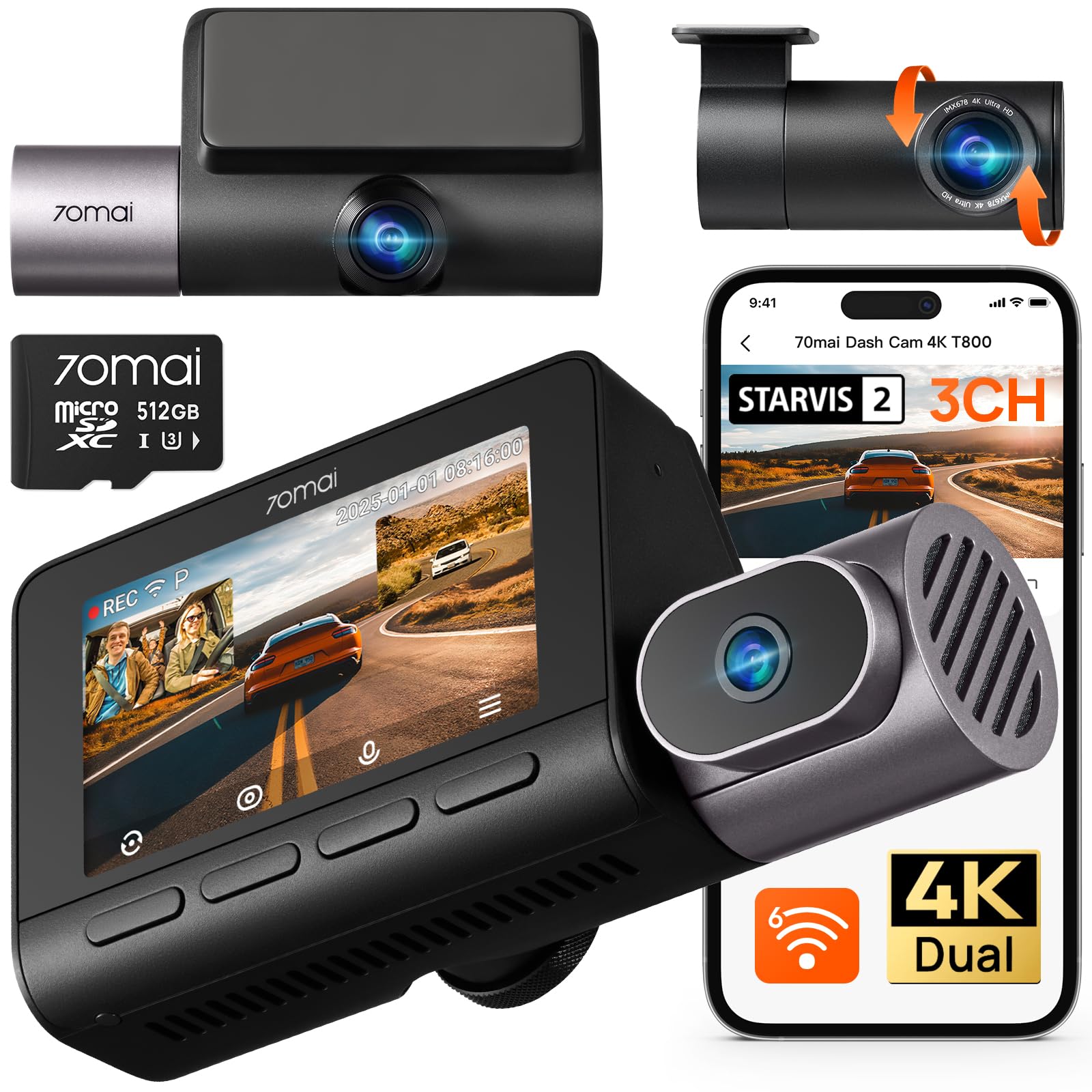
The 70mai 4K T800 is one of the few 360 dash cams that records true 2160P on both the front and rear channels simultaneously, paired with a 1080P interior camera. It uses dual Sony IMX678 STARVIS 2 sensors with 3-channel HDR, and 70mai’s proprietary MaiColor Vivid+ Solution enhances license plate and road sign clarity while reducing headlight glare. Four 940nm infrared LEDs on the cabin camera activate automatically in darkness, making it a strong choice for rideshare drivers who need to record passenger activity.
It ships with a 512GB memory card, which is the largest included capacity in this roundup. Wi-Fi 6 delivers ultra-fast 40MB/s transfer speeds — a 200MB video downloads in roughly 5 seconds. Optional 4G LTE connectivity (hardwire kit UP05 sold separately) enables real-time remote monitoring, theft tracking, and push alerts when the parking guard detects motion or collision. ADAS features like lane departure warnings and forward collision alerts add an extra safety layer.
Some early units arrived with power issues, but 70mai’s customer support resolved most cases with replacements. The supercapacitor design handles extreme heat (up to 140°F) without swelling, and OTA firmware updates ensure the camera stays current. The 4G kit requires a nano-SIM and separate hardwire installation, adding complexity for users who want full remote functionality.
Why it’s great
- True dual 4K front and rear — rare in this price tier
- 512GB memory card included at no extra cost
- Optional 4G LTE with real-time alerts and geo-fencing
- MaiColor Vivid+ processing enhances nighttime plate readability
Good to know
- Only 3 channels — no side camera coverage
- 4G hardwire kit and nano-SIM required for remote monitoring
- Some units reported DOA; customer support turnaround varies
3. Vantrue N5

The Vantrue N5 is a genuine 4-channel system with four dedicated physical cameras — front (158°), front cabin (160°), rear cabin (160°), and rear (165°) — providing true 360-degree coverage without relying on a single fisheye stitch. The front camera records at 2.7K (1944P) while the other three channels run at 1080P simultaneously. The unique rear cabin camera captures the trunk area, back seat, and side windows, making it ideal for monitoring children, pets, or luggage.
STARVIS 2 sensors power the front and cabin cameras, and IR LEDs on both interior cameras deliver clear monochrome footage in pitch-black conditions. The 5G Wi-Fi module offers 4x faster transfer speeds compared to 2.4GHz systems, and the built-in GPS logs speed, location, and route data accessible through the Vantrue app. OTA firmware updates add new features without removing the SD card.
The magnetic mount allows easy detachment without unplugging cables — useful for switching between vehicles. Users report that the G-sensor’s collision folder occasionally captures false positives from rough roads, and the adhesive mounts may loosen in extreme heat over time. Buffered parking mode requires the separate hardwire kit, but once wired, the system reliably captures pre-impact footage.
Why it’s great
- True 4-channel with dedicated rear cabin camera
- STARVIS 2 sensors with IR night vision on two interior cameras
- Magnetic mount for quick removal without unplugging
- Supports up to 512GB microSD for extended recording
Good to know
- Hardwire kit required for buffered parking mode — sold separately
- Adhesive mounts may weaken in direct sunlight
- G-sensor sensitivity can generate false collision events on bumps
4. Vantrue E360 Plus
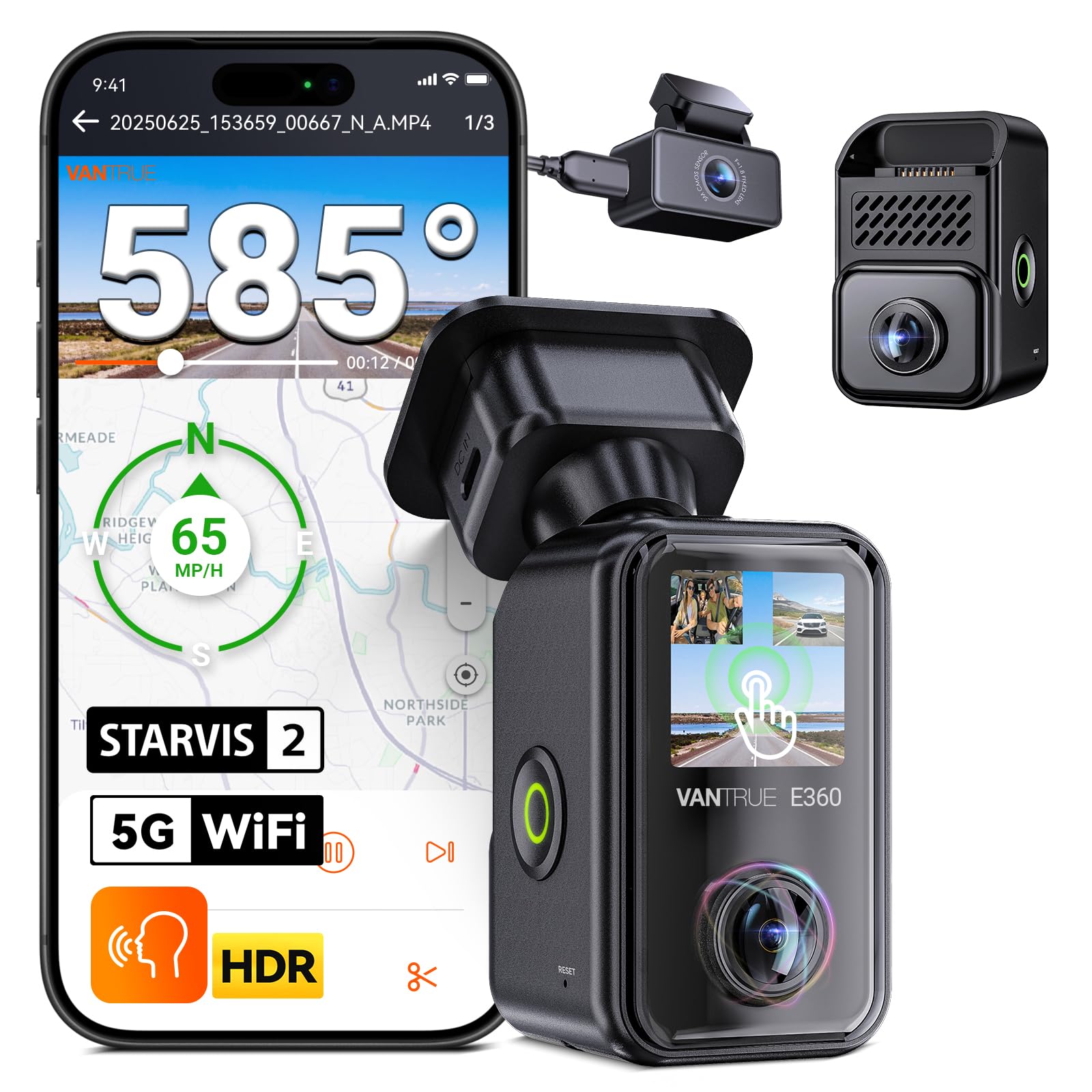
The Vantrue E360 Plus breaks from the traditional multi-lens approach by using dual 210-degree fisheye lenses on the front and interior cameras, plus a 165-degree rear camera. Its proprietary Panovis stitching technology merges the two fisheye streams into a seamless bird’s-eye view that covers the hood, both A-pillars, and the side windows — areas traditional 4-channel cameras miss. This provides a genuinely unique perspective for accident reconstruction.
Both fisheye cameras use STARVIS 2 sensors with infrared LEDs for zero-light visibility. HDR processing on all three channels ensures balanced exposure when transitioning from bright sunlight into dark tunnels. The 1.54-inch IPS touchscreen is responsive for quick menu navigation, and voice commands work in five languages (English, French, Spanish, Chinese, Russian) for hands-free control. Storage supports up to 1TB microSD — the largest limit among 3-channel fisheye designs.
Field reports note occasional IR glare reflecting off the windshield at night, and the G-sensor may be overly sensitive even at the lowest setting. The Apple CarPlay disconnects when the camera’s Wi-Fi is active — a minor inconvenience for iPhone users. The E360 Plus is best suited for drivers who want a panoramic single-perspective view rather than four separate corner recordings.
Why it’s great
- Dual 210° fisheye creates a true bird’s-eye view
- Panovis stitching captures hood and A-pillar gaps
- Supports up to 1TB microSD — best in class for 3-channel
- 5-language voice control with responsive touchscreen
Good to know
- IR glare visible on windshield during night driving
- Wi-Fi conflicts with Apple CarPlay when active
- G-sensor sensitivity may require manual adjustment
5. BOTSLAB G980H
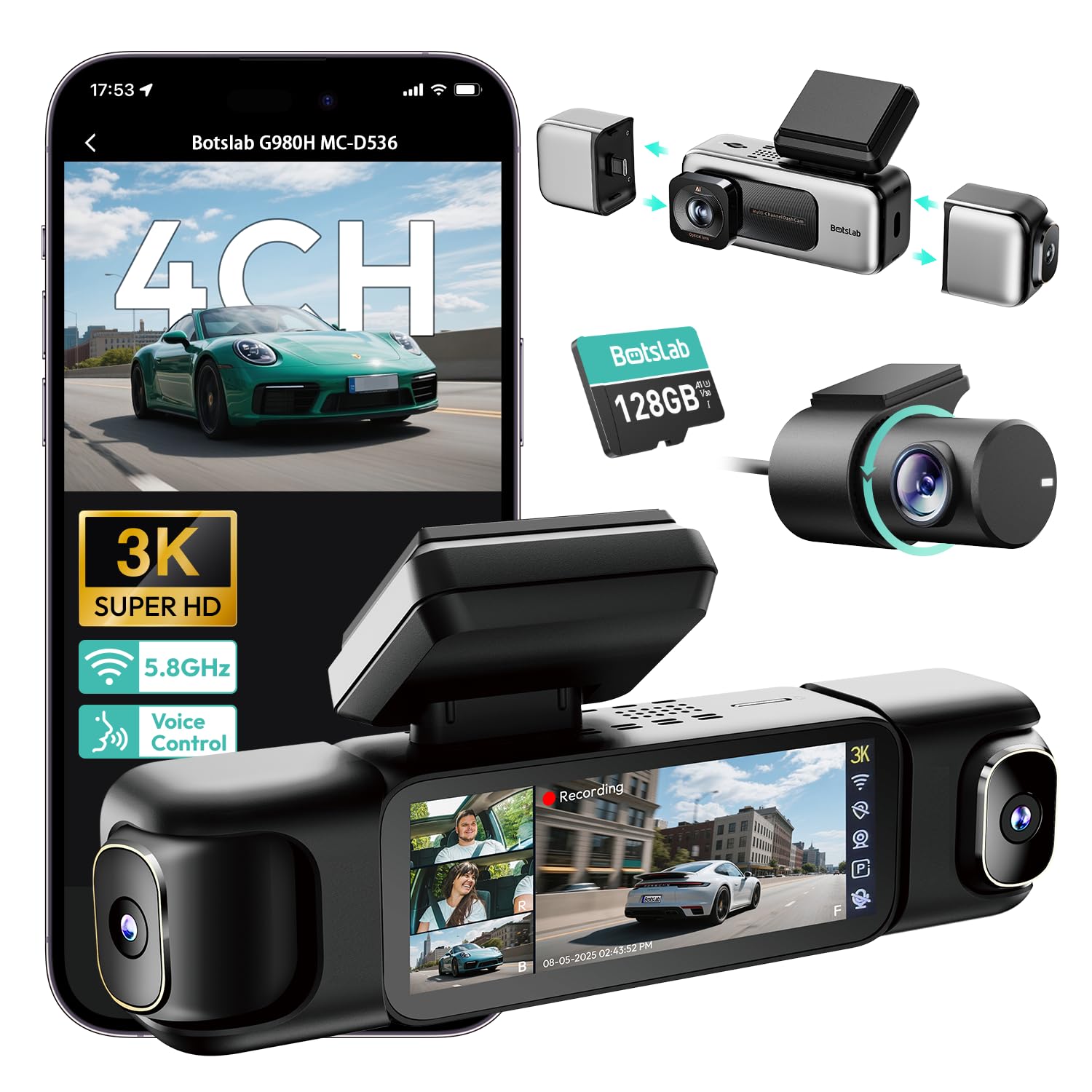
The BOTSLAB G980H delivers a 3K front camera paired with 1080P on the side and rear channels, achieving a combined 560-degree field of view that covers the vehicle’s entire perimeter. The 3.18-inch touchscreen is the largest in this roundup and supports 4-way split-screen playback, letting you review all camera angles simultaneously without switching views — a massive time-saver when reviewing an incident.
Its standout feature is the 8-second pre-recording function. When the G-sensor detects a collision, the camera locks not only the impact footage but also the 8 seconds before the event — critical for capturing the full sequence of an accident. The magnetic side cameras are detachable, so you can run the system in 3-channel (4K+1080P*2) or dual-channel (4K+1080P) mode when full perimeter coverage isn’t needed. The supercapacitor ensures stable operation from -20°C to 70°C.
The app interface is clean, though setup requires granting location and contact permissions — a privacy caveat that caused some users to return the unit. Parking mode supports time-lapse, sentry (motion detection within 5 meters), and collision detection, but the dedicated hardwire kit (ASIN B0DT1633D2) must be purchased separately. The electrostatic stickers leave no residue, making installation reversible.
Why it’s great
- 8-second pre-recording captures footage before impact
- 3.18-inch touchscreen with 4-way split-screen playback
- 560-degree combined field of view with magnetic side cameras
- Supercapacitor handles extreme temperatures without swelling
Good to know
- Hardwire kit for parking mode sold separately
- App requires location and contact permissions that concern some users
- Side cameras need precise positioning to avoid A-pillar obstruction
6. REDTIGER VP40
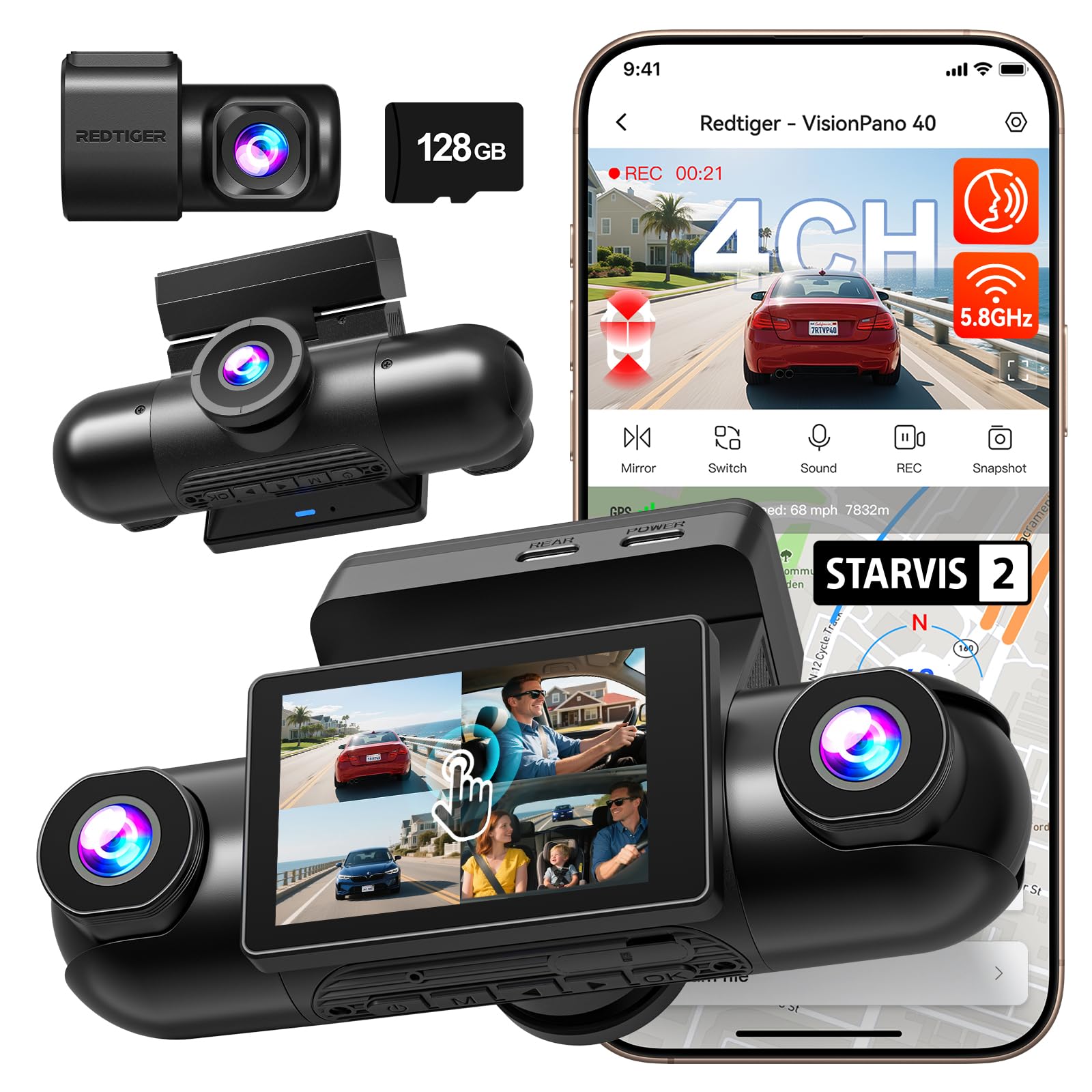
The REDTIGER VP40 is the only mid-range 360 dash cam with dual STARVIS 2 IMX675 image sensors, giving it 2.5x greater dynamic range than standard sensors. It records 2.5K (2560×1440) on both front and rear channels, plus 1080P on both side cameras — a rare combination at this price point. All four lenses are rotatable, so you can aim the side cameras at the cabin, side doors, or blind spots depending on your priority.
5.8GHz Wi-Fi transfers video 4x faster than typical 2.4GHz dash cams, and the Redtiger Cam app allows preview, editing, and sharing across all four channels. Built-in GPS logs speed, route, and location data, which overlays onto footage in the app. Voice control supports hands-free operation of basic functions like saving video or taking photos. The 18-month warranty and included 128GB card make it a low-risk investment.
Some users found the 3×3 adhesive film ineffective for long-term mounting and recommend direct windshield attachment. The side camera mounts can shift on rough roads if not tightened fully. Parking mode is time-lapse based (requires separate hardwire kit) rather than buffered, so it may miss the exact moment of a light tap. The unit is slightly bulkier than competitors, though it hides well behind the rearview mirror.
Why it’s great
- Dual STARVIS 2 IMX675 sensors in a mid-range package
- Rotatable lenses provide flexible angle adjustment
- 5.8GHz Wi-Fi for fast 4-channel video downloads
- 2.5K front and rear recording with 1080P side cameras
Good to know
- Parking mode is time-lapse, not buffered — hardwire kit sold separately
- Adhesive film may not hold in high heat; direct mount recommended
- Slightly bulkier form factor compared to competitor models
7. Driveye D7
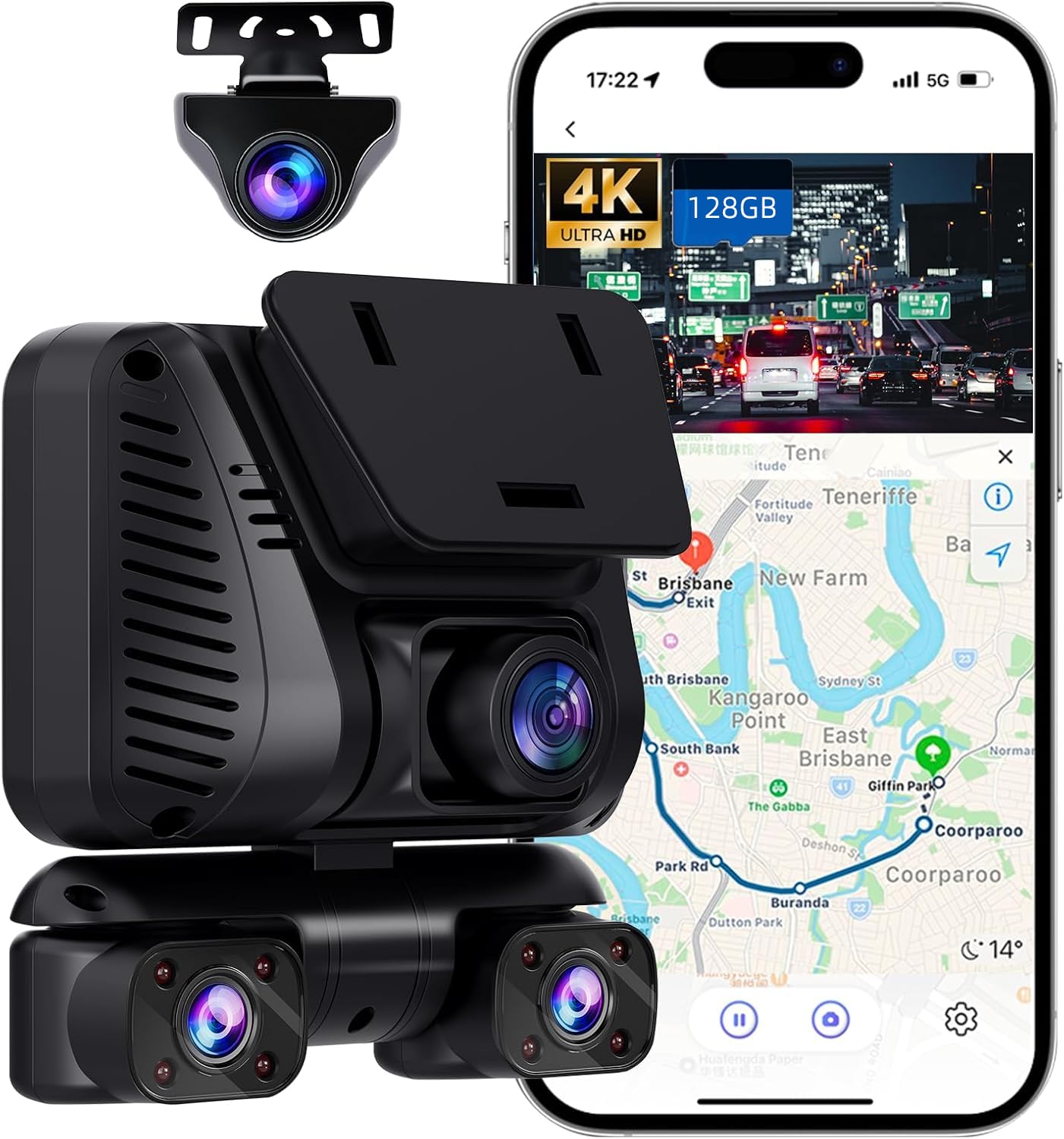
The Driveye D7 stands out for its 4K front channel — even with all four cameras recording simultaneously, the front lens outputs full 4K while the other three run at 1080P. The F1.8 aperture and six-layer glass optics deliver balanced exposure across lighting conditions, and the side cameras each have four infrared LEDs for zero-light cabin recording. It comes with a 128GB card and supports up to 256GB.
Voice control supports 13 English commands, including saving video, starting/stopping recording, and taking photos — useful for hands-free operation. The 5GHz Wi-Fi module transfers clips 3-5x faster than 2.4GHz dash cams, and the built-in GPS logs location and speed data that can be toggled on or off. The enhanced heat dissipation system allows operation from -22°F to 158°F without Wi-Fi disconnections or recording interruptions.
Several users noted that the main mount is fixed and does not pivot, making it difficult to align the front camera in vehicles with a large center mirror housing. In pickups and some SUVs, the side cameras can be blocked by interior trim. The 24-hour parking mode requires a separate add-on kit. The Driveye D7 is a strong contender for daily commuters in compact cars but less ideal for trucks or vans.
Why it’s great
- Full 4K recording on the front channel even in 4-channel mode
- 13 voice commands for hands-free operation
- Excellent heat dissipation rated for -22°F to 158°F
- F1.8 aperture and six-layer glass for low-light clarity
Good to know
- Non-pivoting main mount limits installation flexibility
- Side cameras may be blocked by interior trim in trucks and SUVs
- Parking mode requires a separate hardwire kit purchase
8. LAMTTO DC21
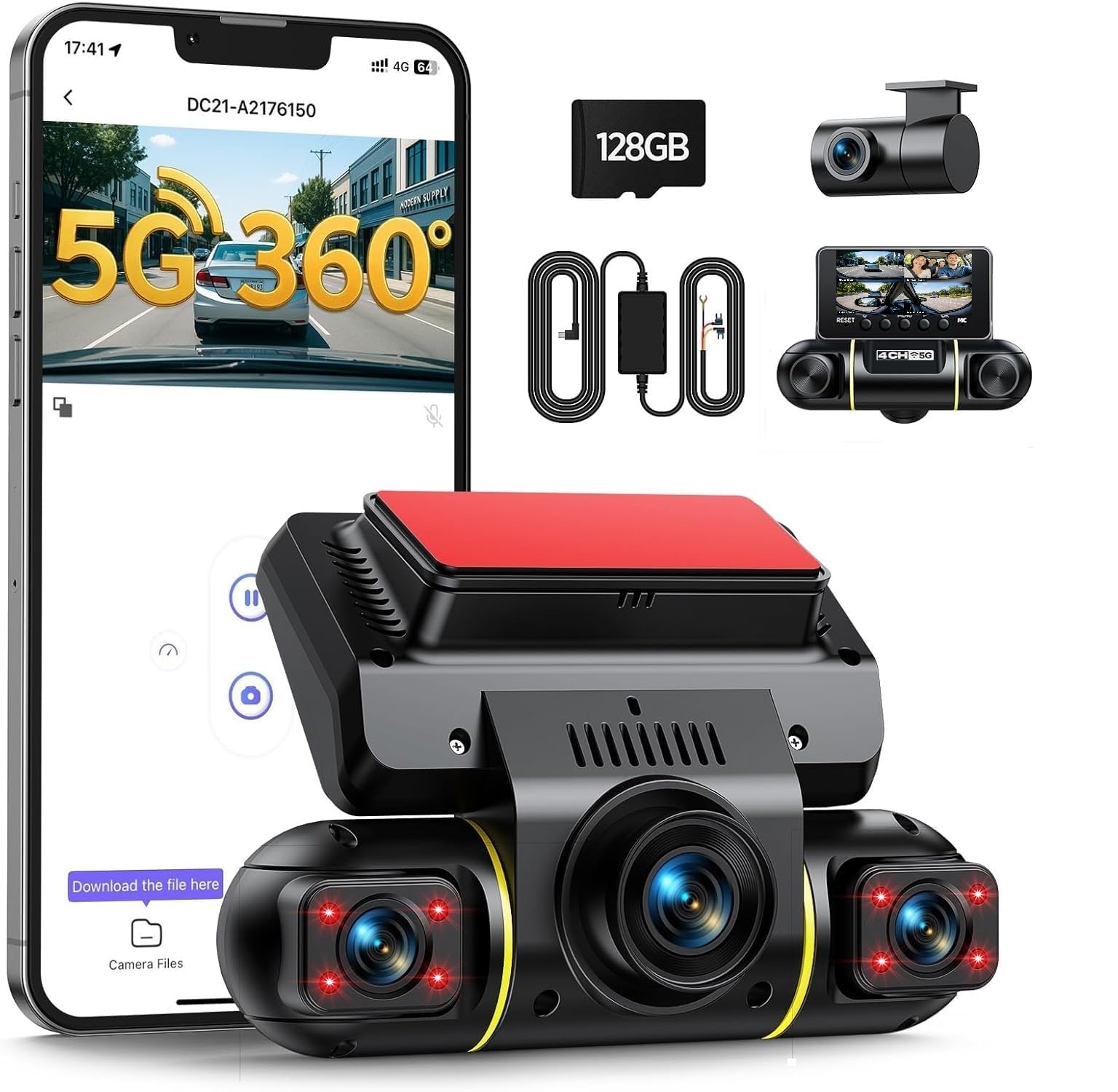
The LAMTTO DC21 is a rare budget-friendly 4-channel dash cam that includes the hardwire kit in the box — no separate – purchase needed to enable 24/7 parking monitoring. All four cameras record at 1080P, and the side/interior cameras use 8 hidden infrared LEDs for black-and-white footage in complete darkness. The F2.0 aperture lens balances exposure reasonably well for a sub-premium sensor.
5G Wi-Fi connects to the Viidure app (iOS and Android) for quick video preview and download. The G-sensor automatically locks collision footage, and the included 128GB card is ready out of the box — no initial purchase required. The DC21 supports dual power modes: cigarette lighter plug-and-play or hardwire fuse-box connection for parking mode. LAMTTO offers lifetime technical support with 24-hour response.
Some users experienced a rear camera blue-screen defect, possibly from a loose cable connection during installation. The rear camera cable may be slightly short for full-size trucks and vans. The app interface is functional but not as polished as the Vantrue or VIOFO apps. For drivers who want a 4-channel system with parking mode at the lowest entry point, the DC21 delivers solid value despite minor app and cable limitations.
Why it’s great
- Hardwire kit included — no extra purchase for parking mode
- 8 IR LEDs provide zero-light cabin visibility
- 128GB card included and ready to record
- Lifetime technical support with 24-hour response
Good to know
- Rear cable may be too short for large trucks and vans
- Occasional rear camera blue screen if cable is not fully seated
- No GPS module — no location or speed logging
9. Zunfly W2

The Zunfly W2 is the most affordable true 4-channel 360 dash cam on this list, offering a 2K front camera plus 1080P on the rear, left, and right channels. The 170-degree super-wide front lens captures license plates at sharp angles — outperforming standard 150-degree budget cameras. An included 64GB card gets you started, with support up to 128GB. The 3-inch IPS screen provides live verification of all four streams.
5GHz Wi-Fi transfers HD video about 4x faster than 2.4GHz connections, and built-in GPS tags speed and location directly onto footage — helpful for insurance claims. Parking mode offers time-lapse or impact detection (hardwire kit sold separately) and consumes about 70% less power than standard systems through motion-activated recording. The supercapacitor preserves footage during sudden power loss.
Some units have a rear camera quality variance — one customer reported an intermittent blue screen, though others confirmed clear 1080P on all four channels. The VIP app has a less intuitive interface than Vantrue or VIOFO apps, and the side cameras lack separate adjustability on some mounts. For entry-level buyers who want 360 coverage on a tight budget, the W2 delivers functional protection without premium sensor performance.
Why it’s great
- Lowest entry price for true 4-channel 360 coverage
- 2K front camera with 170-degree wide-angle lens
- Built-in GPS and 5GHz Wi-Fi in a budget package
- Supercapacitor handles power interruptions safely
Good to know
- 64GB card included; 128GB max (no SSD support)
- Rear camera quality can vary between units
- VIP app interface is less polished than premium competitors
FAQ
What is the difference between 3-channel and 4-channel 360 dash cams?
Can I install a 360 dash cam without professional help?
Why do premium units use a supercapacitor instead of a battery?
Final Thoughts: The Verdict
For most users, the 360 dash cam winner is the VIOFO A329S because it combines unmatched image quality from three STARVIS 2 sensors, industry-leading 4TB SSD storage compatibility, and Wi-Fi 6 transfer speeds in a polished package. If you want dual 4K front and rear recording with optional 4G LTE remote monitoring, grab the 70mai 4K T800. And for a true 4-channel system with dedicated rear cabin coverage and magnetic mounting convenience, nothing beats the Vantrue N5.

Mo Maruf
I created WellFizz to bridge the gap between vague wellness advice and actionable solutions. My mission is simple: to decode the research and give you practical tools you can actually use.
Beyond the data, I am a passionate traveler. I believe that stepping away from the screen to explore new environments is essential for mental clarity and physical vitality.