Our readers keep the lights on and my smoothie glass nicely filled. As an Amazon Associate, I earn from qualifying purchases.
A 360 camera eliminates the age-old problem of missing the shot because you were pointing your lens in the wrong direction. Instead of framing a narrow view, you capture everything around you in a single take—then choose your angle later in post-production. This workflow shift changes how you approach action sports, travel vlogging, and immersive content creation.
I’m Mohammad Maruf — the founder and writer behind WellFizz. Over the years I’ve scrutinized dozens of 360-degree camera specs, from dual-sensor configurations and stitching algorithms to stabilization systems and invisible selfie stick performance, to separate genuine innovation from marketing claims.
Whether you need underwater durability, true 8K spherical resolution, or a compact design for virtual tours, the best 360 camera must balance sensor quality, software maturity, and real-world battery life to earn a spot in your kit.
How To Choose The Best 360 Camera
Selecting a 360 camera comes down to your primary use case—action sports, professional photography, or social-media content. The sensor size, video resolution, stabilization system, and software ecosystem each play a specific role in delivering the final result you see on screen.
Sensor Size and Resolution
A 1-inch or larger sensor captures more light and delivers cleaner low-light footage than smaller 1/2.3-inch sensors found in entry-level models. Higher effective still resolution (measured in megapixels) gives you more cropping room when reframing 360 footage into standard 16:9 video. Dual-sensor configurations double the data at capture time, improving stitch quality and dynamic range.
Stabilization and Horizon Lock
Look for camera-specific stabilization like FlowState from Insta360 or HyperSmooth from GoPro. These gyro-based algorithms keep footage smooth without a gimbal. Horizon Lock maintains a level horizon even when the camera rotates fully—essential for biking, skiing, or any high-motion activity where the camera flips and spins.
Waterproofing and Lens Durability
If your adventures involve water, mud, or impacts, check the waterproof depth rating without an external housing. Replaceable glass lenses extend the camera’s lifespan because a scratched lens destroys image quality. Models with integrated lens guards or protective caps add an extra layer of security.
Software and Editing Workflow
The camera is only half the equation. The companion app’s reframing tools, AI-assisted editing, and export speed determine how quickly you can turn raw 360 footage into social-ready clips. In-camera stitching reduces post-production time, while desktop apps offer finer control for professional creators.
Quick Comparison
On smaller screens, swipe sideways to see the full table.
| Model | Category | Best For | Key Spec | Amazon |
|---|---|---|---|---|
| Insta360 X5 | Action 360 | High-end action & travel | 8K@30fps, 1/1.28″ dual sensors, 15m waterproof | Amazon |
| GoPro MAX2 | Action 360 | 8K spherical video & POV | True 8K 360 video, 29MP photos, replaceable lens | Amazon |
| DJI Osmo 360 | Action 360 | Low-light & 8K detail | 1-inch 360 imaging, 8K@30fps, 120MP photos | Amazon |
| GoPro MAX 2025 | Action 360 | Versatile 360 & Hero dual-mode | 5.6K30 spherical, 1/4-20 mount, 6-mic audio | Amazon |
| Ricoh Theta Z1 | Professional | Real estate & high-quality stills | Dual 1-inch BSI CMOS, 23MP stills, 51GB internal | Amazon |
| AKASO 360 | Budget Action | Entry-level 360 & value | 5.7K video, 48MP sensors, AI tracking | Amazon |
| Kodak PIXPRO SP360 4K | Twin-Cam Kit | DIY VR & spherical capture | Dual 4K cameras, 12MP BSI-CMOS each | Amazon |
| DJI Avata 360 | FPV Drone | Aerial 360 & immersive flight | 1-inch 8K 360 imaging, 4K/60fps single-lens | Amazon |
| MWE 360 Photo Booth | Event Station | Party & commercial photo booths | 23-inch spinning turntable, LED ring light | Amazon |
In‑Depth Reviews
1. Insta360 X5 Essentials Bundle

The Insta360 X5 is built around dual 1/1.28-inch sensors that capture 8K30fps 360 video with noticeably better dynamic range and color accuracy than previous generations. The triple AI chip design pushes low-light performance beyond what dual-sensor action cameras typically deliver, producing usable footage in dim twilight without excessive noise. FlowState stabilization with full 360-degree Horizon Lock keeps the horizon perfectly flat even when the camera spins during jumps or crashes.
Waterproof to 15 meters without a housing, the X5 is ready for snorkeling and pool sessions right out of the box. The replaceable scratch-resistant lenses are a major improvement for long-term durability—a single drop on gravel no longer means a dead camera. The included 114cm Invisible Selfie Stick and fast-charging battery that reaches 80 percent in 20 minutes reduce downtime between shoots.
The Insta360 app offers InstaFrame mode for instant flat exports and AI-powered editing that automatically creates highlight reels. The learning curve for editing 360 footage is real, but the community support and comprehensive app tools make it manageable. The X5’s weight and form factor feel balanced on a helmet mount or selfie stick, though it is slightly larger than the X4.
Why it’s great
- Excellent 8K spherical resolution with dual 1/1.28-inch sensors
- FlowState stabilization and Horizon Lock keep all footage level
- Waterproof to 15m with replaceable scratch-resistant lenses
- Fast charging to 80 percent in 20 minutes
Good to know
- Editing 360 footage requires learning the Insta360 app workflow
- Battery life around 3 hours in practice, less with heavy 8K recording
- MicroSD card sold separately
2. GoPro MAX2
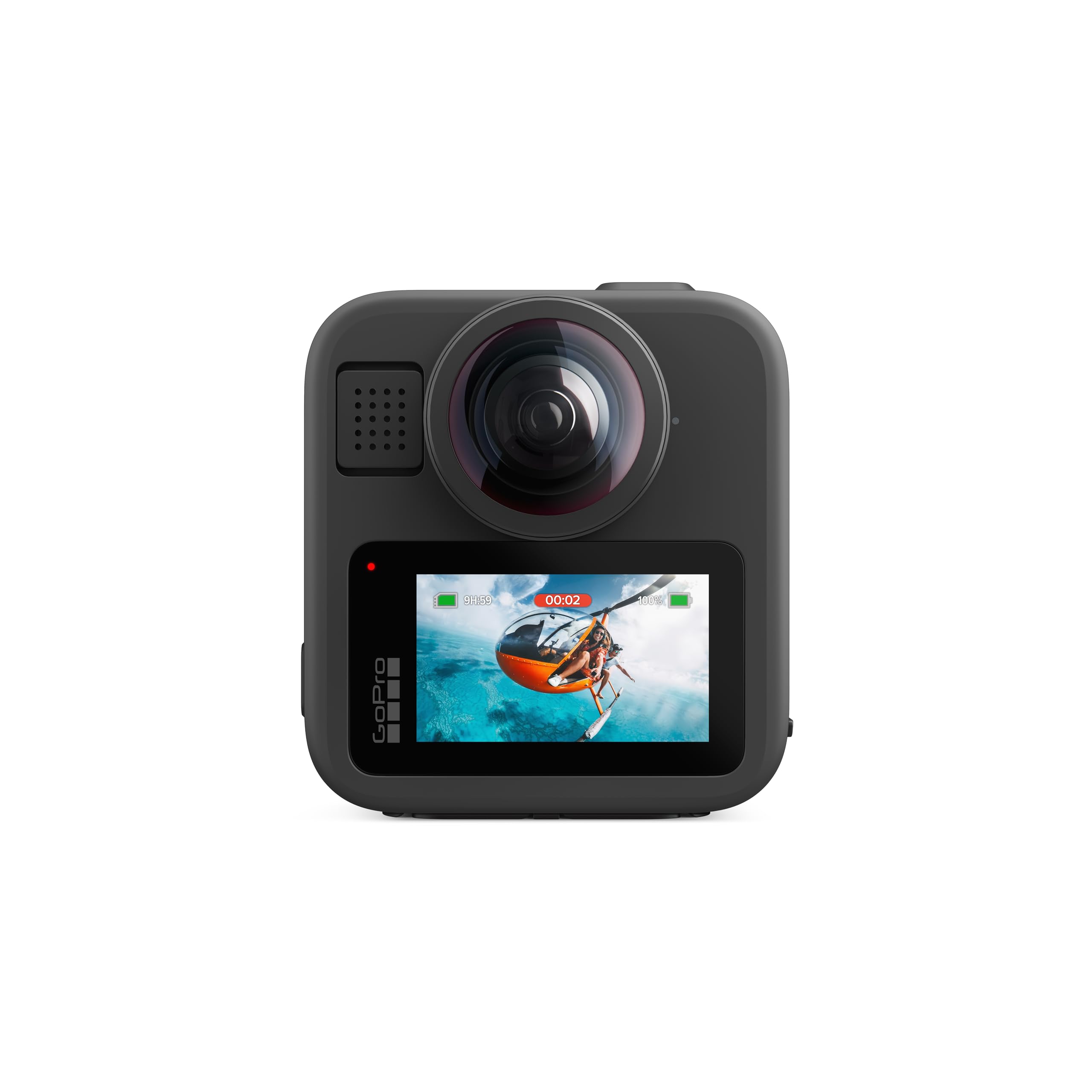
The GoPro MAX2 delivers True 8K 360 video resolution that provides 21 percent more pixels than competing 8K spherical cameras, which means cleaner reframing into 4K without visible artifacts. The 29MP 360 photos capture impressive dynamic range, handling bright snow and dark tree shadows in a single shot without blowing out highlights. HyperSmooth stabilization with Horizon Lock locks the horizon flat even when the camera tumbles down a slope.
Replaceable glass lenses with a water-repelling coating are a standout feature—a scratched lens no longer ruins the entire camera. The camera is waterproof without a housing, though depth rating details suggest it is splashproof rather than deep-water ready. The 6-microphone array captures ambisonic audio that shifts perspective as you reframe in the GoPro Quik app, and the wind reduction algorithm preserves voice clarity during high-speed activities.
The dual-mode toggle between 360 and traditional Hero mode makes the MAX2 adaptable for both immersive capture and standard POV vlogging. The Quik app reframing tool is intuitive, but the monthly storage subscription for large 360 files may catch users off guard. Thermal management is adequate for continuous 8K recording, though some users note heat buildup during extended sessions.
Why it’s great
- True 8K 360 video with 21% more resolution than competitors
- Replaceable water-repelling glass lenses extend camera life
- HyperSmooth stabilization with Horizon Lock stays level during spins
- 6-mic ambisonic audio with effective wind reduction
Good to know
- Battery life shorter than hoped for heavy 8K shooting
- Requires monthly storage subscription for large video files
- Some users report heat buildup during extended recording
3. DJI Osmo 360 Essential Combo
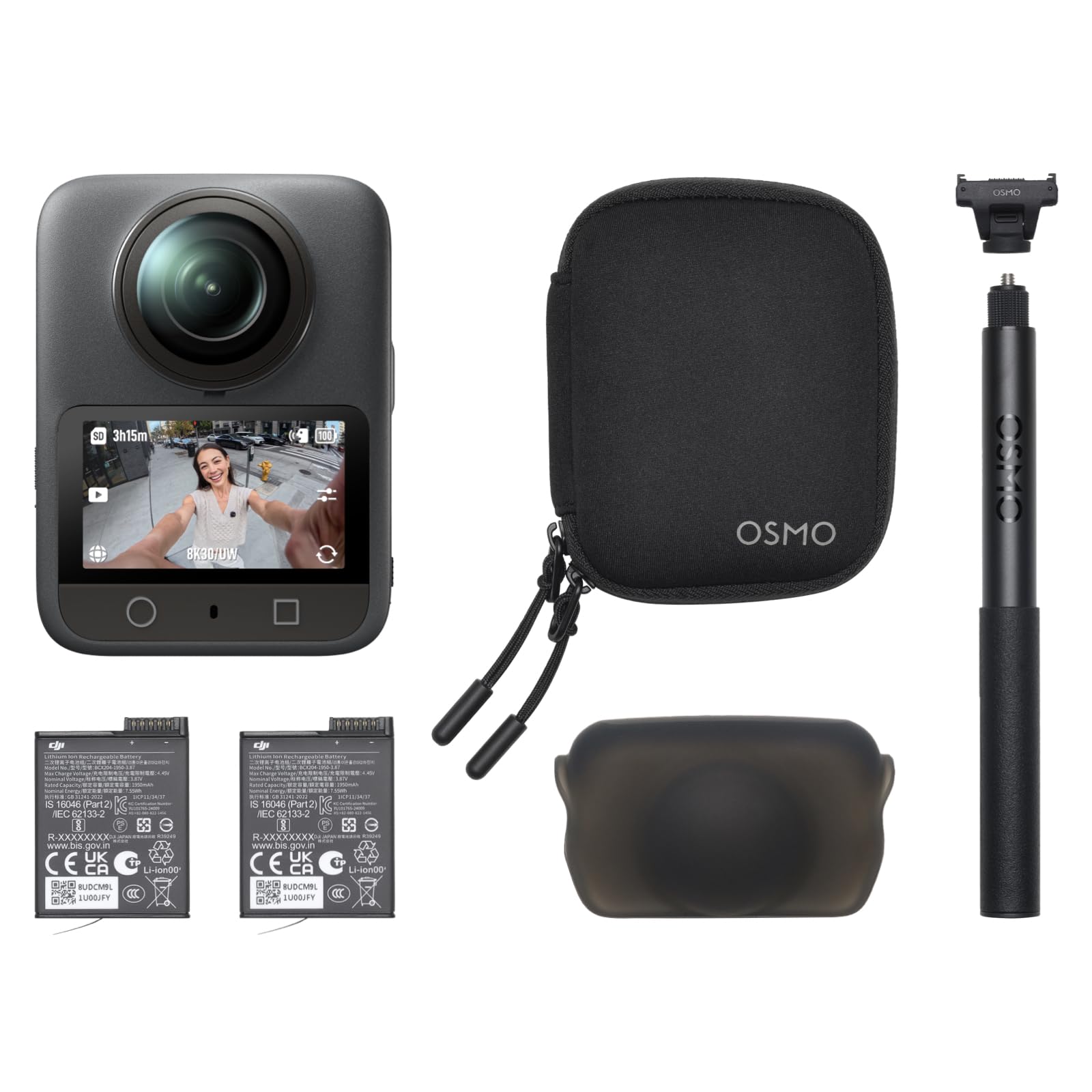
The DJI Osmo 360 uses a true 1-inch 360 imaging system—two 1-inch sensors behind custom lenses—to capture 8K30fps 360 video with exceptional low-light performance and minimal noise after sunset. The 120MP 360 photos stitch together into panoramas that retain fine texture in shadows and highlights, making it suitable for both travel photography and social content. The magnetic quick-release mount works with the Osmo Action accessory ecosystem and standard 1/4-inch threads, giving it flexibility across tripods, helmet mounts, and selfie sticks.
The 1.2-meter Invisible Selfie Stick included in the Essential Combo enables convincing third-person perspective shots where the pole disappears in post-production. The 4-microphone stereo recording supports direct connection to two DJI microphone transmitters without a receiver—a major convenience for vloggers who want clean audio. Built-in 105GB storage means you can start shooting immediately without buying a memory card, and the 1950mAh battery delivers up to 100 minutes of recording time per charge.
The DJI Mimo app provides Pano Dewarp and Pano Pro Color Grading tools that streamline editing, though the app’s removal from Google Play requires manual download from DJI’s website. The learning curve is moderate, particularly for reframing and color grading 360 footage. The magnetic mount system feels secure, and the overall build quality meets DJI’s usual standard of precision engineering.
Why it’s great
- True 1-inch sensors deliver superior low-light image quality
- 8K30fps 360 video with excellent dynamic range
- Built-in 105GB storage eliminates need for immediate SD card purchase
- Direct microphone transmitter connection without extra receiver
Good to know
- DJI Mimo app must be downloaded from DJI website (removed from Google Play)
- Moderate learning curve for editing and color grading 360 footage
- Magnetic mount is quick but requires compatible accessories for full utility
4. GoPro MAX 360 (2025) with Accessory Kit

The updated GoPro MAX (2025) captures 5.6K30 spherical video with in-camera stitching that simplifies offloading and editing through the GoPro Quik app. The addition of a 1/4-20 mounting system is a meaningful upgrade for 360 content creators—it opens compatibility with standard photography gear and enables clean invisible pole shots where the mount disappears from the frame. The single-lens Hero mode offers four digital lens options including ultra-wide Max SuperView for traditional vlogging.
Six built-in microphones capture immersive 360 audio with advanced wind-noise reduction that preserves dialogue during biking or skiing. The camera is waterproof to 16 feet (5 meters) without an external housing, making it suitable for poolside and shallow-water use. The 50-piece accessory kit included in this bundle provides mounts, clips, and attachments that cover most starting scenarios, though the instructions for individual accessories could be clearer.
Battery life is rated at 5 hours under ideal conditions, but real-world 360 recording at maximum resolution typically yields closer to 90 minutes. The touchscreen interface is responsive, and voice control with 12 commands enables hands-free operation when the camera is mounted out of reach. The 5.6K resolution is adequate for reframing to 1080p or 1440p, but users who need 4K reframes from 360 footage may prefer the MAX2’s higher 8K resolution.
Why it’s great
- New 1/4-20 mount expands accessory compatibility beyond GoPro ecosystem
- In-camera stitching simplifies post-production workflow
- 6-mic audio with effective wind-noise reduction
- Waterproof to 5m without a housing
Good to know
- 5.6K resolution limits reframing quality compared to 8K models
- Accessory kit instructions lack clarity on individual item purposes
- Battery life in 360 mode is shorter than the 5-hour rating suggests
5. Ricoh Theta Z1 51GB

The Ricoh Theta Z1 remains a reference for 360 still image quality, using two 1-inch back-illuminated CMOS sensors and a proprietary lens unit that suppresses ghosting, flare, and fringing. The 23-megapixel (7K) stills stitch together with high precision, producing natural-looking panoramas that hold up to close inspection. HDR image processing handles extreme brightness variations—like shooting an interior room with a bright window—without blowing out highlights or crushing shadows.
The 51GB internal memory stores approximately 6,350 JPEG still images or 900 RAW files, which is critical for real estate photographers who shoot dozens of properties per week. 4K 360 video capture includes smooth image stabilization and 4-channel microphone audio, though video is not the Z1’s primary strength. The magnesium alloy body feels premium and durable, and USB 3.0 Type-C connectivity enables fast file transfers to a computer.
Adobe Photoshop Lightroom Classic CC with the RICOH THETA Stitcher plug-in supports RAW development directly, giving pro users complete control over exposure, white balance, and sharpening. The battery is non-user-replaceable and lasts about one hour of active shooting, which is the Z1’s most significant limitation. The lack of a touchscreen also means all settings adjustments happen through the smartphone app or desktop software.
Why it’s great
- Class-leading still image quality with dual 1-inch BSI CMOS sensors
- HDR processing handles extreme brightness variation in real estate scenes
- 51GB internal storage eliminates memory card requirement
- Adobe Lightroom RAW development support for pro editing
Good to know
- Non-user-replaceable battery with approximately 1-hour runtime
- No touchscreen; all settings controlled via app or desktop software
- 4K video quality is good but not competitive with action 360 cameras
6. AKASO 360 Action Camera Standard Combo
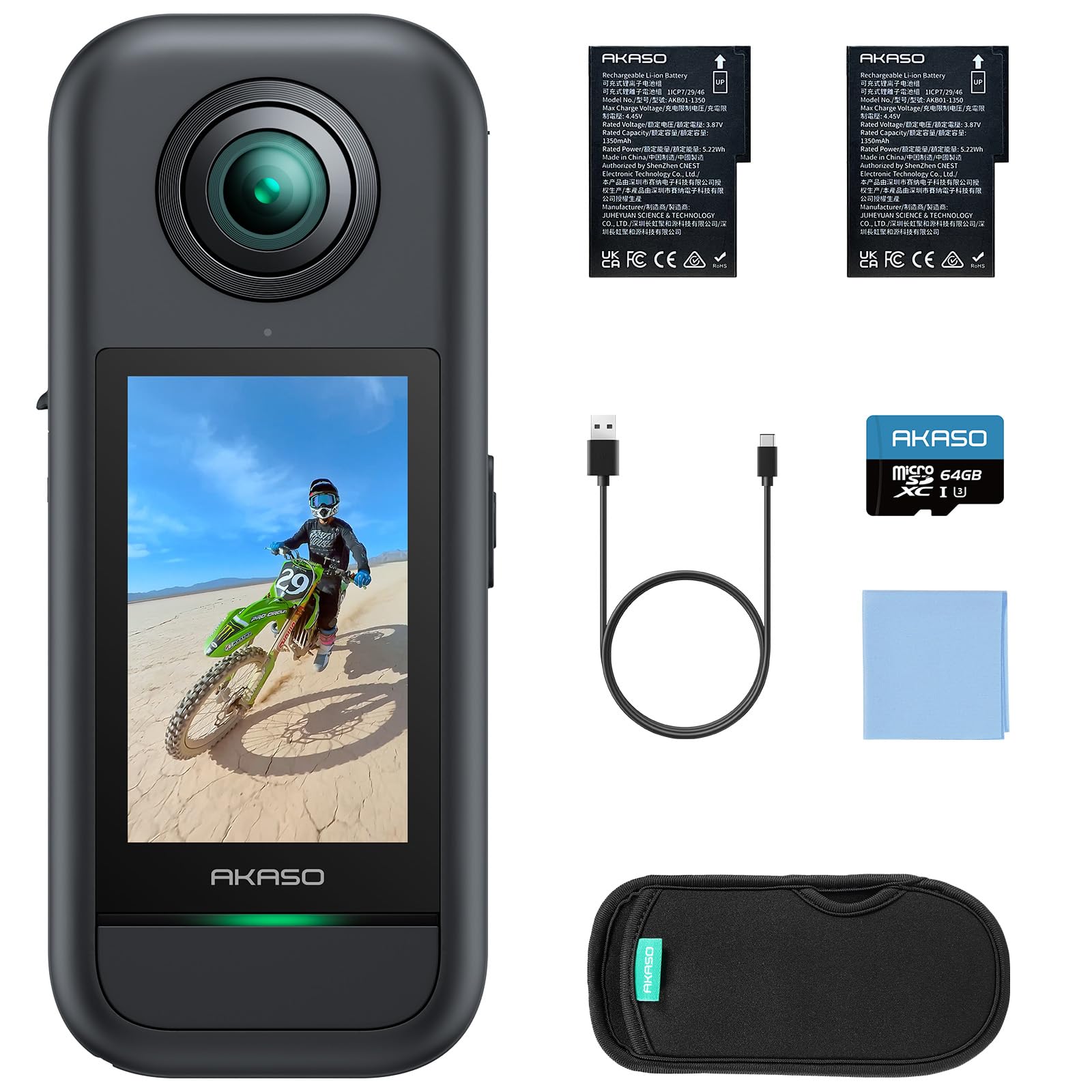
The AKASO 360 delivers 5.7K 360 video and 72MP 360 photos using dual 1/2-inch 48MP sensors—specs that rival significantly more expensive models at a fraction of the investment. Advanced in-app stabilization smooths out shakes without a gimbal, and the 360-degree Horizon Lock keeps footage level regardless of camera orientation. The invisible selfie stick effect works reliably for third-person perspective shots, and the included 64GB MicroSD card removes the immediate need for separate storage.
AI Subject Tracking intelligently keeps detected subjects centered in the frame, which is useful for solo creators who cannot manually reframe mid-shoot. The AKASO 360 Studio app enables reframing and basic editing, though the software lacks the advanced AI reframing tools of Insta360 or GoPro. DNG8 RAW Photo Mode provides greater editing flexibility in post-production, particularly for recovering shadow detail in high-contrast scenes.
Battery life averages 60 minutes under normal usage, which is shorter than premium competitors but expected at this tier. The camera is weatherproof against rain and splashes but not fully submersible. The app occasionally slows down during heavy editing, and users who need a selfie stick must purchase it separately. For budget-conscious buyers, the AKASO 360 delivers solid 360 performance that covers the essentials.
Why it’s great
- Strong 5.7K 360 video quality at an entry-level price point
- Included 64GB MicroSD card reduces immediate accessory costs
- AI Subject Tracking helps solo creators keep subjects in frame
- DNG8 RAW mode enables flexible post-production editing
Good to know
- Battery life averages only 60 minutes
- Weatherproof but not submersible for underwater use
- Selfie stick must be purchased separately
7. Kodak PIXPRO SP360 4K Dual Pro Pack

The Kodak PIXPRO SP360 4K Dual Pro Pack takes a different approach to 360 capture: two separate SP360 4K cameras mount back-to-back on a Dual Camera Base Mount to create a true spherical 360-by-360 view. Each camera has a 12MP BSI-CMOS sensor recording 3840×2160 video at 30fps, effectively doubling the visual data per shot compared to a single dual-lens camera. This setup produces 360 footage suitable for YouTube, Facebook, and VR headset playback.
The complete mounting kit includes an extendable selfie stick, suction cup mount, RF remote, wrist strap, and lens covers—everything needed to start shooting spherical video out of the box. Wi-Fi and NFC connectivity allow wireless control from a smartphone, while the RF remote keeps both cameras synchronized during operation. The free stitching software is functional for basic spherical output, though it lacks the polish and speed of modern all-in-one 360 camera apps.
The dual-camera design introduces practical trade-offs. Accessing the battery, SD card, and ports requires removing both cameras from the mount, which is cumbersome during shoots. Only one charger is included for two cameras, so you must recharge them sequentially. The cameras heat up after extended recording, and the menu system feels dated compared to current-gen action cameras. Despite these quirks, the SP360 4K Dual Pack remains a niche option for enthusiasts who want a traditional twin-cam rig for VR projects.
Why it’s great
- True dual-camera spherical capture with 12MP BSI-CMOS per camera
- Complete kit includes selfie stick, suction mount, RF remote, and case
- Free stitching software supports VR headset playback
- Wi-Fi, NFC, and RF remote for flexible triggering
Good to know
- Accessing battery/SD card requires removing cameras from mount
- Only one charger included for two cameras
- Cameras heat up during extended recording
8. DJI Avata 360 with RC 2
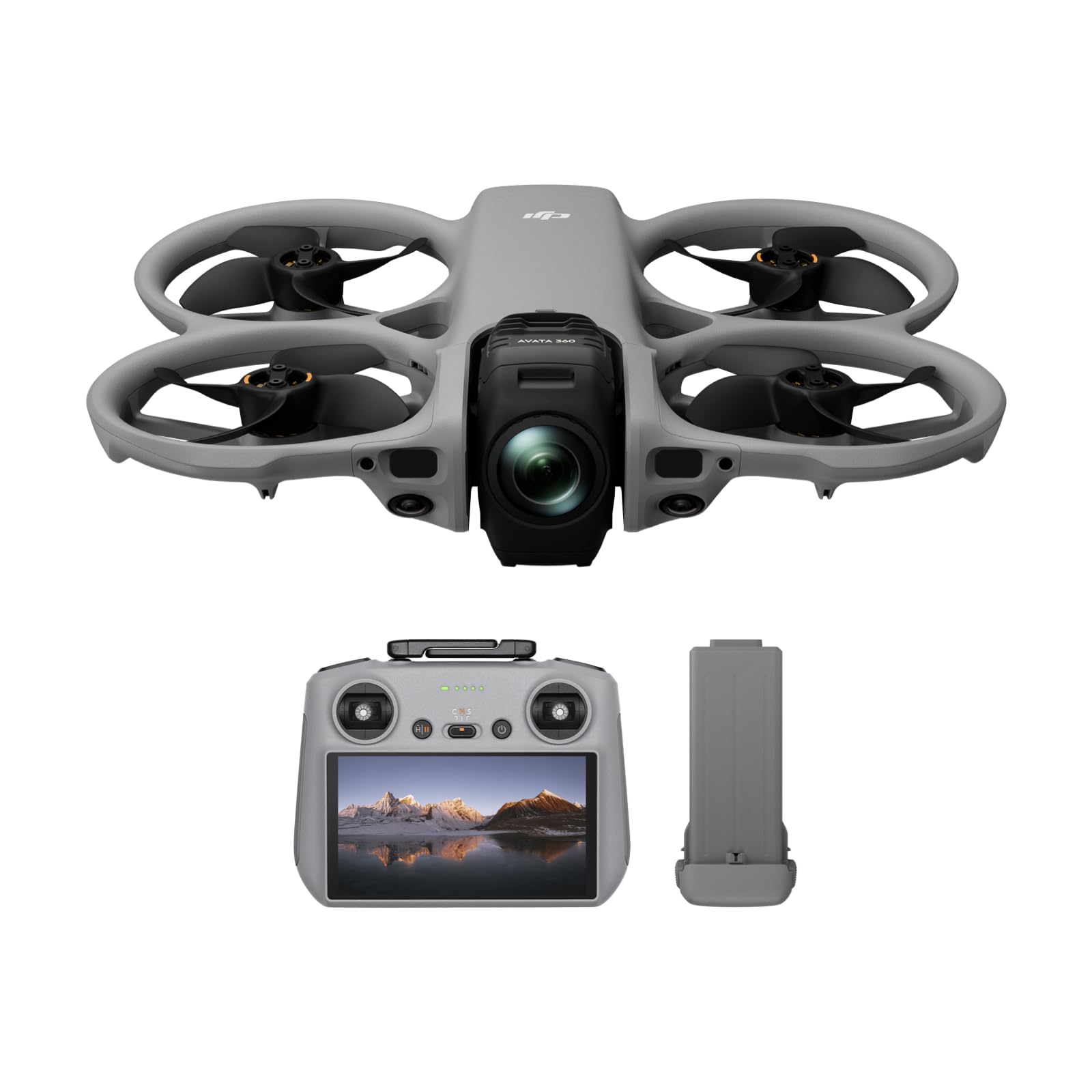
The DJI Avata 360 is a purpose-designed FPV drone with a 1-inch 360 imaging system that captures 8K60fps HDR 360 video from the air—a capability no other consumer drone matches. The integrated propeller guard and omnidirectional obstacle sensing reduce crash risk during proximity flying, making it more forgiving for pilots learning FPV cinematography. O4+ FHD video transmission delivers a 1080p60fps feed up to 20 kilometers with strong anti-interference performance.
360-degree imaging enables infinite rotation and tilt control during flight, producing dynamic camera movements that standard gimbals cannot replicate. In post-production, you can reframe each 360 clip from any perspective, effectively capturing multiple shots from a single pass. The dual-mode system switches between 360 and Single Lens mode for traditional 4K60fps Avata-style footage, though single-lens quality is slightly below dedicated camera drones due to the wider fixed aperture and lack of ND filters.
Flight time is approximately 18 minutes per battery—typical for FPV drones but short compared to camera drones like the Mini series. The Avata 360 is louder than DJI’s camera drones, and the RC 2 controller has a built-in screen for precise control without a phone. The DJI Fly app and DJI Studio are required for stitching and color grading 360 footage, and the initial firmware setup for goggles and Motion Controller 3 can take hours. For pilots who want aerial 360 without compromise, this is the only real option.
Why it’s great
- Only consumer drone with 1-inch 8K60fps 360 imaging
- Integrated propeller guard and obstacle sensing for safer proximity flight
- Infinite gimbal rotation enables unique dynamic camera movements
- O4+ FHD video transmission with 20km range
Good to know
- Approximately 18-minute flight time per battery
- Single-lens mode quality lower than dedicated camera drones
- Initial firmware setup for FPV gear is time-consuming
9. MWE 360 Photo Booth Machine with Flight Case
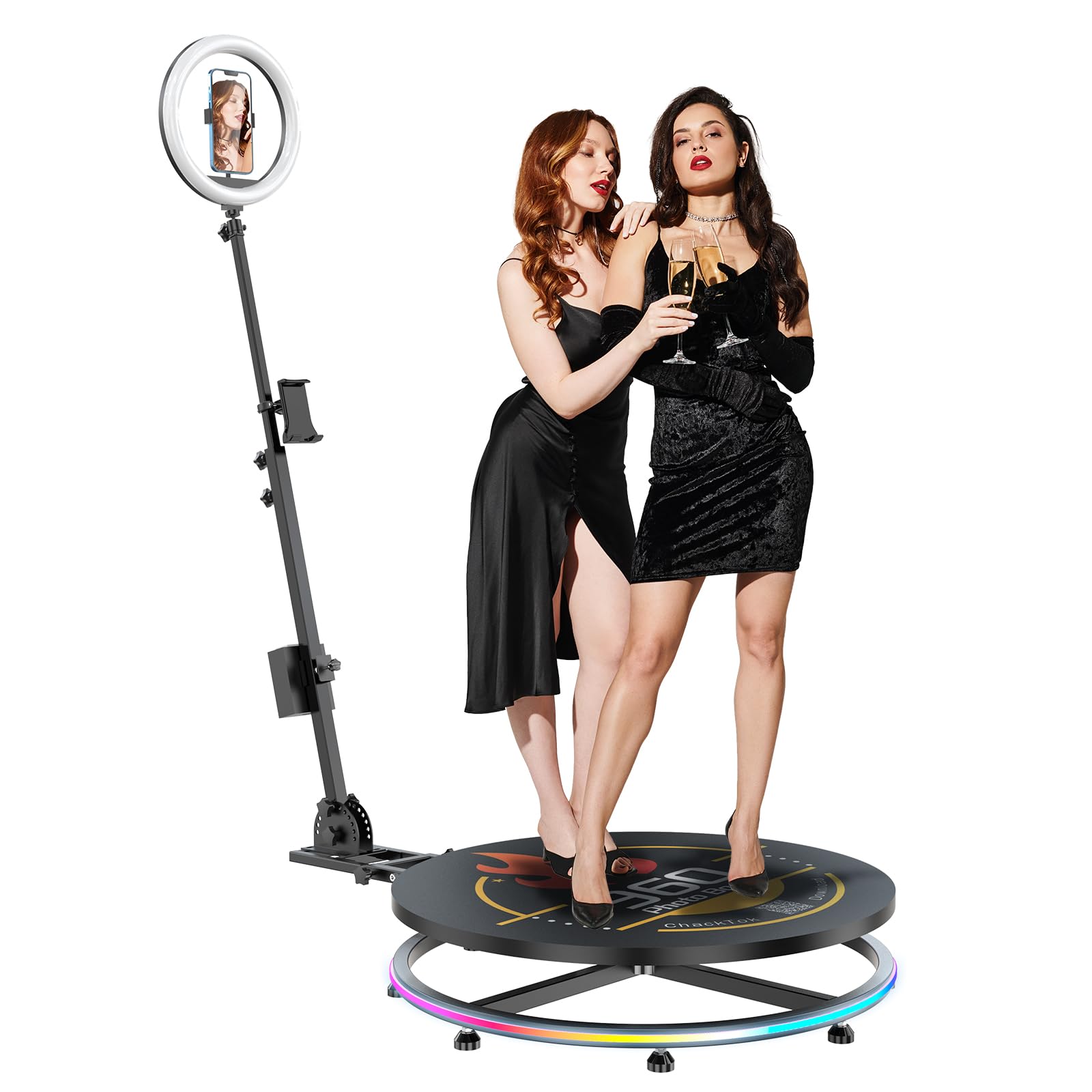
The MWE 360 Photo Booth Machine is a complete event station with a 23-inch rotating turntable that holds 1 to 3 people, a ring light with three color modes and 10 adjustable brightness levels, and a flight case for transport. The spin mechanism rotates 360 degrees to capture slow-motion, boomerang, and standard video clips from every angle. The included software (ChackTok) provides shooting modes like boomerang, normal video, slow-motion, and GIF export with custom music overlay.
Control is handled through the physical button or the ChackTok app, where you can adjust rotation speed, direction, and timer settings wirelessly. The selfie stick height and angle are adjustable, and multiple selfie holders support tablets, GoPros, cameras, and smartphones. The RGB LED strip light adds atmosphere for parties and events, and additional props like stickers increase the fun factor for guests. The flight case includes four rollers for easy transport between venues.
Assembly is straightforward with clear instructions and a checklist, and the motor operates smoothly without extra noise during operation. The 39.4-inch version supports up to 800 pounds, indicating robust construction for commercial use. MWE offers a 5-year replacement policy for quality issues, which provides confidence for event rental businesses. The system is designed for social-media sharing and party entertainment rather than cinematography, so expect fun clips over broadcast-quality footage.
Why it’s great
- Complete event package with turntable, ring light, and flight case
- Multiple device holders support tablets, GoPros, and smartphones
- Smooth quiet motor operation for professional event use
- 5-year replacement policy for quality issues
Good to know
- Designed for event booth use, not outdoor action or professional cinematography
- Requires phone or camera not included in the package
- Software works best with the ChackTok app; limitations with other apps
FAQ
Can a 360 camera replace a standard action camera for vlogging?
How important is internal storage vs. microSD card support?
What is the invisible selfie stick effect and does it work on all 360 cameras?
Why do some 360 cameras overheat during 8K recording?
Are 360 cameras better for real estate photography than standard wide-angle cameras?
Final Thoughts: The Verdict
For most users, the best 360 camera winner is the DJI Osmo 360 because its 1-inch sensors deliver the best balance of low-light performance, 8K resolution, and build quality at a mid-range price point. If you want top-tier action durability with replaceable lenses and True 8K spherical video, grab the GoPro MAX2. And for professional-grade 360 stills with the highest dynamic range, nothing beats the Ricoh Theta Z1.

Mo Maruf
I created WellFizz to bridge the gap between vague wellness advice and actionable solutions. My mission is simple: to decode the research and give you practical tools you can actually use.
Beyond the data, I am a passionate traveler. I believe that stepping away from the screen to explore new environments is essential for mental clarity and physical vitality.