Our readers keep the lights on and my smoothie glass nicely filled. As an Amazon Associate, I earn from qualifying purchases.
Choosing a 35mm film camera means deciding whether you want fully automatic convenience, total manual control over aperture and shutter, or a compact point-and-shoot that fits in a jacket pocket. The market spans new-production half-frame models that squeeze 72 exposures from a single roll, revived SLRs with interchangeable lenses, and instant hybrids that skip the lab entirely — each with a distinct trade-off in weight, creativity, and running cost.
I’m Mohammad Maruf — the founder and writer behind WellFizz. I’ve spent extensive hours researching vintage and modern 35mm platforms, analyzing zone-focus systems, metering accuracy reports, and lens coatings to separate the reliable daily carriers from the expensive shelf queens.
The goal of this guide is to help you match a body to your budget, skill level, and shooting style so you can confidently choose the best 35mm film camera for how you actually shoot.
How To Choose The Best 35mm Film Camera
Before you look at a single camera, decide how much control you want while shooting. Full-manual SLRs like the Pentax K1000 force you to set aperture and shutter speed yourself, which builds skill but can miss spontaneous shots. Auto-exposure cameras handle the math but limit creative override. Half-frame models give you double the frames per roll at the cost of smaller negatives and less resolution per image. Your choice should align with your willingness to carry a second light meter and whether you plan to scan or print at large sizes.
Lens System and Mount Compatibility
The lens mount determines every future purchase. Canon’s FD mount (AE-1, AE-1 Program) and the Pentax K mount (K1000) each have a deep pool of vintage glass available at different price points. The Pentax 17 uses a fixed 25mm lens, which eliminates upgrade options but simplifies carry. If you want to adapt manual lenses to a modern instant body, the NONS SL660’s native EF mount opens up Canon, Nikon, M42, and other lenses with cheap adapters. Always check whether the camera you pick shares a mount with a system you already own.
Metering and Exposure Accuracy
Built-in light meters vary wildly in reliability. The Canon AE-1 Program’s TTL metering is generally accurate when the camera has been properly serviced, while the NONS SL660’s internal meter is widely reported as unreliable for Instax film speeds. If you buy a renewed vintage body, budget for a CLA (clean, lubricate, adjust) or plan to carry a separate handheld meter. Cameras like the Pentax 17 use automatic exposure with zone-focus, which leans on the internal meter being consistent — and user reports confirm it is.
Quick Comparison
On smaller screens, swipe sideways to see the full table.
| Model | Category | Best For | Key Spec | Amazon |
|---|---|---|---|---|
| Pentax 17 | Half-Frame | Doubling frames per roll | 72 exposures per 36-frame roll | Amazon |
| Canon AE-1 Program | SLR Auto | Auto + manual versatility | FD mount, Program AE mode | Amazon |
| Canon AE-1 | SLR Classic | Shutter-priority shooting | TTL metering, 1/1000s max | Amazon |
| Pentax K1000 | Manual SLR | Learning full manual exposure | 50mm f/2 prime, match-needle meter | Amazon |
| Canon Rebel 2000 | Auto SLR | Affordable autofocus daily driver | 28-80mm zoom, 7-point AF | Amazon |
| NONS SL660 | Instant SLR | Manual instant with interchangeable lenses | EF mount, instax Square film | Amazon |
| FUJIFILM X Half | Digital Half-Frame | Film simulation without processing | 18MP, 26 film sims, no preview | Amazon |
| KODAK Snapic A1 | Compact P&S | Casual entry-level shooting | 3-element glass lens, auto flash | Amazon |
| Voigtländer VM 15mm | Lens Only | Ultra-wide Leica M mount | 15mm f/4.5, 11/9 elements | Amazon |
In‑Depth Reviews
1. Pentax 17 35mm Film Camera

The Pentax 17 is a brand-new half-frame camera that splits a standard 35mm frame into two vertical 17x24mm exposures, giving you 72 shots from a single 36-exposure roll. The 25mm f/3.5 lens (37mm equivalent) features Pentax’s HD coating to reduce flare and improve contrast on half-size negatives, and the magnesium-alloy top and bottom covers keep weight low while feeling solid in hand.
Zone-focus is divided into six marked distances — you set the focus by turning the ring to the symbol that matches your subject distance, which takes a roll or two to internalize but becomes quick after practice. The manual film advance lever is designed for a positive click with each throw, recreating the tactile sensation missing from motorized winders. ISO range runs from 50 to 3200, giving you flexibility with black-and-white and color stocks.
User feedback confirms the auto-exposure meter is consistent and the shutter is quiet enough for street candids. The main trade-off is a fixed lens that cannot be swapped, meaning your entire creative palette is locked to that 37mm-equivalent field of view. For everyday carry and film-cost savings, this is currently the most sensible new-production option available.
Why it’s great
- True 72-exposure per-roll capability halves film and development costs
- New production with warranty and service support — no unknown repair history
- HD-coated lens delivers noticeably cleaner images than vintage uncoated glass
Good to know
- Fixed 25mm lens limits creative framing options
- Zone-focus system requires practice for moving subjects
2. Canon AE-1 Program 35mm SLR Film Camera Kit

The AE-1 Program builds on the original AE-1 by adding a fully automatic Program mode that selects both aperture and shutter speed — useful when lighting changes faster than you can adjust two dials. It still offers manual mode for full creative control, and the viewfinder’s split-image rangefinder makes manual focusing easier than the microprism-only alternatives.
The kit typically includes a 50mm f/1.8 FD lens, a power winder, and a zoom lens, giving you three focal lengths to start with. The FD mount has a vast catalog of cheap vintage glass, from 24mm wide-angles to 200mm telephotos, so you can expand your kit without breaking a budget. The metal body and chrome accents give it the classic SLR aesthetic that turned the AE-1 series into a cultural icon.
Some renewed units arrive with dirty viewfinders or sticky shutters, so inspect the light seals and mirror foam immediately. When properly serviced, the metering is reliable and the Program mode delivers correctly exposed frames in most daylight conditions. It is a strong middle-ground between a full-manual learning camera and a point-and-shoot.
Why it’s great
- Program AE mode simplifies shooting while manual mode is always available
- FD lens ecosystem is deep, affordable, and easy to find secondhand
- Power winder accessory enables faster sequential shooting
Good to know
- Renewed units vary in condition — inspect foam seals and mirror operation
- Battery-dependent — without the 4LR44 cell, shutter locks and meter is dead
3. Vintage Canon AE-1 35mm SLR Camera with 50mm 1:1.8 Lens

The original Canon AE-1 set the standard for compact SLR design when it launched in 1976, and it remains one of the most recommended film cameras for beginners today. It uses shutter-priority auto-exposure — you set the shutter speed, and the camera selects the aperture via its TTL center-weighted meter. This is faster than full manual but less flexible than the AE-1 Program’s full-auto mode.
The 50mm f/1.8 FD lens that ships with most kits is sharp in the center even wide open and offers a natural field of view that suits street, portrait, and general walkaround work. Shutter speeds range from 2 seconds to 1/1000th plus Bulb, covering most daytime and indoor scenarios. The chrome top plate and leatherette body are durable enough to survive decades of use when properly stored.
The main risk with any renewed AE-1 is the light meter and shutter capacitor — older units may have the “Canon squeak” (a slow mirror return) or require a CLA to restore accurate metering. If you buy from a seller that specifically tests and certifies the electronics, you avoid the frustration of a dead meter halfway through a roll.
Why it’s great
- Shutter-priority AE is faster than full manual for run-and-gun shooting
- Compact metal body is pocketable for an SLR with a 50mm prime attached
- FD lens ecosystem is massive and budget-friendly
Good to know
- No Program mode — you must always set the shutter speed manually
- Vintage electronics may need capacitor replacement for reliable metering
4. Pentax K1000 Manual Focus SLR Film Camera with Pentax 50mm Lens

The Pentax K1000 is legendary for its simplicity — no auto modes, no program dials, no battery-dependent shutter. You set the aperture ring, rotate the shutter speed dial until the needle in the viewfinder aligns with the circle, and fire. The 50mm f/2 prime lens bundled with most renewed kits is sharp across the frame and fast enough for available-light indoor shooting at ISO 400.
The K1000 uses the Pentax K mount, which is one of the most widely produced lens mounts in history, giving you access to thousands of used lenses from brands like Ricoh, Chinon, and Cosina. The body is entirely mechanical except for the light meter, which runs on a single LR44 battery that users report lasting two years or more with regular use. If the battery dies, the camera still fires at all mechanical shutter speeds — you just lose metering guidance.
The most common complaint on renewed units is a dead or inaccurate light meter. The meter circuit in the K1000 is simple and repairable, but if the seller did not test it thoroughly, you may receive a camera that requires an immediate CLA. When working, the match-needle system is intuitive and teaches exposure fundamentals faster than any auto-exposure body.
Why it’s great
- Fully mechanical shutter works without any battery — only the meter needs power
- K-mount lens selection is enormous and often cheaper than FD or Nikon AI-S
- Match-needle metering is the clearest way to learn the exposure triangle
Good to know
- Renewed units frequently arrive with broken or uncalibrated light meters
- No auto-exposure — you must adjust aperture and shutter for every shot
5. Canon Rebel 2000 SLR Film Camera with Canon 28-80mm EF Auto Focus Lens
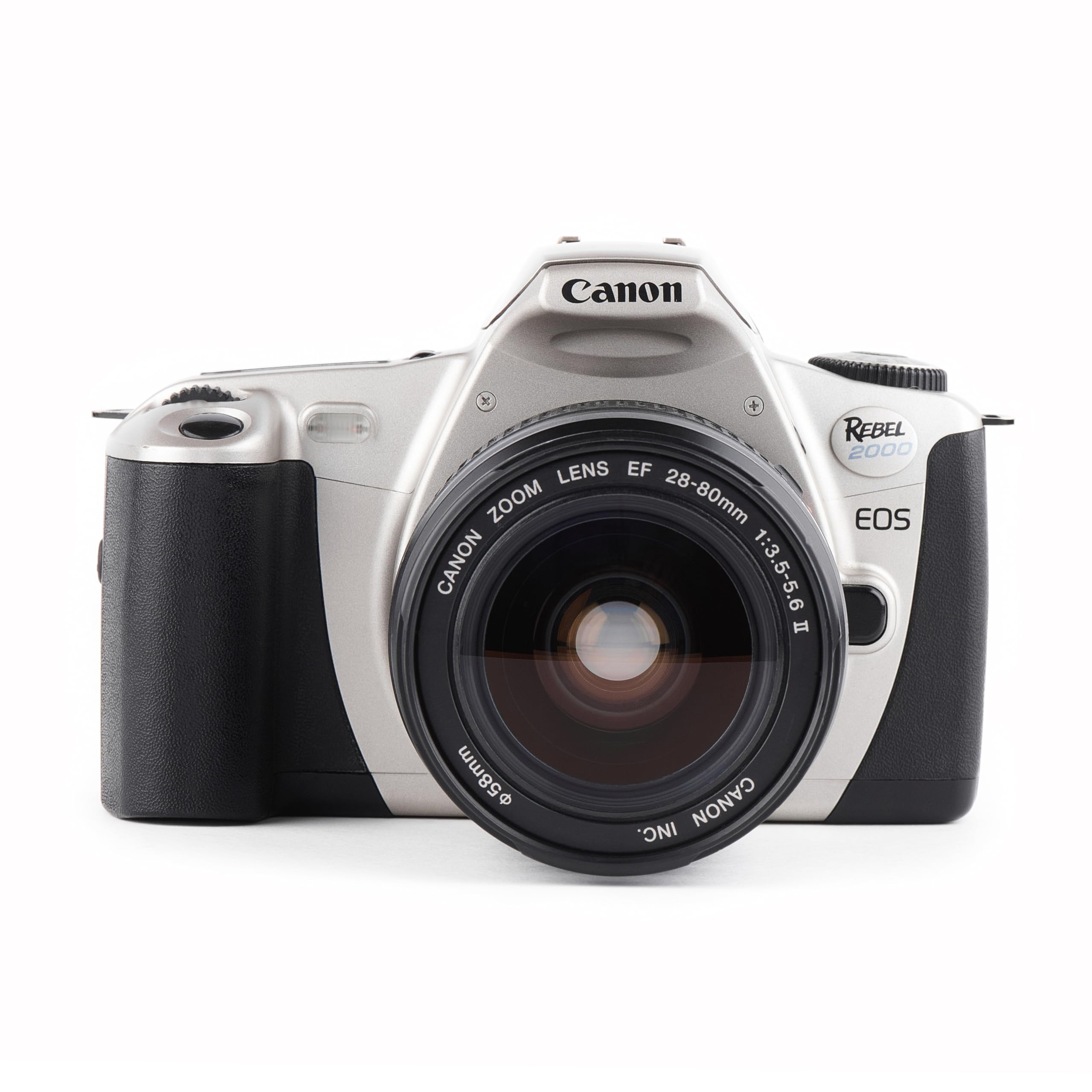
The Canon Rebel 2000 is an autofocus 35mm SLR that gives you the convenience of modern EF lens compatibility while shooting film. Its 7-point autofocus system locks onto subjects quickly in good light, and the built-in pop-up flash provides fill light for backlit scenes. You get Program AE, aperture-priority, shutter-priority, and full manual modes — the same exposure modes found on much pricier film bodies.
The included 28-80mm zoom covers wide to mid-telephoto focal lengths, which is ideal for travel and everyday snapshots without changing lenses. The camera loads, advances, and rewinds film automatically, removing the risk of ripped sprocket holes from manual winding. The body is lightweight plastic, which keeps the kit portable but does not have the metal feel of an AE-1 or K1000.
The main drawbacks are the cheap lens build (the 28-80mm kit zoom has visible chromatic aberration at the edges) and the lack of a depth-of-field preview. For a student starting a film photography class or someone who wants autofocus without spending hundreds on a Contax, the Rebel 2000 delivers reliable results with minimal fuss.
Why it’s great
- EF lens compatibility opens up modern glass (50mm f/1.8 STM works great)
- Autofocus is fast and accurate for moving subjects in daylight
- Auto film loading and rewinding eliminates handling errors
Good to know
- Kit zoom lens has noticeable chromatic aberration at wide apertures
- Plastic body feels less substantial than vintage metal SLRs
6. NONS SL660 Instant Camera

The NONS SL660 is a fully manual SLR that shoots instax Square format and accepts Canon EF-mount lenses natively. The body is machined from CNC aluminum alloy, giving it a dense, cold feel similar to a Leica M body. It has a bright TTL viewfinder, shutter speeds from bulb to 1/250th, and a hot shoe for external flash sync at 1/250th.
Because it uses EF mount, you can attach lenses from Canon, Sigma, Tamron, and adapt vintage glass from M42, Nikon F, and Pentax K with simple adapters. The included wooden hand grip provides a comfortable hold even with heavier lenses. Multiple-exposure mode lets you layer two exposures on one instax frame for creative double images.
The built-in light meter is the weakest link — multiple user reports describe it as underexposing by 1-2 stops for Instax film, which has an ISO of around 800. Most owners recommend using a handheld spot meter and setting the camera manually. The viewfinder also shows a half-frame crop that requires the optical extender, which costs two stops of light and introduces edge distortion with wide lenses. If you are willing to meter externally, the image quality when you nail exposure is excellent — sharp and saturated on Square film.
Why it’s great
- EF mount allows using any Canon AF lens or adapted vintage glass
- CNC aluminum body is built to survive years of hard use
- Full manual control over aperture, shutter, and focus for precise instant shots
Good to know
- Onboard meter is unreliable — plan to carry a handheld spot meter
- Optical viewfinder extender reduces light and crops the frame you see
7. FUJIFILM X Half Mirrorless Camera

The FUJIFILM X Half replicates the half-frame shooting experience using a digital sensor and Instax Mini film output. In Film Camera mode, the rear screen is disabled — you compose through the viewfinder, the shutter fires, and a thumb lever advances the frame counter just like a mechanical camera. This forced no-chimping approach trains you to be deliberate with every shot.
It packs an 18MP 1-inch sensor, 26 analog-inspired film simulations (Classic Chrome, Acros, Velvia), and a 2-in-1 mode that captures a still and a short video with each press. Images can be printed directly to a compatible instax printer or exported to your phone via the app. The dials for ISO, shutter speed, and exposure compensation provide direct tactile control without diving into menus.
The thumb lever that advances the “film” is silent and lacks the mechanical tension of a real film winder, which some users find less satisfying at this price point. Video is limited to 1080p without stabilization, so it is not a hybrid vlogging tool. For someone who wants film-like discipline without buying, shooting, and scanning actual 35mm stock, the X Half delivers the closest digital approximation available.
Why it’s great
- No preview mode forces intentional composition like a real film camera
- 26 film simulations give versatile looks without post-processing
- Direct instax printing from the body is convenient for physical prints
Good to know
- Film advance lever has no tactile resistance — feels disconnected from the action
- JPEG-only output with no RAW option limits editing flexibility
8. KODAK Snapic A1 35mm Film Camera
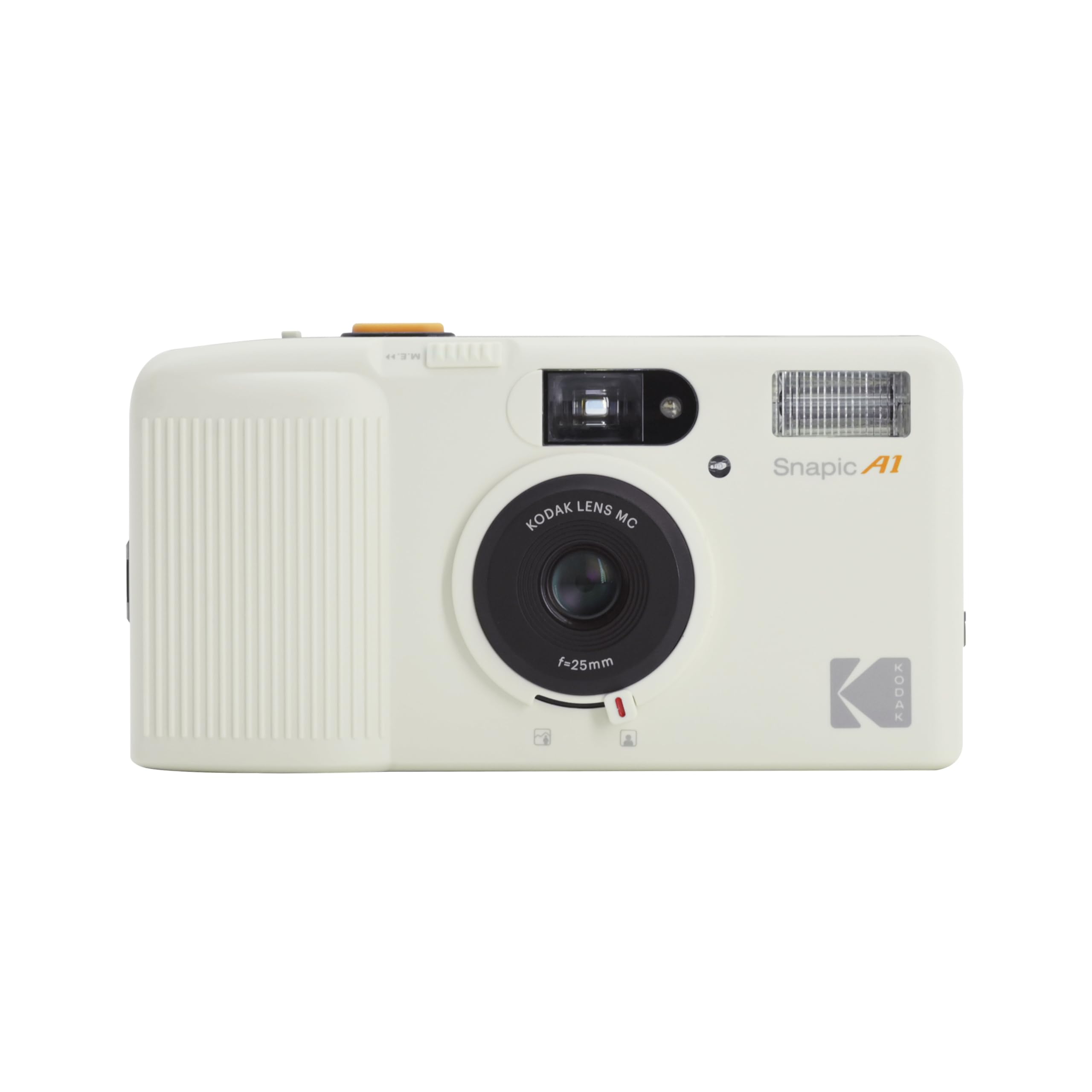
The KODAK Snapic A1 is a compact point-and-shoot that uses a 3-element glass lens — a meaningful upgrade from the plastic lenses in disposable cameras. It offers two-zone focus (near and far), a built-in auto flash with red-eye reduction, and a multiple-exposure mode that lets you blend two scenes on a single frame. The camera weighs only 117g and measures 4.65 x 2.44 x 1.38 inches, making it genuinely pocketable.
Operation is fully automatic: load the film, turn the camera on, and it handles winding, exposure, and flash detection. The LCD shot counter shows remaining exposures, and the on/off switch preserves battery life when not in use. Users consistently report good image quality with ISO 200 film (such as Kodak Gold 200) in daylight conditions, but the auto-exposure system struggles in low light, producing underexposed frames even with the flash engaged.
The main annoyance is the flash button placement — it sits on the front edge where your fingers naturally grip, leading to accidental flash activation. The camera also requires alkaline batteries; NiMH rechargeables will not power the flash circuit. For a first-time film user who wants a step up from a disposable without diving into an SLR system, the Snapic A1 delivers clean daytime results at a low entry cost.
Why it’s great
- Glass 3-element lens produces sharper images than plastic disposable lenses
- Double-exposure mode adds creative layering on a single frame
- Ultra-light and small enough for every-day pocket carry
Good to know
- Auto-exposure underexposes in low light — best results are daytime only
- Flash button is easy to press accidentally during normal handling
9. Voigtländer VM 15 mm/F 4.5 Lens

The Voigtländer VM 15mm f/4.5 is an ultra-wide-angle lens designed for Leica M-mount rangefinders, but it is equally usable on Sony E-mount and Nikon Z cameras via adapters. The 11-element, 9-group optical formula keeps distortion extremely low for a 15mm lens — barrel distortion is almost absent, which makes it a favorite for architecture and interior photography on film and digital bodies alike.
The metal barrel and smooth aperture ring provide the tactile precision that M-mount shooters expect. Vignetting is present at f/4.5 but clears up noticeably by f/8, and lateral chromatic aberration (green-magenta fringing at high-contrast edges) is the main optical weakness. The lens has no electronic contacts, so aperture and focus are entirely manual, and you must use stop-down metering on non-Leica bodies.
This is not a standalone camera — it is a lens for users who already own a compatible body and want an ultra-wide option that is both compact and optically refined. On a Leica M10 or a Sony a7II with adapter, it delivers sharp center resolution and the widest rectilinear field of view available in a rangefinder lens form factor at this weight and cost.
Why it’s great
- Extremely low barrel distortion for a 15mm lens — ideal for architectural work
- Compact metal build fits easily in a small camera bag or jacket pocket
- Works on Leica M, Sony E, and Nikon Z with the correct adapter
Good to know
- No electronic communication — fully manual aperture and focus only
- Lateral chromatic aberration is visible at high-contrast edges on digital sensors
FAQ
What is the difference between a 35mm point-and-shoot and an SLR for film?
Do I need a separate light meter for the Pentax K1000 or Canon AE-1?
Can I use modern Canon EF lenses on a vintage FD-mount body like the AE-1?
What film ISO should I use for a half-frame camera like the Pentax 17?
Why do some renewed film cameras have dead light meters?
Final Thoughts: The Verdict
For most users, the best 35mm film camera winner is the Pentax 17 because it halves your per-roll costs with 72 exposures, uses a sharp HD-coated lens, and is brand-new with full warranty support. If you want Canon AE-1 Program creative flexibility with both auto and manual modes, the AE-1 Program delivers Program AE plus the deep FD lens ecosystem. And for Pentax K1000 learning exposure fundamentals without any battery-dependent electronics, nothing beats the Pentax K1000’s all-mechanical shutter and match-needle meter.

Mo Maruf
I created WellFizz to bridge the gap between vague wellness advice and actionable solutions. My mission is simple: to decode the research and give you practical tools you can actually use.
Beyond the data, I am a passionate traveler. I believe that stepping away from the screen to explore new environments is essential for mental clarity and physical vitality.