Our readers keep the lights on and my smoothie glass nicely filled. As an Amazon Associate, I earn from qualifying purchases.
Loading your first roll of 35mm film is exciting, but choosing the wrong camera can turn that excitement into a graveyard of overexposed, blurry, or mechanically failed shots. A beginner-friendly 35mm body must balance forgiving exposure automation with durable construction and a lens system that actually teaches you the craft without punishing every mistake. This guide cuts through the nostalgia and examines nine specific models across budget-friendly, mid-range, and premium tiers to find the ones that deliver consistently good negatives from roll one.
I’m Mohammad Maruf — the founder and writer behind WellFizz. I’ve spent years analyzing the mechanical specifications, lens quality, and real-world reliability of film cameras to separate the hype from the hardware that actually works for new shooters.
Whether you want a pocketable point-and-shoot or a fully manual SLR, this deep-dive into the best 35mm camera for beginners will help you match your budget and learning goals to the right body.
How To Choose The Best 35mm Camera For Beginners
Choosing a first film camera involves more than just picking a model that looks cool. You need to consider the camera’s metering system, lens availability, build quality, and whether the controls match your learning style. Below are the three biggest factors that will determine whether your first experience with film is frustrating or inspiring.
Exposure Mode and Automation Level
The biggest mistake beginners make is buying a fully manual camera (like the Pentax K1000) thinking it will teach them faster. In reality, a camera with aperture-priority or program AE mode (like the Canon Rebel 2000) lets you focus on composition and focus while the camera handles exposure, building confidence first. You can switch to full manual once you understand how shutter speed and aperture interact.
Lens Mount and Upgrade Path
Interchangeable lens bodies (Canon EF, Pentax K) let you start with a standard 50mm or kit zoom and later add wide-angle or telephoto lenses as your skills grow. Fixed-lens or point-and-shoot cameras limit your creative options. For beginners who want to learn seriously, an SLR with a widely available lens mount is the smarter investment because you can often find used lenses for under .
Mechanical Condition of Renewed or Vintage Bodies
Renewed cameras are the most common option for beginners, but they come with risks. The most common failure points are sticky shutter blades, dead light meters (especially in mechanical bodies like the Pentax K1000), and degraded foam light seals. Look for sellers who explicitly state that the light meter has been calibrated and that the mirror and shutter have been tested. A seller who does not list these details is often selling an untested unit.
Quick Comparison
On smaller screens, swipe sideways to see the full table.
| Model | Category | Best For | Key Spec | Amazon |
|---|---|---|---|---|
| Pentax 17 | Half-Frame | Casual shooters wanting 72 shots per roll | 25mm f/3.5 fixed lens | Amazon |
| Canon AE-1 | SLR | Classic vintage feel with shutter-priority | 50mm f/1.8 FD lens | Amazon |
| Canon Rebel 2000 | SLR | Modern autofocus with manual override | 7-point AF system | Amazon |
| Canon EOS Kiss / Rebel G | SLR | Budget AF SLR with wide-area AF | ISO range 100-3200 | Amazon |
| Pentax K1000 | Manual SLR | Learning full manual exposure control | 50mm f/2 prime lens | Amazon |
| KODAK EKTAR H35N | Half-Frame | Ultra-portable pocket camera | Coated glass lens | Amazon |
| Fujifilm QuickSnap Flash 400 | Disposable | Zero-commitment film experience | 27 exposures each | Amazon |
| Kodak PIXPRO FZ45 | Digital P&S | Digital alternative to film | 4x optical zoom | Amazon |
| 8K Digital Camera | Digital P&S | WiFi sharing and vlogging | 88MP sensor (interpolated) | Amazon |
In‑Depth Reviews
1. Pentax 17

The Pentax 17 is the only brand-new, modern-manufactured 35mm camera on this list, and it delivers exactly what a beginner needs: total reliability, zero worry about degraded foam seals or dead meters, and a half-frame format that gives you 72 exposures from a single 36-exposure roll. Its 25mm f/3.5 lens (37mm equivalent in the full-frame format) is coated with Pentax’s HD coating, producing sharp, contrasty images with minimal flare. The zone-focus system divides distances into six symbols (portrait, group, landscape, etc.), removing the guesswork of manual focusing while still giving you control over sharpness zones.
The magnesium-alloy top and bottom covers give it a dense, premium feel that belies its compact size. The manual film advance lever recreates the tactile ritual many beginners crave, while the automatic exposure system handles metering so you never waste a frame on a bad exposure. The ISO range spans 50 to 3200, covering virtually every common film stock. The quiet, well-damped shutter makes it ideal for candid street photography and social gatherings without drawing attention.
Its main drawback is the fixed, non-interchangeable lens — you are stuck with the 25mm focal length. If you later want wide-angle or telephoto perspectives, you will need to buy a second body or move to an SLR. Some users note that the zone-focus system takes a few rolls to learn range estimation intuitively. These are minor trade-offs for a camera that will work perfectly out of the box for years.
Why it’s great
- Brand-new manufacture — no risk of dead meters or sticky shutters from age.
- Half-frame format cuts per-roll cost in half, encouraging more practice.
- Compact magnesium-alloy body with excellent build quality.
Good to know
- Fixed 25mm lens limits creative focal-length range.
- Zone-focus system requires practice to estimate distances accurately.
- Premium price at the top of the beginner budget range.
2. Vintage Canon AE-1 with 50mm f/1.8 Lens (Renewed)

The Canon AE-1 is one of the most beloved 35mm SLRs ever made, and for a good reason: its shutter-priority auto-exposure mode is intuitive for beginners while retaining full manual control when you’re ready. The 50mm f/1.8 FD lens that typically ships with renewed units is sharp, contrasty, and fast enough for low-light shooting without flash. The through-the-lens (TTL) metering system is reliable when calibrated, and the shutter speed range from 1/1000 to 2 seconds — plus bulb mode — gives you genuine creative room.
The metallic body has a satisfying heft that communicates quality, and the lens mount is compatible with the entire Canon FD family, giving you access to dozens of affordable legacy lenses. The AE-1’s design is iconic, and carrying one often sparks conversations and connections in photography communities. Many renewed units arrive in excellent cosmetic condition, and the all-mechanical shutter (except for the electronic metering) means fewer points of failure than later cameras.
Buying renewed carries real risk. The light meter in the AE-1 uses a now-uncommon battery (the 4LR44 or equivalent), and some renewed units arrive with sticky shutter blades or inaccurate meters. The foam light seals around the back film door and mirror bumper also degrade with age and may need replacement. Always confirm with the seller that the meter has been calibrated and the seals have been replaced before purchasing.
Why it’s great
- Shutter-priority auto mode is beginner-friendly but supports full manual control.
- Excellent 50mm f/1.8 lens provides fast aperture for low light.
- Iconic design and huge ecosystem of affordable FD lenses.
Good to know
- Renewed units vary widely in meter and seal condition.
- Requires a non-standard 4LR44 battery for the light meter.
- No autofocus exists — focusing is entirely manual.
3. Canon Rebel 2000 with 28-80mm Lens (Renewed)
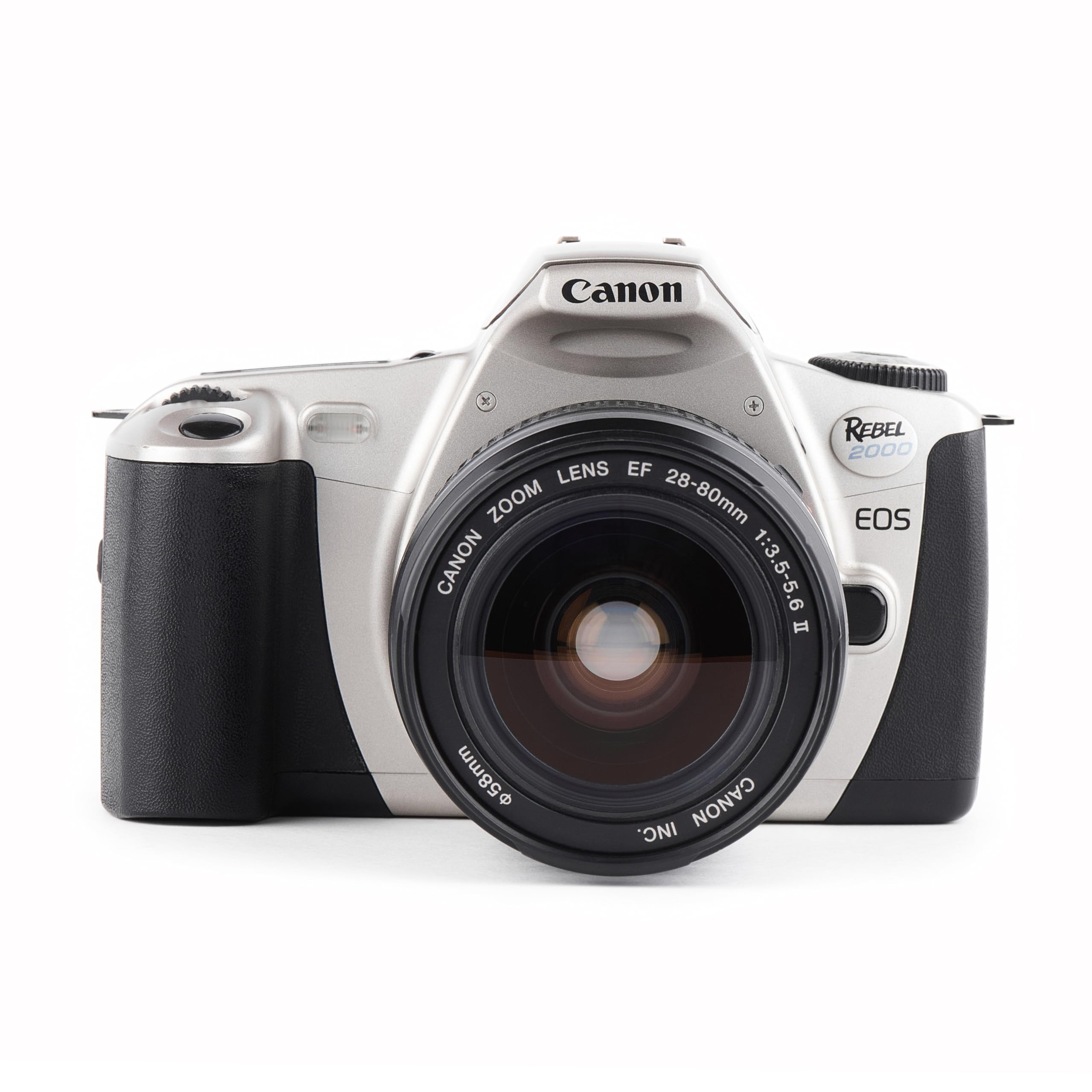
The Canon Rebel 2000 (EOS 300 in Europe) is the most modern film SLR on this list, featuring a 7-point autofocus system that feels quick and responsive even by digital standards. Its 28-80mm kit zoom lens covers the most useful focal range for general photography, from group shots to portraits, and the EF lens mount gives you access to the entire Canon autofocus lens library — including modern lenses with IS and USM. The autofocus in this body locks reliably and accurately, making it ideal for beginners who want to focus on composition rather than focus ring twiddling.
The camera features four exposure modes: Program AE, Aperture Priority, Shutter Priority, and full Manual. This range makes it a fantastic learning platform because you can start in Program AE and gradually experiment with aperture or shutter priority as you learn. The built-in pop-up flash is adequate for fill light, and the automatic film loading and rewinding simplifies handling. The dye-sub backlit LCD shows all key settings clearly.
This is a 25-year-old plastic-bodied camera, and the build quality does not match the metal AE-1. The lens mount is plastic, and the body can feel a bit hollow compared to older all-metal SLRs. Renewed units sometimes come with scratched lens elements or sticky rubber grips. The 28-80mm lens is optically average — fine for learning, but you will want to upgrade to a 50mm f/1.8 STM later for sharper results.
Why it’s great
- Fast, reliable 7-point autofocus system typical of modern DSLRs.
- Full range of exposure modes for skill progression.
- Uses standard Canon EF lenses — massive, affordable selection.
Good to know
- Plastic body and mount do not feel as durable as metal vintage bodies.
- Kit zoom lens is optically average; expect better results with a prime lens.
- Renewed units may have scratched lenses or worn grips.
4. Canon New EOS Kiss / Rebel G with 35-80mm Lens (Renewed)

The Canon EOS Kiss (marketed as the Rebel G in North America) is essentially a slightly earlier, more affordable sibling to the Rebel 2000, sharing the same EF lens mount and autofocus capability. Its wide-area autofocus point is simple but reliable for most everyday scenes, and the camera offers Program, Aperture Priority, Shutter Priority, and full Manual modes — the same four-mode flexibility found on the Rebel 2000. The 35-80mm kit zoom lens covers a practical range for travel, portraits, and street photography.
The body uses two CR123A batteries, which are still manufactured and provide excellent battery life. The built-in flash is decent for close-range fill flash, and the LCD display makes it easy to change settings on the fly. Many users report receiving units that look nearly new, with clear viewfinders and scratch-free lenses.
The 35-80mm kit lens is soft at the wide end and suffers from chromatic aberration in high-contrast scenes. The body is entirely constructed from lightweight polycarbonate, which feels less robust than a metal-bodied camera. The autofocus motor is audible and not as fast as more modern EF lenses. As with any renewed camera, verify that the light meter and shutter are functioning before using film.
Why it’s great
- Most affordable autofocus 35mm SLR with an EF lens mount.
- Four exposure modes provide a clear learning progression.
- Widely available renewed units with good cosmetic condition.
Good to know
- Kit zoom lens is optically mediocre; softness at wide angles is noticeable.
- All-polycarbonate body feels lightweight and less premium.
- Uses CR123A batteries, which are less common than AA or lithium cells.
5. Pentax K1000 with 50mm f/2 Lens (Renewed)

The Pentax K1000 is the most famous beginner manual camera of all time, and for decades it was the standard-issue body in photography schools. It is fully mechanical — no batteries required for shutter operation — and its matched-needle light meter is simple, reliable, and educational. The 50mm f/2 prime lens that ships with most renewed kits is sharp, contrasty, and provides a natural field of view that forces you to think about composition and perspective rather than relying on zoom.
The K1000’s construction is incredibly robust: a solid metal chassis wrapped in textured leatherette that can survive decades of use. The Pentax K mount is one of the most widely adapted lens systems in history, so you have access to thousands of affordable lenses from Pentax, Vivitar, Tamron, and others. The camera can operate entirely without batteries — only the light meter needs a single LR44 cell. This makes it a fantastic tool for understanding the exposure triangle because every shot requires you to set aperture, shutter speed, and focus.
Renewed K1000 units are notorious for arriving with dead or inaccurate light meters. The needle mechanism is delicate, and many sellers do not calibrate it before reselling. The K1000 also lacks any automatic modes — you will lose shots while learning if you forget to adjust settings between lighting environments. The shutter speed range maxes out at 1/1000 and goes down to 1 second, with no bulb mode. Buy only from sellers who explicitly state the meter has been tested and calibrated.
Why it’s great
- Fully mechanical operation teaches exposure fundamentals without relying on automation.
- Extremely durable metal construction that lasts for decades.
- World’s largest lens mount ecosystem with affordable options.
Good to know
- Renewed units often arrive with dead or drifting light meters.
- No autofocus, no program mode — steep learning curve for absolute beginners.
- Shutter only goes to 1/1000; no bulb mode for long exposures.
6. KODAK EKTAR H35N Half Frame Film Camera (Premium Kit)

The KODAK EKTAR H35N is a compact, focus-free half-frame camera that emphasizes portability and ease of use. Its coated glass lens delivers noticeably better image sharpness than the plastic lenses found on most budget point-and-shoots, and the half-frame format doubles your shot count — 72 photos from a standard 36-exposure roll. The built-in star filter creates four-beam flares from light sources, which adds a creative tool that is unique in this price tier.
The camera supports bulb (long exposure) mode via a tripod mount, allowing you to capture light trails and night scenes that would be impossible on simpler disposable cameras. The automatic exposure system handles metering, and the focus-free lens means everything from about 1 meter to infinity is generally sharp. The kit includes accessories like a camera bag and cleaning cloth. At under 110 grams, it is the lightest option here and fits easily into a jacket pocket or small purse.
The half-frame format produces vertical 18x24mm negatives, which is roughly half the resolution of a full 35mm frame. Enlargements beyond 5×7 inches may show visible grain. The camera requires a AAA battery for the flash, and the slide-to-open lens cover is easy to accidentally open in a bag. The lack of any manual control means you are stuck with whatever exposure the meter chooses, which can be limiting in high-contrast lighting.
Why it’s great
- Extremely lightweight and pocketable at 110 grams.
- Coated glass lens produces sharper images than plastic-lens alternatives.
- Unique built-in star filter for creative light flares.
Good to know
- Half-frame negatives limit enlargement potential compared to full-frame.
- No manual exposure or focus control — automatic only.
- Slide-to-open lens cover is prone to accidental opening in bags.
7. Fujifilm QuickSnap Flash 400 Disposable 35mm Camera (4-Pack)

The Fujifilm QuickSnap Flash 400 offers the lowest-commitment path to film photography: no loading, no winding, no settings — just point, press the shutter, and advance. Each disposable camera is pre-loaded with a roll of Fujifilm Superia X-TRA 400 film for 27 exposures, with a built-in flash that illuminates subjects up to 10 feet away. The 4-pack gives you 108 total shots, which is enough to learn the basics of framing and flash photography without investing in a reusable body.
Users consistently report vibrant, well-exposed photos with accurate colors and pleasing contrast, especially when using the flash indoors or in daylight. The ISO 400 film speed is versatile enough for outdoor and indoor snapshots without being overly grainy. The cameras are small enough to fit in a coat pocket, making them ideal for weddings, parties, and group trips where handing out a few cameras creates shared memories. The included microfiber cloths are a nice touch for keeping the lenses smudge-free.
Disposable cameras are inherently wasteful — the entire unit is discarded after 27 exposures. The fixed plastic lens produces soft corners and noticeable aberrations compared to glass-lens cameras. The flash must always be used indoors; outdoor shots without flash will be underexposed. The 27-exposure limit means you cannot swap film mid-roll, forcing you to commit to the entire roll in one environment.
Why it’s great
- Zero learning curve — perfect for absolute beginners and group events.
- Four cameras in one pack provide 108 total exposures for less than the cost of a reusable body plus film.
- Fujifilm Superia X-TRA 400 delivers vibrant, well-exposed results reliably.
Good to know
- Single-use design is wasteful and more expensive per roll over time.
- Plastic lens produces soft corners and visible chromatic aberration.
- Flash must always be used indoors; outdoor non-flash shots often underexpose.
8. Kodak PIXPRO FZ45 Digital Camera (16MP)

The Kodak PIXPRO FZ45 is not a film camera, but it earns a place on this list because it serves the same need for many beginners: a simple, affordable way to learn photography basics. Its 16MP CMOS sensor captures detailed photos with natural colors in good light, and the 4x optical zoom lens with a 27mm wide-angle equivalent gives you framing flexibility that fixed-lens film cameras cannot match. The 2.7-inch LCD screen provides instant feedback — you see your results immediately, which is the single greatest advantage over film for learning.
The FZ45 records 1080p Full HD video and supports SD cards up to 512GB, making it a functional travel companion for both photo and video. The camera runs on two AA batteries, which are universally available. The buttons and menus are simple enough that a complete beginner can start shooting within minutes of opening the box. The built-in flash is adequate for close-range fill lighting.
The sensor performs poorly in low light — image noise becomes noticeable above ISO 800, and the camera lacks any image stabilization. The AA batteries that come in the box are low-capacity alkalines that will need immediate replacement with lithium or rechargeable cells. The video quality is basic, and the lens is not sharp enough for large prints. This is a toy for casual snapshots, not a camera that will grow with a serious photography student.
Why it’s great
- Instant feedback via LCD screen accelerates the learning process.
- 4x optical zoom and 27mm wide-angle provide framing flexibility.
- Operates on standard AA batteries — no proprietary cells needed.
Good to know
- Poor low-light performance with noticeable noise above ISO 800.
- Included AA batteries are low-capacity and need immediate replacement.
- No image stabilization; video quality is basic.
9. 8K Digital Camera (88MP, WiFi, 3.2″ Touchscreen)
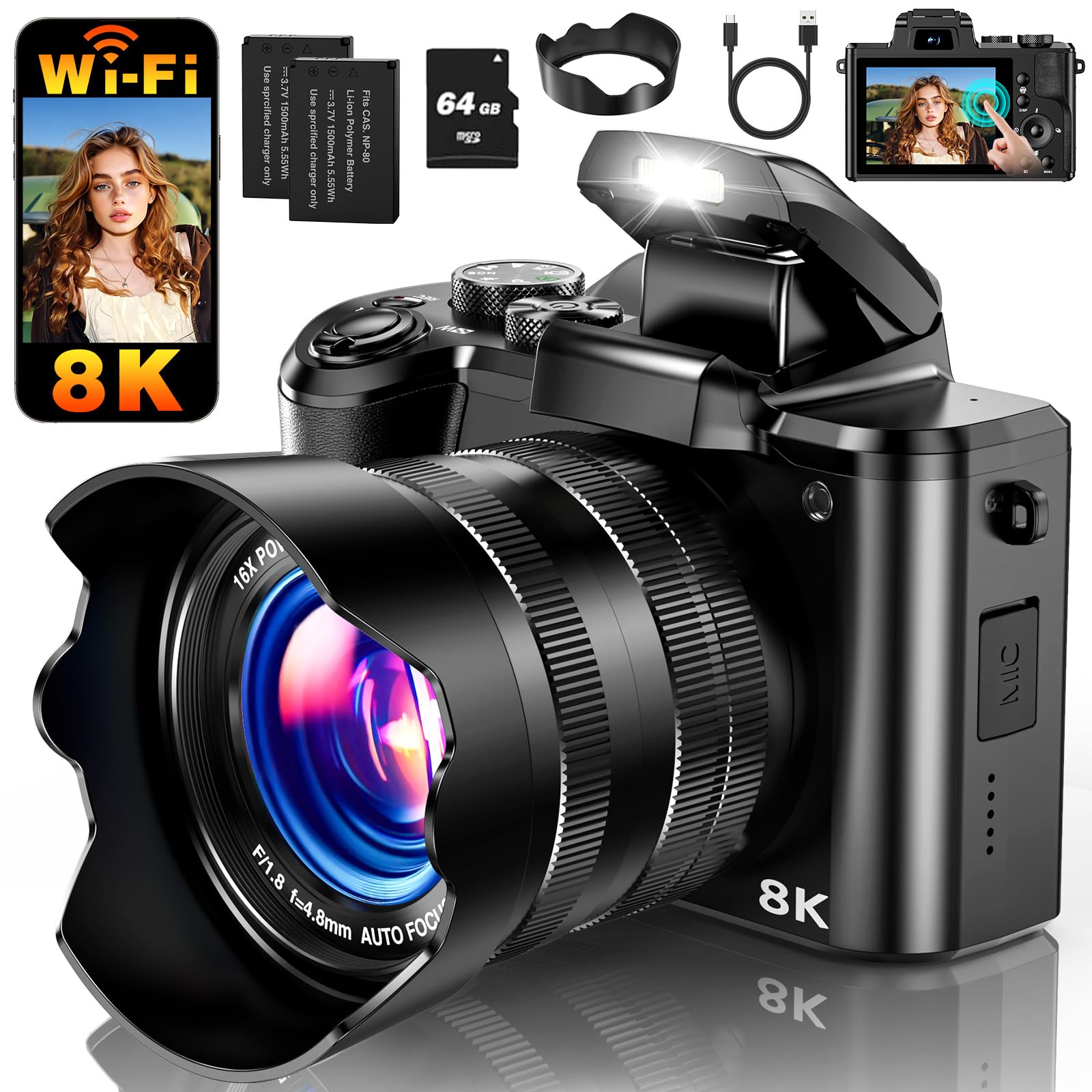
This digital camera from toberto is marketed as an 8K/88MP device, though it is important to understand that the 88MP resolution is interpolated (software-upscaled) rather than native — the actual sensor is much lower resolution. That caveat aside, the camera packs a surprising number of features for its category: a 3.2-inch touchscreen, both front and rear lenses for selfies and vlogging, a 16x digital zoom, built-in WiFi for direct sharing, and a hot shoe mount for external audio or lighting accessories.
The package includes two rechargeable lithium-ion batteries, a 64GB microSD card, a charger, a lens hood, a carrying bag, and a cleaning cloth — everything you need to start shooting immediately without extra purchases. The WiFi function works well for transferring images to a smartphone, and the HDMI output lets you review footage on a larger screen. Many users report that the camera takes sharp, vibrant photos in good lighting and that the menus are intuitive enough for children and seniors to navigate.
The digital zoom degrades image quality quickly past 4x, and the claimed 8K video is upscaled from a lower native resolution. The autofocus is slow and can hunt in low-light conditions. The build quality is lightweight plastic, and the camera relies on a proprietary battery that cannot be replaced by standard AA or AAA cells. This is a novelty camera for casual social media use, not a serious tool for learning photography fundamentals.
Why it’s great
- Loaded package includes batteries, charger, case, and 64GB card.
- WiFi sharing makes social media posting seamless.
- Dual lenses and touchscreen are beginner-friendly for selfies and vlogs.
Good to know
- 88MP and 8K specifications are interpolated, not native sensor resolution.
- Digital zoom degrades image quality significantly beyond 4x.
- Proprietary battery cannot be swapped with standard cells; autofocus hunts in low light.
FAQ
Should a beginner start with a fully manual camera like the Pentax K1000?
What does half-frame mean and is it good for beginners?
How do I verify the condition of a renewed or vintage film camera before buying?
Final Thoughts: The Verdict
For most users, the best 35mm camera for beginners winner is the Pentax 17 because it combines brand-new manufacturing reliability with a half-frame format that doubles your practice shots while the zone-focus and automatic exposure features keep the learning curve manageable. If you want the flexibility of interchangeable lenses and autofocus on a tighter budget, grab the Canon Rebel 2000. And for the purest, most educational fully manual experience with access to the world’s largest lens ecosystem, nothing beats the Pentax K1000 — just confirm the meter works before buying.

Mo Maruf
I created WellFizz to bridge the gap between vague wellness advice and actionable solutions. My mission is simple: to decode the research and give you practical tools you can actually use.
Beyond the data, I am a passionate traveler. I believe that stepping away from the screen to explore new environments is essential for mental clarity and physical vitality.