Our readers keep the lights on and my smoothie glass nicely filled. As an Amazon Associate, I earn from qualifying purchases.
The sweet spot in portable power sits right at 3,500 watts — enough to run an RV air conditioner, a refrigerator, and a handful of lights without hauling a 200-lb behemoth. The trouble is that most buyers either overpay for brand names or grab the cheapest open-frame unit that screams through the campsite. An inverter generator in this class delivers clean sine wave power, variable engine speed for fuel efficiency, and a noise profile that won’t get you evicted from the quiet zone.
I’m Mohammad Maruf — the founder and writer behind WellFizz. I’ve spent years parsing engine displacement charts, decibel ratings, and total harmonic distortion specs to separate genuine value from marketing noise in the portable generator market.
After analyzing engine specs, runtime claims, and real-world user reports across more than a dozen models, this guide cuts through the hype to deliver the most precise breakdown of the best 3500 watt inverter generator for RV owners, home backup users, and outdoor enthusiasts.
How To Choose The Best 3500 Watt Inverter Generator
A 3,500-watt inverter generator isn’t a one-size-fits-all purchase. Your choice hinges on fuel type, portability, noise tolerance, and the specific loads you plan to run. Here’s what to prioritize.
Rated Watts vs. Peak Watts — Ignore the Surge
Every generator advertises a peak (surge) wattage that lasts for a split second during motor startup. The number that actually determines what you can run continuously is the rated (running) wattage. A unit labeled “3,500 watts” might only deliver 2,900 watts continuously. Match your total running load — RV AC (1,500W), fridge (700W), lights (200W) — against the rated wattage, not the peak.
Engine Displacement and Runtime
Larger engine displacement (measured in cubic centimeters, cc) generally correlates with more torque and longer engine life. A 149cc engine is the sweet spot in this class, typically offering 4-8 hours of runtime at half load on a 1.3-gallon tank. Pay attention to fuel capacity and economy mode — an engine that can throttle down to match light loads will double your runtime compared to a fixed-speed unit.
Noise Level — dBA at 23 Feet
Inverter generators are inherently quieter than open-frame models, but the range within this class varies from 59 dBA (conversation-level) to 64 dBA (noticeable from 50 feet). If you’re camping in quiet hours or RV parks with noise restrictions, target models at 60 dBA or below. Every 3 dBA represents a doubling of sound energy, so the difference between 59 and 62 dBA is meaningful.
Dual Fuel vs. Gasoline Only
Dual fuel models let you switch between gasoline and propane. Propane burns cleaner, extends engine life, and stores indefinitely — but reduces peak wattage by roughly 10-15%. Gasoline offers higher power output and lower upfront cost but has a shelf life measured in months. If you prioritize emergency preparedness and long-term fuel storage, dual fuel is the smarter play.
Quick Comparison
On smaller screens, swipe sideways to see the full table.
| Model | Category | Best For | Key Spec | Amazon |
|---|---|---|---|---|
| Champion 4000-Watt Inverter | Premium | Lightweight champ at 48 lbs with CO Shield | 48.1 lbs / 64 dBA / 10h runtime | Amazon |
| Cummins Onan P4500I | Premium | Long-term reliability for RV owners | 224cc OHV / Remote Start / 30.8A | Amazon |
| Pulsar 7,250W Dual Fuel | Premium | Highest power output in class with 240V | 312cc / 118 lbs / Remote + Elec Start | Amazon |
| MaXpeedingrods 3500W Dual Fuel | Mid-Range | Three-start options and 11h runtime on gas | 145cc / Digital Display / Remote Start | Amazon |
| WEN DF360iX Dual Fuel | Mid-Range | Dual fuel with CO Watchdog safety | 3600W surge / 49 lbs / 3-year warranty | Amazon |
| GENMAX GM3500iAD Dual Fuel | Mid-Range | Dual fuel with CO detect and wheels | 145cc / 62 dBA / Telescopic Handle | Amazon |
| Generac GP3300i | Mid-Range | TruePower clean sine + PowerRush starting | 439cc / 59.5 lbs / Economy Mode | Amazon |
| WEN 56360i | Mid-Range | Lightest in class at 46 lbs with fuel shutoff | 149cc / 46 lbs / 3-year warranty | Amazon |
| PowerSmart 3600W | Budget | 8h runtime at 25% load for overnight use | 149cc / 50.7 lbs / 30A RV outlet | Amazon |
| PowerSmart 3800W | Budget | 59 dBA whisper-quiet for noise-sensitive areas | 143cc / 52 lbs / USB port | Amazon |
| Aceup Energy 4000W | Budget | Best bang for the buck under 50 lbs | 149cc / 50 lbs / Parallel Ready | Amazon |
In‑Depth Reviews
1. Champion Power Equipment 4000-Watt RV Ready Portable Inverter Generator

At 48.1 pounds, this Champion is one of the lightest 4,000-watt inverters on the market — and it delivers 3,000 rated watts with a 64 dBA noise rating that’s perfectly acceptable for campsites and tailgates. The 149cc engine sips fuel for up to 10 hours at half load, and the CO Shield carbon monoxide auto shutoff system adds a serious layer of safety for using the generator near a camper or tent. The < 3% THD ensures clean sine wave output for laptops and phone chargers even under load.
Real-world testing shows it handles a 15,000 BTU RV air conditioner plus lights and a refrigerator without bogging down, though running the AC simultaneously with a microwave is too much. The optional parallel kit lets you pair it with another Champion 4,000-watt inverter to double output. The TT-30R outlet is a direct fit for most RV shore power connections without an adapter.
Champion backs this unit with a 3-year limited warranty and free lifetime technical support. Several users reported that the engine started on the first pull after initial setup, and the low-oil shutdown protects the engine from user error. The only common critique is that the physical case could be slightly more robust against dents during transport.
Why it’s great
- Industry-leading weight-to-power ratio at 48.1 lbs
- CO Shield auto shutoff for safer campside use
- 10-hour runtime at half load stretches fuel efficiently
Good to know
- 3,000 rated watts may struggle with AC + microwave combo
- Parallel kit sold separately adds to cost
2. Cummins Onan P4500I Portable Inverter Generator
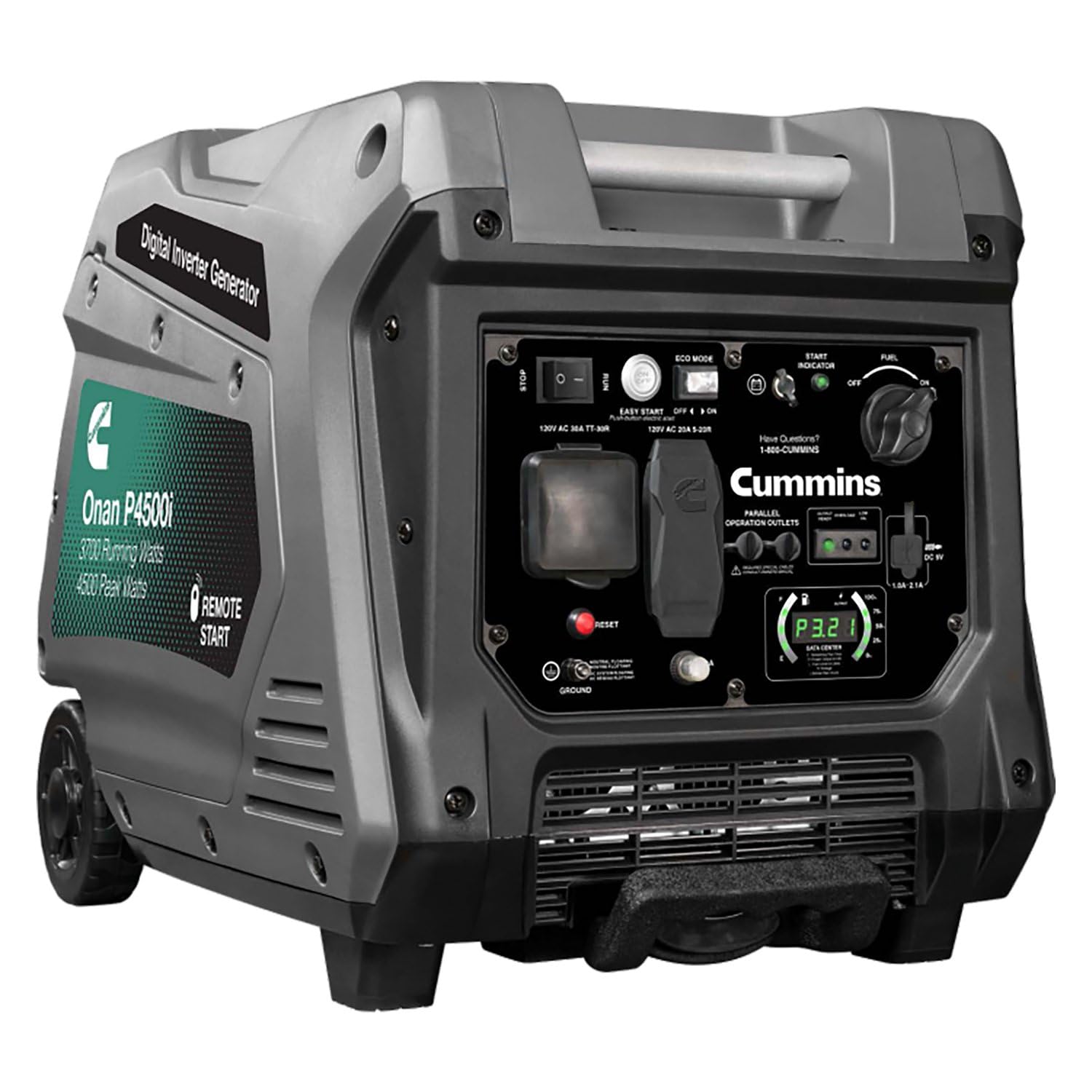
The Cummins Onan P4500I is a 224cc bruiser that delivers 4,500 peak watts and 3,700 rated watts — well above the 3,500-watt threshold — with a noise profile that veteran campers describe as barely noticeable from 20 feet. The remote start feature is a genuine convenience upgrade for RV owners who want to fire up the generator from inside the camper on cold mornings without bundling up. The unit produces true sine wave power with THD low enough for sensitive electronics.
Weighing in at 98 pounds, this is not a throw-it-in-the-car model — it’s a lug-with-wheels generator. Parallel capability with another P4500I delivers up to 50 amps of combined power, making it a viable backup for small homes. The dual 5V USB ports are handy for device charging, and the 30A TT-30R outlet connects directly to RV power inlets. Users report that the engine starts on the first pull or push-button even in sub-zero temperatures.
The 4-stroke OHV engine is a Cummins design, which means parts availability and service support are stronger than many competitors in this class. The oil change interval is every 100 hours, and the included funnel and oil make first-time setup straightforward. A few owners note that the side panel alignment makes draining oil slightly tedious, but overall build quality is a tier above budget brands.
Why it’s great
- 224cc engine delivers class-leading torque and longevity
- Remote start allows operation from inside the RV
- True sine wave output with THD under 3%
Good to know
- 98 pounds is heavy for a single person to lift into a truck bed
- Premium price places it above most 3,500-watt competitors
3. Pulsar 7,250-Watt Super Quiet Dual Fuel Inverter Generator

This Pulsar is a dual-fuel powerhouse that sits in a class above most 3,500-watt units — it delivers 7,250 peak watts on gasoline and 6,500 on propane, with a 312cc engine that offers genuine whole-home backup potential. The 120V/240V output through the L14-30R receptacle allows it to power well pumps, large AC units, and even some welding equipment. The inverter technology keeps THD low enough for sensitive electronics despite the massive output.
The unit includes remote, electric, and recoil start options, plus a digital control center that displays hours, voltage, load, and frequency. Safety features include overload protection, low oil shutdown, and a carbon monoxide detector — all essential for home use. It weighs 118 pounds, so the fold-down handle and flat-free wheels are not optional; they are essential for moving it from the garage to the backyard.
User reports confirm that the generator runs a 15,000 BTU camper AC, microwave, and lights simultaneously with no issues. The fuel efficiency on propane is notably better than gasoline, and the 120V/240V capability makes it one of the most versatile units in this price bracket. A common complaint involves the push-button start solenoid failing in some units, but the issue is fixed with a low-cost replacement part.
Why it’s great
- 312cc engine provides 7,250 peak watts for whole-home power
- 120V/240V output through L14-30R for heavy appliances
- Dual fuel design with remote/electric/recoil start options
Good to know
- 118 pounds requires wheels or a dolly for transport
- Some units have reported starter solenoid issues early on
4. MaXpeedingrods 3500 Watt Dual Fuel Inverter Generator

The MaXpeedingrods MXR3500-DC offers three start methods — remote, electric, and recoil — a rarity at its price point. The 145cc engine produces 3,500 surge watts on gasoline and 3,100 on propane, with a rated output of 3,200 watts (gas) and 2,800 watts (propane). The digital display shows fuel level, voltage, frequency, runtime, and load percentage, which helps you manage power consumption precisely. The eco mode stretches runtime to approximately 11 hours on gas and an impressive 24 hours on propane at 25% load.
The unit comes with a battery, generator cover, parallel cables, and a pressure relief valve kit — a comprehensive accessory package that most competitors charge extra for. The included wheel kit and extendable handle make it manageable on uneven campsite terrain. Users at 3,000 feet altitude report that it runs smoothly on propane with no need for a high-altitude kit, and the push-button start fires reliably on the first press.
Several owners note that the noise level is around 63-65 dBA at 20 feet, not the lower figures sometimes advertised — still quiet enough for conversation but not library-level. The spark plug tool that ships with the unit is undersized and may strip, so you’ll want to have a 5/8-inch socket ready for maintenance. Overall, it packs premium features (remote start, dual fuel, digital display) into a mid-range budget.
Why it’s great
- Three start options including remote for convenience
- 24-hour runtime on propane at low loads
- Comes with wheel kit, cover, and parallel cables
Good to know
- Actual noise level is 63-65 dBA, not the lowest in class
- Included spark plug tool is prone to stripping
5. WEN DF360iX Dual Fuel Inverter Generator

The WEN DF360iX packs a 149cc engine that produces 3,600 surge watts and 2,900 rated watts on gasoline, or 3,500 surge and 2,600 rated on propane. At 49 pounds, it’s one of the lightest dual-fuel inverter generators available, and the fuel shutoff feature lets you run the carburetor dry before storage, preventing gummed-up jets. The WEN Watchdog CO Shutdown Sensor automatically turns off the generator if carbon monoxide accumulates — a critical safety feature for campsites or garage operation.
The control panel includes a digital display showing voltage, frequency, runtime, and load percentage, plus two 5V USB ports for device charging. The tool-free LPG quick-connector and included propane hose make switching between fuels effortless. Users report that the unit starts on the first or second pull on both gas and propane, and quiet enough that “you can have a conversation next to it without raising your voice.” The 3-year warranty provides solid peace of mind for a mid-range price.
A few owners mention that the 20A outlets hold plugs somewhat loosely, which can be annoying when using heavy-gauge extension cords. Also, some units arrived with a cracked propane regulator, but WEN customer service replaced it promptly under warranty. Considering the safety features, portability, and dual fuel versatility, this is a strong contender for the RV crowd.
Why it’s great
- CO Watchdog auto-shutdown adds a critical safety layer
- 49 pounds is exceptionally light for a dual fuel inverter
- Fuel shutoff prevents carburetor issues during storage
Good to know
- 20A outlets can feel loose with heavy plugs
- Propane regulator may need inspection on arrival
6. GENMAX GM3500iAD Dual Fuel Inverter Generator

The GENMAX GM3500iAD runs on both gasoline and propane, producing 3,500 peak watts (3,200 rated) on gas and 3,100 peak (2,800 rated) on propane. The 145cc engine operates at 62 dBA — quiet enough for most campgrounds but slightly louder than the 59 dBA leaders. The telescopic handle and two rolling wheels make it easy to maneuver despite the 56-pound weight, and the CO Detect feature adds automated carbon monoxide shutdown for safer operation.
Parallel capability lets you connect two GM3500iAD units for up to 7,000 peak watts and 6,400 rated watts, giving you a scalable power solution without buying a larger single unit. The control panel includes a fuel gauge, output display, and overload indicator. Users report that it starts on the first pull when cold and runs an RV air conditioner plus fridge without issue. Some owners praise the build quality for the price, noting that the frame feels sturdier than other units in the mid-range bracket.
A minority of users reported unit-specific issues — one reviewer had a generator that would only run on propane, not gasoline, and experienced difficulty getting warranty support. Others noted that the oil level sensor is sensitive, requiring careful filling to avoid a false low-oil shutdown. Overall, the GENMAX offers a solid dual-fuel package with wheel kit included, which saves you from buying a separate dolly or cart.
Why it’s great
- Dual fuel with CO Detect safety automation
- Telescopic handle and wheels included for easy transport
- Parallel capable for doubling output when needed
Good to know
- A few units have reported compatibility issues with gasoline
- Oil level sensor is sensitive and requires precise filling
7. Generac GP3300i Inverter Generator

Generac’s GP3300i produces 3,300 starting watts and 2,900 rated watts with TruePower Technology that delivers output with less than 3% total harmonic distortion — safe for laptops, CPAP machines, and any sensitive electronics. The PowerRush Advance Technology provides over 50% more starting capacity, which helps kick-start motor-driven loads like furnace blowers, well pumps, and AC compressors without the usual voltage sag. At 59.5 pounds, it’s heavier than some 3,500-watt competitors but still manageable for one person to load into a vehicle.
The economy mode automatically adjusts engine speed to match the load, reducing fuel consumption to about 1 gallon for 9 hours of runtime under light load (TV, WiFi, fridge). The unit is parallel-ready, allowing you to link two GP3300i generators for double the output. LED indicators for low oil, overload, and ready status make troubleshooting intuitive even for first-time generator owners. COsense Technology provides automatic shutdown when carbon monoxide reaches unsafe levels.
Users at higher altitudes report that the generator delivers about 1,950 watts continuously at 5,500 feet, which is still competitive for an inverter in this class. A few long-term owners had reliability issues after hundreds of hours, but the 5-year limited warranty from Generac provides a stronger safety net than most competitors. The cold start procedure requires half-choke on the first start, but the engine settles into a steady idle after a few seconds.
Why it’s great
- PowerRush provides 50% more starting capacity for motors
- TruePower output under 3% THD for sensitive electronics
- 5-year warranty backed by the largest US generator brand
Good to know
- 59.5 lbs is heavier than many comparable inverter models
- No pure sine wave certification — THD <3% but not zero
8. WEN 56360i Inverter Generator

The WEN 56360i weighs just 46 pounds, making it the lightest inverter generator in this roundup — it’s genuinely easy for one person to carry into a campsite or lift into a truck bed. The 149cc engine produces 3,600 surge watts and 2,900 rated watts, with clean power output safe for sensitive electronics. The fuel shutoff feature lets you run the carburetor dry before storage, preventing fuel degradation from gumming up the jets — a key maintenance advantage that extends engine life.
The three-year warranty is among the best in the class, and WEN’s customer service has a solid reputation for honoring it. The control panel includes two three-prong 120V receptacles, one TT-30R RV receptacle, one 12V DC outlet, and two 5V USB ports — covering all common needs for camping and home backup. Users report that the generator is quiet enough that they can sleep in the camper while it runs, with the sound described as a “gentle purr” rather than a roar.
Some users note that the 2,900 rated watts are slightly below the 3,000-watt threshold needed for some larger RV AC units with hard-start kits. A few owners experienced difficulty starting in very cold temperatures (below 14°F), requiring an extra pull or two. However, for its weight, portability, and fuel efficiency, the 56360i punches well above its size. The included manual recommends oil changes every 25 hours for the first 50 hours, then every 100 hours thereafter.
Why it’s great
- 46 pounds is the lightest in its power class for easy transport
- Fuel shutoff prevents carburetor gumming during storage
- 3-year warranty provides strong coverage
Good to know
- 2,900 rated watts may not start larger RV AC units
- Cold starts below freezing can require extra pulls
9. PowerSmart 3600-Watt Inverter Generator

The PowerSmart DL5035C-AIUS-2 pairs a 149cc engine with a 1.3-gallon fuel tank to deliver up to 8 hours of runtime at 25% load — ideal for overnight camping or extended power outages without refueling. It produces 3,600 surge watts and 3,200 rated watts with less than 3% THD, making it safe for sensitive electronics. The integrated carry handle keeps the 50.7-pound weight manageable for one person, and the compact footprint (21.9×13.4×19.5 inches) stows easily in an RV compartment or garage corner.
The panel includes a TT-30R RV-ready receptacle plus two 120V 20A outlets, giving you flexibility for both camper hookup and separate appliances. Parallel readiness lets you link two PowerSmart units for double the output (parallel kit sold separately). The recoil start is straightforward, with most owners reporting success on the first or second pull. The economy mode reduces engine speed under light loads, extending the runtime even further.
Some users note that fuel capacity could be larger for truly long off-grid stays — 8 hours at 25% load is solid, but running at 50% load cuts that to approximately 4 hours. The noise level is noticeably higher than the 59 dBA leaders, so it may draw attention in quiet-hour campgrounds. Overall, this PowerSmart is a strong mid-range option for RV owners who prioritize runtime and RV-ready outlets over absolute silence.
Why it’s great
- 8-hour runtime at 25% load reduces refueling frequency
- 3,200 rated watts handles most 15K BTU RV AC units
- TT-30R outlet is direct-fit for RV shore power
Good to know
- 1.3-gallon tank runs 4 hours at high load
- Noise level is mid-pack, not the quietest in class
10. PowerSmart 3800W Inverter Generator
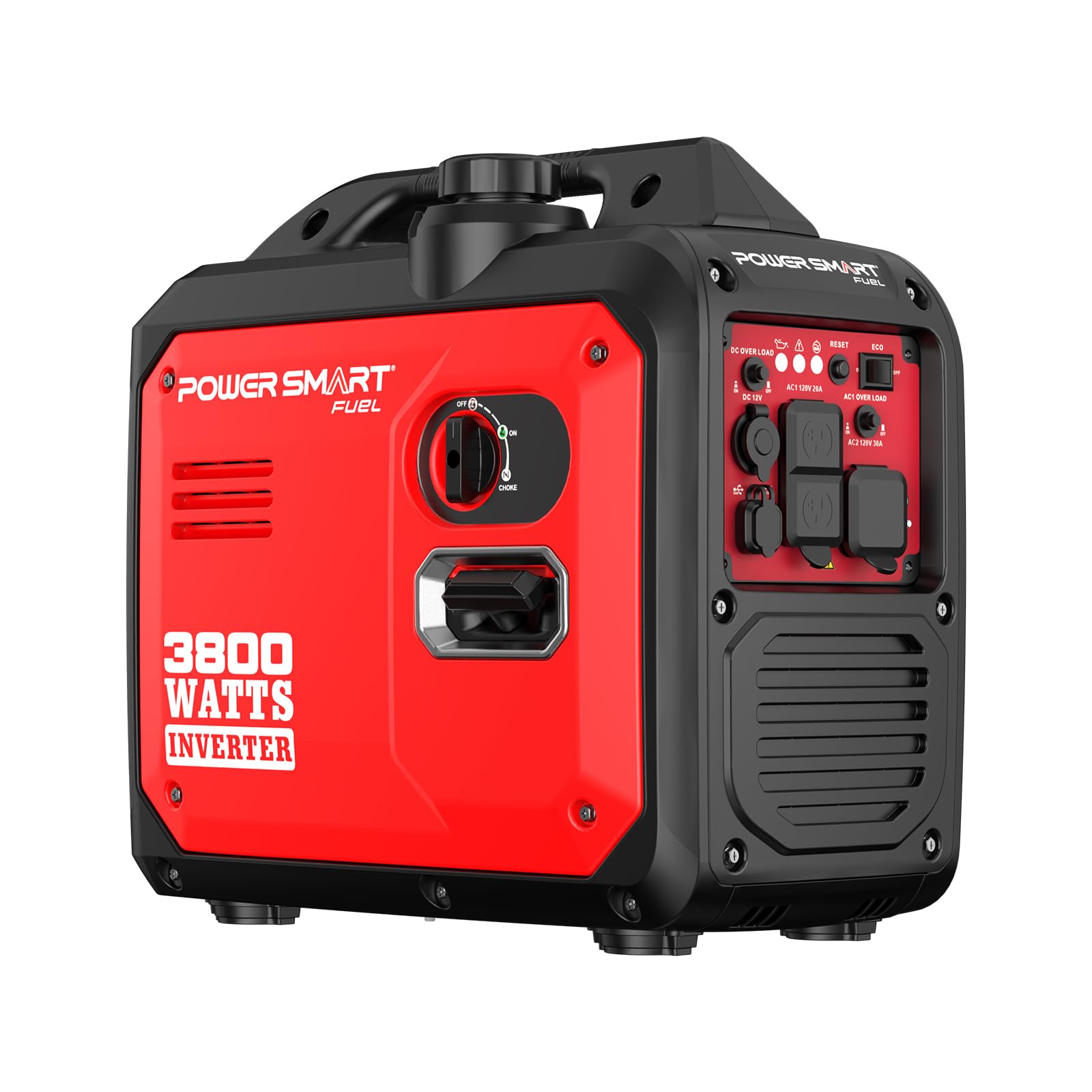
The PowerSmart DB5068 delivers 3,800 surge watts and 3,200 rated watts while operating at just 59 dBA — quiet enough that you can hold a normal conversation next to it without raising your voice. The 143cc 4-stroke OHV engine sips from a 1.19-gallon tank, providing up to 4.5 hours of runtime at 50% load. The clean sine wave output (less than 3% THD) means it’s fully safe for laptops, phones, and tablet charging.
At 52 pounds, it’s a lightweight for the 3,800-watt class, and the ergonomic handle makes it easy to carry from the truck to the campsite. Parallel capability lets you pair two units for 7,600 surge watts — enough for larger RVs or small homes. The 5V USB port is a nice touch for device charging without needing a separate adapter. Multiple owners report that it starts immediately on the first pull without any choke fiddling, and runs smoothly without surging even under varying loads.
The noise level at 59 dBA is the quietest in this roundup, making it the top choice for campgrounds with strict quiet hours. Some users note the lack of a fuel shutoff valve means you need to run the carburetor dry manually or add stabilizer for storage. A few owners also mention that the included documentation is minimal, so first-time generator owners should look up break-in procedures online. The two-year warranty is standard for the price point.
Why it’s great
- 59 dBA is the quietest noise rating in this comparison
- 3,200 rated watts with clean inverter power
- Starts first pull without choke adjustments
Good to know
- No fuel shutoff valve requires manual carburetor draining
- Documentation is sparse for break-in procedures
11. Aceup Energy 4000 Watt Portable Inverter Generator
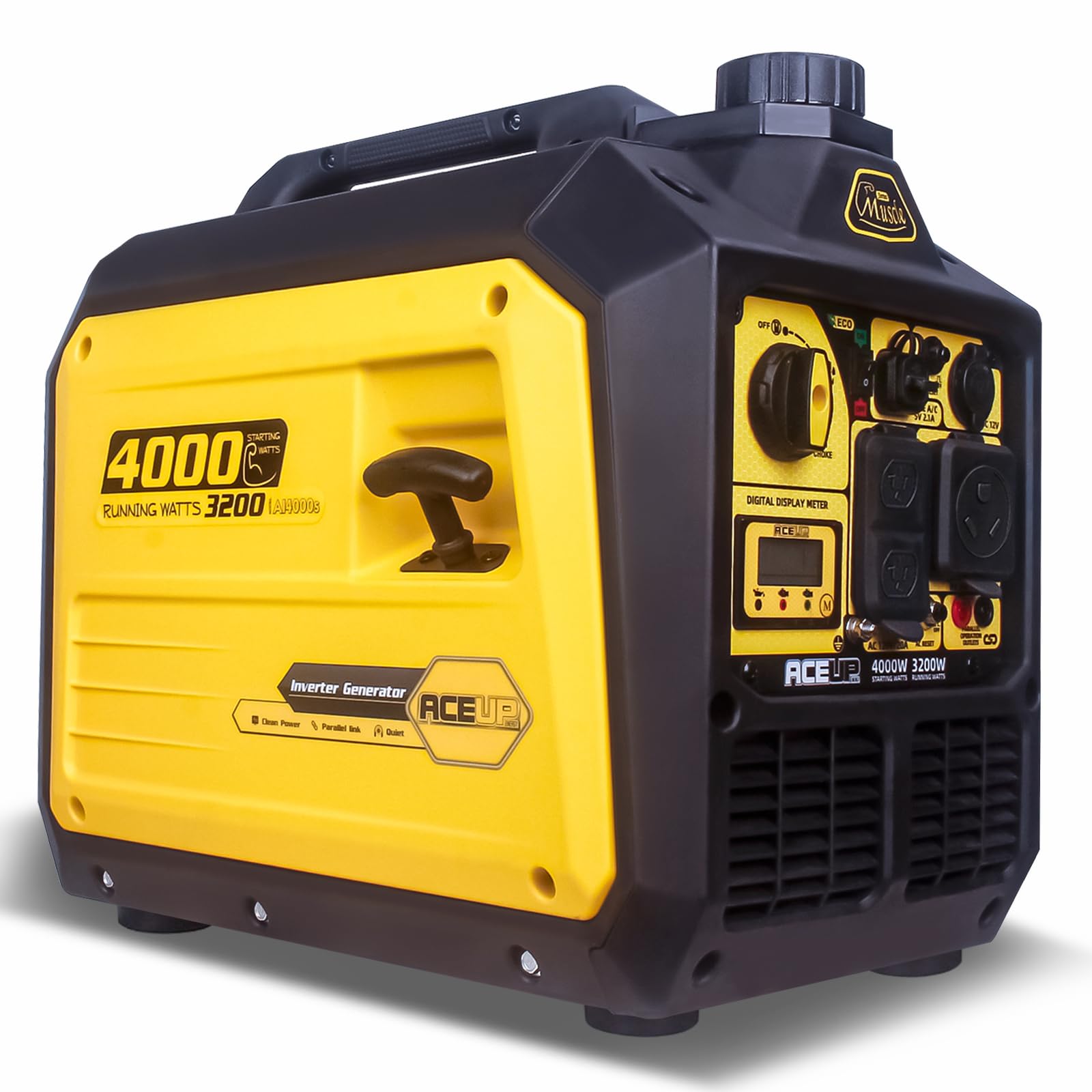
The Aceup Energy AI4000s-1 punches above its budget positioning with a 149cc engine that produces 4,000 surge watts and 3,200 rated watts — both figures exceeding many more expensive competitors. At 50 pounds, it’s one of the lightest in this entire comparison, and the smart gauge tracks voltage, runtime, fuel level, hertz, and power output so you always know what the generator is doing. The 5-in-1 knob integrates fuel on/off, engine on/off, and choke into a single control, simplifying the start procedure.
The control panel includes one 120V 20A outlet, one RV TT-30R receptacle, and one 12V DC 8.3A car charger outlet, plus parallel capability for linking two units. The fully enclosed design reduces noise enough that users describe it as comfortable for conversation at 23 feet. The EPA compliance and 2-year limited warranty (plus lifetime technical support) are solid commitments for an entry-level generator. Owners report that it fits perfectly in an RV side compartment and can run a refrigerator, three lamps, two fans, and internet equipment for up to two weeks on careful fuel use.
A few users raised concerns about potential fuel tank collapse issues (common in budget thin-wall designs) and recommended precautionary venting. The longevity beyond a few seasons of moderate use is still unproven given the newer market presence. For the power output per dollar and the inclusion of an RV-ready outlet at this price point, the Aceup Energy is the strongest budget option for occasional campers and emergency backup users.
Why it’s great
- 3,200 rated watts at 50 pounds is an exceptional power-to-weight ratio
- Intelligent gauge tracks voltage, runtime, and fuel in real time
- 5-in-1 knob simplifies start and shutoff sequence
Good to know
- Potential fuel tank collapse risk from thin-wall construction
- Long-term durability beyond 2 years not yet validated
FAQ
What size generator do I need to run an RV air conditioner?
How often should I change the oil in a 3500-watt inverter generator?
Can I run a 3500-watt generator on propane indefinitely?
What does parallel capability mean for a generator owner?
Final Thoughts: The Verdict
For most users, the best 3500 watt inverter generator winner is the Champion Power Equipment 4000-Watt Inverter because it combines the lightest weight in its class (48.1 lbs), a full 10-hour runtime, the critical CO Shield safety system, and a 3-year warranty — all at a premium-tier value that few competitors match. If you want dual-fuel flexibility with remote start and a digital display, grab the MaXpeedingrods 3500W Dual Fuel. And for absolute quiet at the campsite with 59 dBA noise levels and a budget-friendly price, nothing beats the PowerSmart 3800W Inverter Generator.

Mo Maruf
I created WellFizz to bridge the gap between vague wellness advice and actionable solutions. My mission is simple: to decode the research and give you practical tools you can actually use.
Beyond the data, I am a passionate traveler. I believe that stepping away from the screen to explore new environments is essential for mental clarity and physical vitality.