Our readers keep the lights on and my smoothie glass nicely filled. As an Amazon Associate, I earn from qualifying purchases.
The promise of a 3000 watt solar generator is simple: silent, emission-free power that keeps your fridge running, your lights on, and your life uninterrupted when the grid goes dark. But with capacities ranging from 3000Wh to over 7000Wh and inverter outputs that can surge past 9000W, the difference between a unit that barely covers your basics and one that powers your whole home comes down to battery chemistry, charging speed, and real-world discharge limits — not just the wattage number on the box.
I’m Mohammad Maruf — the founder and writer behind WellFizz. I’ve spent the last three years analyzing the portable power station market, comparing LiFePO₄ cycle life claims against independent test data, and breaking down how inverter topology, MPPT efficiency, and pass-through charging actually play out in real homes and RVs.
After evaluating capacity, recharge rates, output flexibility, and build quality across eight leading models, this guide delivers a clear, spec-driven breakdown of the best 3000 watt solar generator options for every serious backup scenario.
How To Choose The Best 3000 Watt Solar Generator
Not all 3000-watt-class solar generators are built the same. The headline wattage tells you the maximum instantaneous draw the inverter can handle, but it reveals nothing about how long that power lasts or how fast the battery can top back up. A smart buyer looks past the peak number and examines five critical specs that define real-world performance.
Battery Capacity and Chemistry
Watt-hours (Wh) tell you the total energy stored — a 3000Wh unit can deliver 3000W for one hour, or 500W for six hours. For home backup, look for at least 3000Wh to run a refrigerator and lights through an overnight outage. LiFePO₄ (lithium iron phosphate) cells are now the standard, offering 3000-4000 cycles to 70% capacity retention, far outlasting older NMC or lead-acid chemistries.
Inverter Output and Surge Capability
A 3000W continuous inverter with a 6000W surge can start motors on refrigerators, sump pumps, and RV air conditioners without tripping. X-Boost or similar technologies let the inverter draw extra power from the battery momentarily. If you plan to run heavy loads like a well pump or a window AC unit, confirm the surge rating — not just the continuous wattage.
Charging Speed and Input Flexibility
The best units recharge from 0-100% in under two hours via AC wall outlet, thanks to bi-directional inverters that push 2200W or more into the battery. Solar input matters too: look for MPPT controllers that can handle at least 1000W of panel input, and check whether you can combine AC + solar simultaneously for hybrid charging that cuts recharge time in half.
Quick Comparison
On smaller screens, swipe sideways to see the full table.
| Model | Category | Best For | Key Spec | Amazon |
|---|---|---|---|---|
| Jackery HomePower 3000 | Mid-Range | Compact home backup | 3072Wh, 59.5 lbs | Amazon |
| EF ECOFLOW DELTA Pro | Mid-Range | Fast AC charging | 3600Wh, 99 lbs | Amazon |
| Anker SOLIX F3000 | Mid-Range | RV + solar combo | 3072Wh, 91.5 lbs | Amazon |
| Anker SOLIX F3800 | Premium | Whole-home 240V backup | 3840Wh, 132.3 lbs | Amazon |
| EF ECOFLOW DELTA Pro 3 | Premium | Ultra-quiet whole-home | 4096Wh, 115 lbs | Amazon |
| OSCAL PowerMax 6000 | Premium | High-capacity 120/240V | 3600Wh + 3x400W panels | Amazon |
| OSCAL PowerMax 6000 + Extra Battery | Premium | Maximum solar storage | 7200Wh + 4x400W panels | Amazon |
| Honda EU3000iS | Budget | Gas-powered job site/camping | 3000W, 144 lbs, gas | Amazon |
In‑Depth Reviews
1. Jackery HomePower 3000
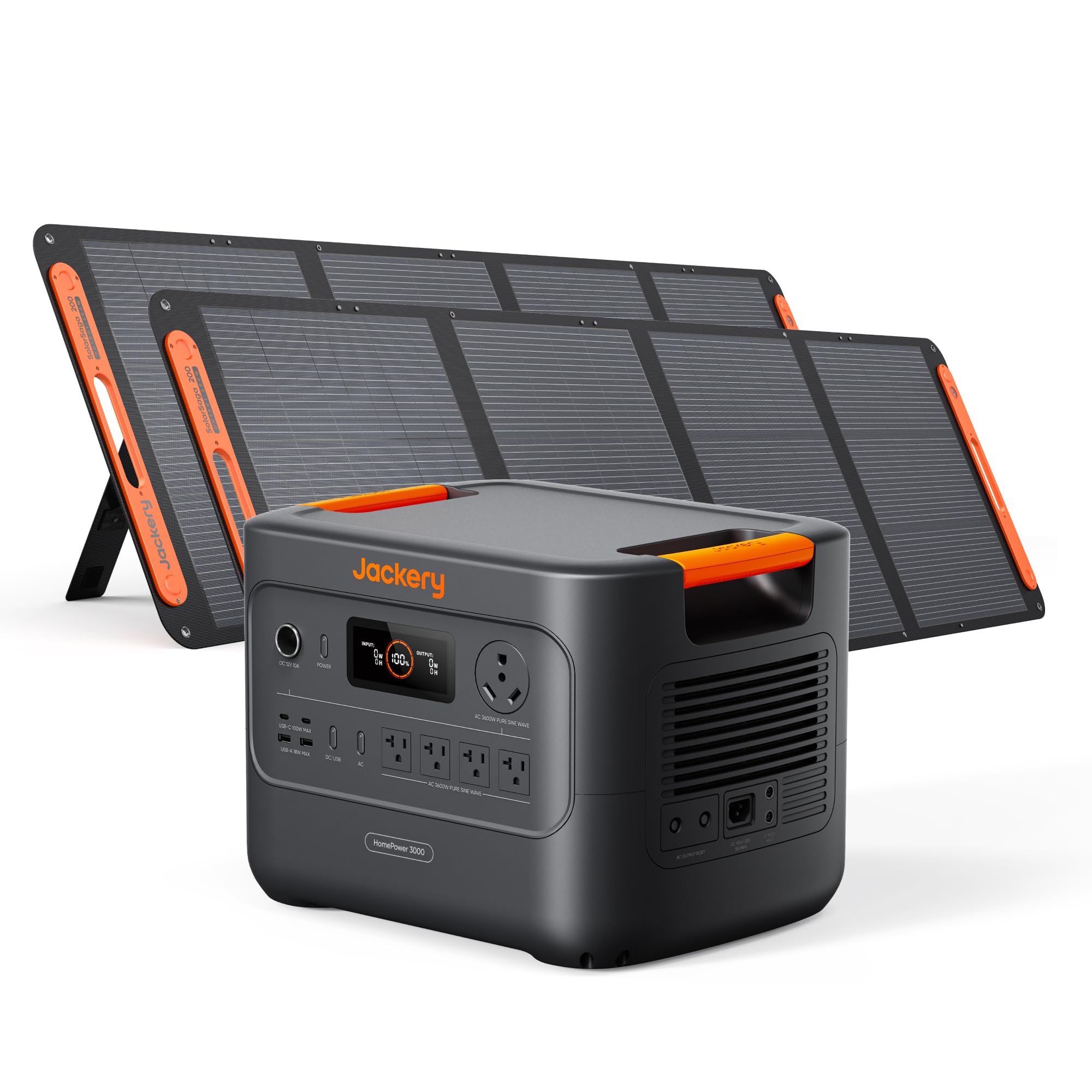
The Jackery HomePower 3000 brings a truly impressive weight-to-capacity ratio — at just 59.5 pounds for 3072Wh, it’s the lightest unit in this class by a wide margin, thanks to Jackery’s CTB (cell-to-body) technology that integrates the battery structure into the housing. The 3600W inverter with a 7200W surge handles motor-starting loads like refrigerators and RV AC units without hesitation.
Charging via AC wall outlet takes just 2.2 hours, and hybrid AC+DC charging drops that to 1.7 hours. The ≤20ms UPS switchover means sensitive electronics — security cameras or a CPAP machine — never glitch during an outage. Solar input is rated for up to 800W with the included 2x200W panels, filling 80% in about 9 hours under full sun.
The onboard TT-30 RV port is a welcome addition for direct RV hookup. The ChargeShield 2.0 algorithm with AI-based charging extends the LiFePO₄ cells to 4000 cycles at 70% capacity. Note that the unit ships in separate packages for the station and panels, and the weight — while light for this class — still benefits from an optional wheel kit for frequent moves.
Why it’s great
- World’s lightest 3kWh station with CTB design
- 7200W surge handles large motor starts
- ≤20ms UPS for uninterrupted sensitive loads
Good to know
- Not expandable with extra batteries
- Panels ship separately from the station
- Wheel kit not included
2. EF ECOFLOW DELTA Pro
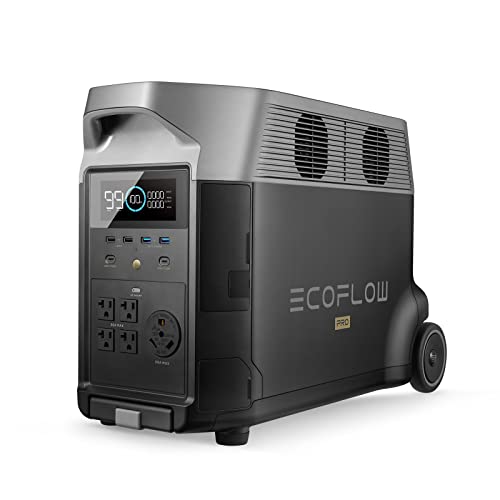
EcoFlow’s DELTA Pro recharges faster than any other unit in this comparison — X-Stream technology pushes 3000W AC input to fill the 3600Wh battery in just 1.8 hours from a 240V outlet (2.7 hours from a standard 120V wall outlet). This speed transforms the generator from a slow overnight backup into a midday recharge tool you can rely on between storms.
The 3600W continuous output expands to 4500W with X-Boost, and pairing two units delivers 7200W — enough for a 3-ton central AC or a well pump. With five charging methods including EV station charging, solar at up to 23% conversion efficiency, and the option to add a Smart Generator, this is the most versatile charging platform here.
At 99 pounds it isn’t light, but the optional extra batteries let you scale from 3.6kWh up to 25kWh. The smart app provides real-time monitoring of charge state, temperature, and individual port output. Multiple verified reviews confirm it runs a home oxygen concentrator for over 10 hours and powers full vendor booths with heat presses.
Why it’s great
- 1.8-hour 240V AC recharge (X-Stream)
- Expandable to 25kWh total capacity
- Five charging modes including EV station
Good to know
- 99 lbs — heavy to move without mobility kit
- X-Boost reduces surge capacity on some loads
- App setup required for full functionality
3. Anker SOLIX F3000
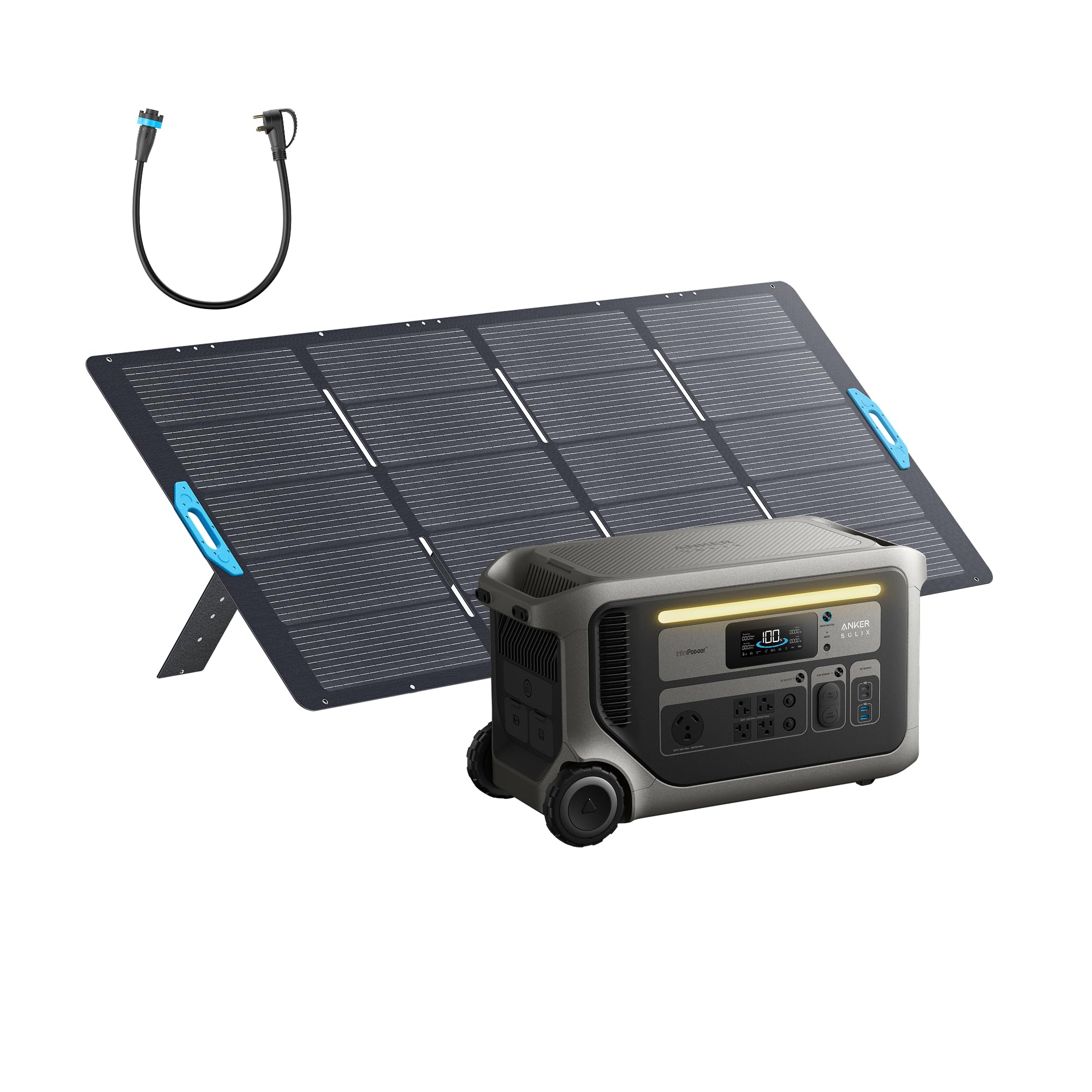
The Anker SOLIX F3000 stands out for its 2400W solar input capability — the highest in the mid-range group — and its ability to simultaneously charge from a 120V generator and solar panels for pass-through hybrid charging at up to 6000W total. This means in a multi-day outage, you can recharge the 3072Wh battery in under an hour by combining solar with a small gas generator.
The 3600W inverter delivers clean sine wave output, and the unit offers a TT-30 plug that runs a 13,500 BTU RV air conditioner on low cool for 6-8 hours. The ultra-low idle power consumption achieves 125 hours of AC standby time — far better than most competitors that drain the battery faster while idle.
With expansion capabilities up to 24kWh and both 165V and 60V solar port compatibility, this is one of the most flexible solar generator platforms available. The included 400W panel is large (91.5 lbs station weight plus panel weight), and some users note the Wi-Fi connection can drop intermittently. The 6-inch wheels help on smooth terrain, though the unit is bulky for tight spaces.
Why it’s great
- 2400W solar input — fastest in this tier
- 6000W pass-through hybrid charging
- 125 hours AC idle standby time
Good to know
- Wi-Fi connectivity can be unreliable
- 400W solar panel underperforms in low light
- Heavy station — mobility kit recommended
4. Anker SOLIX F3800

The Anker SOLIX F3800 brings true split-phase 120V/240V output at 6000W continuous — enough to run a well pump, electric dryer, or even charge an EV directly via the NEMA 14-50 port. The 3840Wh LFP battery provides a full day of essential home backup, and expansion with up to 6 extra batteries pushes capacity to 26.9kWh.
Charging is fast at 2400W AC input, filling in under two hours, but the real story is the dual-voltage output that sets it apart from the 120V-only competition. The integrated inverter supports a 120V and 240V load simultaneously, and pairing two F3800 units yields 12,000W output for extreme scenarios.
At 132.3 pounds, this is a heavy unit that needs the included wheel kit for mobility. Some users report firmware issues where 240V output cuts off during 120V AC charging, and the app lacks a “Time of Use” charging scheduler. The BMS also limits charging input below 50°F, making it less ideal for cold-weather deployment. The 5-year warranty and 10-year lifespan projection add confidence for long-term investment.
Why it’s great
- True 120V/240V split-phase output
- NEMA 14-50 port for EV charging
- Expandable to 26.9kWh total
Good to know
- 132.3 lbs — heavy, wheel kit essential
- 240V output stops during 120V AC charging
- Reduced input speed below 50°F ambient
5. EF ECOFLOW DELTA Pro 3
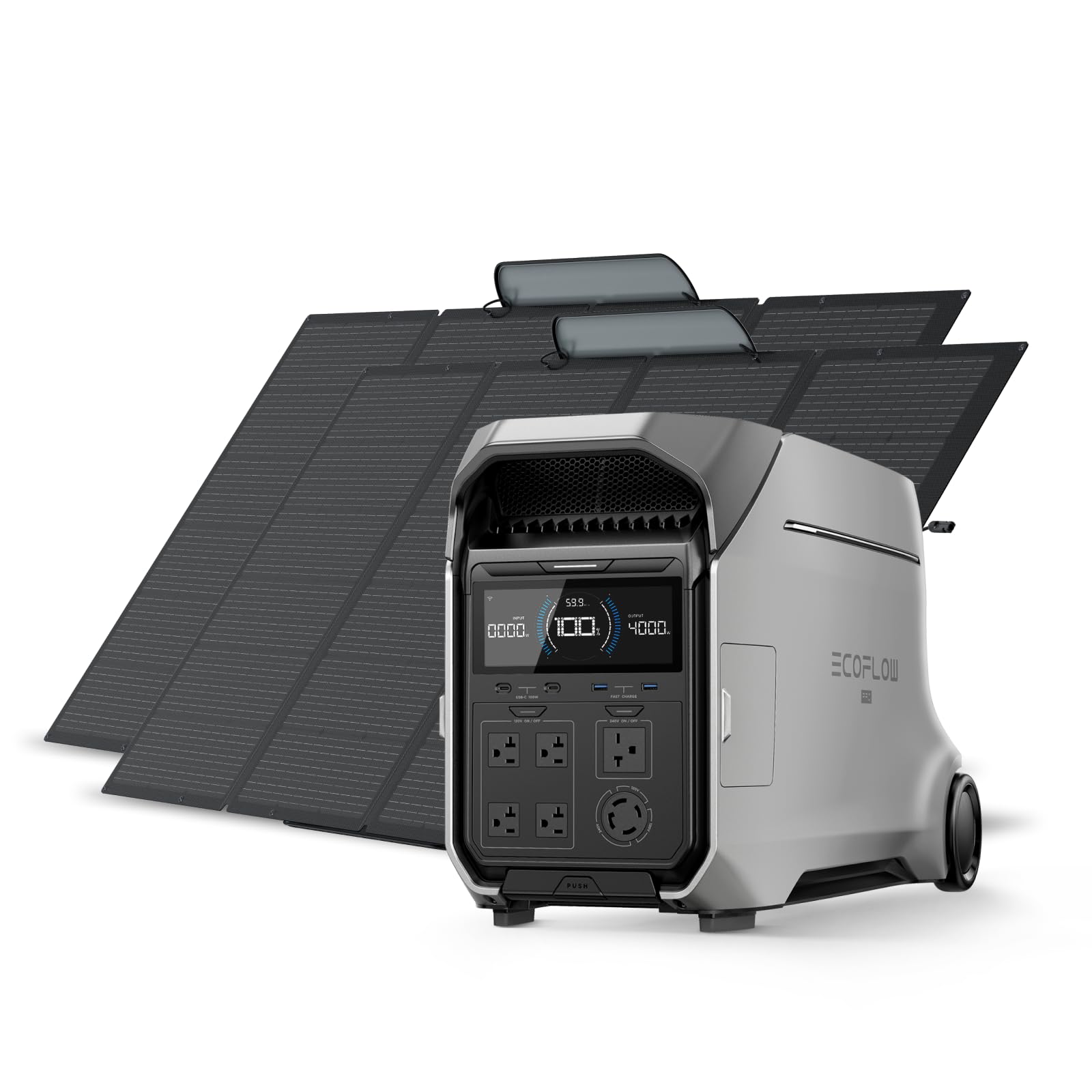
The DELTA Pro 3 delivers 4096Wh of LFP capacity with a 4000W inverter (6000W with X-Boost) and supports both 120V and 240V output, making it the most versatile single-unit solution for whole-home backup. The IP65-rated CTC battery pack provides dust and water resistance that few competitors match, and the 10ms UPS switchover instantly engages during grid drops.
At just 30 dB in X-Quiet mode, this is the quietest unit in the lineup — quieter than a library — making it suitable for indoor placement or bedside use without disturbing sleep. The telescoping handle and 115-pound mass are easier to move than the Anker F3800, though still substantial. Expansion up to 48kWh with extra batteries provides 2-4 days of whole-home runtime.
Charging via AC wall outlet takes about 2.5 hours, while solar input handles up to 2400W. The app provides comprehensive energy monitoring and remote control. Some users report missing second solar panels in shipments, though customer support resolves the issue. The unit works well with a forced-air furnace and tankless water heater, per verified owner reviews.
Why it’s great
- 30 dB noise floor — nearly silent
- IP65-rated CTC battery pack
- 120V/240V output, expandable to 48kWh
Good to know
- 115 lbs — wheeled cart helps but still heavy
- Solar panel shipping errors reported
- Full capacity requires extra batteries
6. OSCAL PowerMax 6000
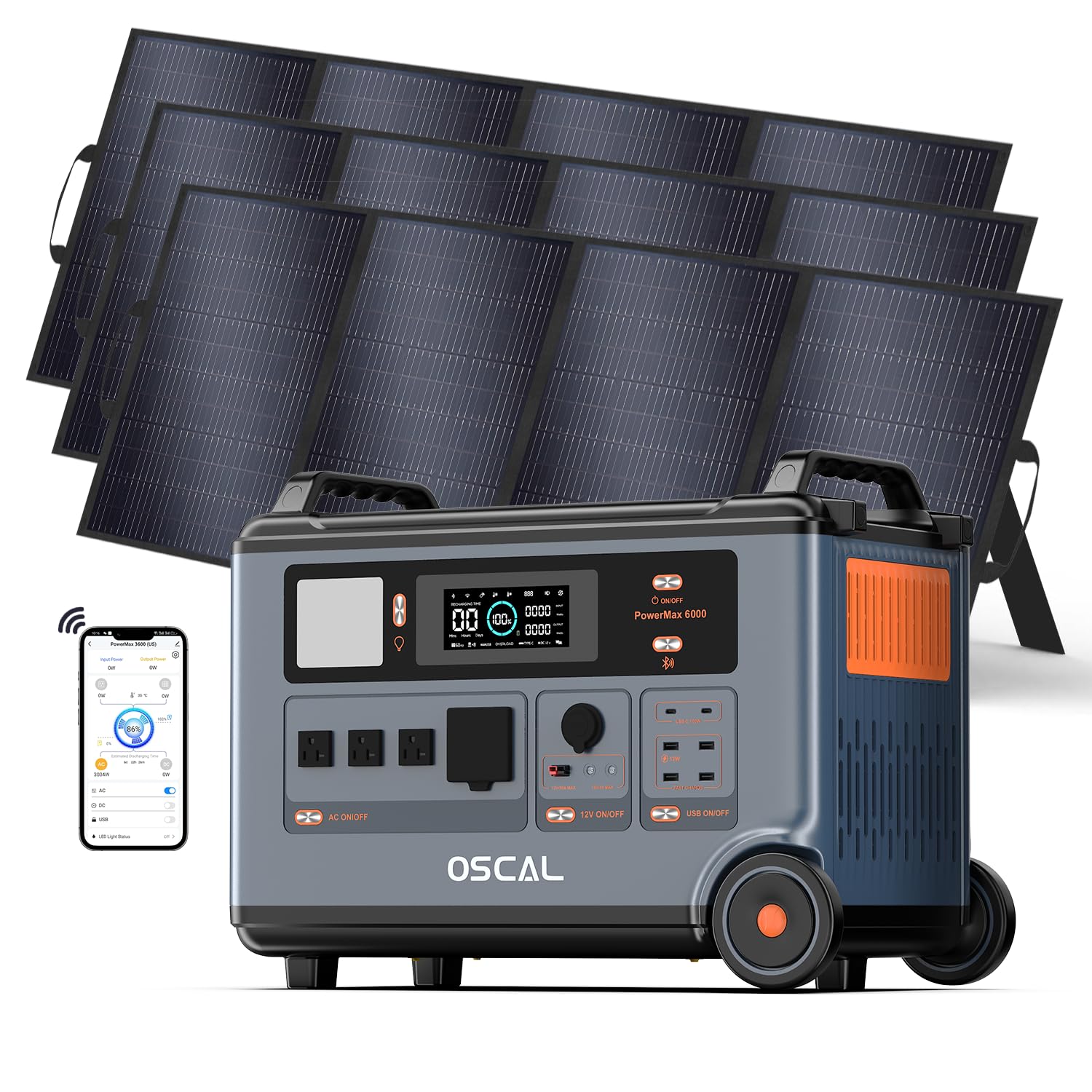
The OSCAL PowerMax 6000 packs a 3600Wh LFP battery with 6000W continuous output (9000W surge) and true 120V/240V split-phase capability. The bundled 3x400W solar panels provide 1200W of total panel capacity, and the 2400W solar input means you can fully recharge in about 4-5 hours of peak sun — an excellent solar-only performance.
AC wall charging at 2200W fills the battery in just 1.44 hours, and the 5-8ms EPS switchover keeps network equipment and security systems running through brief outages. The 14 output ports cover household needs: four AC outlets, multiple USB-C/USB-A, and 12V DC. App-based control over Wi-Fi gives remote monitoring and scheduling.
At 100 pounds the unit is manageable with the included wheels and handle. Users report the fan is quiet, and the build feels durable for travel trailer use. The 2-year warranty is shorter than EcoFlow and Anker’s 5-year terms, and some reviewers note the 6000W surge is optimistic — expect reliable output closer to the continuous rating. The MC4 branch connector for all three panels is not included, so budget extra for that.
Why it’s great
- 3x400W solar panels included in bundle
- 120V/240V split-phase output
- 1.44-hour AC recharge at 2200W
Good to know
- MC4 branch connector not included
- 2-year warranty shorter than competitors
- Surge rating may be optimistic under load
7. OSCAL PowerMax 6000 + Extra Battery
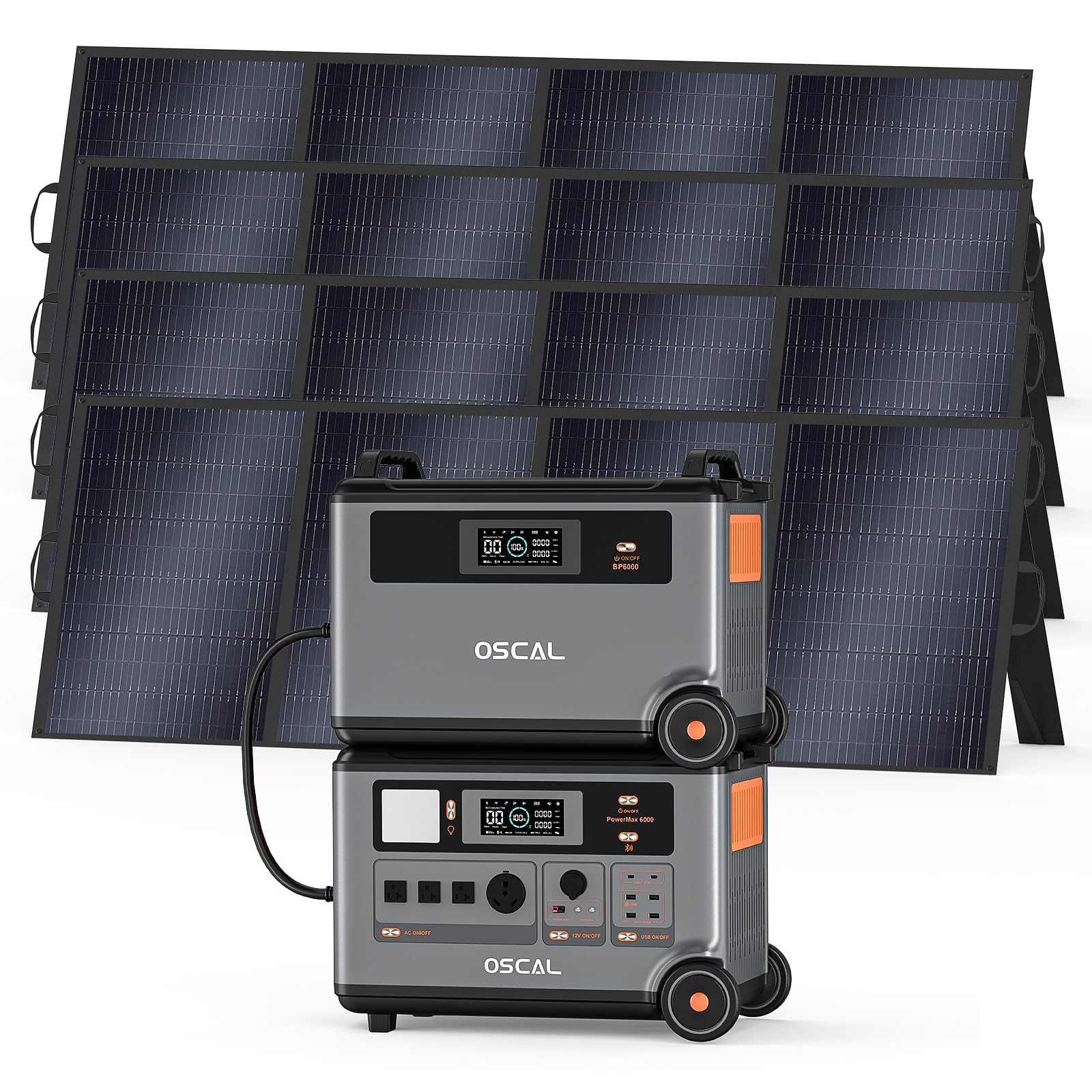
The expanded OSCAL PowerMax 6000 doubles the base configuration to 7200Wh with an extra battery pack and 4x400W solar panels (1600W total panel capacity). This is the highest total solar capacity in the lineup, providing enough power for several days of whole-home backup — running a refrigerator, lights, a well pump, and a furnace fan simultaneously.
Like the base unit, it features 120V/240V split-phase output at 6000W continuous (9000W surge) and recharges via AC in 1.44 hours or via the 2400W solar input in about 5-6 hours of peak sun. The 14 outlet ports and smart app control are identical to the base model, but the larger battery means the EPS switchover backs up loads for much longer between charges.
At 56 pounds for the main unit plus the extra battery pack, the combined weight is manageable with the wheeled dolly. Users report it powers nearly everything in a travel trailer. The same concerns apply: the 2-year warranty is shorter than premium competitors, the MC4 branch connector is not included, and the 6000W surge rating is best treated as a peak figure rather than sustained capacity. For buyers who need maximum solar storage without multiple expansion purchases, this is the most complete out-of-box solution.
Why it’s great
- 7200Wh — largest native battery here
- 4x400W solar panels included
- 120V/240V split-phase output
Good to know
- 2-year warranty lags behind Anker/EcoFlow
- No MC4 branch connector included
- Surge rating best used as peak reference only
8. Honda EU3000iS
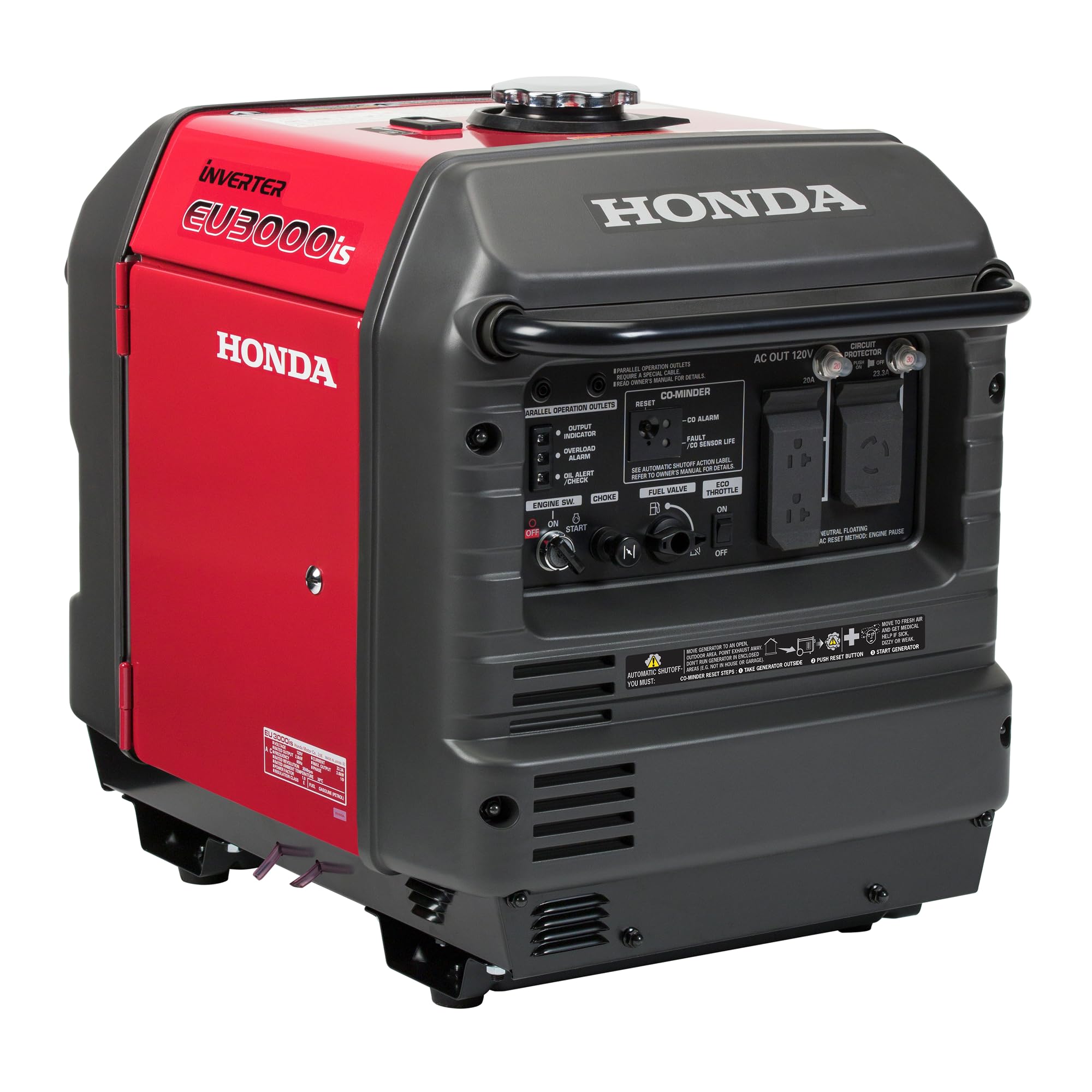
The Honda EU3000iS is included here as the reference gas-powered inverter generator — the benchmark that solar units must beat on noise, fuel efficiency, and runtime. At 50-57 dB, it’s quieter than most conventional generators, and the Eco Throttle system delivers up to 19.6 hours of runtime on a single 3.4-gallon tank of gasoline. It runs 13,500 BTU RV AC units, refrigerators, and sensitive electronics via pure sine wave output.
The electric start and CO-MINDER carbon monoxide detection system add convenience and safety. At 144 pounds it’s heavier than every solar-only unit here, and the 3.4-gallon tank means refueling every 7-20 hours depending on load. The 3000W output is the lowest in this comparison — no surge beyond the rated continuous capacity — so motor-starting loads like a well pump may struggle.
This is not a solar generator. It requires gasoline, produces exhaust that must be vented outdoors, and has ongoing fuel costs. But for job sites, camping in remote areas, or anyone who needs proven reliability without depending on weather for recharging, the Honda EU3000iS remains a gold standard. It’s the right choice when emissions, noise, and fuel logistics are acceptable trade-offs for unmatched uptime.
Why it’s great
- 19.6-hour runtime on 3.4 gallons gas
- Pure sine wave output for electronics
- 50-57 dB — quietest gas inverter in class
Good to know
- Not a solar generator — requires gasoline
- 144 lbs — heavier than solar counterparts
- No surge capacity beyond 3000W
FAQ
How long will a 3000 watt solar generator run a refrigerator?
Can I run my home’s 240V well pump on a solar generator?
What does X-Boost or surge mode do to the battery?
Final Thoughts: The Verdict
For most users, the best 3000 watt solar generator winner is the Jackery HomePower 3000 because it delivers the lightest weight, fastest AC recharge, and most compact footprint in the 3kWh class — ideal for home backup without needing a dolly. If you want whole-home 240V backup and EV charging capability, grab the Anker SOLIX F3800. And for maximum solar storage straight out of the box with dual-voltage output, nothing beats the OSCAL PowerMax 6000 with extra battery.

Mo Maruf
I created WellFizz to bridge the gap between vague wellness advice and actionable solutions. My mission is simple: to decode the research and give you practical tools you can actually use.
Beyond the data, I am a passionate traveler. I believe that stepping away from the screen to explore new environments is essential for mental clarity and physical vitality.